
- 401(k) vs IRA vs HSA: Employer Match and Retirement Accounts
- 401(k) Employer Match: Why Employers Offer It (you are here)
This is part 2 of 2 of our guide to Employer Benefits and Retirement Accounts. It picks up where 401(k) vs IRA vs HSA: Employer Match and Retirement Accounts leaves off, and it is written to stand on its own: the key ideas are restated where you need them.
The backdoor Roth‘s one real hazard is the pro-rata rule: the IRS treats all your traditional IRAs — including SEP and SIMPLE IRAs — as one pot, valued on December 31 of the year you convert, and taxes every conversion in proportion to the pre-tax share of that pot. Example: you make a $7,500 nondeductible contribution while already holding $67,500 of pre-tax IRA money. The after-tax share is $7,500 ÷ ($7,500 + $67,500) = 10%, so converting $7,500 makes only $750 tax-free and $6,750 taxable. Balances inside a 401(k) do not count, which is why the usual fix is to roll pre-tax IRA money into a current employer’s plan (if it accepts roll-ins) before the end of the conversion year. Form 8606 records the calculation; anyone with an existing pre-tax IRA balance should work through it, or consult a professional, before converting.
The pro-rata rule treats your IRAs like a jug of juice mixed from concentrate (pre-tax money) and water (after-tax money). You may want to pour out only the water, but every glass has the same mix as the jug. Converting $7,500 when one-tenth of the jug is water pours out $750 of water and $6,750 of concentrate — and the concentrate is what gets taxed. The only way to pour pure water is to move the concentrate into a different container first, which is what rolling pre-tax IRA money into a 401(k) does.
Many employers match a portion of employee 401(k) contributions — commonly 50% of contributions up to 6% of salary, though formulas vary. This is, without hyperbole, the single best guaranteed return available anywhere in personal finance: no investment in Part 7 offers a guaranteed 50%, or even 25%, immediate return.
A match is partly how a plan passes its tax tests. Each year a traditional 401(k) runs the Actual Deferral Percentage (ADP) test: highly compensated employees (paid over $160,000, the 2026 threshold) may defer on average no more than the greater of 125% of everyone else’s average, or the lesser of twice it and it plus 2 points. If rank-and-file staff average 4%, the higher paid may average 6%; a failed test is fixed by refunding their excess as taxable income. Matching pulls lower-paid workers in and lifts the average.
The shortcut is the safe harbor: match 100% of the first 3% of pay plus 50% of the next 2%, or contribute 3% of pay for everyone, with those contributions fully vested when made, and the plan skips the tests. If your plan uses one of these designs, your match vests immediately (6.7: Vesting, Rollovers, and What Happens When You Change Jobs); an automatic-enrollment safe harbor (a QACA) instead matches 100% of the first 1% of pay plus 50% of the next 5% and may make you wait two years to vest. The target rate changes too: under the basic formula, at $75,000, 3% × $75,000 + 50% × 2% × $75,000 = $3,000 of match for a 5% contribution, more than the 50%-up-to-6% formula pays for 6%.

Contributing below whatever threshold earns the full match is, functionally, declining part of a salary offer — the match is compensation, structured as a retirement contribution rather than cash. Whatever else competes for room in a budget (Part 1.3), contributing at least enough to capture the full employer match should come before almost every other discretionary savings goal — it is step 3 of the order of operations in 1.8, behind only essential bills and a one-month starter fund — precisely because no later investment decision can realistically replicate a guaranteed 50% return.
With the common formula above — 50% of contributions up to 6% of salary — the running household’s match depends directly on its own contribution rate:
- At 6%: it contributes 6% × $75,000 = $4,500; the match is 50% × $4,500 = $2,250; $6,750 goes in.
- At 3%: it contributes 3% × $75,000 = $2,250; the match is $1,125; $3,375 goes in.
The extra 3% costs less than it looks. The additional $2,250 is pre-tax and falls entirely in the household’s 22% bracket (taxable income drops from $54,050 to $51,800, both above the $50,400 threshold), so it saves $2,250 × 22% = $495 of federal income tax. Take-home pay falls by $2,250 − $495 = $1,755 a year — $67.50 per biweekly paycheck ($1,755 ÷ 26). For that $1,755, the account receives $2,250 + $1,125 = $3,375: an immediate gain of 92% ($3,375 ÷ $1,755 = 1.92) before any investment return.
Over a career the gap compounds. The forgone $1,125 match alone, invested each year for 30 years at 7%, grows to $1,125 × [(1.0730 − 1) ÷ 0.07] = $1,125 × 94.46 = $106,268 — with salary held flat, so real raises would make it larger. Check the vesting schedule (6.7: Vesting, Rollovers, and What Happens When You Change Jobs) too: an unvested match is only yours if you stay long enough.
Brigitte Madrian and Dennis Shea (NBER Working Paper 7682, 2000; Quarterly Journal of Economics, 2001) studied a large employer that matched 50% of the first 6% of pay and switched to automatic enrollment at a 3% default. Participation among new hires rose from 37% to 86%, but about three-quarters of those enrolled automatically stayed at 3%, against about one in ten earlier hires, while three-quarters of voluntary enrollees chose 6% or more. The match started only after a year of service, so many defaulted workers were not yet losing any of it, but the authors found that this explained little of the gap; a worker who stays at 3% once eligible collects half the available match. In Vanguard’s How America Saves 2026 (2025 data), automatic-enrollment plans had 94% participation against 64% in voluntary plans, and the average promised match was 4.7% of pay (median 4.0%). Being enrolled is not the same as collecting the match: check that your rate reaches the formula’s ceiling.
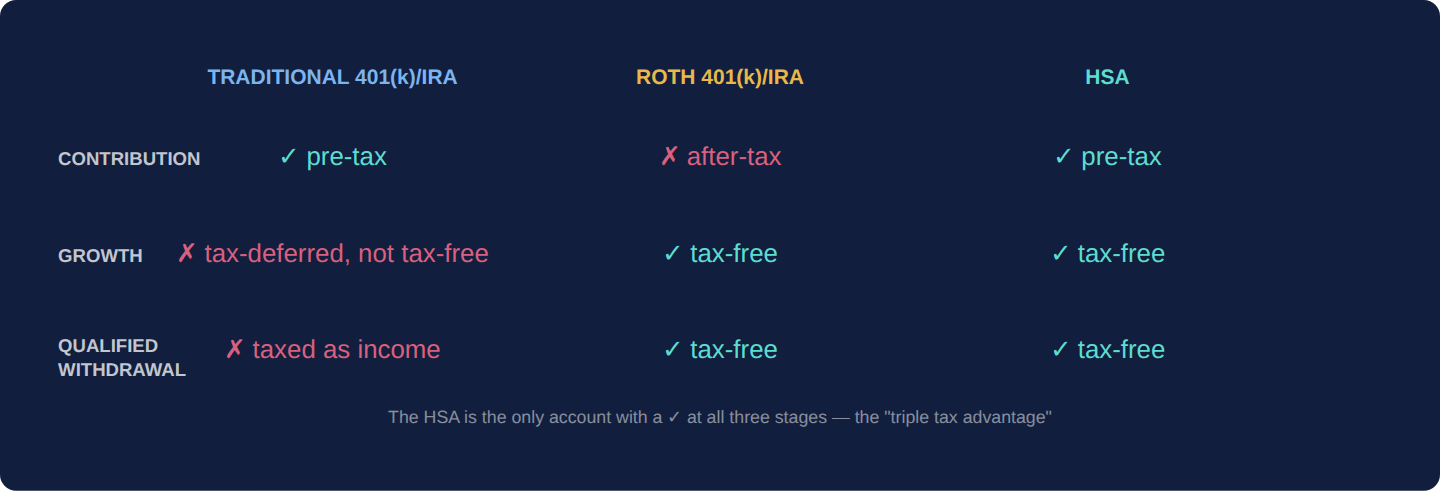
A Health Savings Account (HSA), available to anyone enrolled in a qualifying high-deductible health plan, is the only account in the entire U.S. tax code offering all three tax advantages at once.
A 401(k) deferral escapes income tax but not the 7.65% Social Security and Medicare tax (1.6: Paychecks Decoded). HSA money contributed through an employer’s cafeteria plan counts as an employer contribution, excluded from wages for income tax and FICA: a fourth break the “triple” label leaves out. For the running household, $4,400 through payroll saves $4,400 × 7.65% = $336.60 of FICA, as in 1.8. Paid in from a bank account instead, the $4,400 is still deductible, but the FICA has already been withheld. The small cost: wages free of Social Security tax are also left out of your benefit record (10.3).
Two rules bound the advantage. Non-medical withdrawals before 65 owe income tax plus a 20% additional tax. And only expenses incurred after the HSA was established qualify, so the “reimburse decades later” strategy starts the day the account opens.
| 2026 Limit | HSA | Healthcare FSA | Dependent Care FSA |
|---|---|---|---|
| Annual contribution | $4,400 self-only / $8,750 family, plus $1,000 catch-up at 55+ | $3,400 ($680 carryover allowed) | $7,500 per household ($3,750 if married filing separately) — up from $5,000 under the One Big Beautiful Bill Act from 2026, the first permanent increase since 1986 (a one-year rise to $10,500 for 2021 under the American Rescue Plan Act aside) |
| Use-it-or-lose-it? | No — balances roll over indefinitely and are fully portable between employers | Yes, beyond the carryover allowance — funds are forfeited at year-end | Yes — same forfeiture risk |
| Requires | Enrollment in a qualifying high-deductible health plan (2026: deductible of at least $1,700 self-only / $3,400 family, out-of-pocket maximum no more than $8,500 / $17,000) — and, from 2026, any bronze or catastrophic plan of the kind offered on an ACA marketplace (even if bought outside it), which the One Big Beautiful Bill Act made HSA-compatible | Employer offering; no HDHP requirement | Employer offering; used for eligible child or dependent care costs |
Suppose the running household, already collecting the full match, gives up $1,000 more of take-home pay a year, and its health plan is HSA-eligible. With taxable income of $51,800, its first $1,400 of new pre-tax contributions save 22%, the rest 12% (6.3). Growth is 7% for 30 years (1.0730 = 7.6123); no state tax.
- Traditional 401(k): C × (1 − 0.22) = $1,000, so C = $1,282.05.
- Roth: C = $1,000.
- HSA via payroll: $1,400 × (1 − 0.22 − 0.0765) = $984.90; the other $15.10 buys $15.10 ÷ (1 − 0.12 − 0.0765) = $18.79; C = $1,418.79.
| After 30 years | Traditional 401(k) | Roth | HSA |
|---|---|---|---|
| Balance (C × 7.6123) | $9,759.30 | $7,612.26 | $10,800.21 |
| After tax at 12% | $8,588.19 | $7,612.26 | $9,504.19 (non-medical, after 65) |
| After tax at 22% | $7,612.26 | $7,612.26 | $8,424.17 (non-medical, after 65) |
| Spent on medical care | Taxed as above | $7,612.26 | $10,800.21, untaxed |
The flip points. Traditional and Roth tie at a 22% retirement rate, the rate saved going in. The HSA ties with the Roth only at a withdrawal rate of 1 − $1,000 ÷ $1,418.79 = 29.5%, and beats the traditional 401(k) at any equal rate because it also skipped FICA. That is why the order of operations (1.8: The Financial Order of Operations: Where the Next Dollar Should Go) puts the HSA ahead of the IRA, provided you can pay current bills from cash and the HSA-eligible plan suits your health costs (8.2).
Because HSA funds never expire and are fully portable, many financial planners recommend treating an HSA as a stealth retirement account: pay current medical expenses out of pocket when affordable, let the HSA balance invest and compound untouched for decades, and keep every receipt — qualified medical expenses incurred after the HSA was opened can be reimbursed from the HSA tax-free at any point in the future, even many years later. After age 65, HSA funds can also be withdrawn for any purpose at all, taxed as ordinary income exactly like a traditional IRA, with no penalty — so unused medical savings become, at worst, an extra traditional-IRA-style retirement account. Two caveats: an HSA left to anyone other than a spouse stops being an HSA at death and its full value becomes taxable income to that heir, and contributions must stop once you enroll in Medicare.
Rule: Set your 401(k) rate at the match formula’s ceiling from the first paycheck. After high-interest debt and the emergency fund (1.8: The Financial Order of Operations: Where the Next Dollar Should Go), fund an HSA through payroll if you are eligible. For each further dollar, look at the federal rate it actually saves: 12% or less, choose Roth; 24% or more, choose traditional; 22% or straddling a bracket, split or compute the blended rate as in 6.3.
What it assumes: 2026 brackets, a retirement rate not known to be higher, reasonably priced plan funds, and no need for the money before 59½. When to ignore it: if you will leave before the match vests, it is worth only the vested share (6.7: Vesting, Rollovers, and What Happens When You Change Jobs); if the plan’s cheapest broad fund costs far more than an IRA index fund, put post-match dollars in an IRA first; if pensions or required distributions (10.6) will fill the 22% and 24% brackets later, lean Roth even at 22%.
Contributing below the match ceiling. For the running household, 3% instead of 6% keeps $1,755 a year of take-home pay (6.5), $52,650 over 30 years. The account gets $6,750 − $3,375 = $3,375 a year less, its own $2,250 plus $1,125 of forgone match. At 7% for 30 years: $3,375 × [(1.0730 − 1) ÷ 0.07] = $3,375 × 94.46 = $318,805, of which $106,268 is match the household never had to earn, with salary held flat.
How to avoid it: on the first day of a job, read the match formula in the summary plan description, set your rate at its ceiling (6% here; 5% under the basic safe harbor), confirm the match on the first pay stub, and ask about a true-up before front-loading.
How much should I contribute to my 401(k)?
At least enough to collect the full employer match: 6% of pay on the common 50%-up-to-6% formula, 5% on the basic safe-harbor formula (6% on an automatic-enrollment safe harbor). Beyond that, follow the order of operations in 1.8: clear high-interest debt and build the emergency fund, then fund an HSA if eligible, an IRA, and more 401(k). The match ceiling is a floor, not a target.
Is a Roth 401(k) better than a traditional 401(k)?
It is better when your tax rate in retirement will exceed the rate the traditional contribution saves today, and worse when it will be lower. If the dollars save 12%, Roth usually wins; at 24% or more, traditional usually does. At 22%, or across a bracket line, compute the blended rate as in 6.3. The investment return does not change the answer.
What happens to my HSA if I change jobs or health plans?
The HSA stays yours: the balance, including employer deposits, is portable and never expires, and you can keep spending it tax-free on qualified medical expenses. What stops is new contributions, which are allowed only for months you are covered by an HSA-eligible plan and have no disqualifying coverage, such as a general-purpose health FSA or Medicare.
Can I have an HSA and an FSA at the same time?
Only if the FSA is limited-purpose, typically covering dental and vision. A general-purpose health FSA counts as other health coverage and blocks HSA contributions for those months. A dependent-care FSA is unaffected, since it pays for child or dependent care, not medical costs. Choose the limited-purpose option at open enrollment if your employer offers one.
A job pays total compensation, and benefits that escape tax, above all a 401(k) match and the employer’s health-premium share, can make a lower salary the better offer. For 2026 you can defer $24,500 into a 401(k) or 403(b) ($32,500 at 50 or older, $35,750 at 60–63), an IRA takes $7,500 more, and an HSA offers the only triple tax advantage: pre-tax in, tax-free growth and tax-free withdrawals for medical costs. Traditional versus Roth comes down to one forecast, your tax rate in retirement against the rate your contribution actually saves today, and a backdoor Roth conversion is taxed pro rata across all your traditional IRAs. Whatever else competes for the money, contribute at least enough to collect the full employer match, a guaranteed 50% return on the common formula.
Four questions on this chapter. Decide on your answer first, then click “Reveal Answer.”
1. An investor holds $22,500 of pre-tax money in a rollover IRA through year-end and makes a $7,500 nondeductible IRA contribution. If she converts $7,500 to Roth that year, how much of the conversion is taxable?
- $5,000
- $7,500
- $5,625
- $1,875
Reveal Answer
Answer: C. The pro-rata pot is $7,500 + $22,500 = $30,000, 25% after-tax, so $5,625 is taxable. $5,000 leaves the contribution out of the pot; $1,875 inverts the split. Rolling the pre-tax IRA into a 401(k) first avoids this. (Part 6.4)
2. A healthy 35-year-old in a qualifying high-deductible plan can afford this year’s $1,200 of medical bills from cash. Which approach uses the HSA’s triple tax advantage most fully?
- Pay the bills in cash, invest the HSA and keep the receipts
- Pay the bills from the HSA now, before unspent funds lapse
- Withdraw the HSA for any purpose now, taxed like an IRA
- Use a health FSA instead, since it also rolls over in full
Reveal Answer
Answer: A. HSA money never expires, so paying from cash lets it compound untouched, and saved receipts can be reimbursed tax-free years later. FSA money beyond the carryover is forfeited, and non-medical HSA withdrawals avoid the penalty only after 65. (Part 6.6)
3. A plan uses the safe-harbor match: 100% of the first 3% of pay plus 50% of the next 2%. A worker earning $60,000 contributes 5%. What is the employer’s match for the year?
- $1,800
- $2,400
- $1,500
- $3,000
Reveal Answer
Answer: B. Match = 3% × $60,000 + 50% × 2% × $60,000 = $1,800 + $600 = $2,400. $1,500 applies 50% to the whole 5%; $1,800 stops at the first 3%; $3,000 matches all 5% dollar for dollar. Basic safe-harbor matches are also fully vested when made. (Part 6.5)
4. A worker whose extra pay is all taxed at 22% is willing to give up $1,000 of take-home pay. If she puts it into an HSA through payroll, roughly how much goes into the account?
- $1,282.05
- $1,076.50
- $1,421.46
- $1,000.00
Reveal Answer
Answer: C. Payroll HSA money skips income tax and the 7.65% FICA: $1,000 ÷ (1 − 0.22 − 0.0765) = $1,000 ÷ 0.7035 = $1,421.46. $1,282.05 is the traditional 401(k) figure, which still pays FICA; $1,000 is the Roth figure. (Part 6.6)
- Publication 969 — HSA rules
- Publication 15-B (2026) — Dependent-care exclusion
- 401(k) limit increases to $24,500 for 2026 — 2026 plan and IRA limits
- Instructions for Form 8606 — Pro-rata rule
- Retirement topics: catch-up contributions — Catch-ups and the Roth catch-up rule
- Final regulations on the Roth catch-up rule — Roth catch-up effective dates