
9.1 Adam Smith and Classical Economics
Adam Smith’s The Wealth of Nations, published in 1776, argued that dividing work into specialized tasks multiplies output. His famous pin workshop made 4,800 pins per worker a day, against fewer than 20 for a worker alone: at least 240 times more. He also argued that people trading in their own interest, coordinated by prices, often serve society without anyone intending it.
Why it matters: Specialization and prices explain how a modern economy gets things made.
Summary: Adam Smith’s Wealth of Nations (1776) argued that specialization multiplies output and that self-interested trade, coordinated by prices, frequently serves society without anyone intending it. His pin workshop made 4,800 pins per worker a day against fewer than 20 for a worker alone: at least 240 times more.
- The division of labor raises output through dexterity, saved switching time and machinery, and it is limited by the extent of the market.
- The invisible hand appears once in the book (Book IV, Chapter II), and Smith says self-interest serves the public “frequently”, not always.
- Smith warned that sellers in the same trade conspire to raise prices and gave the state three duties: defense, justice and public works.
- The invisible hand needs competition, full-cost prices, shared information and enforced contracts; when one fails, the argument does not apply.
- Specialization drives the productivity growth that alone raises living standards permanently (Volume I’s Part 1.10).

Modern economics is conventionally traced to Adam Smith’s An Inquiry into the Nature and Causes of the Wealth of Nations (1776), and its argument starts on a workshop floor, not in a market. The primary text. In a small pin works Smith had seen, ten men splitting the job into about eighteen distinct operations could make “upwards of forty-eight thousand pins in a day”, while one man working alone “could scarce, perhaps, with his utmost industry, make one pin in a day, and certainly could not make twenty.” The arithmetic is Smith’s own: 48,000 ÷ 10 = 4,800 pins per worker, against fewer than 20, so the division of labor (splitting production into specialized, repeated tasks) raised output per worker at least 4,800 ÷ 20 = 240 times. He gave three causes: dexterity gained by repetition, time no longer lost passing from one task to another, and machines invented to do the simplified steps. Then he added a limit, in a chapter title: the division of labor is limited by the extent of the market.
Specialists must trade, and Smith’s account of why they do is deliberately unsentimental: “It is not from the benevolence of the butcher, the brewer, or the baker that we expect our dinner, but from their regard to their own interest.” The famous image appears only once in the book, in Book IV, Chapter II, inside an argument about why merchants prefer to invest at home. Such a merchant, Smith wrote, “intends only his own gain; and he is in this, as in many other cases, led by an invisible hand to promote an end which was no part of his intention.” Interpretation. The invisible hand is the claim that individuals pursuing their own interest in a competitive market, coordinated only by prices, tend to produce outcomes that benefit society as a whole, without anyone intending it. Note Smith’s qualifier in the next sentence: by pursuing his own interest a merchant “frequently” promotes society’s, not always. Twentieth-century economists turned the idea into a theorem with explicit conditions: competition, prices that carry the full cost of what is traded, and buyers and sellers who know what they are trading.
Smith’s pin works is a capacity problem. Ten specialists can make 48,000 pins a day, but only if someone buys 48,000 pins a day. Suppose the local market takes 12,000. The shop still needs every one of its roughly eighteen operations covered, so it cannot shrink to the 12,000 ÷ 4,800 = 2.5 workers that the specialized rate implies without someone switching tasks again. Keep all ten and output per worker is 12,000 ÷ 10 = 1,200 pins: still 1,200 ÷ 20 = 60 times the lone worker, but only a quarter of the 240-fold gain. That is why Smith tied the division of labor to the extent of the market, and why roads, canals, cities and later container shipping raised productivity: each widened the market and let specialization go further. The same logic explains why a small economy gains more from trade than a large one: trade widens its market far beyond its borders.
Criticism. Smith supplied the first objections himself. He warned that “People of the same trade seldom meet together, even for merriment and diversion, but the conversation ends in a conspiracy against the public, or in some contrivance to raise prices.” In Book V he wrote that a man who spends his life performing a few simple operations “generally becomes as stupid and ignorant as it is possible for a human creature to become”, and he gave the state three duties: defense, the exact administration of justice, and public works and institutions that no individual could profitably build. Later critics pressed on each condition: Marx (Part 9.3: Marx’s Critique of Capitalism) on who keeps the gains, Keynes (Part 9.5: Keynes and the Keynesian Revolution) on whether markets clear, and Akerlof (Part 9.7: The Rational Expectations Revolution) on whether both sides know what is being traded. What survived. Specialization and market size as the engine of the productivity growth that Volume I’s Part 1.10 identifies as the only line that raises living standards permanently; prices as a coordination device (developed by Hayek, Part 9.4: The Marginalist Revolution); and the habit of asking what incentive, rather than what intention, produced a result.
Smith’s core insight, that decentralized, self-interested market activity coordinated by prices can produce socially useful outcomes without any central planner directing it, remains the philosophical foundation of market economics as practiced today. Later economists, starting with Marx (Part 9.3: Marx’s Critique of Capitalism) and continuing through Keynes (Part 9.5: Keynes and the Keynesian Revolution), identified circumstances in which markets alone fail to produce good outcomes without some form of intervention, and Smith had already named several of them.
This is a reading rule. Treat the invisible hand as a hypothesis with four conditions, not as a conclusion. If (1) many sellers compete, (2) the price paid carries the full cost of the activity, including costs pushed onto others, (3) buyers and sellers know roughly what is being traded, and (4) contracts and property rights are enforced, then expect self-interested trade to serve the wider public, and ask for evidence before accepting a case for intervention. If any one condition fails (a cartel, pollution, a used-car market, a court that cannot enforce a contract), Smith’s argument does not cover the case, and he said so himself. Ignore the rule for questions about who ends up with the gains: the invisible hand is a claim about coordination, not about distribution.
Quoting Smith for “markets are always right.” The phrase appears once in the Wealth of Nations, about merchants preferring to invest at home, and the next sentence says self-interest “frequently”, not always, serves society. The same book warns that traders who meet “seldom” part without a “contrivance to raise prices”, and assigns the state defense, justice and public works. The cost of the misreading is practical: an analyst who assumes prices are set competitively will treat a coordinated price as a market signal and misprice everything downstream of it. Avoid it by checking the four conditions in the Decision Rule before citing Smith either way.
What did Adam Smith mean by the invisible hand?
He meant that people pursuing their own gain in competitive markets are often led, without intending it, to promote the interest of society. The phrase appears once in the Wealth of Nations (Book IV, Chapter II), in a passage about merchants preferring domestic investment, and Smith says self-interest “frequently” serves the public, not that it always does.
What is Adam Smith’s pin factory example?
It is his illustration of the division of labor. Ten workers, each specializing in a few of about eighteen operations, made upwards of 48,000 pins a day, or 4,800 each, while one worker alone could not make 20. That is a gain of at least 240 times per worker, which Smith credited to dexterity, saved switching time and machinery.
Was Adam Smith in favor of laissez-faire?
Largely, but not without limits. He argued for free trade and competition against monopolies and trade restrictions, yet he gave the state three duties (defense, justice, and public works no individual would profitably build), warned that businesses in the same trade conspire to raise prices, and worried that narrow specialization dulls workers’ minds.
Why is Adam Smith called the father of economics?
Because the Wealth of Nations (1776) is conventionally treated as the first systematic account of how a market economy produces and distributes wealth. It linked specialization, trade, prices and the size of the market into one argument that every later school in this Part either built on or argued against.
Smith’s Wealth of Nations (1776) traced wealth to the division of labor, which multiplied pin output per worker at least 240 times and is limited by the extent of the market. Its single mention of the invisible hand claims that self-interest, coordinated by prices, frequently serves society, under conditions Smith himself said can fail, such as collusion among sellers.
Six questions on this chapter. Decide on your answer first, then click “Reveal Answer.”
1. Smith’s ten-person pin workshop made about 48,000 pins a day. If one worker alone could make at most 20, by at least how much did specialization raise output per worker?
- 2,400 times
- 480 times
- 240 times
- 24 times
Reveal Answer
Answer: C. 48,000 ÷ 10 = 4,800 pins per worker; 4,800 ÷ 20 = 240.
2. In what context does the phrase “invisible hand” appear in the Wealth of Nations?
- The opening chapter on the pin workshop and the division of labor
- An argument about why merchants prefer to invest in domestic industry
- A chapter explaining how banks create new credit through their lending
- A defense of the state’s duty to build roads and public works
Reveal Answer
Answer: B. It appears once, in Book IV, Chapter II, in a passage on merchants preferring domestic to foreign industry.
3. A ten-worker pin shop that could make 48,000 pins a day can sell only 12,000. Keeping all ten workers, how does output per worker compare with a lone worker making 20?
- 60 times as much
- 120 times as much
- 15 times as much
- 240 times as much
Reveal Answer
Answer: A. 12,000 ÷ 10 = 1,200 pins per worker; 1,200 ÷ 20 = 60, a quarter of the full 240-fold gain, because the market limits specialization.
4. Which situation takes a market outside the conditions Smith’s invisible-hand argument needs?
- Prices change often in response to shifts in supply and demand
- Buyers and sellers never meet face to face before trading
- Sellers pursue their own profit rather than the public good
- Sellers in the same trade agree among themselves to raise prices
Reveal Answer
Answer: D. Self-interest is the premise of the argument; collusion removes the competition it depends on, and Smith warned about exactly this.
5. Worked problem: Smith described ten workers dividing pin-making into specialized tasks and making 48,000 pins a day, against at most 20 for one worker alone. How many pins per worker is that, and the productivity multiple?
Reveal Answer
Answer: 48,000 ÷ 10 = 4,800 pins each, or 240 times the 20 a lone worker could make.
6. Worked problem: If the market is too small to sell 48,000 pins, what happens to the gains from specialization?
Reveal Answer
Answer: They shrink: Smith argued the division of labor is limited by the extent of the market.
9.2 Ricardo and Comparative Advantage
David Ricardo showed in 1817 that two countries both gain from trade when each specializes in the good it makes at the lower opportunity cost, even if one country is better at making everything. Opportunity cost means what you give up to make something. In Ricardo’s numbers, specializing yields 0.2 more cloth and 0.125 more wine from the same labor.
Why it matters: You gain from trade by doing what you are relatively best at, not what you are absolutely best at.
Summary: Comparative advantage, formalized by David Ricardo in 1817, shows that two countries both gain from trade when each specializes in the good it makes at the lower opportunity cost, even if one is better at everything. In Ricardo’s numbers, specializing yields 0.2 more cloth and 0.125 more wine from the same labor.
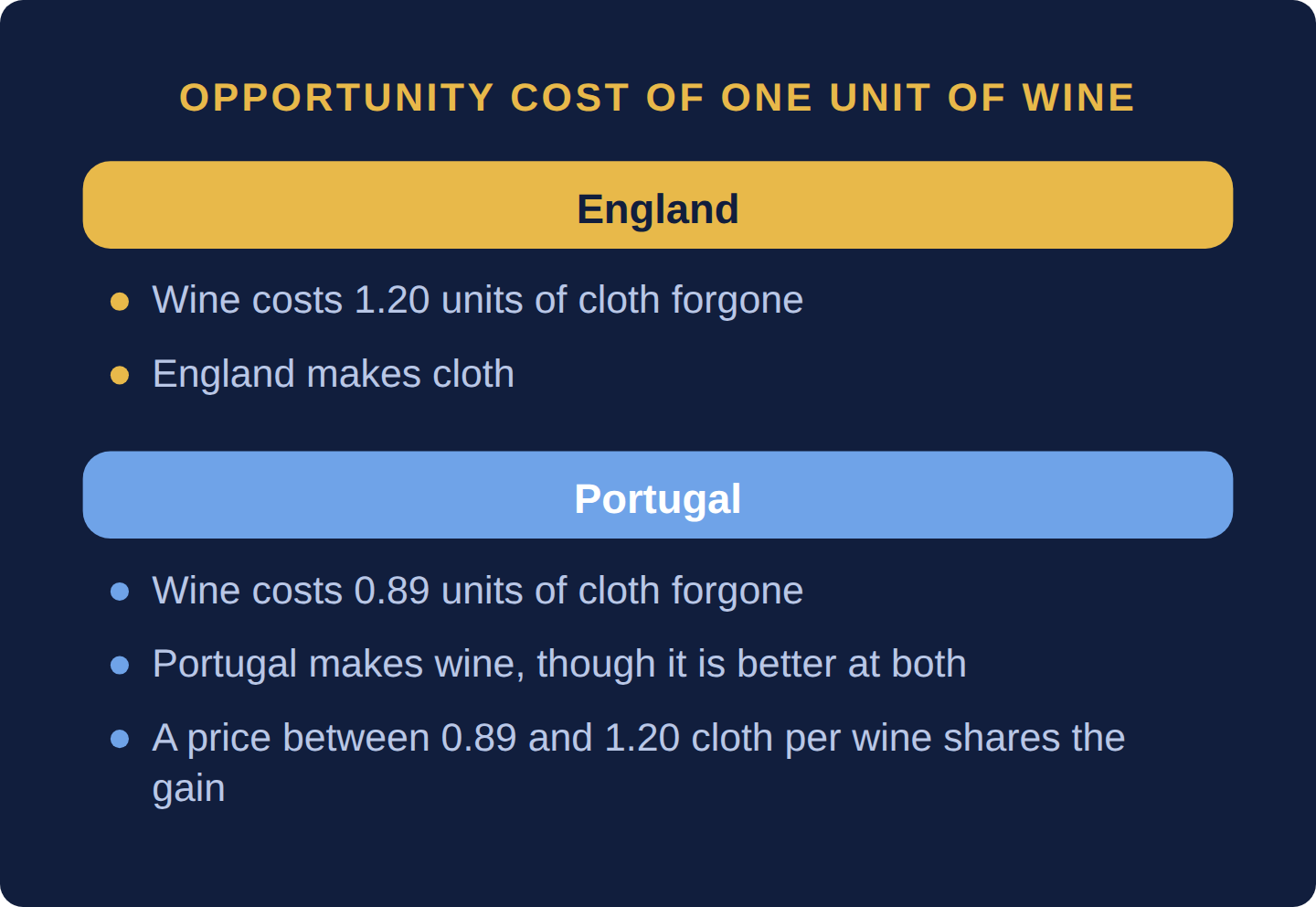
- Wine costs England 1.20 units of cloth forgone and Portugal 0.89, so Portugal makes wine and England cloth, though Portugal is better at both.
- Any trade price between 0.89 and 1.20 cloth per wine shares the gain; at either edge one country takes all of it.
- Ricardo assumed capital stays at home; with free capital movement, absolute advantage decides where production goes.
- Trade raises total income but can cut income for some groups: Chinese imports explain one-quarter of the 1990–2007 fall in US manufacturing jobs.
- The live debate is about distribution and adjustment, not about whether specialization creates gains.
David Ricardo’s On the Principles of Political Economy and Taxation (1817) formalized the concept of comparative advantage introduced in Volume I’s Part 1.4: international trade benefits both countries even when one is more efficient at producing everything, provided each specializes where its relative (not absolute) advantage is greatest. The primary text. Ricardo used four numbers. Making cloth in England takes the labor of 100 men for a year and making wine 120; in Portugal, cloth takes 90 and wine 80. Portugal is better at both, yet Ricardo concluded that “England would therefore find it her interest to import wine, and to purchase it by the exportation of cloth”, and that Portugal would import cloth even though it could make cloth with fewer men than England.
Interpretation. The cost that matters is the opportunity cost: what a country gives up to make one more unit of a good. Every man-year Portugal spends on cloth is a man-year not spent on wine, where its edge is larger. The worked example below runs the numbers.
Ricardo measured cost in man-years of labor. The table restates his example and adds the column that decides everything: what one unit of wine costs in cloth given up.
| Country | Cloth (men for one year) | Wine (men for one year) | Cost of 1 wine in cloth forgone |
|---|---|---|---|
| England | 100 | 120 | 120 ÷ 100 = 1.20 |
| Portugal | 90 | 80 | 80 ÷ 90 = 0.89 |
Step 1, absolute advantage: Portugal needs fewer men for both goods. Step 2, comparative advantage: wine costs Portugal 0.89 cloth but England 1.20 cloth, so Portugal has the comparative advantage in wine and England, by the mirror image, in cloth (a unit of cloth costs England 100 ÷ 120 = 0.83 wine against Portugal’s 90 ÷ 80 = 1.125). Step 3, specialize: without trade each country makes one unit of each good, using 220 man-years in England and 170 in Portugal, for a world total of 2 cloth and 2 wine. Put England’s 220 men on cloth and Portugal’s 170 on wine and the world gets 220 ÷ 100 = 2.2 cloth and 170 ÷ 80 = 2.125 wine: 0.2 cloth and 0.125 wine more from the same labor. Step 4, the price band: trade happens at any price between 0.89 and 1.20 cloth per wine. At one cloth for one wine, England gets wine for 100 man-years instead of 120 (a saving of 20 ÷ 120 = 16.7%) and Portugal gets cloth for 80 instead of 90 (10 ÷ 90 = 11.1%). At the edges of the band one country takes all the gain and the other none; outside it, one country is better off not trading.
The four-number result holds under Ricardo’s assumptions. Change one and the answer changes.
| Situation | What changes | Why |
|---|---|---|
| Capital can move abroad freely | Absolute advantage starts to matter | Ricardo said so himself: with free movement of capital it “would undoubtedly be advantageous to the capitalists of England, and to the consumers in both countries” for both goods to be made in Portugal |
| Trade price sits at the edge of the band | One country gets all the gain | At 1.20 cloth per wine England saves nothing on wine; at 0.89 Portugal saves nothing on cloth |
| Transport costs exceed the cost gap | No trade at all | If shipping a unit of wine costs more than 1.20 − 0.89 = 0.31 cloth, autarky is cheaper for one side |
| Workers released by imports stay idle | National gain can turn into a loss | The gain assumes labor moves to the export industry; unemployment (Part 9.5: Keynes and the Keynesian Revolution) breaks that link |
| Losses concentrated in one region | Aggregate gain, local damage | Autor, Dorn and Hanson (2013) found Chinese import competition explains one-quarter of the 1990–2007 fall in US manufacturing jobs, with lasting local unemployment |
| Factor owners rather than countries | The scarce factor can lose | Stolper and Samuelson (1941) showed trade can lower the real income of the factor a country has least of |
| Strategic goods | Price is not the only cost | Relying on one supplier for a critical input adds a disruption risk the price does not show |
Criticism. The model rests on assumptions Ricardo stated openly: labor as the measure of cost, workers who move costlessly from one industry to another, and capital that stays at home. He explained the last one by “the difficulty with which capital moves from one country to another”. Modern work kept the theorem and attacked the comfort drawn from it: trade raises total income, but someone can lose, and adjustment is slow and local. What survived. The proposition itself remains one of the most robust results in economics and the single most important theoretical foundation for the case for free trade. The live argument is about who gains, how fast the losers adjust and what to do for them, not about whether specialization by comparative advantage creates gains.
Before accepting or rejecting an argument about trade, compute each country’s opportunity cost ratio for the two goods. If the ratios differ, both countries can gain by specializing, whoever is more productive in absolute terms, and any price between the two ratios shares the gain. If the ratios differ by less than the cost of shipping, expect no trade. Then ask the separate question the theorem does not answer: which workers, regions or owners lose, and how quickly they can move. Ignore the rule’s comfort when capital and labor move freely across the border (absolute advantage then decides where production goes) or when released workers are likely to stay unemployed.
Confusing absolute with comparative advantage. A country, or a company, that is better at everything is tempted to do everything itself. In Ricardo’s numbers, Portugal making its own cloth spends 90 man-years per unit instead of the 80 it takes to make the wine that buys it: 10 ÷ 90 = 11.1% of the labor wasted on every unit. Translate that to a firm: if a team costs $150,000 a year per person and in-house work takes 90 person-years instead of the 80 that could earn the outsourced product, the firm burns 10 × $150,000 = $1.5 million per unit of output. Avoid it by ranking activities by opportunity cost, not by where you are best.
What is comparative advantage in simple terms?
It is the ability to produce a good at a lower opportunity cost than someone else, meaning you give up less of other things to make it. In Ricardo’s example, wine costs Portugal 0.89 units of cloth forgone but costs England 1.20, so Portugal should make wine and England cloth, even though Portugal is better at both.
What is the difference between absolute and comparative advantage?
Absolute advantage means producing more with the same resources; comparative advantage means producing at a lower opportunity cost. Portugal has the absolute advantage in both cloth and wine in Ricardo’s example, but only the comparative advantage in wine. Gains from trade come from comparative advantage, so even the less productive country always has something worth exporting.
Does comparative advantage mean everyone gains from trade?
No. It shows that total output and income rise, so winners could in principle compensate losers. It does not show that every worker or region gains. Stolper and Samuelson (1941) showed trade can cut real income for a country’s scarce factor, and US evidence on Chinese imports after 1990 found concentrated, lasting local job losses.
Ricardo (1817) showed that both countries gain when each specializes by comparative advantage, the lower opportunity cost, even if one is more productive at everything: in his numbers the same labor yields 0.2 more cloth and 0.125 more wine. The result assumes capital stays at home and released workers find jobs; trade raises total income, but some groups and regions can lose.
Six questions on this chapter. Decide on your answer first, then click “Reveal Answer.”
1. Using Ricardo’s numbers (England: cloth 100, wine 120 man-years; Portugal: cloth 90, wine 80), what does one unit of wine cost England in cloth forgone?
- 1.20 units of cloth
- 0.83 units of cloth
- 1.125 units of cloth
- 0.89 units of cloth
Reveal Answer
Answer: A. England’s wine takes 120 man-years that could make 120 ÷ 100 = 1.20 units of cloth.
2. In Ricardo’s example, at which price would trade benefit both England and Portugal?
- 1.5 cloth per unit of wine
- 1.3 cloth per unit of wine
- 1.0 cloth per unit of wine
- 0.8 cloth per unit of wine
Reveal Answer
Answer: C. Both gain at any price between Portugal’s cost of 0.89 and England’s cost of 1.20 cloth per wine; only 1.0 lies inside that band.
3. Which change did Ricardo himself say would weaken the case for producing by comparative advantage?
- Workers moving freely between industries
- Transport costs falling close to zero
- Both countries adopting the same currency
- Capital moving freely between countries
Reveal Answer
Answer: D. He wrote that with free capital movement it would benefit English capitalists and consumers for both goods to be made in Portugal.
4. What did Autor, Dorn and Hanson (2013) find about Chinese import competition?
- It raised total US manufacturing employment between 1990 and 2007
- It explains about one-quarter of the 1990–2007 fall in US manufacturing jobs
- It had no measurable effect on local US unemployment rates or on local wages
- It explains nearly all of the 1990–2007 fall in US manufacturing jobs
Reveal Answer
Answer: B. Their abstract attributes one-quarter of the decline to import competition, with lasting local effects on unemployment and wages.
5. Worked problem: England’s cost of wine is 1.20 units of cloth and Portugal’s is 0.89. What is England’s cost of one unit of cloth in wine, and Portugal’s?
Reveal Answer
Answer: England: 1 ÷ 1.20 = 0.833 wine. Portugal: 1 ÷ 0.89 = 1.124 wine. England is the cheaper cloth producer.
6. Worked problem: Within what range of cloth-per-wine trade prices do both countries gain?
Reveal Answer
Answer: Between 0.89 and 1.20: Portugal gains by selling wine above 0.89, England by buying below 1.20.
- Smith (1776), An Inquiry into the Nature and Causes of the Wealth of Nations (Project Gutenberg) — The founding text of classical economics
- Ricardo (1817), On the Principles of Political Economy and Taxation (Project Gutenberg) — Chapter 7, On Foreign Trade: the original statement of comparative advantage