
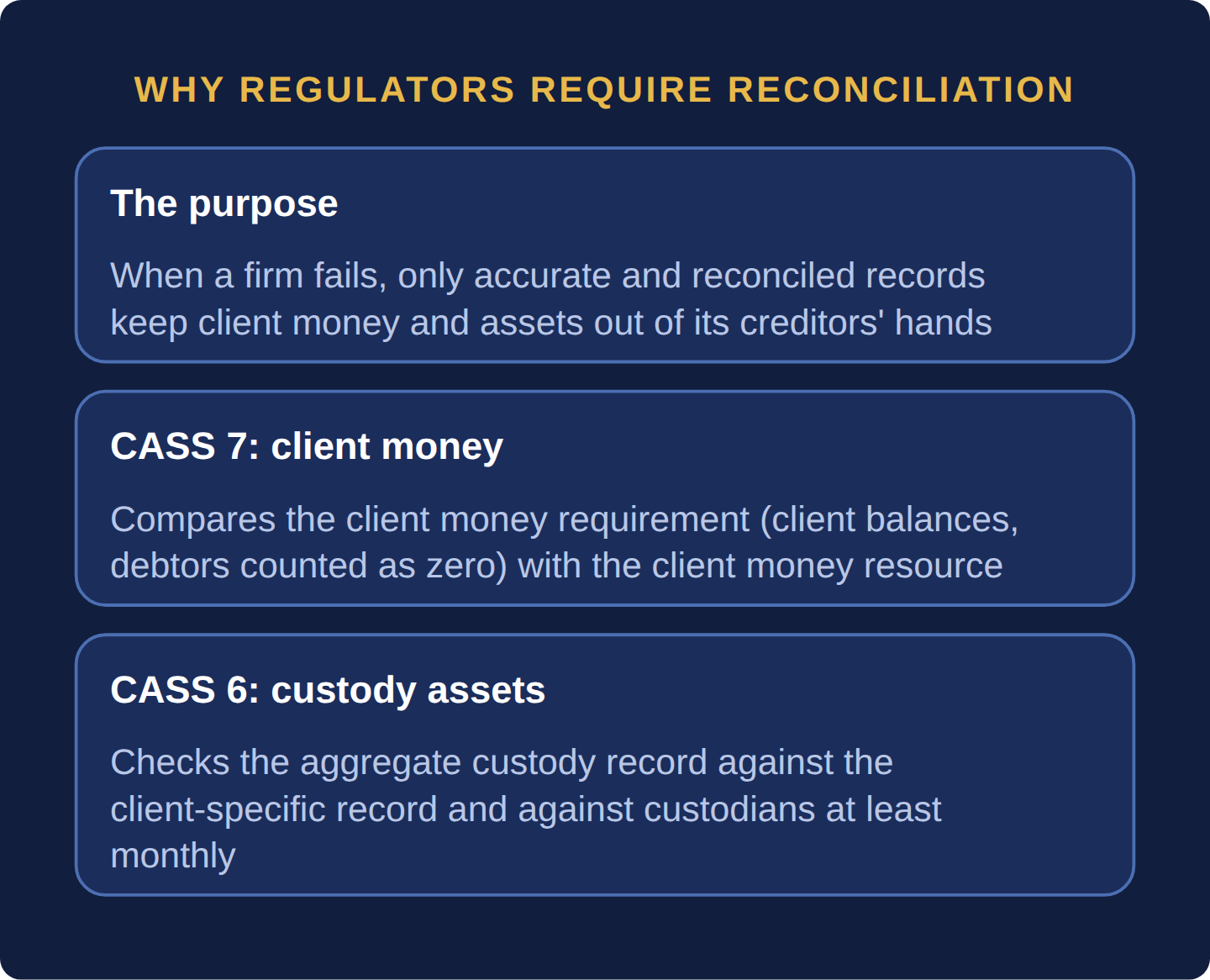
Reconciliation means comparing your records with someone else’s and fixing the differences. It is a regulatory control because, when a firm fails, only accurate, reconciled records keep client money and assets out of its creditors’ hands. The UK’s CASS rules require internal and external reconciliations, same-day funding of client money shortfalls, monthly reports, an annual audit, a 48-hour resolution pack and a named senior person who is accountable.
Why it matters: If the records don’t match, clients’ assets can be lost in a failure.
Summary: Reconciliation is a regulatory control because, when a firm fails, only accurate and reconciled records keep client money and assets out of its creditors’ hands. The UK’s CASS 6 (custody assets) and CASS 7 (client money) prescribe internal and external reconciliations, same-day funding of client money shortfalls, monthly CMAR reporting, an annual CASS audit, a 48-hour resolution pack and a named senior person accountable.
- CASS 7 compares the client money requirement (client balances, with debtors counted as zero) with the client money resource every business day; a shortfall is funded by close of business.
- CASS 6 checks the aggregate custody record against the client-specific record and against custodians at least monthly; gaps are covered with the firm’s own assets.
- A bank must countersign an acknowledgment letter before client money is held there, so it cannot set off the money against the firm’s debts.
- The “CASS Officer is SMF18” shorthand is wrong: CASS responsibility can sit with any existing SMF holder.
- The US equivalents are SEC Rule 15c3-3 (daily reserve computation for large broker-dealers since June 30, 2026), Rule 17a-13 and CFTC Rule 1.32.
Volume II’s Part 9 established that client asset protection depends on continuous reconciliation: segregation has to be proven in practice, not only documented. This Part supplies the toolkit underneath that statement, starting here with the reconciliations regulators prescribe for client money and custody assets.
Reconciliation is the process of comparing two independent records of the same underlying activity (an internal ledger against a custodian statement, a trade blotter against an exchange confirmation) and identifying, investigating and resolving every discrepancy. For client assets it is a written rule with a frequency, a deadline and a named senior person accountable, for a mechanical reason: when a firm fails, the only thing standing between its clients and its creditors is whether client money and assets are where the records say. When the futures broker MF Global failed on October 31, 2011, the US Commodity Futures Trading Commission (CFTC) found it nearly $1 billion short of customer funds after it had used them for its own needs in its final days (CFTC, June 2013). FTX repeated the failure in crypto in 2022: the CFTC alleged that customer assets were held by its affiliated trading firm, Alameda Research, commingled with Alameda’s own funds and withdrawn by the billions (CFTC, December 2022).
The UK’s Client Assets Sourcebook (CASS), in the Financial Conduct Authority (FCA) Handbook, is the most detailed version of these rules and this chapter’s model. CASS 6 covers safe custody assets, the securities and other instruments a firm holds for clients. CASS 7 covers client money, which a firm holds on a statutory trust (CASS 7.17.2R), so it stays outside the firm’s estate if the firm fails. The trust does not let the firm use client money to advance credit to a client, to itself or to anyone else (CASS 7.17.5G), which is why the arithmetic below never nets one client’s debt against another’s cash.
Both regimes ask two questions: do the firm’s own records agree with themselves (the internal check), and do they agree with the banks, custodians and depositories that actually hold the assets (the external check)?
| Control | CASS 6: safe custody assets | CASS 7: client money |
|---|---|---|
| Internal check | Internal custody record check: aggregate record (by location) against client-specific record (by client); at least monthly (CASS 6.6.11R) | Internal client money reconciliation: requirement against resource, every business day, on the previous day’s close (CASS 7.15.15R) |
| External check | External custody reconciliation against custodian, depository and registrar records; at least monthly (CASS 6.6.37R) | External client money reconciliation against bank and third-party statements; at least monthly (CASS 7.15.22R) |
| When it does not agree | Cover a shortfall with the firm’s own assets or money until it is resolved (CASS 6.6.54R) | Pay a shortfall into a client bank account by close of business that day; withdraw an excess in the same window (CASS 7.15.29R) |
| Third-party paperwork | A written agreement with each third party holding the assets (CASS 6.3.4AR) | A countersigned acknowledgment letter (CASS spells it “acknowledgement”) from each bank, confirming the money is client money the bank cannot use against the firm’s debts, before any client money is held there (CASS 7.18.2R) |
| Tell the FCA | In writing, without delay, if records are materially inaccurate, a check cannot be performed or a discrepancy cannot be resolved (CASS 6.6.57R, 7.15.33R) | |
The asymmetry is deliberate: cash can be topped up within hours, so CASS 7 sets a same-day deadline; a missing security may not be buyable at once, so CASS 6 makes the firm stand behind it until the cause is found.
The daily CASS 7 test compares two numbers. The client money requirement, under the standard method, is the sum of every client’s balance excluding negative balances (clients who owe the firm), plus margin and any extra the firm has chosen to segregate (CASS 7.16.16R). The client money resource is the aggregate balance on the firm’s client bank accounts (CASS 7.16.8R). Requirement above resource is a shortfall, and firm money goes in the same day, before the investigation ends, because the rule protects clients precisely while the cause is unknown. Resource above requirement is an excess: firm money inside a trust account, withdrawn in the same window.
A UK broker holds client money in US dollars. Last night’s client balances: A $420,000; B $185,500; C $96,250; D −$38,000 (bought stock, not yet paid); E $12,750. D is a debtor and counts as zero.
Requirement = 420,000 + 185,500 + 96,250 + 12,750 = $714,500. Resource = two client bank accounts, 500,000 + 190,000 = $690,000. Shortfall = 714,500 − 690,000 = $24,500, transferred from the firm’s own account before close of business; then the investigation starts. A classic cause is a client purchase settled from the client bank account before that client paid, which spends other clients’ money. Had the clerk netted D’s debt, the requirement would read 714,500 − 38,000 = $676,500 and the same accounts would show a false $13,500 “excess” (690,000 − 676,500).
Four obligations turn the arithmetic into supervision. Classification: a firm is CASS large above £1 billion of client money or £100 billion of custody assets, CASS small below £1 million and £10 million, and medium in between, judged on the previous calendar year’s peak (CASS 1A.2). The Client Money and Assets Return (CMAR): large and medium firms file it monthly, within 15 business days of month end (SUP 16.14.3R). The CASS audit: an external auditor reports to the FCA at least yearly, under a reasonable assurance engagement if the firm holds client assets, within four months of the period end (SUP 3.10). The CASS resolution pack: a maintained file (master index, banks and custodians used, agreements and acknowledgment letters, key people, procedures; CASS 10.2.1R) that an insolvency practitioner must be able to retrieve within 48 hours of appointment (CASS 10.1.7R).
Then comes the named person. Large and medium firms must give CASS oversight, board reporting and the CMAR to a single director or senior manager (CASS 1A.3.1AR), whom the industry calls the CASS Officer, a term the rules do not use. Under the Senior Managers and Certification Regime (SM&CR), firms covered by SYSC 24 must also give the prescribed responsibility for CASS compliance to a Senior Management Function (SMF) holder. “The CASS Officer is SMF18” is a shorthand, not the rule: the responsibility can sit with someone who already holds another SMF; only a person who holds no other SMF is approved as SMF18 (Other Overall Responsibility) or, in a branch of an overseas firm, SMF22; and the CASS 1A oversight role may instead go to a non-SMF manager, who is then certified for it (CASS 1A.3.1BG).
The rules moved in 2026. Amendments announced in FCA Handbook Notice 142 (June 2026, CASS changes in force by September 25) narrowly allow less frequent external custody reconciliations where a third party refuses monthly statements, and let firms keep interest on client money only after notifying the client and where the Consumer Duty allows. Since May 7, 2026, payment and e-money firms follow a CASS 15 safeguarding regime (PS25/12) built the same way: daily reconciliation, a monthly return, a resolution pack and an annual audit.
If the client money requirement, computed client by client with every negative balance floored at zero, exceeds the resource by any amount, fund the gap from firm money the same day and then investigate. Withdraw an excess only after confirming it is not unallocated client receipts. If custody records disagree and the cause is not found, cover the gap with firm assets until it is. If a discrepancy cannot be resolved, notify the regulator without delay. In the UK this is the legal minimum, not a heuristic; elsewhere apply the local rule (in the US, Rule 15c3-3 or CFTC Rule 1.32) on the same logic.
Netting a debtor client against everyone else. In the worked example, netting D’s −$38,000 shows a false $13,500 excess. Withdraw it and the resource falls to 690,000 − 13,500 = $676,500 against a true requirement of $714,500: a shortfall of $38,000, exactly the netted debt. If the firm fails that night and the pool is shared pro rata, every client loses 38,000 ÷ 714,500 = 5.32%; client A’s share is 420,000 × 38,000 ÷ 714,500 ≈ $22,337, recoverable only through the insolvency. Avoid it by building the zero floor into the reconciliation system so no one can net by hand.
What is the difference between CASS 6 and CASS 7?
CASS 6 protects safe custody assets, such as securities held for clients; CASS 7 protects client money, held on a statutory trust. Client money is reconciled internally every business day and shortfalls are funded that day; custody records are checked at least monthly and gaps are covered with the firm’s own assets.
Is the CASS Officer always an SMF18?
No. The prescribed responsibility for CASS must sit with a Senior Management Function holder, who may already hold another SMF. Only a person with no other SMF is approved as SMF18 (or SMF22 in an overseas firm’s branch), and day-to-day oversight may go to a certified non-SMF manager.
Does the US have an equivalent of CASS?
Yes, spread across several rules. Broker-dealers compute a customer reserve under SEC Rule 15c3-3, daily since June 30, 2026, for firms with $500 million or more of average total credits, and count securities against their records quarterly under Rule 17a-13; futures commission merchants compute customer segregation every business day under CFTC Rule 1.32.
Reconciliation is a regulatory control because, in a failure, only accurate and reconciled records keep client assets out of creditors’ hands. CASS 7 compares the client money requirement (debtor balances counted as zero) with the resource every business day and funds any shortfall by close of business; CASS 6 checks custody records internally and against custodians at least monthly and covers gaps with the firm’s own assets. Acknowledgment letters, the monthly CMAR, the annual CASS audit, the 48-hour resolution pack and a named senior manager complete the regime, with SEC Rule 15c3-3 and CFTC Rule 1.32 as the US counterparts.
Six questions on this chapter. Decide on your answer first, then click “Reveal Answer.”
1. A broker’s client balances are P $250,000, Q $130,000, R −$45,000 (owes the firm) and S $60,000. Its client bank accounts hold $410,000. Under the CASS 7 standard method, how much firm money must go in by close of business?
- $45,000
- $15,000
- $0
- $30,000
Reveal Answer
Answer: D. R counts as zero, so the requirement = 250,000 + 130,000 + 60,000 = $440,000; shortfall = 440,000 − 410,000 = $30,000. Netting R’s debt would wrongly show a $15,000 excess.
2. Under CASS 7, what must a firm have before it holds any client money at a bank?
- A countersigned acknowledgment letter from that bank
- An auditor’s opinion on the bank’s solvency
- A guarantee from that bank covering the whole balance
- Written approval from the FCA for that account
Reveal Answer
Answer: A. CASS 7.18.2R bars holding client money in an account until the bank has countersigned the acknowledgment letter confirming the money is client money.
3. How often must a firm perform its internal client money reconciliation under CASS 7?
- Monthly, just before the CMAR is filed
- At least monthly, against the banks’ own statements
- Every business day, on the previous day’s records
- Weekly, on the last business day
Reveal Answer
Answer: C. CASS 7.15.15R requires it each business day based on the previous business day’s close; the external reconciliation against banks is the one required at least monthly.
4. Which statement about the so-called CASS Officer under the UK’s Senior Managers regime is accurate?
- Medium firms need no named person for CASS oversight
- It can sit with someone who already holds another SMF
- Only the chief executive may hold the CASS responsibility
- It must always be held by an approved SMF18 holder
Reveal Answer
Answer: B. The prescribed responsibility for CASS goes to an SMF holder who may already hold another SMF; SMF18 applies only to someone with no other SMF (CASS 1A.3.1BG).
5. Worked problem: A firm’s client money requirement is $120m and its client money resource is $115m. What happens under CASS 7?
Reveal Answer
Answer: There is a $5m shortfall, which the firm must fund from its own money by close of business that day.
6. Worked problem: If the resource later rises to $121m, what is the position?
Reveal Answer
Answer: A $1m surplus, which the firm may leave in the account or withdraw once the reconciliation is signed off.
- FCA Handbook, CASS 6.6 Records, accounts and reconciliations — Internal custody record checks and external custody reconciliations at least monthly; shortfall cover (6.6.54R); exception 6.6.40AR; notification
- FCA Handbook, CASS 7.15 Records, accounts and reconciliations — Daily internal and monthly external client money reconciliations; same-day shortfall funding (7.15.29R)
- FCA Handbook, CASS 7.16 Client money calculation — Client money requirement excluding negative balances (7.16.16R) and resource (7.16.8R)
- FCA Handbook, CASS 7.17 Statutory trust — Statutory trust (7.17.2R) and no credit from client money (7.17.5G)
- FCA Handbook, CASS 7.18 Acknowledgement letters — Countersigned acknowledgment letter before holding client money (7.18.2R)
- FCA Handbook, CASS 1A.2 and 1A.3 — CASS firm classification thresholds; CASS oversight allocation and SM&CR guidance (1A.3.1BG)