
11.1 The Plumbing — Clearing Houses, Depositories, and Custodians
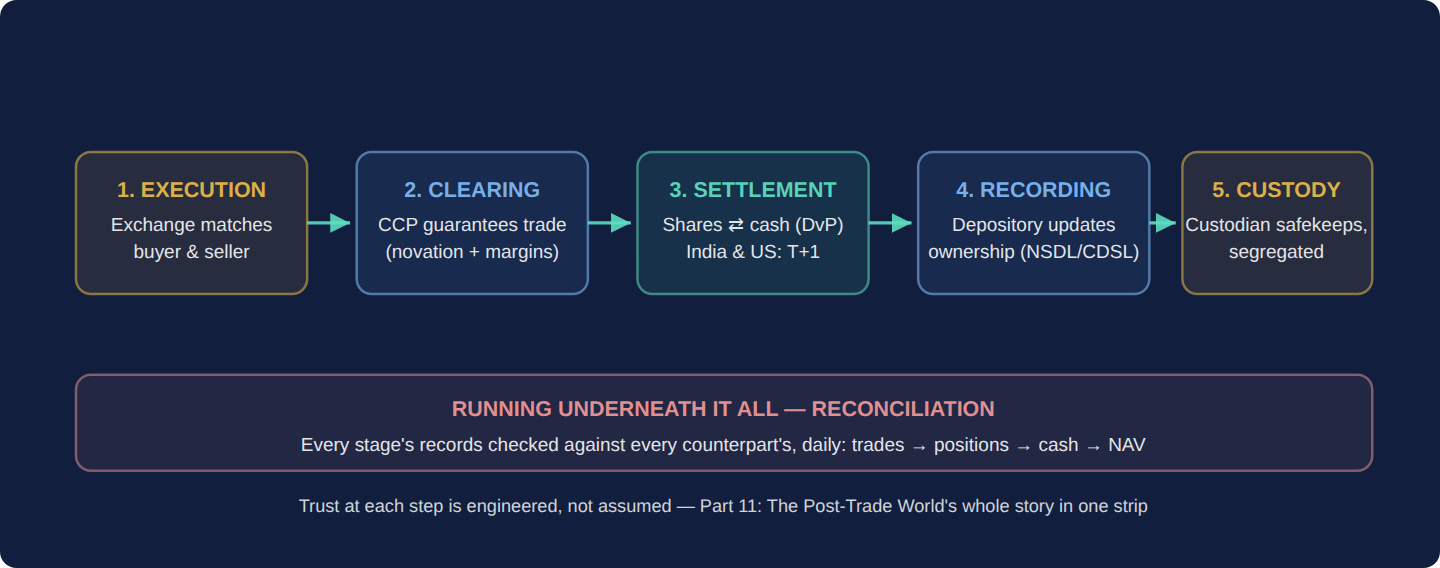
A trade passes from execution to clearing, settlement, recording and custody: the clearing house guarantees the trade, the depository records who owns what, and the custodian safekeeps institutional assets.
Why it matters: Each role removes a different risk from a trade.
Summary: A trade passes from execution to clearing, settlement, recording and custody: the clearing house guarantees the trade, the depository records who owns what, and the custodian safekeeps institutional assets.
- In the example, $24 million of gross obligations becomes a $4 million payment after multilateral netting, a reduction of about 83%.
- India completed its move to T+1 on January 27, 2023, the US, Canada and Mexico followed on May 28, 2024, and the EU, UK and Switzerland remain on T+2 until October 11, 2027.
- BNY alone reports over $59 trillion in assets under custody and/or administration as of March 31, 2026.
- Exchange-traded obligations guaranteed by CCPs kept functioning through 2008, while bilateral, uncleared derivatives froze.
Between “trade agreed” and “shares delivered, cash paid” stand three institutions almost nobody outside finance can name: the clearing house guarantees the trade, the depository records who owns what, and the custodian safekeeps institutional investors’ assets. Together they answer the oldest question in markets: how do I trade with a stranger and be certain I get paid?
The trade lifecycle runs: execution → confirmation → clearing → settlement → recording. On execution day the exchange has merely matched two strangers; everything of substance follows. Clearing is where the central counterparty (CCP) — NSE Clearing and ICCL in India, DTCC’s subsidiaries NSCC and FICC and CME in the US, LCH in London — steps into the middle of every trade through novation: it becomes the buyer to every seller and the seller to every buyer. Your counterparty risk toward a stranger becomes exposure to a fortress institution, defended by margins collected from members and a mutual default fund. This is why markets kept functioning through 2008’s bankruptcies: exchange-traded obligations were guaranteed by CCPs, while the bilateral, uncleared derivatives of chapter 3.11 froze — precisely why post-crisis reform pushed derivatives into central clearing. (The footnote: concentrating everyone’s risk in a handful of CCPs makes them the new too-big-to-fail nodes, which is why regulators stress-test them like systemic banks.)
Settlement is the actual exchange — securities move against payment, Delivery versus Payment (DvP), so neither side can take the money and run. Ownership changes inside depositories: NSDL and CDSL in India (your demat account lives in one of them), the DTC in the US, Euroclear and Clearstream internationally. India dematerialized paper certificates in the late 1990s, killing an entire genre of fraud — forged and stolen share certificates — in one architectural stroke. Settlement speed is measured in days after trade: India completed its move to T+1 on January 27, 2023, and the US, Canada and Mexico followed on May 28, 2024; India also offers an optional same-day T+0 cycle for a list of large stocks, while the EU, UK and Switzerland remain on T+2 until October 11, 2027. (NSE Clearing and ICCL clear Indian equities; CCIL is the CCP for government securities, money markets and foreign exchange.) Faster settlement shrinks the window in which a counterparty can fail, but compresses every downstream process — including the reconciliation of the next chapter — into hours where there used to be days.
Finally the custodians — arguably the largest financial institutions the public has never heard of. BNY Mellon, State Street, JPMorgan, Citi, and Northern Trust collectively safekeep assets measured in the tens of trillions of dollars (BNY alone reports over $59 trillion in assets under custody and/or administration as of March 31, 2026) on behalf of the mutual funds, pension funds, insurers, and sovereign funds of chapter 3.15: The Hidden Giants — Insurance and Pension Funds. “Custody” means holding clients’ securities segregated from the custodian’s own balance sheet, settling their trades, collecting their dividends, handling corporate actions, and reporting — earning fractions of a basis point on colossal volumes. The segregation is the crucial design: client assets at a custodian are not the custodian’s property and don’t fund its business — a mutual fund’s shares would survive its custodian’s bankruptcy. Hold that thought; chapter 11.3: Protecting Client Assets — Trust, Engineered shows what happens when that principle is honored, and when it isn’t.
Margin (Section 8.2: Capital Markets Operations — The Trade Lifecycle) is half of a CCP’s defense; multilateral netting is the other half. Take three brokers on one day. A owes B $10 million for shares bought, B owes C $8 million, and C owes A $6 million: gross obligations are 10 + 8 + 6 = $24 million. Once the CCP has taken over every trade through novation, each member has a single position against the CCP: A pays 10 − 6 = $4 million, B receives 10 − 8 = $2 million, C receives 8 − 6 = $2 million. Only $4 million moves, a reduction of 1 − 4/24 ≈ 83%. The same step shrinks the loss if A defaults: the CCP’s hole is the $4 million A owed, not $24 million of tangled claims. At scale the effect is the same: DTCC reports that its securities-netting engine, NSCC’s Continuous Net Settlement, nets about 98.6% of obligations (the 3-broker numbers above are illustrative).
Buying shares is like buying a house, compressed into a day. The exchange is the marketplace where you found the seller. The CCP is like an escrow guarantee ensuring neither party can vanish mid-deal. The depository is the land registry recording the title change. And the custodian is a vault-keeper who holds title deeds for institutions that own thousands of houses — keeping each client’s deeds in a separate, labeled box that never mixes with the vault-keeper’s own property.
What does a clearing house do?
It guarantees the trade between buyer and seller, sitting in the middle after execution.
What is multilateral netting?
Offsetting many obligations against each other. In the example, $24 million of gross obligations becomes a $4 million payment, a reduction of about 83%.
When did T+1 settlement start?
India completed its move to T+1 on January 27, 2023, and the US, Canada and Mexico followed on May 28, 2024. The EU, UK and Switzerland remain on T+2 until October 11, 2027.
A trade passes from execution to clearing, settlement, recording and custody. The central counterparty takes over every trade by novation and nets members’ obligations (in the chapter’s example $24 million of gross debts becomes a $4 million payment), the depository records who owns what, and the custodian keeps clients’ assets segregated. The US, Canada, Mexico and India settle on T+1; the EU and UK follow on October 11, 2027.
Four questions and two worked problems on this chapter. Decide on your answer first, then click “Reveal Answer.”
1. In the chapter’s three-broker example, A owes B $10 million, B owes C $8 million and C owes A $6 million. After the CCP nets the positions, how much cash moves in total?
- $24 million, paid in three separate transfers
- $4 million, paid by A to the CCP
- $18 million, the gross total less the smallest debt
- $8 million, equal to the middle obligation
Reveal Answer
Answer: B. Gross is 10 + 8 + 6 = $24 million. A pays 10 − 6 = $4 million; B and C each receive $2 million, so only $4 million moves (an 83 percent reduction).
2. A broker defaults after a trade has been accepted by the clearing house. Which feature of the CCP means the broker’s counterparty still gets paid?
- Novation, which makes the CCP the counterparty to both sides
- Custody, which separates clients’ assets from the broker’s
- Dematerialization, which removes paper share certificates
- Reconciliation, which compares both sides’ records daily
Reveal Answer
Answer: A. Through novation the CCP becomes buyer to every seller and seller to every buyer, backed by members’ margin and the default fund, so the survivor’s claim is against the CCP.
3. Which statement about T+1 settlement is accurate as of October 2026?
- The US and India settle on T+1, and the EU and UK did so in 2024 as well, under one rule
- India settles on T+1 and the US on T+0 since May 2024, with the EU on T+2 until 2028
- India, the US, Canada and Mexico settle on T+1; the EU and UK move on October 11, 2027
- Only the US settles on T+1, with India still on T+2 and the EU on T+2 until later
Reveal Answer
Answer: C. India moved on January 27, 2023, and the US, Canada and Mexico on May 28, 2024; the EU, UK and Switzerland are scheduled for October 11, 2027.
4. Why is a mutual fund’s stock held at a custodian safe if the custodian itself goes bankrupt?
- The central bank guarantees all custody balances held by any bank
- The depository swaps the shares for cash if the custodian fails
- The custodian insures every portfolio with its own capital reserves
- Client securities are segregated and are not the custodian’s property
Reveal Answer
Answer: D. Segregation means the assets belong to the clients and do not fund the custodian’s business, so its creditors cannot claim them.
5. Worked problem: A owes B $12m, B owes C $9m, C owes A $5m and A owes C $3m. What is each firm’s net position?
Reveal Answer
Answer: A: −12 − 3 + 5 = −$10m; B: +12 − 9 = +$3m; C: +9 + 3 − 5 = +$7m.
6. Worked problem: Gross obligations total $29m. After multilateral netting, how much actually moves, and what is the reduction?
Reveal Answer
Answer: Only A pays: $10m in total. Reduction = 1 − 10 ÷ 29 = 65.5%.
11.2 Reconciliation — Making a Quadrillion Numbers Agree
Reconciliation compares independent records in a deliberate order: trades, positions, cash and nostro accounts, client money, then P&L and NAV. A break is any mismatch, and an aged break past its deadline is what auditors chase.
Why it matters: A break that nobody closes can hide a much larger problem.
Summary: Reconciliation compares independent records in a deliberate order: trades, positions, cash and nostro accounts, client money, then P&L and NAV. A break is any mismatch, and an aged break past its deadline is what auditors chase.
- In the example a bank’s nostro ledger shows $4,125,000.00 against the correspondent’s $4,121,350.00, a $3,650 break that resolves into a $3,500 timing item and a $150 unbooked fee, leaving $0 unexplained.
- Barings’ Nick Leeson controlled both trading and the back-office records that should have checked him, and Wirecard’s imaginary €1.9B was at bottom a cash reconciliation nobody forced to closure.
- Settlement compressing from T+2 to T+1, and optionally T+0 in India, leaves reconciliation a shrinking window to catch problems before money moves.
Every transaction is recorded independently by at least two parties — and independent records drift apart. Reconciliation is the discipline of comparing them, finding every mismatch (“break”), and resolving it fast. It sounds like bookkeeping; it is actually the financial system’s immune system, and one of the largest employers in global financial operations.
Chapter 8.3: Reconciliation — Financial Bookkeeping at Massive Scale introduced the six-step sequence; here is the professional’s full map. Reconciliation comes in types, and mature operations run them in a deliberate sequence: trade reconciliation first (do both sides agree on quantity, price, fees — catching errors before they become settlement failures), then position reconciliation (do internal books match the custodian’s record of holdings — the stock-record check), then cash reconciliation (internal ledger versus bank/custodian statements, currency by currency), including NOSTRO reconciliation — a bank’s own foreign-currency accounts held at other banks, where unmatched entries can hide fraud or unknown exposures — then client money and assets reconciliation (the same checks run against what the firm owes each client, the subject of the next chapter), and only then P&L and NAV reconciliation, the final proof behind the daily price of every mutual fund unit you own. The sequence is logic, not tradition: reconcile positions before cash and an entire category of possible explanations for each cash break is already eliminated.
The working vocabulary: a break is any mismatch; a tolerance is the threshold below which tiny differences are ignored; an aged break — one unresolved past its deadline — is the metric auditors and regulators pounce on, because breaks that linger are where errors compound and frauds hide. The headline KPI is the STP rate (straight-through processing): the percentage of items that match automatically with no human touch. Modern platforms — SmartStream’s TLM, Trintech, Gresham, Broadridge — ingest feeds in any format, normalize them, auto-match the vast majority, and route the exceptions through workflow to investigators; AI (Part 7: Artificial Intelligence) is now lifting match rates further by learning fuzzy correspondences rules miss and predicting which breaks matter most. The economics are stark: at millions of daily transactions, every percentage point of STP is headcount, and every hour of faster resolution is risk retired — pressure that intensifies as settlement has compressed from T+2 to T+1 and, in India, optionally to T+0 (chapter 11.1: The Plumbing — Clearing Houses, Depositories, and Custodians), leaving reconciliation a shrinking window to catch problems before money actually moves.
Why does it matter this much? Because unreconciled books are how disasters incubate: rogue traders (Barings’ Nick Leeson famously controlled both trading and the back-office records that should have checked him), misplaced client money (next chapter), and balance-sheet fictions (Wirecard’s imaginary €1.9B — chapter 5.6: When the Numbers Lie — Financial Fraud and Its Anatomy — was, at bottom, a cash reconciliation that nobody forced to closure). A tidy reconciliation function is invisible; its absence is a scandal with a name.

A bank’s internal ledger shows $4,125,000.00 in its dollar nostro account at a correspondent bank; the correspondent’s statement says $4,121,350.00. The break is 4,125,000 − 4,121,350 = $3,650. Matching finds two items: a $3,500 receipt the bank booked on trade date that the correspondent will credit tomorrow (a timing item that clears itself), and a $150 account fee the correspondent debited that the bank has not booked. Then 3,500 + 150 = $3,650, so the unexplained residual is $0. With a $100 tolerance the fee is still above the line, so it needs a journal entry, which a second person must approve (maker-checker, Section 8.5: Risk Management and Compliance in Practice). If the $3,500 were still open past its deadline, it would become an aged break. The figures are illustrative.
What is a reconciliation break?
Any mismatch between two independent records.
What is an aged break?
A break past its deadline, which is what auditors chase.
Can you give an example of a break?
A bank’s nostro ledger shows $4,125,000.00 against the correspondent’s $4,121,350.00, a $3,650 break that resolves into a $3,500 timing item and a $150 unbooked fee, leaving $0 unexplained.
What do Barings and Wirecard show?
Barings’ Nick Leeson controlled both trading and the back-office records that should have checked him, and Wirecard’s imaginary €1.9B was at bottom a cash reconciliation nobody forced to closure.
Reconciliation compares independent records in a deliberate order: trades, positions, cash and nostro accounts, client money, then P&L and NAV. A break is any mismatch, a tolerance ignores trivial ones, and an aged break past its deadline is what auditors chase. In the example, a $3,650 cash break resolves into a $3,500 timing item and a $150 unbooked fee.
Four questions and two worked problems on this chapter. Decide on your answer first, then click “Reveal Answer.”
1. A bank’s ledger shows $4,125,000 at a correspondent and the statement shows $4,121,350. A $3,500 receipt is in transit and the rest is an unbooked fee. What is the fee?
- $3,500, since the in-transit item is the fee
- $150, since 4,125,000 − 4,121,350 − 3,500 = 150
- $3,650, since the whole break is the fee
- $7,150, since both items add to the break twice
Reveal Answer
Answer: B. The break is $3,650; subtracting the $3,500 timing item leaves a $150 fee that still needs a journal entry.
2. Why do mature operations reconcile positions before cash?
- Settling the securities question first removes a category of explanations for each cash break
- Positions are only held by custodians, never by firms, so firms cannot check them at all
- Cash is the least liquid asset and so matters least, which is why it is checked last
- Regulators forbid cash checks until positions are certified by an external auditor each month
Reveal Answer
Answer: A. If positions already agree with the custodian, a cash difference cannot be a missing delivery, which narrows the investigation.
3. Which measure is the usual headline KPI of a reconciliation function?
- The number of staff per reconciliation
- The count of items in the aged-break queue
- The size of the tolerance threshold
- The straight-through processing (STP) rate
Reveal Answer
Answer: D. STP rate is the percentage of items matched automatically with no human touch; aged breaks are a risk measure, not the headline productivity KPI.
4. What does an aged break indicate?
- A break between two systems of the same firm, which clears itself within one day
- A break caused by an out-of-date price feed, which a refreshed feed always resolves
- A mismatch left unresolved past its deadline, where errors compound and frauds can hide
- A mismatch below the tolerance threshold that is ignored, so it needs no ownership or escalation
Reveal Answer
Answer: C. Aged breaks are what auditors and regulators chase because lingering items hide errors and fraud; ignoring items below tolerance is a different practice.
5. Worked problem: A nostro ledger shows $2,500,000.00 and the correspondent statement $2,496,200.00. What is the break?
Reveal Answer
Answer: $2,500,000.00 − $2,496,200.00 = $3,800.00.
6. Worked problem: It is explained by a $3,500 timing item and a $300 unbooked fee. What is left unexplained?
Reveal Answer
Answer: $3,800 − $3,500 − $300 = $0: the break can be closed.
11.3 Protecting Client Assets — Trust, Engineered
Client assets are protected by segregation, continuous reconciliation, regulatory reporting and a named senior manager who answers personally, as in the UK’s CASS regime, SEBI’s overnight upstreaming rule and the SEC’s Customer Protection Rule.
Why it matters: Protecting client assets is what lets people trust a firm with their money.
Summary: Client assets are protected by segregation, continuous reconciliation, regulatory reporting and a named senior manager who answers personally, as in the UK’s CASS regime, SEBI’s overnight upstreaming rule and the SEC’s Customer Protection Rule.
- MF Global (2011) left roughly $1 billion of customer funds missing when it failed, and FTX (2022) was the same sin in crypto costume.
- Larger firms file a monthly Client Money and Assets Return and maintain a resolution pack that an administrator can retrieve within 48 hours of a collapse.
- From July 1, 2023, Indian brokers may not keep client funds overnight, and backstops like SIPC have limits: $500,000 per customer, with no cover for market losses.
When a broker or bank fails, why don’t its customers lose their shares and cash? Because the law forces client assets to be segregated from the firm’s own, reconciled continuously, reported to regulators, and — in the strictest regimes — placed under the personal, named responsibility of a specific senior individual. Trust in finance isn’t a mood; it’s an engineered system with a human being’s name on it.
The nightmare scenario is co-mingling: a firm dips into client money to fund itself, then fails. It has happened — MF Global (2011) left roughly $1 billion of customer funds missing when it failed; FTX (2022) was the same ancient sin in crypto costume, with the SEC alleging that customer funds were diverted to an affiliated trading firm. Each scandal hardened the architecture that now stands, and the UK’s version — the FCA’s Client Assets Sourcebook (CASS) — is among the most detailed regimes in the world. Its pillars: client money must sit in segregated accounts held on statutory trust, legally the clients’ property and beyond creditors’ reach if the firm fails; client securities must be segregated and — closing the loop with chapter 11.2: Reconciliation — Making a Quadrillion Numbers Agree — reconciled at prescribed frequency, with discrepancies made good from the firm’s own funds immediately; larger firms file a monthly Client Money and Assets Return to the regulator and maintain a resolution pack that an administrator can retrieve within 48 hours of a collapse; and an annual, dedicated client-assets audit sits on top.
The most distinctive element is personal accountability: under the UK’s Senior Managers regime, protecting client assets is a prescribed responsibility that must be allocated to one named senior individual — a CASS Officer — who answers to the regulator personally, not corporately. Rules with a specific person’s name attached get followed differently from rules addressed to “the firm”; that is the design’s quiet genius, and regulators globally have converged on the same principles in local dialect — SEBI’s client-funds segregation and upstreaming rules for Indian brokers (from July 1, 2023, brokers may not keep client funds overnight), and the SEC’s Customer Protection Rule in the US, which requires brokers to keep possession or control of customers’ fully paid securities and to hold a computed reserve of cash or Treasuries for customers.
Step back and see what this chapter really is: the answer to the question Part 0: How Money Was Born opened with. Money began as trust in scarce metal, evolved into trust in states, and here reaches its industrial endpoint — trust in systems: segregation plus reconciliation plus reporting plus a named individual who answers for it. When you leave shares with a broker or money with a platform and sleep soundly, this machinery — and the professionals of chapter 10.6 who run its daily checks — is what you’re actually trusting.

Segregation protects clients only if the money is really there and the records say so. MF Global filed for bankruptcy on October 31, 2011, and roughly $1 billion of customer funds was missing; a settlement with the CFTC required full restitution of the remaining commodity customer claims. In the FTX case the SEC alleged that customer funds were diverted to an affiliated trading firm, Alameda Research. The backstop in the US has limits: SIPC covers up to $500,000 per customer, of which $250,000 may be cash, restores missing assets rather than lost value, and does not cover commodity futures or foreign exchange trades.
How are client assets protected?
By segregation, continuous reconciliation, regulatory reporting and a named senior manager who answers personally, as in the UK’s CASS regime, SEBI’s overnight upstreaming rule and the SEC’s Customer Protection Rule.
What happened at MF Global and FTX?
MF Global (2011) left roughly $1 billion of customer funds missing when it failed, and FTX (2022) was the same sin in crypto costume.
What is a resolution pack?
Larger firms file a monthly Client Money and Assets Return and maintain a resolution pack that an administrator can retrieve within 48 hours of a collapse.
Client assets are protected by segregation, continuous reconciliation, regulatory reporting and a named senior manager who answers personally, as in the UK’s CASS regime, SEBI’s overnight upstreaming rule and the SEC’s Customer Protection Rule. The rules were hardened by failures such as MF Global and FTX, and backstops like SIPC have limits: $500,000 per customer, with no cover for market losses.
Four questions and two worked problems on this chapter. Decide on your answer first, then click “Reveal Answer.”
1. Why do customers of a failed broker normally keep their fully paid securities?
- The broker’s bondholders are required to cover shortfalls before any customer assets are distributed
- The securities are segregated and held under the broker’s control for customers, not as the firm’s own property
- The government buys the shares at the last closing price and delivers cash to each customer
- Customer positions are netted against the broker’s debts, so each customer receives a pro-rata share
Reveal Answer
Answer: B. Segregation rules (CASS in the UK, SEC Rule 15c3-3 in the US) keep customer assets separate from the firm’s, so the firm’s creditors cannot claim them.
2. SIPC covers up to $500,000 per customer, of which $250,000 may be cash. A customer’s $120,000 of stock falls to $80,000 in a market crash while the broker is solvent. What does SIPC pay?
- Nothing, because SIPC does not cover declines in value
- $40,000, the loss in value from the market crash itself
- $80,000, the remaining value of the stock after the crash
- $120,000, the original purchase amount of the position
Reveal Answer
Answer: A. SIPC restores missing assets when a broker fails; it does not reimburse market losses, and here no broker has failed.
3. What is distinctive about the UK’s approach to protecting client assets?
- A named senior manager holds personal responsibility for compliance with the client asset rules
- Only the firm, not any person, answers to the regulator for failures in client asset protection
- Reconciliation is replaced by an annual audit, so daily checks of client assets are not required
- Client money is pooled in the firm’s own operating account, where it is used for firm expenses
Reveal Answer
Answer: A. Under the Senior Managers regime the firm’s compliance with CASS is a prescribed responsibility allocated to a specific senior manager, which makes accountability personal.
4. Which event is described in the chapter as customer money going missing when a broker failed?
- Barings in 1995, with a rogue trader’s hidden losses and falsified accounts
- MF Global in 2011, with roughly $1 billion of customer funds missing
- Wirecard in 2020, with missing cash balances held in trust accounts abroad
- Lehman in 2008, with its funding run and collapse of repo financing
Reveal Answer
Answer: B. MF Global filed for bankruptcy on October 31, 2011; Barings and Wirecard are examples of unreconciled records but not of missing client money at a broker.
5. Worked problem: A UK firm collapses on Friday at 5:00 pm and the administrator must be able to retrieve its resolution pack within 48 hours. By when?
Reveal Answer
Answer: Sunday at 5:00 PM, two days later.
6. Worked problem: A US broker-dealer’s customer credits are $500m and customer debits $80m. What must it hold in its reserve account (credits minus debits)?
Reveal Answer
Answer: $500m − $80m = $420 million, computed so that client assets are protected if the firm fails.
- DTCC, About us — The US central securities depository and clearing infrastructure
- BIS, Committee on Payments and Market Infrastructures — The committee that sets standards for payment and settlement systems
- CFTC, MF Global settlement — Customer funds shortfall, Oct 31, 2011
- SEC, FTX charges — Alleged diversion of customer funds to Alameda
- FCA Handbook, SUP 16.14 (CMAR) — Monthly CMAR for large and medium CASS firms
- FCA Handbook, CASS 10 resolution pack — 48-hour retrieval
- FCA Handbook, SYSC 24.2 — Prescribed responsibility for CASS compliance
- eCFR, 17 CFR 240.15c3-3 — Customer Protection Rule: possession or control, reserve formula