
The Controller owns the accuracy of the books. Every month they turn thousands of transactions into trustworthy financial statements, run the close and manage the relationship with the auditors.
Why it matters: If the books are wrong, every decision built on them is wrong too.
Summary: The Controller owns the accuracy of the books, turning thousands of transactions into trustworthy financial statements every month, and runs the close and the audit relationship.
- The close runs from sub-ledger cutoff through accruals, reconciliations and flux review.
- A fast close of about 3–5 business days marks a mature function.
- Most Controllers start as staff accountants or auditors; a CPA or CA is close to expected.
- Transactional work often moves to a GBS or GCC; sign-off stays onshore.
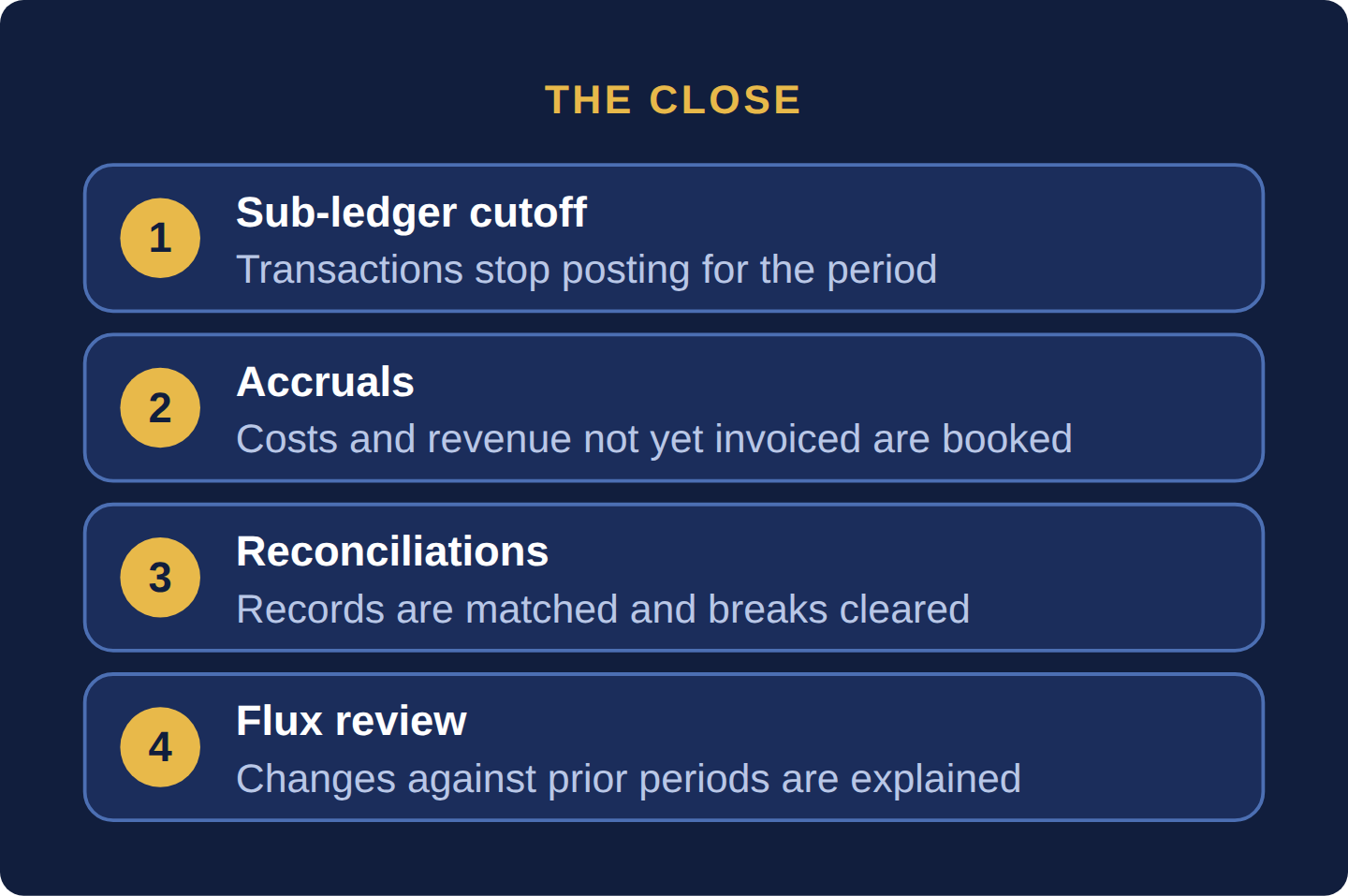
The Controller owns the mechanical accuracy of the company’s books — the person most directly responsible for turning thousands of individual transactions into a set of financial statements that can be trusted.
| Cadence | What Actually Happens |
|---|---|
| Daily | Reviewing cash position reports, approving routine journal entries above a set threshold, resolving accounting queries from business units, monitoring the accounts payable/receivable aging |
| Weekly | Team check-ins on close-readiness, reviewing significant or unusual transactions flagged by the team, coordinating with FP&A on emerging variances |
| Monthly | Running the “month-end close” — the intense multi-day process of finalizing all accounts, reconciling every balance sheet line, reviewing management accounts before they go to the CFO and business unit heads |
| Quarterly | Preparing quarterly financial statements for external filing (public companies), coordinating with external auditors on quarterly reviews, presenting results to the audit committee |
| Annually | Leading the company’s side of the annual external audit, finalizing the annual report’s financial statements, setting the accounting policy agenda for the coming year |
The “close” — the monthly cycle of finalizing the books — is the Controller function’s defining rhythm and its single most visible stress point: a company’s ability to close its books quickly and accurately (a “fast close,” often within 3–5 business days) is itself treated as a marker of finance-function maturity, distinct from the accuracy of the numbers themselves.
| Question | Typical answer |
|---|---|
| Entry titles | Staff accountant in industry, or staff auditor at a public accounting firm (the most common route). |
| The ladder (typical years) | Staff Accountant (0–3) → Senior Accountant (2–5) → Accounting Manager (5–9) → Assistant Controller (8–12) → Controller (10–15+); at large public companies, Chief Accounting Officer above that. |
| Qualifications that help | CPA (US) or CA (India): common, and close to expected at public companies. CMA (IMA): optional, useful on the cost side. |
| Where people come from | Audit seniors and managers after two to five years; internally promoted senior accountants. |
| Where people go next | Chief accounting officer, divisional or smaller-company CFO, finance transformation, accounting advisory. |
| Relative pay tier (1 lowest to 5 highest) | Entry: 2; Senior: 4. SEC reporting experience and company size move it most. |
| Who fits | People who like precision and a deadline that repeats monthly, and can refuse a late entry calmly. People who need variety, or dread saying no to seniors, burn out at year-end. |
| What interviewers ask | Shortening a close calendar; a reconciliation you could not tie out; a revenue or lease judgment (ASC 606, ASC 842); fixing an audit finding. |
Understanding this role means knowing what “close the books” actually involves, day by day:
Day 1–2 (Sub-ledger cutoff): Accounts payable, accounts receivable, fixed assets, and payroll sub-ledgers are locked for the period. Any transaction dated in the closing month must be posted before this cutoff, or it waits for next month — this is the single most common source of cross-team friction during close, since a late invoice from another department can force a reopening.
Day 2–3 (Accruals and estimates): Expenses incurred but not yet invoiced (a consultant’s December work billed in January) are booked as accruals; revenue earned but not yet billed is booked as accrued revenue. This is where accounting judgment enters — an accrual is always an estimate, refined each month as actual invoices arrive.
Day 3–4 (Balance sheet reconciliations): Every balance sheet account — bank accounts, intercompany balances, prepaid expenses, accrued liabilities — is reconciled line by line against an independent source (a bank statement, a sub-ledger report, a supporting schedule). This is the same discipline Part E.2: Reconciliations applies to a broker’s cash and securities and Volume II, Part 9 applies to client assets, here applied to a company’s own books.
Day 4–5 (Flux analysis and review): The Controller’s team compares this month’s results to last month’s and to budget, investigating any line item that moved more than a set threshold (commonly 5–10%) — a “flux” — and documenting the reason before the numbers go to the CFO. A flux with no clear explanation is the single most common reason a close gets delayed at the last stage.
Day 5+ (Management reporting): Finalized numbers are packaged into the management reporting pack and handed to FP&A (Part C.3: The Head of FP&A) for variance commentary and to the CFO for review — the Controller’s own work is essentially complete once the trial balance is locked and reconciled.
Reports to: the CFO directly in most firm types; at very large corporates, sometimes via a separate Chief Accounting Officer role sitting between the Controller and the CFO.
Typical direct reports: Assistant/Deputy Controller, General Ledger Manager, Accounts Payable Manager, Accounts Receivable Manager, Technical Accounting lead, Financial Systems (ERP) lead — plus Payroll Manager where payroll sits inside accounting rather than HR.
Key interactions:
- Head of FP&A (C.3: The Head of FP&A) — hands off the locked trial balance and management accounts every month; FP&A’s variance analysis is only ever built on the Controller’s already-reconciled numbers.
- Treasurer (C.2: The Treasurer) — reconciles cash and bank balances during close; treasury’s cash position is one of the balance sheet lines the Controller’s team ties out.
- Tax Director (C.6: The Tax Director) — supplies pre-tax figures the tax provision is calculated from, and receives the current/deferred tax entries back in time for close.
- Head of Internal Audit (C.5: The Head of Internal Audit) — the Controller’s own function is the most frequently audited in the company, and owns remediation of agreed findings, especially SOX 404 controls.
- Head of Stock Plan Administration (C.10: The Head of Stock Plan Administration) — supplies the monthly stock-based compensation expense entry ahead of close.
- External auditors — not a finance role, but the Controller’s most recurring outside relationship; the Controller’s team supports their fieldwork for every quarterly review and the annual audit.
Outside finance: business unit leaders (explaining and approving accruals and cost allocations), Legal (contract terms affecting revenue recognition), HR (payroll and benefits accruals where payroll is HR-owned).
Core systems: the ERP/general ledger (SAP, Oracle, NetSuite), close and reconciliation software (BlackLine), consolidation platforms (OneStream, Oracle Fusion Cloud EPM), and AP/AR sub-ledger modules.
Where the work sits: at many multinationals payables, receivables, journal postings and reconciliations run from a GBS or GCC in Bengaluru, Hyderabad, Pune or Chennai, while the onshore Controller keeps judgments, review and sign-off; the risk is a reconciliation approved without anyone examining the evidence.
What does the Controller own?
The accuracy of the books: the Controller turns thousands of transactions into trustworthy financial statements every month and runs the close and the audit relationship.
What are the steps of the close?
From sub-ledger cutoff through accruals, reconciliations and flux review.
How fast should a close be?
A fast close of about 3–5 business days marks a mature function.
The Controller owns the accuracy of the books and runs the close and the audit relationship. A close of about 3 to 5 business days marks a mature function.
Six questions on this chapter. Decide on your answer first, then click “Reveal Answer.”
1. A cost line rose from $200,000 to $226,000; the flux threshold is 10 percent. What happens next?
- Explain and document the 13 percent move
- Pass it: the move is only 2.6 percent
- Reopen the sub-ledger for a 26 percent move
- Accrue the 13 percent move into next month
Reveal Answer
Answer: A. ($226,000 − $200,000) ÷ $200,000 = 13 percent, above the threshold.
2. A consultant’s December work is invoiced in January. How is it treated in the December close?
- Record nothing until the invoice is paid
- Show it as a January FP&A variance
- Accrue an estimate, true it up later
- Book accrued revenue in December
Reveal Answer
Answer: C. Incurred but uninvoiced expenses are accrued in the month the work was done.
3. Which credential is close to expected for a Controller at a US public company?
- CFA
- CTP
- FPAC
- CPA
Reveal Answer
Answer: D. Controllers own accounting judgments and audits, so the CPA (or CA) is the usual credential.
4. With reconciliations prepared in an India GCC, what control risk must the onshore Controller manage?
- Preparation more often than the calendar requires
- Approval without anyone examining the evidence
- Review by staff holding a different credential
- Preparation in a different currency from the ledger
Reveal Answer
Answer: B. Split preparation and approval only works if the reviewer tests the evidence.
5. Worked problem: A Controller reconciles 40 accounts; 95% match automatically. How many need manual work?
Reveal Answer
Answer: 5% × 40 = 2 accounts.
6. Worked problem: A close takes 8 business days and a fast close is 4. Over 12 months how many business days are saved?
Reveal Answer
Answer: 4 × 12 = 48 business days.
- NYSED Office of the Professions, CPAs — CPA licensing by state (C.1)