
D.1 Stage One — One Person Doing Everything
In the earliest stage, with under about 30 employees, finance is usually just the founder plus an outside bookkeeper. The first in-house accountant makes sense once the outside firm’s fee, which grows with volume, exceeds the fixed cost of a hire. But slow month-end closes and stalled investor checks often force the hire earlier.
Why it matters: The first finance hire is usually triggered by a pain, not by a plan.
Summary: Under about 30 employees, finance is the founder plus an outside bookkeeper. The first in-house accountant pays for itself once the outside firm’s volume-based fee exceeds the fixed cost of a hire, though slow closes and stalled diligence often force the hire sooner.
- Typical scale: pre-Series A, under about 30 employees, revenue from zero to a few million dollars.
- The founder keeps the plan and approves payments; the outside firm keeps the books.
- Break-even = (in-house cost − outside base fee) ÷ fee per transaction.
- A three-week close or stalled diligence can justify an earlier hire.
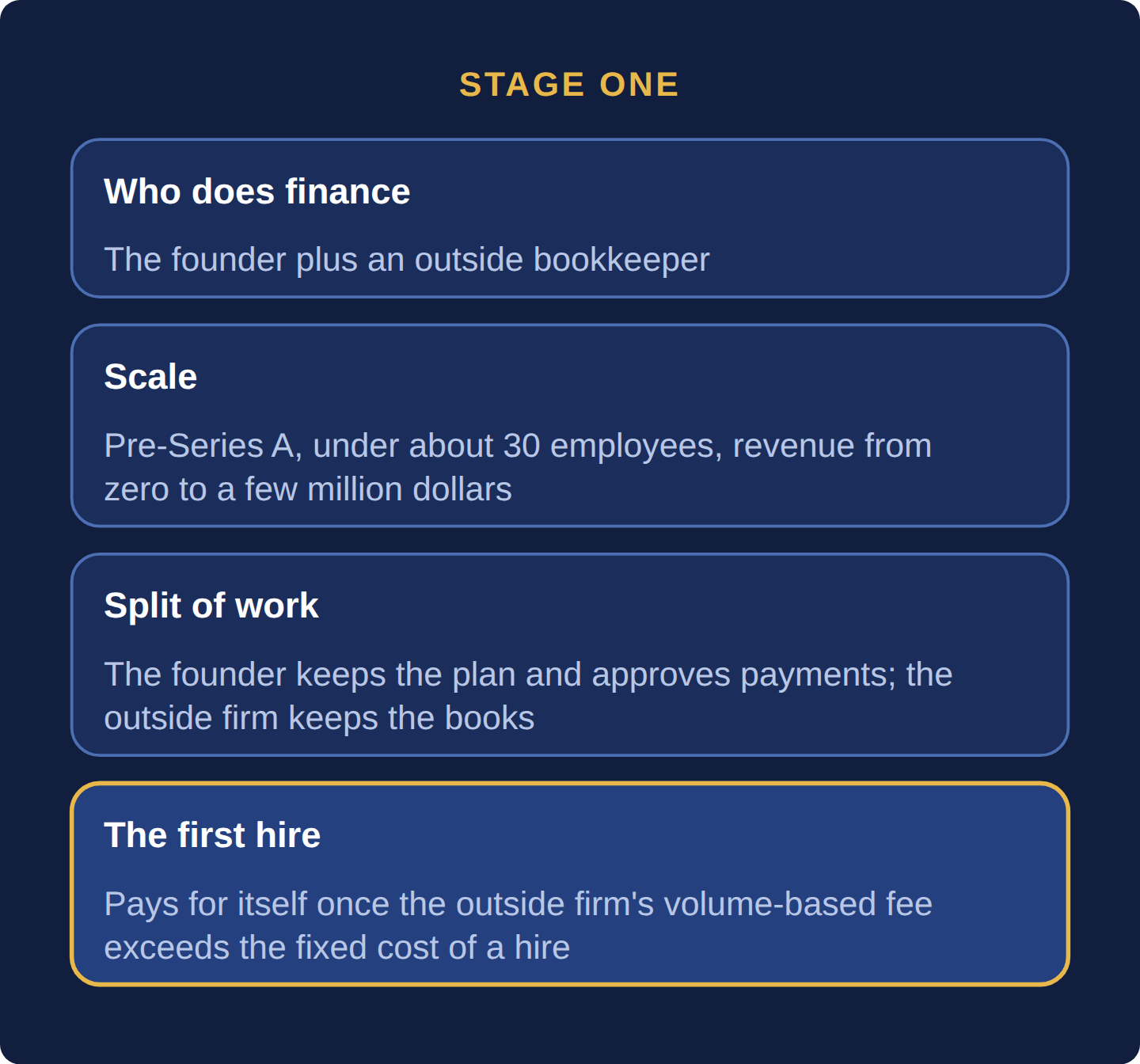
At a very early-stage company (typically pre-Series A, under about 30 employees, with revenue anywhere from zero to a few million dollars) there is usually no dedicated finance hire. The one person doing finance is the founder or CEO, who keeps the planning spreadsheet and approves payments, while an outside accounting firm or bookkeeper processes transactions and prepares basic monthly statements without any strategic involvement in the business.
The outside firm’s fee grows with transaction volume (bills, invoices, payroll runs, bank lines); a hire is a fixed cost. Costs are an index: 100 = the fully loaded annual cost of one in-house accountant. Illustrative assumptions: the outside firm charges 24 a year plus 0.06 per monthly transaction; going in-house costs 100 for the hire plus 15 for software and an outside CPA who still reviews year-end and tax.
| Monthly transactions | Outsourced: 24 + 0.06 × volume | In-house |
|---|---|---|
| 500 | 24 + 0.06 × 500 = 54 | 115 |
| 1,500 | 24 + 0.06 × 1,500 = 114 | 115 |
| 3,000 | 24 + 0.06 × 3,000 = 204 | 115 |
Break-even volume = (115 − 24) ÷ 0.06 ≈ 1,517 transactions a month. Below it, outsourcing is cheaper; above it, the hire wins on cost alone. In practice the hire often comes earlier for reasons the index misses: the close takes three weeks or more, investors’ diligence questions go unanswered, or revenue contracts need judgment the outside firm will not exercise.
Who does finance at a company under 30 employees?
The founder plus an outside bookkeeper.
Who does what?
The founder keeps the plan and approves payments; the outside firm keeps the books.
When does a first in-house accountant pay for itself?
Once the outside firm’s volume-based fee exceeds the fixed cost of a hire.
Under about 30 employees, finance is the founder plus an outside bookkeeper. The first in-house accountant pays for itself once the outside fee exceeds the fixed cost of a hire.
Six questions on this chapter. Decide on your answer first, then click “Reveal Answer.”
1. With D.1’s index (outside fee 24 + 0.06 per monthly transaction; in-house 115), what happens at 2,000 transactions a month?
- Outsourcing costs 104, so outsourcing is cheaper by 11
- Outsourcing costs 120, so in-house is cheaper by 5
- Outsourcing costs 144, so outsourcing is cheaper by 29
- Outsourcing costs 144, so in-house is cheaper by 29
Reveal Answer
Answer: D. 24 + 0.06 × 2,000 = 144; 144 − 115 = 29.
2. Same fee schedule, but the in-house option now costs 130. Where is break-even?
- About 1,267 transactions a month
- About 2,167 transactions a month
- About 1,767 transactions a month
- About 1,517 transactions a month
Reveal Answer
Answer: C. Break-even = (130 − 24) ÷ 0.06 ≈ 1,767; 1,517 uses the old 115 in-house cost.
3. A 25-person company is below break-even volume, but its close takes four weeks and diligence questions go unanswered. What fits the chapter?
- Hire in-house anyway; the cost index misses these signals
- Hire a full-time CFO and keep the bookkeeper indefinitely
- Stay outsourced until volume passes the break-even point
- Move the close to a quarterly cycle to save on fees
Reveal Answer
Answer: A. Slow closes, stalled diligence and judgment-heavy contracts often justify the hire before cost break-even.
4. At Stage One, who is the “one person doing everything” in finance?
- An FP&A analyst seconded by the lead investor
- The founder or CEO, with an outside bookkeeper
- The first in-house accountant on the payroll
- A part-time controller hired from a Big 4 firm
Reveal Answer
Answer: B. The founder keeps the plan and approves payments; an outside firm does the books.
5. Worked problem: A company has 18 employees and one founder doing finance with an outside bookkeeper. Which stage is it?
Reveal Answer
Answer: Under about 30 employees: Stage One.
6. Worked problem: The outside firm charges $1,000 plus $2 per invoice a month; an in-house accountant costs $6,000 a month. At what invoice volume does the hire pay for itself?
Reveal Answer
Answer: 1,000 + 2n = 6,000, so n = 2,500 invoices a month.
D.2 Stage Two — The First Real Hires
At Series A, the company has roughly 30 to 100 people and $1 to $10 million of revenue, and the first one to three finance people arrive. Often it is because a fundraise needs more rigor than the founder can supply. The seat teaches the whole function fast, but at a price: the person may step down a title when a CFO arrives.
Why it matters: The first finance seat is a great classroom, but it may not stay the top job.
Summary: At Series A (about 30–100 employees, $1–10 million of revenue) the first one to three finance people arrive, often because a fundraise needs rigor the founder cannot supply. The seat teaches the whole function fast, at the price of a likely title step-down when a CFO arrives.
- Triggers: a priced round, transaction volume, regular board reporting.
- Roles exist only as tasks, so segregation of duties is the first audit finding.
- First-year goals: a close checklist, a clean first audit, ownership of the board pack.
- Take the CPA (CA in India) first if you lean toward accounting.
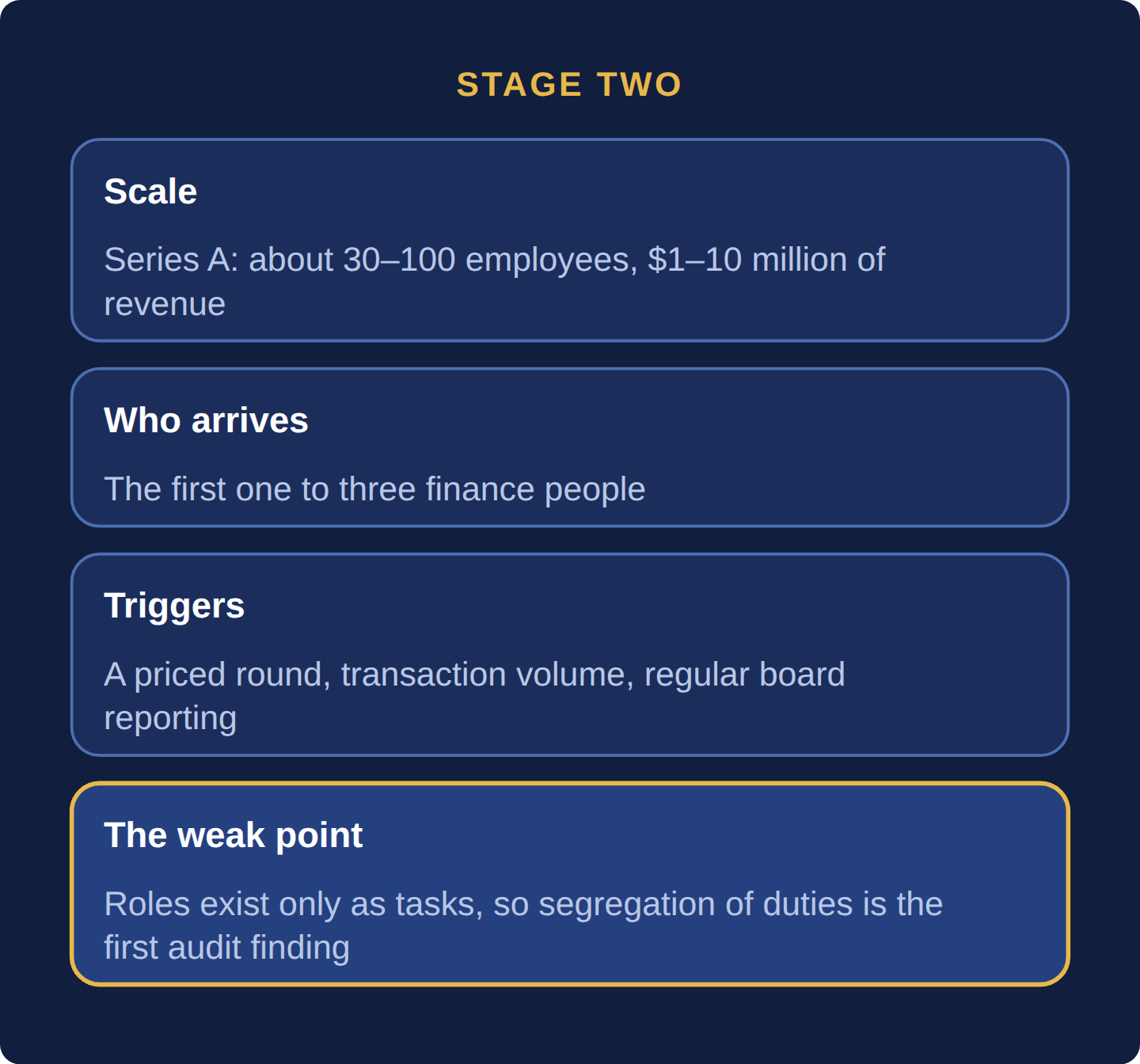
The first dedicated finance hire usually comes at Series A (typically 30–100 employees and roughly $1–10 million of revenue) and is either a controller-type generalist, to bring bookkeeping in-house and clean it up ahead of fundraising due diligence, or, increasingly, the company’s first CFO or Head of Finance, hired because a fundraising round demands a level of financial rigor and modeling the founder can no longer credibly produce alone. The whole team is typically one to three people.
| Typical Trigger | What Gets Hired |
|---|---|
| Preparing for a priced fundraising round | A CFO or Head of Finance, often part-time or fractional at first, to build the financial model and manage the data room |
| Transaction volume outgrows a bookkeeper | A first in-house accountant, to own day-to-day bookkeeping and basic monthly reporting |
| The board starts asking for regular reporting | A basic monthly board reporting pack becomes a recurring, structured deliverable rather than an ad hoc document |
At this stage one to three people handle accounting, basic FP&A and payroll at once. The separation described in Parts B and C exists only as tasks, not roles, so one person both records transactions and approves payments, and the first audit usually exposes that gap.
The first finance job at a Series A company gives you in two years what a large company spreads over six: the close, payroll, the cap table, the board pack, the data room and the first audit. In your first year, write the close checklist, get the first audit through without adjustments, and own the board pack; that last item is what gets you noticed by the board and the investors who will vouch for you later. If you lean toward accounting, take the CPA first (CA in India), because the Controller seat that opens at Series B usually requires it. The common detour: a “Head of Finance” title at 40 people often becomes a Controller reporting to the CFO hired at Series B. Accept it if the company is growing; the alternative is leaving with a broad but shallow record. Moving later to a large corporate usually means picking one discipline (C.1: The Controller or C.3) and entering at a title one level lower.
When do the first real finance hires arrive?
At Series A, with about 30–100 employees and $1–10 million of revenue, when the first one to three finance people arrive.
What triggers the hires?
A priced round, transaction volume and regular board reporting.
What is the first audit finding?
Roles exist only as tasks, so segregation of duties is the first audit finding.
At Series A the first one to three finance people arrive, often because a fundraise needs rigor the founder cannot supply. Roles exist only as tasks, so segregation of duties is the first audit finding.
Six questions on this chapter. Decide on your answer first, then click “Reveal Answer.”
1. You are “Head of Finance” at a fast-growing 40-person company. At Series B a CFO is hired and you are offered the Controller seat. What does the chapter advise?
- Ask to report to the CEO alongside the newly hired CFO
- Accept the Controller seat while the company keeps growing
- Decline the seat and move into an FP&A analyst role
- Leave at once to protect the senior title you hold
Reveal Answer
Answer: B. The step-down is the common detour; leaving yields a broad but shallow record.
2. As a Series A company’s first finance hire, which first-year goals does the Career Insight recommend?
- A three-year model, a new ERP and a treasury policy
- An investor relations site, guidance and an earnings call
- Close checklist, a clean first audit and owning the board pack
- Tax provision, transfer pricing and a SOX narrative
Reveal Answer
Answer: C. Those three build the record that gets you noticed by the board and investors.
3. One accountant both records bills and releases payments. What usually surfaces the problem?
- The company’s first audit
- The founder’s runway spreadsheet
- A monthly board pack review
- The next payroll run
Reveal Answer
Answer: A. Segregation of duties is missing, and the first audit usually exposes it.
4. Which credential should an accounting-leaning first hire take first, and why?
- The FRM, because runway is a risk-management problem at a startup
- The CMA, because FP&A is split out at Series A and needs it
- The CFA, because investors test the valuation model at each round
- The CPA, because the Series B Controller seat usually requires it
Reveal Answer
Answer: D. The Series B Controller seat usually asks for it.
5. Worked problem: A company has 60 employees, $5m revenue and 3 finance staff costing $90,000 each. What does finance cost as a share of revenue?
Reveal Answer
Answer: 3 × $90,000 = $270,000; ÷ $5m = 5.4%.
6. Worked problem: What share of staff are in finance?
Reveal Answer
Answer: 3 ÷ 60 = 5%.
D.3 Stage Three — The Scale-Up Build-Out
With 100 to 500 employees and $10 to $100 million of revenue, the Controller and FP&A functions split into separate teams, about 4 to 25 people in total. The build-out follows trigger events: a full-scope audit, a priced Series B or C round, the first foreign entity, complex contracts and an IPO plan.
Why it matters: Finance grows in steps, each prompted by something the company now has to prove.
Summary: At 100–500 employees and $10–100 million of revenue, Controller and FP&A split into separate teams of about 4–25 people in total. The build-out follows trigger events: a full-scope audit, a priced Series B or C, the first foreign entity, complex contracts and an IPO plan.
- An audit demand brings a Controller with audit experience.
- A priced round separates FP&A from the books.
- A foreign entity brings intercompany accounting and transfer pricing.
- RevOps typically sits under the chief revenue officer; revenue accounting under the Controller.
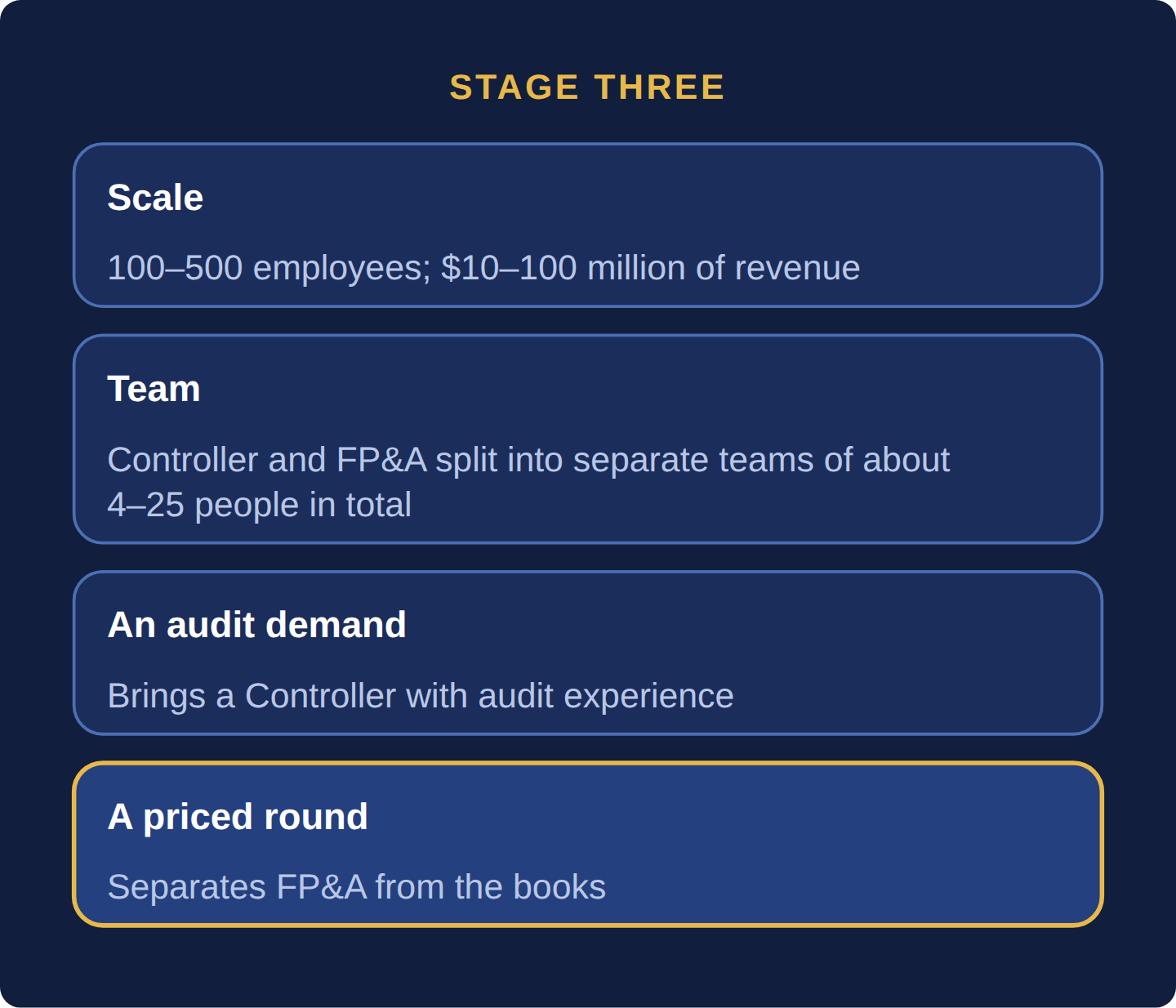
This is the stage described in Part B.6: High-Growth Startup / Scale-Up: roughly 100–500 employees and $10–100 million of revenue, with a finance team of about 4–25 in which dedicated (if still small) Controller and FP&A functions separate from one another as distinct roles rather than tasks shared by generalists, while Revenue Operations typically grows under the chief revenue officer. Cash runway management and fundraising readiness remain the CFO’s dominant personal focus, but the CFO no longer does hands-on bookkeeping or model-building.
The build-out is event-driven rather than smooth; the typical order of trigger events is below.
| Trigger event | Typical hire or change | Why |
|---|---|---|
| A full-scope audit, demanded by Series B investors or a lender’s covenant | A Controller with public-accounting audit experience (C.1: The Controller) | Audited US GAAP statements need accrual accounting, a documented close and supporting schedules that a one-to-three-person team rarely keeps |
| A priced Series B or C round | A Head of FP&A (C.3: The Head of FP&A), splitting the model from the books | Investors test unit economics and cohorts; the CFO can no longer build that model and run the raise at once |
| First foreign entity (sales office or engineering center) | Intercompany accounting, transfer-pricing documentation (C.6: The Tax Director) and a local provider for statutory books | Each entity has its own tax filings, and in many countries, India included, its own audit |
| Multi-element or usage-based contracts | A revenue accountant under the Controller; RevOps grows under the chief revenue officer (C.9: The Head of Revenue Operations (SaaS)) | ASC 606 judgments on performance obligations and timing drive reported revenue |
| An IPO targeted roughly 18–24 months out | Technical accounting, SOX readiness and the first internal-audit capacity | Public reporting starts the Stage Four build (D.4: Stage Four — Specialization Begins; Part F.3: The IPO Is Six Months Away) |
What happens at 100–500 employees?
Controller and FP&A split into separate teams of about 4–25 people in total.
What brings a Controller with audit experience?
An audit demand, such as a full-scope audit.
What separates FP&A from the books?
A priced round.
At 100 to 500 employees and $10 to 100 million of revenue, Controller and FP&A split into separate teams. The build-out follows trigger events such as a full-scope audit or a priced round.
Six questions on this chapter. Decide on your answer first, then click “Reveal Answer.”
1. A lender’s new covenant requires audited statements from a 200-person company. Which hire does D.3 link to this?
- A Treasurer to renegotiate the covenant terms
- A Head of Investor Relations for lender updates
- A revenue accountant to apply ASC 606
- A Controller with public-accounting audit experience
Reveal Answer
Answer: D. Audit-ready books are Controller work.
2. A US scale-up opens its first foreign entity. What finance work follows?
- Intercompany accounting, transfer pricing and local statutory books
- A full internal-audit team reporting to the CFO from day one
- A dedicated Investor Relations function at the parent company
- A move from accrual to cash-basis accounting for the group
Reveal Answer
Answer: A. Each entity has its own tax filings and often its own audit.
3. A company has 300 employees and $40 million of revenue. What finance team fits Part D‘s ranges?
- Stage Five, 100 people or more
- Stage Four, about 25–100 people
- Stage Three, about 4–25 people
- Stage Two, about 1–3 people
Reveal Answer
Answer: C. 100–500 employees and $10–100 million of revenue both place it at Stage Three.
4. A scale-up sells usage-based contracts with several performance obligations. How is the work typically split?
- Both roles report directly to the CEO, because revenue is a strategic function
- Revenue accountant under the Controller; RevOps under the chief revenue officer
- RevOps under the Controller, while the revenue accountant sits under the CRO
- Both roles report to the Head of FP&A, because forecasting drives revenue
Reveal Answer
Answer: B. ASC 606 judgments stay in accounting; Revenue Operations typically sits under the chief revenue officer (C.9: The Head of Revenue Operations (SaaS)).
5. Worked problem: A company has 350 employees and $60m of revenue. Which stage is it?
Reveal Answer
Answer: 100–500 employees and $10–100m revenue: Stage Three.
6. Worked problem: It has a finance team of 4 to 25. What share of staff is that?
Reveal Answer
Answer: 4 ÷ 350 = 1.1% to 25 ÷ 350 = 7.1%.
D.4 Stage Four — Specialization Begins
Past about 500 employees and $100 million of revenue, finance grows to roughly 25 to 100 people, and specialist functions appear. Events like an IPO, a large debt raise or a first major acquisition can trigger several of these at once.
Why it matters: Big events can force several new teams into existence at the same time.
Summary: Past about 500 employees and $100 million of revenue, finance grows to roughly 25–100 people and specialist functions appear. An IPO, a large debt raise or a first major acquisition triggers several at once.
- An IPO or public debt creates Treasury and Investor Relations.
- Multiple tax jurisdictions bring a Tax Director in-house.
- Internal Audit separates from the Controller for independence.
- Recurring M&A justifies a standing Corporate Development team.
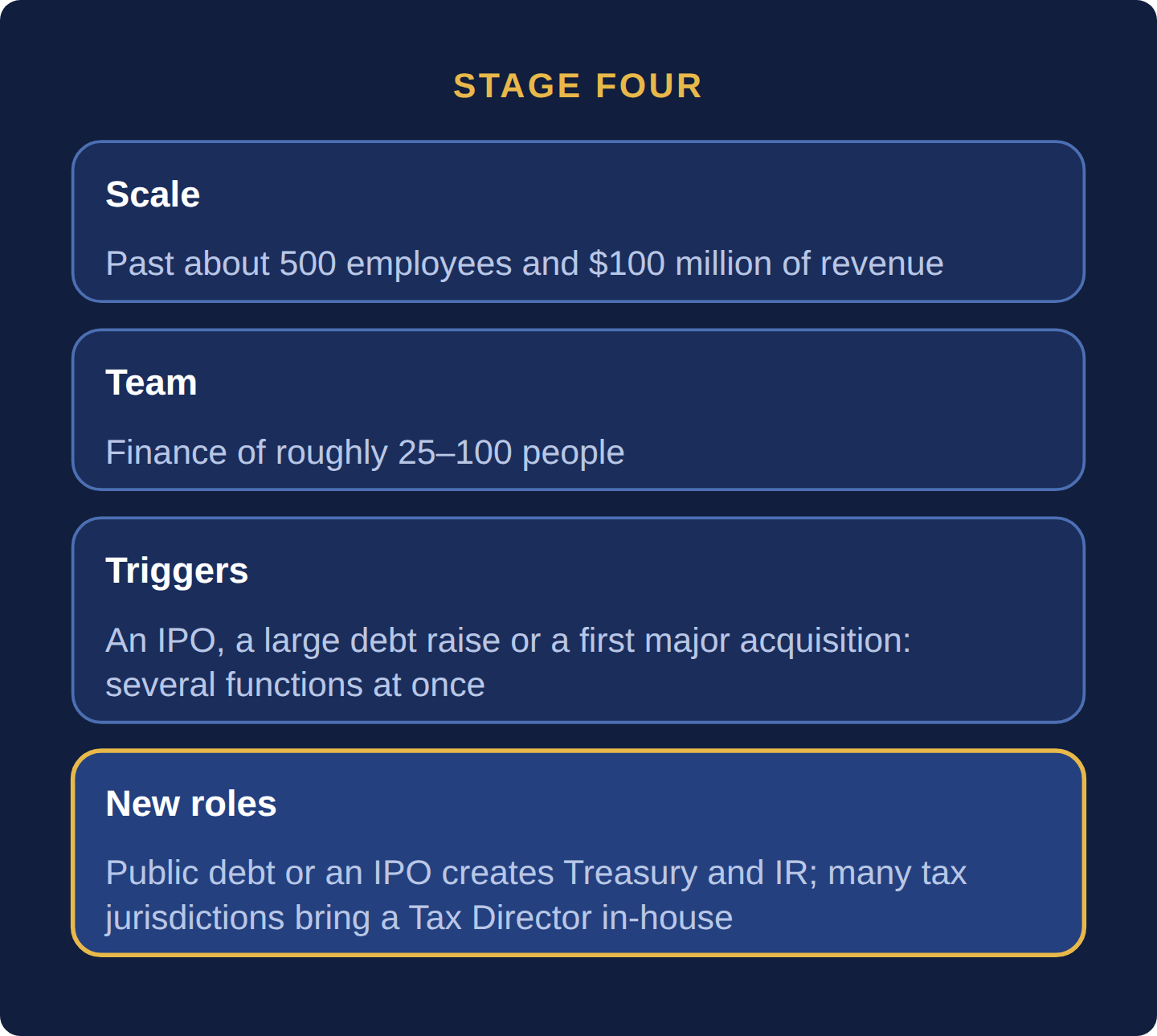
Somewhere past about 500 employees and $100 million of revenue (finance of roughly 25–100 people), and very often triggered by an IPO process, a large debt raise or the company’s first major acquisition, distinct specialist functions appear for the first time. This is the stage where the finance organization starts to resemble the fully built structures described in Part B.
| Typical Trigger | Function That Gets Created |
|---|---|
| IPO process, or first significant public/institutional debt raise | A dedicated Treasurer, separated out from the Controller’s team, and a dedicated Investor Relations function |
| Multiple overlapping tax jurisdictions | A dedicated Tax Director, replacing reliance on an outside tax advisory firm for routine compliance |
| Board or audit committee maturity requirements, often ahead of an IPO | A dedicated Internal Audit function, separated from the Controller’s own team for independence |
| An active, recurring M&A strategy rather than a one-off deal | A dedicated Corporate Development team, rather than hiring external bankers fresh for every transaction |
The IPO process is very often the single biggest inflection point in a finance organization’s history: public company reporting obligations, SOX internal control requirements and continuous investor scrutiny typically force the creation of several specialist functions within a short window, rather than the gradual, one-at-a-time build-out that characterizes earlier stages.
When does specialization begin?
Past about 500 employees and $100 million of revenue, when finance grows to roughly 25–100 people.
What creates Treasury and Investor Relations?
An IPO or public debt.
What brings a Tax Director in-house?
Multiple tax jurisdictions.
Past about 500 employees and $100 million of revenue, finance grows to roughly 25 to 100 people and specialist functions appear. An IPO, a large debt raise or a first major acquisition triggers several at once.
Six questions on this chapter. Decide on your answer first, then click “Reveal Answer.”
1. An 800-person company now files in a dozen tax jurisdictions through an outside firm. What typically follows?
- A dedicated Tax Director brings routine compliance in-house
- The Treasurer adds tax to the cash forecasting role
- Internal Audit takes over tax filings for independence
- The Controller absorbs tax using the outside firm’s templates
Reveal Answer
Answer: A. Overlapping jurisdictions are the usual Tax Director trigger.
2. Why does Internal Audit separate from the Controller’s team at this stage?
- Speed: the close finishes faster without audit staff
- Tax: audit work counts toward transfer-pricing files
- Cost: an outsourced team is cheaper than an in-house one
- Independence: it must test the controls the Controller runs
Reveal Answer
Answer: D. Internal audit must be independent of the controls it tests.
3. A company plans three acquisitions a year for five years. Which change does D.4 link to this?
- A second Controller for each target company
- Hiring fresh bankers for every single deal
- A standing Corporate Development team
- Moving M&A work into the FP&A team
Reveal Answer
Answer: C. Recurring M&A justifies a dedicated team.
4. Why is the IPO usually the biggest inflection point in a finance organization’s history?
- The IPO raises cash, which removes the need for a Treasurer and cash planning
- Public reporting, SOX controls and investor scrutiny force several hires at once
- Private company audits are dropped after listing day, which cuts the audit workload
- Listing rules require the CFO to run Internal Audit personally for two years
Reveal Answer
Answer: B. Specialists arrive together, not one at a time.
5. Worked problem: A $150m-revenue company has 25–100 finance staff at $120,000 each. What is the finance cost range as a share of revenue?
Reveal Answer
Answer: 25 × $120k = $3.0m = 2.0%; 100 × $120k = $12.0m = 8.0%.
6. Worked problem: A company announces an IPO. Which two functions does it usually create?
Reveal Answer
Answer: Treasury and Investor Relations, as the chapter notes.
D.5 Stage Five — The Fully Specialized Function
At 2,000 or more employees and revenue above about $1 billion, every function is its own team and splits into sub-specialties. The CFO stops doing the work and instead orchestrates the interfaces between teams, making sure the pieces fit together.
Why it matters: At this size, the CFO’s skill is coordination, not calculation.
Summary: At 2,000+ employees and revenue above about $1 billion, every Part C function is its own team and splits into sub-specialties. The CFO stops executing and orchestrates the interfaces between teams.
- Finance typically runs from 100 to several hundred people; thousands at the largest.
- Controllership splits into close, revenue, technical accounting and SEC reporting.
- Transactional work pools in shared services, often in India.
- Internal Audit reports functionally to the audit committee.
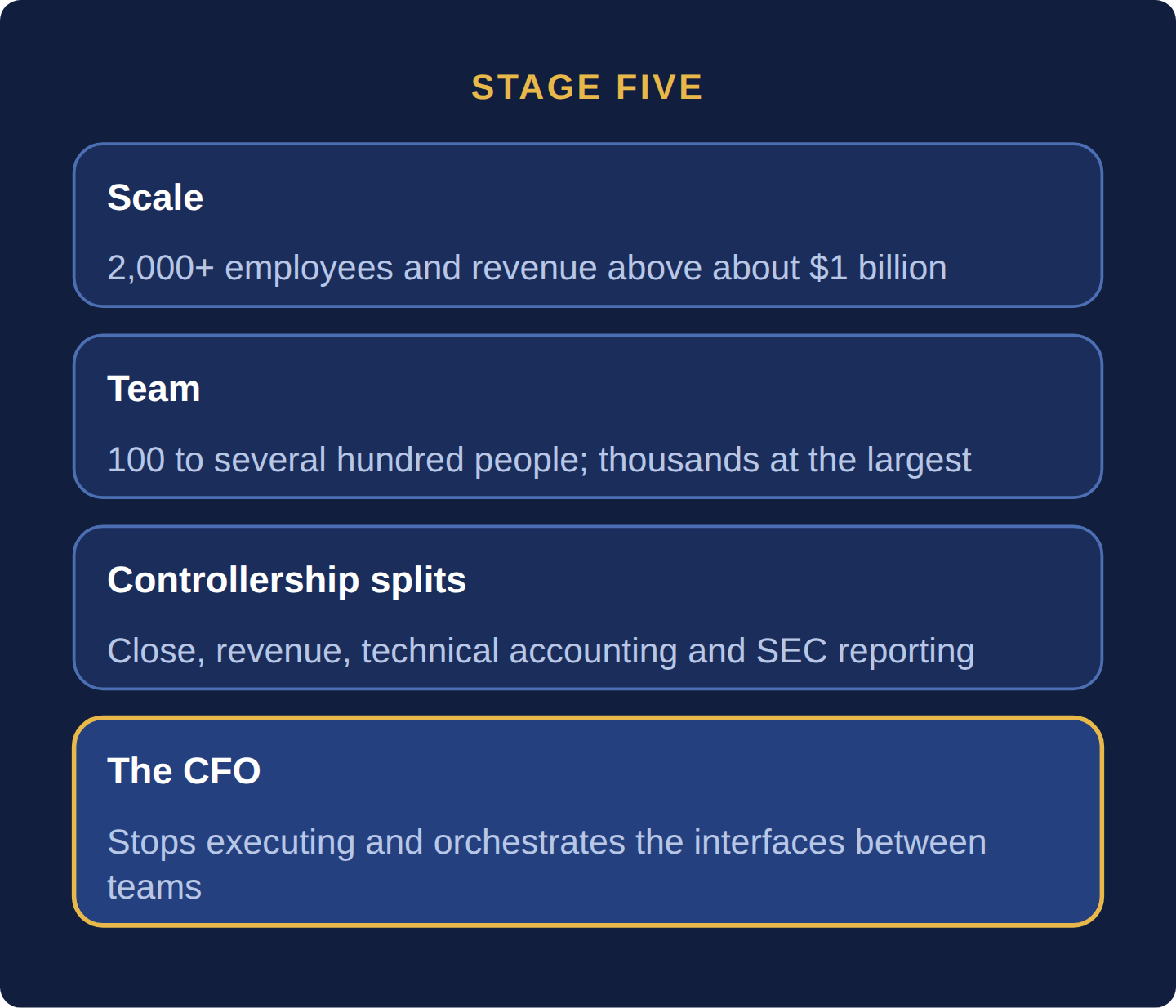
This is the large industrial or consumer corporate structure described in full in Part B.1: Large Industrial / Consumer Corporate: typically 2,000 or more employees and revenue above about $1 billion, with a finance organization of 100 to several hundred people (thousands at the largest multinationals). Every function from Part C exists as its own team, each led by a specialist with a career in that discipline rather than a generalist wearing multiple hats. The CFO’s role shifts away from executing any single function toward orchestrating the interfaces between them: capital allocation decisions that need input from Treasury, Tax and Corporate Development at once, for instance.
At this scale each function splits into sub-specialties, mapped below to the chapter covering each seat.
| Function | What splits into its own team | Read |
|---|---|---|
| Controllership | General ledger and close, revenue accounting, technical accounting, SEC reporting, plant and legal-entity controllers | C.1, B.1 |
| FP&A | Corporate planning, business-unit finance partners, often under Business Unit CFOs | C.3, B.1 |
| Treasury | Cash and liquidity, capital markets, foreign-exchange and interest-rate hedging, bank relationships | C.2; at banks, E.9 |
| Tax | Compliance, tax provision, transfer pricing, indirect tax | C.6 |
| IR, Corporate Development, Internal Audit | Each a standing team; Internal Audit reports functionally to the audit committee, outside the CFO line | C.4, C.8: The Head of M&A / Corporate Development, C.5: The Head of Internal Audit |
| Shared services | Payables, receivables, payroll accounting and reconciliations, often in a global business services center in India | B.1, H.2: Pathways in India, Section 0.3 |
| Financial institutions only | Risk, actuarial, fund accounting, valuation, compliance, regulatory capital, and the operations seats of Part E | C.7, C.11: The Chief Actuary–C.16: The Head of Investment Management, Part E |
How big is a fully specialized finance function?
Typically 100 to several hundred people, and thousands at the largest companies.
How does controllership split?
Into close, revenue, technical accounting and SEC reporting.
What does the CFO do at this stage?
The CFO stops executing and orchestrates the interfaces between teams.
At 2,000+ employees and revenue above about $1 billion, every Part C function is its own team and splits into sub-specialties. The CFO stops executing and orchestrates the interfaces.
Six questions on this chapter. Decide on your answer first, then click “Reveal Answer.”
1. At a $5 billion manufacturer, who does the Head of Internal Audit report to functionally?
- The Controller, who runs the monthly close
- The audit committee of the board
- The Chief Financial Officer directly
- The Head of FP&A, who plans the budget
Reveal Answer
Answer: B. Internal Audit stays outside the CFO line so it can test finance’s own controls (C.5: The Head of Internal Audit).
2. Where does a large corporate typically move payables, receivables and reconciliations to cut cost?
- To Investor Relations, which already reports the results to analysts
- To the Tax team, which already holds the invoices for every country
- To a shared-services or global business services center, often in India
- To the Business Unit CFOs in each division, as their own function
Reveal Answer
Answer: C. At Stage Five transactional work is pooled in shared services (B.1: Large Industrial / Consumer Corporate, H.2: Pathways in India).
3. A Stage Five CFO weighs a debt-financed acquisition. Whose input is needed at once?
- Payroll, Procurement and Facilities
- Internal Audit, IR and Shared Services
- Revenue accounting, RevOps and Sales
- Treasury, Tax and Corporate Development
Reveal Answer
Answer: D. At full scale the CFO orchestrates such interfaces.
4. At a large corporate, which team typically owns transfer pricing?
- Tax
- Treasury
- FP&A
- Controllership
Reveal Answer
Answer: A. Tax splits into compliance, provision, transfer pricing and indirect tax (C.6: The Tax Director).
5. Worked problem: A company has 3,000 employees and $2bn of revenue with 250 finance staff at $130,000 each. What does finance cost as a share of revenue?
Reveal Answer
Answer: 250 × $130k = $32.5m; ÷ $2bn = 1.62%.
6. Worked problem: How does controllership split at this stage?
Reveal Answer
Answer: Into close, revenue, technical accounting and SEC reporting.