
- Annuities and Long-Term Care Insurance Explained (you are here)
- Medicaid Look-Back Penalty and the Spouse's Allowance Explained
Living a very long time is a risk too. A lifetime income annuity is a contract where you hand over a lump sum and get paid for the rest of your life. Buy one only to close the gap between essential spending and guaranteed income, and only with money you won’t need back. It pays more than a bond because those who die early help fund those who live long. For long-term care, match the tool to your savings: Medicaid as a backstop for modest savings, insurance if a long stay would leave a spouse with nothing, and self-insuring if your assets could pay for three years of care.
Why it matters: The right fix depends on how much you have and what you need to protect.
Summary: Buy a lifetime income annuity only to close a gap between essential spending and guaranteed income, and only with money you will not need back; the payout beats a bond because early deaths fund the long-lived, and the bet pays off if you live past about 87. For long-term care, match the tool to your balance sheet: Medicaid as the backstop for modest savings, insurance when a long stay would impoverish a spouse, and self-insurance when your assets could pay for three years of care and still cover everyone else.
- Mortality credits grow with age: at 85 they add roughly 8 to 11 points a year to a 4% bond yield, which is why late-starting annuities are cheap.
- In the illustrative example, a 7% annuity beats drawing the same income from a portfolio earning 4% if you live past about 87, an age about 36% of 65-year-old men and 48% of women reach.
- Variable and indexed annuities carry layered fees and surrender charges, often starting near 7% and falling over six to eight years.
- A three-year nursing-home stay at 2025’s median private-room rate costs $388,725, and Medicare pays none of the custodial part.
- Medicaid looks back 60 months: gifts made in that window delay coverage month for month, and a spouse at home can keep at most $162,660 of countable assets in 2026.
Two expensive risks grow with age: outliving your money, and needing years of help with daily living. Insurance exists for both, and both products are widely sold, poorly understood, and sometimes worth it.
An annuity, stripped to its core, is a contract in which you give an insurer money and the insurer promises payments back. The version that insures longevity is the income annuity: you hand over a lump sum and receive a fixed payment for as long as you live. It can pay more than a bond of the same size because of mortality credits — buyers who die early leave their remaining money in the pool, and that money funds the payments to those who live long. You are giving up the lump sum and anything left to heirs in exchange for income you cannot outlive. The main types:
- Single-premium immediate annuity (SPIA) — pay once, income starts within a year, usually for life. The purest longevity insurance.
- Deferred income annuity (DIA) — pay now, income starts years later (say at 80 or 85). Because many buyers will not reach the start date, a small premium buys a large late-life income.
- Fixed (multi-year guaranteed) annuity — a set interest rate for a set term, like a certificate of deposit issued by an insurer instead of a bank.
- Variable annuity — money invested in fund-like subaccounts inside an insurance wrapper, with optional guarantee riders, each carrying its own annual fee.
- Fixed indexed annuity — returns linked to a stock index, with a floor (often 0%) and a cap or participation rate that limits the upside. The crediting formulas are complex and set by the insurer.
Picture a pool of people the same age, each putting in $1, invested in bonds earning 4%. At year end the money of those who died stays in the pool and is shared among the survivors. If a fraction q died during the year, each survivor’s return is 1.04 ÷ (1 − q) − 1. The extra above 4% is the mortality credit. Using the death probabilities in Social Security’s actuarial life table:
| Age | Chance of dying within the year | Survivor’s return: 1.04 ÷ (1 − q) − 1 |
|---|---|---|
| Man, 65 | 1.65% | 1.04 ÷ 0.983545 − 1 = 5.74% |
| Man, 75 | 3.38% | 1.04 ÷ 0.966198 − 1 = 7.64% |
| Woman, 85 | 7.18% | 1.04 ÷ 0.928248 − 1 = 12.04% |
| Man, 85 | 9.27% | 1.04 ÷ 0.90732 − 1 = 14.62% |
Three consequences follow. Annuities pay more the older you are when payments start, which is why a deferred income annuity starting at 80 or 85 is cheap per dollar of income. Payouts are generally lower for women, who live longer. And no investment portfolio can earn the credit, because it comes from pooling lives, not from markets. The insurer keeps a margin for costs, profit and the risk that its buyers live longer than the population table, so real payouts sit below these pure figures.
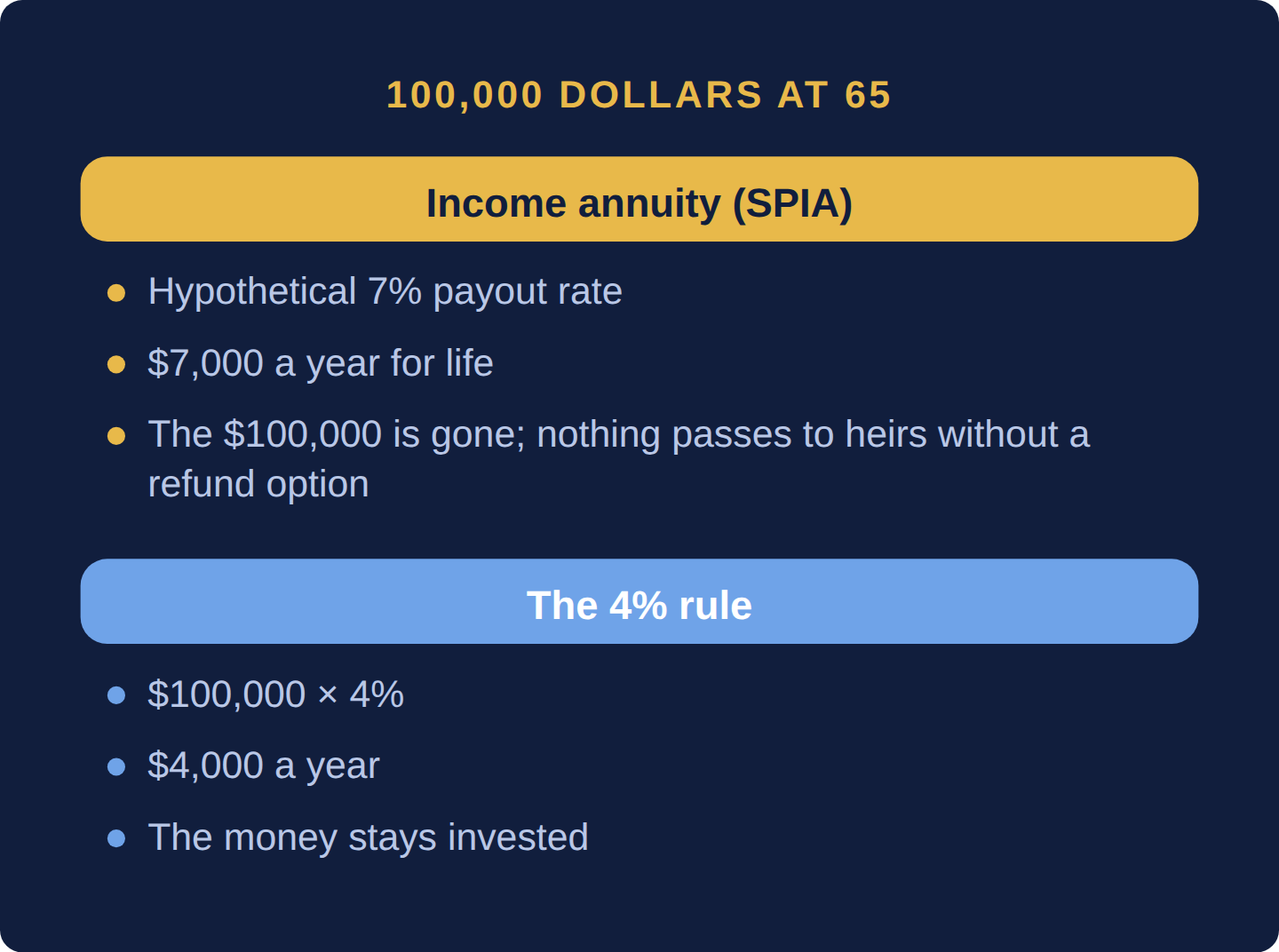
Suppose a 65-year-old is offered a lifetime payout rate of 7% on a $100,000 SPIA — a round, hypothetical figure; real quotes vary with age, sex, interest rates and insurer. Income = $100,000 × 7% = $7,000 a year for life, compared with $100,000 × 4% = $4,000 from the same money under the 4% rule (10.2). The price of that extra $3,000: the $100,000 is gone, and nothing passes to heirs unless a refund or period-certain option was bought (which lowers the payout). And unless the contract has an inflation adjustment, the $7,000 shrinks in real terms: after 20 years at 3% inflation it buys what $7,000 ÷ 1.0320 = $7,000 ÷ 1.806 = $3,876 buys today.
Costs and traps. Simple income annuities have no visible annual fee — the cost is built into the payout. Variable and indexed annuities are different: layered fees can total far more than an index fund‘s, and most carry surrender charges — a penalty, typically declining over several years, for withdrawing more than a set amount early. Sales commissions can be high, which is one reason these products are sold more often than they are bought. The guarantee is only as good as the insurer: if one fails, a state guaranty association covers annuity benefits up to a limit — at least $250,000 in present value in most states — so it is worth checking the insurer’s financial strength rating and keeping each insurer’s share within that limit.
A 65-year-old has $100,000 to turn into income. Illustrative assumptions: the hypothetical 7% annuity payout from the example above, a portfolio that earns 4% a year, withdrawals at each year end, no inflation adjustment and no taxes. Three choices: (A) buy the annuity for $7,000 a year for life; (B) keep the money invested and withdraw the same $7,000; (C) keep it invested and withdraw $4,000 under the 4% rule (10.2).
| Dies at | (A) Annuity: income received | (B) Portfolio at $7,000: income, then left to heirs | (C) Portfolio at $4,000: income, then left to heirs |
|---|---|---|---|
| 75 | $70,000; nothing left | $70,000; $63,982 left | $40,000; $100,000 left |
| 85 | $140,000; nothing left | $140,000; $10,666 left | $80,000; $100,000 left |
| 95 | $210,000; still paying | $151,256; ran out during the 22nd year (about age 87) | $120,000; $100,000 left |
Formula for (B): balance after t years = $100,000 × 1.04t − $7,000 × (1.04t − 1) ÷ 0.04. The money runs out when $7,000 × (1 − 1.04−n) ÷ 0.04 = $100,000, which gives n = −ln(1 − 0.04 × $100,000 ÷ $7,000) ÷ ln 1.04 = 21.6 years.
Break-even: at the same income, the annuity beats the portfolio only for someone who lives past about 87. In Social Security’s life table, 28,901 of the 79,084 men alive at 65 reach 87 (36.5%), and 42,223 of 87,399 women (48.3%). That is the right way to read an annuity: (C) protects heirs and gives less income, (B) gives more income with a real chance of running dry, and (A) turns the run-dry risk into a certainty of income at the cost of the bequest. A higher portfolio return moves the break-even later, and a higher payout rate moves it earlier. Buying at 70 rather than 65 raises the payout and shortens the years needed to break even, though the break-even age itself may not fall.
The standard view: economic theory says retirees should turn much of their savings into lifetime income. Menahem Yaari’s classic 1965 result is that full annuitization is optimal under idealized conditions, and Davidoff, Brown and Diamond (NBER, 2003) showed that complete annuitization can remain optimal under more general conditions and that substantial annuitization is valuable even when markets are incomplete. Its assumptions: fairly priced annuities, predictable spending needs and no strong bequest motive. The alternative: most retirees buy little or none, and there are rational reasons: Social Security is already an inflation-adjusted annuity, a lump sum is needed for shocks such as long-term care, most fixed annuities lose purchasing power to inflation, insurers can fail, and many people want to leave money to children. What the evidence says: framing explains part of the gap. In a survey experiment, Brown, Kling, Mullainathan and Wrobel (2008) found that 72% of respondents preferred a life annuity to a savings account when the choice was described in terms of consumption, but only 21% when it was described in terms of investment returns. What remains open: how much to annuitize. The reasonable middle ground is partial: enough guaranteed income, counting Social Security, to cover essential spending, with the rest kept liquid.
Long-term care means help with daily activities — bathing, dressing, eating — at home, in assisted living, or in a nursing home. Medicare does not pay for long-term custodial care. According to the federal Administration for Community Living, someone turning 65 has almost a 70% chance of needing some long-term care; women need it for 3.7 years on average and men for 2.2, and 20% will need it for more than five years. Most care is short or provided by family; the financial risk is the long, paid tail.
| Care setting (national median, 2025) | Annual cost |
|---|---|
| Nursing home, private room | $129,575 ($355 a day) |
| Nursing home, semi-private room | $114,975 ($315 a day) |
| Assisted living | $74,400 ($6,200 a month) |
| In-home caregiver, 44 hours a week | $80,080 ($35 an hour) |
A three-year nursing-home stay at the median private-room rate costs $129,575 × 3 = $388,725 before any price growth. There are three ways to meet that risk:
- Traditional long-term care insurance — pays a daily or monthly benefit after a waiting period. Premiums are lowest when bought in your fifties, but insurers can and have raised premiums on existing policies, and if you never need care you get nothing back.
- Hybrid policies — life insurance or an annuity with a long-term care rider. Premiums are usually fixed and, if care is never needed, a death benefit goes to heirs; the trade-off is a large upfront payment or higher premium for less care coverage per dollar.
- Self-insuring — earmarking part of the portfolio, often home equity, for care.
Medicaid pays for long-term care only after assets are largely spent down, under state rules. To stop people giving assets away just before applying, Medicaid applies a 60-month look-back: gifts or below-value transfers in the five years before applying trigger a penalty period without coverage. States are also required to seek repayment from the estates of many recipients after death. Planning around these rules needs an elder-law attorney, and starts years before care is needed (12.3).
Five questions on this chapter. Decide on your answer first, then click “Reveal Answer.”
1. A 65-year-old buys a $200,000 income annuity with a 6% lifetime payout and no inflation adjustment. At 3% inflation, what will the payment buy in today’s dollars after 20 years?
- $6,644
- $7,500
- $12,000
- $4,800
Reveal Answer
Answer: A. Real value = payment ÷ (1 + inflation)^years: $12,000 ÷ 1.03^20 = $12,000 ÷ 1.806 = $6,644. Cutting 3% × 20 = 60% gives $4,800, dividing by 1.60 gives $7,500, and $12,000 ignores inflation. (Part 10.10)
2. Why can a lifetime income annuity pay a 65-year-old more each year than a bond of the same size?
- The insurer invests the premium in stock-index subaccounts
- Early deaths leave money in the pool that pays the long-lived
- Surrender charges paid by early exits subsidize the payout
- State guaranty associations add to the insurer’s payments
Reveal Answer
Answer: B. Mortality credits: buyers who die early leave their remaining money in the pool, funding those who live long. The buyer gives up the lump sum and any bequest; guaranty associations act only if an insurer fails. (Part 10.10)
3. A pool of same-age annuitants invests in bonds earning 4%, and 10% of the members die during the year, leaving their money to the survivors. What return does each survivor earn that year?
- 15.56%
- 14.00%
- 10.00%
- 14.40%
Reveal Answer
Answer: A. Survivor’s return = 1.04 ÷ (1 − 0.10) − 1 = 15.56%. Adding 4% + 10% gives 14.00%, multiplying 1.04 × 1.10 gives 14.40%, and 10.00% ignores the bond yield. The extra over 4% is the mortality credit. (Part 10.10)
4. Worked problem: A 65-year-old buys a $250,000 income annuity at a 7% payout rate. What is the annual income, and what would a 4% withdrawal give?
Reveal Answer
Answer: Annuity = 7% × $250,000 = $17,500. 4% rule = $10,000.
5. Worked problem: A long-term care policy costs $3,000 a year for 25 years and the care it may cover costs $100,000 a year for 3 years. What is the premium total against the benefit?
Reveal Answer
Answer: Premiums = 25 × $3,000 = $75,000. Benefit = 3 × $100,000 = $300,000, paid only if care is needed.