
Finance has two kinds of qualification. A credential, such as the Certified Financial Planner (CFP), the Chartered Financial Analyst (CFA) or the Certified Public Accountant (CPA), is awarded by a professional body or licensing board after exams, experience and ethics rules. A degree, such as an MBA with a finance concentration or a Master of Finance, is awarded by a university.
Why it matters: Each one opens a different door. Pick by the job you want, not by the prestige of the letters.
Summary: The certified financial planner credential is for advising individuals, the chartered financial analyst charter is for investment analysis, and the CPA is for accounting, audit and tax. An MBA or Master of Finance is a degree, and some corporate leadership programs are built for it.
- CFP Board asks for four things: education, an exam, experience (6,000 hours, or 4,000 in an apprenticeship) and ethics.
- The CFA Program has three exam levels, about 300 hours of study per level, and qualified work experience.
- Since January 2024 the CPA exam has three core sections plus one discipline section, each four hours long; most state boards require 150 semester hours of education.
- AT&T’s FLDP and Citi’s FMA are examples of corporate programs aimed at MBA or Master’s graduates.
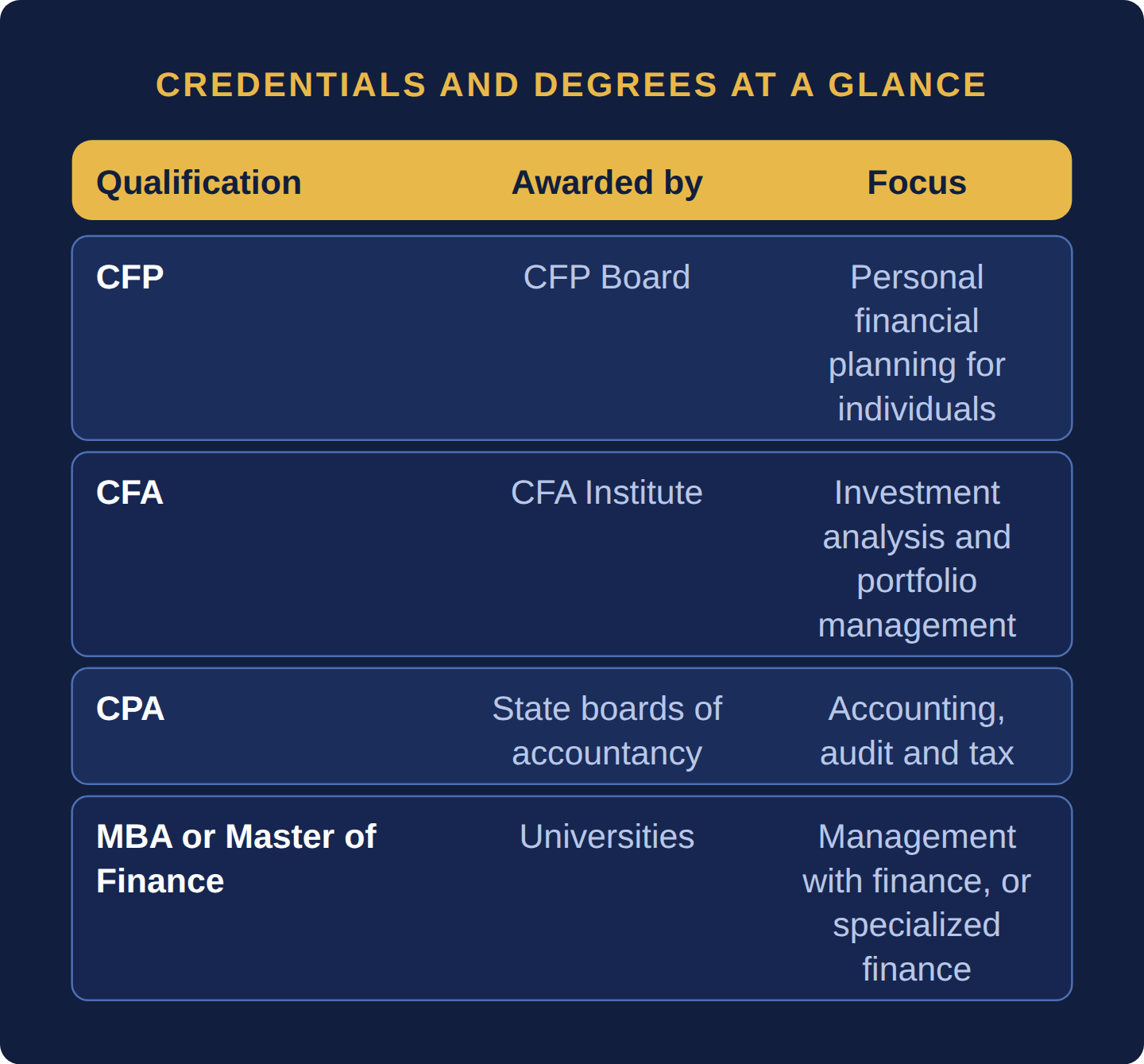
Choosing a finance qualification is easier once you separate what each one is for. The certified financial planner credential, the chartered financial analyst charter and the CPA license each serve a different kind of work. An MBA with a finance concentration and a Master of Finance are graduate degrees that sit beside them. Employers use them differently, and picking the wrong one is a costly detour.
The certified financial planner credential
The certified financial planner credential is awarded by CFP Board and is built around advising individuals on their money. CFP Board lists four requirements: education, examination, experience and ethics. Education has two parts. You complete coursework through a CFP Board-registered program, the certified financial planner course you take before the exam, and you hold a bachelor’s degree in any discipline from an accredited institution; the degree can be finished up to five years after you pass the exam. Experience is either 6,000 hours of professional experience related to the financial planning process, or 4,000 hours of apprenticeship experience that meets additional requirements. Ethics means signing an ethics declaration and passing a background check.
The chartered financial analyst charter
The chartered financial analyst charter is awarded by CFA Institute and focuses on investment analysis and portfolio management. The program has three exam levels, plus practical skills modules. To start, CFA Institute asks for a bachelor’s degree (or being within a set window of finishing one), or 4,000 hours of work experience and education combined over at least three sequential years. CFA Institute says candidates spend about 300 hours of study on each exam level. Qualified work experience is also required for the charter, and it can be completed before, during or after the exams.
The CPA license
The CPA is a license issued by a state board of accountancy, and it focuses on accounting, audit and tax. Since January 2024 the Uniform CPA Exam has had four sections: three core sections (Auditing and Attestation, Financial Accounting and Reporting, and Taxation and Regulation) and one discipline section chosen from Business Analysis and Reporting, Information Systems and Controls, or Tax Compliance and Planning. Each section is four hours long, and the pass score is 75. Most state boards require 150 semester hours of education, which is more than a standard bachelor’s degree; rules vary by state, so check your board before you plan.
MBA finance and Master of Finance degrees
An MBA with a finance concentration (often called an MBA finance degree) and a Master of Finance are degrees, not credentials. Neither is required for the CFP, CFA or CPA. They matter for a different reason: some corporate programs are built for them. AT&T describes its FLDP as an accelerated leadership program for MBA graduates, and Citi’s FMA targets Master’s and MBA graduates; both are covered in Financial Leadership Development Program: FLDP, FMP, FMA. As a rule of thumb, the MBA is a general management degree with finance as a concentration, while the Master of Finance is more specialized.
| Qualification | Type | Awarded by | Main focus | What it asks for, as the body describes it |
|---|---|---|---|---|
| CFP | Credential | CFP Board | Personal financial planning for individuals | CFP Board-registered coursework, a bachelor’s degree in any discipline, the exam, 6,000 hours (or a 4,000-hour apprenticeship), ethics declaration and background check |
| CFA | Charter | CFA Institute | Investment analysis and portfolio management | Three exam levels, practical skills modules, qualified work experience; entry by degree or 4,000 hours |
| CPA | License | State boards of accountancy (exam run by AICPA and NASBA) | Accounting, audit and tax | Typically 150 semester hours; three core sections plus one discipline section |
| MBA or Master of Finance | Degrees | Universities | Management with finance, or specialized finance | University admission rules; chosen for corporate programs such as AT&T’s FLDP and Citi’s FMA |
The credential you choose sets the kind of work you can credibly ask for. A planner’s clients want trusted personal advice, an investment team wants an analyst, and a controller’s team wants someone who can sign off the numbers. Paying for the wrong one costs years: the CFP is mostly an experience clock, the CFA a study clock, and the CPA an education requirement.
| Question | Typical answer |
|---|---|
| Best for | CFP: advising individuals. CFA: investment analysis and portfolio work. CPA: accounting, audit, tax and controllership. MBA or Master of Finance: corporate leadership programs and career changes. |
| Do I need a finance degree? | Not for the CFP: CFP Board accepts a bachelor’s degree in any discipline. The CFA asks for a bachelor’s degree or equivalent. A state board sets the CPA education rules, usually 150 semester hours. |
| Can I combine them? | Yes. J&J encourages CMA or CPA certification alongside its FLDP, and Citi lists CPA, CFA and FRM as pluses for its FMA. |
| Where they connect to the finance function | CPA: Controller and audit and tax. CFA: capital markets and treasury investment work; see Treasurer. CFP: personal finance (Volume V). |
| India | See Finance Careers in India for CA, CS, CFA and FRM routes. |
The requirements can be turned into rough time estimates. These use a full-time year of about 2,000 working hours (40 hours a week for 50 weeks), which is an assumption, not a rule.
Step 1 — CFP experience: the standard path is 6,000 ÷ 2,000 = 3.0 years; the apprenticeship path is 4,000 ÷ 2,000 = 2.0 years.
Step 2 — CFA study time: 3 levels × 300 hours = 900 hours. At 10 hours a week that is 900 ÷ 10 = 90 weeks, about 1.7 years.
Step 3 — CPA time in the exam room and in school: 4 sections × 4 hours = 16 hours of testing. Education is 150 − 120 = 30 extra semester hours beyond a typical 120-hour bachelor’s degree.
Result: the CFP is mostly an experience clock, the CFA a study clock, and the CPA an education requirement. Plan the one that is slowest for you first.
Where each one is used:
- CPA — controllership, audit and tax; see Controller and Internal Audit and Tax.
- CFA — investment and capital-markets roles; see Treasurer.
- MBA or Master of Finance — corporate leadership programs; see Financial Leadership Development Program.
- Long-term path — see How to Become a CFO.
Pick by the first job you want, not by prestige. If you want to advise individuals, start the CFP coursework and look for an apprenticeship. If you want investment analysis, register for CFA Level I and begin counting qualified experience early. If you want accounting, audit or tax, check your state board’s 150-hour rule before you choose a degree. Add an MBA or Master of Finance when you want a corporate leadership program that asks for one, not as a default.
Is the CFP the same as the CFA?
No. The CFP is for personal financial planning for individuals; the CFA is for investment analysis and portfolio management. They are awarded by different bodies (CFP Board and CFA Institute).
Do I need a finance degree to become a certified financial planner?
No. CFP Board requires a bachelor’s degree in any discipline from an accredited institution, which you may finish up to five years after passing the exam, plus coursework from a CFP Board-registered program.
How many hours of experience does the CFP need?
6,000 hours of professional experience related to the financial planning process, or 4,000 hours of apprenticeship experience that meets additional requirements.
How many levels are there in the CFA Program?
Three exam levels, plus practical skills modules. CFA Institute says candidates spend about 300 hours of study per level.
How is the CPA exam structured?
Since January 2024: three core sections (AUD, FAR, REG) and one discipline section (BAR, ISC or TCP). Each section is four hours long.
Do I need an MBA finance degree or a Master of Finance?
Not for the CFP, CFA or CPA. Some corporate programs ask for one: AT&T’s FLDP is for MBA graduates and Citi’s FMA for Master’s and MBA graduates.
The certified financial planner credential is for advising individuals (education, exam, 6,000 or 4,000 hours, ethics); the chartered financial analyst charter is for investment analysis (three exam levels, about 300 study hours each, qualified experience); the CPA is a state license for accounting, audit and tax (three core sections plus one discipline section, usually 150 semester hours). An MBA finance degree or a Master of Finance is a degree, useful mainly for corporate leadership programs.
Six questions on this chapter. Decide on your answer first, then click “Reveal Answer.”
1. Which qualification asks for 6,000 hours of experience, or 4,000 hours in an apprenticeship?
- CFA
- CPA
- CFP
- MBA
Reveal Answer
Answer: C. The CFP: 6,000 hours of professional experience related to financial planning, or 4,000 hours of apprenticeship experience.
2. How many exam levels does the CFA Program have?
- One
- Two
- Three
- Four
Reveal Answer
Answer: C. Three levels, plus practical skills modules.
3. Since January 2024, how is the CPA exam structured?
- Four core sections only
- Three core sections plus one discipline section
- Two core sections plus two disciplines
- A single eight-hour exam
Reveal Answer
Answer: B. Three core sections (AUD, FAR, REG) plus one discipline section (BAR, ISC or TCP), each four hours long.
4. Which of these is a degree rather than a credential?
- CFP
- CFA
- CPA
- Master of Finance
Reveal Answer
Answer: D. A Master of Finance is awarded by a university. The CFP, CFA and CPA are credentials or licenses.
5. Worked problem: A planner logs 1,500 qualifying hours a year. How many years does the 6,000-hour path take, and the 4,000-hour apprenticeship path?
Reveal Answer
Answer: 6,000 ÷ 1,500 = 4.0 years; 4,000 ÷ 1,500 = 2.67 years. The apprenticeship saves 1.33 years.
6. Worked problem: A candidate studies 12 hours a week. How many weeks do three CFA levels take at 300 hours each?
Reveal Answer
Answer: 3 × 300 = 900 hours; 900 ÷ 12 = 75 weeks, about 1.4 years.
- CFP Board, How to Become a Certified Financial Planner — Four requirements: education, exam, experience (6,000 or 4,000 hours), ethics
- CFA Institute, CFA Program charter requirements — Three exam levels, practical skills modules, enrollment and work experience
- CFA Institute, CFA charter factsheet (PDF) — About 300 study hours per exam level
- Washington Society of CPAs, CPA Exam — Three core sections plus one discipline section; four hours each; pass score 75
- NASBA, CPA Exam — State boards of accountancy and the Uniform CPA Examination
- Wikipedia, Uniform Certified Public Accountant Examination — State-board eligibility and the 150-hour rule (check your own state board)
- AT&T Careers, Finance programs — FLDP described as a program for MBA graduates
- Citi Careers, Full-Time Programs — Associate programs for Master’s, MBA and PhD graduates