
H.1 The Decision Matrix
Choose your first seat by the ordinary working day you want, not by the title you want later. Each temperament or goal maps to one seat, one type of firm, one starting credential and one trap. If two choices tie, break the tie by asking which has the worst day you could live with repeating for five years.
Why it matters: You will spend far more days in the job than at the title.
Summary: Choose a first seat by the ordinary working day you want, not the title you want later. Each temperament or goal maps to one seat, one firm type, one starting credential and one trap; break a tie by the worst day you can repeat for five years.
- Numbers and certainty: a corporate close team and the CPA or CA.
- Markets: product control at a trading bank, not settlements.
- People and persuasion: credit analysis first, then relationship management.
- CFO ambition: Big Four audit, then FP&A or controllership; the MBA comes later.
- Test any role in 30 days: its worst day, one real task, and where people five and ten years ahead went.
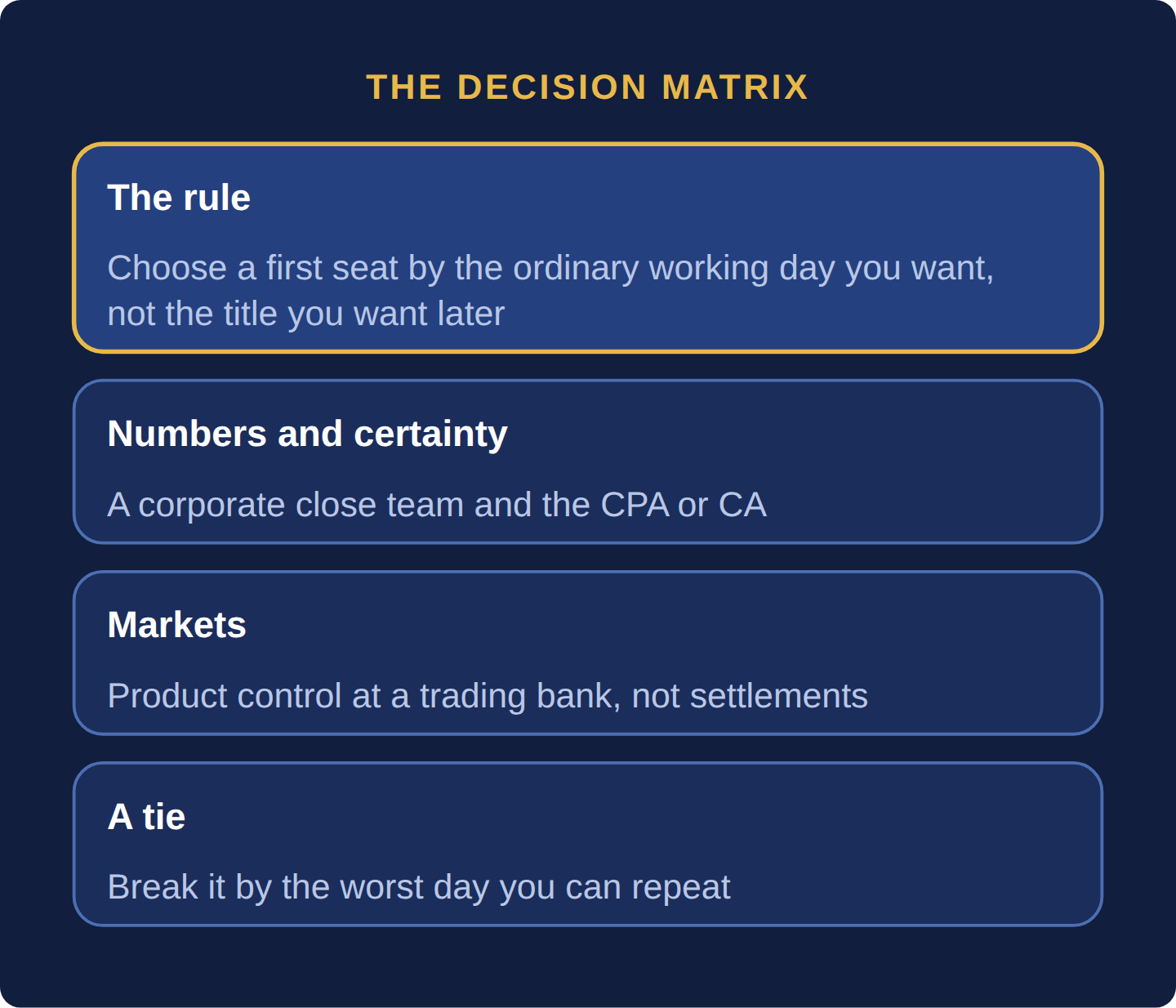
Pick a first seat by what you want to do on an ordinary Tuesday, not by the title you want in fifteen years. For each temperament or goal the table names the seat to apply for, the firm type that trains it best, the credential to start first, and the trap that most often costs people two or three years. Each row draws on the Getting In and Moving Up box of the role it names; the credential column gives a practical first step, not the only route.
| If you have… | First seat | Firm type | Credential to start | The trap to avoid |
|---|---|---|---|---|
| A love of numbers and certainty | Staff accountant on a corporate close team (C.1: The Controller) | Large industrial or consumer corporate (B.1: Large Industrial / Consumer Corporate) | CPA (US) or CA (India) | Settling into pure matching work (E.2: Reconciliations) for years: certainty without judgment tops out around pay tier 3. |
| A love of markets | Product control analyst (E.7: Product Control) | Trading bank (B.2: Bank / Financial Institution) | CPA, CA or ACCA; CFA Level I for the valuation side | Taking a settlements seat (E.1: Settlements) and waiting to drift to the desk: moves to trading run through product control or trade support (E.6: Trade Support), rarely through settlements. |
| A love of people and persuasion | Credit analyst on a coverage team (E.10: Credit Analysis), then relationship management (E.11: Relationship Management) | Commercial or corporate bank (B.2: Bank / Financial Institution) | The bank’s credit training program, then the CFA | Skipping credit: a relationship manager who cannot read financial statements loses credibility with clients and the credit committee. |
| A love of systems and process | Revenue operations or billing analyst (C.9: The Head of Revenue Operations (SaaS)) | Software or SaaS company (B.5: IT / Software / SaaS Company) | Salesforce Certified Platform Administrator | Becoming only the system administrator: keep a hand in billing and revenue controls, or the ladder stops below Director. |
| A love of law and control | Compliance analyst (C.14: The Chief Compliance Officer) | Asset manager (B.7: Asset Management Firm) or broker-dealer (B.2: Bank / Financial Institution) | FINRA SIE (no sponsor needed); in India, CS | Joining a compliance team that reports to the CFO or to the business it checks: the independence problem becomes your career problem. |
| An entrepreneurial appetite | Staff auditor serving venture-backed clients for two to three years, then the first controller or FP&A hire (C.3: The Head of FP&A) | Audit firm, then a Series B-C scale-up (B.6: High-Growth Startup / Scale-Up) | CPA or CA | Joining a seed-stage company as its only finance person in year one: nobody checks your work, so you learn habits instead of standards. |
| A need for predictable hours | Internal audit associate (C.5: The Head of Internal Audit) | Large corporate (B.1: Large Industrial / Consumer Corporate) | CIA (Certified Internal Auditor) | Calling a close or morning-P&L seat predictable: the calendar is fixed, but the hours in close week (C.1: The Controller) or after a volatile market day (E.7: Product Control) are not. |
| Ambition for the CFO chair | Staff auditor at a Big Four firm, moving to FP&A or controllership in years three to five | Big Four, then a large corporate (B.1: Large Industrial / Consumer Corporate) | CPA or CA; an MBA later, not first | Staying ten years in one narrow seat (tax, IR, stock plans): CFOs are usually made from controller, FP&A or divisional CFO seats (A.4: How CFOs Are Made). |
Two rows will often fit. Break the tie by the bad days: every seat has a recurring worst day (close week, a 3 p.m. settlement cutoff, a committee that rejects your credit memo, an examiner’s document request), and the seat to choose is the one whose worst day you can repeat for five years. Pay follows proximity to revenue (Section 0.1: The Six Worlds of Finance); exits follow the seat’s feeder routes in its Getting In box.
Before you accept an offer or request a transfer, run this checklist over one month:
- Days 1-5: read the role’s cadence table in this volume and ask one person in the seat for the worst day of the last month, hour by hour.
- Days 6-10: do one real task of the role on public data: reconcile a bank statement (E.2: Reconciliations), explain a quarter’s revenue variance (C.3: The Head of FP&A), spread a listed company’s statements (E.10: Credit Analysis) or value a company on comparables (C.13: The Head of Portfolio Valuation).
- Days 11-15: find three people five years ahead and three people ten years ahead of you in the seat; note where each went next.
- Days 16-20: rehearse the “What interviewers ask” themes in the role’s Getting In box; if you cannot answer one, learn it now.
- Days 21-25: ask who checks the seat’s work and who signs; a seat with no reviewer teaches less.
- Days 26-30: score the seat on worst day, pay tier, exits and hours; take it only if the worst day scores at least as well as the title.
How should I choose a first finance seat?
By the ordinary working day you want, not the title you want later.
What if I like numbers and certainty?
A corporate close team and the CPA or CA.
What if I want markets?
Product control at a trading bank, not settlements.
Choose a first seat by the ordinary working day you want, not the title you want later. Each temperament maps to one seat, one firm type, one credential and one trap.
Six questions on this chapter. Decide on your answer first, then click “Reveal Answer.”
1. A 24-year-old enjoys markets and wants a finance-function seat from which a later move toward the trading desk is realistic. Which first seat fits H.1’s recommendation?
- Reconciliations analyst at a bank’s GCC
- Product control analyst at a trading bank
- Settlements analyst at a large global custodian bank
- Stock plan analyst at a software company
Reveal Answer
Answer: B. Product control sees each desk’s P&L daily, and its exits include desk business management and trading; moves from settlements to the desk are rare.
2. A 23-year-old commerce graduate wants to be a public-company CFO in about twenty years. Which first move does H.1 recommend?
- Tax analyst, staying in tax through director level
- Investor relations for ten years to learn how markets think
- Big Four audit, then FP&A or controllership by year five
- A full-time MBA straight after graduation, before any work
Reveal Answer
Answer: C. CFOs are usually made from controller, FP&A or divisional CFO seats (A.4: How CFOs Are Made); a CPA or CA comes first and an MBA later.
3. A 25-year-old drawn to rules and control has two compliance analyst offers at asset managers: one team reports to the CFO, the other to the general counsel. Which should she take, and why?
- The general counsel’s team: compliance must test the CFO’s own numbers
- The CFO’s team, because the CFO controls the compliance team’s budget
- Either one, because the reporting line does not change the daily work
- The CFO’s team, because finance knowledge matters most in a compliance seat
Reveal Answer
Answer: A. A compliance line to the CFO is an independence red flag (B.3: Private Equity and Hedge Fund, C.14: The Chief Compliance Officer).
4. A 26-year-old who loves systems is two years into a revenue operations role and now spends every day administering the CRM. What is the trap H.1 warns about?
- Lacking the FRM, which most revenue operations heads are required to hold
- Staying at a software company instead of moving to a bank’s operations team
- Touching billing work, which belongs only to the controller’s revenue team
- Losing the link to billing and revenue controls, which caps the ladder
Reveal Answer
Answer: D. The systems track is valuable, but without billing and revenue-control work the ladder typically stops below Director (C.9: The Head of Revenue Operations (SaaS)).
5. Worked problem: A candidate weights three needs at 0.5, 0.3 and 0.2. A corporate close seat scores 8, 6, 7 and a trading product-control seat 6, 9, 5. Which scores higher?
Reveal Answer
Answer: Close = 7.2; product control = 6.7: the close seat scores higher.
6. Worked problem: With weights of 0.2, 0.6 and 0.2 instead, which seat scores higher?
Reveal Answer
Answer: Close = 6.6; product control = 7.6: product control wins, so the weights decide the answer.
H.2 Pathways in India
Finance careers in India start in one of three ways: a statutory qualification such as CA, CMA, CS or actuarial; a degree plus campus hiring; or a global credential such as the CFA or FRM. Global capability centers are the main entry employer. To get past their ceiling, take on process ownership or move onshore through an internal transfer.
Why it matters: The first door you pick shapes how high the ladder goes without a move.
Summary: Indian finance careers start through a statutory qualification (CA, CMA, CS, actuarial), a degree plus campus hiring, or a global credential (CFA, FRM). Global capability centers are the main entry employer; process ownership or an internal transfer onshore breaks their ceiling.
- CA: Foundation, Intermediate, two years of articleship, then the Final; graduates enter at Intermediate.
- CS: CSEET (graduates exempt), Executive and Professional stages, 21 months of training.
- NISM certificates are mandatory for specified roles at SEBI-regulated intermediaries and are revalidated every three years.
- A US intracompany transfer needs one continuous year with the employer abroad within the prior three years.
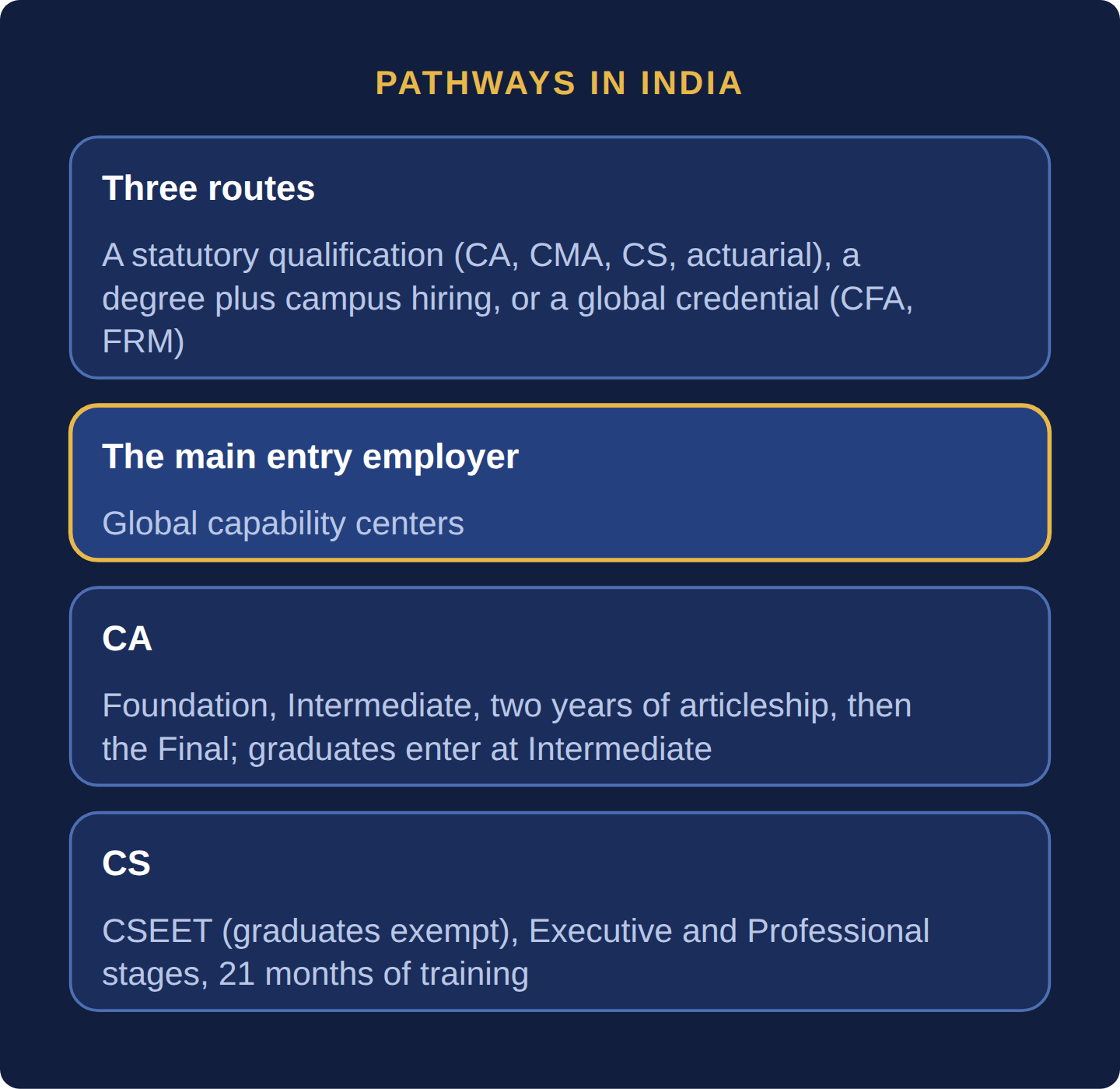
An Indian finance career starts through one of three doors: a professional qualification run by a statutory institute (CA, CMA, CS, actuarial), a degree plus campus hiring (B.Com, BBA, MBA), or a global credential taken while working (CFA, FRM). The table gives the stages each body sets and the time a typical candidate takes; the stages are the institutes’ rules, the durations are typical patterns.
| Route | Stages (as the body sets them) | Typical time | Where it leads |
|---|---|---|---|
| CA (Institute of Chartered Accountants of India) | Foundation (register after Class X, sit after appearing in Class XII) → Intermediate (two groups) → ICITSS course → two years of practical training (articleship) under a CA → Advanced ICITSS and self-paced online modules → Final (two groups). Commerce graduates with 55% (others 60%) and Intermediate passers of ICMAI or ICSI enter directly at Intermediate. | About four years from Class XII at the fastest; five or more is common. Graduates: about three years. | Big Four audit, controllership (C.1: The Controller), tax (C.6: The Tax Director), internal audit (C.5: The Head of Internal Audit), fund accounting (C.12: The Head of Fund Accounting), product control (E.7: Product Control); the default base for an Indian CFO. |
| CMA (Institute of Cost Accountants of India) | Foundation (graduates enter directly at Intermediate) → Intermediate → Final; Intermediate passers may enter the CA course directly at Intermediate. | Three to four years, often alongside a degree. | Costing, plant finance, FP&A (C.3: The Head of FP&A); often paired with a CA. |
| CS (Institute of Company Secretaries of India) | CSEET entrance test (held in February, June and October; graduates are exempt and register directly) → Executive stage → Professional stage; 21 months of long-term practical training after passing the Executive stage. | Three to four years. | Company secretary and listed-company compliance officer (Section B.9 India Lens), board governance. |
| CFA (CFA Institute) | Three exams; 4,000 hours of relevant work experience over at least 36 months for the charter. | Two to four years for the exams. | Valuation (C.13: The Head of Portfolio Valuation), credit (E.10: Credit Analysis), investment (C.16: The Head of Investment Management), ALM (E.9: Treasury and Asset-Liability Management (ALM)), equity research. |
| FRM (GARP) | Two exams (Part I and Part II) plus two years of relevant work experience. | One to two years for the exams. | Risk (C.7: The Chief Risk Officer), collateral (E.5: Collateral and Margin), regulatory capital (C.15: The Head of Regulatory Capital & Reporting), liquidity risk. |
| Actuarial (Institute of Actuaries of India) | Entrance through the institute’s ACET test, then a series of exams to Associate and Fellow; a Fellow of the institute is required to act as an insurer’s Appointed Actuary. | Typically six to ten years to fellowship; exam passes, not years, set the pace (C.11: The Chief Actuary). | Reserving and pricing (C.11: The Chief Actuary), ALM (C.16: The Head of Investment Management), actuarial consulting. |
| NISM certifications (National Institute of Securities Markets) | Single exams, mandatory for associated persons in SEBI-regulated intermediaries in the functions SEBI specifies: for example Series VII (securities operations and risk management), Series VI (depository operations), Series II-A and II-B (registrars and transfer agents), Series V-A (mutual fund distribution), Series III-A (intermediaries’ compliance). A certificate is revalidated every three years by re-examination or continuing education. | Weeks per exam. | Broker, depository participant, RTA and AMC operations and compliance seats (Part E India Lens). |
| MBA (finance) | Two-year program; IIM Ahmedabad, for example, admits domestic applicants through the Common Admission Test (CAT), then a writing test and interviews. | Two years, usually after two to four years of work. | Campus hiring into banking, corporate FP&A (C.3: The Head of FP&A), corporate development (C.8: The Head of M&A / Corporate Development), treasury (C.2: The Treasurer), relationship management (E.11: Relationship Management). |
Global capability centers. The main employer of new Indian finance graduates is the GCC (Section 0.3: Where Every Role in This Volume Sits): a multinational’s own center in Bengaluru, Hyderabad, Pune, Chennai or Gurugram. Typical entry seats, by employer:
- Global banks and brokers: reconciliations (E.2: Reconciliations), settlements (E.1: Settlements), corporate actions (E.3: Corporate Actions), trade support (E.6: Trade Support), product control reporting (E.7: Product Control), regulatory reporting (C.15: The Head of Regulatory Capital & Reporting) and KYC review (E.11: Relationship Management).
- Custodians, asset managers and fund administrators: fund accounting and NAV preparation (C.12: The Head of Fund Accounting, E.8: Fund Administration and Transfer Agency), transfer agency and investor services.
- Corporates: record-to-report, procure-to-pay and order-to-cash in the GBS (B.1: Large Industrial / Consumer Corporate), FP&A reporting support (C.3: The Head of FP&A) and tax compliance (C.6: The Tax Director).
Commerce graduates typically join as analysts through campus hiring; newly qualified CAs join a grade higher, often in product control, fund accounting or record-to-report review. Many careers start one step earlier, at a third-party knowledge process outsourcing (KPO) firm doing the same reconciliation or fund-accounting work for several clients, and move into a captive center after two or three years. For CAs the other large door is a Big Four practice, and Big Four to industry is the classic first move.
The ladder and its ceiling. Inside a center the ladder usually runs analyst (0-3 years), team lead (3-5), manager (5-9), senior manager or process head (9-14), site or tower head (14+). Because sign-off and judgment stay onshore (Section B.9 India Lens), a center career tends to flatten at site leadership. Two moves break the ceiling.
- Become a global process owner. Own a process end to end (all reconciliations for a region, the whole NAV cycle for a fund range) rather than the India piece of it. That makes you the obvious candidate when the onshore seat opens.
- Move onshore with the same employer. A US intracompany transfer (the L-1 category) requires at least one continuous year with the employer, or a parent, affiliate or subsidiary, abroad within the three years before admission, and a US role that is managerial, executive or needs specialized knowledge. A US CPA license, issued by a state board under its own rules (A.4: How CFOs Are Made), makes the move into a controller track easier.
The Indian-company CFO track. The path that ends in an Indian listed company’s CFO seat runs through a CA, Big Four or industry controllership, then a business-finance or plant-finance head role and the controller seat of an Indian group, often with an MBA added along the way (A.4 India Lens). A GCC career transfers best at the manager level, when the move is into an Indian company’s controllership or FP&A and the candidate already knows statutory audit and Indian tax; above that level, the gap is direct experience of a board, an audit committee and a regulator, which a captive center rarely gives.
What are the routes into finance in India?
A statutory qualification (CA, CMA, CS, actuarial), a degree plus campus hiring, or a global credential (CFA, FRM).
What are the stages of the CA?
Foundation, Intermediate, two years of articleship, then the Final; graduates enter at Intermediate.
Who is the main entry employer?
Global capability centers.
Indian finance careers start through a statutory qualification, a degree plus campus hiring, or a global credential. Global capability centers are the main entry employer.
Six questions on this chapter. Decide on your answer first, then click “Reveal Answer.”
1. How often is ICSI’s CSEET held, and who may skip it?
- Twice a year; graduates must still pass it before the Executive stage
- Once a year; only qualified CAs and CMAs may skip it and register directly
- Three times a year; no candidate is exempt from the test
- Three times a year; graduates register directly for the Executive stage
Reveal Answer
Answer: D. ICSI’s CSEET FAQ says the test is held in February, June and October, and graduates and postgraduates in any discipline are exempt.
2. A CA student starts two years of practical training on August 1, 2027, and wants the longest industrial training ICAI allows. When can the industrial training start at the earliest?
- February 1, 2029
- November 1, 2028
- August 1, 2028
- August 1, 2027
Reveal Answer
Answer: C. Training ends July 31, 2029; industrial training of 9-12 months is allowed in the last year, so 12 months starts August 1, 2028.
3. An analyst joined a US bank’s Hyderabad GCC on March 1, 2025. Under the US intracompany transferee definition, from when does she meet the prior-employment test?
- March 1, 2026, after one continuous year
- March 1, 2028, after three continuous years
- March 1, 2027, after two continuous years
- September 1, 2025, after six continuous months
Reveal Answer
Answer: A. 8 CFR 214.2(l) requires one continuous year of employment abroad with the same employer group within the three years before admission: March 1, 2025, plus one year.
4. An operations analyst at an Indian stockbroker holds the NISM Series VII certificate. What keeps it valid?
- Nothing; the certificate stays valid for life once it is passed
- Revalidation every three years by exam or continuing education
- Annual renewal by paying a registration fee to SEBI each April
- Revalidation every five years by the employer’s written attestation
Reveal Answer
Answer: B. NISM revalidates a certificate for three years from expiry by a pass in the relevant exam or completion of its continuing professional education program.
5. Worked problem: The CS pathway has 21 months of training and the CA articleship is 2 years. What is the difference in months?
Reveal Answer
Answer: 24 − 21 = 3 months.
6. Worked problem: The CA runs Foundation, Intermediate, articleship, then Final. A graduate enters at Intermediate. What share of the four stages is skipped?
Reveal Answer
Answer: 1 of 4 = 25%.
H.3 Role by Firm-Type Matrix
The type of firm you join decides which ladders you can climb without moving. Banks hold the most core roles, startups the fewest, and the operations roles in Part E cluster in banks, asset managers and market infrastructure.
Why it matters: If the role you want doesn’t exist at the firm, you will need to change firms to reach it.
Summary: The firm type you join decides which ladders you can climb without moving. Banks hold the most core roles, startups the fewest, and the Part E operations roles cluster in banks, asset managers and market infrastructure.
- Every firm type has a CFO and a controller.
- Banks: 20 of 28 roles are core.
- A startup has four core roles until it grows.
- The same title (CRO, VP, treasurer, CIO) can name very different jobs; ask who the role reports to and whose money it handles.
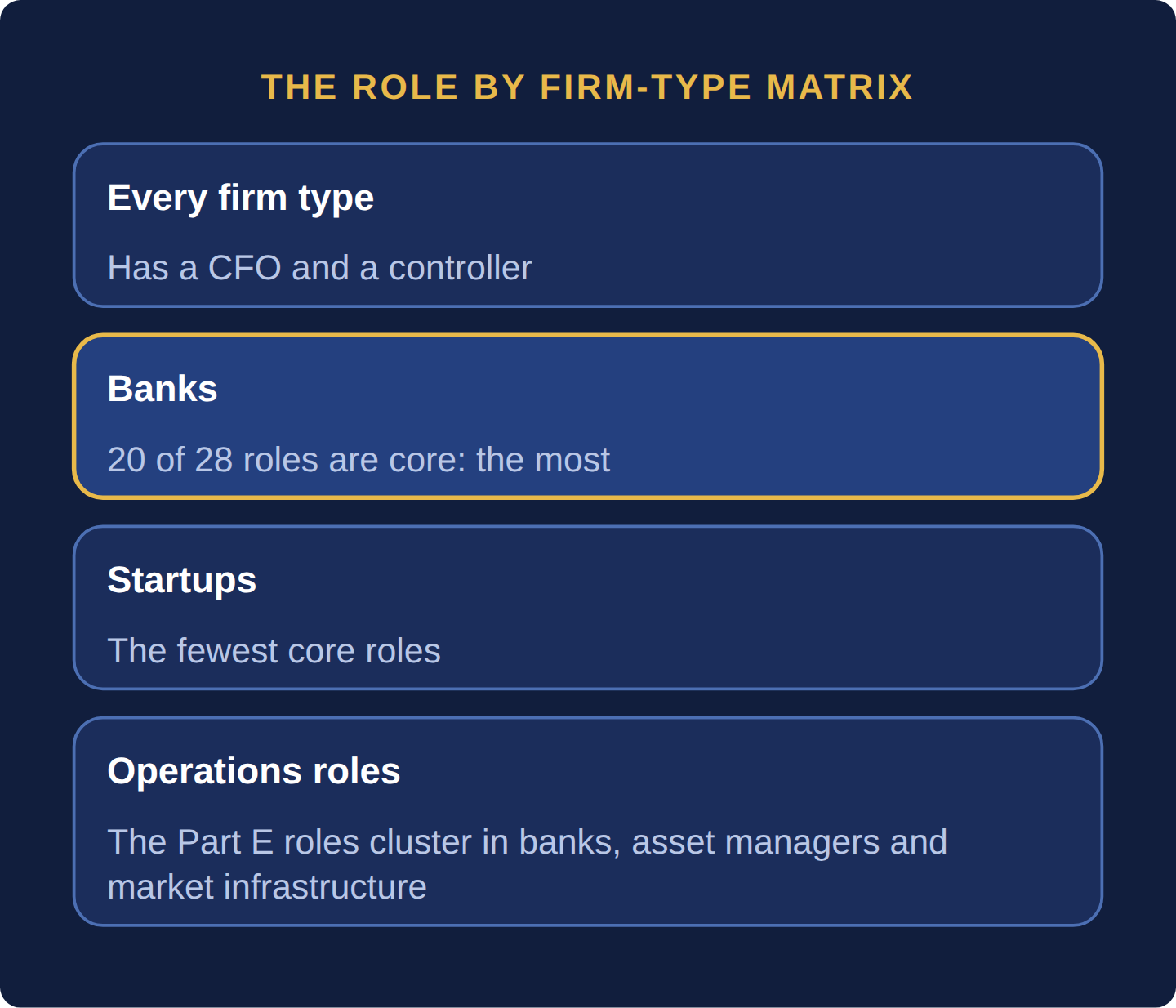
The same role is central in one firm type and missing in another, so your firm type decides which ladders you can climb without moving. The matrix places all 28 roles of Parts A, C and E against the eight org charts of Part B plus market infrastructure (exchanges, clearing houses, depositories, custodians and fund administrators; Section 0.1: The Six Worlds of Finance). Read each cell this way:
- core: a named team on that firm type’s chart, or the firm’s business itself;
- present: the work exists, usually smaller or inside another team;
- rare: found only at the largest or most specialized firms of that type;
- absent: normally not found.
The cells are typical patterns drawn from the Part B charts and the role chapters, not counts from a survey.
| Role | Industrial corporate (B.1: Large Industrial / Consumer Corporate) | Bank (B.2: Bank / Financial Institution) | PE and hedge fund (B.3: Private Equity and Hedge Fund) | Insurer (B.4: Insurance Company) | Software (B.5: IT / Software / SaaS Company) | Startup (B.6: High-Growth Startup / Scale-Up) | Asset manager (B.7: Asset Management Firm) | Fintech and payments (B.8: Fintech and Payments Company) | Market infrastructure |
|---|---|---|---|---|---|---|---|---|---|
| Chief Financial Officer (A.1: What Every CFO Owns, Universally–A.4: How CFOs Are Made) | core | core | core | core | core | core | core | core | core |
| Controller (C.1: The Controller) | core | core | core | core | core | core | core | core | core |
| Treasurer (C.2: The Treasurer) | core | core | present | present | core | rare | present | core | present |
| Head of FP&A (C.3: The Head of FP&A) | core | core | rare | core | core | core | core | core | present |
| Head of Investor Relations (C.4: The Head of Investor Relations) | core | core | core | present | core | rare | present | present | present |
| Head of Internal Audit (C.5: The Head of Internal Audit) | core | core | rare | core | core | absent | present | present | core |
| Tax Director (C.6: The Tax Director) | core | core | core | present | core | rare | core | present | present |
| Chief Risk Officer (C.7: The Chief Risk Officer) | present | core | present | core | rare | absent | present | present | core |
| Head of M&A / Corporate Development (C.8: The Head of M&A / Corporate Development) | core | present | rare | present | core | rare | present | present | present |
| Head of Revenue Operations (C.9: The Head of Revenue Operations (SaaS)) | rare | absent | absent | absent | core | core | rare | present | rare |
| Head of Stock Plan Administration (C.10: The Head of Stock Plan Administration) | present | present | rare | rare | core | present | rare | present | rare |
| Chief Actuary (C.11: The Chief Actuary) | absent | absent | absent | core | absent | absent | absent | rare | absent |
| Head of Fund Accounting (C.12: The Head of Fund Accounting) | absent | present | core | present | absent | absent | core | rare | core |
| Head of Portfolio Valuation (C.13: The Head of Portfolio Valuation) | rare | present | core | present | absent | absent | present | absent | present |
| Chief Compliance Officer (C.14: The Chief Compliance Officer) | present | core | core | core | present | rare | core | core | core |
| Head of Regulatory Capital and Reporting (C.15: The Head of Regulatory Capital & Reporting) | absent | core | rare | present | absent | absent | rare | present | present |
| Head of Investment Management (C.16: The Head of Investment Management) | rare | present | core | core | absent | absent | core | rare | rare |
| Settlements (E.1: Settlements) | rare | core | present | present | absent | absent | core | core | core |
| Reconciliations (E.2: Reconciliations) | present | core | core | present | present | rare | core | core | core |
| Corporate Actions (E.3: Corporate Actions) | absent | core | present | rare | absent | absent | present | absent | core |
| Client Assets and Safeguarding (E.4: Client Assets and Safeguarding (CASS Oversight)) | absent | core | rare | absent | absent | absent | present | core | core |
| Collateral and Margin (E.5: Collateral and Margin) | rare | core | core | present | absent | absent | present | rare | core |
| Trade Support (E.6: Trade Support) | absent | core | core | present | absent | absent | core | rare | present |
| Product Control (E.7: Product Control) | absent | core | rare | rare | absent | absent | rare | absent | rare |
| Fund Administration and Transfer Agency (E.8: Fund Administration and Transfer Agency) | absent | present | present | rare | absent | absent | present | absent | core |
| Treasury and ALM (E.9: Treasury and Asset-Liability Management (ALM)) | rare | core | rare | core | absent | absent | rare | present | present |
| Credit Analysis (E.10: Credit Analysis) | present | core | present | present | rare | rare | present | present | present |
| Relationship Management (E.11: Relationship Management) | absent | core | present | rare | absent | absent | present | present | core |
Three patterns stand out. Banks host the most seats: 20 of the 28 roles are core there, so a bank’s graduate program is the widest first door. A startup has only four core roles (the CFO, the controller, FP&A and revenue operations), so joining one narrows your ladder until it grows (Part D). And the Part E roles cluster in banks, asset managers and market infrastructure: an operations career moves easily among those three and hardly at all into a software company or an industrial corporate.
Titles also travel badly between firm types. Section 0.3: Where Every Role in This Volume Sits compares controller, risk, treasury, analyst and operations; seven more titles mislead just as often:
| Title | One job | A different job | What to ask |
|---|---|---|---|
| CRO | Chief risk officer at a bank or insurer, reporting to the board’s risk committee (C.7: The Chief Risk Officer) | Chief revenue officer at a software company, running sales, with revenue operations under it (C.9: The Head of Revenue Operations (SaaS)) | Which committee does this person report to? |
| Vice President | A mid-level rung at a bank, often six to ten years in (E.7: Product Control, E.11: Relationship Management) | A senior executive at a corporate, often reporting to the CFO | How many levels sit between this title and the CEO? |
| Investor relations | Shareholders and analysts of a listed company, under Regulation FD (C.4: The Head of Investor Relations) | Limited partners of a PE fund: quarterly reports and fundraising (B.3: Private Equity and Hedge Fund) | Are the investors public shareholders or fund investors? |
| Chief investment officer | An insurer’s CIO, investing against policy liabilities within an investment committee’s limits (C.16: The Head of Investment Management) | An asset manager’s CIO, running funds against a benchmark for clients (B.7: Asset Management Firm) | Whose liabilities set the limits? |
| Valuation | Independent price verification of a bank’s trading book, inside product control (E.7: Product Control) | Fair-valuing private holdings for a fund’s NAV and its valuation committee (C.13: The Head of Portfolio Valuation) | Liquid marks checked daily, or Level 3 models reviewed quarterly? |
| Compliance officer | A US adviser’s or broker-dealer’s compliance program, examined by the SEC or FINRA (C.14: The Chief Compliance Officer) | An Indian listed company’s compliance officer, who must be a qualified company secretary (B.9: What Is Common Across All Eight) | Which regulator examines the work? |
| Treasurer | A corporate’s cash, debt and hedging (C.2: The Treasurer) | A mutual fund’s treasurer: the officer who signs the fund’s financial statements and oversees its NAV (B.7: Asset Management Firm) | Is the money the company’s or the fund investors’? |
Which roles does every firm have?
Every firm type has a CFO and a controller.
Which firm type has the most core roles?
Banks: 20 of 28 roles are core.
Where do the operations roles cluster?
In banks, asset managers and market infrastructure.
The firm type you join decides which ladders you can climb without moving. Banks hold the most core roles (20 of 28), startups the fewest.
Six questions on this chapter. Decide on your answer first, then click “Reveal Answer.”
1. In the H.3 matrix, which firm type has the largest number of the 28 roles marked core?
- Asset manager, with 20 of 28 core
- Market infrastructure, with 20 of 28 core
- Industrial corporate, with 20 of 28 core
- Bank, with 20 of 28 roles core
Reveal Answer
Answer: D. Banks combine corporate finance, regulatory, treasury and operations seats.
2. A software company’s job posting says the role reports to the CRO. What does CRO most likely mean there?
- Chief revenue officer, who runs sales and revenue operations
- Chief reporting officer, who owns the SEC filing calendar
- Chief risk officer, who reports to the board’s risk committee
- Chief regulatory officer, who owns capital reporting
Reveal Answer
Answer: A. At software companies revenue operations usually sits under the chief revenue officer (C.9: The Head of Revenue Operations (SaaS)); at banks and insurers CRO means chief risk officer (C.7: The Chief Risk Officer).
3. A settlements analyst at a bank wants to change firm type but keep the role. Which move does the matrix support best?
- To a software company’s finance operations team
- To an asset manager or a market infrastructure firm
- To a Series B startup’s finance and accounting team
- To an industrial corporate’s group finance team
Reveal Answer
Answer: B. Settlements is core at banks, asset managers, fintechs and market infrastructure; it is rare at industrial corporates and absent at software companies and startups.
4. Which role is core at an insurer but absent at a bank in the matrix?
- Chief Compliance Officer
- Treasury and ALM
- Chief Actuary
- Head of Regulatory Capital and Reporting
Reveal Answer
Answer: C. The chief actuary exists to set insurance reserves (C.11: The Chief Actuary); the other three are core at banks.
5. Worked problem: Banks have 20 of 28 roles as core. What share is that?
Reveal Answer
Answer: 20 ÷ 28 = 71.4%.
6. Worked problem: A startup has 8 core roles. What share of the 28, and how many fewer than a bank?
Reveal Answer
Answer: 8 ÷ 28 = 28.6%; 12 fewer than a bank.