
- Debt Collection and Bankruptcy: What to Do When You Can't Pay (you are here)
- Automatic Stay in Bankruptcy and the Means Test Explained
If you can’t pay a debt, the worst move is to ignore it. Act early and in order: call the lender, then talk to a nonprofit credit counselor, and if the debt could not be repaid in about five years, speak to a bankruptcy attorney or legal aid. Know your rights with debt collectors too. The costliest outcomes, such as a court judgment, a wage garnishment or a restarted time limit on the debt, usually happen because people didn’t respond, not because of the debt itself.
Why it matters: Answering a collector’s letter or a court summons keeps your options open.
Summary: When you cannot pay, act early and in order: call the lender, then a nonprofit credit counselor, and if the debt could not be repaid in about five years, a bankruptcy attorney or legal aid. Know your rights with collectors, because the costliest outcomes — a default judgment, a garnishment, a restarted limitations clock — usually come from not responding rather than from the debt itself.
- At 30 days late a delinquency reaches the bureaus; at 180 days a card is charged off and often sold, and debt buyers paid an average of 4.0 cents per dollar in the FTC’s 2013 study, which is why settlements below face value happen.
- A debt management plan at 8% clears $15,000 in 60 months for $304.15 a month, 6.5% of the running household’s take-home pay.
- Debt settlement can cost fewer dollars only if it works; growing balances, fees, lawsuits and tax on forgiven debt eat the margin.
- More than 70% of debt collection lawsuits end in default judgments (Pew, 2020): answering the summons keeps your defenses alive.
- Ordinary creditors need a court judgment to garnish wages, capped at 25% of disposable earnings; defaulted federal student loans can be garnished up to 15% without one.
- Filing for bankruptcy stops collection immediately; in a large study, Chapter 13 protection raised filers’ earnings and cut foreclosures.
Throughout this volume we follow a single filer earning $75,000; here it carries $15,000 of card debt at 22% after a few hard months.
Falling behind follows a predictable sequence, and almost every option gets worse the further along it you are. The best time to act is before the first payment is missed; the second-best time is before the account is 30 days late.
| Days past due | What typically happens (credit card) |
|---|---|
| 1–29 | Late fee and a missed-payment notice. Not yet reportable to the bureaus |
| 30 | Reported to the bureaus as 30 days late — the first mark on your report, which stays for seven years |
| 60 | The issuer may apply a penalty APR to the existing balance; it must restore your old rate after six consecutive on-time minimum payments |
| 90–150 | Each further month is reported; the card is usually frozen or closed and handled by internal collections |
| 180 | Charged off (closed-end loans such as personal loans: 120 days). The debt is still owed and is often sold or placed with a collection agency |
Call the lender first. Most card issuers and lenders run hardship programs that are rarely advertised: a temporarily lower rate or payment, a skipped payment, or a fixed payoff plan, usually for a few months to a year and often with the card frozen. Ask what will be reported to the bureaus before you agree.
Nonprofit credit counseling is the next step when several debts are involved. A counselor at a reputable nonprofit agency (look for NFCC membership or the agencies the U.S. Trustee Program approves for pre-bankruptcy counseling) reviews your budget, usually free of charge, and may propose a debt management plan (DMP): you make one monthly deposit, the agency pays your unsecured creditors, and the creditors often lower rates or waive fees. The FTC notes that plans typically take 48 months or more; enrolled cards are usually closed. Ask for fees in writing. A DMP is not debt settlement, where a for-profit company asks you to stop paying while it negotiates; that path damages your credit, invites lawsuits, and forgiven debt may be taxable income.
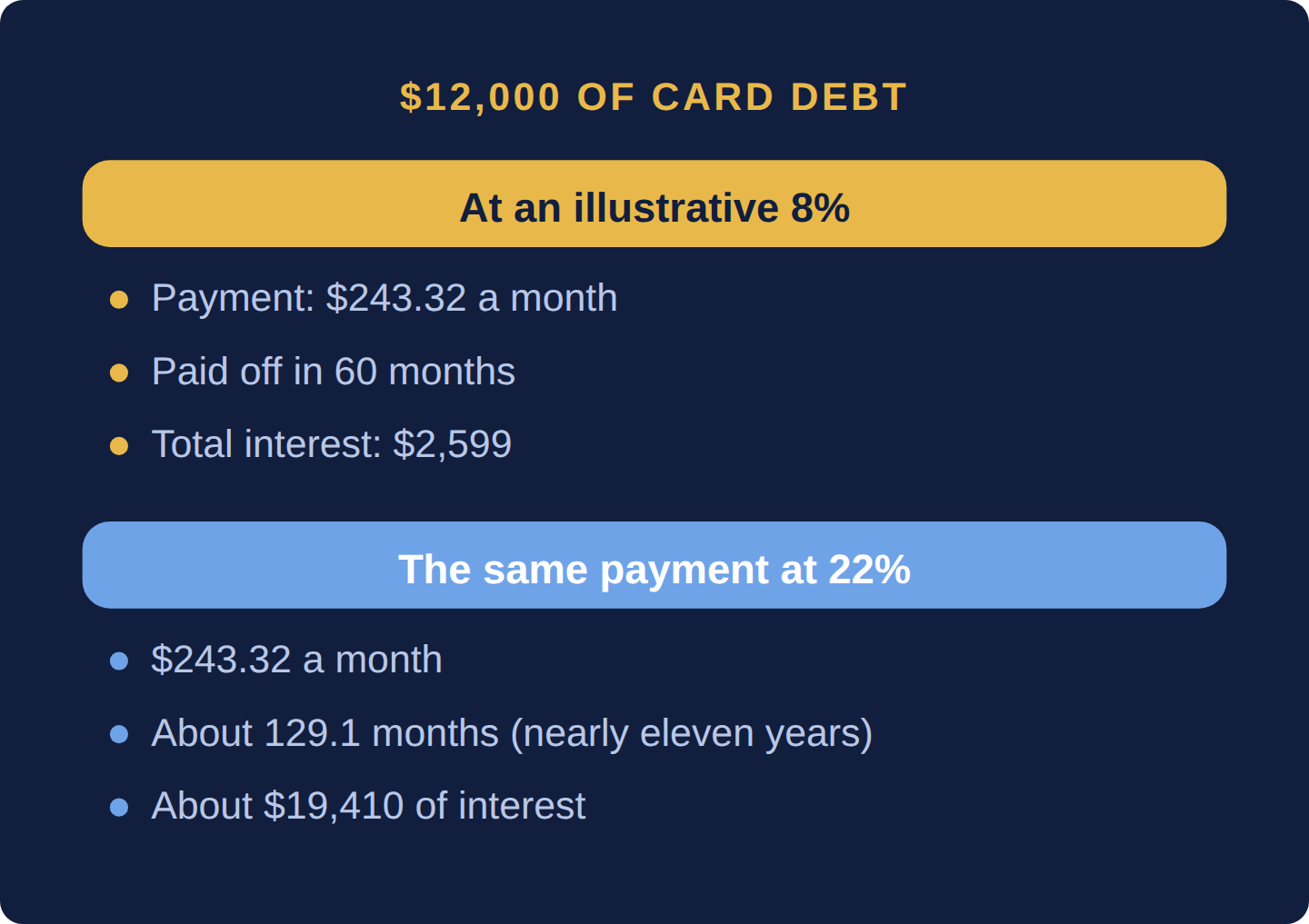
Suppose a DMP cuts a $12,000 card balance from 22% to an illustrative 8% (concessions vary by creditor). Paid off over 60 months: payment = $12,000 × (0.08 ÷ 12) ÷ [1 − (1 + 0.08 ÷ 12)−60] = $243.32; total interest = $243.32 × 60 − $12,000 = $2,599.
The same $243.32 a month at 22% takes n = −ln(1 − 0.22 ÷ 12 × $12,000 ÷ $243.32) ÷ ln(1 + 0.22 ÷ 12) ≈ 129.1 months (130 payments, nearly eleven years), and about $19,410 of interest. The rate, not the payment, is doing the work.
Collections and your rights. The Fair Debt Collection Practices Act and the CFPB’s Regulation F govern third-party collectors. A collector must give you validation information — the creditor, the amount, and how to dispute — in its first contact or within five days of it. If you dispute in writing within the 30-day validation period, it must pause collection until it verifies the debt. It may not call more than seven times in seven days about one debt, and it must contact you before reporting the debt to a bureau. A written request to stop communicating ends contact except for notices such as a lawsuit.
Statutes of limitations — the window for suing on a debt — are set by each state, most often three to six years, and states differ on when the clock starts. After it expires, a collector cannot sue or threaten to sue. But in many states a partial payment or a written acknowledgment can restart the clock. The credit-report clock is separate: most negative items drop off seven years after the original delinquency (the law’s outer limit runs seven years from 180 days after the delinquency began), and paying does not extend that.
Once a card is charged off at 180 days, the original creditor has written the balance off its books and often sells it. The FTC’s 2013 study of nine of the largest debt buyers, covering more than 5,000 portfolios with nearly 90 million accounts and $143 billion of face value, found buyers paid an average of 4.0 cents per dollar. Price fell with age: the FTC’s model put a typical small card debt under three years old at 7.9 cents, against 3.1 cents at three to six years, 2.2 cents at six to fifteen, and virtually nothing beyond fifteen.
Three consequences follow. A buyer that paid about $400 for a $10,000 account can profit from a settlement far below face value, so lump-sum offers of a fraction of the balance are often worth making. Older debt is cheap because it is hard to collect — records thin out as accounts change hands, and many are near or past the statute of limitations — which is why you should demand validation before paying. And expiry of the limitations period does not erase the debt: Regulation F bars a collector from suing or threatening to sue on a time-barred debt (12 CFR §1006.26(b)), but it may still ask you to pay, and in many states a payment revives the right to sue.
Judgments. If you are sued, respond by the court’s deadline — ignoring a summons usually produces a default judgment. A judgment allows wage garnishment, capped by federal law at the lesser of 25% of disposable earnings or the amount above 30 times the federal minimum wage ($217.50 a week). For the running household, disposable earnings (gross pay minus taxes withheld) are $2,884.62 − $234.92 − $213.02 = $2,436.68 per paycheck, so 25% = $609.17 per paycheck could be garnished — 28.2% of its $2,163.60 take-home pay. Some states protect more.
Most debt lawsuits are won by default. Pew’s 2020 review of state courts found that debt collection suits more than doubled between 1993 and 2013, to about 4 million a year, and that more than 70% end in a default judgment because the defendant never responds. Fewer than 10% of defendants have a lawyer, against nearly all plaintiffs; in Utah, 53% of represented defendants won, against 19% of those without counsel. That gap is a correlation — people who hire lawyers may have stronger cases — but the default figure is not: a case you do not answer is lost before anyone checks the evidence.
Bankruptcy protection can change what happens next. Dobbie and Song (American Economic Review, 2015) linked about 500,000 Chapter 13 filings to Social Security earnings records and used the random assignment of cases to judges, who differ in how often they dismiss, to isolate the effect of being granted protection. Over the following five years, filers granted protection earned $5,562 a year more (25.1% of their pre-filing earnings), were 6.8 points more likely to be employed, had five-year mortality 1.2 points lower and foreclosure rates 19.1 points lower than filers whose cases were dismissed. The authors find the gap comes mainly from dismissed filers doing worse, not protected filers doing better — evidence that relentless collection itself has costs.
Bankruptcy is a federal court process with two consumer forms. Both require credit counseling from an approved agency within 180 days before filing and a financial-management course before discharge.
Four questions on this chapter. Decide on your answer first, then click “Reveal Answer.”
1. A debt management plan cuts an $8,000 card balance from 22% to 8%, repaid over 48 months. About how much interest is paid over the plan?
- About $640
- About $1,374
- About $4,098
- About $2,560
Reveal Answer
Answer: B. Payment = $8,000 × (0.08 ÷ 12) ÷ [1 − (1 + 0.08 ÷ 12)^−48] = $195.30; interest = $195.30 × 48 − $8,000 ≈ $1,374. $2,560 charges 8% on the full balance for four years, $640 is one year of that, and $4,098 uses the old 22%. (Part 3.8)
2. A card first went 30 days late in March 2023 and later went to collections. If you pay the collection in full in 2026, when does the negative history generally leave your report?
- When your state’s statute of limitations runs out
- Seven years after the 2026 payment, around 2033
- About seven years after the March 2023 delinquency
- As soon as the collection is paid in full
Reveal Answer
Answer: C. The credit-report clock runs from the original delinquency, and most negative items drop off after seven years; paying does not extend it. It is separate from the statute of limitations, which governs lawsuits. (Part 3.8)
3. Worked problem: A debt management plan cuts a $9,000 card balance from 21% to 7% over 48 months. What is the payment and total interest?
Reveal Answer
Answer: Payment = $215.52. Total interest = 215.52 × 48 − $9,000 = $1,345.
4. Worked problem: At 21%, how long would that same payment take to clear the debt?
Reveal Answer
Answer: n = −ln(1 − 0.21÷12 × $9,000 ÷ $215.52) ÷ ln(1 + 0.21÷12) = 76 months.
- Fact Sheet #30: wage garnishment — Garnishment limits
- Bankruptcy court miscellaneous fee schedule — Filing fees
- Approved credit counseling agencies — Pre-bankruptcy counseling
- How long information stays on a credit report — Seven- and ten-year rules
- Chapter 7 bankruptcy basics — Liquidation and the means test
- Collecting on old debts — Statutes of limitations