
A fiscal deficit is when a government spends more than it collects in a year. Part of it is cyclical: it grows in a downturn and shrinks in a recovery on its own, thanks to automatic stabilizers like unemployment benefits and changing tax revenue. The other part is structural: it remains even at full employment, so it won’t close just because the economy recovers. Closing it takes policy action.
Why it matters: The structural part of a deficit will not fix itself.
Summary: A fiscal deficit is spending above revenue in a year. Part of it is cyclical, created and removed by automatic stabilizers, and part is structural, which remains at full employment and does not close on its own as the economy recovers, so closing it takes policy action.
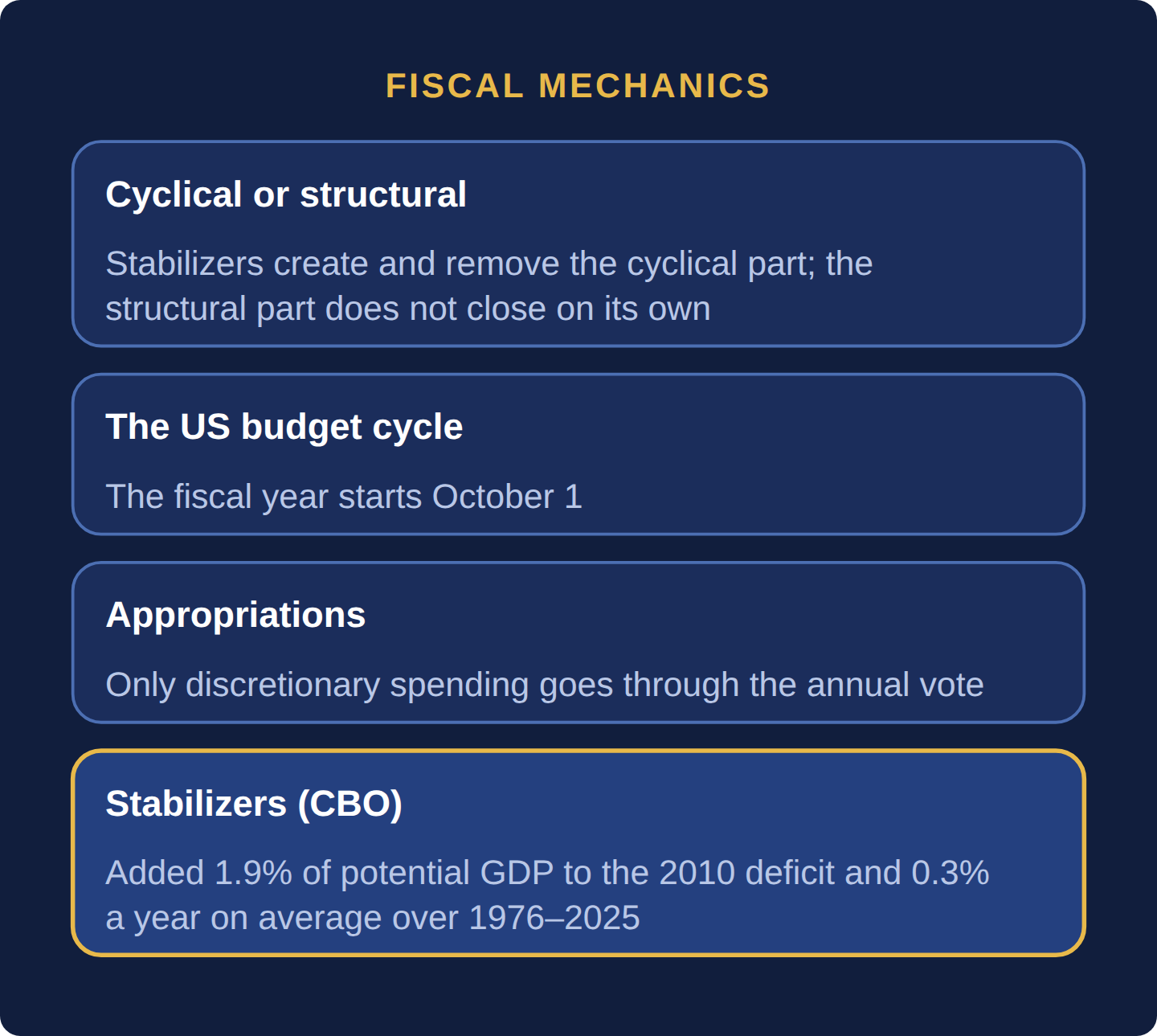
- The US fiscal year starts October 1; only discretionary spending goes through the annual appropriations vote.
- CBO estimates the stabilizers added 1.9% of potential GDP to the 2010 deficit and 0.3% a year on average over 1976 to 2025.
- CBO projects the deficit without stabilizers at 6.1% of potential GDP over 2026 to 2036, against a 3.7% 50-year average.
- In the worked example, a recession spending cut raises the debt ratio in year one whenever the multiplier exceeds about 0.91.
- Set targets for the structural balance, not the headline deficit, to avoid cutting into a downturn.
A government runs a fiscal deficit when spending exceeds tax revenue in a given year (financed by the borrowing covered in 3.1–3.2), and a fiscal surplus in the rarer case where the reverse holds. Automatic stabilizers are built-in features of the budget that widen the deficit automatically during a downturn without any new legislation — unemployment benefit payouts rise and tax revenue falls automatically as the economy weakens, providing a built-in countercyclical cushion. Discretionary fiscal policy, by contrast, requires active new legislation — a specific stimulus package or a specific tax change — and typically takes considerably longer to design and implement than the automatic stabilizers already built into the system.
The budget cycle is the annual calendar on which those decisions are made. In the United States the fiscal year starts on October 1. The Congressional Budget Act sets the timetable: the President submits a budget on the first Monday in February, the Congressional Budget Office (CBO) reports to the budget committees by February 15, Congress is meant to finish a budget resolution by April 15, and the House is meant to pass its annual appropriations bills by June 30. When appropriations are not enacted by October 1, Congress passes a continuing resolution that extends existing funding, or agencies without funding shut down. Only discretionary spending goes through that annual vote. Mandatory spending such as Social Security and Medicare, and net interest, run on permanent law and flow automatically, which is why most changes in the deficit happen without any annual decision at all.
The deficit therefore has two parts. The cyclical deficit is the part the automatic stabilizers create and remove as the economy moves around its potential. The structural deficit (CBO calls it the deficit without automatic stabilizers, a close cousin of the “cyclically adjusted” deficit) is what would remain with the economy at full employment. Only the structural part is a policy choice; the cyclical part reverses on its own when the economy recovers.
CBO estimates the stabilizers by linking revenue to the output gap (actual GDP minus potential GDP) and outlays such as unemployment insurance to the gap between the unemployment rate and its noncyclical rate. Its August 2026 estimates show they are smaller than many readers assume. From 1976 to 2025 they added an average of 0.3% of potential GDP a year to the deficit. In 2010, after the financial crisis, they added 1.9% of potential GDP to a deficit of 8.5%, so 1.9 ÷ 8.5 = 22% of that deficit was cyclical. In 2020 they added 0.9% to a deficit of 12.4%: 0.9 ÷ 12.4 = 7%. Most of the 2020 deficit was discretionary pandemic legislation, not the stabilizers.
The forward-looking number matters more. CBO projects the deficit without automatic stabilizers to average 6.1% of potential GDP from 2026 to 2036, against a 50-year average of 3.7%. A deficit of that size at full employment will not close as the economy grows; it closes only through legislation, or it keeps adding to the debt (Section 3.7: Debt Sustainability Analysis — r versus g).
A government with GDP of $1,000 billion and debt of $800 billion (80% of GDP) is in a recession and cuts spending by $20 billion (2% of GDP) to reduce borrowing. Two illustrative assumptions drive the result: the fiscal multiplier (dollars of GDP lost per dollar of spending cut) and the share of lost GDP that comes back out of tax revenue, set here at 30%. Lost GDP = $20B × multiplier; lost revenue = 30% × lost GDP; net saving = $20B − lost revenue; new ratio = ($800B − net saving) ÷ ($1,000B − lost GDP).
| Multiplier | Lost GDP | Lost revenue | Net borrowing saved | Debt-to-GDP after one year |
|---|---|---|---|---|
| 0.5 | $10B | $3B | $17B | $783B ÷ $990B = 79.1% |
| 1.0 | $20B | $6B | $14B | $786B ÷ $980B = 80.2% |
| 1.5 | $30B | $9B | $11B | $789B ÷ $970B = 81.3% |
The flip point is where the ratio stays at 80%: ($780B + $6B × m) ÷ ($1,000B − $20B × m) = 0.80, so 22m = 20 and m = 0.91. Above a multiplier of about 0.9, the cut raises the debt ratio in its first year even though it lowers the debt in dollars. Research suggests multipliers tend to be larger in a deep slump with interest rates at their floor than in a boom, which is why the timing of consolidation matters as much as its size. Olivier Blanchard and Daniel Leigh (IMF Working Paper 13/1, January 2013) found that forecasters in the euro-area crisis systematically underestimated multipliers: countries that planned more consolidation grew less than forecast.
Before judging a deficit, split it into its cyclical and structural parts using the budget office’s own estimate (CBO in the US). If most of the deficit is cyclical and unemployment is well above its noncyclical rate, let the stabilizers work and judge the government on its plan for the structural deficit, not on this year’s total. If the structural deficit is large at full employment (as a rule of thumb, above about 3% of GDP while r is close to or above g), treat it as a standing addition to debt that only legislation will remove. Ignore the split when one-off items such as bank rescues, asset sales or emergency programs dominate the year; strip those out first, then apply the rule.
Chasing a headline deficit target in the middle of a recession. In the worked example above, a $20 billion cut with a multiplier of 1.5 saves only $11 billion of borrowing, costs $30 billion of output, and pushes debt-to-GDP from 80.0% to 81.3%: the opposite of what the cut was for. A government that keeps cutting as the deficit widens cyclically chases a target that moves away from it. Avoid it by setting targets for the structural balance, which ignores the cycle, and by phasing consolidation in as the output gap closes.
What are examples of automatic stabilizers?
The main ones are the individual income tax, which falls faster than income in a downturn because its rates are progressive, the corporate income tax, which tracks volatile profits, and unemployment insurance and nutrition assistance, which pay out more as unemployment rises. None needs a new vote. CBO estimates they added 1.9% of potential GDP to the US deficit in 2010, and an average of 0.3% a year over 1976 to 2025.
What is the difference between a structural and a cyclical deficit?
A cyclical deficit is the part caused by the economy running below potential; it disappears when the economy recovers. A structural deficit is what remains at full employment and reflects tax and spending law. CBO projects the US deficit without automatic stabilizers at 6.1% of potential GDP on average from 2026 to 2036, so most of the US deficit is structural.
When does the US federal fiscal year start?
On October 1. Fiscal year 2026 ran from October 1, 2025, to September 30, 2026. The President’s budget is due on the first Monday in February, and the annual appropriations bills are meant to be enacted before October 1; when they are not, Congress passes a continuing resolution or the unfunded parts of government shut down.
Is fiscal stimulus or austerity better in a recession?
Much of the post-2008 evidence favors letting the stabilizers work and avoiding large cuts during a deep slump, because multipliers appear larger then: Blanchard and Leigh found that forecasters underestimated them in the euro-area crisis. Whether new stimulus is wise depends on its timing, on whether the central bank can still cut rates, and on the debt dynamics in Section 3.7: Debt Sustainability Analysis — r versus g.
Deficits combine a cyclical part, created and removed by automatic stabilizers, and a structural part that persists at full employment and does not close on its own as the economy recovers, so closing it takes policy action; CBO projects the US structural deficit at about 6.1% of potential GDP over 2026 to 2036. Cutting spending in a recession can raise the debt ratio in its first year when the fiscal multiplier is high, so targets work best when set on the structural balance.
Six questions on this chapter. Decide on your answer first, then click “Reveal Answer.”
1. In a recession a government cuts spending by $10 billion. Assume a multiplier of 1.2 and that 30% of lost GDP is lost tax revenue. How much does borrowing actually fall in the first year?
- $6.4 billion
- $10.0 billion
- $3.6 billion
- $8.8 billion
Reveal Answer
Answer: A. Lost GDP = $10B × 1.2 = $12B; lost revenue = 30% × $12B = $3.6B; net saving = $10B − $3.6B = $6.4B.
2. On what date does the US federal fiscal year begin?
- July 1
- October 1
- April 1
- January 1
Reveal Answer
Answer: B. The federal fiscal year runs from October 1 to September 30, which is why appropriations are due before October 1.
3. What is the structural deficit?
- The deficit that remains after subtracting all interest payments
- The part of the deficit created by the automatic stabilizers alone
- The deficit that appears only in years when the economy is in recession
- The deficit that would remain with the economy at full employment
Reveal Answer
Answer: D. The structural deficit strips out the cyclical effect of the stabilizers; the deficit excluding interest is the primary deficit.
4. CBO estimates automatic stabilizers added 1.9% of potential GDP to a 2010 deficit of 8.5%. Roughly what share of that deficit was cyclical?
- About one-half
- About nine-tenths
- About one-fifth
- About one-twentieth
Reveal Answer
Answer: C. 1.9 ÷ 8.5 ≈ 22%, about one-fifth; the rest was structural or the result of discretionary policy.
5. Worked problem: A government runs a deficit of 5.0% of GDP. Automatic stabilizers add 1.9% of GDP to it. What is the structural deficit?
Reveal Answer
Answer: Structural = 5.0% − 1.9% = 3.1% of GDP, which will not close on its own as the economy recovers.
6. Worked problem: If the economy returns to full employment and the stabilizers add nothing, what is the deficit?
Reveal Answer
Answer: Only the structural part remains: 3.1% of GDP.
- CBO, Effects of Automatic Stabilizers on the Federal Budget: 2026 to 2036 — Stabilizer size and structural deficit projections
- Blanchard and Leigh, Growth Forecast Errors and Fiscal Multipliers (IMF WP/13/1) — Underestimated multipliers in the euro-area crisis
- House Budget Committee, Timetable of the Budget Process