
12.3 Case Two — Valuing a Company Mid-Accounting-Scandal
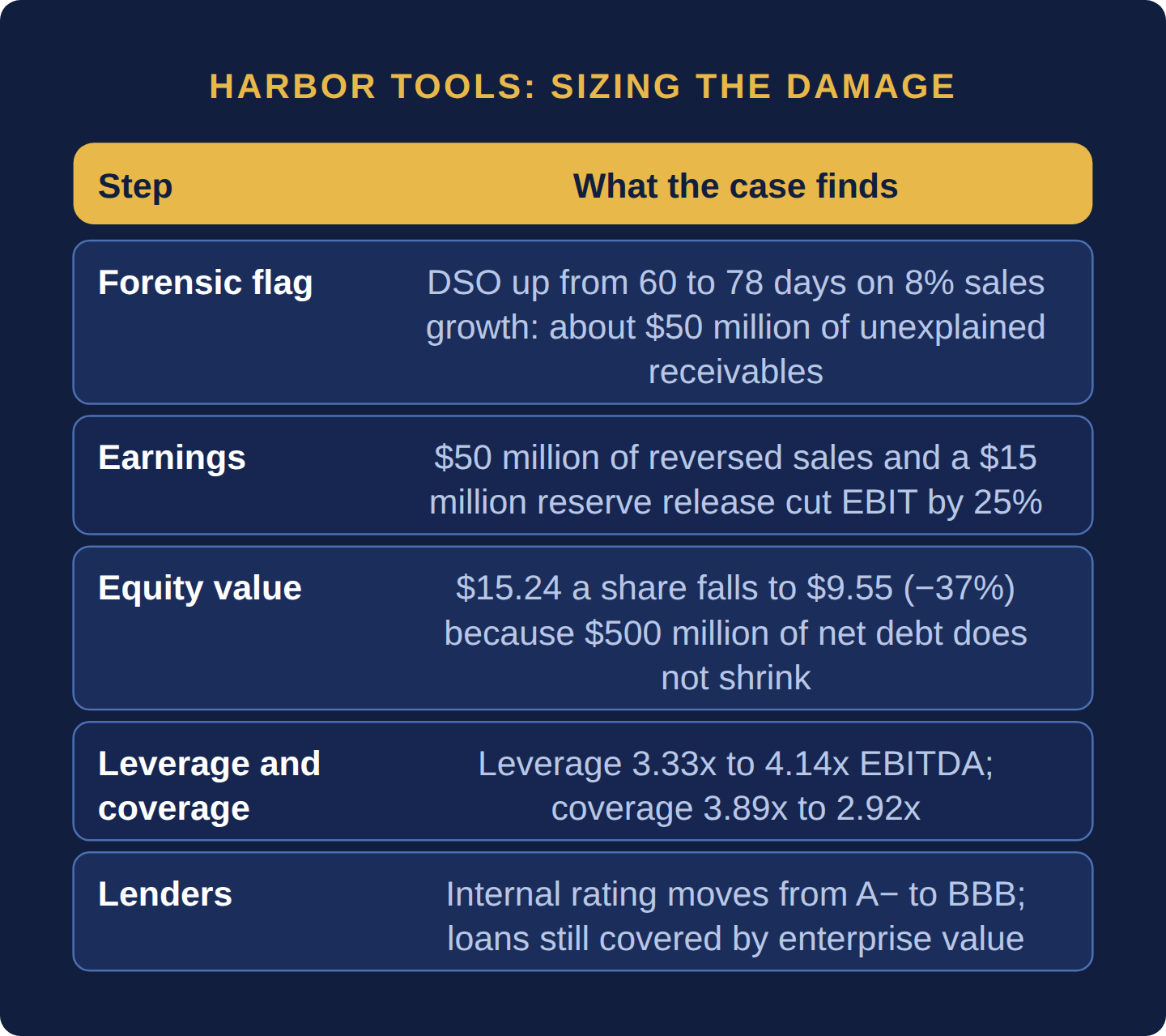
This case values a company in the middle of an accounting scandal. First size the allegation with forensic ratios, then rebuild the valuation from restated numbers. For Harbor Tools, $50 million of reversed sales and a $15 million reserve release cut EBIT by 25%. But the equity value falls by 37%, from $15.24 to $9.55 a share, because the $500 million of net debt does not shrink.
Why it matters: Debt magnifies the effect of an accounting error on what shareholders own.
Summary: Size the allegation first with forensic ratios, then rebuild the valuation from the restated base. For Harbor Tools, $50 million of reversed sales and a $15 million reserve release cut EBIT 25%, but equity value falls 37%, from $15.24 to $9.55 a share, because the $500 million of net debt does not shrink.
- DSO rising from 60 to 78 days on 8% sales growth flags about $50 million of unexplained receivables.
- Cutting the price by the earnings drop ($11.43) overvalues the stock by about 20%.
- Restated leverage rises from 3.33x to 4.14x EBITDA and coverage falls from 3.89x to 2.92x.
- The credit memo moves the internal rating from A− to BBB but finds the loans still covered by enterprise value.
- Whether misstated accounts breach loan representations decides who controls the waiver talks.
The situation: A whistleblower alleges that Harbor Tools, the company valued at $15.24 a share in Section 1.3: Discounted Cash Flow (DCF) — Building the Model, booked year-end sales before customers took control (the revenue recognition abuse of Section 6.2: Revenue Recognition — Where Manipulation Hides) and released warranty reserves, an expense manipulation, to hit its targets: the pressure-to-hit-a-number pattern of Section 6.8: Famous Cases as Pattern Templates. No restatement has been confirmed. An analyst must value the equity, and the company’s lenders must decide what to do with $600 million of loans.
Tracing the chain across Parts: The first step is not valuation but forensic triage with the toolkit of Section 6.7: The Forensic Accounting Toolkit — Ratios and Red Flags: receivables against sales, days sales outstanding (DSO), reserve balances, and the gap between profit and operating cash flow that Volume I’s Part 5 first introduced. Only once a defensible view of underlying earnings exists does the valuation machinery of Part 1: Corporate Finance & Valuation become usable again, and then every method must be rebuilt: the DCF’s cash flows (Section 1.3: Discounted Cash Flow (DCF) — Building the Model) from restated figures, and comparable-company multiples (Section 1.7: Comparable Company Analysis (“Comps”)) applied with care while the market itself is repricing the stock. Governance runs in parallel: the audit committee’s independent directors (Section 7.1: From Oversight to Action — What Volume I’s Board Table Didn’t Cover), not the implicated managers, now control the company’s credible path, and an activist (Section 7.7: Activist Investors and Proxy Fights) may already be circling.
This case illustrates a core practitioner discipline: valuation and forensic accounting are not sequential, one-time steps but a constantly re-checked loop — every fresh disclosure during an unfolding scandal should trigger a fresh forensic pass before any valuation number is trusted again, rather than treating the original DCF or comps output as a stable anchor to simply adjust at the margins.
Illustrative balance sheet detail for Harbor Tools; prior-year revenue = 1,000 ÷ 1.08 = 925.9.
| Test (Section 6.7: The Forensic Accounting Toolkit — Ratios and Red Flags) | Prior year | Reported year | Reading |
|---|---|---|---|
| Receivables vs revenue growth | 152.2 | 214.0 | receivables +40.6% against revenue +8.0% |
| DSO = receivables ÷ revenue × 365 | 152.2 ÷ 925.9 × 365 = 60.0 days | 214.0 ÷ 1,000 × 365 = 78.1 days | 18.1 extra days × (1,000 ÷ 365) = $49.6 million of unexplained receivables |
| Warranty reserve ÷ revenue | 2.0% | 0.5% | (2.0% − 0.5%) × 1,000 = $15.0 million of profit from a reserve release |
The triage sizes the problem before management confirms anything: about $50 million of revenue booked without transfer of control, and $15 million of profit from a reserve release. Removing the $50 million brings DSO back to (214.0 − 50.0) ÷ 950 × 365 = 63.0 days, close to its history.
With the allegation sized, the valuation can be rebuilt on the restated numbers.
The DCF of Section 1.3: Discounted Cash Flow (DCF) — Building the Model is rerun with the same growth path (8%, 7%, 6%, 5%, 4%), D&A 4%, capex 5% and working capital 12% of revenue, but from restated revenue of 950 and a run-rate EBIT margin of 105 ÷ 950 = 11.05%. It treats the reversed sales as a lower base, not a timing shift: the prudent reading until investigators show the customers are real.
| Item | Reported | Adjustment | Restated |
|---|---|---|---|
| Revenue, Year 0 | 1,000.0 | −50.0 (reversed sales) | 950.0 |
| EBIT | 140.0 | −20.0 (50 × 40% gross margin) −15.0 (reserve) | 105.0 |
| EBIT margin | 14.0% | 11.05% | |
| EBITDA | 180.0 | −35.0 | 145.0 |
| Net income (interest 36, tax 25%) | 78.0 | 51.8 | |
| Year-1 free cash flow | 93.0 | 65.7 | |
| Enterprise value (WACC 8.5%, g 3%) | 2,024.5 | 1,454.8 | |
| Equity value per share (net debt 500, 100m shares) | $15.24 | $9.55 |
EBIT fell 25%, enterprise value 28.1% and equity 37.4%: the $500 million of net debt does not shrink, so the equity absorbs the cut with leverage. Across the restatement each $1 million of run-rate EBIT lost costs about $16.3 million of enterprise value (569.7 ÷ 35.0); a pure margin loss on a fixed revenue base, the reserve step, costs $16.7 million (251.0 ÷ 15.0), because reversed sales also cut the capex and working capital the model must fund. Correcting only the revenue gives $12.06 a share; adding 1 percentage point to WACC for the uncertainty (9.5%) gives $7.33.
The lenders need a different document: a credit memo on the same restated figures.
- Recommendation: downgrade the internal rating from A− to BBB with a negative outlook; no new commitments; negotiate a covenant waiver only for a fee, a margin step-up and monthly reporting.
- Leverage: debt ÷ EBITDA = 600 ÷ 180 = 3.33x reported; 600 ÷ 145 = 4.14x restated (net 2.78x to 3.45x).
- Coverage: EBIT ÷ interest = 140 ÷ 36 = 3.89x to 105 ÷ 36 = 2.92x, which moves the synthetic rating from A3/A− (spread 0.89%) to Baa2/BBB (1.11%).
- Covenant: under an illustrative net debt ÷ EBITDA test of 3.50x, the EBITDA floor is 500 ÷ 3.50 = $142.9 million; the cushion shrinks from 20.6% to 1.5%.
- Asset coverage: debt is 41% of restated enterprise value (49% at a 9.5% WACC), so the loans stay well covered even as the equity loses 37%.
- Open legal question: whether delivering misstated financial statements breaches the credit agreement’s representations and so gives lenders an event of default, which decides who holds the leverage in the waiver talks.
Value a company under an accounting allegation in three passes: size the allegation from the triage ratios, rebuild the model from the restated base and run-rate margin, then add a discount-rate or probability layer for what is still unknown. If the triage-sized adjustment moves value by more than 10%, do not publish a target price from reported numbers; publish the range between the reported and the restated values instead. Ignore the rule only when the allegation has been independently investigated and rejected.
Cutting the share price by the same percentage as earnings. EBIT fell 25%, so an analyst marks Harbor at 0.75 × $15.24 = $11.43. The restated DCF gives $9.55, so that shortcut overvalues the stock by 20%, because the debt does not shrink with the earnings. Always rebuild enterprise value first and subtract net debt; the equity’s percentage loss exceeds the earnings loss whenever the company carries debt.
How do you value a company after an accounting restatement?
Rebuild it from the restated base, not by trimming the old answer. Reset revenue and the run-rate margin, rerun the cash flows, and subtract net debt from the new enterprise value. In this case a 25% EBIT cut takes the value per share from $15.24 to $9.55, down 37%, because the debt stays fixed.
What is a credit memo?
It is the lender’s written case for approving, changing or refusing credit: borrower, purpose, leverage, coverage, covenants, collateral or enterprise-value coverage, risks and a recommendation with conditions. After a restatement it is rewritten on the restated figures, as in the Harbor memo above.
Why does DSO matter in fraud detection?
Because sales booked without real customers produce receivables that are never collected, so days sales outstanding rises. Harbor’s DSO jumped from 60 to 78 days while sales grew 8%; the extra 18 days equal about $50 million of receivables, which is how the triage sized the alleged sales. A rising DSO is a signal to investigate, not proof.
Under an accounting allegation, size the problem with forensic ratios (DSO, reserves, profit versus cash) and rebuild the DCF from the restated base: Harbor Tools’ 25% EBIT cut becomes a 37% equity cut, $15.24 to $9.55 a share, because net debt is fixed. The credit memo, written on the same restated figures, shows leverage up to 4.14x and the covenant cushion down to 1.5%, yet the loans still covered by enterprise value.
Six questions on this chapter. Decide on your answer first, then click “Reveal Answer.”
1. Harbor Tools’ restated EBIT is 25% lower. An analyst cuts the $15.24 target by 25% to $11.43, but the rebuilt DCF gives $9.55. Why is the equity hit larger?
- The restatement increases the share count used in the valuation
- The restated model also raises the discount rate from 8.5% to 9.5%
- Net debt stays fixed, so equity absorbs the whole value cut
- The restated model also cuts long-term growth from 3% to 2%
Reveal Answer
Answer: C. Enterprise value falls 28.1% to $1,454.8 million; subtracting the unchanged $500 million of net debt cuts equity 37.4%.
2. Revenue is $1,000 million and DSO rose from 60.0 to 78.1 days while sales grew 8%. About how much of the receivables balance is unexplained by the old collection pattern?
- About $50 million
- About $62 million
- About $18 million
- About $214 million
Reveal Answer
Answer: A. Extra days × daily revenue = 18.1 × (1,000 ÷ 365) ≈ $49.6 million; $62 million is the total rise in receivables and $214 million the whole balance.
3. Harbor carries $600 million of debt. Using gross debt ÷ EBITDA, how does restating EBITDA from $180 million to $145 million change leverage in the credit memo?
- From 4.29x to 5.71x
- From 3.33x to 4.14x
- From 3.89x to 2.92x
- From 3.33x to 3.33x
Reveal Answer
Answer: B. 600 ÷ 180 = 3.33x and 600 ÷ 145 = 4.14x; 3.89x to 2.92x is interest coverage (EBIT ÷ interest).
4. A whistleblower alleges revenue manipulation and no restatement is confirmed. What should the analyst do first?
- Wait for the formal restatement before doing any analysis
- Cut the old target by the share price’s fall since the news
- Apply peer multiples to reported EBITDA for a quick floor value
- Size the allegation with forensic ratios before any model
Reveal Answer
Answer: D. The triage ratios (receivables, DSO, reserves, profit versus cash) size the problem; only then can the DCF be rebuilt from a restated base.
5. Worked problem: A company reports EBITDA of $100m and is valued at 10× EBITDA, or $1,000m. An investigation finds true EBITDA was $80m. What is the corrected value, and by how much was the buyer overpaying?
Reveal Answer
Answer: Corrected value = 10 × $80m = $800m. Overpayment = $1,000m − $800m = $200m, or 25% of the true value.
6. Worked problem: Under SOX 302 the CEO and CFO certify the financial statements. Who is exposed personally if the certification is knowingly false?
Reveal Answer
Answer: Both officers personally, under 18 U.S.C. §1350 as well as the company.
12.4 Case Three — Structuring a Hedge During a Currency Crisis
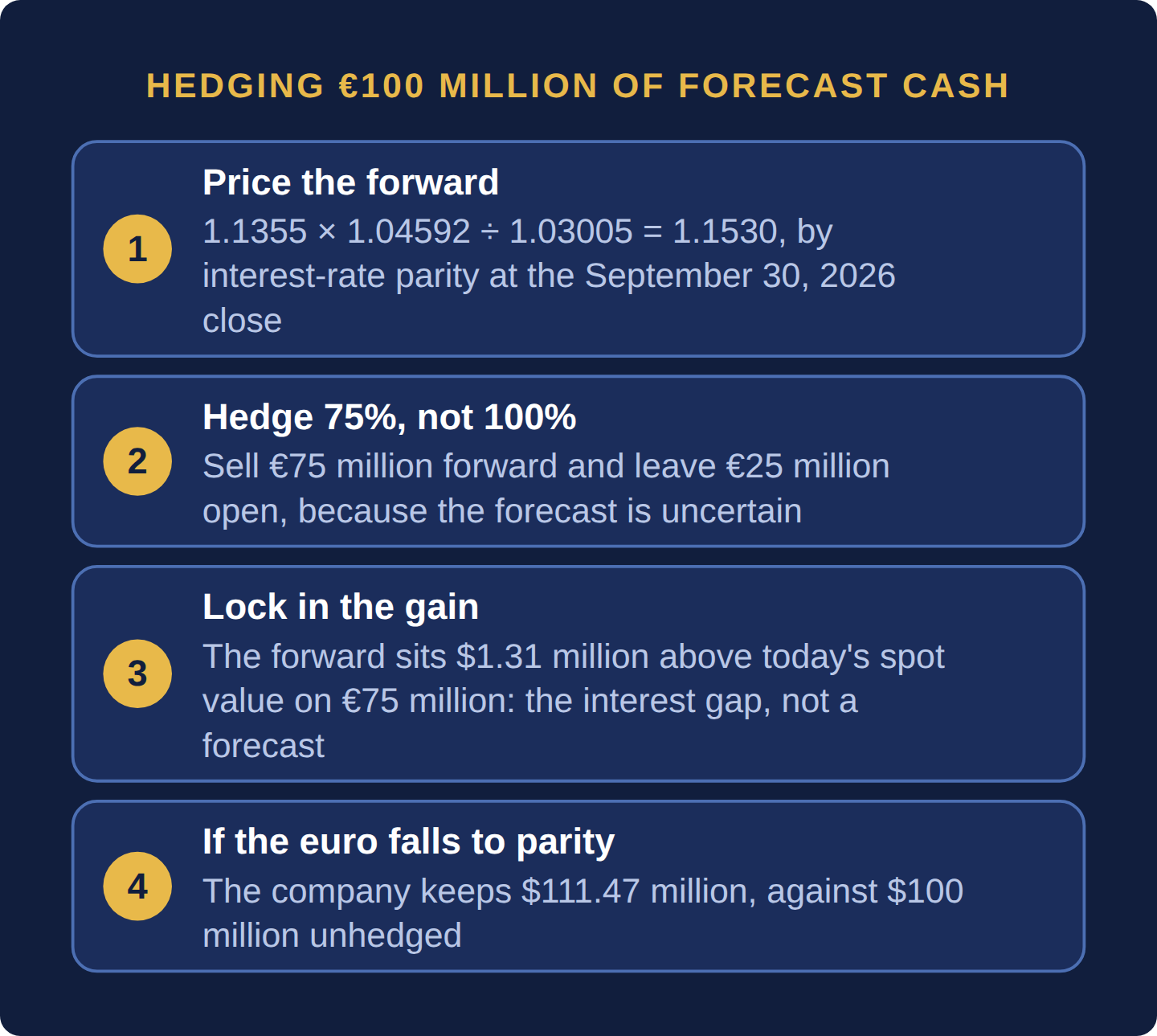
This case structures a hedge for a company facing a currency crisis. The one-year forward rate comes from interest-rate parity: 1.1355 × 1.04592 ÷ 1.03005 gives 1.1530. Selling €75 million forward, which is 75% of the forecast, locks in $1.31 million more than today’s rate. And if the euro falls to parity, the company keeps $111.47 million, against $100 million if unhedged.
Why it matters: A partial hedge protects the downside while leaving room for the forecast to be wrong.
Summary: Price the hedge by interest-rate parity: 1.1355 × 1.04592 ÷ 1.03005 = a one-year EURUSD forward of 1.1530. Selling €75 million forward (75% of the forecast) locks $1.31 million above spot and, if the euro falls to parity, keeps $111.47 million against $100 million unhedged.
- The forward premium is the interest gap, not a forecast, so waiting for the crisis only costs the move you waited through.
- A put struck at 1.1530 costs $2.47 million and beats the forward only above 1.1875.
- Collateral under a CSA can demand $7.5 million per 10-cent euro rally on €75 million.
- A forecast intercompany remittance cannot be a cash flow hedge under ASC 815; a documented net investment hedge keeps the forward’s marks out of earnings.
- The rupee version in the India Lens shows the same parity turning a gain into a cost.
The situation: A US industrial company services dollar debt partly from euros its European subsidiary earns: €100 million of net cash is forecast to reach the parent in twelve months. That currency mismatch is the structure behind the 1997 Asian Financial Crisis (Section 10.3: The 1997 Asian Financial Crisis) on a smaller scale. A euro-area debt scare is building, and the treasurer wants to hedge before a sharp fall; the ECB’s euro reference rate last fell below parity in 2022, to 0.9565 dollars on September 28. (The rupee version is in the India Lens at the end of this Part.)
Tracing the chain across Parts: The tools are the forward and, for multi-year debt, the cross-currency swap (Section 4.6: Currency Swaps), both priced by interest-rate parity. Section 4.8: Hedging vs Speculation — Using Derivatives in Practice sets the size: the hedge must match the actual euro exposure, or it becomes a bet. A flight to quality also widens the company’s own credit spreads (Section 3.6: Credit Spreads Decomposed), raising funding costs before any covenant is touched. Section 10.7: The Repeating Pattern — What Every Bubble and Crisis Shares adds that the dollar debt is leverage, which amplifies a currency fall: hedge early, not after certainty arrives.
Pricing the hedge. From Section 4.6: Currency Swaps, at the close of September 30, 2026: F = S × (1 + rUSD) ÷ (1 + rEUR) = 1.1355 × 1.04592 ÷ 1.03005 = 1.1530. Because dollar rates are higher, a company selling euros forward locks in more than spot: on €75 million, (1.1529841 − 1.1355) × 75,000,000 = $1,311,308. That is the interest gap, not a forecast.
The company hedges €75 million (75% of the forecast) and leaves €25 million open because the forecast is uncertain. The alternative to the forward is a one-year euro put struck at 1.1530 (Garman-Kohlhagen at the illustrative 7.5% volatility of Section 4.8: Hedging vs Speculation — Using Derivatives in Practice): $0.0330 per euro, $2,473,778 today, $2,587,362 at maturity. Dollar value of the €100 million in one year:
| EURUSD in one year | Unhedged | 75% forward at 1.1530 | 75% put at 1.1530 (net of premium) |
|---|---|---|---|
| 1.00 (crisis) | $100.00 million | $111.47 million | $108.89 million |
| 1.1355 (spot unchanged) | $113.55 million | $114.86 million | $112.28 million |
| 1.25 (euro rallies) | $125.00 million | $117.72 million | $122.41 million |
Flip points on the hedged €75 million: the forward beats staying open below 1.1530; the put beats staying open below 1.1530 − 0.0345 = 1.1185 and beats the forward above 1.1530 + 0.0345 = 1.1875: Section 4.8: Hedging vs Speculation — Using Derivatives in Practice‘s flip points, mirrored. In the crisis row the forward saves $11.47 million.
Bank forwards may be collateralized under a credit support annex (CSA), the part of the ISDA documentation that says when each side posts cash as the trade’s value moves. If the euro rallies 10 cents, the forward on €75 million loses about 75,000,000 × $0.10 = $7,500,000; with a zero threshold that cash is called within days, while the extra euros that offset it arrive only when the subsidiary remits them. In a crisis three strains coincide: banks cut currency credit lines, the cross-currency basis widens, and the company’s credit spread widens just when collateral is hardest to raise. Size the hedge to the collateral you can post, not only to the exposure.
Accounting. Under US GAAP this forward cannot be a cash flow hedge of the remittance. A forecast intercompany dividend does not affect consolidated earnings until it is declared, so it is not an eligible forecast transaction (ASC 815-20-25-15; Deloitte’s Hedge Accounting Roadmap, Section 5.3.1.1.1). Left undesignated, the forward is an economic hedge: its fair value changes hit earnings every quarter, while the euro net assets it protects move only the translation adjustment in other comprehensive income. To keep that mismatch out of earnings, the company can designate the forward, documented at inception (ASC 815-20-25-3), as a hedge of its net investment in the subsidiary, provided the subsidiary’s euro net assets stay at or above the €75 million hedged. Its effective gains and losses then sit in the cumulative translation adjustment (ASC 815-35-35-1) and reach earnings only if the subsidiary is sold or substantially liquidated (ASC 830-30-40-1). Once the dividend is declared, the euro receivable itself can be hedged.
The treasury committee approves hedges against a written proposal.
- Exposure: €100 million of forecast euro cash over 12 months, servicing dollar debt; a fall to 1.00 cuts its value from $113.55 million at spot to $100.0 million.
- Proposal: sell €75 million 12 months forward at about 1.1530, booked in three €25 million tranches to average the entry rate; leave €25 million open.
- Why not the put: it costs $2,473,778; the forward locks $1,311,308 above spot; the put wins only above 1.1875.
- Liquidity: keep $7,500,000 of revolver capacity per 10-cent euro rally for collateral; negotiate a CSA threshold.
- Controls: notional never above the forecast; net investment hedge designation under ASC 815 at inception; monthly review outside treasury (Section 4.8: Hedging vs Speculation — Using Derivatives in Practice).
Hedge a forecast currency cash flow with forwards for 50% to 80% of the amount you are confident of, rising toward 100% as it becomes contractual, and layer the trades over time. Use options when the cash flow may not happen at all (a bid, an acquisition). Before trading, check the quote against parity and compute the collateral a 10% adverse move would demand. If you cannot fund it, hedge less or negotiate a threshold first. The percentages are working heuristics.
Waiting for the crisis to confirm itself. A forward locks today’s spot plus the interest gap, not the pre-crisis level. If the euro first falls to 1.05, the forward becomes 1.05 × 1.04592 ÷ 1.03005 = 1.0662, and €75 million sold then brings $6.51 million less than selling at 1.1530 today. The forward is never a forecast, so there is no cheap moment to wait for: the cost of delay is the move you waited through.
How is an FX forward rate calculated?
By interest-rate parity: forward = spot × (1 + quote-currency rate) ÷ (1 + base-currency rate) over the same period. With EURUSD at 1.1355, a one-year dollar rate of 4.59% and a euro rate of 3.01%, the forward is 1.1530. Dealer quotes differ slightly because of the cross-currency basis and their spread.
Should a company hedge 100% of its forecast currency exposure?
Usually not. Forecasts miss, and if the cash flow does not arrive the excess hedge is a speculative position whose losses nothing offsets. Policies set a range for forecasts, such as the 50% to 80% of Section 4.8: Hedging vs Speculation — Using Derivatives in Practice, rising for contracted flows; 75% here is one such choice.
Should a currency hedge use a forward or an option?
A forward fixes the rate both ways with no premium; an option sets a floor and keeps the upside for a premium. On €75 million, the 1.1530 put costs about $2.47 million today and beats the forward only if the euro ends above about 1.1875. Options suit cash flows that may not happen.
Interest-rate parity sets the one-year EURUSD forward at 1.1530, so a company selling €75 million forward locks $1.31 million above spot and, if the euro falls to parity, keeps $111.47 million against $100 million unhedged. The hedge proposal sizes the hedge to 75% of the forecast, plans for collateral calls, designates it at inception as a net investment hedge (a forecast intercompany remittance cannot be a cash flow hedge under ASC 815), and hedges before the crisis rather than after it.
Four questions on this chapter. Decide on your answer first, then click “Reveal Answer.”
1. EURUSD spot is 1.1355, the one-year dollar rate 4.59% and the euro rate 3.01% (annual effective). What one-year forward does interest-rate parity give?
- 1.1876
- 1.1355
- 1.1530
- 1.1183
Reveal Answer
Answer: C. F = 1.1355 × 1.04592 ÷ 1.03005 = 1.1530; 1.1183 inverts the rates, and 1.1876 applies only the dollar rate.
2. The company sold €75 million forward at 1.1530 and left €25 million open. The euro ends the year at 1.00. How many dollars do the €100 million bring?
- $100.00 million
- $111.47 million
- $108.89 million
- $115.30 million
Reveal Answer
Answer: B. 75 × 1.1530 + 25 × 1.00 = 86.47 + 25.00 = $111.47 million; $108.89 million is the put strategy net of premium.
3. The treasurer waits, and the euro falls to 1.05 before the hedge is placed. With unchanged rates the forward is 1.0662. What does the delay cost on €75 million?
- About $6.5 million
- Nothing, because the interest gap is unchanged
- About $1.3 million
- About $11.5 million
Reveal Answer
Answer: A. (1.1530 − 1.0662) × 75,000,000 ≈ $6.51 million: the forward locks spot plus the interest gap, so the delay costs the move waited through.
4. Why does the hedge proposal sell forward 75% of the forecast euros rather than 100%?
- A full hedge must be done with options, which need a premium
- Banks do not quote forwards above 75% of a subsidiary’s forecast
- Interest-rate parity holds only for amounts below the full exposure
- A hedge above the euros that actually arrive becomes a bet
Reveal Answer
Answer: D. If the forecast cash flow fails to arrive, the excess hedge is a bet whose losses nothing offsets.
- 15 U.S.C. §7241, Corporate responsibility for financial reports (Cornell LII) — The officer certification of financial reports required after the accounting scandals of 2001–02
- FRED, DGS1
- ECB euro reference rate, USD
- ECB AAA yield curve, 1-year spot