
2.4 Government Spending, Taxes, and the National Debt
Fiscal policy, meaning taxes and spending, is set by Congress and the President, separately from the Fed’s monetary policy. US federal debt passed $40 trillion in 2026. The debt ratio rises when the primary deficit outweighs the gap between growth and the interest rate.
Why it matters: Net interest on the debt is now larger than defense spending.
Summary: Fiscal policy is set by Congress and the President, separately from the Fed’s monetary policy. US federal debt passed $40 trillion in 2026, and the debt ratio rises when the primary deficit outweighs the gap between growth and the interest rate.
- Federal debt was $40.26 trillion on October 1, 2026: $32.4 trillion held by the public and $7.8 trillion owed to federal trust funds such as Social Security.
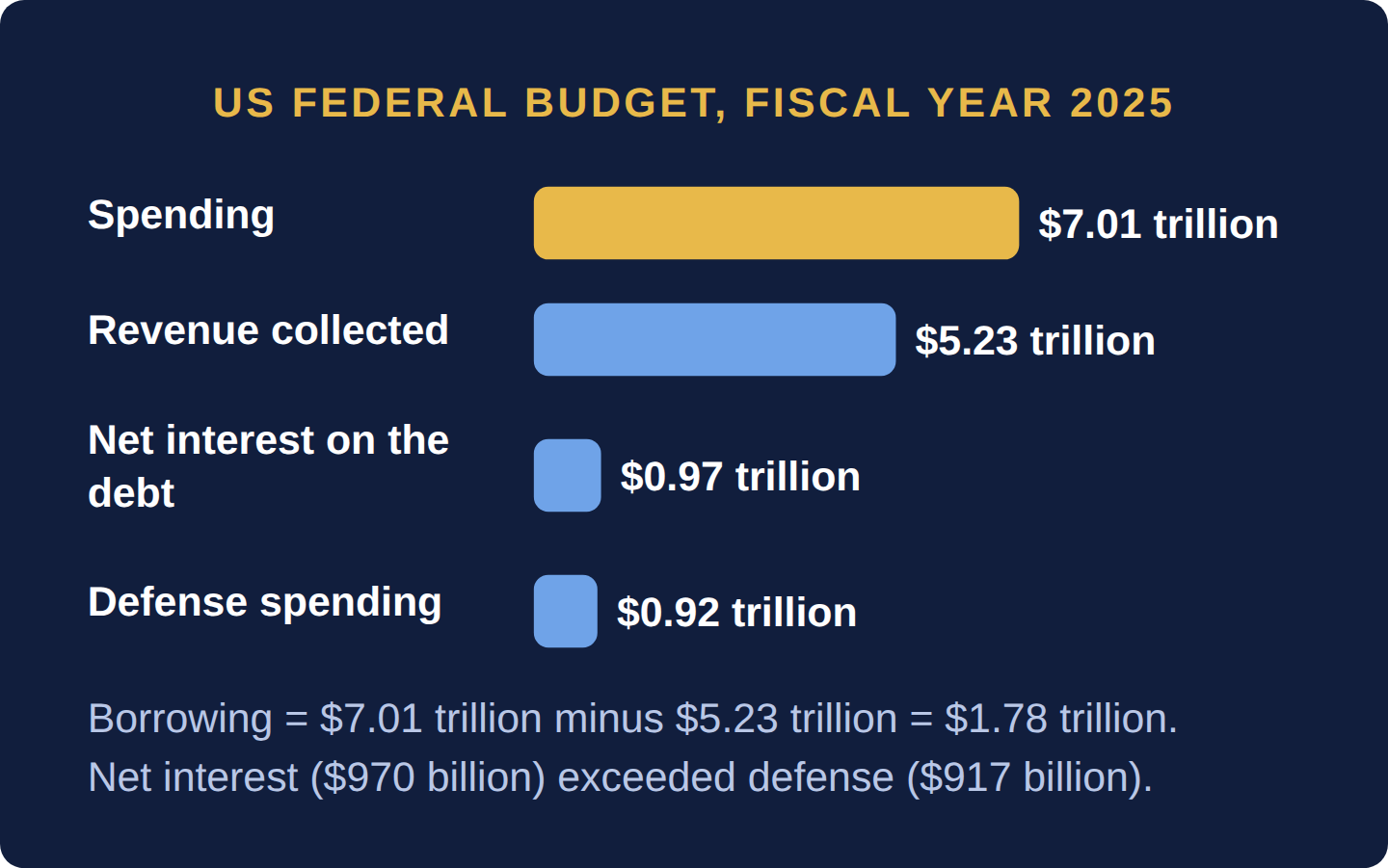
- In fiscal year 2025 Washington collected $5.23 trillion, spent $7.01 trillion and so borrowed $1.78 trillion.
- Net interest on the debt ($970 billion) was larger than defense spending ($917 billion).
- Debt held by the public was about 98% of 2025 GDP, and the ratio is rising by about 1 percentage point a year because the primary deficit more than offsets growth outpacing the interest bill.
Fiscal policy is the government’s use of spending and taxation to influence the economy — entirely separate from the Fed’s monetary policy. The key distinction: monetary policy is set by an independent central bank (the Fed); fiscal policy is set by the elected government (the President proposes, Congress appropriates). This separation is deliberate — it prevents elected officials from printing money to fund their spending promises.
If the government spends more in a given year than it collects in taxes, it runs a budget deficit and must borrow to cover the gap by selling Treasury securities. The accumulated total of past borrowing is the national debt. US federal debt passed $40 trillion in 2026 ($40.26 trillion on October 1, 2026). Of that, $32.4 trillion is debt held by the public, owed to investors (the Fed among them), and $7.8 trillion is owed by the Treasury to federal trust funds such as Social Security. In fiscal year 2025 (October 2024 to September 2025) Washington collected $5.23 trillion, spent $7.01 trillion and so borrowed $1.78 trillion. Net interest on the debt ($970 billion) was larger than defense spending ($917 billion).
It works much like a household budget at a vast scale. If you spend more than your salary each month, you put the difference on a credit card. Do that every month for years, and the outstanding balance keeps growing — and you keep paying interest on it. A government’s national debt is that same idea multiplied by trillions and running across many decades. The difference: a government that issues debt in its own currency can, in extremis, instruct its central bank to create money — though at the risk of inflation.
| Term | Meaning |
|---|---|
| Budget Deficit | When government spending in a single year exceeds tax and other revenues in that same year |
| Budget Surplus | When government revenues in a year exceed spending — rare in most major economies |
| National Debt | The total accumulated borrowing built up over all years — the running total of all past deficits minus surpluses |
| Treasury Bond (T-Bond) | Long-term US government debt, issued for 20 or 30 years; part of the benchmark safe asset in global finance |
| Treasury Note (T-Note) | Medium-term US government debt, issued for 2, 3, 5, 7 or 10 years; the 10-year note sets the benchmark yield (Section 2.9: Bonds and the Yield Curve — The Market That Rules Them All) |
| Treasury Bill (T-Bill) | Short-term US government debt, issued for 4 to 52 weeks; the closest proxy to a “risk-free” return in global finance |
Debt is judged against income. A $32 trillion debt means little until you set it against the economy that services it, so economists track the debt-to-GDP ratio. At the end of fiscal 2025, debt held by the public was $30.28 trillion against 2025 GDP of $30.86 trillion: 30.28 ÷ 30.86 ≈ 98%. Two forces move the ratio. The primary deficit (the deficit before interest payments) adds new debt each year; and the gap between the interest rate the government pays (r) and the growth rate of nominal GDP (g) makes old debt grow faster or slower than the economy. When r is below g, a country can run a small primary deficit and still see its ratio hold steady; when r rises above g, the ratio climbs even with a balanced primary budget.
The standard approximation: change in the debt ratio ≈ primary deficit (as % of GDP) + (r − g) ÷ (1 + g) × debt ratio. Approximate US inputs for 2025 (fiscal-year budget data mixed with calendar-year GDP, so treat the result as a sketch):
| Input | Value | How it is derived |
|---|---|---|
| Debt ratio (d) | 98.1% | $30.28T ÷ $30.86T |
| Average interest rate (r) | 3.36% | Average rate on marketable Treasury debt, December 2025 |
| Nominal GDP growth (g) | 5.04% | $30.86T ÷ $29.38T − 1 |
| Primary deficit | 2.61% of GDP | $1,775B deficit − $970B net interest = $805B; $805B ÷ $30.86T |
Interest-growth term: (0.0336 − 0.0504) ÷ 1.0504 × 98.1% ≈ −1.57 percentage points. Change in the ratio ≈ 2.61 − 1.57 ≈ +1.0 percentage point a year. Growth faster than the interest bill is still shrinking the ratio by about 1.6 points a year, but the primary deficit more than offsets it. The cushion is thinning: the average rate on marketable Treasury debt has risen from 1.43% at the end of 2021 to 3.48% in August 2026 as old cheap debt is refinanced, and if r climbed to meet g, the ratio would rise by the full primary deficit, about 2.6 points a year.
How much does a dollar of deficit spending add to GDP? The fiscal multiplier is the change in GDP caused by a one-dollar change in government spending or taxes. If Congress spends an extra $100 billion and the multiplier is 0.6, output rises by $100 billion × 0.6 = $60 billion; at 1.0, by $100 billion. Below one, the spending partly crowds out private activity (the Fed may raise rates in response, or imports absorb the demand); above one, the first round of spending triggers further rounds of hiring and buying. The size is disputed (see the box below).
The budget also steadies the economy on its own. Automatic stabilizers are parts of the tax and spending system that respond to the business cycle without any new law. In a recession, incomes fall, so income and payroll tax receipts fall faster than incomes because of progressive rates; unemployment insurance and food assistance payments rise as more people qualify. The deficit widens by itself and cushions spending, which is why deficits balloon in recessions before Congress passes any stimulus; in a boom the process reverses.
How the Treasury borrows. The Treasury sells its debt at regular public auctions: bills of 4 to 52 weeks, notes of 2 to 10 years and bonds of 20 or 30 years. It fills non-competitive bids first, then accepts competitive bids from the lowest yield upward until the offering is sold, and every winner receives the highest accepted yield: a single-price auction. Who ends up holding the debt? Of the $32.4 trillion held by the public, the Fed holds about $4.56 trillion (14%), foreign investors about $9.25 trillion (28.5%, of which foreign governments and central banks hold $3.77 trillion; Japan, the United Kingdom and mainland China are the largest), and US investors such as money market and mutual funds, banks, pension funds, insurers and households hold the remaining $18.6 trillion or so (57%).
The debt ceiling. Congress approves spending and taxes in one set of laws and, separately, caps the total the Treasury may borrow: the debt ceiling, or statutory debt limit. The limit does not authorize new spending; it decides whether the Treasury may borrow to pay for obligations Congress has already made. The Treasury warns that failing to raise it in time would mean defaulting on legal obligations, which is why standoffs over it rattle bond markets. Congress raised the limit by $5 trillion in July 2025, to about $41.1 trillion; on October 1, 2026, debt subject to the limit was about $40.06 trillion, leaving roughly $1.04 trillion of room.
Twin deficits. A country runs twin deficits when it has a budget deficit and a current-account deficit (it buys more from the world than it sells and borrows the difference from abroad) at the same time. The United States does both: a federal deficit of about 5.8% of GDP in fiscal 2025 ($1.78T ÷ $30.86T) and a current-account deficit of 3.0% of GDP in the second quarter of 2026. The link is an accounting one: a government deficit must be financed by private savers at home or by foreigners, and whatever domestic saving cannot cover, after private investment, shows up as the current-account deficit (Section 1.20: The Accounting of an Economy). Section 9.4: When Countries Go Broke — Sovereign Default and the IMF shows what happens when foreign creditors stop lending.
Multipliers. Valerie Ramey’s 2019 survey of the post-2008 research found most estimates of the average spending multiplier between 0.6 and 1, and larger effects for tax changes (her range for tax multipliers was −2 to −3: a tax cut of 1% of GDP raising output by 2–3%). Alan Auerbach and Yuriy Gorodnichenko (NBER working paper, 2010) found spending far more powerful in recessions than in expansions. One camp concludes that stimulus mostly reshuffles activity; the other that it pays to spend boldly in a slump, especially with interest rates at zero. Ramey notes that multipliers can fall outside her range in particular circumstances, so both camps cite her.
Debt. In 2019, with interest rates below growth, Olivier Blanchard argued that public debt “may have no fiscal cost” because it can be rolled over while the ratio drifts down. Since 2022 the arithmetic has tightened: the average rate the Treasury pays has more than doubled, and interest now costs more than defense. No one has found a debt ratio at which trouble reliably starts: how much debt markets tolerate depends on who holds it, in which currency it is owed and what it costs (Section 9.4: When Countries Go Broke — Sovereign Default and the IMF). What economists agree on is the mechanism in the worked example: the ratio’s path depends on r − g and the primary balance, not on the size of the debt alone.
What is fiscal policy?
Government decisions on taxes and spending, set by Congress and the President, separately from the Fed’s monetary policy.
How big is US federal debt?
$40.26 trillion on October 1, 2026: $32.4 trillion held by the public and $7.8 trillion owed to federal trust funds such as Social Security.
How much did the US government borrow in fiscal year 2025?
It collected $5.23 trillion and spent $7.01 trillion, so it borrowed $1.78 trillion.
How much does the US pay in interest on its debt?
Net interest on the debt was $970 billion, larger than defense spending of $917 billion.
When does the debt ratio rise?
When the primary deficit outweighs the gap between growth and the interest rate.
Fiscal policy is set by Congress and the President: US federal debt passed $40 trillion in 2026, debt held by the public is about 98% of GDP, and net interest ($970 billion in fiscal 2025) now exceeds defense spending. The debt ratio rises when the primary deficit outweighs the gap between growth and the interest rate, currently by about 1 point a year. Multipliers (mostly 0.6–1 for spending in normal times, larger in recessions), automatic stabilizers, single-price Treasury auctions, the debt ceiling and twin deficits complete the toolkit; economists still disagree on how large multipliers are and how much debt is too much.
Four questions and two worked problems on this chapter. Decide on your answer first, then click “Reveal Answer.”
1. US debt held by the public is about 98% of GDP, r is 3.36%, g is 5.04% and the primary deficit is 2.61% of GDP. Using change ≈ primary deficit + (r − g) ÷ (1 + g) × debt ratio, about how fast is the ratio changing?
- Rising about 1.0 point a year
- Falling about 1.6 points a year
- Rising about 4.2 points a year
- Rising about 2.6 points a year
Reveal Answer
Answer: A. (0.0336 − 0.0504) ÷ 1.0504 × 98.1% ≈ −1.57 points; 2.61 − 1.57 ≈ +1.0 point a year.
2. In a recession, income tax receipts fall and unemployment insurance payments rise without any new law. What are these called?
- Reserve management purchases
- Primary deficits
- Automatic stabilizers
- Fiscal multipliers
Reveal Answer
Answer: C. Automatic stabilizers are features of the tax and spending system that widen the deficit in a downturn and narrow it in a boom on their own.
3. Congress spends an extra $100 billion and the fiscal multiplier is 0.6. By how much does GDP rise?
- $40 billion
- $60 billion
- $160 billion
- $100 billion
Reveal Answer
Answer: B. $100 billion × 0.6 = $60 billion. A multiplier below one means the spending partly crowds out private activity.
4. What does raising the US debt ceiling do?
- Lets the Treasury pay for obligations already made
- Allows the Fed to buy bonds directly from the Treasury
- Raises the interest rate on new Treasury bonds
- Authorizes Congress to start new spending programs
Reveal Answer
Answer: A. The debt limit does not authorize new spending; it allows the Treasury to finance obligations Congress has already made.
5. Worked problem: Federal debt is $40.26tn and GDP is $30.86tn. What is debt to GDP, and what is the ratio for the $32.4tn held by the public?
Reveal Answer
Answer: Total = 40.26 ÷ 30.86 = 130.5%. Public = 32.4 ÷ 30.86 = 105.0%.
6. Worked problem: The public debt carries an average interest rate of 3.5%. What is the annual interest cost?
Reveal Answer
Answer: 3.5% × $32.4tn = $1.13tn, or 3.7% of GDP.
2.5 The US Dollar as the World's Reserve Currency
A reserve currency is one that other countries hold in large quantities and use to price trade and financial contracts. The US dollar has held that role since the Bretton Woods agreement of 1944, which gives the United States what Valéry Giscard d’Estaing called an “exorbitant privilege”.
Why it matters: It lets the US borrow cheaply in its own currency.
Summary: A reserve currency is one that other countries hold in large quantities and use to denominate trade and financial contracts. The US dollar has held that role since the Bretton Woods agreement of 1944, which gives the United States what Valéry Giscard d’Estaing called an “exorbitant privilege”.
- The dollar’s position was further cemented by the petrodollar system of the 1970s.
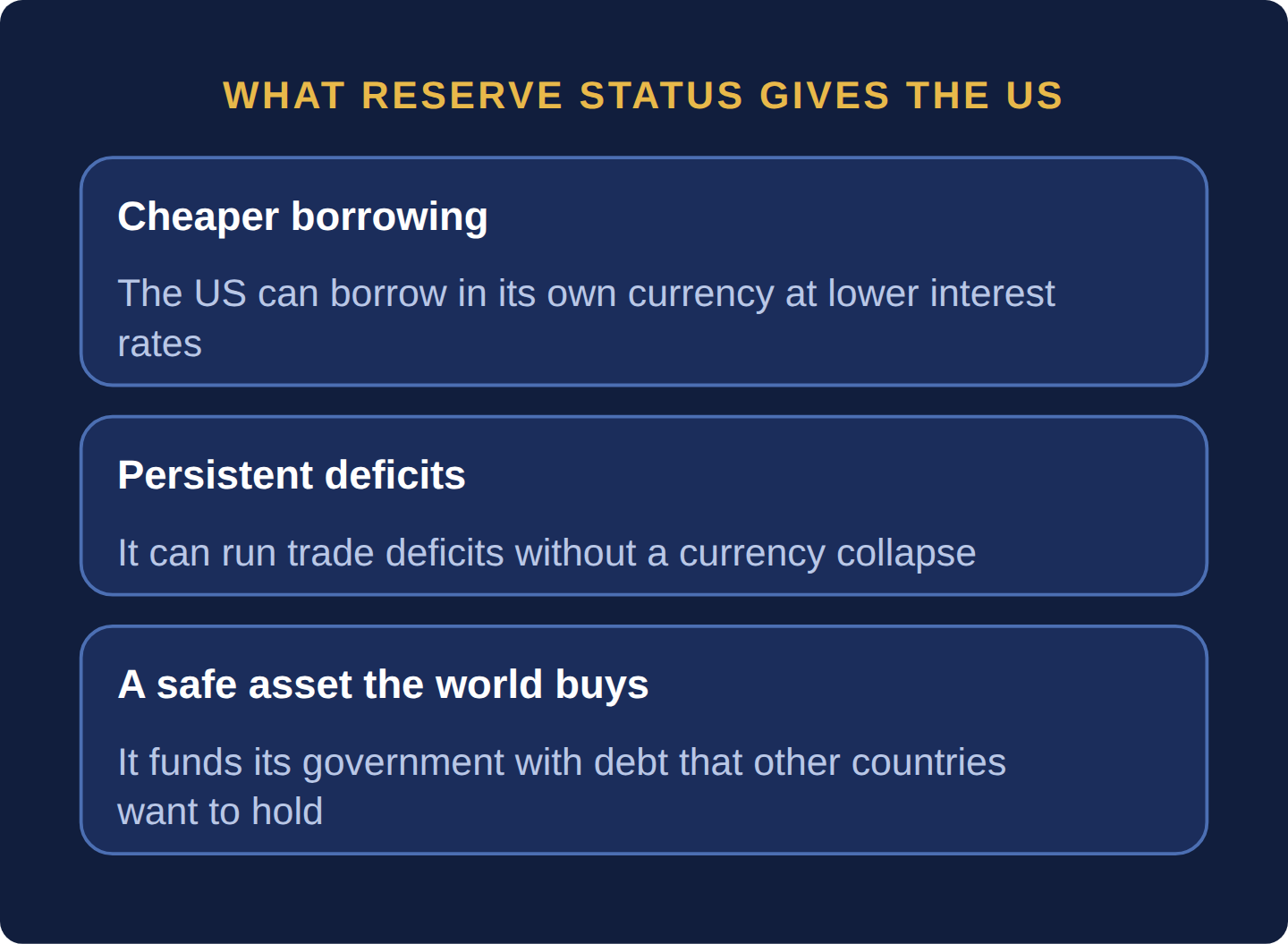
- The privilege lets the US borrow in its own currency at lower interest rates, run persistent trade deficits without currency collapses, and fund its government with debt the world buys as a safe asset.
A reserve currency is one that other countries and institutions hold in large quantities as part of their foreign exchange reserves and use to denominate international trade and financial contracts. The US dollar has been the world’s dominant reserve currency since the Bretton Woods agreement of 1944, and its position was further cemented by the petrodollar system of the 1970s.
The dollar’s reserve status gives the United States what French Finance Minister Valéry Giscard d’Estaing famously called an “exorbitant privilege” in the 1960s: the US can borrow in its own currency from the rest of the world at lower interest rates than it otherwise would, run persistent trade deficits without the currency collapses that would punish other nations, and fund its government by issuing debt that the rest of the world eagerly buys as a safe asset.
What holding a reserve currency exposes you to
A central bank that holds a large share of its reserves in one currency is exposed to that currency’s value. The exposure is the reserves times the share held in that currency, which is why reserve managers watch currency composition as closely as total size.
A central bank holds $600bn of reserves, 58% of them in dollars. The dollar then falls 10% against the basket of its other currencies.
| Step | Calculation | Result |
|---|---|---|
| 1. Dollar holdings | 58% × $600bn | $348 billion |
| 2. Fall in value | 10% × $348bn | $34.8 billion |
| 3. Share of total reserves | $34.8bn ÷ $600bn | 5.8% |
Result: a 10% dollar fall costs this central bank 5.8% of its reserves in local-currency terms. Reducing the dollar share to 48% would cut that loss to 4.8%, which is one reason reserve managers diversify.
| Advantage | How It Works |
|---|---|
| Cheap borrowing | Global demand for dollar assets keeps US interest rates lower than they would otherwise be |
| Seigniorage | The US earns a profit from the difference between the cost of producing dollars and their purchasing power globally |
| Trade flexibility | The US can run trade deficits for far longer than other countries, because the world needs dollars and willingly accepts them (Section 9.4: When Countries Go Broke — Sovereign Default and the IMF shows the limits) |
| Sanctions power | Because global trade and finance runs through dollar-clearing systems, the US can weaponize access to dollars as a foreign policy tool (Russia, Iran, North Korea); how dollar clearing works is explained in Section 3.5: How Money Crosses Borders — SWIFT and Correspondent Banking |
| Crisis resilience | In global crises, investors flee to dollars as a safe haven — strengthening the dollar precisely when other countries’ currencies weaken |
What is a reserve currency?
A currency that other countries hold in large quantities and use to denominate trade and financial contracts.
Why is the US dollar the world’s reserve currency?
It has held the role since the Bretton Woods agreement of 1944, and the petrodollar system of the 1970s cemented its position.
What is the exorbitant privilege?
A phrase of Valéry Giscard d’Estaing for what the dollar’s role gives the US: borrowing in its own currency at lower interest rates, running persistent trade deficits without currency collapses, and funding its government with debt the world buys as a safe asset.
A reserve currency is held in large quantities by other countries and used to price trade and contracts. The dollar has held the role since Bretton Woods in 1944, which gives the US cheaper borrowing, room to run deficits and a government debt the world buys as a safe asset.
Four questions and two worked problems on this chapter. Decide on your answer first, then click “Reveal Answer.”
1. Who called the dollar’s reserve status an “exorbitant privilege”?
- Goldman Sachs economist Jim O’Neill, in a 2001 paper
- Federal Reserve Chair Paul A. Volcker, in the 1980s
- US Treasury Secretary Henry Morgenthau Jr., in 1944
- Valéry Giscard d’Estaing, French finance minister
Reveal Answer
Answer: D. Section 2.5: The US Dollar as the World’s Reserve Currency attributes the phrase to Giscard d’Estaing in the 1960s.
2. Since which agreement has the US dollar been the world’s dominant reserve currency?
- The Treaty of Versailles, 1919
- The Plaza Accord, 1985
- Bretton Woods, 1944
- The Maastricht Treaty, 1992
Reveal Answer
Answer: C. The dollar’s dominance dates from the 1944 Bretton Woods agreement and was reinforced by the petrodollar system of the 1970s.
3. Why does the US have sanctions power over foreign banks?
- US law caps every foreign bank’s dollar deposits
- Much global finance settles through dollar clearing
- SWIFT is a US government agency that issues dollars
- The Fed sets interest rates for foreign central banks
Reveal Answer
Answer: B. Because so many cross-border payments settle in dollars through US clearing, cutting a bank off from dollar access is a powerful tool (Section 3.5: How Money Crosses Borders — SWIFT and Correspondent Banking explains the plumbing).
4. During a global crisis, what typically happens to the dollar, and why?
- It weakens, as the Fed must print to cover losses
- It strengthens, as investors flee to it as a safe haven
- It is unchanged, because its value is fixed to gold
- It weakens, because foreigners sell Treasuries first
Reveal Answer
Answer: B. Section 2.5: The US Dollar as the World’s Reserve Currency lists crisis resilience: investors move into dollars in crises, strengthening it when other currencies weaken.
5. Worked problem: A central bank holds $450bn of reserves, 58% in dollars. How many dollars is that, and what moves if it shifts 5 points into euros?
Reveal Answer
Answer: Dollars = $261bn. A 5-point shift = 5% × $450bn = $22.5bn sold for euros.
6. Worked problem: An exporter invoices $10m in dollars and the dollar falls 8% against its home currency. What does it lose in home-currency value?
Reveal Answer
Answer: 8% of the invoice value, 8%: $10m is worth 8% fewer home-currency units, which is why invoicing currency matters.
- US Treasury Fiscal Data: Debt to the Penny, Monthly Treasury Statement, Daily Treasury Statement, Average Interest Rates — Debt $40.26T, public $32.43T, FY2025 receipts/outlays/net interest/defense, statutory limit $41.1T, average rates
- TreasuryDirect, How auctions work; Treasury bills, notes and bonds — Single-price auction; maturities of bills, notes and bonds
- BEA, Gross Domestic Product — US GDP levels and growth used in the 1.3 worked example (Sections 2.2, 2.4)
- US Treasury TIC, Major Foreign Holders of Treasury Securities — Foreign holdings $9.25T, official $3.77T, July 2026
- Federal Reserve H.15 Selected Interest Rates and H.4.1 Factors Affecting Reserve Balances — EFFR, prime rate, primary credit and Treasury yields (Oct 1, 2026); H.4.1 reserves $2.95T and Fed Treasury holdings
- Federal Reserve H.4.1
- BIS, Triennial Central Bank Survey of foreign exchange and OTC derivatives markets — The BIS survey that measures the dollar’s share of foreign exchange trading