
Rational expectations says people’s forecasts are not systematically wrong, because they use all the information they have. John Muth formulated the idea in 1961, and Robert Lucas extended it to policy in the 1970s. If people see a policy coming, they act in advance, so a predictable policy loses force. Finance theories often traced to Lucas, such as Markowitz in 1952, Sharpe’s CAPM in 1964 and Fama’s efficient markets in 1970, ran alongside it and mostly came first.
Why it matters: A policy that everyone expects can have less effect than a surprise.
Summary: Rational expectations, first formulated by John Muth in 1961 and extended to policy by Robert Lucas in the 1970s, holds that people’s forecasts are not systematically wrong, so predictable policy loses force. The finance theories often traced to Lucas (Markowitz 1952, Sharpe’s CAPM 1964, Fama’s efficient markets 1970) ran alongside it, and mostly came first.
- The Lucas critique (1976): relationships estimated under one policy shift when policy changes.
- Akerlof’s lemons (1970): when buyers cannot judge quality, good products withdraw and markets can unravel.
- In the lemons example, buyers valuing cars at 1.5 times quality never trade; the break-even multiple is 2.
- The 2013 Nobel committee: prices are unpredictable over days or weeks but broadly foreseeable over three to five years.
- Whether that predictability reflects risk or error is unsettled; behavioral finance (Part 6: Behavioral Finance) argues the second.
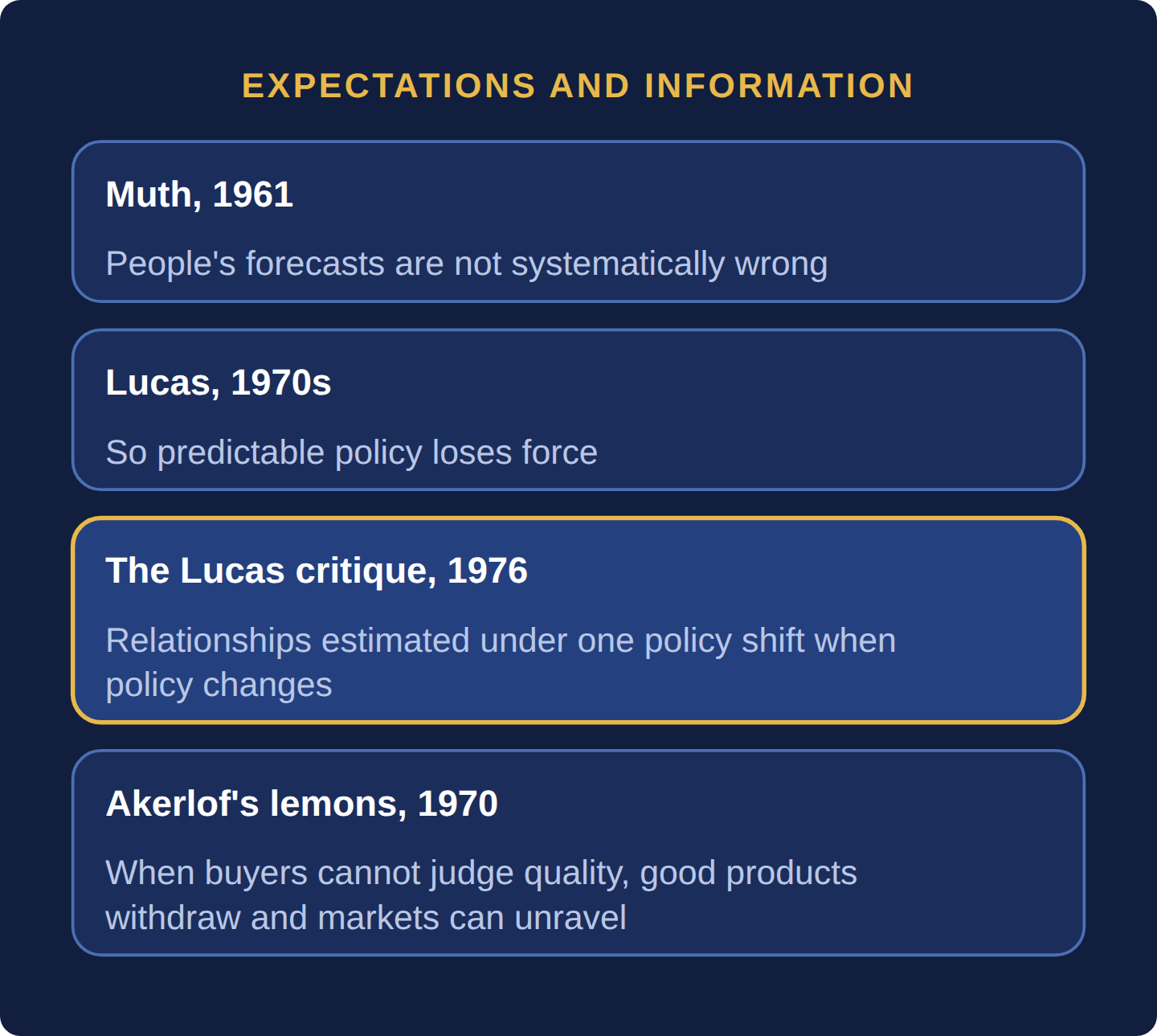
Rational expectations is the assumption that people form expectations using the relevant information and an accurate understanding of how the economy works, so their forecasts are not systematically wrong. The primary texts. The first precise formulation came from John Muth in 1961 (“Rational Expectations and the Theory of Price Movements”, Econometrica), about prices in individual markets. In the 1970s Robert Lucas extended it to the whole economy, arguing that people incorporate expected policy into their current behavior. A government or central bank therefore cannot systematically fool the public with predictable policy actions: once a policy becomes predictable, people anticipate it and adjust, often neutralizing much of its intended effect. His 1976 paper “Econometric Policy Evaluation: A Critique” added the Lucas critique: relationships estimated from past data, such as the Phillips curve, shift when policy changes, so they cannot be used to predict the effect of a new policy. Lucas won the 1995 Nobel Prize.
The finance line ran alongside, not after. The market-efficiency assumptions behind modern portfolio theory did not come from Lucas; most predate him. Harry Markowitz’s “Portfolio Selection” (1952) built the efficient frontier (Volume II’s Part 5.2). William Sharpe’s capital asset pricing model, CAPM (1964), priced risk in equilibrium (Volume II’s Part 1.5). Eugene Fama’s 1970 review defined the efficient market hypothesis: prices fully reflect available information. Fischer Black and Myron Scholes published their option-pricing formula in 1973 (Volume II’s Part 4.4), and Robert Merton derived it another way the same year. Muth’s 1961 paper is the common ancestor: the same idea of unbiased, information-using expectations, applied to markets by Fama and to policy by Lucas. Nobel Prizes followed: Markowitz and Sharpe (with Merton Miller) in 1990, Merton and Scholes in 1997 (Black had died in 1995).
The information line. George Akerlof’s “The Market for ‘Lemons'” (1970) showed what happens when one side knows more: a market can “contract into an adverse selection of low-quality products”, in the Nobel committee’s words. Akerlof shared the 2001 prize with Michael Spence (signaling: the informed side spends to prove quality) and Joseph Stiglitz (screening: the uninformed side designs contracts to sort). The worked example shows the unraveling.
Used cars range in quality from worthless to $10,000, spread evenly; a car’s quality is what it is worth to its owner. Buyers value a car at 1.5 times its quality but cannot tell good from bad before buying. At any price p, only owners whose cars are worth no more than p will sell, so the average quality on offer is p ÷ 2. A buyer therefore expects a car worth 1.5 × p ÷ 2 = 0.75 × p, less than the price. At p = $10,000 the average car on offer is worth $5,000 to its owner and $7,500 to a buyer: no deal. Lower the price and the better cars leave first, so the market unravels toward zero even though every car is worth 50% more to a buyer than to its owner. If buyers valued cars at 2.5 times quality, the average car at p = $10,000 would be worth 2.5 × $5,000 = $12,500 to them and the market would clear; the break-even multiple is 2. Inspections, warranties, dealers’ reputations and credit ratings exist to break this logic, and the same mechanism explains why the riskiest borrowers accept the highest loan rates.
Criticism. Shiller’s evidence of excess volatility, Kahneman and Tversky’s prospect theory (1979; Part 6.2: Loss Aversion and Prospect Theory) and Richard Thaler’s behavioral economics (Nobel 2017; Part 6.6: Mental Accounting) challenged the rational-investor assumption from inside economics. What survived. Rational expectations is the default modeling assumption in macroeconomics; central bank credibility and forward guidance rest largely on it; index investing rests on Fama’s evidence; and the Lucas critique is a standing warning to anyone who stress-tests with relationships estimated under a different regime.
The 2013 Nobel Prize went jointly to Eugene Fama and Robert Shiller, who stand on opposite sides of this question, and to Lars Peter Hansen, whose statistical method tests both. The committee summarized the evidence: “There is no way to predict the price of stocks and bonds over the next few days or weeks. But it is quite possible to foresee the broad course of these prices over longer periods, such as the next three to five years.” Fama’s work since the 1960s showed that new information reaches prices very quickly, which the committee credited with the rise of index funds. Shiller found in the early 1980s that stock prices fluctuate much more than dividends and that the price-to-dividend ratio tends to fall when high and rise when low. The two readings of that predictability: rational investors demand higher returns in riskier times (Fama’s side, tested with Hansen’s methods), or investors err and limits such as borrowing constraints stop smart money from correcting them (behavioral finance, Part 6.8: What This Means for Markets and Individual Investors). The data have not settled it. A working position: assume short-term prices are hard to beat, and treat valuation extremes as information about long-run returns, not about next month.
Read the chronology this way: 1952 Markowitz, 1961 Muth, 1964 Sharpe, 1970 Fama and Akerlof, 1972–76 Lucas, 1973 Black and Scholes, 1979 Kahneman and Tversky, early 1980s Shiller. Rational expectations and efficient markets are siblings born of Muth’s idea; neither is the parent of the other.
This is a reading rule for any claimed edge, in policy or in markets. If a policy works only because people do not anticipate it, assume its effect decays once it becomes predictable. If an investment strategy uses only public information, assume it is priced unless you can name the reason it persists: a risk others are paid to avoid, a constraint that stops arbitrage, or a behavioral bias with evidence behind it. If one side of a deal knows more about quality than the other, expect adverse selection and ask what signal, warranty or screen protects the uninformed side. Ignore the efficiency presumption at valuation extremes over multi-year horizons, where the evidence shows some predictability.
Paying the average price in a lemons market. In the worked example, a buyer who offers $5,000 because “the average car is worth $5,000” attracts only cars worth $5,000 or less to their owners, averaging $2,500, so the buyer overpays by about $5,000 − $2,500 = $2,500, or half the price, before counting the 1.5-times premium. The same error hits a lender that prices all applicants at the average default rate: the safest borrowers go elsewhere and the pool worsens. Avoid it by buying information (an inspection, an audit, a credit file) before paying for average quality.
What is the Lucas critique?
It is Robert Lucas’s 1976 argument that relationships estimated from historical data shift when policy changes, because people change their behavior in response to the new policy. A model that predicts the effect of a new policy using relationships from the old regime will therefore give the wrong answer.
Is the efficient market hypothesis true?
Partly, and the answer depends on the horizon. The evidence that earned Fama and Shiller a shared 2013 Nobel Prize shows that prices are very hard to predict over days or weeks but somewhat predictable over three to five years. Whether that reflects changing risk premiums or investor error is still debated.
What is the market for lemons?
It is George Akerlof’s 1970 model of a market where sellers know quality and buyers do not. Buyers pay only for average quality, so owners of good products withdraw, average quality falls, and the market can collapse. Warranties, inspections, brands and credit scores exist largely to solve this problem.
Rational expectations began with Muth (1961) and reached macroeconomic policy through Lucas, whose critique warns that estimated relationships shift when policy changes. Markowitz, Sharpe and Fama built the efficient-markets line alongside it, Akerlof showed how hidden quality unravels markets, and the Fama-Shiller evidence shows prices hard to predict short term but partly predictable over years.
Six questions on this chapter. Decide on your answer first, then click “Reveal Answer.”
1. Which of these was published before Muth’s 1961 paper on rational expectations?
- Lucas’s critique of policy evaluation
- Fama’s efficient markets review
- Sharpe’s capital asset pricing model
- Markowitz’s “Portfolio Selection”
Reveal Answer
Answer: D. Markowitz published in 1952; Sharpe in 1964, Fama in 1970 and Lucas’s critique in 1976.
2. Car quality is spread evenly from $0 to $10,000 and buyers value cars at 1.5 times quality. At a price of $8,000, what is the average car on offer worth to a buyer?
- $8,000
- $6,000
- $7,500
- $12,000
Reveal Answer
Answer: B. Only cars worth up to $8,000 are offered, averaging $4,000 to owners; 1.5 × $4,000 = $6,000, below the price, so the market unravels.
3. What did the 2013 Nobel committee say about predicting stock and bond prices?
- Easy over days or weeks, but unpredictable over three to five years
- Reliably predictable over all horizons using dividend data alone
- Hard over days or weeks, but broadly foreseeable over three to five years
- Impossible over any horizon, from a few days to several decades
Reveal Answer
Answer: C. The committee’s summary of Fama, Hansen and Shiller’s work: short-run prices are unpredictable, the broad course over three to five years is not.
4. What is the Lucas critique?
- Relationships estimated under old policy shift when policy changes
- Options cannot be priced at all without a reliable model of future volatility
- Investors weigh losses more heavily than equal-sized gains
- Central banks cannot affect real output even in the short run
Reveal Answer
Answer: A. Lucas (1976) showed that people change behavior when policy changes, so models estimated on past data mislead.
5. Worked problem: Used cars are worth $10,000 (good) or $4,000 (lemon), half each, and buyers cannot tell. What will a buyer pay, and which sellers leave if good-car owners need $8,000?
Reveal Answer
Answer: Average value = 0.5 × $10,000 + 0.5 × $4,000 = $7,000. Good-car owners who need $8,000 leave the market.
6. Worked problem: Once they leave, what price do buyers expect to pay?
Reveal Answer
Answer: Only lemons remain, so the price falls to $4,000: the market unravels.
- Muth (1961), Rational Expectations and the Theory of Price Movements, Econometrica — The origin of rational expectations
- Lucas (1976), Econometric policy evaluation: A critique, Carnegie-Rochester Conference Series on Public Policy — The Lucas critique
- Akerlof (1970), The Market for “Lemons”: Quality Uncertainty and the Market Mechanism, The Quarterly Journal of Economics — The lemons problem of asymmetric information