
5.3 Market Makers and the Bid-Ask Spread
Market makers earn the bid-ask spread by standing ready to buy and sell. The spread pays for three costs: processing orders, the risk of holding inventory, and adverse selection, which means losing money to traders who know more than the market maker does. Adverse selection is why spreads widen around news and in small, opaque companies, where informed traders have the biggest edge.
Why it matters: A wide spread is the market maker’s price for uncertainty.
Summary: Market makers earn the bid-ask spread for standing ready to trade, and the spread covers three costs: order processing, inventory risk and adverse selection, the losses to traders who know more. Adverse selection is the part that explains why spreads widen around news and in small, opaque companies.
- In the Glosten–Milgrom model, a 20% informed share between values of $49.80 and $50.20 produces a $0.08 spread with no other costs.
- Kyle’s lambda measures price impact per share of net order flow; more noise trading makes markets deeper.
- Effective spread = realized spread + price impact; in the example, $0.03 of a $0.04 effective spread was price impact.
- Spreads widen before earnings and news even when volatility is unchanged, because informed flow is more likely.
- Most US market making is now electronic, but the economics are unchanged.

A market maker continuously quotes both a bid and an ask price for a security, standing ready to buy or sell at those prices, providing the market’s ongoing liquidity — anyone wanting to trade immediately can transact against the market maker’s quotes rather than waiting for another genuine buyer or seller to appear. The market maker’s compensation for providing this constant willingness to trade is the bid-ask spread itself: buying at the (lower) bid and selling at the (higher) ask, capturing the small difference on each completed round trip.
Market makers carry inventory risk: a position bought at the bid and not yet sold at the ask can lose value before the offsetting trade arrives. That is one reason spreads widen when prices are volatile. It is not the only one, and in modern markets it is often not the main one. Spreads also widen before earnings, around news and in small, opaque companies even when volatility is unchanged, because the market maker’s real danger is trading with someone who knows more. That second risk, adverse selection, is explained below.
Adverse selection means that the traders most eager to trade with you are disproportionately the ones who know your price is wrong. The classic model is Glosten and Milgrom (1985). A market maker faces a stream of buyers and sellers. Some fraction are informed and buy only when the stock is worth more than the ask; the rest trade for reasons unrelated to value (cash needs, rebalancing). The market maker cannot tell them apart, so the ask must equal the stock’s expected value given that someone wants to buy.
Work it through. A stock is worth $50.20 or $49.80 with equal odds. Informed traders are 20% of the flow; uninformed traders buy or sell with equal odds. If the stock is worth $50.20, the chance the next trader is a buyer is 0.20 + 0.80 × 0.5 = 0.60; if it is worth $49.80, the chance is 0.40. So ask = 0.60 × 50.20 + 0.40 × 49.80 = $50.04 and, by symmetry, bid = $49.96, an $0.08 spread with no inventory cost or fee at all. Raise the informed share to 40% and the spread doubles to $0.16. The market maker breaks even: each informed trader gains 50.20 − 50.04 = $0.16 a share, each uninformed trader loses 50.04 − 50.00 = $0.04, and 0.20 × 0.16 = 0.80 × 0.04 = $0.032. Uninformed traders pay for the informed ones through the spread.
Kyle (1985) models how an insider hides inside random “noise” orders, and in the dynamic version trades gradually. Market makers respond by moving the price by a fixed amount per share of net buying, a price-impact coefficient now called Kyle’s lambda. In the single-auction version it equals the volatility of the stock’s true value divided by twice the volatility of noise trading. With value uncertainty of $1.00 a share and noise flow of 100,000 shares, lambda = 1.00 ÷ (2 × 100,000), or $0.50 per 100,000 shares of net buying. Double the noise trading and lambda halves to $0.25: more uninformed volume means deeper markets. Both models explain why part of market impact is permanent: the order itself carries information.
Researchers split the spread into three components: order-processing costs (systems, fees, the market maker’s labor and capital), inventory costs and adverse-selection costs. In the study of large NYSE stocks by Huang and Stoll (1997), order processing was the largest component and the other two were smaller but significant, with the mix varying by trade size. The adverse-selection share is higher for small companies and around information events.
You can measure the split after the fact. The effective spread is twice the distance between the trade price and the midpoint at the time of the trade. The price impact is twice the move in the midpoint over the following minutes, and the realized spread, what the liquidity provider actually keeps, is the difference. A buy at $50.03 when the midpoint is $50.01 has an effective spread of 2 × 0.02 = $0.04. If the midpoint is $50.025 five minutes later, price impact = 2 × 0.015 = $0.03 and realized spread = 2 × (50.03 − 50.025) = $0.01. Three quarters of the spread went to covering adverse selection, not to profit.
Most US equity market making is now electronic, alongside exchange-appointed designated market makers such as the NYSE’s; the economics are the same: quote tight when flow looks uninformed, widen or step away when it may not be.
If a stock’s quoted spread widens while its volatility has not changed, read it as rising adverse selection, often ahead of earnings, deals or news, and avoid market orders until it narrows. If you post resting orders, track realized spread: if price impact keeps exceeding about half of the effective spread, your quotes are being picked off. These are rules of thumb; they fail just after scheduled announcements, when every spread widens at once.
Reading the effective spread as the market maker’s profit. In the example above, the effective spread was $0.04 a share but the realized spread was $0.01, because the midpoint moved $0.015 against the market maker within five minutes. A firm budgeting the full $0.04 on 1,000,000 shares a day would expect $40,000 of gross revenue and earn $10,000 before fees and systems costs.
Why do market makers widen spreads before earnings announcements?
Because the next trader is more likely to know something about the result. In the Glosten–Milgrom logic, a higher share of informed traders raises the ask and lowers the bid. Inventory risk also rises with expected volatility, adding to the same effect.
Do market makers lose money to informed traders?
Yes, on those trades, and they recover it from uninformed traders through the spread. In the worked example, informed traders gain $0.16 a share and uninformed traders lose $0.04, which balances when informed flow is 20% of trades. Misjudge that share and the market maker loses.
What is the difference between quoted and effective spread?
The quoted spread is the posted gap between best bid and ask. The effective spread is twice the distance between the actual trade price and the midpoint, so it is smaller when a trade gets price improvement and larger when an order walks the book.
Market makers are paid the spread for standing ready to trade, and much of it covers adverse selection, inventory and processing costs. The Glosten–Milgrom and Kyle models show why informed flow widens spreads and moves prices, and the effective spread splits into realized spread and price impact.
Six questions on this chapter. Decide on your answer first, then click “Reveal Answer.”
1. A stock is worth $30.30 or $29.70 with equal odds, and informed traders are 25% of order flow. In the Glosten–Milgrom setup, what is the ask?
- $30.000
- $30.075
- $30.030
- $30.150
Reveal Answer
Answer: B. P(buy | high) = 0.25 + 0.75 × 0.5 = 0.625 and P(buy | low) = 0.375; ask = 0.625 × 30.30 + 0.375 × 29.70 = $30.075.
2. A buy prints at $25.06 when the midpoint is $25.04; five minutes later the midpoint is $25.05. What is the realized spread?
- $0.04
- $0.03
- $0.02
- $0.01
Reveal Answer
Answer: C. Realized spread = 2 × (25.06 − 25.05) = $0.02; effective spread is 2 × 0.02 = $0.04 and price impact 2 × 0.01 = $0.02.
3. In Kyle’s model, what happens to price impact per share (lambda) if noise trading doubles?
- It halves, so the market becomes deeper
- It falls to zero, because prices stop moving
- It is unchanged, because only insiders matter
- It doubles, so the market becomes thinner
Reveal Answer
Answer: A. Lambda equals value volatility divided by twice noise-trading volatility, so doubling noise trading halves it.
4. Why do spreads often widen before an earnings release even when volatility has not risen yet?
- Regulators require wider quotes ahead of scheduled news
- Market makers must hold larger inventories before news
- Exchanges raise their minimum tick size before announcements
- Market makers expect more trades from better-informed traders
Reveal Answer
Answer: D. A higher expected share of informed flow raises adverse-selection costs, which widens the spread.
5. Worked problem: In the Glosten-Milgrom model the asset is worth $49.70 or $50.30 and 30% of traders are informed. What is the spread with no other costs?
Reveal Answer
Answer: Spread = informed share × value gap = 0.30 × $0.60 = $0.18.
6. Worked problem: Express a $0.08 spread on a $50 stock in basis points.
Reveal Answer
Answer: $0.08 ÷ $50 = 16 bps.
5.4 Price-Time Priority and Matching Engines
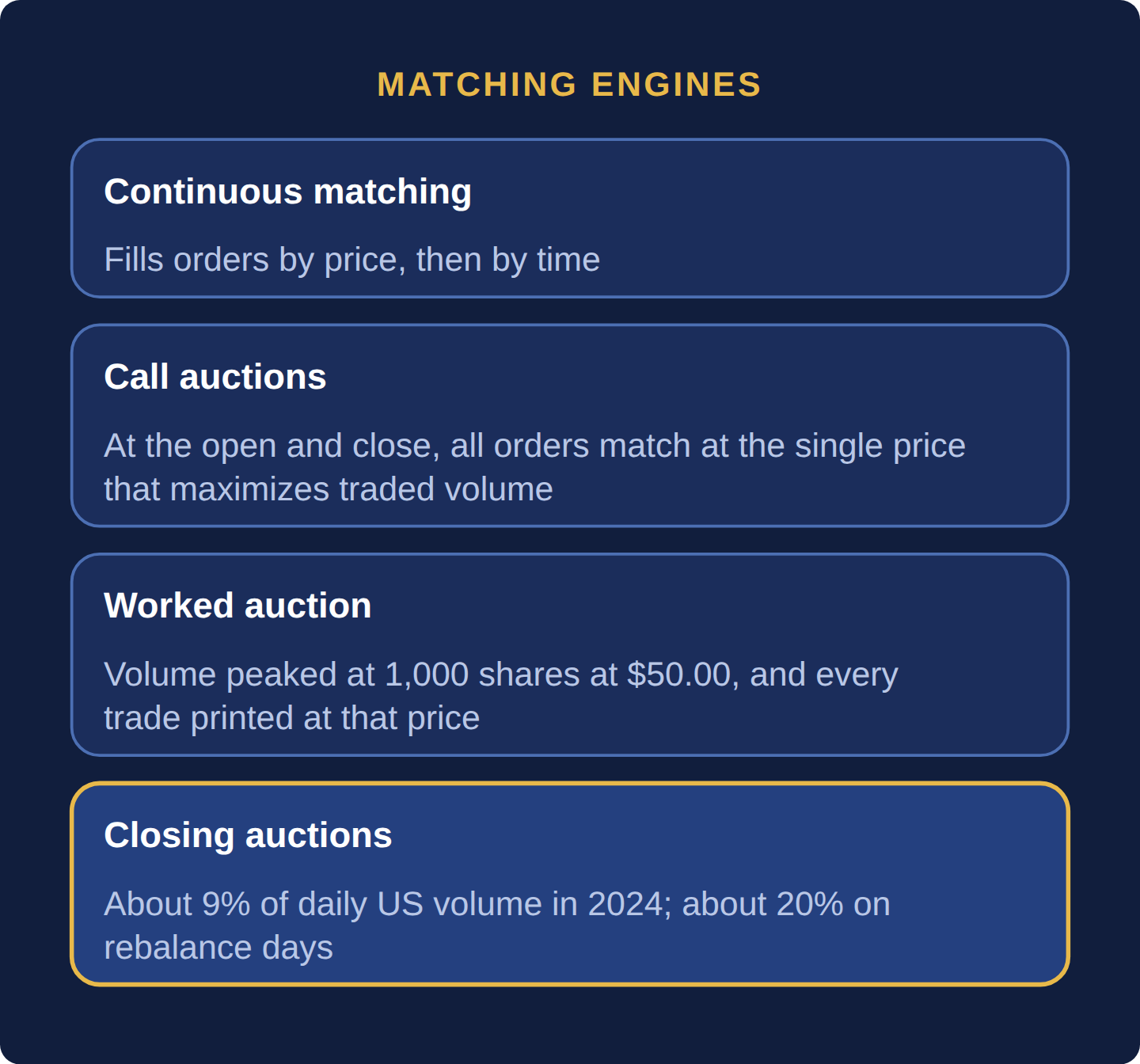
Most trading is matched continuously by two rules: best price first, and among equal prices, whoever was first in line. Exchanges also run call auctions at the open and close, which match all orders at the single price that allows the most shares to trade. And they halt or pause trading when prices move too far, too fast, to give people time to think.
Why it matters: The rules of the queue decide who trades and at what price.
Summary: Continuous matching fills orders by price, then by time. Exchanges also run call auctions at the open and close, which match all orders at the single price that maximizes traded volume, and they halt or pause trading when prices move too far, too fast.
- In the worked auction, executable volume peaked at 1,000 shares at $50.00, and every trade printed at that price.
- US closing auctions handled about 9% of daily volume in 2024 and about 20% on rebalance days.
- US market-wide circuit breakers trigger at 7%, 13% and 20% falls in the S&P 500; single stocks have Limit Up-Limit Down bands and five-minute pauses.
- The US moved stock settlement to T+1 on May 28, 2024; the EU plans the same on October 11, 2027.
- A large one-sided auction order can move the auction price; watch the published imbalance.
When multiple orders sit at the identical price in the order book, most exchanges use price-time priority to decide which order executes first: orders at a better price always execute before orders at a worse price, and among orders at the identical price, the order that arrived first in time is filled first. The exchange’s matching engine is the software system continuously applying this rule, processing incoming orders and executing matches, typically within microseconds — the exact infrastructure that high-frequency trading (5.6) is built to interact with as fast as physically possible.
Continuous matching is not the only design. A call auction collects orders for a period without executing any, then matches them all at one price: the price at which the largest number of shares can trade. US exchanges open and close each day with auctions, and the official closing price that index funds and fund valuations use comes from the closing auction. In 2024 US closing auctions matched about $50 billion on a typical day, roughly 9% of daily volume, and about 20% on index-rebalance and options-expiration days (BMLL, U.S. closing auction dynamics (June 2025)). Auctions pool liquidity at one moment, which is why large passive orders favor them.
Buy orders: 200 at $50.10, 300 at $50.05, 500 at $50.00, 400 at $49.95. Sell orders: 300 at $49.90, 300 at $49.95, 400 at $50.00, 500 at $50.10. At each candidate price, demand is every buy limit at or above it; supply is every sell limit at or below it.
| Price | Shares demanded | Shares supplied | Executable | Imbalance |
|---|---|---|---|---|
| $49.90 | 1,400 | 300 | 300 | 1,100 buy |
| $49.95 | 1,400 | 600 | 600 | 800 buy |
| $50.00 | 1,000 | 1,000 | 1,000 | 0 |
| $50.05 | 500 | 1,000 | 500 | 500 sell |
| $50.10 | 200 | 1,500 | 200 | 1,300 sell |
Executable volume is the smaller of demand and supply, and it peaks at $50.00 with 1,000 shares. Every matched trade prints at $50.00, including the buyer who would have paid $50.10. Exchanges publish the running imbalance before the auction so that other traders can step in to offset it; when two prices tie on volume, rules pick the smaller imbalance and then the price nearer a reference price.
Exchanges also stop or slow matching when prices move too far, too fast. The US market-wide circuit breakers are set off by a fall in the S&P 500 from the prior close: 7% (Level 1) and 13% (Level 2) halt all trading for 15 minutes if hit before 3:25 p.m., and 20% (Level 3) closes the market for the day. If the index closed at 6,000, the levels would be 6,000 × 0.93 = 5,580, 6,000 × 0.87 = 5,220 and 6,000 × 0.80 = 4,800. For single stocks, Limit Up-Limit Down (LULD) blocks trades outside a band around the average price of the preceding five minutes, 5% for most Tier 1 stocks (members of the S&P 500 and Russell 1000 and some exchange-traded products), with wider bands for other and low-priced shares; if the price stays at the band for 15 seconds, trading pauses for five minutes and resumes with an auction. For a large stock at $50, the band is $47.50 to $52.50. LULD was introduced after the 2010 Flash Crash (Section 5.6: How High-Frequency Trading Actually Captures Its Edge) exposed how far single stocks could fall in minutes.
After matching comes settlement, when cash and shares change hands through a clearing house. The US moved stock settlement from two business days after the trade (T+2) to one (T+1) on May 28, 2024 (SEC press release 2023-29), shortening the clearing house’s exposure to a member’s default. The EU plans the same move on October 11, 2027, with the UK and Switzerland moving in step. T+1 is the US standard cycle and there is no same-day (T+0) standard; India offers T+0 as an option (see the India Lens).
If you must trade at the official close (index tracking, fund valuation, a closing benchmark), use market-on-close or limit-on-close orders in the closing auction rather than trading in the final minutes. If your order exceeds about 5% of expected auction volume, use a limit-on-close and watch the published imbalance. For small orders in liquid stocks the difference is a few basis points and can be ignored.
Assuming a generous auction limit cannot move the price. In the example, the buyer of 200 shares at $50.10 paid $50.00. Had the buyer sent 2,000 shares at $50.10, executable volume would have peaked at 1,500 shares at $50.10, so the auction would have cleared $0.10 higher, costing 1,500 × 0.10 = $150 more on this tiny book and proportionally more on a real one. Check the imbalance before sizing an auction order.
What is a closing auction?
It is a call auction at the end of the day that matches all closing orders at one price, the price that maximizes shares traded. That price becomes the official close used by index funds and fund valuations, which is why a large share of daily volume concentrates there.
What happens when a circuit breaker is triggered?
In the US, a 7% or 13% fall in the S&P 500 before 3:25 p.m. halts all stock trading for 15 minutes, and a 20% fall closes the market for the day. A single-stock Limit Up-Limit Down pause stops trading for five minutes, then reopens with an auction.
What does T+1 settlement mean?
The trade settles one business day after the trade date, when shares reach the buyer and cash reaches the seller. The US moved from T+2 to T+1 on May 28, 2024, which shortens the time a clearing house is exposed if a member fails.
Matching engines fill orders by price and then time, while call auctions at the open and close match all orders at the price that maximizes volume. Circuit breakers and Limit Up-Limit Down bands halt or pause trading in fast markets, and US stocks have settled on T+1 since May 28, 2024.
Six questions on this chapter. Decide on your answer first, then click “Reveal Answer.”
1. In a call auction, cumulative demand is 900 shares at $10.00 and 600 at $10.05; cumulative supply is 700 at $10.00 and 1,100 at $10.05. Which price clears the auction?
- $10.00, with 900 shares executed
- $10.05, with 600 shares executed
- $10.05, with 1,100 shares executed
- $10.00, with 700 shares executed
Reveal Answer
Answer: D. Executable volume is the smaller of demand and supply: 700 at $10.00 and 600 at $10.05, so $10.00 maximizes volume.
2. The S&P 500 closed at 5,000. At what level does a US Level 2 market-wide circuit breaker trigger?
- 4,350
- 4,000
- 4,650
- 4,500
Reveal Answer
Answer: A. Level 2 is a 13% fall: 5,000 × 0.87 = 4,350.
3. What happens when a Limit Up-Limit Down band is reached and the price stays there for 15 seconds?
- The exchange closes that stock until the next day
- The stock’s trades for the day are canceled
- Trading in that stock pauses for five minutes
- All US stock trading halts for 15 minutes
Reveal Answer
Answer: C. LULD pauses trading in the single stock for five minutes, then reopens it with an auction.
4. When did US stock settlement move from T+2 to T+1?
- September 5, 2017
- May 28, 2024
- January 27, 2023
- October 11, 2027
Reveal Answer
Answer: B. The SEC’s T+1 rule had a compliance date of May 28, 2024; January 2023 is India’s T+1 date and October 2027 the EU’s planned date.
5. Worked problem: Buy orders: 400 at $50.10, 700 at $50.05, 500 at $50.00. Sell orders: 300 at $49.95, 600 at $50.00, 500 at $50.05. At which single price is traded volume highest?
Reveal Answer
Answer: Executable volume: $49.95: 300, $50.00: 900, $50.05: 1100, $50.10: 400. The maximum is 1100 shares at $50.05.
6. Worked problem: US closing auctions handled about 9% of a day’s volume. On a 10m-share day, and on a rebalance day when it is 20%, how many shares is that?
Reveal Answer
Answer: 9% × 10m = 900,000 shares; 20% × 10m = 2,000,000 shares.
- Glosten & Milgrom (1985), Bid, ask and transaction prices in a specialist market with heterogeneously informed traders, Journal of Financial Economics — The model in which the spread compensates for trading against informed traders
- Kyle (1985), Continuous Auctions and Insider Trading, Econometrica — The model of how informed trading moves prices
- SEC press release 2023-29, T+1 settlement — US T+1 compliance date
- Investor.gov, Stock market circuit breakers — US market-wide breakers and LULD