
4.1 Why Multinational Tax Structuring Exists
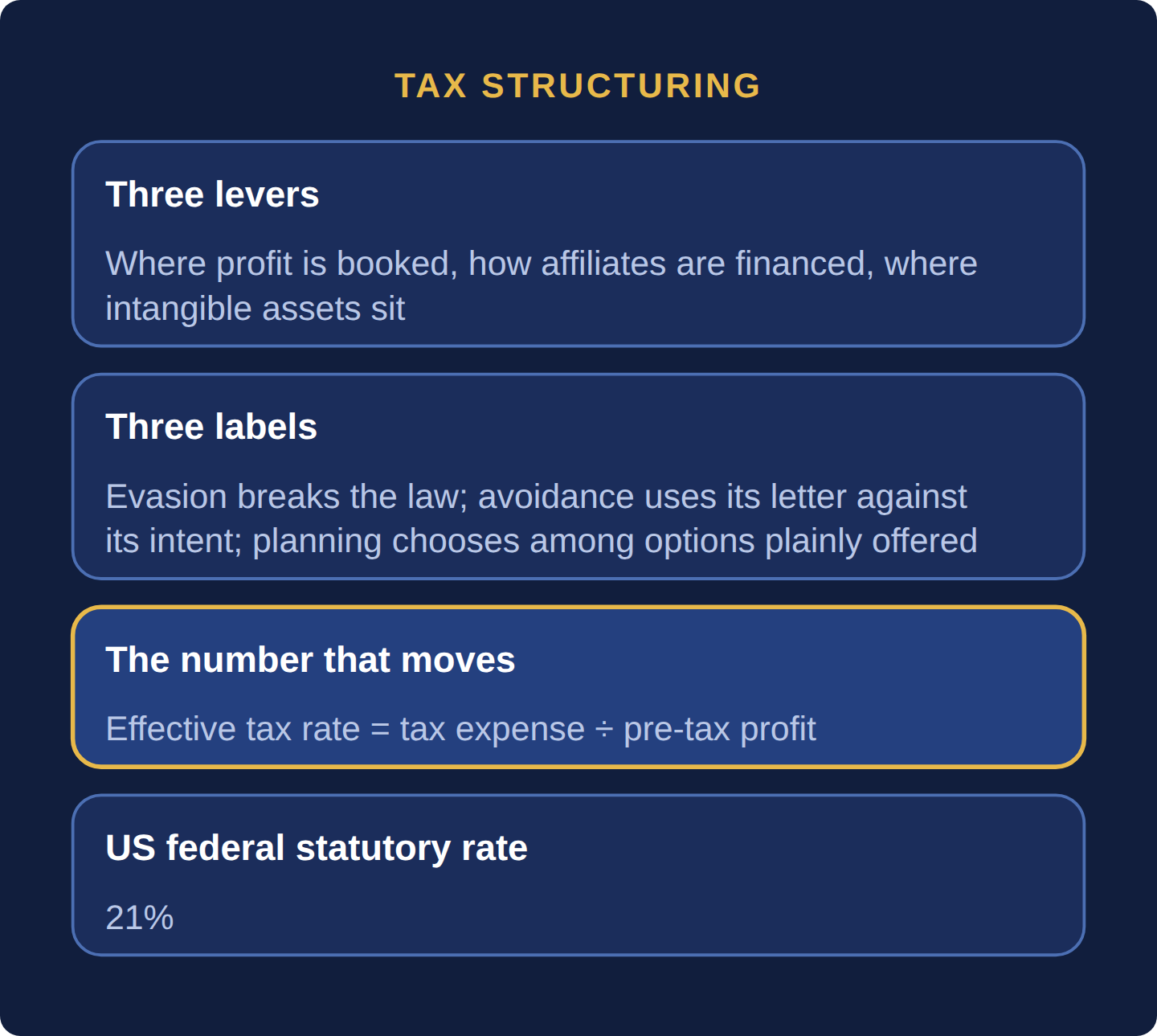
Multinational companies plan their taxes with three levers: where profit is booked, how affiliates are financed and where intangible assets sit. Since 2015, each lever has met a counter-rule. So the real saving from a structure is only what survives transfer pricing review, controlled foreign company rules and the 15% minimum tax, which is usually far less than the headline gap between tax rates.
Why it matters: The tax rate on paper is not the tax saved in practice.
Summary: Multinationals structure their tax affairs by choosing where profit is booked, how affiliates are financed and where intangible assets sit. Since 2015 each lever has met a counter-rule, so a structure’s real saving is what survives transfer pricing review, controlled foreign company rules and the 15% minimum tax, usually far less than the headline rate gap.
- Evasion breaks the law; avoidance uses the letter of the law against its intent; planning chooses among options the law plainly offers.
- The effective tax rate (tax expense ÷ pre-tax profit) is the number structuring moves; the US federal statutory rate is 21%.
- In the worked example an $8.4 million headline saving shrinks to $3.36 million after the US CFC charge and to $2.4 million after a 15% domestic minimum tax.
- If the low-tax affiliate has no staff, a §482 reallocation plus a 40% penalty can turn the plan into a $9.36 million loss.
- Value every structure after the counter-rules, and put real people where the profit is booked.
A multinational company operates across many countries, each with its own tax rate and rules — and every legitimate business decision about where to locate a factory, a headquarters, or intellectual property has a tax consequence attached to it. Tax structuring is the legitimate, legal practice of arranging a multinational’s operations, financing, and intercompany transactions in a way that manages its overall tax position efficiently — distinct from tax evasion (illegally concealing income or falsifying records), though, as Section 4.7: Where Efficiency Ends and Avoidance Begins explains, the line between efficient structuring and the aggressive avoidance that regulators target is contested and has moved sharply since 2015.
Three terms need to be kept apart. Tax evasion breaks the law. Tax avoidance uses the letter of the law to cut tax in ways the legislature did not intend; it is legal until a court or a specific anti-abuse rule says otherwise. Tax planning chooses among options the law plainly offers, such as building a plant where a tax incentive exists. The number that captures the result is the effective tax rate (ETR): tax expense divided by pre-tax profit. A US group’s ETR can sit well below the 21% federal statutory rate (26 U.S.C. §11) when part of its profit is reported in lower-tax countries.
Structuring works through three levers. The first is where profit is booked: the prices group companies charge each other (transfer pricing, Sections 4.2 and 4.3) decide which entity keeps the margin. The second is how entities are financed: interest paid by a subsidiary in a high-tax country is deductible there, while the affiliate that lent the money may be taxed lightly, so debt moves profit as surely as prices do. The third is where intangible assets sit: patents, software and brands earn royalties that flow to whichever affiliate owns them. Since 2015 each lever has acquired a counter-rule: transfer pricing that follows people rather than contracts, caps on interest deductions, anti-hybrid and controlled foreign company rules (Section 4.5: Base Erosion and Profit Shifting (BEPS)), and a 15% minimum tax (Section 4.6: The Global Minimum Tax (Pillar Two)). The rest of this Part is about how those levers and counter-rules interact.
Take a US group that moves $40 million of annual profit into an affiliate in a zero-tax jurisdiction. The headline saving is the US rate on the profit moved: $40,000,000 × 21% = $8,400,000. Two counter-rules shrink it.
- The US controlled foreign company charge. From tax years beginning after December 31, 2025, a US shareholder pays current US tax on most of its foreign subsidiaries’ active income (“net CFC tested income,” the renamed GILTI regime) after a 40% deduction, an effective rate of 21% × (1 − 0.40) = 12.6%. US tax on the $40 million: $40,000,000 × 12.6% = $5,040,000. Saving left: $8,400,000 − $5,040,000 = $3,360,000.
- A domestic minimum tax in the low-tax country. If that country adopts a 15% qualified domestic minimum top-up tax (Section 4.6: The Global Minimum Tax (Pillar Two)), it collects $40,000,000 × 15% = $6,000,000. The US credits 90% of foreign taxes against the CFC charge: 90% × 15% = 13.5%, which exceeds 12.6%, so no US tax remains. Total tax: 15%. Saving left: ($40,000,000 × 21%) − $6,000,000 = $2,400,000, less than a third of the headline.
The simplifications matter: this ignores expense allocation, the minimum tax’s payroll-and-assets carve-out, and timing. The lesson does not depend on them. Every structure has to be valued after the counter-rules, and the residual $2.4 million survives only if the affiliate has the people to justify its profit under the arm’s length principle (Section 4.2: The Arm’s Length Principle).
Value a structure after the counter-rules, never before. Recompute the saving in three steps: (1) if the group’s consolidated revenue is at least €750 million in two of the four preceding years, apply 15% in every jurisdiction that has a qualified domestic minimum top-up tax, and in every jurisdiction if the group does not elect the side-by-side safe harbor available to US-parented groups since January 2026 (Section 4.6: The Global Minimum Tax (Pillar Two)); (2) apply the home country’s controlled foreign company charge (12.6% for US groups from 2026, before credits); (3) assume the tax authority reallocates profit to the entity whose people make the key decisions. If the saving that remains is smaller than the expected cost of a challenge (probability × (tax + interest + penalty + any foreign tax that cannot be recovered)), do not proceed. If it survives, proceed only when staff, assets and decisions sit where the profit is booked.
When to set the rule aside: ordinary location choices made for nontax reasons (a plant near customers, a hub near talent) need no such test; the tax result is a byproduct, and documenting the business reason is enough.
Budgeting the headline rate gap and booking profit where no one works. In the example above the board is shown an $8.4 million saving; the real figure is $2.4 million. Suppose the zero-tax affiliate has no staff and the IRS reallocates the full $40 million back to the US parent under 26 U.S.C. §482. The group owes the US tax it hoped to avoid, $8,400,000. Assume the US parent has $500 million of gross receipts. Because the $40 million adjustment exceeds the lesser of $20 million or 20% of gross receipts ($500 million × 20% = $100 million, so $20 million applies), the 40% gross valuation misstatement penalty can apply: 40% × $8,400,000 = $3,360,000. The $6,000,000 already paid in the affiliate’s country is not automatically refunded. Cost beyond simply never doing the deal: $3,360,000 + $6,000,000 = $9,360,000, almost four times the saving actually available.
How to avoid it: show the board the after-counter-rule figure, put real functions in the affiliate before profit goes there, and keep contemporaneous transfer pricing documentation, which can remove the penalty (Section 4.2: The Arm’s Length Principle).
Is tax avoidance legal?
Usually yes, until a specific rule or a court says otherwise. Tax evasion, which hides income or falsifies records, is a crime. Avoidance stays within the words of the law, but anti-abuse rules let authorities disregard arrangements that lack real substance: in the US the economic substance doctrine, codified in 2010 as 26 U.S.C. §7701(o), and in treaties the principal purpose test (Section 4.4: Tax Treaties and Double Taxation Relief). The practical question is not “is it legal?” but “will it survive a challenge?”
What is the difference between the statutory and the effective tax rate?
The statutory rate is the rate written in the law; the effective rate is what a company actually pays relative to its profit. The US federal statutory rate is 21%. A group’s effective rate is its tax expense divided by pre-tax profit, so it falls when profit is earned in lower-tax countries or reduced by credits and deductions, and rises when expenses are disallowed or foreign taxes cannot be credited.
Why can multinationals pay lower tax rates than domestic companies?
Because only a multinational can choose which country reports its profit. A domestic firm pays its home rate on everything. A multinational can price intra-group sales, loans and royalties so that more profit lands in lower-tax affiliates. How much profit actually moves this way is disputed: estimates range from a small share of corporate tax revenue to more than a third of multinational profits (Section 4.5: Base Erosion and Profit Shifting (BEPS)).
Multinational tax structuring works through three levers (where profit is booked, how affiliates are financed and where intangibles sit), and since 2015 each has a counter-rule. In the worked example a headline saving of $8.4 million shrinks to $2.4 million after the US CFC charge and a 15% domestic minimum tax, and becomes a loss if the affiliate has no staff, so value structures after the counter-rules.
Six questions on this chapter. Decide on your answer first, then click “Reveal Answer.”
1. A US group moves $40 million of annual profit into a zero-tax affiliate. From 2026 the US charges net CFC tested income at an effective 12.6%, and the affiliate’s country levies no tax. How much US tax does the move save each year compared with taxing the profit at 21%?
- $5.04 million
- $8.4 million
- $2.4 million
- $3.36 million
Reveal Answer
Answer: D. Headline saving $40m × 21% = $8.4m, less the CFC charge $40m × 12.6% = $5.04m, leaves $3.36m.
2. Which description fits tax avoidance rather than tax evasion or ordinary tax planning?
- Hiding income from the tax authority to reduce the tax owed for the year
- Using the law’s wording to cut tax in ways the legislature did not intend
- Building a plant where the law expressly offers a tax incentive for it
- Paying tax late after filing an accurate and complete annual return
Reveal Answer
Answer: B. Evasion is concealment and illegal; planning picks options the law plainly offers; avoidance exploits the wording against its intent and is legal until a rule or court says otherwise.
3. A group reports pre-tax profit of $200 million and tax expense of $30 million. What is its effective tax rate?
- 17.6%
- 12.6%
- 15%
- 21%
Reveal Answer
Answer: C. Effective tax rate = tax expense ÷ pre-tax profit = $30m ÷ $200m = 15%, regardless of the 21% statutory rate.
4. Why does a 15% domestic minimum tax in the affiliate’s country leave no residual US charge on net CFC tested income?
- The 90% credit on 15% foreign tax, 13.5%, exceeds the 12.6% US rate
- The CFC charge applies only to profit taxed below 10% abroad
- The foreign tax is credited in full against the 21% statutory rate
- US law exempts any income already taxed under a domestic minimum tax
Reveal Answer
Answer: A. Only 90% of foreign tax is creditable: 90% × 15% = 13.5%, which more than covers the 12.6% effective US charge.
5. Worked problem: A group earns $600m before tax and pays $120m of tax. What is its effective tax rate?
Reveal Answer
Answer: ETR = tax expense ÷ pre-tax profit = $120m ÷ $600m = 20%.
6. Worked problem: Booking $100m of profit in a 9% jurisdiction instead of a 21% one saves how much tax?
Reveal Answer
Answer: Saving = $100m × (21% − 9%) = $12 million, before counter-rules such as a minimum tax.
4.2 The Arm's Length Principle
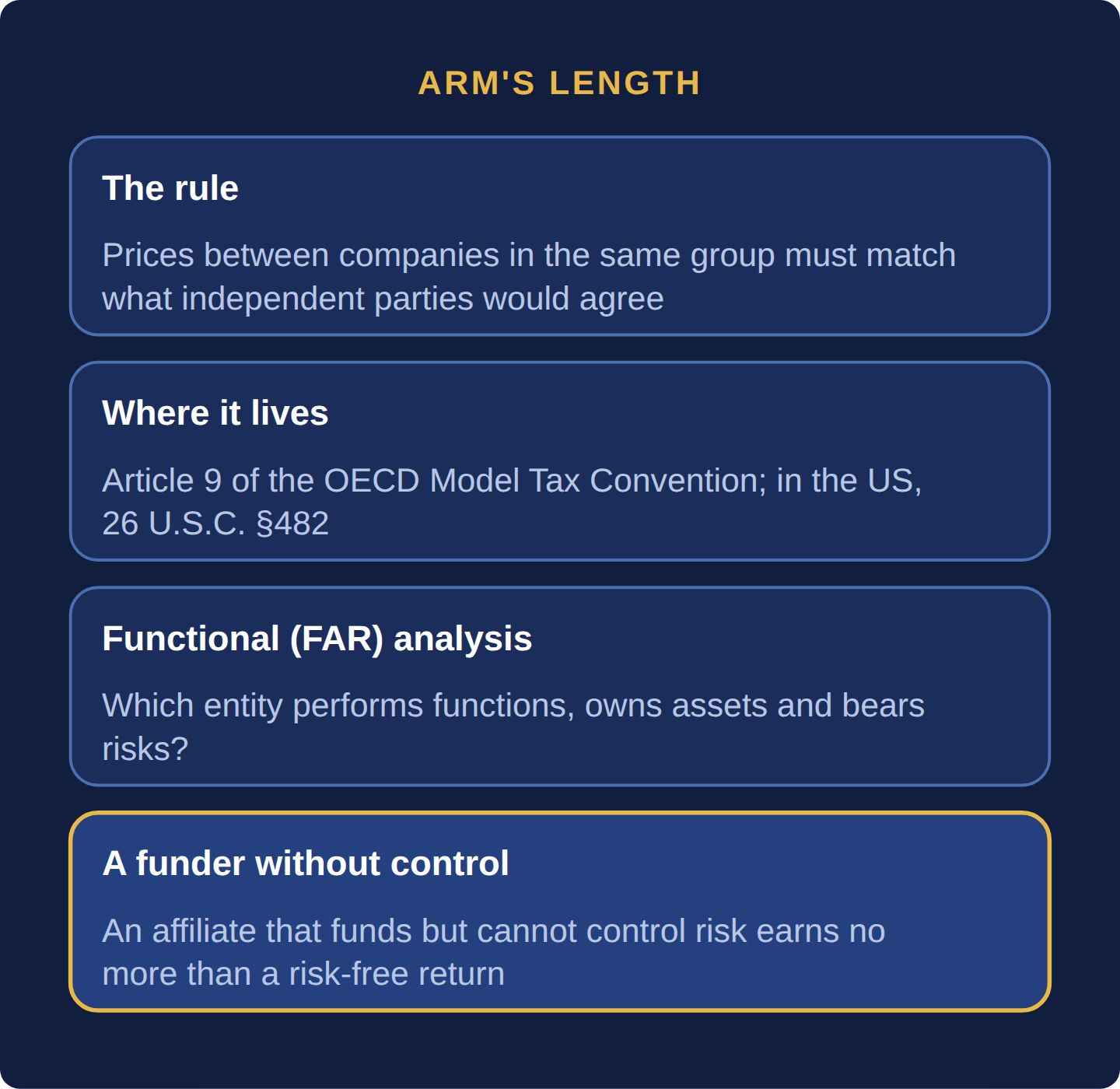
The arm’s length principle says that when two companies in the same group trade with each other, the price must match what independent parties would agree. Otherwise a group could shift profit by pricing deals between its own members. It sits in Article 9 of the OECD Model Tax Convention and, in the US, in 26 U.S.C. §482. Since the 2015 BEPS revisions, profit follows the people who control the risks and perform the key functions, not just the contracts.
Why it matters: A contract on paper no longer decides where profit is taxed.
Summary: The arm’s length principle requires prices between companies in the same group to match what independent parties would agree. It lives in Article 9 of the OECD Model Tax Convention and, in the US, in 26 U.S.C. §482; since the 2015 BEPS revisions, profit follows the people who control risks and perform DEMPE functions, not the contracts.
- A functional (FAR) analysis asks which entity performs functions, owns assets and bears risks.
- An affiliate that funds but cannot control risk earns no more than a risk-free return.
- US penalties of 20% or 40% apply to large §482 adjustments; contemporaneous documentation produced within 30 days removes them.
- The OECD formally rejects global formulary apportionment (Guidelines paragraph 1.32).
- In the worked example a $25 million adjustment carries a $2.1 million penalty that documentation would have avoided.
The foundational rule governing nearly all international tax structuring is the arm’s length principle: transactions between related entities within the same multinational group (a US parent company selling goods to its own Indian subsidiary, for instance) must be priced as if the two parties were independent, unrelated businesses negotiating at arm’s length — not artificially priced simply to shift profit toward whichever jurisdiction has the lowest tax rate.
Every major tax authority in the world has adopted some version of the arm’s length principle as its foundational transfer pricing rule, precisely because without it, a multinational could trivially shift all its reported profit into whichever single jurisdiction offers the lowest tax rate, regardless of where genuine economic activity actually occurred — this is exactly the concern the Finance Function companion guide flagged as one of the most scrutinized areas a Tax Director manages.
The principle has two legal homes. Between countries it is Article 9 of the OECD Model Tax Convention (“Associated Enterprises”), which almost every bilateral treaty copies, interpreted through the OECD Transfer Pricing Guidelines (2022 edition). Inside the US it is 26 U.S.C. §482, which lets the IRS reallocate income among commonly controlled businesses, and the Treasury regulations under it. Both start from the same question: what would independent parties have agreed, given what each party actually does?
That question is answered with a functional analysis, often called a FAR analysis: which entity performs which functions, owns which assets, and bears which risks. Since the 2015 BEPS revisions, the Guidelines tell tax authorities to “accurately delineate” the transaction from the parties’ conduct, not just their contracts. A contract that assigns a risk to an affiliate is respected only if that affiliate controls the risk and has the financial capacity to bear it. For intangibles, the return follows the people who perform the DEMPE functions (development, enhancement, maintenance, protection and exploitation), not the name on the patent register. An affiliate that only provides money, without the capability to control the investment risk, is entitled to no more than a risk-free return.
An affiliate in a low-tax country funds $500 million of research and legally owns the resulting patents. It has two employees who approve payments; every research decision is made by engineers and managers at the US parent. Group companies pay the affiliate $120 million a year in royalties.
Under the post-2015 framework, the affiliate funds but does not control the risk, so it earns a risk-free return on its money. At an illustrative 4% rate: $500,000,000 × 4% = $20,000,000. The rest, $120,000,000 − $20,000,000 = $100,000,000 a year, belongs to the entity that performs the DEMPE functions and can be reallocated there. Before 2015, a well-drafted contract and legal ownership often sufficed to keep the full $120 million offshore; that is the gap the reform closed.
Enforcement in the US has teeth. Under 26 U.S.C. §6662(e) and (h), a 20% penalty applies when net §482 adjustments for the year exceed the lesser of $5 million or 10% of gross receipts, and 40% when they exceed the lesser of $20 million or 20% of gross receipts. The main defense is documentation: adjustments are excluded from the penalty calculation if the taxpayer used a specified method reasonably, had documentation in existence when the return was filed, and hands it over within 30 days of an IRS request. The arm’s length principle has a theoretical rival, global formulary apportionment, which would split a group’s consolidated profit among countries by a fixed formula (for example, sales, payroll and assets). OECD members formally reject it in the Guidelines (paragraph 1.32) because countries would never agree on one formula, though the Pillar One negotiations moved partway toward it before stalling (Section 4.5: Base Erosion and Profit Shifting (BEPS)).
For every intercompany flow, name the people who control the risk. If the entity that books the profit can point to employees who make and can reverse the key decisions (what to develop, which markets to enter, whether to fund), price it as the entrepreneur that earns the residual. If it cannot, price it as what it is: a routine service provider (cost plus a markup), a routine distributor (a modest return on sales), or a passive funder (a risk-free return). Have the documentation finished by the return’s filing date and ready to deliver within 30 days of a request.
When to look further: where two or more entities each control important risks or own unique intangibles, no single entity is “routine,” and a profit split (Section 4.3: Transfer Pricing Methods) is likely the more reliable answer.
Treating documentation as an after-the-fact filing chore. Suppose the IRS makes a $25 million net §482 adjustment against a US company with $400 million of gross receipts. The 40% threshold is the lesser of $20 million or 20% × $400,000,000 = $80,000,000, so $20 million applies, and $25 million exceeds it. Extra tax: $25,000,000 × 21% = $5,250,000. Penalty: 40% × $5,250,000 = $2,100,000. Had a reasonable method been documented before filing and produced within 30 days, the adjustment would have been excluded from the penalty computation and the penalty would have been $0. The tax is owed either way; the $2.1 million is the price of late paperwork.
What is transfer pricing in simple terms?
Transfer pricing is the setting of prices for sales, services, loans and licenses between companies in the same group. Because those prices decide how much profit each country can tax, tax authorities require them to match what independent parties would charge. The issue is not whether a group may trade with itself, which is normal, but whether the price moves profit away from where the work is done.
Is an arm’s length price the same as the market price?
Often, but not always. Where an identical product trades between unrelated parties, the market price is the best evidence. Many intra-group transactions have no market (a license of a unique patent, a guarantee of an affiliate’s debt), so the arm’s length result is inferred from comparable companies’ margins or from how independent parties would split the profit. The result is usually a range, not a single number.
What happens if two countries disagree about the right price?
The same profit can be taxed twice, once by each country. Treaties provide a mutual agreement procedure in which the two tax authorities negotiate to remove the double tax, and companies can negotiate an advance pricing agreement to settle the method before any dispute arises (Section 4.4: Tax Treaties and Double Taxation Relief). Both take years, so prevention through documentation is cheaper.
The arm’s length principle prices intra-group transactions as independent parties would, and since 2015 profit follows the people who control risks and perform DEMPE functions rather than the contracts. In the US, §482 adjustments above set thresholds carry 20% or 40% penalties that contemporaneous documentation removes.
Six questions on this chapter. Decide on your answer first, then click “Reveal Answer.”
1. An affiliate funds $300 million of research but has no staff able to control the research risk. Group companies pay it $50 million a year in royalties, and the risk-free rate is 4%. Under the post-2015 OECD Guidelines, what is the most the affiliate should keep each year?
- $12 million
- $38 million
- $0
- $50 million
Reveal Answer
Answer: A. A funder that cannot control the risk earns no more than a risk-free return: $300m × 4% = $12m; the other $38m belongs to the entity performing the DEMPE functions.
2. The IRS makes an $8 million net §482 adjustment against a company with $200 million of gross receipts, which had no qualifying documentation. At a 21% tax rate, what is the valuation misstatement penalty?
- $672,000
- $0
- $1,680,000
- $336,000
Reveal Answer
Answer: D. $8m exceeds the 20% threshold (lesser of $5m or $20m) but not the 40% one (lesser of $20m or $40m). Extra tax $8m × 21% = $1.68m; penalty 20% × $1.68m = $336,000.
3. What do the DEMPE functions cover when profit from intangibles is allocated?
- Distribution, enforcement, management, pricing and valuation of rights
- Development, enhancement, maintenance, protection and exploitation
- Development, enforcement, monitoring, patenting and earnings retention
- Design, engineering, marketing, production and export of the product
Reveal Answer
Answer: B. The Guidelines tie returns on intangibles to whoever performs and controls development, enhancement, maintenance, protection and exploitation, not to legal ownership alone.
4. Why do OECD members reject global formulary apportionment as an alternative to the arm’s length principle?
- Consolidated group accounts cannot supply the data a formula needs
- A formula would move most taxable profit into the low-tax countries
- Countries would have to agree on one formula, which they have not
- Article 9 of every tax treaty explicitly prohibits using a formula
Reveal Answer
Answer: C. Guidelines paragraph 1.32 rejects it; the core objection is that a formula only works if all countries adopt the same one, which has never been agreed.
5. Worked problem: An affiliate makes goods at a cost of $80 each and the group uses a cost-plus markup of 8%. What is the arm’s length transfer price?
Reveal Answer
Answer: Price = $80 × 1.08 = $86.40.
6. Worked problem: A distributor earns a 12% markup on total costs of $50m. The comparables’ interquartile range is 5% to 9% with a median of 7%. What adjustment would US rules make?
Reveal Answer
Answer: 12% is outside the range, so results are adjusted to the median: (5%) × $50m = $2.5m of profit moved.
- 26 U.S.C. §11
- 26 U.S.C. §6662, Imposition of accuracy-related penalty on underpayments — Transfer pricing penalty thresholds and 30-day documentation rule; 20%/40% economic substance penalty
- Treasury Regulation 1.482-1