
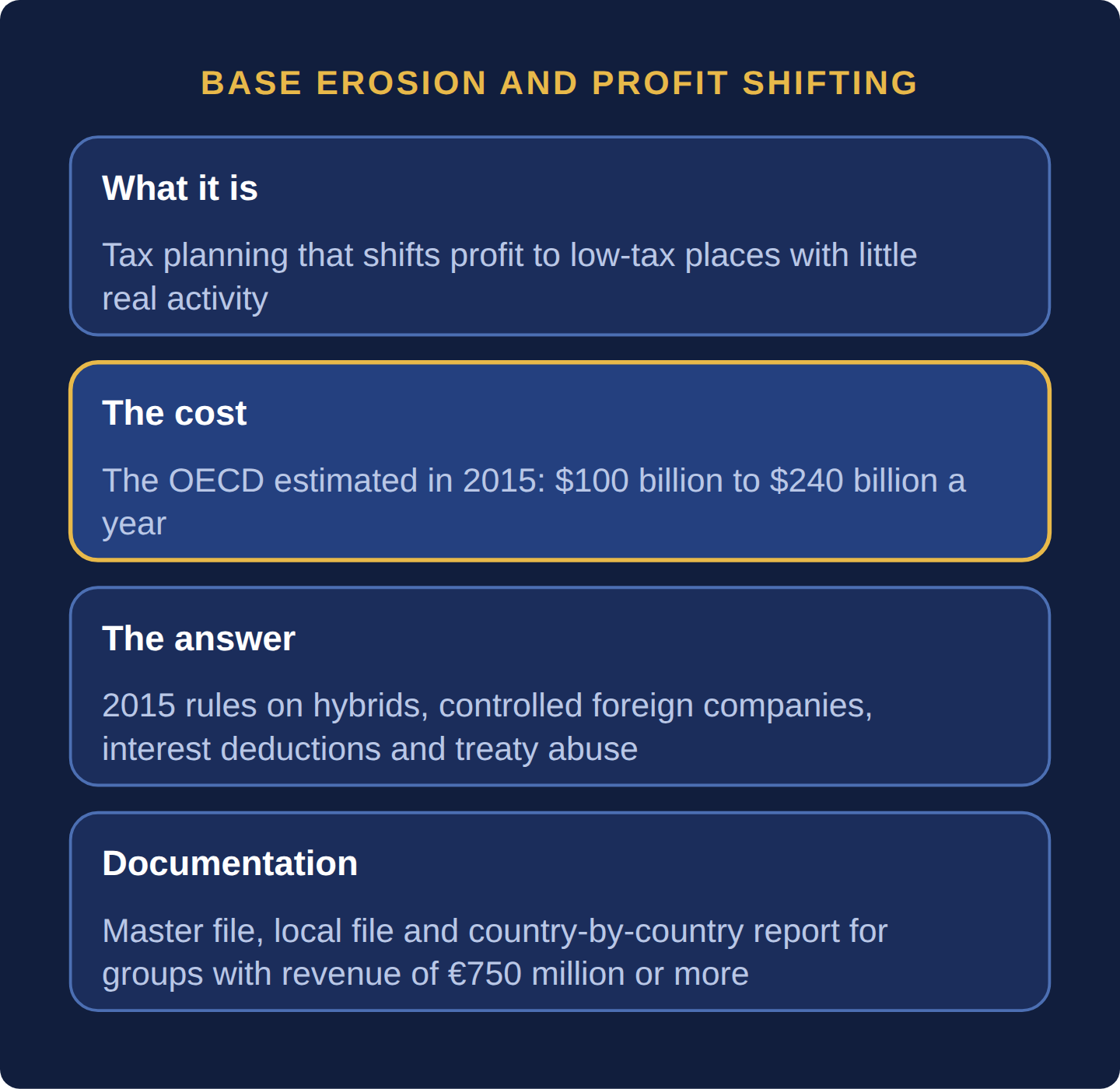
BEPS stands for base erosion and profit shifting. It means moving profit to low-tax places where there is little real activity. In 2015 the OECD and G20 answered with rules on hybrid arrangements, controlled foreign companies, interest deductions, treaty abuse and transparency. Pillar One’s plan to reallocate profit to market countries has stalled, but its Amount B simplification for routine distributors survives.
Why it matters: The aim is for profit to be taxed where the real activity happens.
Summary: BEPS is tax planning that shifts profit to low-tax places with little real activity, and the OECD/G20 project that answered it in 2015 with rules on hybrids, controlled foreign companies, interest deductions, treaty abuse and transparency. Pillar One’s market-country reallocation has stalled; its Amount B simplification for routine distributors survives.
- The OECD estimated in 2015 that profit shifting cost $100 billion to $240 billion a year.
- Three-tier documentation means a master file, a local file and a country-by-country report for groups with revenue of €750 million or more.
- US anti-hybrid rules (§267A) and the 30% interest cap (§163(j)) are the domestic versions of Actions 2 and 4.
- Estimates of shifted profit range from about 36% of multinational profits to far smaller figures, depending on how the data are corrected.
- Amount B prices baseline distribution at a 1.5% to 5.5% return on sales where countries adopt it.
Base Erosion and Profit Shifting (BEPS) refers to tax planning that exploits gaps and mismatches between countries’ tax rules to shift profit to low- or no-tax jurisdictions where little real economic activity takes place, eroding the tax base of the countries where the value was created. After the 2008 crisis, public and political concern about large multinationals paying very low effective tax rates led the G20 to ask the OECD for a coordinated BEPS Action Plan (2013), whose 15 actions were delivered as a final package in October 2015. The measures are now carried forward by the OECD/G20 Inclusive Framework on BEPS, which had 148 member jurisdictions as of January 2026. They include country-by-country reporting, limits on interest deductions, rules against hybrid mismatches and treaty abuse, and, the most far-reaching later outcome, the global minimum tax covered next.
When the OECD presented the final BEPS reports to G20 finance ministers in October 2015, it estimated that profit shifting cost governments $100 billion to $240 billion a year, 4% to 10% of global corporate income tax revenue. The package attacked the three levers of Section 4.1: Why Multinational Tax Structuring Exists with matching rules, most of which the US has its own version of:
- Hybrid mismatch rules (Action 2). A hybrid mismatch exploits a payment or entity that two countries classify differently: one country treats an instrument as debt and allows an interest deduction, the other treats the same payment as an exempt dividend, so the income is taxed nowhere. Since 2018, 26 U.S.C. §267A denies a US deduction for related-party interest or royalties paid under a hybrid transaction or to a hybrid entity when the payment is not taxed, or is deducted again, abroad.
- Controlled foreign company (CFC) rules (Action 3). These tax a parent currently on certain income of its foreign subsidiaries, so parking profit offshore does not defer home tax. The US version, renamed net CFC tested income from 2026, applies an effective 12.6% rate (21% after a 40% deduction) and credits 90% of foreign taxes, so foreign tax of at least 12.6% ÷ 0.9 = 14% removes the US charge.
- Interest limitation (Action 4). The US caps net business interest deductions at 30% of adjusted taxable income (26 U.S.C. §163(j)); for tax years after 2024 depreciation and amortization are again added back, making the base close to EBITDA.
On transparency, Action 13 created the three-tier documentation standard: a master file describing the group’s global business and transfer pricing policies, a local file on each entity’s material intercompany transactions, and the country-by-country report (CbCR). CbCR applies to groups with consolidated revenue of at least €750 million (US filers use Form 8975 at $850 million). The OECD expected the threshold to exempt 85% to 90% of multinational groups while still covering about 90% of corporate revenue.
Pillar One was the attempt to go further. Its Amount A would have reallocated part of the largest groups’ residual profit to the countries where their customers are, regardless of physical presence, in exchange for the repeal of national digital services taxes. Its multilateral convention was never signed, and on February 19, 2026, US Treasury officials said publicly that Pillar One is “dead” and that there is no longer a two-pillar solution. With the trade-off gone, countries feel free to keep or introduce digital services taxes, which the US treats as discriminatory and has threatened to answer with trade measures. What survives is Amount B, a simplified approach for baseline wholesale distributors: a pricing matrix sets a return on sales between 1.5% and 5.5% by industry and the distributor’s asset and expense intensity, with an operating-expense cross-check. Countries may apply it for fiscal years beginning on or after January 1, 2025. It is optional: Inclusive Framework members committed in June 2024 to respect the Amount B result where a listed lower-capacity “covered jurisdiction” applies it, and to take reasonable steps to relieve double taxation, but elsewhere the other country can still contest the price.
Country-by-country reporting — requiring large multinationals to disclose revenue, profit, and tax paid in every single country they operate in, submitted confidentially to tax authorities — was BEPS’s single most practically significant transparency measure, since it gave tax authorities worldwide, for the first time, a global view of exactly where a multinational’s profit was being reported relative to where its actual employees and operations were located.
The large estimate. Tørsløv, Wier and Zucman (The Missing Profits of Nations, Review of Economic Studies, 2022) compare the profitability of foreign-owned and local firms. Affiliates in tax havens are an order of magnitude more profitable relative to their wage bill: for US multinationals in 2015, pre-tax profits were 346% of wages in haven affiliates against 46% in non-haven affiliates. From gaps like this they estimate that 36% of multinational profits, about $616 billion of roughly $1.7 trillion in 2015, was shifted to tax havens.
The measurement critique. Blouin and Robinson (Double Counting Accounting, working paper, May 2020) argue that US international accounts data count the profit of indirectly owned affiliates more than once, inflating the profit that appears in holding-company jurisdictions. Applying their correction to an earlier study (Clausing, 2016) cuts the estimated US revenue loss for 2012 from $77–111 billion to about $10 billion, or from 30–45% to 4–8% of US corporate tax revenue.
What it means for you. Both camps agree that profit shifting exists and is concentrated in a few jurisdictions; they disagree on its size by a factor of several. The size matters for policy (how much revenue Pillar Two can raise) more than for practice: for a company, the relevant risk is its own transfer pricing, not the global total. Country-by-country reports, now filed by every large group, are the data that may eventually settle the question.
Read your own country-by-country report the way an auditor will. For each jurisdiction, divide its share of group profit by its share of employees and of tangible assets. Where profit share is several times the people-and-assets share (for example, 30% of profit with 2% of staff is 30% ÷ 2% = 15 times), expect a risk review, and make sure the master file explains which valuable functions or intangibles justify it. Where no such explanation exists, change the pricing or move the functions before the auditor asks. This is a screening heuristic, not a legal test: capital-intensive or IP-rich entities legitimately show high ratios.
Keeping a pre-2018 hybrid financing in place. A US subsidiary pays $50 million a year of interest to a foreign affiliate on an instrument the affiliate’s country treats as equity, so the receipt is an exempt dividend there. Before §267A, the US deduction saved $50,000,000 × 21% = $10,500,000 a year with no tax anywhere on the other side. Under §267A the deduction is disallowed: the group’s US tax rises by $10,500,000 a year, and if the return was filed claiming the deduction, interest and penalties follow. Inventory every intra-group instrument and entity classification on both sides of the border.
What is BEPS in simple terms?
BEPS stands for base erosion and profit shifting: tax planning that moves profit from countries where the work is done to countries where tax is low, often using gaps between countries’ rules. It also names the OECD/G20 project that produced countermeasures in 2015, including hybrid mismatch rules, interest limits, treaty anti-abuse rules and country-by-country reporting.
Does the US tax the foreign profits of US companies?
Partly, and immediately. From 2026, most active income of a US company’s foreign subsidiaries is taxed each year as net CFC tested income at an effective 12.6%, with credit for 90% of foreign taxes. Profits taxed abroad at about 14% or more generally owe no further US tax. Certain passive income is taxed in full under older CFC rules.
Who has to file a country-by-country report?
Groups with consolidated revenue of at least €750 million in the preceding fiscal year, under the OECD standard. In the US the parent files Form 8975 if group revenue was $850 million or more. The report lists, for each country, revenue, profit, tax paid, employees and tangible assets, and is shared among tax authorities, not published.
BEPS named profit shifting to low-tax places and produced the 2015 countermeasures: anti-hybrid, CFC and interest rules, treaty anti-abuse and three-tier documentation with country-by-country reporting. How much profit is shifted is disputed, Pillar One’s Amount A has stalled, and Amount B survives as an optional simplification for routine distributors.
Six questions on this chapter. Decide on your answer first, then click “Reveal Answer.”
1. From 2026 the US taxes net CFC tested income at an effective 12.6% and credits 90% of foreign taxes. At roughly what foreign effective rate does the residual US charge fall to zero?
- 14%
- 12.6%
- 15%
- 13.5%
Reveal Answer
Answer: A. The credit must cover 12.6%: 0.9 × r = 12.6%, so r = 12.6% ÷ 0.9 = 14%.
2. A US subsidiary pays $30 million of related-party interest on an instrument its lender’s country treats as equity, so the receipt is an exempt dividend there. At 21%, how much does §267A raise the group’s annual US tax?
- $4.5 million
- $3.78 million
- $0
- $6.3 million
Reveal Answer
Answer: D. §267A disallows the deduction because the payment is not taxed abroad: $30m × 21% = $6.3m.
3. What are the three tiers of BEPS Action 13 transfer pricing documentation?
- Master file, local file and GloBE information return
- Master file, local file and country-by-country report
- Master file, residence certificate and local file
- Local file, APA report and country-by-country report
Reveal Answer
Answer: B. Action 13 set the master file (group overview), the local file (entity transactions) and the CbC report (country-level data).
4. Why do Blouin and Robinson estimate far less US profit shifting than earlier studies?
- They exclude every affiliate located in a European Union country
- They measure shifting by tax paid instead of by profit reported
- US data count indirectly owned affiliates’ profit more than once
- They use only data from before the 2015 BEPS package took effect
Reveal Answer
Answer: C. Their double-counting correction cuts Clausing’s 2012 estimate from $77–111 billion to about $10 billion.
5. Worked problem: A group has revenue of €720m. Another has €800m. Which must file a country-by-country report?
Reveal Answer
Answer: The threshold is €750m: the €800m group must file; the €720m group need not.
6. Worked problem: A group books $200m of profit in a 25% jurisdiction that could be booked in a 10% one. What is the tax difference?
Reveal Answer
Answer: $200m × (25% − 10%) = $30 million a year.