
4.1 What a Stock Exchange Actually Is
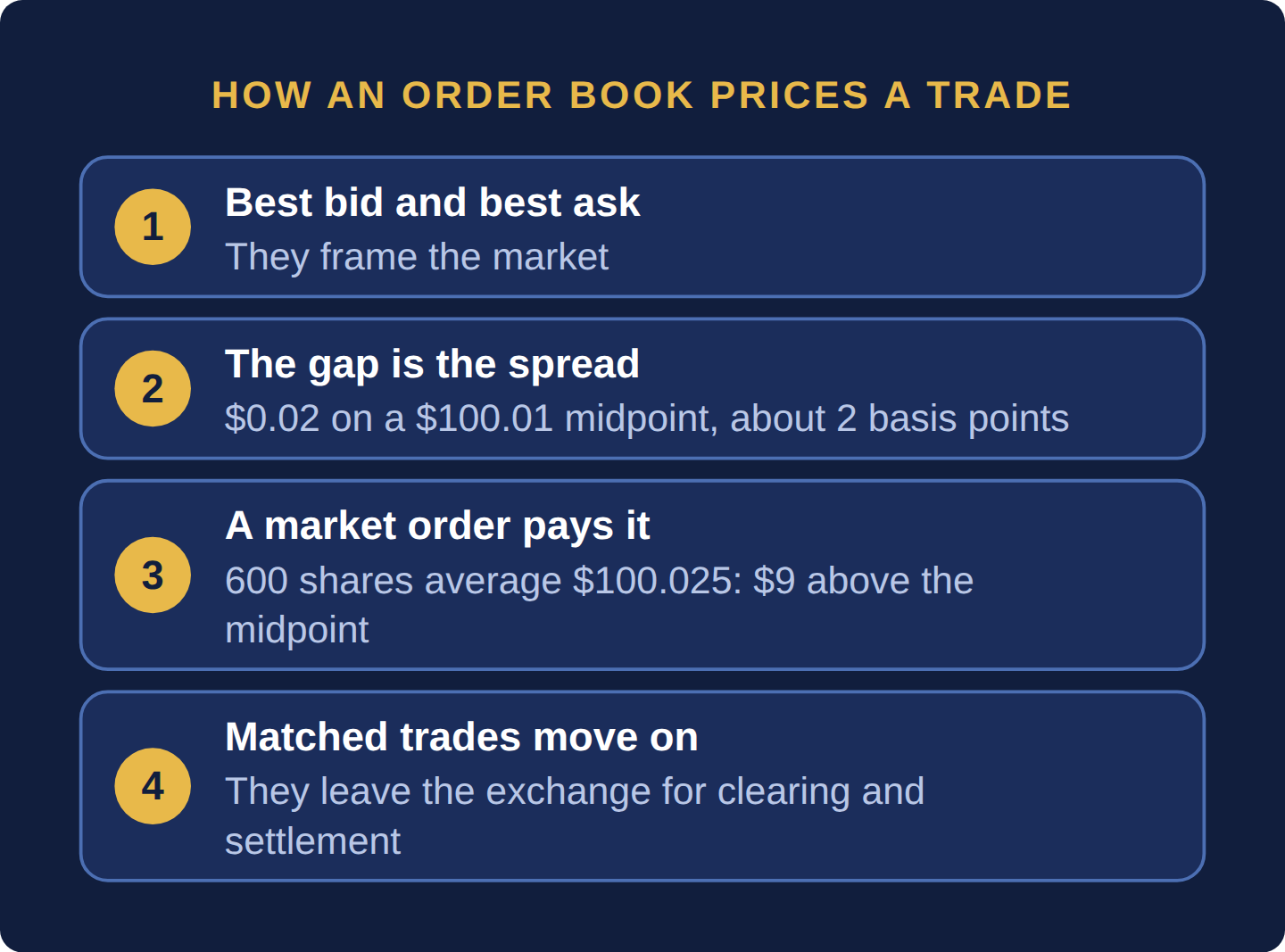
A stock exchange is a regulated, mostly electronic marketplace funded by listing, transaction and data fees. Its price-making core is the order book: the best bid and best ask frame the market, the gap between them is the spread, and a market order pays that spread for immediacy.
Why it matters: The order book is where every stock price you see actually comes from.
Summary: A stock exchange is a regulated, mostly electronic marketplace funded by listing, transaction and data fees. Its price-making core is the order book: the best bid and best ask frame the market, the gap is the spread, and a market order pays it for immediacy.
- In the illustrative book the spread is $0.02 on a $100.01 midpoint, about 2 basis points.
- A market order to buy 600 shares averages $100.025, so the buyer pays $9 more than the midpoint, the price of immediacy.
- Once trades match, they leave the exchange for clearing and settlement.
A stock exchange is a regulated marketplace where buyers and sellers come together to trade shares of publicly listed companies, as well as other securities like bonds and derivatives. Exchanges provide price transparency, liquidity (the ability to buy or sell quickly at a known price), and regulatory oversight that protects both investors and companies.
Modern stock exchanges no longer have the famous trading floors where people in colored jackets shouted orders at each other. The New York Stock Exchange still maintains a largely ceremonial trading floor used primarily for listing day events and media appearances. The vast majority of trading today happens electronically, through sophisticated matching engines that pair buy and sell orders in microseconds.
Exchanges earn revenue primarily by charging listing fees (companies pay to be listed), transaction fees (a tiny fraction of every trade), and data fees (selling real-time price feeds to financial institutions and data vendors). They are themselves listed companies in many cases — the NYSE is owned by Intercontinental Exchange (ICE), which is itself listed on the NYSE. The London Stock Exchange Group (LSEG) is a FTSE 100 company. The businesses of providing market infrastructure have become businesses like any other.
A stock exchange is like a farmers’ market, but for company ownership. At a farmers’ market, sellers bring their produce and buyers come knowing they will find multiple vendors with clear prices, quality standards enforced by the market authority, and a safe, organized environment for transactions. A stock exchange does the same for shares: organized, transparent, regulated, and liquid. The exchange itself does not set the prices — it provides the venue where buyers and sellers collectively determine them.
How a price is actually made. Inside every matching engine sits an order book: the live list of all unfilled limit orders, each an instruction to buy or sell a stated quantity only at a stated price or better. The highest price any buyer is bidding (the best bid) and the lowest price any seller is asking (the best ask) frame the market, and the gap between them is the bid-ask spread. A market order, an instruction to trade at once at the best available price, does not wait in the book: it trades against the resting orders, starting at the best price and working outward. Market makers are firms that keep posting both bids and asks through the day; they earn the spread on round trips and carry the risk of holding inventory while prices move.
| Bids (buyers waiting) | Asks (sellers waiting) |
|---|---|
| 500 shares at $100.00 | 300 shares at $100.02 |
| 800 shares at $99.99 | 700 shares at $100.03 |
| 1,200 shares at $99.98 | 1,000 shares at $100.05 |
In this illustrative book the spread is $100.02 − $100.00 = $0.02, the midpoint is ($100.00 + $100.02) ÷ 2 = $100.01, and $0.02 ÷ $100.01 ≈ 0.02%, or 2 basis points. A market order to buy 600 shares takes all 300 at $100.02 and 300 of the 700 at $100.03: average price (300 × $100.02 + 300 × $100.03) ÷ 600 = $100.025, so the buyer pays ($100.025 − $100.01) × 600 = $9 more than the midpoint. That $9 is the price of immediacy. It grows when the book is thin, because a large order has to reach further down the list, which is why spreads widen when market makers step back in a panic. Once matched, the trade leaves the exchange for clearing and settlement (Section 8.2: Capital Markets Operations — The Trade Lifecycle).
What is a stock exchange?
A regulated, mostly electronic marketplace funded by listing, transaction and data fees.
What is an order book?
The list of buy and sell orders at each price. The best bid and best ask frame the market.
What is the bid-ask spread?
The gap between the best bid and the best ask. In the illustrative book it is $0.02 on a $100.01 midpoint, about 2 basis points.
What does a market order cost?
It pays the spread for immediacy. A market order to buy 600 shares averages $100.025, so the buyer pays $9 more than the midpoint.
A stock exchange is a regulated, mostly electronic marketplace funded by listing, transaction and data fees. Its price-making core is the order book: the best bid and best ask frame the market, the gap is the spread, a market order pays it for immediacy, and market makers earn it for standing ready on both sides. Once trades match, clearing and settlement follow (Section 8.2: Capital Markets Operations — The Trade Lifecycle).
Four questions and two worked problems on this chapter. Decide on your answer first, then click “Reveal Answer.”
1. In an order book the best bid is $50.00 and the best ask is $50.06. What is the bid-ask spread?
- $100.06
- $0.03
- $0.06
- $50.03
Reveal Answer
Answer: C. The spread is the best ask minus the best bid: $50.06 − $50.00 = $0.06. The midpoint, $50.03, is a different number.
2. A market order to buy 600 shares meets asks of 300 at $100.02 and 700 at $100.03. What average price does the buyer pay?
- $100.025
- $100.050
- $100.030
- $100.020
Reveal Answer
Answer: A. Half the shares fill at $100.02 and half at $100.03: (300 × $100.02 + 300 × $100.03) ÷ 600 = $100.025.
3. What does a market maker do that an ordinary investor placing one trade does not?
- Sets the official closing price of each listed share by decree
- Guarantees every buyer a profit on the shares they purchase
- Decides which companies may list on the exchange
- Posts both bids and asks through the day, earning the spread
Reveal Answer
Answer: D. Market makers keep two-sided quotes in the book, earn the spread on round trips and carry inventory risk. They do not set prices by decree, guarantee profits or control listings.
4. Why do spreads usually widen in a panic?
- The exchange raises its fees whenever prices fall quickly
- Limit orders are banned until prices have recovered
- Every buyer switches to market orders at the same moment
- Market makers step back, so the book thins out
Reveal Answer
Answer: D. Market makers carry the risk of holding inventory while prices move. When they post fewer quotes, the book thins and the gap between best bid and best ask grows.
5. Worked problem: The best bid is $49.95 and the best ask $50.01. What are the midpoint and the spread in basis points?
Reveal Answer
Answer: Midpoint = $49.98. Spread = $0.06 ÷ $49.98 = 12.0 bps.
6. Worked problem: There are 200 shares offered at $50.01 and 300 at $50.03. What does a market buy of 500 shares pay on average?
Reveal Answer
Answer: (200 × $50.01 + 300 × $50.03) ÷ 500 = $50.0220.
4.2 Major Stock Exchanges — The World's Financial Hubs
The world’s major exchanges differ in size and role. NYSE and NASDAQ in New York are the largest, while Asia’s hubs include Shanghai, Tokyo, Hong Kong and India’s BSE and NSE.
Why it matters: Where a company lists shapes who can invest in it.
Summary: The world’s major exchanges differ in size and role: NYSE and NASDAQ in New York are the largest, while Asia’s hubs include Shanghai, Tokyo, Hong Kong and India’s BSE and NSE.
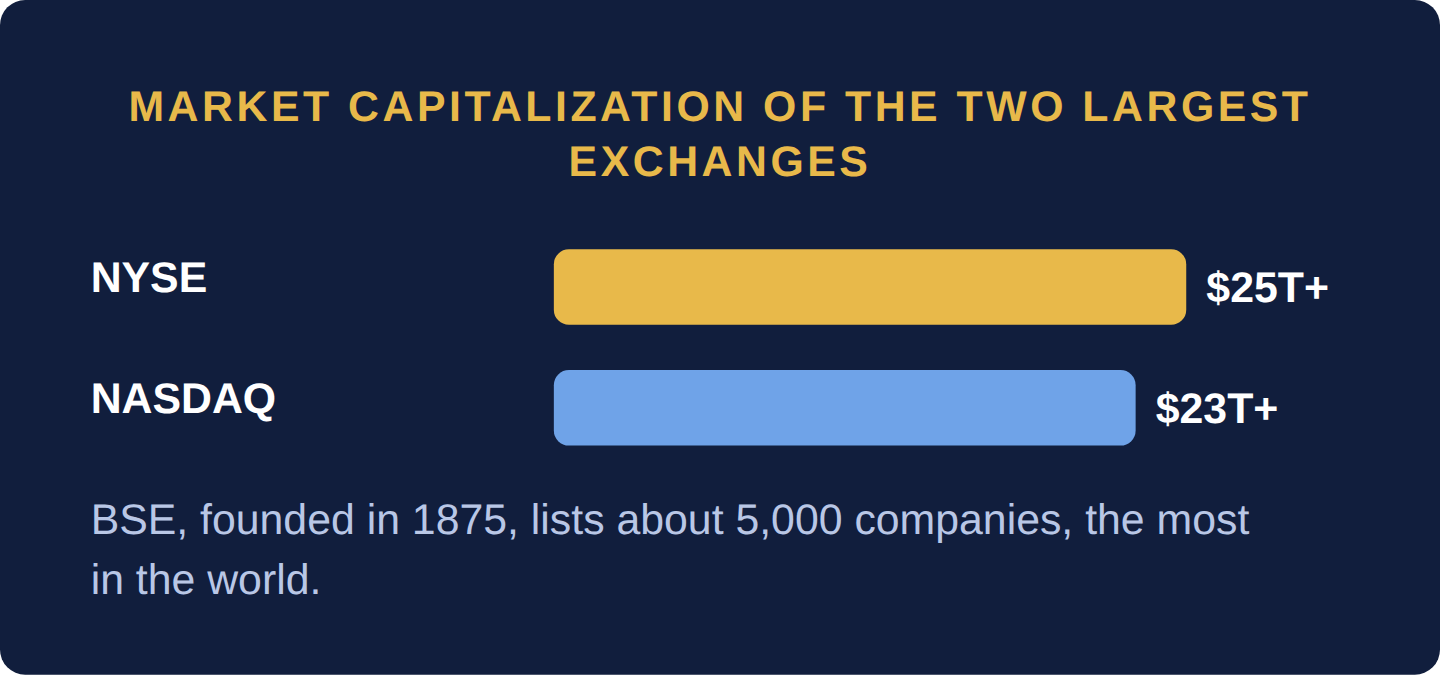
- NYSE is the world’s largest by market cap ($25T+) and NASDAQ is primarily electronic ($23T+); the NASDAQ exchange is not the same as the NASDAQ index.
- BSE, founded in 1875, has about 5,000 listed companies, the most in the world, while NSE is India’s largest by trading volume.
| Exchange | Location | Market Cap | Key Characteristics |
|---|---|---|---|
| NYSE | New York, USA | $25T+ | World’s largest by market cap; home to blue-chip multinationals; owned by ICE; Dow Jones and S&P 500 list here |
| NASDAQ | New York, USA | $23T+ | Primarily electronic; home to major tech companies (Apple, Microsoft, Amazon, Google, Meta); note: NASDAQ the exchange ≠ NASDAQ the index |
| Shanghai (SSE) | Shanghai, China | $7T+ | Largest in Asia; A shares (domestic investors, yuan) and B shares (foreign investors); capital controls limit international access |
| Tokyo (TSE/JPX) | Tokyo, Japan | $6T+ | Largest in Asia-Pacific outside China; home to major Japanese multinationals; Nikkei 225 is its primary index |
| Euronext | Amsterdam / Paris / Brussels / Dublin / Lisbon / Milan / Athens / Oslo | $6.5T+ | Pan-European exchange formed through mergers; covers multiple major European economies under one umbrella |
| Hong Kong (HKEX) | Hong Kong | $4T+ | Gateway between Chinese and international capital; many mainland Chinese companies list here for international investor access |
| BSE | Mumbai, India | $4T+ | One of Asia’s oldest exchanges (founded 1875); world’s largest by number of listed companies (~5,000); Sensex is its 30-stock benchmark index |
| NSE | Mumbai, India | $4T+ | India’s largest by trading volume; NIFTY 50 is its primary benchmark; known for technology leadership in trading infrastructure; optional T+0 settlement piloted here and on BSE in 2024 |
| London (LSE) | London, UK | $3.5T+ | Historic center of global finance; part of LSEG group which also owns FTSE Russell (index provider) and LSEG Data & Analytics (financial data, formerly Refinitiv) |
| Shenzhen (SZSE) | Shenzhen, China | $3.5T+ | China’s second major exchange; focus on technology and growth companies; ChiNext is its tech-focused board — analogous to NASDAQ in the US |
| Toronto (TSX) | Toronto, Canada | $3T+ | Largest in Canada; significant concentration in mining, energy, and financial sectors |
| Frankfurt (Deutsche Börse) | Frankfurt, Germany | $2.5T+ | Germany’s primary exchange; DAX 40 is its benchmark; home to major German industrials and financial companies |
How an exchange earns its living
An exchange is a business with three main revenue lines: listing fees paid by companies to be quoted, transaction fees paid by traders, and fees for selling market data. The mix differs from one exchange to the next and explains why exchanges compete for listings as hard as for trading volume.
An exchange earns $120m from listings, $380m from trading and $150m from market data in a year.
| Revenue line | Amount | Share of total |
|---|---|---|
| Listing fees | $120m | 18.5% |
| Trading fees | $380m | 58.5% |
| Market data | $150m | 23.1% |
| Total | $650m | 100.0% |
Result: trading is 58.5% of revenue, so a fall of 20% in trading volume cuts total revenue by 11.7%, while a loss of listings or data revenue changes it far less. That is why exchanges diversify.
What are the largest stock exchanges in the world?
NYSE is the largest by market capitalization ($25T+) and NASDAQ is primarily electronic ($23T+). The NASDAQ exchange is not the same as the NASDAQ index.
Which exchanges are in Asia?
Shanghai, Tokyo, Hong Kong and India’s BSE and NSE.
What is the difference between BSE and NSE?
BSE, founded in 1875, has about 5,000 listed companies, the most in the world, while NSE is India’s largest by trading volume.
The largest exchanges are NYSE (over $25 trillion) and NASDAQ (over $23 trillion) in New York, with Asian hubs in Shanghai, Tokyo, Hong Kong and India. BSE, founded in 1875, has the most listed companies, while NSE is India’s largest by trading volume.
Four questions and two worked problems on this chapter. Decide on your answer first, then click “Reveal Answer.”
1. Which description of India’s two exchanges matches the chapter?
- The two exchanges list entirely different sets of companies
- BSE leads in trading volume and carries the NIFTY 50 index
- BSE lists the most companies; NSE has the most volume
- NSE was founded in 1875 and is home to the Sensex index
Reveal Answer
Answer: C. BSE (founded 1875, Sensex) lists the most companies; NSE (NIFTY 50) leads on trading volume. Both list many of the same companies.
2. On the Shanghai exchange, what separates A shares from B shares?
- A shares are for domestic buyers; B shares for foreign
- A shares are listed in Shanghai; B shares list only in Hong Kong
- A shares carry voting rights while B shares carry no votes
- A shares are government bonds; B shares are shares of banks
Reveal Answer
Answer: A. The chapter describes A shares as for domestic investors, in yuan, and B shares as for foreign investors; capital controls still limit international access.
3. Someone says ‘NASDAQ rose 2% today’. What does the chapter warn you to check?
- Whether the shares were listed on the NYSE or on Euronext
- Whether they mean the NASDAQ exchange or the NASDAQ index
- Whether the exchange itself paid a dividend to its holders that day
- Whether trading took place in the A-share or B-share segment
Reveal Answer
Answer: B. The chapter notes that NASDAQ the exchange is not NASDAQ the index: one is the venue, the other a number computed from some of its shares.
4. Which exchange does the chapter describe as the gateway between Chinese and international capital?
- Tokyo (TSE/JPX), home of the Nikkei 225 index
- Shenzhen (SZSE), the second major mainland exchange
- Toronto (TSX), heavy in mining and energy shares
- Hong Kong (HKEX)
Reveal Answer
Answer: D. Hong Kong is where many mainland Chinese companies list for international investors. Shenzhen is China’s second major exchange, focused on technology and growth firms.
5. Worked problem: An exchange charges $0.0003 per share and 12 billion shares trade on a day. What is the daily fee revenue, and over 252 trading days?
Reveal Answer
Answer: $0.0003 × 12bn = $3.6 million a day; × 252 = $907 million.
6. Worked problem: NYSE’s market capitalization is $25tn and NASDAQ’s is $23tn. What is NYSE’s share of the two combined?
Reveal Answer
Answer: 25 ÷ (25 + 23) = 52.1%.
4.3 How Global Exchanges Work Together — The 24-Hour Market
Because exchanges span the world’s time zones, equity and related trading is effectively continuous, and events in one session flow into the next. Circuit breakers pause trading when markets fall too fast.
Why it matters: A sharp fall in New York on Thursday afternoon usually shows up in Asian opens on Friday morning.
Summary: Because exchanges span the world’s time zones, equity and related trading is effectively continuous, and events in one session flow into the next. Circuit breakers pause trading when markets fall too fast.
- Individual stock markets are open only about six to eight hours on weekdays, so a sharp US fall on a Thursday afternoon typically means lower Asian opens on Friday morning.
- Exchanges are linked through index correlations, cross-listings, ADRs and GDRs (Infosys, Wipro and HDFC have all traded as ADRs on NYSE), algorithmic arbitrage and 24-hour futures markets.
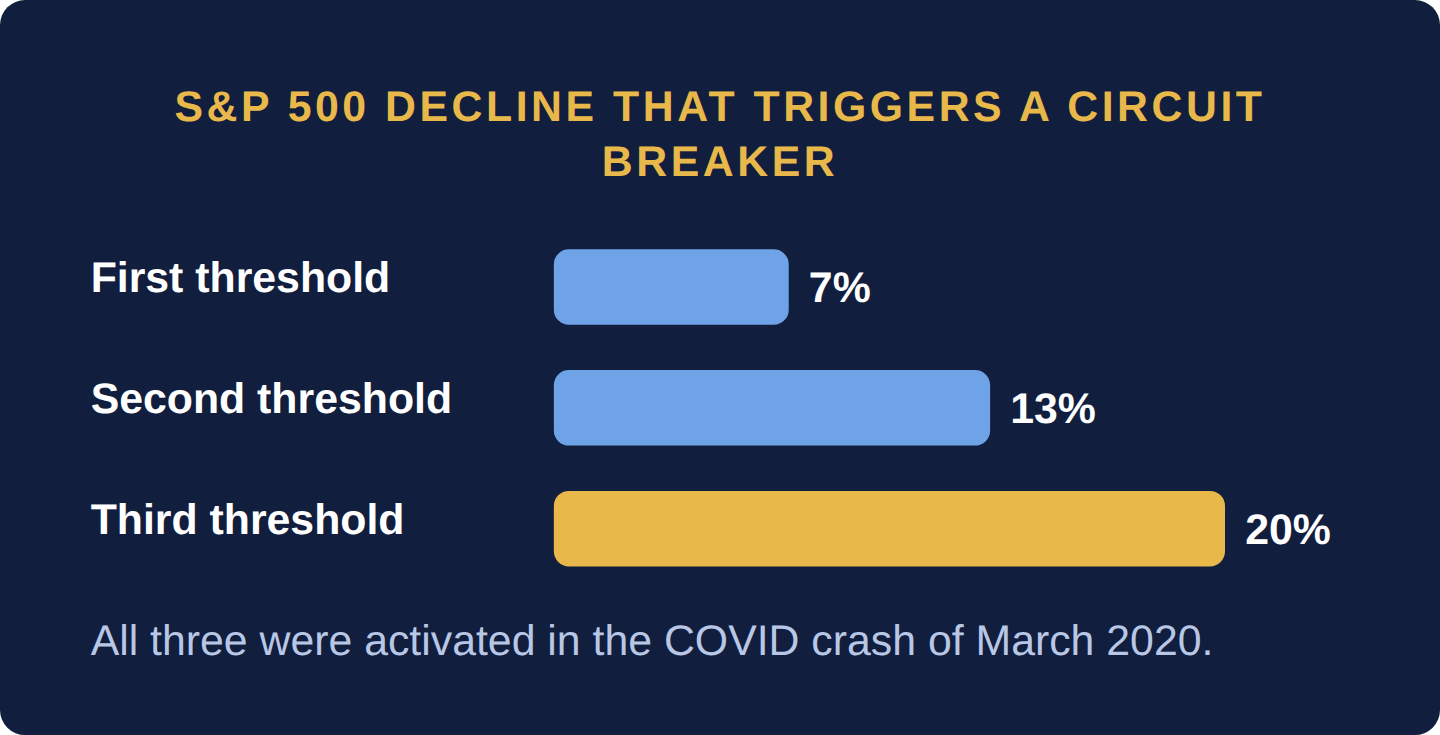
- US market-wide circuit breakers, triggered by S&P 500 declines of 7%, 13% and 20%, were activated multiple times in the COVID crash of March 2020.
Stock markets individually are open only during specific hours — typically six to eight hours on weekdays. But because exchanges are spread across the world’s time zones, trading in equity and related markets is effectively continuous. Events in one session flow directly into the next: if US markets fall sharply on a Thursday afternoon, Asian markets typically open lower on Friday morning, responding to the overnight news. European markets then open reflecting both the prior day’s US close and early Asian trading.
| Session (approximate) | Major Exchanges Open |
|---|---|
| Asian Session (~1:30 AM GMT) | Tokyo (TSE), Shanghai (SSE), Shenzhen (SZSE), Hong Kong (HKEX) |
| Asia–Europe Overlap (~8:00 AM GMT) | Asian markets near close; Indian markets still trading (NSE/BSE session 9:15 AM–3:30 PM IST = 3:45–10:00 AM GMT) |
| European Session (~8:00 AM GMT) | London (LSE), Frankfurt (Deutsche Börse), Paris/Amsterdam (Euronext), Zurich (SIX) |
| Europe–US Overlap (~1:30 PM GMT) | Busiest period globally — London open + NYSE/NASDAQ opening; highest trading volumes worldwide |
| American Session (~1:30–8:00 PM GMT) | NYSE, NASDAQ, TSX; US futures and options; pre- and after-hours trading extends further |
Exchanges are deeply interconnected through index correlations (a global risk-off event causes simultaneous selling everywhere), cross-listings (major companies listed on multiple exchanges simultaneously), ADRs and GDRs (allowing foreign companies to trade on US exchanges and vice versa — Infosys, Wipro, and HDFC have all traded as ADRs on NYSE), algorithmic arbitrage (keeping prices aligned across markets in microseconds), and 24-hour futures markets (providing continuous price signals even when cash equity markets are closed).
When markets fall too fast, circuit breakers automatically pause trading — giving participants time to process information and preventing panic from becoming a self-reinforcing cascade. The US market-wide circuit breakers (triggered by S&P 500 declines of 7%, 13%, and 20%) were activated multiple times during the COVID crash in March 2020 — the most activations in any single month since their introduction.
Are stock markets open 24 hours a day?
Individual stock markets are open only about six to eight hours on weekdays, but because exchanges span the world’s time zones, trading is effectively continuous.
How are stock exchanges linked?
Through index correlations, cross-listings, ADRs and GDRs (Infosys, Wipro and HDFC have all traded as ADRs on NYSE), algorithmic arbitrage and 24-hour futures markets.
What is a circuit breaker?
A pause in trading when markets fall too fast. US market-wide circuit breakers, triggered by S&P 500 declines of 7%, 13% and 20%, were activated multiple times in the COVID crash of March 2020.
- Stock exchanges are regulated electronic marketplaces — matching engines pair buy and sell orders in microseconds. Exchanges earn from listing fees, transaction fees, and data sales. Many are themselves listed companies.
- NYSE and NASDAQ together hold $48T+ in listed market cap — the dominant global hub. India has two major exchanges: BSE (founded 1875, most listed companies globally) and NSE (highest trading volume, technology leader). Many companies list on both, but they are separate platforms, and BSE lists far more companies in total.
- The global trading day rolls continuously across time zones: Asia → India → Europe → US. Events in each session flow directly into the next. The Europe–US overlap (~1:30–4:30 PM GMT) is the highest-volume period globally.
- Circuit breakers — automatic trading halts — exist to prevent panic-driven cascades. In the digital age, coordination across globally connected markets is both the system’s strength and its vulnerability.
Because exchanges span the world’s time zones, equity and related trading is effectively continuous, and events in one session flow into the next. Each market is open only about six to eight hours on weekdays, so a sharp US fall on a Thursday afternoon typically means lower Asian openings the next morning. Circuit breakers pause trading when a market falls sharply.
Four questions and two worked problems on this chapter. Decide on your answer first, then click “Reveal Answer.”
1. The S&P 500 falls 7% in a session. What do the chapter’s US market-wide circuit breakers do?
- Pause trading so participants can absorb the news
- Cancel every trade already made earlier that day
- Close the exchange for the remainder of that week
- Fix all prices at the previous close until recovery
Reveal Answer
Answer: A. A 7% decline triggers the first market-wide pause (13% and 20% are the next levels). The aim is to stop panic becoming a self-reinforcing cascade.
2. US markets fall sharply on a Thursday afternoon. What does the chapter expect on Friday morning?
- Asian markets stay shut until US markets have recovered
- Asian markets tend to open lower on the news
- European markets ignore the US close entirely when they open
- Indian markets open at the same level as last Thursday
Reveal Answer
Answer: B. Because sessions follow the sun, events in one session flow into the next: Asia reacts to the US close, and Europe to both.
3. What is an ADR, as used in the chapter?
- A fund that tracks the Nikkei 225 index for US savers
- A rule that halts trading after a large one-day fall
- A way for a foreign firm’s shares to trade in the US
- A fee charged by exchanges for selling price data
Reveal Answer
Answer: C. ADRs (and GDRs) let foreign companies trade on US exchanges, and vice versa; Infosys, Wipro and HDFC have all traded as ADRs on the NYSE.
4. Which window does the chapter call the busiest period globally?
- The Europe–US overlap around 1:30 PM GMT
- The Asia–Europe overlap around 8:00 AM GMT
- The Asian session around 1:30 AM GMT
- The after-hours session beyond 8:00 PM GMT
Reveal Answer
Answer: A. When London is open and NYSE and NASDAQ open, trading volumes worldwide are highest.
5. Worked problem: US market-wide circuit breakers halt trading at 7%, 13% and 20% falls in the S&P 500. With the index at 5,000, at what levels do they trigger?
Reveal Answer
Answer: 7%: 4,650. 13%: 4,350. 20%: 4,000.
6. Worked problem: A market open 6.5 hours a day trades continuously. What share of a 24-hour day is it open, and how many such markets in different time zones cover the whole day?
Reveal Answer
Answer: 6.5 ÷ 24 = 27.1%; covering 24 hours needs at least 4 markets with no overlap.
4.4 The IPO Process — How a Company Goes Public
An IPO is the process by which a private company first sells shares to the public. It raises capital, lets early investors cash out and changes a company’s governance and transparency. Investment banks underwrite it, and a lock-up bars insiders from selling afterward.
Why it matters: It is the moment a private company becomes a public one.
Summary: An IPO is the process by which a private company first sells shares to the public: a source of capital, a liquidity event for early investors and a transformation in governance and transparency. Investment banks underwrite it, and a lock-up bars insiders from selling afterward.
- Companies go public to raise capital for expansion or debt repayment, give founders and early investors liquidity, use listed shares as currency for acquisitions and gain the credibility of a major listing.
- In a firm commitment underwriting, the most common structure, the bank buys all the shares at the IPO price and resells them, absorbing the difference if demand is weak.
- After listing, a lock-up period of typically 90 to 180 days bars insiders and early investors from selling.
An Initial Public Offering (IPO) is the process by which a privately owned company first sells shares to the general public, transitioning from private ownership to being publicly listed on a stock exchange. It is one of the most significant events in a company’s lifecycle: a source of capital, a liquidity event for early investors, and a transformation in governance and transparency obligations.
Companies go public primarily to raise capital for expansion or debt repayment, to provide liquidity for founders and early investors, to use listed shares as currency for acquisitions, and to gain the brand credibility of a major exchange listing.

The Role of Investment Banks — Underwriters
Investment banks play a central role in every IPO as underwriters. In a firm commitment underwriting (the most common structure), the investment bank agrees to buy all the shares from the company at the agreed IPO price and then resell them to investors. If demand is weaker than expected and they cannot sell all shares at that price, the bank absorbs the difference. This financial commitment gives the bank a powerful incentive to price the IPO accurately. After listing, a lock-up period (typically 90 to 180 days, shown in the figure above) bars insiders and early investors from selling, so a flood of their shares does not hit the market just after the IPO.
Major IPOs typically have a lead underwriter (called the bookrunner or lead manager) and a syndicate of co-underwriters. For very large IPOs, there may be dozens of banks in the syndicate, each responsible for selling a portion. In India, these roles are performed by SEBI-registered Book Running Lead Managers (BRLMs).
An investment bank underwriting an IPO is like a property dealer who agrees to buy your house at a fixed price and takes responsibility for finding buyers. If they cannot find buyers at that price, they absorb the loss. Because of this risk, the bank is highly motivated to ensure the IPO is correctly priced, properly marketed, and attracting the right investors — their own money is on the line.
What is an IPO?
The process by which a private company first sells shares to the public.
Why do companies go public?
To raise capital for expansion or debt repayment, give founders and early investors liquidity, use listed shares as currency for acquisitions and gain the credibility of a major listing.
What does an IPO underwriter do?
In a firm commitment underwriting, the most common structure, the bank buys all the shares at the IPO price and resells them, absorbing the difference if demand is weak.
What is a lock-up period?
A period, typically 90 to 180 days after listing, during which insiders and early investors may not sell.
An IPO is the first sale of a private company’s shares to the public, giving it capital and early investors liquidity at the price of more transparency. Investment banks underwrite it, most commonly on a firm commitment basis, and a lock-up of typically 90 to 180 days bars insiders from selling afterward.
Four questions and two worked problems on this chapter. Decide on your answer first, then click “Reveal Answer.”
1. In a firm commitment underwriting, what happens if investors will not buy all the shares at the IPO price?
- The regulator buys the unsold shares at par
- The bank absorbs the shortfall
- Investors who applied must buy the remainder
- The company must cancel the listing permanently
Reveal Answer
Answer: B. The bank agrees to buy all the shares from the company, so unsold shares are its loss. That risk gives it a reason to price the IPO accurately.
2. What is the purpose of the lock-up period (90–180 days)?
- To keep the share price fixed at the original offer price
- To give the bank time to finish preparing its filing
- To stop every investor from trading for several months
- To restrict insiders from selling right after the IPO
Reveal Answer
Answer: D. A lock-up restricts insiders’ sales so a flood of insider shares does not hit the market just after listing.
3. Which is the correct order of the IPO steps shown in the chapter?
- Book building, regulatory filing, listing day, roadshow, allotment
- Roadshow, allotment, regulatory filing, book building, listing day
- Regulatory filing, roadshow, book building, allotment, listing day
- Allotment, book building, roadshow, regulatory filing, listing day
Reveal Answer
Answer: C. The journey runs from board decision and due diligence through filing, roadshow, price discovery by book building, allotment, then listing day.
4. A company raises $400 million in an IPO. Which is a purpose listed in the chapter?
- Replacing audited accounts with analyst estimates of profit
- Guaranteeing the share price rises once trading begins
- Providing liquidity for founders and early investors
- Avoiding all disclosure obligations for the company’s owners
Reveal Answer
Answer: C. Companies list to raise capital, give founders and early investors liquidity, use shares for acquisitions and gain credibility. Listing adds disclosure rather than removing it.
5. Worked problem: A company sells 20 million shares at $25 with a 7% underwriting fee. What does it net?
Reveal Answer
Answer: Gross $500m; fee $35m; net = $465 million.
6. Worked problem: The shares open at $29.50. How much ‘money was left on the table’ compared with the offer price?
Reveal Answer
Answer: 20m × ($29.50 − $25.00) = $90 million, a first-day gain of 18%.
- New York Stock Exchange — The New York Stock Exchange’s own description
- Nasdaq, About — Nasdaq’s own description
- BSE (Bombay Stock Exchange) — BSE’s official site
- Investor.gov, Initial Public Offering (IPO) — Investor.gov’s explanation of the IPO process