
US stocks don’t trade in one place. They trade across many exchanges, dark pools, which are private venues that don’t show orders in advance, and wholesalers. Rules tie them together: the national best bid and offer and Regulation NMS. Most retail orders go to wholesalers who pay brokers for sending them, a practice the EU now bans for retail clients.
Why it matters: Where your order is sent affects the price you get, even if you never see it.
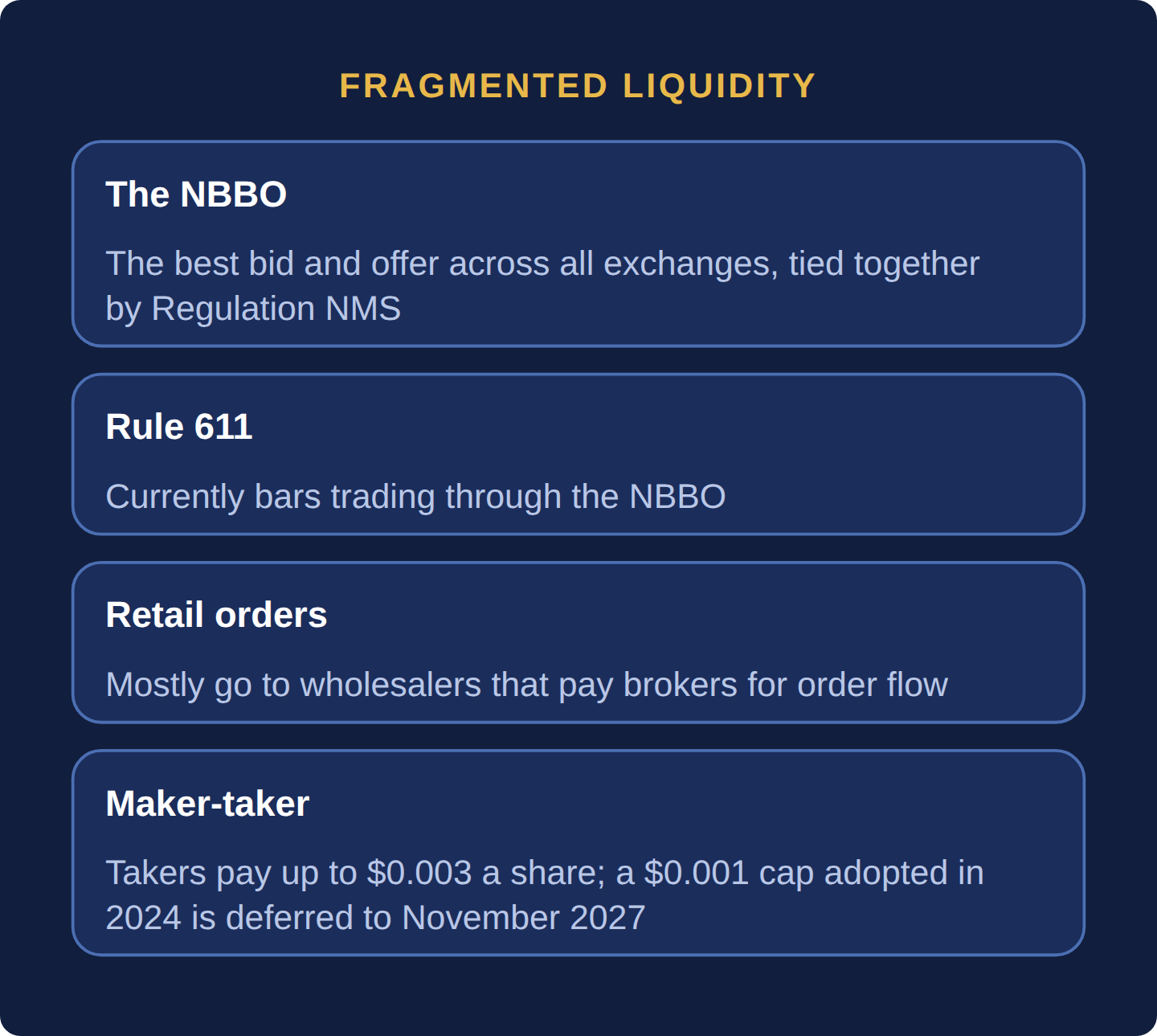
Summary: US stocks trade across many exchanges, dark pools and wholesalers, tied together by the national best bid and offer and Regulation NMS. Retail orders mostly go to wholesalers that pay brokers for order flow, a practice the EU now bans for retail clients.
- The NBBO is the best bid and offer across all exchanges; Rule 611 currently bars trading through it, and the SEC proposed rescinding that rule in June 2026.
- Maker-taker pricing charges takers up to $0.003 a share and pays makers a rebate; a $0.001 cap adopted in 2024 is deferred to November 2027.
- Off-exchange trading passed half of US consolidated volume for the first time in 2025 (50.6%).
- The EU’s ban on payment for order flow applies everywhere since its member-state exemptions ended on June 30, 2026.
- Compare brokers on price improvement per share, not on headline commission.
Not all trading happens on the fully transparent, publicly visible order book described in 5.1. A dark pool is a private trading venue where orders are not displayed publicly before execution — designed specifically for large institutional orders, allowing them to trade without revealing their full size to the broader market and triggering the adverse market-impact reaction a visible order of the same size would cause. The rise of dark pools and multiple competing exchanges has led to what’s called fragmented liquidity — the same stock now trades simultaneously across many different public and private venues rather than a single centralized location, which is precisely the environment that gave rise to the “smart order routing” technology used to find the best available price across this fragmented landscape in real time.
Fragmentation needs a reference price. In the US, the national best bid and offer (NBBO) is the highest bid and lowest offer across all exchanges. If Venue A quotes $49.99–$50.02, Venue B $50.00–$50.03 and Venue C $49.98–$50.01, the NBBO is $50.00 bid (B) and $50.01 offer (C). Regulation NMS (2005) is built around it. Rule 611, the Order Protection Rule, bars a venue from executing a trade at a price worse than a displayed, protected quote elsewhere; Rule 610 caps the fee an exchange can charge to access a quote at $0.003 a share; Rule 612 sets a one-cent minimum price increment for stocks priced at $1 or more. All three are under revision: in September 2024 the SEC adopted a half-cent increment for some stocks and a lower access-fee cap of $0.001 (SEC press release 2024-137), but their compliance date has been pushed to November 2027 (SEC Chairman statement, June 11, 2026). On June 11, 2026, it proposed rescinding Rule 611 altogether, arguing that markets have changed since 2005 and that the rule has raised costs and complexity, limited order-handling choices and contributed to fragmentation; the proposal would also remove Rule 610(e), which bars quotes that lock or cross protected quotes elsewhere (SEC fact sheet, Release 34-105655).
The fee cap matters because of maker-taker pricing: most US exchanges charge the order that takes liquidity a fee and pay the order that rested a rebate. With a $0.0030 taker fee and a $0.0020 maker rebate (illustrative, at the current cap), the exchange keeps $0.0010 a share. On a stock with a one-cent spread, the taker fee equals 60% of the half-spread a taker pays, and the rebate can tempt a broker to route customer limit orders to the venue that pays most rather than the one that fills best.
Retail orders mostly never reach an exchange. US brokers route them to wholesale market makers who fill them internally, usually at or slightly inside the NBBO, and many brokers receive payment for order flow (PFOF) for doing so. If the NBBO is $50.00–$50.02 and the wholesaler fills a 100-share buy at $50.015, the customer gets $0.005 × 100 = $0.50 of price improvement. Wholesalers pay for retail flow because it is, on average, uninformed (Section 5.3: Market Makers and the Bid-Ask Spread). The debate is whether customers would get more price improvement if their orders competed in open auctions. The SEC proposed such an Order Competition Rule in late 2022 and withdrew it, with its Regulation Best Execution proposal, in June 2025 (Federal Register, June 17, 2025). Off-exchange trading, including wholesalers and dark pools, reached 50.6% of US consolidated volume in 2025, the first year above half (Cboe, 2025 U.S. Equities Year in Review).
Europe chose the opposite path. The EU’s MiFIR review bans investment firms acting for retail clients from receiving PFOF; member states where it existed could exempt their own firms only until June 30, 2026, so the ban now applies across the EU (MiFIR Article 39a (ESMA)). The UK regulator has long discouraged PFOF under its rules on third-party payments (FCA Dear CEO letter on PFOF (2017)). EU dark trading under the reference-price waiver is also capped: since October 2025 a single cap of 7% of a stock’s trading volume over 12 months replaced the earlier 4% and 8% double cap (ESMA, single volume cap).
Retail investors: compare brokers on price improvement per share, not commission. US brokers publish order-routing reports (Rule 606) and market centers publish execution statistics (Rule 605). Institutions: send a large order to a dark venue or auction only if the information leakage avoided exceeds the cost of not filling, measured by implementation shortfall (Section 5.5: Algorithmic Execution Strategies). Published averages hide differences by order size, so compare like with like.
Choosing a broker only because trading is “commission-free”. A difference of $0.005 a share in price improvement is $5 a month on 1,000 shares, but on an active trader’s 100,000 shares a month it is $500 a month, or $6,000 a year, more than most commissions ever cost.
What is payment for order flow?
It is a payment a wholesale market maker makes to a retail broker for the right to fill its customers’ orders. Retail orders are, on average, uninformed, so the wholesaler can fill them at or inside the best quotes and still earn part of the spread. It is legal in the US and banned for retail clients in the EU.
Are dark pools legal?
Yes. In the US they operate as alternative trading systems registered with the SEC and report trades after execution. In the EU, dark trading at the reference price is capped at 7% of a stock’s volume. Concerns center on access and on how operators treat orders.
What is the NBBO?
The national best bid and offer is the highest bid and lowest offer for a US stock across all exchanges. Brokers use it as the benchmark for best execution, and the Order Protection Rule currently bars venues from trading through it; the SEC proposed in June 2026 to rescind that rule.
India’s cash equity market runs on the same machinery, with tighter guard rails. Trading is concentrated on the NSE, with the BSE second. Most stocks carry a daily price band of 2%, 5%, 10% or 20%; orders outside it are rejected. Stocks with derivatives have no daily band but an operating range of 10% to catch erroneous orders (NSE, price bands). Market-wide circuit breakers work off the Nifty 50 or the Sensex at 10%, 15% and 20%: a 10% move before 1:00 p.m. halts trading for 45 minutes, followed by a 15-minute pre-open call auction, and a 20% move closes the market for the day (NSE, market-wide circuit breakers). Each day opens with a 15-minute pre-open call auction before continuous trading starts at 9:15 a.m.
The close changed in 2026. The official closing price used to be the volume-weighted average price of the last 30 minutes. Under a SEBI circular of January 16, 2026, exchanges introduced a Closing Auction Session for stocks with derivatives, live from August 3, 2026 (NSE circular of July 30, 2026): a reference price from trades between 3:00 and 3:15 p.m., order entry from 3:20 to 3:30 p.m. within a ±3% band, and matching at the price that maximizes executable volume, the same logic as the worked auction in Section 5.4: Price-Time Priority and Matching Engines (NSE, Closing Auction Session).
The co-location case. Between 2010 and 2014, NSE’s tick-by-tick data feed sent updates to brokers’ servers one after another, in the order they had connected, so a broker that logged in first saw prices fractionally earlier. SEBI’s April 30, 2019, order found that NSE had not exercised due diligence, directed it to disgorge about ₹625 crore with 12% annual interest, barred it from accessing the securities market for six months and ordered disgorgement from brokers including OPG Securities (Business Standard on the SEBI order (May 2019)). On January 23, 2023, the Securities Appellate Tribunal set aside the disgorgement, found a lack of due diligence and imposed ₹100 crore (Business Standard on the SAT order (January 2023)). SEBI appealed; in 2026 NSE settled the co-location and related dark-fiber matters for ₹1,491.21 crore (₹1,223.56 crore for co-location), and the Supreme Court allowed the settlement on September 18, 2026 (report of the Supreme Court order (September 2026)). The lesson matches Section 5.6: How High-Frequency Trading Actually Captures Its Edge: at microsecond speeds, the order in which data is sent is itself a form of access.
Settlement. India completed the move to T+1 for all stocks in January 2023, more than a year before the US. SEBI launched an optional same-day (T+0) cycle for 25 stocks on March 28, 2024, and widened it to the top 500 stocks by market value, phased in from January 31, 2025 (SEBI circular of December 10, 2024); early take-up was negligible, and T+1 remains the norm.
In rupees. For a pension fund trading ₹500 crore of one stock, each basis point of implementation shortfall (Section 5.5: Algorithmic Execution Strategies) is ₹500 crore ÷ 10,000 = ₹5 lakh, so a 54.4 bps shortfall costs about ₹2.72 crore.
Fragmented US trading is tied together by the NBBO and Regulation NMS, whose order protection rule the SEC proposed to rescind in June 2026, while maker-taker fees and payment for order flow shape where orders go. The EU bans payment for order flow for retail clients and caps dark trading, and investors should compare brokers on price improvement.
Six questions on this chapter. Decide on your answer first, then click “Reveal Answer.”
1. Venue A quotes $30.00–$30.04, Venue B $30.01–$30.05 and Venue C $29.99–$30.03. What is the NBBO?
- $30.01 bid and $30.05 offer
- $30.01 bid and $30.03 offer
- $29.99 bid and $30.05 offer
- $30.00 bid and $30.04 offer
Reveal Answer
Answer: B. The NBBO takes the highest bid (B, $30.01) and the lowest offer (C, $30.03) across venues.
2. A wholesaler fills a 300-share buy at $15.005 when the NBBO is $14.99–$15.01. How much price improvement does the customer receive?
- $0.50
- $3.00
- $4.50
- $1.50
Reveal Answer
Answer: D. Improvement = (15.01 − 15.005) × 300 = $1.50.
3. What is the status of payment for order flow for retail clients in the EU as of October 2026?
- Banned for all member states since exemptions ended in June 2026
- Banned only in member states that opted into the ban by 2024
- Allowed if the broker discloses it in quarterly Rule 606 reports
- Allowed for any retail order that receives price improvement
Reveal Answer
Answer: A. MiFIR Article 39a bans it; exemptions for member states where it existed expired on June 30, 2026.
4. What did the SEC propose on June 11, 2026, about Regulation NMS?
- Requiring all retail orders to go through auctions
- Banning payment for order flow for retail brokers
- Rescinding Rule 611, the order protection rule
- Raising the access-fee cap to $0.005 a share
Reveal Answer
Answer: C. The SEC proposed rescinding Rule 611 and the locked-and-crossed-markets provision of Rule 610(e).
5. Worked problem: An exchange charges takers $0.0030 a share and pays makers a $0.0028 rebate. On 1,000,000 shares, what do the taker pay, the maker receive and the exchange keep?
Reveal Answer
Answer: Taker pays $3,000; maker receives $2,800; the exchange keeps $200.
6. Worked problem: A cap of $0.0010 a share applies. What is the most a taker can pay on 1,000,000 shares?
Reveal Answer
Answer: $0.0010 × 1,000,000 = $1,000.
- ESMA, switch to the single volume cap — 7% dark-trading cap
- SEC Chairman Atkins, statement on minimum pricing increments and access fee caps, June 11, 2026 — Compliance deferred to November 2027
- ESMA, MiFIR Article 39a — EU PFOF ban and exemption end date
- SEC fact sheet, Regulation NMS reforms (Release 34-105655) — Proposal to rescind Rules 611 and 610(e)
- SEC press release 2024-137, Regulation NMS amendments — Half-cent tick and $0.001 access-fee cap
- Federal Register, Withdrawal of Proposed Regulatory Actions (June 17, 2025) — Order Competition Rule and Regulation Best Execution withdrawn