
9.3 Sanctions Regimes and How They Actually Bite
Sanctions bite in two ways: they block the property of designated parties, and they bar anyone from dealing with them. OFAC, the US sanctions office, extends that to any company owned 50% or more, in total, by blocked persons. US reach goes abroad through dollar clearing, because dollar payments pass through US banks. Penalties vary a lot: the penalty for a single violation can differ about 21-fold depending on whether it was egregious and whether the firm reported it itself.
Why it matters: A company can fall under sanctions rules through its owners, even when its own name isn’t on a list.
Summary: Sanctions bite by blocking designated parties’ property and barring dealings with them, and OFAC extends that to any entity 50% or more owned, in aggregate, by blocked persons. Dollar clearing carries US jurisdiction abroad, and a single violation’s penalty can vary about 21-fold depending on whether it was egregious and self-disclosed.
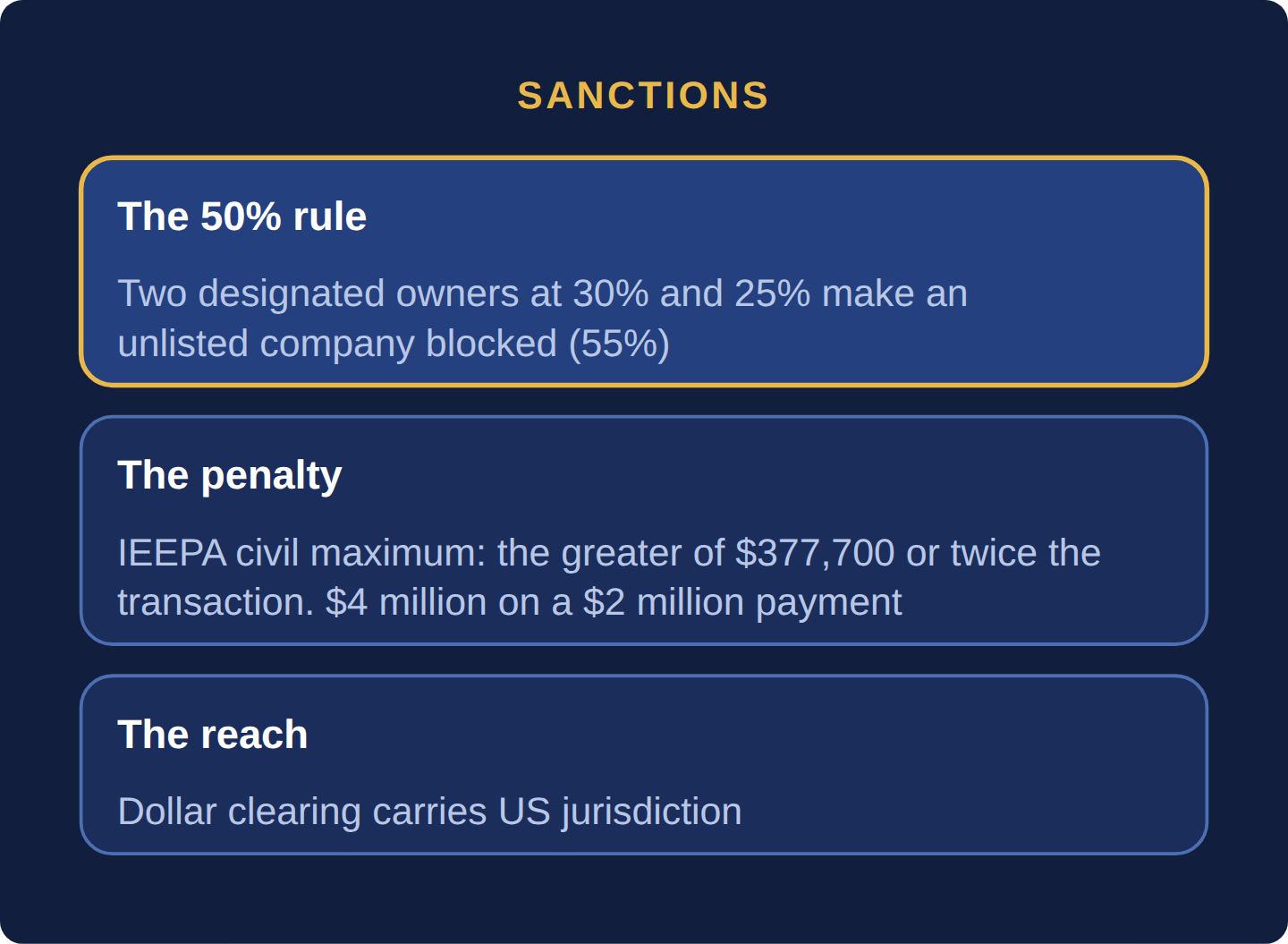
- Two designated owners at 30% and 25% make an unlisted company blocked (55%).
- The IEEPA civil maximum is the greater of $377,700 or twice the transaction: $4 million on a $2 million payment.
- Self-disclosure halves the base penalty; non-egregious cases cap at $188,850.
- OFAC can now bring cases up to 10 years after the violation.
- SWIFT bans cut messaging; designation and the roughly $300 billion freeze of Russian central bank assets went further.
Volume I’s Part 1 introduced sanctions conceptually as a tool of economic statecraft. Mechanically, sanctions typically operate through a designated persons/entities list (such as the US Treasury’s OFAC SDN List) — any individual, company, vessel, or country named on such a list becomes effectively frozen out of the financial systems of the sanctioning jurisdiction, and any bank processing a transaction connected to a sanctioned party risks severe regulatory penalties itself, regardless of its own intent.
Banks respond with sanctions screening — automatically checking every transaction’s parties against these lists before processing — and because major clearing systems and correspondent banking relationships (Volume I’s Part 3) run overwhelmingly through US-dollar and a small number of other major-currency clearing systems, a sanctioning jurisdiction’s reach frequently extends well beyond its own borders, an effect sometimes called the extraterritorial reach of financial sanctions.
Being cut off from SWIFT messaging isolates a bank’s cross-border payments, but it is not the heaviest tool. Designation on the SDN List blocks the party’s property under US jurisdiction and bars US persons from dealing with it at all, and secondary exposure reaches foreign banks that clear dollars. Reserve freezes go further still: within 100 days of Russia’s 2022 invasion, coordinating governments had immobilized about $300 billion of Russian central bank assets. The EU’s SWIFT ban of March 2022 named seven Russian banks; Sberbank, the largest, was added only in June 2022, showing how messaging bans are rationed while blocking and asset freezes do the heavy lifting.
Screening only names misses most exposure, because OFAC’s 50 Percent Rule treats any entity owned 50% or more, in the aggregate, by one or more blocked persons as blocked itself, listed or not. The rule speaks to ownership, not control.
Worked example. A US bank processes a $2,000,000 payment for Company X, which is not on the SDN List. Two designated individuals own 30% and 25% of X: 30% + 25% = 55%, so X is blocked and the payment is a violation. Under IEEPA the civil maximum is the greater of $377,700 or twice the transaction: max(377,700; 2 × 2,000,000) = $4,000,000. OFAC’s Enforcement Guidelines set the base penalty by two judgments:
| Case | Base penalty rule | Base for this payment |
|---|---|---|
| Non-egregious, self-disclosed | Half the transaction value, capped at $188,850 | $188,850 |
| Non-egregious, not self-disclosed | Schedule amount, capped at $377,700 | $377,700 |
| Egregious, self-disclosed | Half the statutory maximum | $2,000,000 |
| Egregious, not self-disclosed | Statutory maximum | $4,000,000 |
The same payment can cost 4,000,000 ÷ 188,850 ≈ 21 times more depending on self-disclosure and whether the conduct looks willful. OFAC now has 10 years, not 5, to bring a case for violations after April 24, 2019.
The standard answer is “screen the parties against the list.” These facts change it:
| Situation | What changes | Why |
|---|---|---|
| Two designated owners at 25% each | The company is blocked though unlisted | Ownership by blocked persons is aggregated to the 50% test |
| A designated person controls a company but owns 40% | The company is not blocked by the rule, but dealing with that person acting for it is prohibited | The 50 Percent Rule covers ownership only; designation can follow separately |
| Non-US bank, non-US clients, dollar payment | US sanctions apply | The payment clears through a US correspondent; BNP Paribas’s 2014 plea rested on dollar payments routed through the US |
| A violation found seven years later | Still actionable | The limitation period is 10 years for violations after April 24, 2019 |
| The firm finds and reports its own breach | Base penalty halves; non-egregious cases cap at $188,850 | Voluntary self-disclosure is the largest single mitigating factor in the Guidelines |
| A bank cut from SWIFT but not designated | Its assets are not frozen by the ban itself; other measures decide what dealings are lawful | A messaging ban is not a blocking order |
Screen every party in a payment, including beneficial owners, vessels and intermediary banks, not just the customer. If designated persons together own 50% or more of a counterparty, treat it as blocked; if they own less but exercise control, escalate before processing. When a hit is confirmed after the fact, self-disclose quickly: in the worked example that choice alone moves the base penalty from $377,700 to $188,850 (non-egregious) or from $4 million to $2 million (egregious). Keep sanctions records for 10 years. The rule does not cover the EU and UK regimes, which apply their own ownership and control tests.
Hiding a sanctioned party inside a payment message. BNP Paribas removed references to sanctioned entities from payment messages and used “satellite banks” to move more than $8.8 billion through the US financial system for Sudanese, Iranian and Cuban parties between 2004 and 2012; on June 30, 2014, it agreed to plead guilty and pay $8.97 billion. Message-stripping turns every payment into an egregious, willful violation, the top row of the penalty table, so the remedy is a hard rule: payment data is never edited to pass a screen.
What is the OFAC 50 Percent Rule?
Any entity owned 50% or more, directly or indirectly and in the aggregate, by blocked persons is itself blocked, listed or not; two designated owners at 25% each are enough. The rule concerns ownership, not control.
What is the penalty for violating OFAC sanctions?
For IEEPA-based programs, the greater of $377,700 or twice the transaction value per violation (the 2025 amount, unchanged for 2026). The base penalty is lower for non-egregious or self-disclosed violations, and willful violations can be prosecuted as crimes.
Does being removed from SWIFT freeze a bank’s assets?
No. A SWIFT ban stops the bank from using that messaging network, which cripples routine cross-border payments, but its assets are frozen only if a government designates it or blocks its property. That is why designation and reserve freezes are the stronger tools.
Sanctions bite through blocking: designated parties, and entities 50% or more owned by them in aggregate, are frozen out of the sanctioning jurisdiction, with dollar clearing extending US reach. Penalties scale with transaction size, egregiousness and self-disclosure, and SWIFT bans are narrower tools than designation or reserve freezes.
Six questions on this chapter. Decide on your answer first, then click “Reveal Answer.”
1. A US bank processes a $150,000 payment for a blocked party under an IEEPA-based program. What is the statutory civil maximum for that violation?
- $150,000
- $377,700
- $755,400
- $300,000
Reveal Answer
Answer: B. The maximum is the greater of $377,700 or twice the transaction: max(377,700; 2 × 150,000 = 300,000) = $377,700.
2. Three designated persons own 20%, 20% and 15% of an unlisted company. Under OFAC’s 50 Percent Rule, what is the company’s status?
- Not blocked until OFAC lists it by name
- Not blocked, as no single owner has 50%
- Blocked, because they own 55% together
- Blocked only if one owner controls it
Reveal Answer
Answer: C. Ownership by blocked persons is aggregated: 20 + 20 + 15 = 55%, at least 50%, so the company is blocked though unlisted.
3. A bank finds and voluntarily discloses a non-egregious violation involving a $300,000 payment. What is OFAC’s base penalty?
- $377,700
- $188,850
- $300,000
- $150,000
Reveal Answer
Answer: D. For non-egregious, self-disclosed cases the base is half the transaction value, capped at $188,850: 0.5 × 300,000 = $150,000, below the cap.
4. A bank has been removed from SWIFT but not designated by any government. Which statement is accurate?
- Messaging is cut but assets are not frozen
- Its assets are frozen wherever they are held
- All payments to it are automatically unlawful
- It is added to the SDN List by default
Reveal Answer
Answer: A. A SWIFT ban removes access to a messaging network; freezing assets requires designation or a blocking order.
5. Worked problem: Two blocked persons own 35% and 20% of an unlisted company. Is the company blocked under OFAC’s 50% rule?
Reveal Answer
Answer: Aggregate ownership = 35% + 20% = 55%, which is at least 50%, so yes, it is blocked.
6. Worked problem: The IEEPA civil maximum is the greater of $377,700 or twice the transaction. What is it for a $300,000 payment and a $100,000 payment?
Reveal Answer
Answer: $300,000: twice = $600,000, so $600,000. $100,000: twice = $200,000, below $377,700, so $377,700.
9.4 Dodd-Frank vs MiFID II Compared
Two big rule books shape modern financial markets. Dodd-Frank, from the US in 2010, targeted systemic risk, swaps and consumer protection. MiFID II, from the EU in 2018, targeted market structure, transparency and investor protection. Don’t mix up their jobs: EU derivatives clearing comes from a separate regulation called EMIR, and MiFID II’s rule separating research fees from trading fees has been partly reversed since 2024.
Why it matters: Knowing which law covers which job keeps you from citing the wrong one.
Summary: Dodd-Frank (US, 2010) targeted systemic risk, swaps and consumer protection, while MiFID II (EU, 2018) targeted market structure, transparency and investor protection. EU derivatives clearing comes from a separate regulation, EMIR, not MiFID II, and MiFID II’s research unbundling has been partly reversed since 2024.
- US swaps clearing comes from Dodd-Frank Title VII; the CFTC’s first clearing determination was on November 28, 2012.
- EMIR (Regulation 648/2012) clearing started June 21, 2016; MiFIR adds the trading obligation.
- The UK allowed joint research and execution payments from August 1, 2024; the EU Listing Act does so from June 2026.
- A $5 million research budget is 5 basis points of a $10 billion fund but 10% of the manager’s revenue.
- The SEC withdrew its proposed Regulation Best Execution on June 12, 2025; FINRA Rule 5310 still applies.

The 2008 crisis (Volume I’s Part 3) produced two of the most consequential pieces of financial regulation of the modern era, on opposite sides of the Atlantic, sharing similar goals but different emphases.
| Dimension | Dodd-Frank (US, 2010) | MiFID II (EU, 2018) |
|---|---|---|
| Core Focus | Systemic risk, “too big to fail,” derivatives clearing, and consumer protection (creating the CFPB) | Market structure, transparency, and investor protection across trading venues |
| Signature Provision | The Volcker Rule — restricting banks from proprietary trading for their own account | Unbundling research and execution costs — requiring asset managers to pay for investment research separately, rather than folding it into trading commissions; partly reversed since 2024 (UK joint payments allowed from August 1, 2024; EU Listing Act joint payments from June 2026) |
| Derivatives | Title VII mandates central clearing and trading on regulated platforms for standardized swaps, under CFTC and SEC rules (first CFTC clearing determination November 28, 2012) | Clearing comes from a separate regulation, EMIR (Regulation (EU) No 648/2012), phased in from June 21, 2016; MiFID II and MiFIR add the obligation to trade certain cleared derivatives on venues and transaction reporting |
| Best Execution | A “reasonable diligence” standard for brokers under FINRA Rule 5310; the SEC’s proposed Regulation Best Execution was withdrawn on June 12, 2025 | Highly detailed, quantitative best-execution and transaction-reporting requirements |
Bundling hides a cost inside dealing commissions, which are charged to the fund, so clients pay it. Take a manager with $10 billion under management, a 0.50% fee and a $5 million research budget: revenue is 10,000,000,000 × 0.005 = $50 million, and research costs 5,000,000 ÷ 10,000,000,000 = 5 basis points of fund assets. Unbundled and paid by the manager, the same $5 million is 10% of the manager’s revenue, which gave every manager a direct incentive to buy less research. The UK’s 2023 Investment Research Review concluded the unbundling rules had “adverse impacts on the provision of investment research in the UK” and left UK managers at a competitive disadvantage; the FCA allowed joint payments from August 1, 2024, and the EU’s Listing Act let firms pay “jointly or separately” for execution and research, applying from June 2026. Joint payment now comes with conditions: a written payment policy given to clients, a research budget and an annual assessment of research quality, with the EU letting clients ask each year for the total cost attributable to third-party research.
Map each obligation to its actual source before you design a control: in the EU, clearing and trade reporting to repositories come from EMIR, trading venues, best execution, research payments and transaction reporting to regulators from MiFID II and MiFIR; in the US, swaps clearing and trading from Dodd-Frank Title VII through CFTC and SEC rules, and best execution from FINRA Rule 5310. Then date-stamp the mapping: if a rule is newer than 2023 or still proposed, check whether it was finalized, amended or withdrawn before relying on it. Use the side-by-side table above as orientation, not as a compliance map.
Treating the return of joint payment as a return to hidden costs. In the worked example the research bill is $5 million a year, 5 basis points of the fund; over 10 years that is $50 million of clients’ money. Paid jointly without a budget, a policy and the annual cost information clients may now request, it is the same conflict unbundling was written to expose, and the first question in any review will be who paid and for what. Keep the budget and the allocation records whichever payment method you choose.
Does MiFID II require derivatives clearing?
No. The EU clearing obligation comes from EMIR, Regulation (EU) No 648/2012, phased in from June 21, 2016. MiFID II and MiFIR add the obligation to trade certain cleared derivatives on venues, plus transaction reporting. In the US, clearing comes from Dodd-Frank Title VII through the CFTC.
Is MiFID II research unbundling still in force?
Only as one option. The UK has allowed joint payment for research and execution since August 1, 2024, and the EU’s Listing Act lets firms pay jointly or separately from June 2026, in both cases with a payment policy, a budget and cost disclosure.
What is the Volcker Rule?
It is Section 619 of Dodd-Frank, which bars banking entities from proprietary trading and limits their investments in hedge funds and private equity funds, with exemptions for market making, underwriting and hedging. It applies to banks, not to standalone asset managers.
Dodd-Frank and MiFID II share post-2008 origins but differ in emphasis: systemic risk, swaps and consumer protection in the US; market structure, transparency and investor protection in the EU. EU derivatives clearing comes from EMIR, not MiFID II, and research unbundling has been partly reversed since 2024, so compliance maps must be built from each rule’s actual source and current status.
Six questions on this chapter. Decide on your answer first, then click “Reveal Answer.”
1. Which EU law imposes the obligation to centrally clear standardized OTC derivatives?
- MiFIR, Regulation (EU) No 600/2014
- The Listing Act, Directive (EU) 2024/2811
- EMIR, Regulation (EU) No 648/2012
- MiFID II, Directive 2014/65/EU
Reveal Answer
Answer: C. Clearing comes from EMIR, phased in from June 21, 2016; MiFID II and MiFIR add the trading obligation and transaction reporting.
2. A manager runs $4 billion at a 0.60% fee and spends $3 million a year on third-party research. If it pays for research itself, what share of its revenue does research consume?
- 0.75%
- 7.5%
- 25.0%
- 12.5%
Reveal Answer
Answer: D. Revenue = 4,000,000,000 × 0.006 = $24 million; 3 ÷ 24 = 12.5%. The 7.5 figure is basis points of fund assets.
3. From what date did the FCA allow UK firms to make joint payments for research and execution?
- June 21, 2016
- August 1, 2024
- June 6, 2026
- January 3, 2018
Reveal Answer
Answer: B. PS24/9, published July 26, 2024, introduced the joint payment option from August 1, 2024. The EU’s Listing Act changes apply from June 2026.
4. What happened to the SEC’s proposed Regulation Best Execution?
- It was withdrawn on June 12, 2025
- It replaced FINRA Rule 5310 in 2024
- It was folded into Reg BI in 2019
- It took effect on June 30, 2020
Reveal Answer
Answer: A. The SEC withdrew it with 13 other pending proposals on June 12, 2025; broker best execution still rests on FINRA Rule 5310.
5. Worked problem: The CFTC’s first clearing determination was November 28, 2012, and EMIR clearing began June 21, 2016. How many days apart?
Reveal Answer
Answer: 1301 days, or about 3.6 years.
6. Worked problem: A swap’s notional is $200m and initial margin is 3%. How much margin must be posted under mandatory clearing?
Reveal Answer
Answer: 3% × $200m = $6 million.
- OFAC, 50 Percent Rule guidance — Aggregated ownership test
- OFAC Enforcement Guidelines, 31 CFR Part 501, Appendix A — Base penalty matrix
- limitation period
- Treasury, June 29, 2022
- 2025 penalty adjustment
- US Department of Justice, June 30, 2014
- Regulation (EU) No 648/2012 (EMIR) — Source of EU clearing obligation
- Directive (EU) 2024/2811 (Listing Act) — EU research payment changes