
3.6 Capital Markets — Where Stocks and Bonds Live
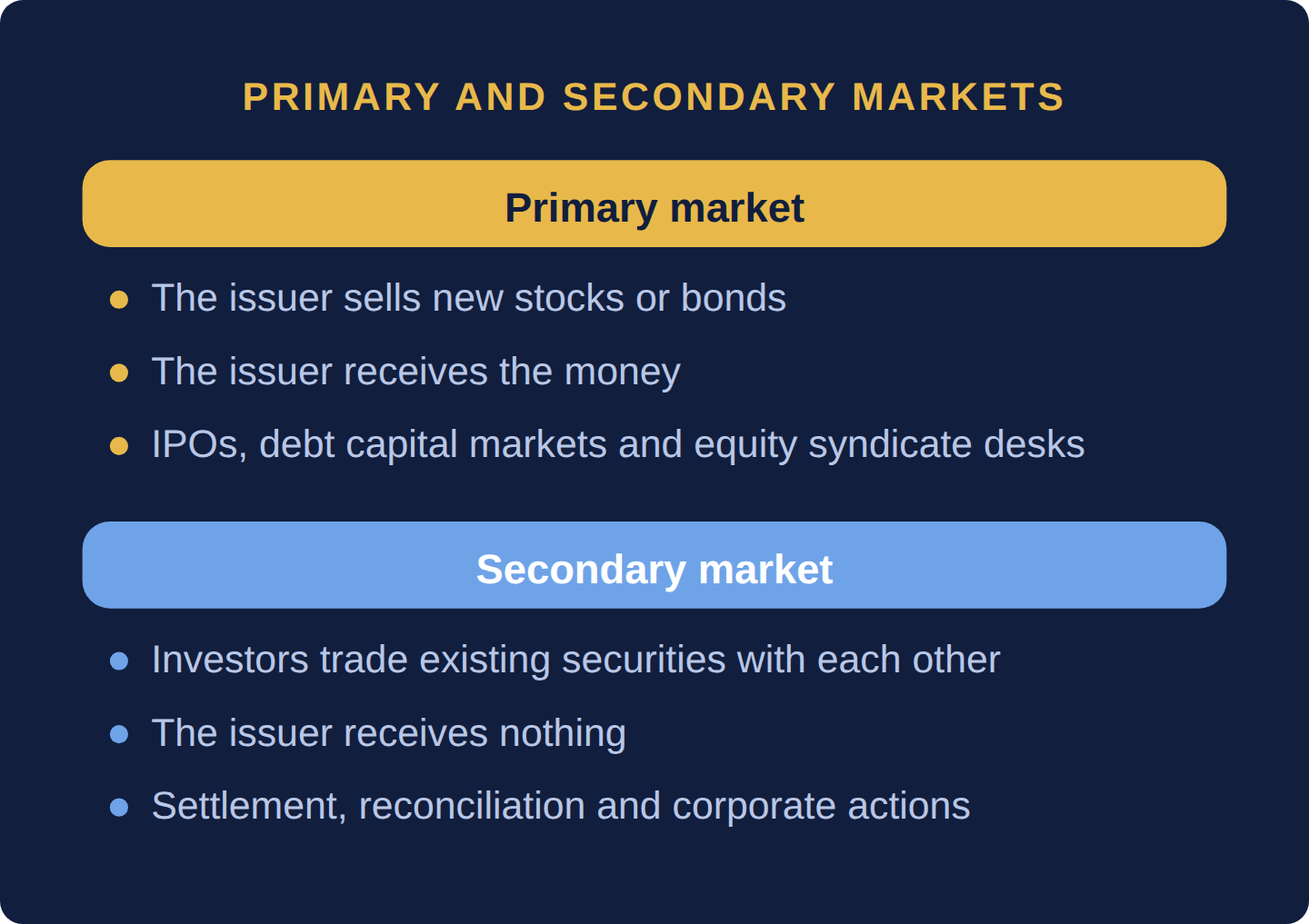
Capital markets let companies and governments raise money by issuing stocks and bonds in the primary market. Those securities then trade between investors in the secondary market, where the issuer receives nothing.
Why it matters: Operations work such as settlement, reconciliation and corporate actions happens mainly in the secondary market.
Summary: Capital markets let companies and governments raise money by issuing stocks and bonds in the primary market; those securities then trade between investors in the secondary market, where the issuer receives nothing.
- Operations work such as settlement, reconciliation and corporate actions happens predominantly in the secondary market, while origination (IPO), debt capital markets and equity syndicate desks work in the primary market.
- When a large bond is issued or an IPO is priced, it flows from primary to secondary within days, and operations teams must handle the transition.
Capital markets are the venues where companies and governments raise money by selling financial instruments — primarily stocks and bonds — to investors. They are the bridge between those who have capital (investors) and those who need it (companies, governments). Every time a government issues a bond to fund infrastructure, or a company sells shares to fund expansion, it is using the capital market.
| Term | What It Is |
|---|---|
| Stock (Equity / Share) | A small ownership slice of a company. Holding a stock makes you a part-owner, entitled to a share of profits (dividends) and voting rights on major decisions. |
| Bond | A formal IOU — you lend money to a company or government, which promises to repay the principal at a set future date (maturity) and pay interest (coupon) in the meantime. |
| Primary Market | Where securities are sold for the very first time (e.g., an IPO or government bond auction). Money goes directly to the issuer. |
| Secondary Market | Where existing securities are bought and sold between investors after their initial issuance. Money goes from buyer to seller — the original company gets none of it. |
| Stock Exchange | An organized, regulated marketplace (like the NYSE, BSE, or NSE) where shares are listed and traded. |
| Bond Auction | The mechanism by which governments sell new bonds — typically a competitive auction where dealers bid for the right to buy bonds at various yields. |
Understanding the primary/secondary market distinction is essential in capital markets operations. Operations work such as settlement, reconciliation and corporate actions happens predominantly in the secondary market. But the origination (IPO) teams, debt capital markets teams, and equity syndicate desks work in the primary market. When a large bond is issued or an IPO is priced, it flows from primary to secondary within days, and operations teams must handle the transition. Knowing where in this chain any given transaction sits tells you who owns it, who settles it, and who is responsible for any errors.
What are capital markets?
Markets where companies and governments raise money by issuing stocks and bonds, which then trade between investors.
What is the difference between the primary and secondary market?
In the primary market the issuer sells new securities and receives the money. In the secondary market investors trade existing securities with each other and the issuer receives nothing.
What happens when a large bond is issued or an IPO is priced?
It flows from the primary to the secondary market within days, and operations teams must handle the transition.
Capital markets let companies and governments raise money by issuing stocks and bonds in the primary market; those securities then trade between investors in the secondary market, where the issuer receives nothing. Knowing which market a transaction sits in tells operations teams who owns it, who settles it and who answers for errors.
Four questions and two worked problems on this chapter. Decide on your answer first, then click “Reveal Answer.”
1. A company sells new shares to the public for the first time in an IPO. Which market is this?
- The secondary market
- The primary market
- The interbank market
- The repo market
Reveal Answer
Answer: B. Securities are sold for the first time in the primary market, and the money goes to the issuer.
2. An investor sells 1,000 shares of a listed company to another investor on an exchange. How much does the company receive?
- A fixed share of the price
- The next dividend payment
- The full sale price
- Nothing
Reveal Answer
Answer: D. Secondary-market trades move money from buyer to seller; the original company gets none of it.
3. What is a bond’s coupon?
- The price at which the bond trades today
- The principal repaid to holders at maturity
- Interest the issuer pays until maturity
- The fee paid to the dealer selling the bond
Reveal Answer
Answer: C. A bond is a formal IOU: the issuer repays principal at maturity and pays interest, the coupon, in the meantime.
4. Which teams work mainly in the primary market?
- Origination, debt capital markets and equity syndicate
- Custody, safekeeping and asset servicing for clients
- Settlement, reconciliation and corporate actions teams
- Payments, cash management and collections for clients
Reveal Answer
Answer: A. The chapter places origination (IPO), debt capital markets and equity syndicate desks in the primary market; operations work is mostly secondary-market.
5. Worked problem: A company sells 20 million shares at $25 in an IPO and pays a 6.5% underwriting discount. What are the gross and net proceeds?
Reveal Answer
Answer: Gross = 20m × $25 = $500m. Fee = 6.5% × $500m = $32.5m. Net = $467.5m.
6. Worked problem: A bond issue of $400m at par pays a 5% coupon. What is the annual interest, and what yield do buyers earn if it trades at 96?
Reveal Answer
Answer: Interest = $20m a year. At a price of 96 the current yield = $5 ÷ $96 = 5.21%.
3.7 Types of Banks — The Full Ecosystem
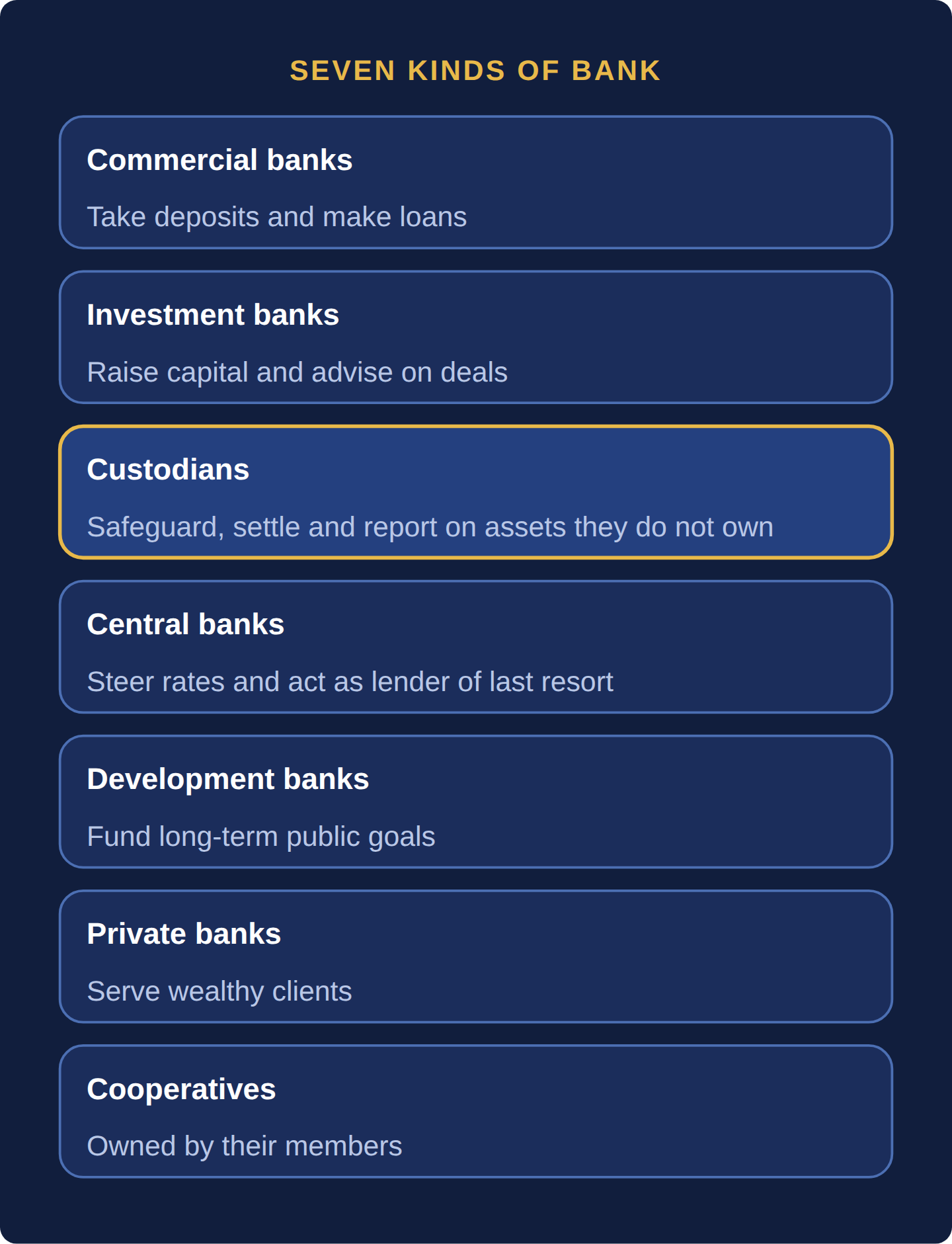
The banking ecosystem spans commercial banks, investment banks, custodians, central banks, development banks, private banks and cooperatives, each with a distinct job.
Why it matters: Knowing who does what makes news about “the banks” easier to read.
Summary: The banking ecosystem spans commercial banks, investment banks, custodians, central banks, development banks, private banks and cooperatives, each with a distinct job.
- A custodian bank is like a secure safe-deposit vault for the stocks, bonds and cash of pension funds, insurance companies and sovereign wealth funds; it does not own what it holds.
- Custodians such as State Street and BNY Mellon track, safeguard, settle and report on those assets, and are a daily counterparty for capital markets operations.
| Type | What It Does | Examples |
|---|---|---|
| Commercial / Retail Bank | Everyday banking: deposits, loans, credit cards, payment processing for individuals and businesses | JPMorgan Chase, HDFC Bank, SBI, Barclays |
| Investment Bank | Helps companies and governments raise capital (IPOs, bond issuance), advises on mergers and acquisitions, trades securities on behalf of clients and itself | Goldman Sachs, Morgan Stanley, JPMorgan (investment division) |
| Custodian Bank | Safely holds and administers securities and assets on behalf of large institutional investors. Does not own what it holds — tracks, safeguards, settles, and reports on those assets with absolute precision | State Street, BNY Mellon, Northern Trust, HSBC Securities Services |
| Central Bank | Sets monetary policy and short-term interest rates; issues currency and reserves; lender of last resort for the banking system | Federal Reserve, RBI, Bank of England, ECB |
| Development Bank | Provides financing for long-term infrastructure and development projects that commercial banks won’t fund due to long payback periods or insufficient returns | World Bank, Asian Development Bank, NABARD (India) |
| Private Bank | Wealth management services for high-net-worth individuals (typically $1M+ in investable assets): investment management, tax planning, estate planning | UBS, Citi Private Bank, Kotak Private Banking |
| Cooperative / Credit Union | Member-owned financial institution; profits returned to members; often serves specific communities or professions | Various cooperative banks in India; credit unions in the US |
Why different banks look so different on the balance sheet
A bank’s return on equity is its return on assets multiplied by its leverage. A deposit-funded commercial bank earns a thin return on assets and uses moderate leverage; a trading-heavy investment bank earns less per dollar of assets and relies on more leverage; a custodian earns fees and holds little risk on its own balance sheet.
Compare two banks. The commercial bank has assets of $100bn and equity of $8bn and earns 1.0% on assets. The trading bank has $100bn of assets and equity of $5bn and earns 0.5% on assets.
| Bank | Leverage | Return on assets | Return on equity |
|---|---|---|---|
| Commercial | $100bn ÷ $8bn = 12.5× | 1.0% | 12.5% |
| Trading | $100bn ÷ $5bn = 20× | 0.5% | 10.0% |
Result: the trading bank earns a lower return on equity and is also more fragile: a loss of 5% of its assets ($5bn) would erase all its equity, against 8% for the commercial bank.
A custodian bank is like a highly secure, professionally managed safe-deposit vault — except instead of storing family jewelry, it stores billions of dollars of stocks, bonds, and cash for pension funds, insurance companies, and sovereign wealth funds. It does not own what it holds. Its job is to track, safeguard, settle, and report on those assets with absolute precision — because even a single error can mean real money or real assets are misattributed. For anyone working in capital markets operations, custodians are a daily counterparty.
What types of banks are there?
Commercial banks, investment banks, custodians, central banks, development banks, private banks and cooperatives.
What is a custodian bank?
A secure vault for the stocks, bonds and cash of pension funds, insurance companies and sovereign wealth funds. It does not own what it holds.
What do custodians do?
Custodians such as State Street and BNY Mellon track, safeguard, settle and report on assets, and are a daily counterparty for capital markets operations.
The banking ecosystem spans commercial banks, investment banks, custodians, central banks, development banks, private banks and cooperatives, each with a distinct job. Custodians such as State Street and BNY Mellon hold assets they do not own and are a daily counterparty for capital markets operations.
Four questions and two worked problems on this chapter. Decide on your answer first, then click “Reveal Answer.”
1. What sets a custodian bank apart from the other banks in this chapter?
- It is owned by its members, not shareholders
- It lends mainly to large infrastructure projects
- It holds and administers assets it does not own
- It serves only clients with $1 million or more
Reveal Answer
Answer: C. Custodians such as State Street and BNY Mellon track, safeguard, settle and report on assets owned by their clients.
2. Why do development banks fund projects that commercial banks avoid?
- Commercial banks may not lend to any government
- The projects are always in foreign currencies
- Development banks are not allowed to charge interest
- The projects have long paybacks or low returns
Reveal Answer
Answer: D. Development banks such as the World Bank, ADB and NABARD finance long-term projects whose payback periods or returns do not suit commercial lenders.
3. Which institution returns its profits to the people it serves as owners?
- A custodian bank such as State Street
- A credit union or cooperative bank
- An investment bank such as Goldman Sachs
- A private bank such as UBS
Reveal Answer
Answer: B. Cooperatives and credit unions are member-owned, and their profits are returned to members.
4. Which activity belongs to an investment bank rather than a commercial bank?
- Advising companies on mergers and acquisitions
- Issuing credit cards to retail customers nationwide
- Taking savings deposits from individual households
- Processing everyday payments for small businesses
Reveal Answer
Answer: A. Investment banks help raise capital, advise on mergers and acquisitions, and trade securities; deposits, cards and payments are commercial banking.
5. Worked problem: A custodian holds $2tn of client assets and charges 0.02% a year. What is its fee income?
Reveal Answer
Answer: $2tn × 0.0002 = $400 million a year, with the client’s assets kept off its own balance sheet.
6. Worked problem: A bank earns 1.0% on assets with leverage of 12.5×. What is its return on equity, and what if leverage rises to 16×?
Reveal Answer
Answer: ROE = 1.0% × 12.5 = 12.5%; at 16× = 16.0%, but with less loss absorption.
3.8 The 2008 Financial Crisis — When the System Almost Broke
Subprime mortgages were securitized, rated AAA and sold worldwide. When house prices fell, losses hit heavily borrowed firms funded with short-term money, lenders pulled back, and Lehman Brothers filed for bankruptcy in September 2008. The crisis produced Basel III and the Dodd-Frank Act.
Why it matters: Today’s bank rules are the response to this crisis.
Summary: Subprime mortgages were securitized, rated AAA and sold worldwide; when house prices fell, the losses hit heavily levered firms funded with short-term wholesale money, lenders pulled back, and Lehman Brothers filed for bankruptcy in September 2008. The crisis produced Basel III‘s capital and liquidity rules and the Dodd-Frank Act.
- A firm with $30 billion of assets funded by $29 billion of borrowing and $1 billion of equity is levered 30 to 1, so a fall of about 3.3% in its assets wipes out all of its equity.
- Lehman Brothers, a 158-year-old investment bank, filed for bankruptcy in September 2008, and the global economy entered its worst recession since the 1930s.
- Congress authorized $700 billion for TARP, whose lifetime cost Treasury puts at about $31.1 billion.
US lenders made home loans that many borrowers could not repay, packaged them into securities, and sold them around the world with top ratings. When house prices fell, the losses landed on banks that had borrowed heavily and funded themselves overnight. Lenders stopped trusting each other, credit froze, and governments had to rescue the system.
The 2008 global financial crisis is the most important financial event of the past century after the Great Depression. Understanding it is not optional for anyone in finance — it reshaped regulation, monetary policy, and institutional behavior in ways that are still being felt today, and it is the origin story of almost every regulatory requirement, risk management framework, and control process in modern banking.
In the years before 2008, US banks gave out enormous numbers of risky home loans — called subprime mortgages — to borrowers with weak credit histories who were unlikely to keep up repayments if circumstances changed. The banks did this partly because they had found a way to pass the risk on: through securitization, thousands of these individual mortgages were bundled together into complex financial products called mortgage-backed securities (MBS) and collateralized debt obligations (CDOs), which were then sold to investors worldwide.
Credit rating agencies — whose job it was to independently assess the risk of these products — gave many of them top safety ratings (AAA), often incorrectly, partly because they were paid by the banks issuing the products. Investors worldwide — pension funds, insurance companies, banks in Germany, the UK, Iceland, Australia — bought these products believing they were safe.
When US housing prices fell and large numbers of subprime borrowers defaulted simultaneously in 2006–2007, the value of these securities collapsed. Because financial institutions worldwide held them, the losses spread globally. In September 2008, Lehman Brothers — a 158-year-old investment bank — filed for bankruptcy, triggering a global panic. Credit markets froze. Banks stopped lending to each other. The global economy entered its worst recession since the 1930s.

Leverage turns a modest loss into a fatal one (illustrative figures). A firm with $30 billion of assets funded by $29 billion of borrowing and $1 billion of equity is levered 30 to 1. If its assets fall in value by 1 ÷ 30 ≈ 3.3%, the loss is $30bn × 1/30 = $1 billion: its whole equity. Now add the funding: if much of the $29 billion is borrowed overnight in the repo market (Section 3.16: The Repo Market — The Financial System’s Overnight Plumbing), lenders can refuse to roll it the next morning as soon as they doubt the collateral. The firm must sell assets into a falling market, which deepens the loss for every other holder. As Fed Chair Ben Bernanke told the Financial Crisis Inquiry Commission in 2010, the shadow banking system and some of the largest global banks had become dependent on short-term wholesale funding such as repo and commercial paper, and lenders pulled it the way depositors run on a bank. That is why Basel III added liquidity rules (Section 3.2: How Banks Create Money — Fractional Reserve Banking) to its capital rules (Section 3.13: The BIS and the Basel Framework — Global Banking Rules).
Imagine a wholesaler bundles thousands of questionable IOUs from strangers together into a single package and sells it to investors with a certificate claiming the package is low-risk. The investors trust the certificate and buy. Then many of the strangers stop paying. The IOUs are worthless, the package collapses, and the investors who trusted the certificate — many of them on the other side of the world — suddenly face massive losses. Now multiply that by trillions of dollars across the entire global financial system simultaneously.
| Key Term | What It Means in the 2008 Context |
|---|---|
| Subprime Mortgage | Home loan to a borrower with weak credit history — high risk of default if housing prices fell or incomes dropped |
| Securitization | Bundling many mortgages together into a tradeable security (MBS/CDO) and selling it to investors globally, distributing the risk — or so it appeared |
| Mortgage-Backed Security (MBS) | A bond whose cash flows come from thousands of individual mortgage repayments — investors receive the interest and principal as homeowners pay |
| Systemic Risk | The risk that failure in one part of a tightly connected system triggers failures throughout the whole system — the defining feature of 2008 |
| Too Big to Fail | The idea that some institutions are so large and interconnected that their failure would be catastrophic — making government rescue politically unavoidable |
| Bailout (TARP) | Congress authorized $700 billion for the Troubled Asset Relief Program through the Emergency Economic Stabilization Act of 2008 so taxpayers could backstop the financial system. Treasury disbursed $443.5 billion, collected most of it back, and puts the program’s lifetime cost at about $31.1 billion (all programs closed by September 30, 2023) |
2008 is the clearest real-world proof of systemic risk — risky home loans in US suburbs ended up causing job losses, bank failures, and recessions on every continent. It directly produced Basel III (stricter capital requirements), Dodd-Frank (the sweeping 2010 US law that tightened bank supervision, mandated annual stress tests, moved derivatives onto regulated platforms, and created a dedicated consumer financial-protection agency), and years of near-zero interest rates. Every regulation, every risk management framework, every reconciliation control, every stress test in modern finance has been shaped, directly or indirectly, by the lessons of 2008.
What caused the 2008 financial crisis?
Subprime mortgages were securitized, rated AAA and sold worldwide. When house prices fell, the losses hit heavily levered firms funded with short-term wholesale money, and lenders pulled back.
What is leverage, and why was it dangerous?
A firm with $30 billion of assets funded by $29 billion of borrowing and $1 billion of equity is levered 30 to 1, so a fall of about 3.3% in its assets wipes out all of its equity.
What happened to Lehman Brothers?
The 158-year-old investment bank filed for bankruptcy in September 2008, and the global economy entered its worst recession since the 1930s.
How much did the TARP bailout cost?
Congress authorized $700 billion for TARP, but Treasury puts its lifetime cost at about $31.1 billion.
Subprime mortgages were securitized, rated AAA and sold worldwide; when house prices fell, the losses hit heavily levered firms funded with short-term wholesale money, lenders pulled back, and Lehman Brothers filed for bankruptcy in September 2008. Congress authorized $700 billion for TARP, whose lifetime cost Treasury puts at about $31.1 billion, and the crisis produced Basel III’s capital and liquidity rules and the Dodd-Frank Act.
Four questions and two worked problems on this chapter. Decide on your answer first, then click “Reveal Answer.”
1. A firm has $40 billion of assets and $1 billion of equity. What fall in the value of its assets wipes out its equity?
- 25%
- 2.5%
- 4.0%
- 1.0%
Reveal Answer
Answer: B. The firm is levered 40 to 1, so a loss of $1 billion ÷ $40 billion = 2.5% of its assets equals all of its equity.
2. Congress authorized $700 billion for TARP. What does the Treasury put the program’s lifetime cost at?
- The full $700 billion
- Zero, as every dollar was repaid
- About $31.1 billion
- About $443.5 billion
Reveal Answer
Answer: C. Treasury disbursed $443.5 billion, collected most of it back, and puts TARP’s lifetime cost at about $31.1 billion.
3. What is securitization?
- Selling a bank’s shares to the public for the first time
- Insuring deposits up to a fixed limit per depositor
- Lending cash overnight against government bonds
- Bundling many loans into a security sold to investors
Reveal Answer
Answer: D. Securitization pooled thousands of mortgages into mortgage-backed securities and CDOs that were sold to investors worldwide.
4. What conflict of interest affected the credit rating agencies before 2008?
- They were paid by the banks issuing the products
- They owned large stakes in the mortgage borrowers
- They were funded by the central banks they rated
- They earned fees from investors who shorted them
Reveal Answer
Answer: A. The issuers paid for the ratings, which helped explain why many risky products received AAA ratings.
5. Worked problem: A firm has $30bn of assets and $1bn of equity. What is its leverage, and what fall in asset value wipes out its equity?
Reveal Answer
Answer: Leverage = 30 to 1. Wipe-out fall = 1 ÷ 30 = 3.33%.
6. Worked problem: A firm at 40-to-1 leverage ($40bn of assets, $1bn of equity) sees assets fall 4%. What is its equity afterward?
Reveal Answer
Answer: Loss = 4% × $40bn = $1.6bn, so equity = $1bn − $1.6bn = −$0.6bn: insolvent.
- Investor.gov, Initial Public Offering (IPO) — Investor.gov’s explanation of how an IPO sells shares in the primary market
- World Bank, Financial Sector — World Bank overview of the financial sector and its institutions
- Federal Reserve History, Failure of Lehman Brothers — Lehman bankruptcy and the 2008 panic (Section 3.8)
- Ben S. Bernanke, testimony to the Financial Crisis Inquiry Commission, September 2, 2010 — Dependence on short-term wholesale funding and runs
- US Treasury, About TARP — $700bn authorized, $443.5bn disbursed, ~$31.1bn lifetime cost
- Dodd-Frank Wall Street Reform and Consumer Protection Act, Public Law 111-203 (July 21, 2010) — The 2010 US reform law enacted after the 2008 crisis (Section 3.8)