
A company’s finance team grows through five stages, from a founder with an outside bookkeeper to a specialized function of hundreds. Place a company by whichever measure, headcount or revenue, puts it later. The cost of finance as a share of revenue falls as the company grows, from several percent at Series A to roughly 1% at large companies, as a rule of thumb. Complexity, more than size, drives how many people finance needs. And Indian law pulls statutory audit, GST and the company secretary earlier than the US pattern.
Why it matters: The right finance team depends on how complicated the business is, not only on how big it is.
Summary: The five stages run from a founder with an outside bookkeeper to a specialized function of hundreds, with every size anchored to headcount and revenue. Finance cost falls from several percent of revenue at Series A to roughly 1% at large companies (a rule of thumb).
- Place a company by whichever measure, headcount or revenue, puts it later.
- Complexity drives finance headcount more than size does.
- Implied staffing: about 2–5 finance staff per 100 employees.
- Indian law pulls statutory audit, GST and the company secretary earlier than the US pattern.
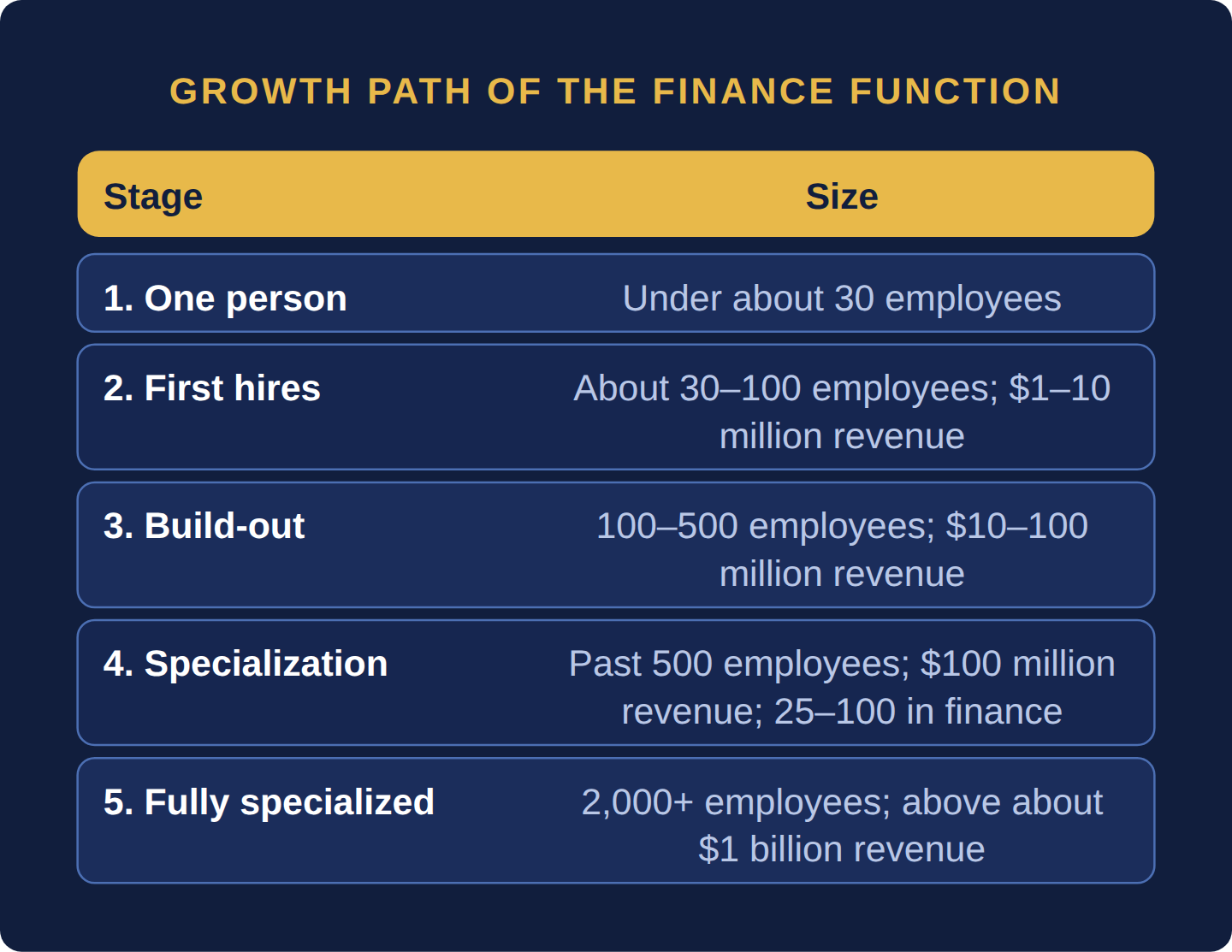
| Stage | Typical headcount | Typical revenue | Finance team size | Defining characteristic |
|---|---|---|---|---|
| 1. Founding / Seed | Under 30 | Zero to about $2 million | 0–1 in-house (founder plus outside bookkeeper) | No dedicated finance hire; bookkeeping outsourced |
| 2. Series A | 30–100 | About $1–10 million | 1–3 | First in-house accountant or Head of Finance; tasks shared across very few people |
| 3. Scale-Up (Series B–C) | 100–500 | About $10–100 million | 4–25 | Distinct Controller and FP&A functions emerge; cash runway remains the CFO’s dominant focus |
| 4. Pre-IPO / Growth | 500–2,000 | About $100 million–$1 billion | 25–100 | Treasury, IR, Tax and Internal Audit separate out, often triggered by an IPO or major debt raise |
| 5. Large Corporate | 2,000+ | Above about $1 billion | 100 to several hundred; thousands at the largest multinationals, much of it in shared-service centers | Every function fully specialized; the CFO orchestrates interfaces between functions |
All ranges are typical US patterns, not statistics, consistent with the funding-stage table in B.6: High-Growth Startup / Scale-Up. Revenue and headcount do not move in step (a software company may reach $100 million of revenue with 400 people, a retailer needs thousands), so place a company by whichever measure puts it later: complexity (entities, currencies, contract types) drives finance headcount more than size.
Benchmarks by stage. Typical ranges, not a published benchmark. Staffing is implied by the table above (25 finance staff ÷ 500 employees × 100 = 5); cost is a practitioner rule of thumb, high at small companies because finance has a fixed minimum cost.
| Stage | Finance staff per 100 employees | Finance cost as a percent of revenue |
|---|---|---|
| 2. Series A | About 3 | Often 5% or more |
| 3. Scale-Up | About 4–5 | Roughly 2–5% |
| 4. Pre-IPO / Growth | About 5 | Roughly 1.5–3% |
| 5. Large Corporate | About 2–5 | Roughly 1%, lower at the most automated |
How is a company placed on the growth path?
By whichever measure, headcount or revenue, puts it later.
What drives finance headcount?
Complexity drives finance headcount more than size does.
How does finance cost change with size?
It falls from several percent of revenue at Series A to a much smaller share at scale.
Indian law pulls several Part D hires earlier than the US pattern, because duties attach to the company from incorporation rather than to fundraising events.
- Statutory audit from day one: every company, private ones included, must have an auditor; the board appoints the first one within 30 days of registration (Companies Act, 2013, section 139(6)). A US private company’s first audit usually comes from investors or lenders; an Indian founder needs a CA firm in year one.
- GST from the first sale across a state line: a supplier of goods to another state must register for GST whatever its turnover, and a branch in a new state needs a fresh, separate registration. Multi-state GST filing and input tax credit reconciliation often make a GST accountant the first in-house hire, ahead of FP&A.
- Company secretary: listed companies and public companies with paid-up share capital of ₹10 crore or more must have whole-time key managerial personnel, including a company secretary and a CFO; private companies at the same ₹10 crore threshold need a whole-time company secretary (rule 8A, since April 1, 2020). The CS runs board and shareholder compliance, a seat the US scale-up gives to outside counsel.
- Internal audit by threshold, not by IPO: section 138 and rule 13 require an internal auditor (a CA, a cost accountant or another professional the board chooses) at every listed company, at unlisted public companies with paid-up capital of ₹50 crore or more, turnover of ₹200 crore or more, bank borrowings above ₹100 crore or deposits of ₹25 crore or more, and at private companies with turnover of ₹200 crore or more or borrowings above ₹100 crore. Many companies outsource it to a CA firm before building a team.
- The GCC finance center: multinationals typically open an Indian global capability center (GCC) for finance at Stage Five, once processes and the ERP are standardized: payables, receivables and reconciliations first, then close, FP&A support and tax. India hosted over 1,700 GCCs employing over 19 lakh people as of FY24.
The five stages run from a founder with an outside bookkeeper to a specialized function of hundreds, with every size anchored to headcount and revenue. Complexity drives finance headcount more than size does.
Six questions on this chapter. Decide on your answer first, then click “Reveal Answer.”
1. A company has 25 finance staff and 500 employees. How many finance staff per 100 employees is that?
- 0.5
- 5
- 20
- 2
Reveal Answer
Answer: B. 25 ÷ 500 × 100 = 5.
2. A retailer has 1,200 employees but only $60 million of revenue. Where should you place it?
- Stage Three, by revenue, the more reliable measure
- Stage Three, by averaging the two measures
- Stage Five, because retail is labor intensive
- Stage Four, by headcount, the later of the two measures
Reveal Answer
Answer: D. D.6 says to place a company by whichever measure puts it at the later stage.
3. A company with $2 billion of revenue spends about 1% of revenue on finance. Roughly what is its finance cost?
- $20 million
- $200 million
- $2 million
- $12 million
Reveal Answer
Answer: A. $2 billion × 1% = $20 million (a rule of thumb).
4. An Indian private company has paid-up share capital of ₹12 crore. What must it have under rule 8A?
- A GCC finance center
- A US-style audit committee
- A whole-time company secretary
- A whole-time internal audit team
Reveal Answer
Answer: C. Since April 1, 2020, private companies at ₹10 crore or more of paid-up capital need one.
5. Worked problem: A company has 600 employees and $80m of revenue. By headcount it is Stage Four (over 500); by revenue Stage Three ($10–100m). Which stage does the guide assign?
Reveal Answer
Answer: Whichever measure puts it later: Stage Four.
6. Worked problem: A company has 2,500 employees and $1.2bn of revenue. Which stage?
Reveal Answer
Answer: Stage Five: over 2,000 employees and above about $1bn.