
0.1 The World Before Money — The Barter System
Barter is trading goods for goods, with no money in between. It works in a small village where everyone knows what everyone has, and it fails in a bigger economy, because you must find someone who has what you want and wants what you have at the same moment. That failure is why money exists.
Why it matters: Every form of money, from shells to paper, was a fix for these problems.
Summary: Before money, people traded goods directly, which is called barter. It worked in small, close-knit communities but broke down as societies grew, because of three built-in problems.
- Barter needs a double coincidence of wants: you must find someone who has exactly what you want and wants exactly what you have, at the same moment.
- Some goods cannot be split (a cow worth twenty baskets of grain when you need only five), and with no standard of value every trade needs a fresh negotiation.
Barter, also called the barter system, is the direct exchange of goods or services for other goods or services, with no money in between. It is the oldest form of trade and the starting point of the history of money. It describes any exchange in which each side hands over something of value and receives something of value in return.
How a barter trade works
A barter trade succeeds only when three conditions hold at the same moment. Each side must want what the other holds, the quantities must be able to match in value, and both sides must accept the same rate of exchange. A person with surplus grain who needs sandals finds someone with spare sandals who needs grain, and the two agree how much grain is worth how many sandals.
In a small, close-knit community this works reasonably well. A village of farmers can work out who has surplus wheat, who needs firewood and who can offer labor, because everyone knows everyone else’s stock and needs. The difficulty appears when the community and the range of goods grow.
The three structural problems
| Problem | The test it fails | Example |
|---|---|---|
| Double coincidence of wants | Both traders want exactly what the other holds, at the same moment | The grain owner wants sandals, but the sandal maker wants something other than grain |
| Indivisibility | Goods can be split to match the value of the trade | A cow worth twenty baskets of grain cannot be divided to pay for five baskets |
| No standard of value | A shared unit exists for judging whether a deal is fair | Every trade needs a fresh negotiation about how much of one good equals one of another |
The search cost of a double coincidence
The first problem has a measurable cost. Suppose a share p of the people you meet hold what you want, and a share q of them want what you hold. If these two traits are independent, the chance that a random meeting works is p × q, and the expected number of meetings before one works is the reciprocal.
Expected meetings = 1 ÷ (p × q)
| Share who suit you (each side) | Chance one meeting works | Expected meetings |
|---|---|---|
| 50% | 25% | 4 |
| 20% | 4% | 25 |
| 10% | 1% | 100 |
| 5% | 0.25% | 400 |
| 1% | 0.01% | 10,000 |

Why the barter system breaks at scale: the price-list problem
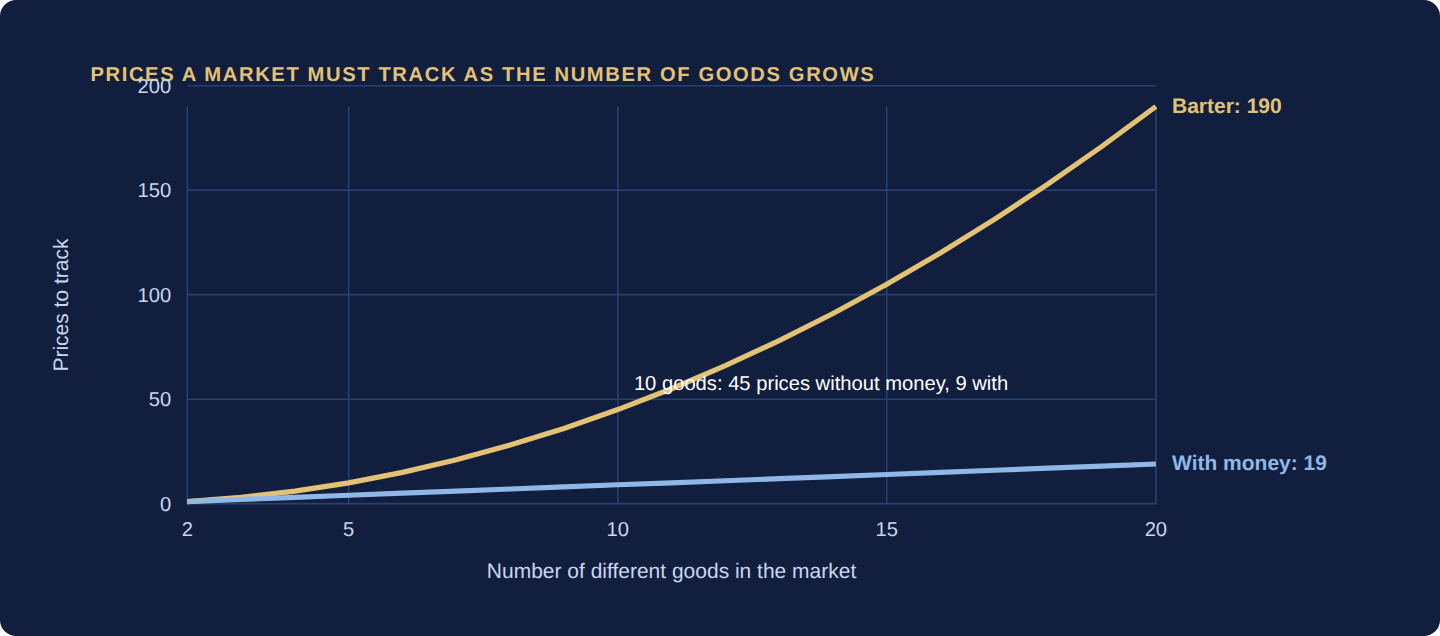
The third problem grows faster than the market does. With n goods and no money, every good needs a price in terms of every other good, so the market must track n(n − 1) ÷ 2 exchange rates. If one good serves as a common money, each good needs a single price in that money, and the market needs only n − 1 prices.
| Goods in the market | Prices without money | Prices with one money |
|---|---|---|
| 5 | 10 | 4 |
| 10 | 45 | 9 |
| 20 | 190 | 19 |
| 100 | 4,950 | 99 |
Three-way deadlocks
Even when a swap would make everyone better off, barter can fail to find it. If a farmer wants sandals, the sandal maker wants firewood and a woodcutter wants wheat, no two of them can trade directly, yet a three-way exchange would satisfy all three. Real markets hold thousands of such circles. A common medium turns each circle into simple pairs of trades: every person sells for money and buys with money.

Common misreadings
“Barter is just slower than money.” The deeper difference is cost that grows with scale: search time and price lists expand until trade stops growing. “Barter has no prices.” It has prices, but a separate exchange rate for every pair of goods. “Indivisibility only affects big goods.” It affects any good whose smallest unit is worth more than the purchase.
A method for diagnosing a failed trade
- Check the wants. Does each side want what the other holds? If not, the trade fails on double coincidence.
- Check divisibility. Can the goods be split so the values match? If not, one side overpays or the trade fails.
- Check the rate. Is there an agreed exchange rate, or must the pair negotiate from scratch?
- Count the prices. With n goods, compute n(n − 1) ÷ 2. A large number signals a market that needs a medium.
- Name the fix. A single widely accepted good, used as the medium of every trade, removes all three problems.
Practice problems
Before money existed, human beings traded goods and services directly with one another. If you had surplus grain and needed a pair of sandals, you found someone with spare sandals who needed grain and you swapped. This is called barter — the direct exchange of things of value without any intermediate medium.
Barter worked reasonably well in small, close-knit communities where everyone knew everyone else. A village of farmers could work out between themselves who had surplus wheat, who needed firewood, and who could offer labor in exchange. No money needed.
Imagine a school canteen where no money exists. You have an extra sandwich. Your friend has a spare apple. If you both want what the other has, the trade is simple. But what if you want a biscuit, and the person with the biscuit wants crayons, not a sandwich? You are stuck. That stuckness is exactly what killed barter as economies grew.
Barter has three fundamental problems that made it unworkable at any scale:
- Double coincidence of wants: You need to find someone who has exactly what you want and who wants exactly what you have, at the same moment. In a large society, this becomes almost impossible.
- Indivisibility: Some goods cannot be split. If a cow is worth twenty baskets of grain but you only need five, there is no clean way to make that trade under barter.
- No standard of value: Every trade required a fresh negotiation, because there was no agreed unit by which to measure whether a deal was fair.
What is the barter system?
The direct exchange of goods or services for other goods or services, with no money. It works when the people trading are few and know each other’s needs.
What are the problems of the barter system?
Three: the double coincidence of wants, the indivisibility of goods and the lack of a standard of value. As goods multiply, the prices to track grow as n(n − 1) ÷ 2.
What is the double coincidence of wants?
The condition that each trader wants exactly what the other holds, at the same moment. Jevons wrote in 1875 that it “will rarely happen”.
Why did money replace barter?
The standard explanation is that money removes the search for a double coincidence and gives every good one price. Some historians add that early societies also relied on credit, so the real sequence may have been less tidy than the textbook story.
- Barter is the direct exchange of goods for goods; it works when the community is small enough for everyone to know what everyone holds.
- It fails at scale for three reasons: double coincidence of wants, indivisibility and no standard of value.
- Without money the number of prices grows as n(n − 1) ÷ 2; with one money it grows only as n − 1.
- The expected search for a double coincidence is 1 ÷ (p × q) meetings, which explodes as matches become rare.
- The remedy is a common medium of exchange, which is where commodity money begins.
Four questions and three worked problems on this chapter. Decide on your answer first, then click “Reveal Answer.”
1. A farmer with surplus grain wants sandals, but the only sandal maker wants firewood. Which barter problem does this show?
- Indivisibility of goods
- The scarcity of commodity money
- The double coincidence of wants
- The lack of a standard of value
Reveal Answer
Answer: C. Barter needs each side to want exactly what the other has at the same moment; here the sandal maker wants firewood, not grain.
2. A cow is worth twenty baskets of grain, but you need only five baskets. Which barter problem blocks the trade?
- Double coincidence of wants
- Lack of portability
- No standard of value
- Indivisibility
Reveal Answer
Answer: D. A cow cannot be split into a quarter without destroying its value, so there is no clean way to trade it for five baskets.
3. Why did barter work reasonably well in small villages but fail as economies grew?
- Neighbors knew who had surpluses; at scale, finding a matching partner became nearly impossible
- Large economies produced too few surplus goods for barter to be worth the effort of trading
- Small villages had more gold to back their trades than large, growing economies did at the time
- Governments in large economies banned barter by law in order to promote the use of coins
Reveal Answer
Answer: A. The chapter explains that barter relies on finding a matching partner, which is easy among neighbors and almost impossible at scale.
4. Without money, every trade required a fresh negotiation over what counted as fair. Which problem is this?
- Lack of durability
- No standard of value
- Double coincidence of wants
- Indivisibility
Reveal Answer
Answer: B. With no agreed unit to measure value, each swap had to be priced from scratch.
5. Worked problem: A market has 12 goods. How many prices must be tracked without money, and how many with one common money?
Reveal Answer
Answer: Without money: 12 × 11 ÷ 2 = 66. With one money: 12 − 1 = 11. Money cuts the price list by a factor of six.
6. Worked problem: A person owns one cow worth twenty baskets of grain and needs only five baskets. Which barter problem is this, and what does it cost the owner?
Reveal Answer
Answer: Indivisibility. The cow cannot be split, so the owner either overpays by fifteen baskets of value or cannot trade. A divisible medium would let the owner sell the whole cow and spend only the value of five baskets.
7. Worked problem: In a market, 5% of traders hold what you want and 5% want what you hold. What is the chance that one meeting works, and how many meetings do you expect before a trade?
Reveal Answer
Answer: Chance = 0.05 × 0.05 = 0.0025, or 0.25%. Expected meetings = 1 ÷ 0.0025 = 400.
0.2 Commodity Money — When Things Became Currency
Commodity money is a useful physical good, such as shells, salt or silver, that a whole community agrees to accept in payment. It fixed barter’s biggest problem, because any trade could now go through the commodity, but the goods themselves could rot, be hard to split or be gathered in bulk.
Why it matters: It is the first step from direct swaps to one shared medium of exchange.
Summary: Commodity money was the first fix for barter: a widely desired physical object, such as shells, salt, or silver and barley, that a whole community agreed to accept in trade. It solved the double coincidence problem but brought problems of its own.
- Cowrie shells were used across Africa, South Asia and East Asia for thousands of years, and silver and barley were the standards of value in Mesopotamia around 3000 BCE.
- Cattle could not be divided easily, grain could rot, and shells could be collected from beaches, inflating the supply and destroying their value.
Commodity money is a physical good, desired for its own uses, that a community agrees to accept as a medium of exchange. It has real intrinsic value, because it can be used for something other than trade, and it is also accepted by everyone as a way to store and transfer value.
How commodity money works
Under barter every trade needs a double coincidence of wants. A commodity that everyone accepts splits each trade into two steps: sell what you hold for the commodity to anyone who wants it, then spend the commodity on what you need. The seller of sandals no longer has to want grain; accepting the commodity is enough.
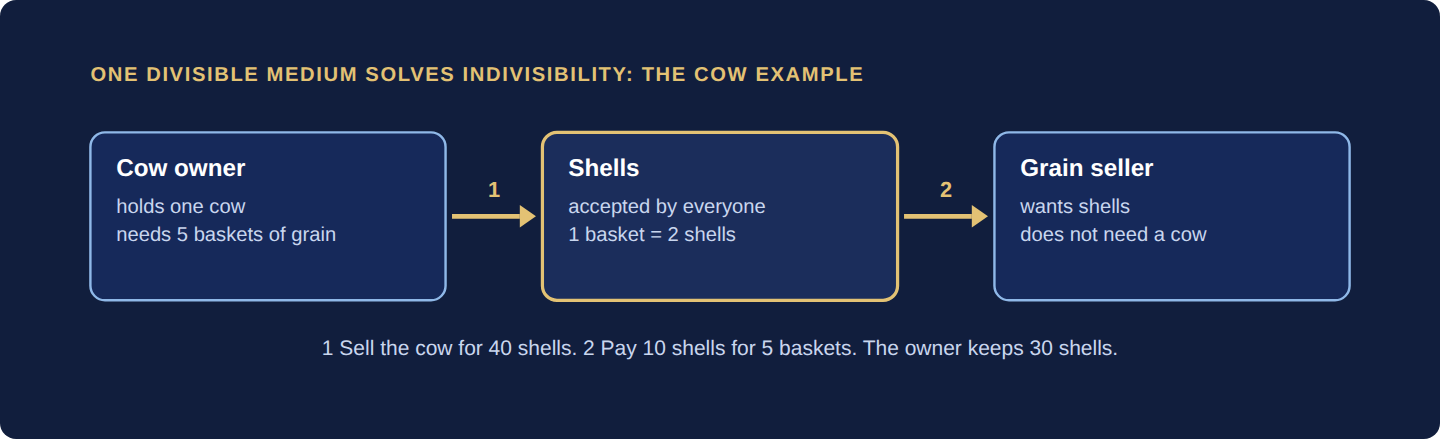
A medium also supplies a standard of value. Suppose a basket of grain is priced at 2 shells and a cow is worth 20 baskets. The cow is then worth 40 shells, and every other good can be priced the same way in a single list.
| Good | Price in shells | Equivalent |
|---|---|---|
| 1 basket of grain | 2 | — |
| 1 pair of sandals | 10 | 5 baskets of grain |
| 1 cow | 40 | 20 baskets of grain |
Which goods were used
| Commodity | Where and when | Note |
|---|---|---|
| Cowrie shells | Across Africa, South Asia and East Asia, for thousands of years | Collected from beaches, so anyone who gathered more raised the supply |
| Salt | Ancient Rome | The Latin salarium, a payment to soldiers and officials, is traditionally linked to sal, salt, and gave English the word salary; whether soldiers were ever paid in salt itself is debated |
| Silver and barley | Ancient Mesopotamia, around 3000 BCE | The primary standards of value |
Why intrinsic value matters
Because commodity money is useful in its own right, demand for it comes from two sources: people who want to consume it and people who want to spend it. The consumption demand puts a floor under its value, since the good remains useful even if people stop accepting it as money. The price of that floor is that the supply of the money is tied to the supply of the commodity.
The supply problem
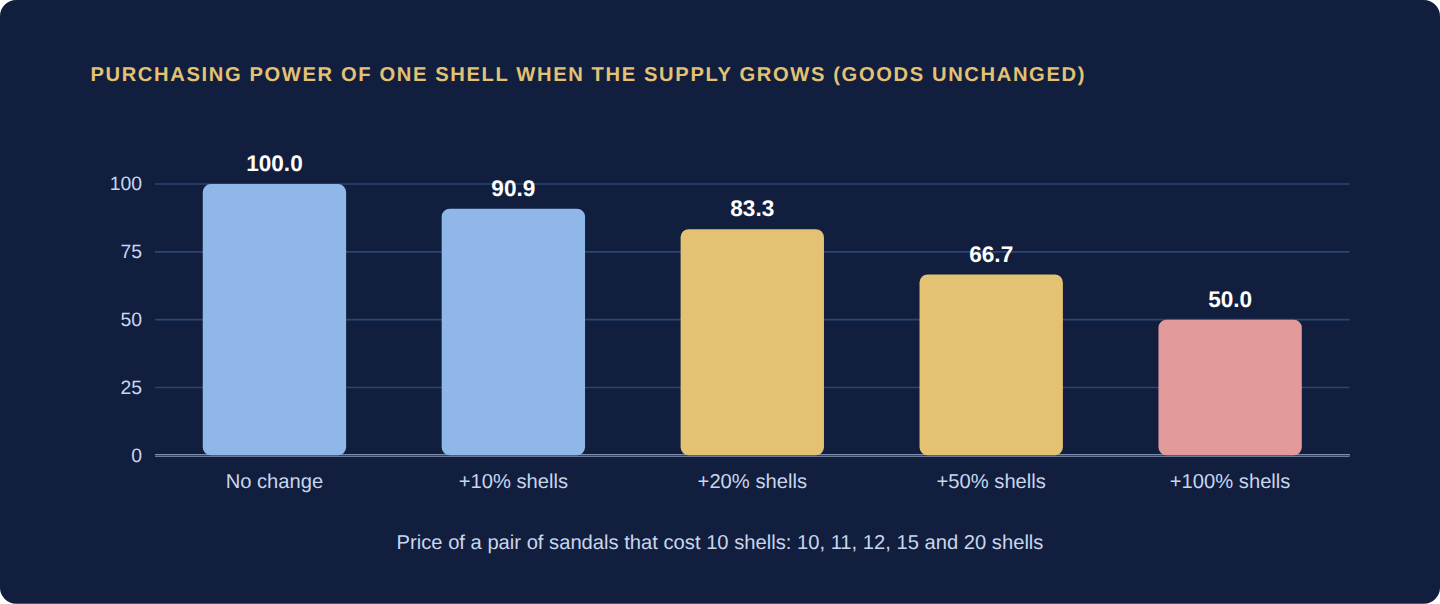
A commodity that can be gathered cheaply can be over-supplied. If the stock of shells rises by a fraction g while the quantity of goods stays the same, each shell buys 1 ÷ (1 + g) as much as before, and prices measured in shells rise by the factor 1 + g.
Purchasing power per unit = 1 ÷ (1 + g)
| Rise in shell supply | Purchasing power of one shell | Sandals priced at 10 shells now cost |
|---|---|---|
| 0% | 100.0% | 10 |
| +10% | 90.9% | 11 |
| +20% | 83.3% | 12 |
| +50% | 66.7% | 15 |
| +100% | 50.0% | 20 |
Durability and divisibility
Cattle and grain fail different tests. A cow cannot be divided into small change, so it cannot pay for a small purchase. Grain can rot, so wealth held as grain decays in storage. A good money must be durable, divisible, portable and naturally scarce, and no single commodity in this list met all four.

Common misreadings
“Commodity money has no value apart from trade.” The opposite is true: its intrinsic use value is what separates it from money that rests only on trust. “The word salary proves soldiers were paid in salt.” The link between salarium and sal is traditional, and whether salt itself was paid is debated. “Any commodity can serve as money.” It must be widely desired, divisible, durable and hard to over-supply.
A method for testing a commodity as money
- Test the demand. Is the good wanted by nearly everyone in the community?
- Test divisibility. Can it be split into small units without losing value?
- Test durability. Will it keep its value in storage?
- Test the supply. Can anyone cheaply add to the stock? If so, expect each unit to lose purchasing power as the stock grows.
- Test the price list. Can every good be priced in it? If yes, it is working as a standard of value.
Practice problems
The first solution to barter’s problems was commodity money: choosing a specific, widely-desired physical object and agreeing across a community that it would be used as a medium of exchange. The object had real intrinsic value — you could use it for something other than trading — but it was also accepted by everyone as a way to store and transfer value.
Different civilizations chose different commodities. Cowrie shells were used across Africa, South Asia, and East Asia for thousands of years. Salt was valuable enough in ancient Rome that the Latin salarium, a payment to soldiers and officials, is traditionally linked to sal, salt, and gave English the word salary (whether soldiers were ever paid in salt itself is debated). In ancient Mesopotamia around 3000 BCE, silver and barley were the primary standards of value.
If everyone in your school agreed that a specific kind of eraser was the standard unit of value — one eraser buys a pencil, three erasers buy a notebook — then erasers have become commodity money. You can still use them to erase things, but their real power now is as a medium of exchange that everyone trusts and accepts.
Commodity money solved the double coincidence problem: you could now sell your grain for shells, and use those shells to buy sandals from someone who didn’t need your grain at all. But it introduced new problems: cattle couldn’t be divided easily, grain could rot, and shells could be collected from beaches — inflating the supply and destroying their value. What was needed was something durable, divisible, portable, and naturally scarce.
What is commodity money?
Money that is itself a useful good, such as cowrie shells, salt, cattle or silver and barley, accepted because everyone in the community values it.
What are examples of commodity money?
Cowrie shells, used across Africa, South Asia and East Asia for thousands of years, and silver and barley, which were the standards of value in Mesopotamia around 3000 BCE.
What are the problems with commodity money?
Cattle could not be divided easily, grain could rot, and shells could be collected from beaches, which inflated the supply and destroyed their value.
How does commodity money solve the double coincidence of wants?
It splits a trade in two: you sell what you have for the commodity and then buy what you want with it, so the seller no longer needs to want what you hold.
- Commodity money is a physical good with real use value that a community accepts as a medium of exchange.
- It solves the double coincidence of wants by splitting a trade into a sale for the commodity and a purchase with it.
- A single medium creates a single price list and lets large goods be paid for in small change.
- If the stock of the commodity grows faster than the goods it buys, purchasing power per unit falls as 1 ÷ (1 + g).
- Cattle, grain and shells each had a flaw, which pushed societies toward durable, divisible, scarce metal.
Four questions and three worked problems on this chapter. Decide on your answer first, then click “Reveal Answer.”
1. What made commodity money an improvement on barter?
- It allowed the government to set the value of every good sold in the market
- It removed the need for anyone to trust the value of the item being used in trade
- You could sell for the commodity and spend it with someone who did not want your goods
- It guaranteed that prices of everyday goods would never change over time
Reveal Answer
Answer: C. Commodity money solved the double coincidence problem: shells or salt could be accepted by anyone and spent elsewhere.
2. Why could shells collected from beaches destroy their own value as money?
- Anyone could gather more, inflating the supply
- They rotted quickly in storage
- They were too heavy to carry over long distances
- Governments refused to accept them for taxes
Reveal Answer
Answer: A. The chapter notes that easy collection inflated the supply of shells and eroded their value: scarcity matters.
3. What links the word salary to salt, according to the chapter?
- Roman law required every soldier’s wage to be paid in salt until coins replaced it
- The Latin salarium, a payment to soldiers, is traditionally linked to sal, salt
- Salt was the only commodity that ancient Mesopotamia used as its standard of value
- Salary was the Roman name for a sealed bag of salt used by merchants in trade
Reveal Answer
Answer: B. The chapter gives the traditional etymology and notes that whether soldiers were actually paid in salt is debated.
4. Which set of properties did commodity money still lack, leading to the search for something better?
- Backing by a central bank, legal-tender status and a fixed supply
- An exchange rate against foreign currencies and a managed supply
- Acceptance by the community, a physical use and a stable value
- Durability, divisibility, portability and natural scarcity together
Reveal Answer
Answer: D. Cattle could not be divided, grain rotted and shells could be gathered; metal later combined all four properties.
5. Worked problem: A basket of grain costs 2 shells and a cow is worth 20 baskets. A cow owner sells the cow and buys 5 baskets. How many shells does the owner keep?
Reveal Answer
Answer: The cow sells for 20 × 2 = 40 shells. Five baskets cost 5 × 2 = 10 shells. The owner keeps 40 − 10 = 30 shells, which the owner can spend later in any size.
6. Worked problem: The stock of shells rises by 50% and the quantity of goods is unchanged. What happens to the purchasing power of one shell, and to the price of sandals that cost 10 shells?
Reveal Answer
Answer: Purchasing power = 1 ÷ 1.5 = 0.667, so each shell buys about 66.7% of what it did. Sandals now cost 10 × 1.5 = 15 shells.
7. Worked problem: Name the flaw in each case: (a) a cow cannot pay for a small purchase, (b) stored grain spoils, (c) shells gathered from beaches flood the market.
Reveal Answer
Answer: (a) Indivisibility: the unit is too large. (b) Lack of durability: the stored value decays. (c) Unstable supply: anyone can add to the stock, so each unit loses value.
0.3 Metal Coins — The First Standard Currency
Around 600 BCE the kingdom of Lydia stamped pieces of metal to guarantee their weight and purity, creating the first standard coins. Metal is durable, divisible, portable and scarce, and the stamp made the state the guarantor of money.
Why it matters: The stamp ended the argument over weight and purity in every trade.
Summary: Around 600 BCE the kingdom of Lydia produced what historians consider the world’s first standardized metal coins, stamped to guarantee their weight and purity. The stamp meant a third party, the state, was now underwriting the value of money.
- Gold, silver and copper were durable, divisible, portable and naturally scarce, the properties commodity money lacked.
- Before standard coins, every metal trade meant weighing the metal and arguing about its purity; a government stamp ended that argument.
A coin is a piece of metal of standard weight and purity, stamped by an issuing authority that guarantees both. The kingdom of Lydia, in modern-day Turkey, produced what historians consider the world’s first standardized metal coins around 600 BCE, made of electrum, a natural alloy of gold and silver.
How a stamped coin works
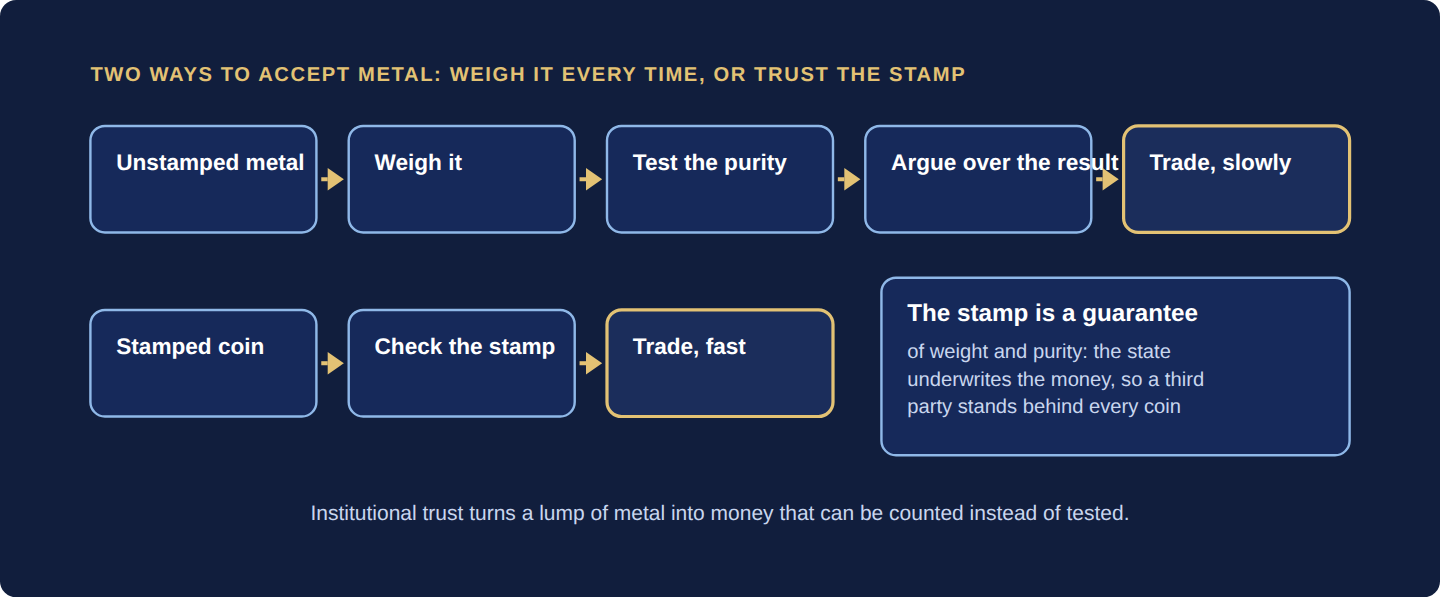
A stamped coin carries two claims at once. The first is its metal content, which gives it value in its own right. The second is the issuer’s guarantee that the coin holds the stated weight and purity. Together they let a trader accept a coin by counting it, where before a trader had to weigh and test every piece of metal.
Before standard coins, trading with metal meant weighing it at each transaction and arguing about whether the silver was as pure as claimed. The stamp ended that argument. It was not decoration: it was a government guarantee that the coin contains what it says. For the first time a third party, the state, underwrote the value of money.
The six properties of good money
Gold, silver and copper had the properties that commodity money lacked: they were durable, divisible, portable and naturally scarce. Six tests describe what any form of money needs.
| Property | The test | What failure looks like |
|---|---|---|
| Durability | Money must last; it cannot rot, rust or crumble with ordinary use | Stored grain rots |
| Divisibility | It must divide into smaller units to handle trades of any size | A cow cannot pay for a small purchase |
| Portability | It must be easy to carry so it can support trade across distances | Bulky goods cannot travel with a trader |
| Scarcity | Supply must be limited; too much of it and it loses value | Shells gathered from beaches flood the market |
| Acceptability | Money only works if people agree to accept it; collective trust is essential | A good only one village will take |
| Uniformity | Each unit must be identical to every other unit of the same denomination | Pieces of silver of unknown purity |

How the early forms compare
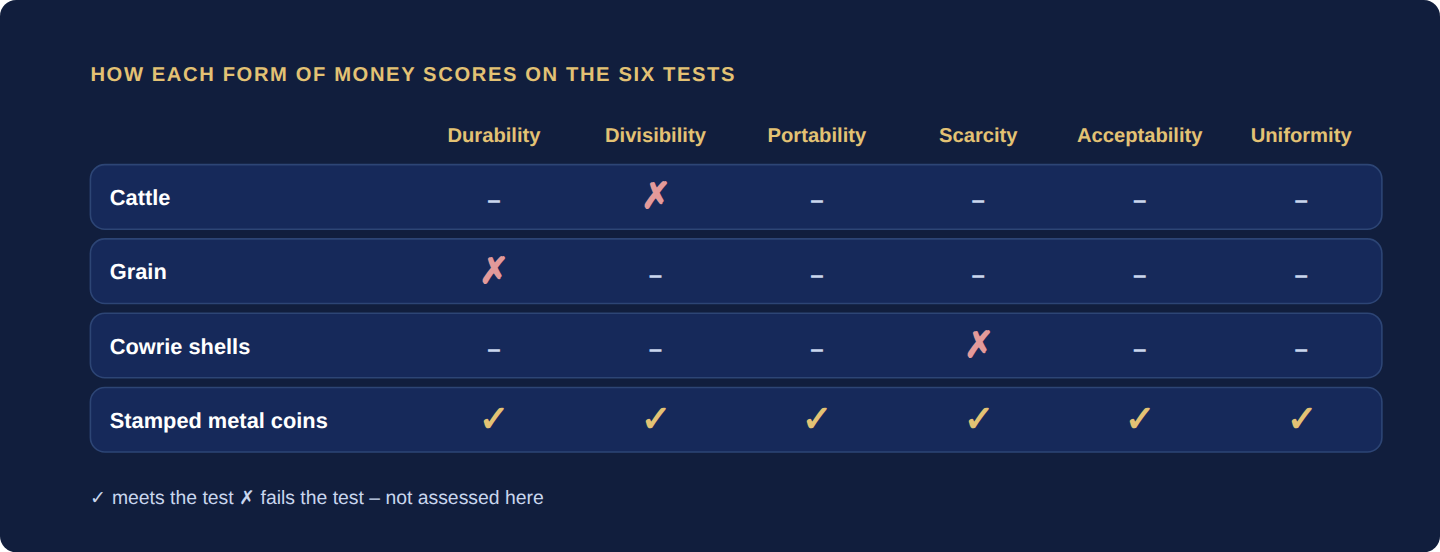
Scoring each early form against the six tests shows why metal won. Cattle fail on divisibility, grain on durability and shells on scarcity. Stamped metal coins pass all six, with the stamp supplying uniformity and the issuer’s backing supplying acceptability.
Limits: trust and weight
The guarantee is only as good as the issuer. If an issuer lowers the metal in a coin while keeping the stamp, the coin is worth less than it claims, and traders return to weighing and testing. Take a coin stamped at 10 grams of silver that assays at 9 grams: it is missing 1 ÷ 10 = 10% of its guaranteed metal, and that gap is a direct loss of trust.
| Stamped metal | Assayed metal | Shortfall |
|---|---|---|
| 10 g | 10 g | 0% |
| 10 g | 9 g | 10% |
| 10 g | 8 g | 20% |
Coins also have a physical limit. Ten thousand coins of 10 grams each weigh 100,000 grams, or 100 kilograms. Heavy payments over long distances were impractical, which is the problem paper money was later invented to solve.
Common misreadings
“A coin is worth only its metal.” A coin is worth its metal plus the guarantee that lets it be accepted without testing. “Electrum is gold.” Electrum is a natural alloy of gold and silver. “Lydian coins were the first money.” They were the first standardized metal coins; commodity money and barter came before them.
A method for applying the six tests
- List the candidate. Name the form of money, such as grain, shells, cattle or stamped silver.
- Run the six tests. For each property, ask the question in the test column and record pass or fail.
- Find the weakest test. The failed test predicts the practical problem: rot, indivisibility, inflation or distrust.
- Check the issuer. If the form depends on a guarantee, ask who gives it and what it costs the issuer to break it.
- Compare with the alternative. Prefer the form whose weakest test is least harmful for the trades people actually make.
Practice problems
Around 600 BCE, the kingdom of Lydia (in modern-day Turkey) produced what historians consider the world’s first standardized metal coins — small pieces of electrum (a natural alloy of gold and silver) stamped with an official seal guaranteeing their weight and purity. Metal — particularly gold, silver, and copper — had all the properties commodity money lacked: it was durable, divisible, portable, and naturally scarce.
The king’s stamp was critically important. It wasn’t decorative — it represented a government guarantee: this coin contains exactly what we say it does, and we stand behind that claim. For the first time, a third party — the state — was underwriting the value of money. This concept of institutional trust in currency remains central to how money works today.
Before standardized coins, trading with metal meant hauling out a scale at every transaction and arguing about whether your piece of silver was really as pure as you claimed. A government-stamped coin eliminated that argument entirely. Both parties trusted the stamp. That trust was money’s first superpower.
The Six Properties of Good Money
Who made the first coins?
The kingdom of Lydia, around 600 BCE, in electrum stamped to guarantee weight and purity.
Why were metals used as money?
Gold, silver and copper are durable, divisible, portable and naturally scarce, the properties earlier commodity money lacked.
What makes good money?
Six tests: durability, divisibility, portability, scarcity, acceptability and uniformity.
What was the limit of metal coins?
Trust in weight and purity. Before the stamp every metal trade meant weighing and arguing, and even a stamp works only while people trust the issuer behind it.
- Barter broke down because of the double coincidence of wants, indivisibility, and no standard of value.
- Commodity money (shells, salt, grain) solved the coincidence problem but introduced supply instability and durability risks.
- Metal coins (Lydia, ~600 BCE) solved durability, divisibility, and portability — and introduced the foundational concept of state-backed trust in currency.
- The six properties of good money — durability, divisibility, portability, scarcity, acceptability, uniformity — became the framework against which every subsequent monetary system would be judged.
- The first standardized metal coins came from Lydia around 600 BCE and were made of electrum, stamped to guarantee weight and purity.
- Metal is durable, divisible, portable and naturally scarce, which earlier commodity money was not.
- The stamp made the state the guarantor of money: the foundation of institutional trust in currency.
- Durability, divisibility, portability, scarcity, acceptability and uniformity are the tests every monetary system is judged by.
- A guarantee is only as strong as its issuer, and heavy coins limited large payments.
Four questions and three worked problems on this chapter. Decide on your answer first, then click “Reveal Answer.”
1. What did the king’s stamp on Lydian coins represent?
- A sign that the coin was made of pure gold
- A promise that the coin could be exchanged for land
- A state guarantee of the coin’s weight and purity
- A record of who had minted the coin for tax purposes
Reveal Answer
Answer: C. The stamp meant the state stood behind the coin’s content, the first institutional trust in currency.
2. The earliest Lydian coins, from around 600 BCE, were made of electrum. What is electrum?
- A natural alloy of gold and silver
- Pure silver refined from ore
- Iron coated with a thin layer of gold
- A copper and tin alloy used for bronze
Reveal Answer
Answer: A. The chapter defines electrum as a natural gold-silver alloy.
3. Which property of good money requires that each unit be identical to every other unit of the same denomination?
- Divisibility
- Scarcity
- Acceptability
- Uniformity
Reveal Answer
Answer: D. Uniformity means one unit can always replace another of the same face value.
4. A currency loses value because the issuer creates far more of it than people need. Which property of good money has failed?
- Uniformity
- Scarcity
- Portability
- Durability
Reveal Answer
Answer: B. Money must be in limited supply; too much of it and each unit buys less.
5. Worked problem: A coin is stamped as holding 10 grams of silver but assays at 9 grams. What share of the guaranteed metal is missing, and what is the effect on trust?
Reveal Answer
Answer: Missing share = (10 − 9) ÷ 10 = 10%. Traders can no longer accept the coin by counting it, so they return to weighing and testing, which restores the costs the stamp removed.
6. Worked problem: A payment of 10,000 coins of 10 grams each must be carried to another city. What is the weight, and which property of good money does it strain?
Reveal Answer
Answer: 10,000 × 10 g = 100,000 g = 100 kg. It strains portability: large payments become impractical to carry, which created demand for paper claims on metal.
7. Worked problem: Match the property to the failure: (a) shells gathered from beaches, (b) a cow too large for a small trade, (c) grain left in storage.
Reveal Answer
Answer: (a) Scarcity: supply is not limited. (b) Divisibility: the unit cannot be split. (c) Durability: the good decays.
0.4 Paper Money — From China to the World
Paper money began as a receipt for coins left on deposit. People found the receipt easier to carry than the coins and began trading the receipts themselves. Later governments and banks issued notes directly, so paper money is a promise, only as good as the issuer behind it.
Why it matters: A promise can be broken, which is why every paper-money system rests on trust and limits.
Summary: Paper money began as a receipt for coins on deposit and only later became currency issued by governments and banks. In every case it was a promise, only as good as the issuer behind it.
- China led: the Tang Dynasty’s “flying money” receipts appeared by the early 800s, and the government issued its first standard notes in 1024.
- In Europe, Stockholms Banco issued the first banknotes in 1661 as loans, over-issued them and failed; in 1668 the Riksbank, the world’s oldest central bank, was founded from its ruins.
- The Bank of England, founded in 1694, also issued notes redeemable in coin.
Paper money began as a receipt: a certificate proving that its holder has metal on deposit. It is a claim on something valuable, and the claim, not the paper, carries the value. Its story is a turning point in the history of money, and it shows how much depends on the issuer.
How a receipt becomes money
A receipt can be handed to someone else, who can in turn claim the metal. As long as people trust the issuer, they find it easier to pass the receipt around than to carry heavy coins, so the receipt starts to circulate as money. This is the original form of paper money: convenience in exchange for a new dependency on the credibility of whoever holds the metal.
Where paper money began
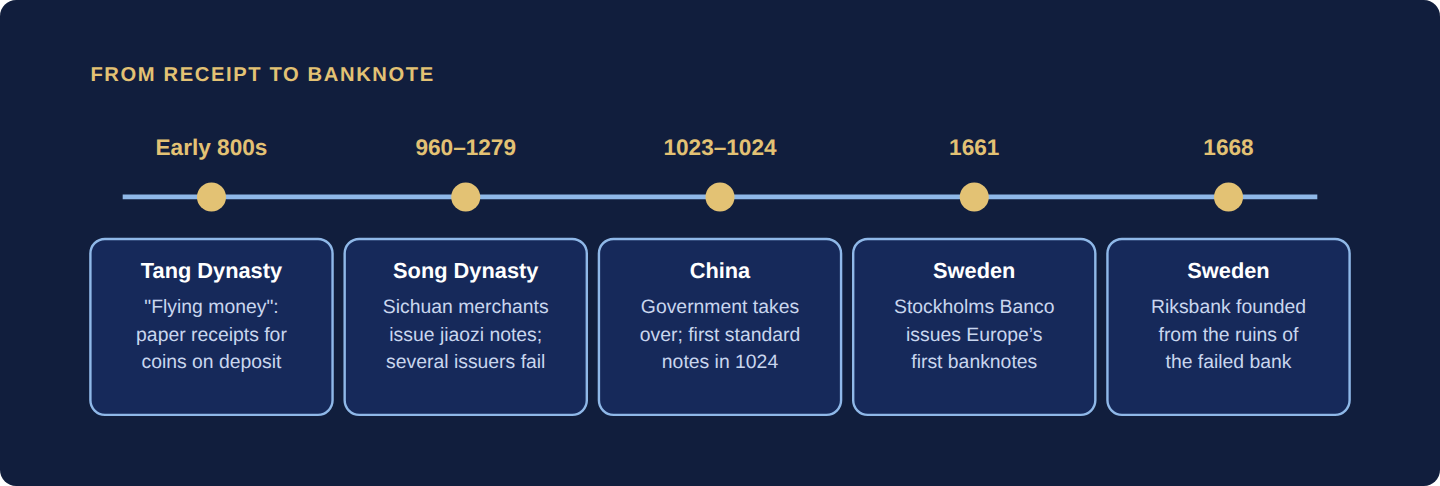
By the early 800s, under the Tang Dynasty, Chinese merchants had developed a solution nicknamed “flying money”: they deposited coins with a trusted merchant or government office and received a paper receipt. Under the Song Dynasty (960–1279), merchants in Sichuan issued paper notes called jiaozi. After several issuers failed, the government took over in 1023 and issued its first standard notes in 1024, the world’s first true government-issued paper currency.
Europe’s first banknotes
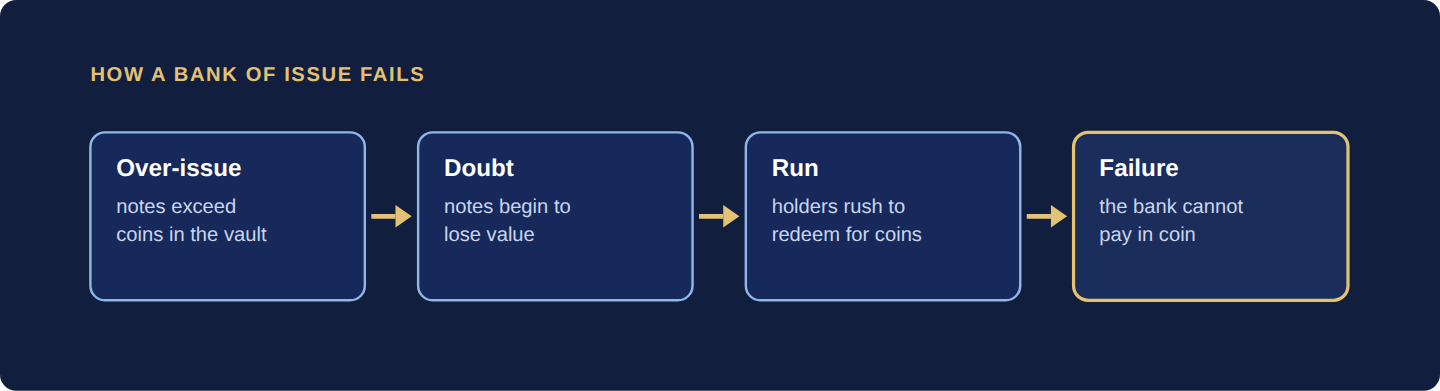
Europe followed much later. In 1661 Stockholms Banco, Sweden’s first bank, founded by Johan Palmstruch, issued the first banknotes in Europe. They held a surprise: the notes were handed out as loans, not only as receipts for coins on deposit, so the bank was creating money by lending. It issued too many, the notes lost value, and holders rushed to redeem them for coins the bank did not have. The bank failed, and in 1668 Sweden founded a new bank from its ruins, today’s Sveriges Riksbank.
| Receipt model | Loan model | |
|---|---|---|
| How a note is issued | In exchange for coins left on deposit | Handed out as a loan |
| What stands behind it | The coins on deposit | The issuer’s promise to redeem |
| Example | Tang “flying money” | Stockholms Banco, 1661 |
| Main risk | Little, while the deposits are kept | Over-issue: more notes than coins to redeem them |
Measuring the backing
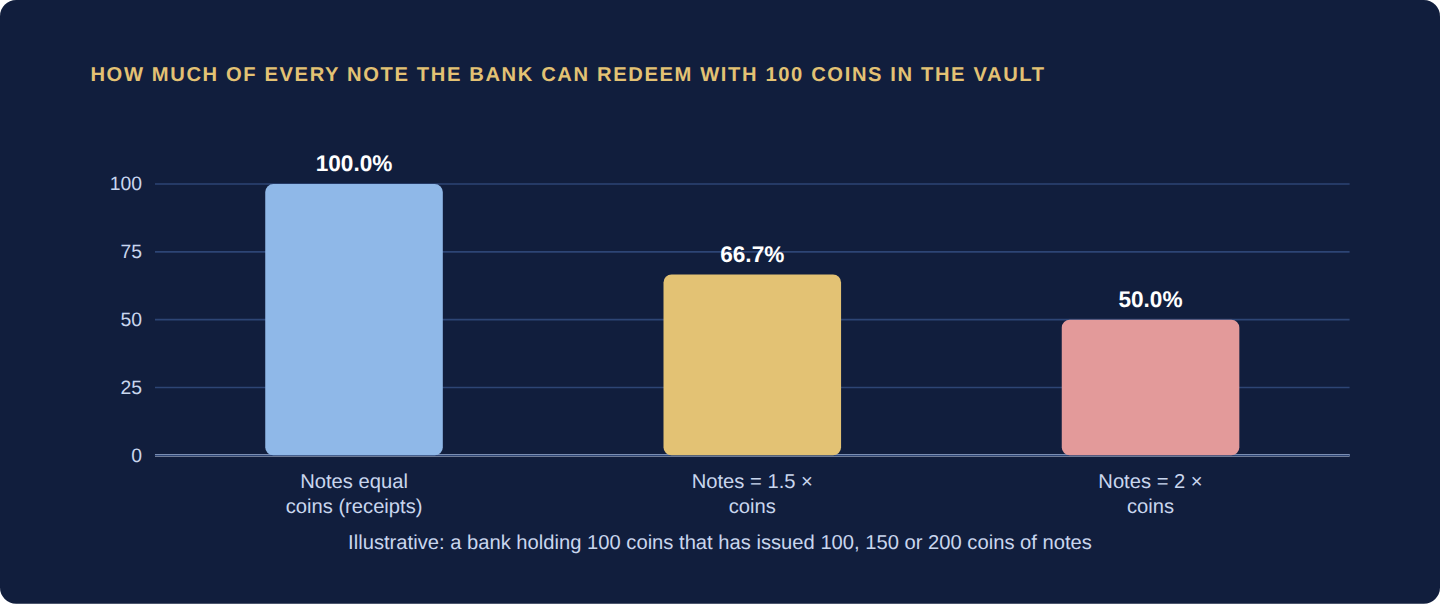
The strength of a paper note can be measured by the backing ratio: the metal the issuer holds divided by the notes it has outstanding.
Backing ratio = metal held ÷ notes outstanding
| Coins in the vault | Notes outstanding | Backing ratio | Most that can be redeemed at once |
|---|---|---|---|
| 100 | 100 | 100% | All of it |
| 100 | 150 | 66.7% | Two-thirds of the notes |
| 100 | 200 | 50% | Half of the notes |
Why a run happens
Below 100% the bank survives only if holders do not all ask for coins at once. Once some holders doubt the notes and redeem, the bank has less metal behind each remaining note, which gives the rest a reason to hurry. The fall in value and the rush to redeem reinforce each other.
Why it matters
Paper money separated the physical object from the value it represented. That made transactions faster and more flexible, and it created a new risk: if the issuer prints more promises than it has metal to back them, the promise becomes hollow. The tension between the convenience of paper and the discipline of backing shaped monetary policy for centuries.
Common misreadings
“Paper money was invented by governments.” It began as private receipts for deposited coins, and governments took over later. “Europe invented paper money.” China issued government paper currency in 1024; Europe’s first banknotes came in 1661. “A bank failure shows paper money cannot work.” It shows that a promise is only as good as the issuer that makes it.
A method for judging any note
- Identify the issuer. Who promises to pay, and can they be made to?
- Identify the backing. What does the issuer hold: coins on deposit, loans, or only a promise?
- Compute the backing ratio. Divide the metal held by the notes outstanding.
- Stress it. Ask what happens if holders redeem everything at once, and who loses if the ratio is below 100%.
- Check the incentive. Does the issuer gain by issuing more than it can back? If so, expect over-issue.
Practice problems
Carrying heavy metal coins over long distances was impractical. By the early 800s, under the Tang Dynasty, Chinese merchants had developed a solution, nicknamed “flying money”: they would deposit their coins with a trusted merchant or government office and receive a paper receipt — a certificate proving they had metal on deposit. Under the Song Dynasty (960–1279 CE), merchants in Sichuan issued paper notes called jiaozi; after several issuers failed, the government took over in 1023 and issued its first standard notes in 1024, the world’s first true government-issued paper currency.
Europe followed much later. In 1661 Stockholms Banco, Sweden’s first bank, founded by Johan Palmstruch, issued the first banknotes in Europe. They held a surprise: the notes were handed out as loans, not only as receipts for coins on deposit, so the bank was creating money by lending (Section 0.9: How Currency Is Created Today — and How Much Is Too Much shows banks still do). It issued too many, the notes lost value, holders rushed to redeem them for coins the bank did not have, and it failed; in 1668 Sweden founded a new bank from its ruins, today’s Sveriges Riksbank, the world’s oldest central bank. The Bank of England, founded in 1694 as banker to the government, also issued notes redeemable in coin; they were handwritten for each deposit until partly printed notes arrived in 1725.
This is a crucial point: early paper money was not money in itself — it was a promise. A receipt backed by real metal stored somewhere. If you trusted the issuer, it was as good as gold. Literally.
Imagine you deposit your gold jewelry at a trusted bank and they give you a signed receipt. You could either go back and collect your gold, or give the receipt to someone else who trusted the bank. That receipt is paper money in its original form — a claim on real metal, not money itself.
Paper money introduced something new and powerful: the separation between the physical object and the value it represented. This made transactions faster and more flexible — but it also introduced a new risk. If the issuer printed more receipts than they had gold in the vault, the promise became hollow. This tension between the convenience of paper and the discipline of backing would define monetary policy for centuries — and echoes in every modern debate about money printing today.
Who invented paper money?
China. The Tang Dynasty’s “flying money” receipts appeared by the early 800s, and the government issued its first standard notes in 1024.
When did banknotes start in Europe?
Stockholms Banco issued the first banknotes in 1661 as loans, over-issued them and failed; the Riksbank, the world’s oldest central bank, was founded in 1668 from its ruins.
What backs paper money?
Originally metal on deposit: the claim carries the value, not the paper. Notes issued as loans create money, and over-issue pushes the backing ratio below 100%.
What is a bank run?
A rush to redeem notes or deposits. Doubt lowers value, and the rush exposes the shortfall, so a run reinforces itself.
- Paper money began as a receipt for metal on deposit; the claim carries the value, not the paper.
- China issued the first government paper currency in 1024; Europe’s first banknotes came from Stockholms Banco in 1661.
- Notes issued as loans create money, and over-issue lowers the backing ratio below 100%.
- A run is self-reinforcing: doubt lowers value, and the rush to redeem exposes the shortfall.
- Paper money is only as good as its issuer, which is why backing and discipline became central to monetary policy.
Four questions and three worked problems on this chapter. Decide on your answer first, then click “Reveal Answer.”
1. What was unusual about the banknotes Stockholms Banco issued in 1661?
- They were lent out, not only issued as receipts for coins on deposit
- They were backed by land owned by the Swedish crown rather than by coins
- They could be redeemed only by foreign merchants trading in Stockholm
- They were printed by the Bank of England under a Swedish license
Reveal Answer
Answer: A. The notes were lent out, so the bank created money by lending, an early form of what banks do today.
2. Why did Stockholms Banco fail?
- The Swedish government seized its gold to pay for a war with Denmark
- It over-issued notes and could not pay out the coins holders demanded
- A fire destroyed its records and no one could prove what they were owed
- It refused to issue notes to merchants, who moved their business abroad
Reveal Answer
Answer: B. Over-issue led to falling value and a rush to redeem; the bank could not pay and collapsed.
3. Which institution grew out of the ruins of Stockholms Banco in 1668?
- The Bank of Amsterdam, Europe’s first exchange bank
- The Swedish National Debt Office
- Sveriges Riksbank, the world’s oldest central bank
- The Bank of England, the first bank to print notes
Reveal Answer
Answer: C. In 1668 the Swedish estates founded a new bank from its ruins, today’s Riksbank.
4. Early paper money is described as ‘a promise.’ What did that promise depend on?
- The quality of the paper and ink used to print each note
- The number of notes the issuer chose to keep in its own vault
- A law that required every merchant to accept paper at a premium
- Trust that the issuer held the metal and would pay it on demand
Reveal Answer
Answer: D. A note was a claim on metal stored elsewhere; if the issuer printed more claims than metal, the promise became hollow.
5. Worked problem: Roughly how many years separated China’s first standard government notes from Europe’s first banknotes?
Reveal Answer
Answer: 1661 − 1024 = 637 years.
6. Worked problem: A bank holds 100 coins and has issued notes worth 125 coins. What is the backing ratio, and what share of the notes can be redeemed in coin at once?
Reveal Answer
Answer: Backing ratio = 100 ÷ 125 = 0.80, or 80%. The bank can redeem at most 80% of its notes at once; if more than 80% of holders ask, it fails.
7. Worked problem: Explain in three steps how Stockholms Banco failed.
Reveal Answer
Answer: (1) It issued notes as loans, so notes in circulation exceeded the coins it held. (2) The notes lost value and holders rushed to redeem them. (3) The bank could not pay in coin and failed; the Riksbank was founded in 1668 from its ruins.
0.5 The Gold Standard — Anchoring Paper to Metal
Under the gold standard a government promised to swap its paper money for a fixed weight of gold on demand. That promise limited how much money could be printed and kept exchange rates steady, but it left no room to respond to a crisis.
Why it matters: It shows what “backing” money really means, and why governments gave it up.
Summary: Under the gold standard a country’s paper currency could be converted into a fixed amount of gold, which tied the money supply to the government’s reserves. It brought discipline and stable exchange rates, then proved too rigid.
- If one British pound was defined as 7.32 grams of gold, any holder of a note could receive exactly that amount from the Bank of England.
- World War One broke the system when governments printed money far beyond their gold, and the Great Depression of the 1930s finished it by preventing countries from stimulating their economies.
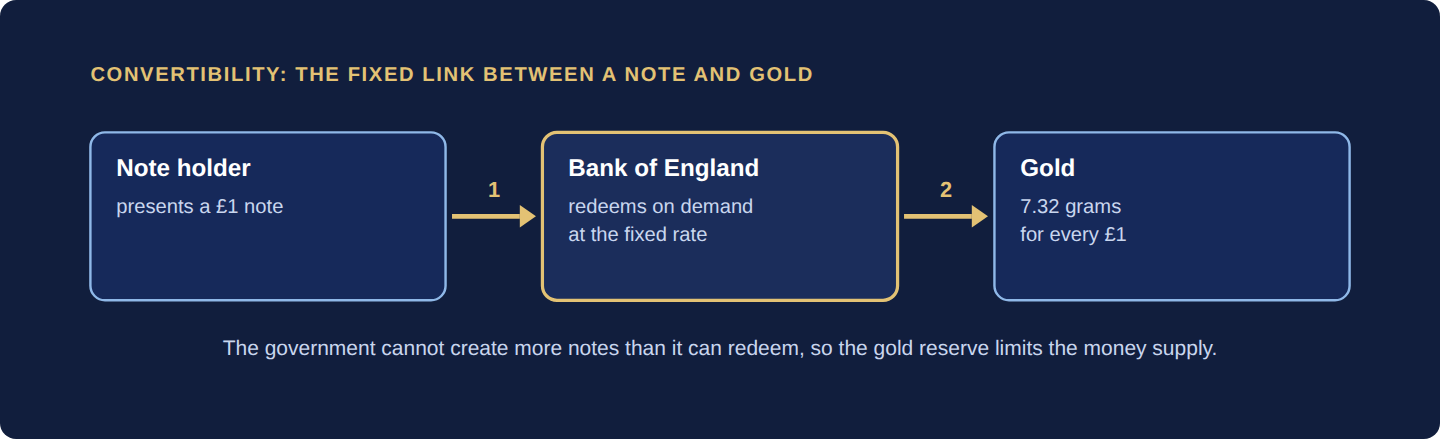
The gold standard is a monetary system in which a country’s paper currency is directly convertible into a fixed amount of gold. If one British pound is defined as 7.32 grams of gold, any holder of a pound note can walk into the Bank of England and receive exactly that amount.
How convertibility works
Because notes must be redeemable at a fixed rate, the total paper money in circulation is limited by the gold the government holds in reserve. The gold weight behind each unit of currency fixes the maximum amount of money the reserve can support.
Maximum notes = gold reserve ÷ gold per unit of currency
Gold prices follow from the definition. A troy ounce weighs 31.1035 grams, so if one pound equals 7.32 grams, an ounce of gold is worth 31.1035 ÷ 7.32 = about 4.25 pounds. Exchange rates follow the same way: if a dollar were defined as 1.5 grams of gold, a pound would be worth 7.32 ÷ 1.5 = 4.88 dollars.
| Quantity | Calculation | Result |
|---|---|---|
| Price of one troy ounce of gold | 31.1035 g ÷ 7.32 g per pound | About £4.25 |
| Notes a 7,320 kg reserve can support | 7,320,000 g ÷ 7.32 g per pound | 1,000,000 pounds |
| Exchange rate if a dollar is 1.5 g | 7.32 g ÷ 1.5 g | 4.88 dollars per pound |
The automatic adjustment
Fixed gold weights tied countries together. A country that bought more than it sold paid the gap in gold, which shrank its money supply, lowered its prices and made its exports more competitive until the gap narrowed. That automatic correction kept exchange rates stable and predictable, and international trade flourished.

Strengths and costs
| Feature | Effect |
|---|---|
| Limited money creation | Governments could not print unlimited money, so inflation was largely contained over the long run |
| Stable exchange rates | Fixed gold weights made rates predictable, which supported international trade |
| Rigidity | Prices still swung, and deflation and panics were common |
| No room for stimulus | Countries found the system prevented them from stimulating their economies out of depression |
Rise and fall
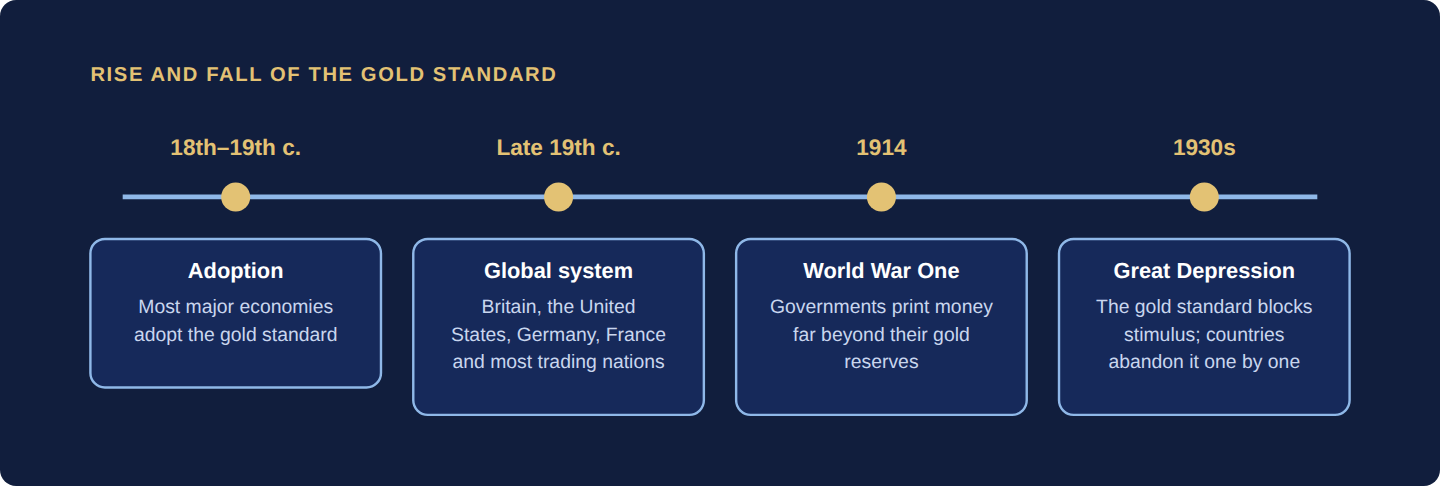
Through the 18th and 19th centuries most major economies adopted it, and by the late 19th century Britain, the United States, Germany, France and most major trading nations were on it. World War One ended the system in 1914: governments needed to fund massive military spending and printed money far beyond their gold reserves. The Great Depression of the 1930s delivered the final blow, and countries abandoned the standard one by one.
Common misreadings
“The gold standard meant no inflation and no crises.” Inflation was largely contained over the long run, but prices still swung, and deflation and panics were common. “The gold standard ended once, in 1971.” It broke down in 1914 and was abandoned in the 1930s; the later link between the dollar and gold is a different arrangement. “Governments could not spend.” They could spend what they raised in taxes or borrowing; they could not create money beyond their reserves.
A method for assessing a monetary regime
- Find the anchor. What fixes the value of the currency: gold, another currency or nothing?
- Find the limit. Who can create money, and what stops them? Under gold, the reserve.
- Trace the adjustment. How does the system respond to a trade deficit or a shock? Under gold, through gold flows and falling prices.
- Count the cost. Who pays for the adjustment: workers through falling output, or savers through inflation?
- Compare the alternatives. Judge the regime by how well it handles the shocks its society actually faces.
Practice problems
Through the 18th and 19th centuries, most major economies formally adopted the gold standard: a system where a country’s paper currency was directly convertible into a fixed amount of gold. If one British pound was defined as 7.32 grams of gold, any holder of a pound note could walk into the Bank of England and receive exactly that amount. Total paper money in circulation was therefore constrained by how much gold the government held in reserve.
The gold standard’s great advantage was discipline. Governments could not print unlimited money, so inflation was largely contained over the long run, though prices still swung and deflation and panics were common. Exchange rates were stable and predictable. International trade flourished.
By the late 19th century, the gold standard was truly global — Britain, the United States, Germany, France, and most major trading nations had all adopted it. The system lasted until the outbreak of World War One in 1914. The war destroyed it: governments needed to fund massive military expenditure and began printing money far in excess of their gold reserves. The Great Depression of the 1930s delivered the final blow — countries found that the gold standard prevented them from stimulating their economies out of depression. One by one, they abandoned it.
The gold standard was like running a household where your spending was strictly limited to whatever cash you had physically in your wallet. Disciplined, yes — but if you desperately needed to pay a doctor’s bill and your wallet was empty, the rule became a trap. Countries in depression found the gold standard was exactly that trap.
What is the gold standard?
A monetary system in which a country’s paper currency can be converted into a fixed amount of gold, so the gold reserve limits the money supply.
How did the gold standard work?
Each currency was defined as a fixed weight of gold, so a note holder could demand exactly that amount. The reserve therefore capped the notes: maximum notes = gold reserve ÷ gold per unit of currency.
Why did the gold standard end?
World War One broke it when governments printed money far beyond their gold, and in the Great Depression it stopped countries from stimulating their economies.
What were the strengths and costs of the gold standard?
Discipline and stable exchange rates, set against rigid money, falling prices and frequent panics.
- The gold standard makes paper currency convertible into a fixed weight of gold, so the reserve limits the money supply.
- Maximum notes = gold reserve ÷ gold per unit; gold prices and exchange rates follow directly from the definitions.
- Gold flows corrected trade imbalances automatically, which kept exchange rates stable and trade growing.
- Discipline came at a cost: prices still swung, deflation and panics were common, and there was no room for stimulus.
- World War One broke the system in 1914 and the Great Depression finished it in the 1930s.
Four questions and three worked problems on this chapter. Decide on your answer first, then click “Reveal Answer.”
1. Under the gold standard, what limited the total paper money in circulation?
- The size of the government’s annual budget deficit
- The number of banks licensed to issue loans
- The volume of exports the country sold abroad
- The gold held in reserve
Reveal Answer
Answer: D. Paper was convertible into a fixed amount of gold, so issuance was chained to gold holdings.
2. If a pound is defined as 7.32 grams of gold, what can a holder of a one-pound note do under the gold standard?
- Use the note to buy government bonds paying 7.32% interest
- Exchange the note for 7.32 grams of silver at a market rate
- Exchange the note at the Bank of England for 7.32 grams of gold
- Swap the note for any foreign currency at a floating rate
Reveal Answer
Answer: C. Convertibility at a fixed weight is the defining feature of the gold standard described in the chapter.
3. Why did the Great Depression push countries off the gold standard?
- It stopped them from expanding money and credit
- Trade between countries stopped entirely during the 1930s
- Gold mines ran dry and no new gold could be found
- Paper money had been banned by international treaty
Reveal Answer
Answer: A. The chapter explains that the gold standard prevented governments from stimulating their economies, so they abandoned it.
4. Which event first broke the global gold standard in the early 20th century?
- The California gold rush, which flooded markets with gold
- World War One and the printing it brought
- The Nixon Shock, when the US closed the gold window
- The founding of the IMF at Bretton Woods
Reveal Answer
Answer: B. War spending in 1914 led governments to print far more than their gold could back.
5. Worked problem: One pound is defined as 7.32 grams of gold and a troy ounce is 31.1035 grams. What is the gold price of one ounce in pounds?
Reveal Answer
Answer: 31.1035 ÷ 7.32 = about 4.25 pounds per ounce.
6. Worked problem: A reserve holds 14,640 kilograms of gold and the pound is 7.32 grams of gold. What is the most paper money the reserve can support?
Reveal Answer
Answer: 14,640 kg = 14,640,000 g. Maximum notes = 14,640,000 ÷ 7.32 = 2,000,000 pounds.
7. Worked problem: Under the gold standard, a country runs a persistent trade deficit. Describe the adjustment in order.
Reveal Answer
Answer: Gold flows out to pay the gap; the money supply shrinks because notes are tied to gold; domestic prices fall; exports become cheaper and rise while imports fall; the deficit narrows. The cost is falling prices and often falling output along the way.
0.6 Bretton Woods — The Dollar Becomes the World's Anchor
In 1944, 44 Allied nations tied every currency to the US dollar, and only the dollar to gold, at $35 an ounce. The system ended in 1971 when the US stopped swapping dollars for gold, but the dollar stayed the world’s reserve currency.
Why it matters: Today’s dollar-centered system grew out of this agreement.
Summary: At Bretton Woods in 1944, 44 Allied nations tied every currency to the US dollar, and only the dollar to gold, at $35 an ounce. The system ended in 1971 with the Nixon Shock, but the dollar kept its role as the world’s reserve currency.
- Bretton Woods created the IMF, to help countries with balance of payments problems, and the World Bank, to fund post-war rebuilding.
- Dollars piled up abroad as the US spent heavily in the 1960s, until foreign-held dollars exceeded US gold; on August 15, 1971, President Nixon stopped foreign governments exchanging dollars for gold.
- The dollar kept its dominance without the gold anchor, through habit, infrastructure and the size of the US economy.
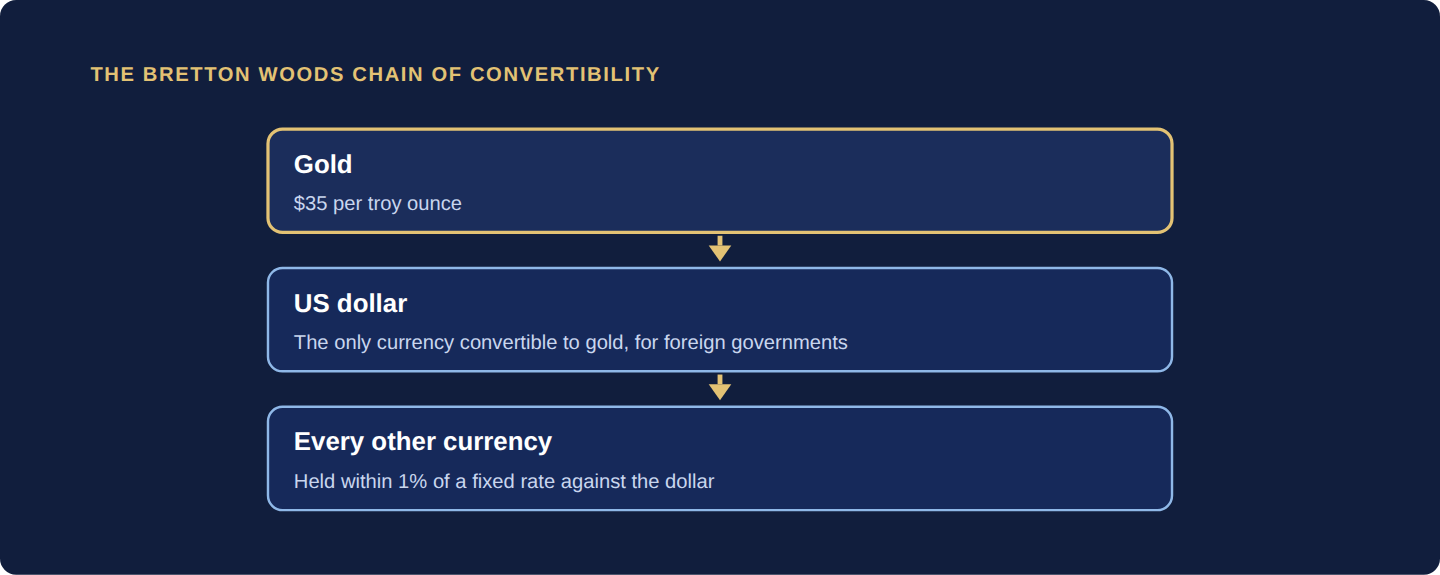
Bretton Woods is the monetary system agreed in 1944 in which every participating currency was tied to the US dollar, and only the dollar was convertible to gold, for foreign governments, at a fixed $35 per troy ounce. It takes its name from the New Hampshire town where the agreement was made.
How the system was built
As World War Two drew to a close, representatives from 44 Allied nations gathered at the Mount Washington Hotel in Bretton Woods, New Hampshire. Instead of every currency being tied to gold, every currency would be tied to the US dollar and held within 1% of a fixed rate. Only the dollar would remain convertible to gold. The United States could do this credibly because it emerged from the war with the world’s largest economy and the largest gold reserves of any country.
Two institutions were created with it: the IMF, to help countries facing balance of payments problems, and the World Bank, to fund post-war rebuilding.
The arithmetic of the system
| Rule | Number | What it implies |
|---|---|---|
| Dollar price of gold | $35 per troy ounce | One dollar is 1 ÷ 35 = 0.0286 ounce, or 31.1035 ÷ 35 = 0.889 grams of gold |
| Band around the fixed rate | Within 1% | A currency fixed at 10 per dollar may trade between 9.90 and 10.10 |
| Band, second example | Within 1% | A currency fixed at 4 per dollar may trade between 3.96 and 4.04 |
The system worked remarkably well through the 1950s and 1960s. It carried a fatal flaw, which economists later named the Triffin dilemma: to supply the world with dollars the United States had to send them abroad, and the more dollars went abroad the weaker the gold behind each one became.
The flaw, measured
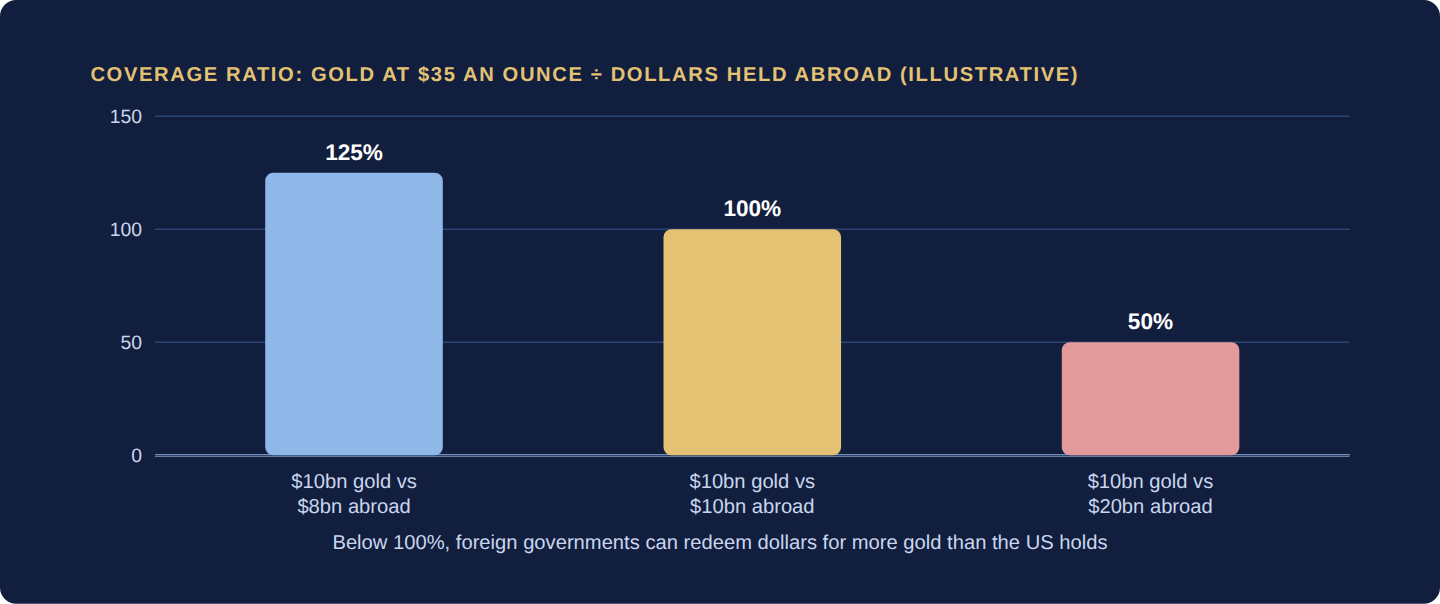
The strength of the promise to convert is measured by a coverage ratio: the gold available divided by the dollars foreign governments hold and could redeem.
Coverage ratio = gold held (at $35 an ounce) ÷ dollars held abroad
| Gold held | Dollars held abroad | Coverage | Outcome |
|---|---|---|---|
| $10 billion | $8 billion | 125% | Convertibility credible |
| $10 billion | $10 billion | 100% | At the limit |
| $10 billion | $20 billion | 50% | A run can empty the reserve |
The end of convertibility
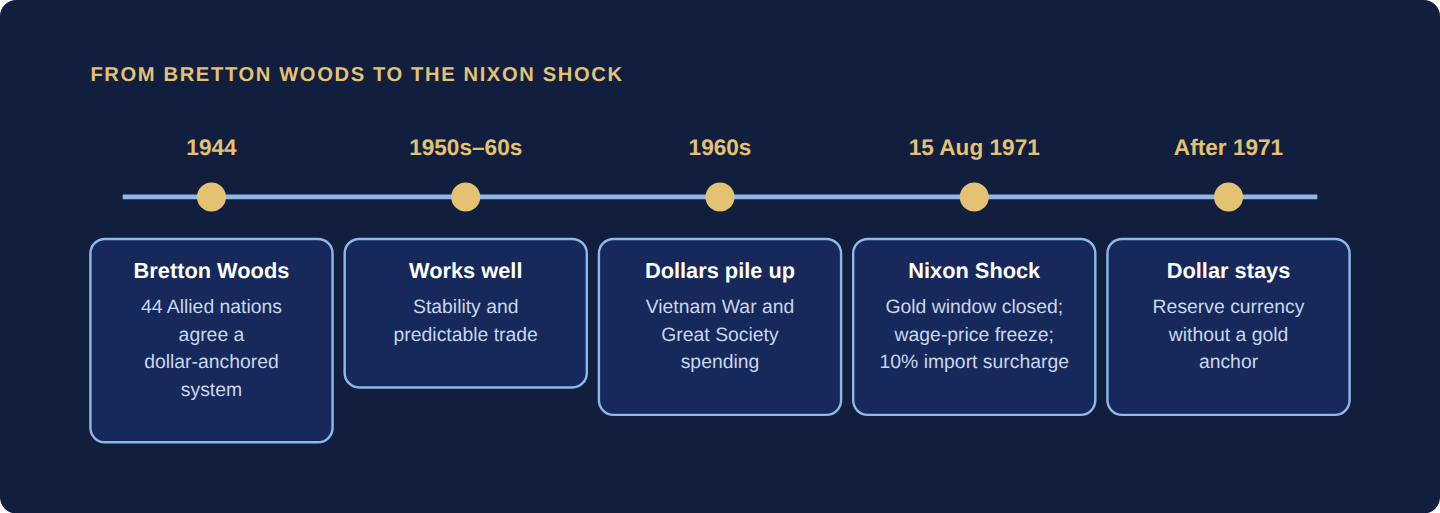
As the US spent heavily on the Vietnam War and Great Society programs in the 1960s, dollars piled up abroad until foreign-held dollars exceeded the gold the US held to back them. Countries began redeeming their dollars for gold, and America’s reserves fell sharply. On August 15, 1971, President Nixon announced that foreign governments could no longer exchange their dollars for gold, alongside a 90-day wage and price freeze and a 10% surcharge on imports. This is known as the Nixon Shock.
Why it still matters
Bretton Woods is why the US dollar is still the world’s reserve currency. When the system ended, the dollar did not lose its dominance; it lost its gold anchor. The world kept using dollars out of habit, infrastructure and the sheer size of the US economy, which is why efforts to replace the dollar are structurally hard.
Common misreadings
“Bretton Woods was a gold standard.” Only the dollar was linked to gold; every other currency was linked to the dollar. “The Nixon Shock ended the dollar’s role.” It ended the dollar’s link to gold; its dominance continued. “Foreign governments caused the collapse.” They redeemed dollars the US had promised to honor, once the dollars abroad exceeded the gold behind them.
A method for testing a peg
- Identify the anchor. What does the currency promise to convert into, at what rate?
- Count the claims. How many units are held by people who can demand conversion?
- Count the reserve. What does the issuer actually hold, valued at the promised rate?
- Compute the coverage ratio. Divide the reserve by the claims; below 100% the promise is exposed.
- Check the trend. Is the gap widening? A rising ratio of claims to reserves is the early warning.
Practice problems
As World War Two drew to a close in 1944, representatives from 44 Allied nations gathered at the Mount Washington Hotel in Bretton Woods, New Hampshire. The solution they crafted was elegant: instead of every currency being tied to gold, every currency would be tied to the US Dollar — held within 1% of a fixed rate, and only the US Dollar would be convertible to gold, for foreign governments, at a fixed rate of $35 per troy ounce.
The US could do this credibly because it emerged from the war with the world’s largest economy and the largest gold reserves of any country. Under Bretton Woods, two major institutions were created: the IMF, to help countries facing balance of payments problems, and the World Bank, to fund post-war rebuilding. The system worked remarkably well through the 1950s and 1960s.
But it carried a fatal flaw. As the US spent heavily on the Vietnam War and Great Society programs in the 1960s, dollars piled up abroad, until foreign-held dollars exceeded the gold the US held to back them. Countries began redeeming their dollars for gold, and America’s reserves fell sharply. On August 15, 1971, President Nixon announced that foreign governments could no longer exchange their dollars for gold, alongside a 90-day wage and price freeze and a 10% surcharge on imports. This moment is known as the Nixon Shock.
Bretton Woods was like a restaurant where every table’s bill was settled in one specific currency — US dollars — and the restaurant owner promised to exchange those dollars for gold if anyone asked. It worked beautifully until the owner spent so much money renovating the kitchen that he no longer had enough gold in the safe to honor every dollar issued. The moment customers sensed this, they rushed to redeem — and the owner closed the gold window entirely.
Bretton Woods is why the US dollar is still the world’s reserve currency today. The entire post-war global financial order was built around it. When the system ended, the dollar didn’t lose its dominance — it simply lost its gold anchor. The world kept using dollars out of habit, infrastructure, and the sheer size of the US economy. Understanding this history is essential to understanding why BRICS’s de-dollarization efforts (Section 2.6: BRICS and the Challenge to Dollar Dominance) are so structurally difficult to execute.
What was the Bretton Woods system?
The 1944 agreement among 44 Allied nations that tied every currency to the US dollar within 1%, and the dollar to gold at $35 an ounce.
What did Bretton Woods create?
The IMF, to help countries with balance of payments problems, and the World Bank, to fund post-war rebuilding.
Why did Bretton Woods collapse?
Dollars piled up abroad as the US spent heavily in the 1960s, until foreign-held dollars exceeded US gold. On August 15, 1971, President Nixon stopped foreign governments exchanging dollars for gold.
What was the Nixon Shock?
President Nixon’s decision of August 15, 1971, to close the gold window, which ended the dollar’s convertibility into gold.
- Bretton Woods (1944) tied every currency to the dollar within 1%, and only the dollar to gold at $35 an ounce.
- The IMF and the World Bank were created alongside it to manage payments problems and rebuild after the war.
- Coverage ratio = gold held ÷ dollars held abroad; once it fell below 100%, convertibility stopped being credible.
- On August 15, 1971, the US closed the gold window, a decision known as the Nixon Shock.
- The dollar kept its dominance without the gold anchor, which explains why the dollar-centered order has lasted.
Four questions and three worked problems on this chapter. Decide on your answer first, then click “Reveal Answer.”
1. Under Bretton Woods, how were most currencies anchored?
- Allowed to float freely, with the IMF stepping in only during market crises
- Each pegged directly to gold at a rate chosen by its own central bank
- Pegged to the dollar, with the dollar convertible to gold at $35 an ounce
- Pegged to a basket made up of the five largest economies’ currencies
Reveal Answer
Answer: C. Currencies were fixed to the dollar within 1%, and only the dollar was convertible to gold, for foreign governments.
2. What pressure eventually broke the Bretton Woods system?
- The IMF ran out of money to lend to deficit countries in need
- European countries refused to accept dollars after 1960 in payment
- Gold prices fell so far that the $35 peg became too generous to holders
- Foreign-held dollars grew larger than the US gold stock backing them
Reveal Answer
Answer: D. As dollars piled up abroad beyond US gold, the promise to convert became doubtful and countries redeemed.
3. What did President Nixon announce on August 15, 1971?
- Foreign governments could no longer swap dollars for gold
- The Fed would stop issuing paper money for a year
- The dollar would be pegged to European currencies
- Every holder of dollars could now swap them for gold
Reveal Answer
Answer: A. The Nixon Shock closed the gold window and added a 90-day wage and price freeze and a 10% import surcharge.
4. Which two institutions were created at Bretton Woods?
- The Federal Reserve and the Bank for International Settlements
- The IMF and the World Bank
- The European Central Bank and the World Bank
- The World Trade Organization and the IMF
Reveal Answer
Answer: B. The IMF was set up to help countries with balance of payments problems and the World Bank to fund rebuilding.
5. Worked problem: At $35 per troy ounce, how much gold is one dollar, in ounces and in grams? A troy ounce is 31.1035 grams.
Reveal Answer
Answer: 1 ÷ 35 = 0.0286 ounce. In grams, 31.1035 ÷ 35 = 0.889 g.
6. Worked problem: A currency is fixed at 10 units per dollar and may move within 1% of that rate. What is its permitted range?
Reveal Answer
Answer: 10 × 0.99 = 9.90 and 10 × 1.01 = 10.10, so the range is 9.90 to 10.10 units per dollar.
7. Worked problem: The US holds gold worth $12 billion at the official price, and foreign governments hold $20 billion. What is the coverage ratio, and what share of foreign-held dollars could be redeemed at once?
Reveal Answer
Answer: Coverage = 12 ÷ 20 = 60%. Only 60% of foreign-held dollars could be redeemed; a rush to redeem would exhaust the gold, which is the exposure that led to 1971.
0.7 Fiat Currency — Money Backed by Nothing But Trust
Fiat money has value because a government declares it legal tender and people trust it, not because a commodity backs it. Every major currency has worked this way since 1971. That makes money flexible, and it also makes abuse possible.
Why it matters: Fiat money explains both modern central banking and inflation.
Summary: Since 1971 every major currency has been fiat money: valued not because a commodity backs it but because a government declares it legal tender and people trust it. Its strength is flexibility; its permanent risk is abuse.
- Fiat is Latin for “let it be done”; the dollar, euro, rupee, pound, yen and yuan are all fiat money.
- Well-managed fiat money lets central banks cut interest rates and expand their balance sheets in recessions, and raise rates against inflation.
- Because there is no physical limit to how much can be printed, irresponsible governments can and do abuse it.
Fiat currency is money that has value not because a physical commodity backs it but because a government declares it legal tender and citizens trust and accept it. The word fiat is Latin for “let it be done”: money by decree.
What stands behind fiat money
After 1971 the world moved entirely to fiat currency. Every major currency today is fiat money: the US dollar, the euro, the Indian rupee, the British pound, the Japanese yen and the Chinese yuan. What anchors the value is not metal but two things working together: the legal status the government gives the currency, and the public’s trust that it will keep its purchasing power.
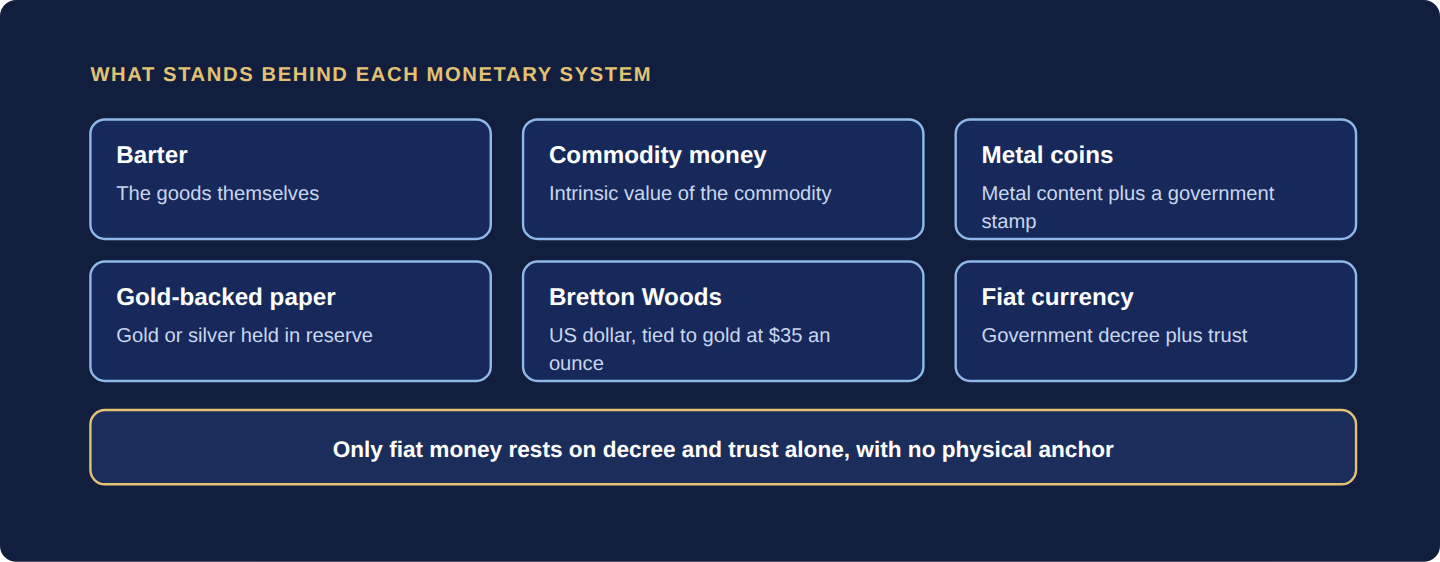
| System | What backs it | Period | Key weakness |
|---|---|---|---|
| Barter | The goods themselves | Pre-history | Double coincidence; not scalable |
| Commodity money | Intrinsic value of the commodity | 3000 BCE to about 600 BCE | Bulky, hard to divide, supply varies |
| Metal coins | Metal content plus a government stamp | 600 BCE to the 1600s | Heavy for large transactions |
| Paper (gold-backed) | Gold or silver in reserve | 1600s to the 1930s | Rigid; limits crisis response |
| Bretton Woods | US dollar tied to gold at $35 an ounce | 1944 to 1971 | Required discipline the US could not maintain |
| Fiat currency | Government decree plus trust | 1971 to the present | Abuse leads to inflation and hyperinflation |
Why fiat money works
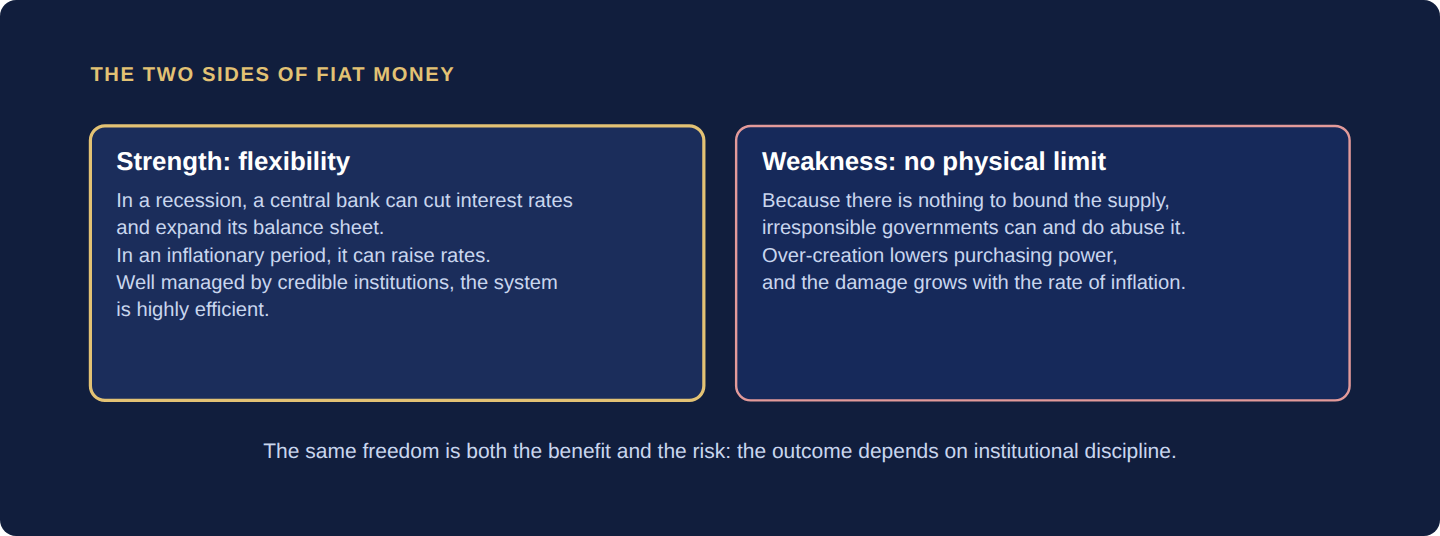
Fiat money is not inherently reckless. When it is managed by credible institutions it is a highly efficient and flexible system. Central banks can respond to economic conditions: in a recession they can cut interest rates and expand their balance sheets, and in an inflationary period they can raise rates. A currency tied to a fixed quantity of metal cannot respond this way.
Why fiat money is risky
The strength of fiat money is also its weakness. Because there is no physical limit to how much can be created, irresponsible governments can and do abuse it. The cost shows up as inflation, which lowers the purchasing power of every unit of money.
Measuring the erosion
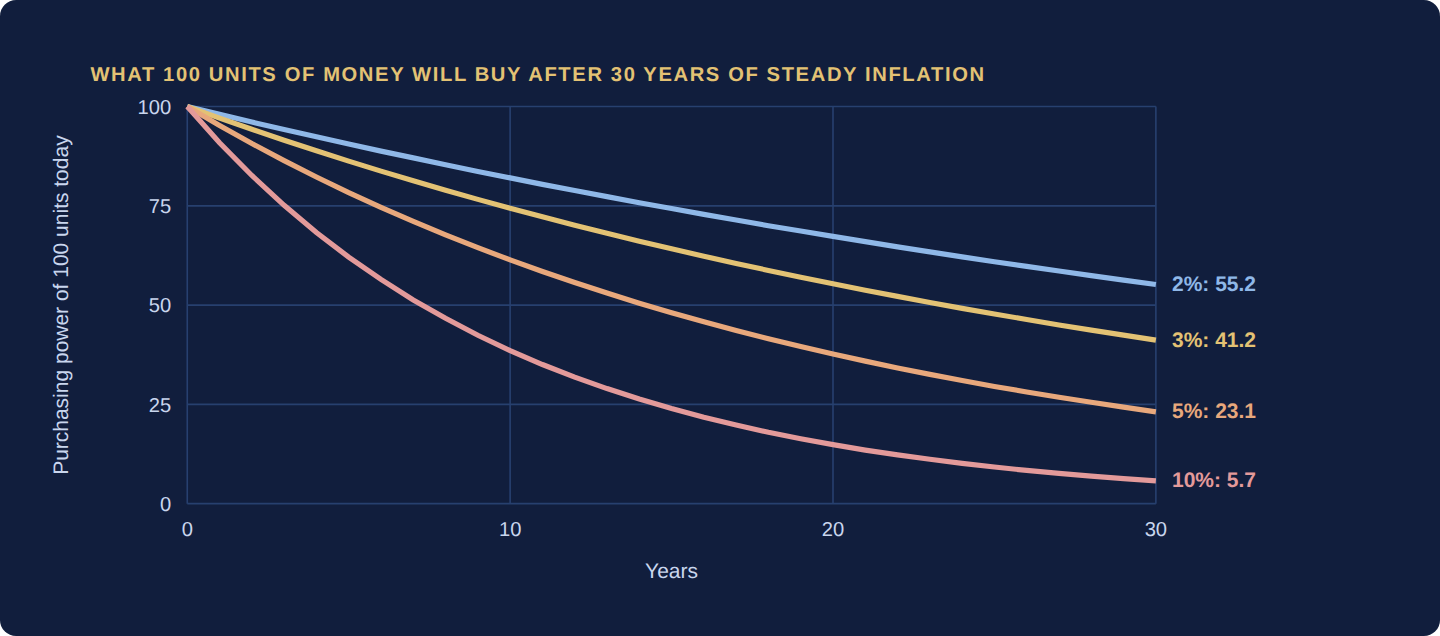
The purchasing power of a unit of money after t years of steady inflation at rate i is its starting value divided by (1 + i) raised to the power t.
Purchasing power = 100 ÷ (1 + i)t
| Steady inflation | After 10 years | After 20 years | After 30 years |
|---|---|---|---|
| 2% | 82.0 | 67.3 | 55.2 |
| 3% | 74.4 | 55.4 | 41.2 |
| 5% | 61.4 | 37.7 | 23.1 |
| 10% | 38.6 | 14.9 | 5.7 |
A quick estimate of how long it takes for money to lose half its value is the rule of 72: divide 72 by the inflation rate in percent. At 3% the answer is about 24 years; at 10%, about 7.2 years.
Common misreadings
“Fiat money is backed by nothing.” It is backed by legal tender status and by trust in the institutions that manage it, which is a real anchor, though not a physical one. “Fiat money always leads to inflation.” It makes abuse possible, not certain; well-managed fiat systems keep inflation low. “Only the dollar is fiat.” Every major currency is.
A method for assessing a fiat currency
- Check the institution. Is the central bank credible and able to act on its own judgment?
- Check the rate. What is steady inflation, and what is the purchasing power left after 10 and 20 years?
- Check the financing. Does the government fund its spending through taxes and borrowing, or by creating money?
- Check the response. Can policymakers cut or raise rates as conditions change, and do they do so credibly?
- Check trust. Do people hold and save in the currency, or look for alternatives?
Practice problems
After 1971, the world moved entirely to fiat currency: money that has value not because it is backed by a physical commodity, but because a government declares it legal tender and citizens trust and accept it. The word fiat is Latin for “let it be done” — a government decree. Every major currency today — the US dollar, the euro, the Indian rupee, the British pound, the Japanese yen, the Chinese yuan — is fiat money.
Fiat money is not inherently reckless. When well-managed by credible institutions, it is a highly efficient and flexible monetary system. Central banks can respond to economic conditions — cutting interest rates and expanding their balance sheets during recessions, raising rates during inflationary periods (Section 0.9: How Currency Is Created Today — and How Much Is Too Much shows how). But fiat money’s great strength is also its great weakness: because there is no physical limit to how much can be printed, irresponsible governments can and do abuse it.
Fiat money is like a check from a trusted friend. The paper itself is worthless — it’s just paper. But if your friend is reliable, has a job, and has always honored their commitments, you accept the check happily. The moment you stop trusting your friend’s ability or willingness to honor it, the check becomes worthless. Fiat money is exactly that: a collective agreement to trust the government and its institutions.
The Full Arc: Six Monetary Systems Compared
| System | Backed By | Period | Key Advantage | Key Weakness |
|---|---|---|---|---|
| Barter | The goods themselves | Pre-history | No intermediary needed | Double coincidence; not scalable |
| Commodity Money | Intrinsic value of the commodity | 3000 BCE–~600 BCE | Widely accepted | Bulky, hard to divide, supply varies |
| Metal Coins | Metal content + government stamp | 600 BCE–1600s | Portable, durable, divisible | Heavy for large transactions |
| Paper (Gold-Backed) | Gold/silver in reserve | 1600s–1930s | Convenient; discipline imposed | Rigid; limits crisis response |
| Bretton Woods | US Dollar (tied to gold at $35/oz) | 1944–1971 | Global stability; predictable trade | Required US discipline it couldn’t maintain |
| Fiat Currency | Government decree + trust | 1971–present | Flexible; crisis management possible | Abuse leads to inflation/hyperinflation |
What is fiat currency?
Money valued because a government declares it legal tender and people trust it, not because a commodity backs it. “Fiat” is Latin for “let it be done”.
Which currencies are fiat?
The dollar, euro, rupee, pound, yen and yuan. The world moved entirely to fiat money after 1971.
What are the advantages of fiat money?
Flexibility: central banks can cut interest rates and expand their balance sheets in a recession, and raise rates against inflation.
What is the risk of fiat money?
Nothing physical limits the supply, so irresponsible governments can and do abuse it.
- Paper money originated as a receipt for stored metal — convenience in exchange for a new dependency on issuer credibility.
- The Gold Standard imposed monetary discipline across the global economy but proved too rigid when wars and depressions demanded flexibility.
- Bretton Woods (1944) replaced the gold standard with a dollar-anchored system. It collapsed in 1971 when Nixon closed the gold window — the Nixon Shock.
- Fiat currency — every major currency today — derives its value from government authority and collective trust. Its strength is flexibility; its permanent risk is abuse.
- Fiat currency has value because a government declares it legal tender and citizens trust it; the word means “let it be done”.
- Every major currency today is fiat, and the world moved entirely to fiat after 1971.
- Its strength is flexibility: central banks can cut rates and expand balance sheets in a recession and raise rates against inflation.
- Its permanent risk is abuse, because nothing physical limits the supply.
- Purchasing power = 100 ÷ (1 + i)t; steady inflation at 3% halves the value of money in about 24 years.
Four questions and three worked problems on this chapter. Decide on your answer first, then click “Reveal Answer.”
1. What gives fiat currency its value?
- A fixed quantity of gold held in the central bank’s vaults
- A guarantee from the IMF that it will hold its value
- Legal-tender status and public trust in its issuer
- The cost of the paper and metal used to make it
Reveal Answer
Answer: C. Fiat money is backed by decree and trust, not by a commodity.
2. What does the word fiat mean?
- Let it be done
- Backed by gold
- Printed by the state
- Trusted by all
Reveal Answer
Answer: A. Fiat is Latin for ‘let it be done’, a government decree.
3. According to the chapter’s comparison table, what is the key weakness of fiat currency?
- It is too heavy for large transactions
- Abuse can lead to inflation or hyperinflation
- It requires the US to maintain gold discipline
- Its supply is too rigid to respond to a crisis
Reveal Answer
Answer: B. Because there is no physical limit on issuance, irresponsible governments can debase it.
4. In a recession, how can central banks running fiat currencies respond?
- By fixing all prices for a year to stop deflation
- By converting their currency into dollars at a fixed rate
- By buying gold to raise the backing of each note
- By cutting interest rates and expanding their balance sheets
Reveal Answer
Answer: D. The chapter notes that fiat systems allow rate cuts and balance-sheet expansion in recessions and rate rises against inflation.
5. Worked problem: Inflation runs at a steady 4% a year. What will 100 units of money buy, in today’s terms, after 20 years?
Reveal Answer
Answer: 100 ÷ 1.0420 = 100 ÷ 2.19 = about 45.6. The money has lost more than half its purchasing power.
6. Worked problem: Using the rule of 72, about how long does it take for money to lose half its value at 6% inflation?
Reveal Answer
Answer: 72 ÷ 6 = 12 years.
7. Worked problem: A government pays for its spending by instructing the central bank to create money well beyond what the economy produces. Which feature of fiat money makes this possible, and what is the likely result?
Reveal Answer
Answer: The feature is that there is no physical limit on how much can be created. The result is inflation, which lowers the purchasing power of every unit and can grow into hyperinflation if it continues.
0.8 Why Currency Was Created — The Three Functions of Money
Money does three jobs at once: it is a medium of exchange, a store of value and a unit of account. Anything that does all three can work as money, which is why cigarettes became currency in prisoner-of-war camps.
Why it matters: The three jobs explain why each form of money in history was replaced.
Summary: Money performs three functions at once: it is a medium of exchange, a store of value and a unit of account. Any object that does all three can serve as money, which is why cigarettes became currency in prisoner-of-war camps.
- The gold standard succeeded because gold performed all three functions better than anything before it, and it failed because it was too rigid an anchor for stored value.
- Fiat money excels as a medium of exchange and unit of account, but its reliability as a store of value depends on the discipline of the institution managing it.
Money is any object that performs three functions at the same time: it serves as a medium of exchange, a store of value and a unit of account. The three functions explain why, across the history of money, societies moved from one form of money to the next: each stage failed some of the demands of a growing economy.
The three functions
| Function | What it does | Test | What breaks it |
|---|---|---|---|
| Medium of exchange | Is universally accepted as payment, eliminating the double coincidence of wants | Will sellers accept it for anything? | Without it, every trade needs a fresh barter negotiation |
| Store of value | Holds its value over time, so earning it today allows spending it next month or next year without significant loss of purchasing power | Does it keep its purchasing power? | Inflation or volatility |
| Unit of account | Provides a common measure of value, so the price of a sandwich, a car and a house can be compared on the same scale | Can every price be quoted in it? | A unit whose value keeps changing |
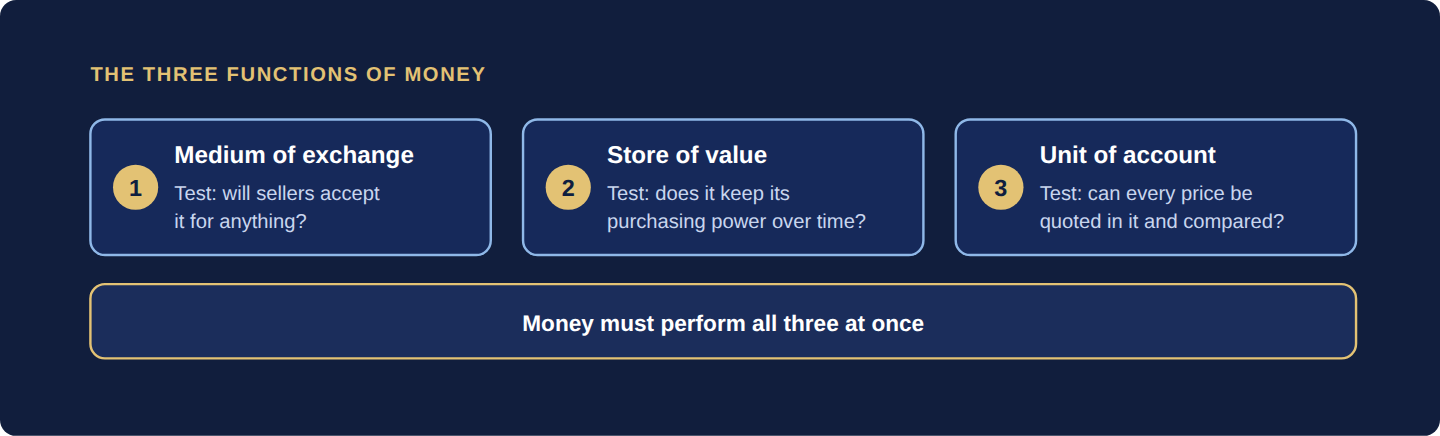
Any object can qualify
Any object that performs all three functions can serve as money. This is why cigarettes became currency in prisoner-of-war camps, and why mobile phone minutes have served as informal currency in parts of Africa. It is also the framework for the argument over Bitcoin: its proponents say it qualifies as money, but its volatility makes it a poor store of value and unit of account by most current definitions.
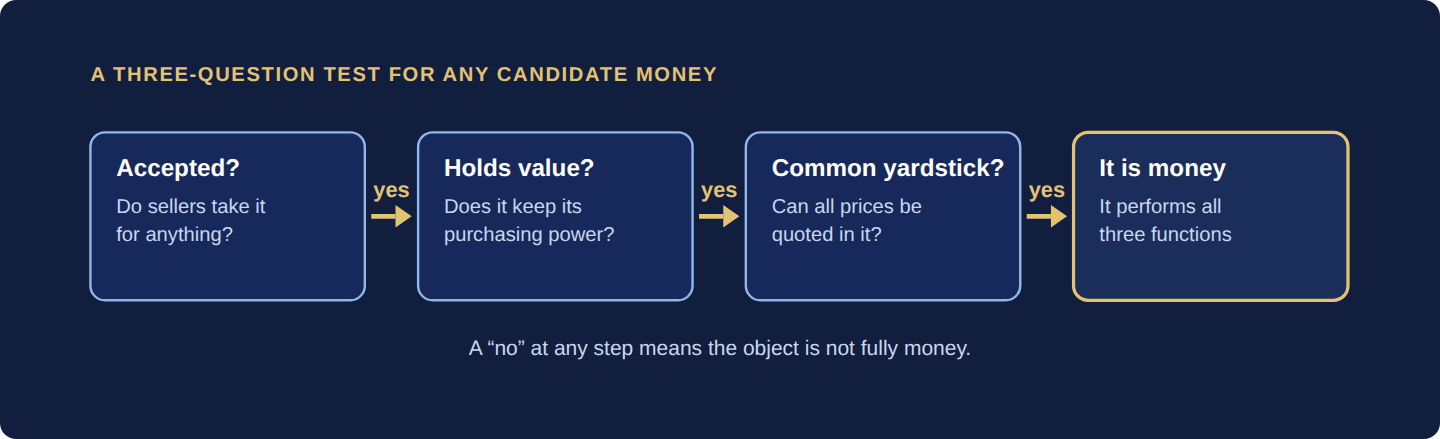
Measuring the store of value
Volatility damages a store of value in a way that is easy to miss: losses are harder to recover than they are to suffer. If money loses a fraction L of its value, it must then gain L ÷ (1 − L) to get back to where it started.
Gain needed to recover a loss = L ÷ (1 − L)
| Loss in value | Gain needed to recover |
|---|---|
| 10% | 11.1% |
| 20% | 25.0% |
| 40% | 66.7% |
| 50% | 100.0% |
The same swings destroy a unit of account. If the value of a currency moves by 20% in a month, a price quoted in it means something different on the first day and the last, and contracts, wages and rents become guesses.
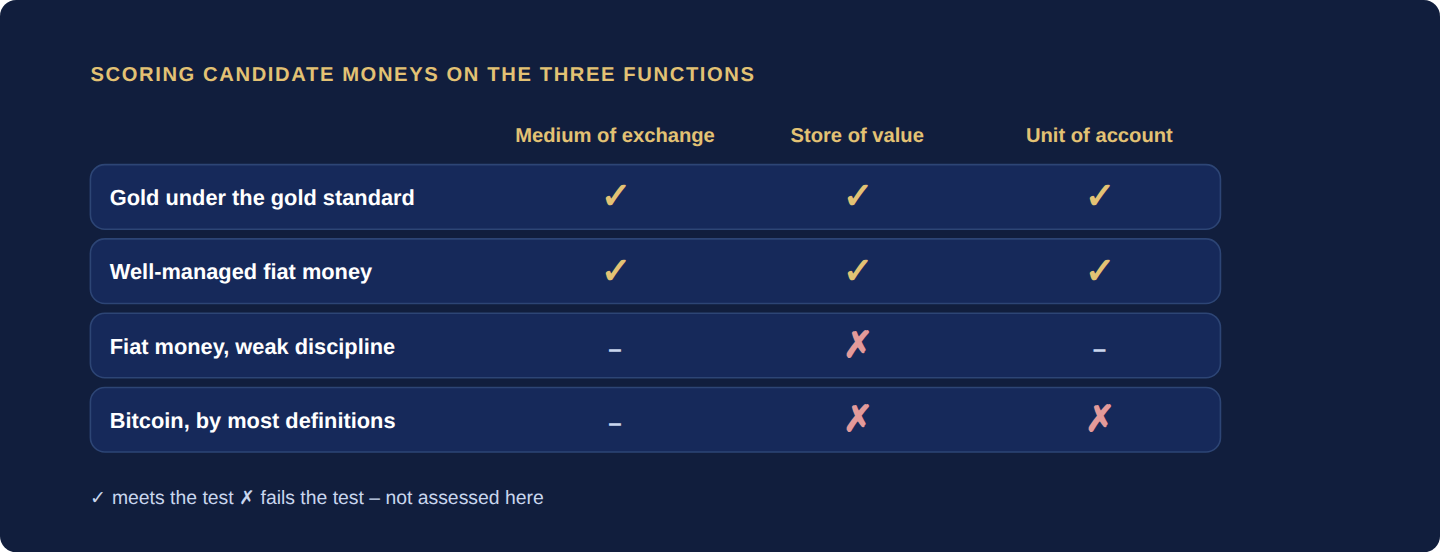
Why the functions explain history
The gold standard succeeded because gold performed all three functions better than anything before it. It eventually failed because it was too rigid as a store-of-value anchor, limiting governments’ ability to manage economies. Fiat money excels as a medium of exchange and unit of account, but its reliability as a store of value depends entirely on the discipline of the institution managing it.
Common misreadings
“Money is cash.” Money is defined by function, and much of it exists as balances in accounts. “One function is enough.” An object that is accepted in trade but loses value quickly fails as money over any period longer than a transaction. “Bitcoin is not money because no government backs it.” The argument does not turn on backing but on volatility: by most definitions it is a poor store of value and unit of account.
A method for testing a candidate money
- Test acceptance. Will sellers take it in payment for anything, not just for one good?
- Test value over time. Compute its purchasing power after a year of normal use. A large loss means a weak store of value.
- Test the yardstick. Can every price be quoted in it, and does the quote mean the same thing next month?
- Check volatility. Use the recovery formula: a loss of L needs L ÷ (1 − L) to repair.
- Judge the institution. For fiat money, ask whether the issuer is disciplined enough to protect the store of value.
Practice problems
At every stage of monetary history, societies moved from one form of money to the next because their current system failed to meet the demands of growing, complex economies. Money exists to solve a specific set of problems that barter cannot handle. To work well, money must simultaneously perform three distinct functions:
Any object that successfully performs all three functions can serve as money. This is why cigarettes became currency in prisoner-of-war camps, why mobile phone minutes have served as informal currency in parts of Africa, and why Bitcoin’s proponents argue it qualifies as money — though its volatility makes it a poor store of value and unit of account by most current definitions.
Understanding these three functions explains every major monetary development in history. The gold standard succeeded because gold performed all three functions better than anything before it. It eventually failed because it was too rigid as a store-of-value anchor, limiting governments’ ability to manage economies. Fiat money excels as a medium of exchange and unit of account — but its reliability as a store of value depends entirely on the discipline of the institution managing it.
What are the three functions of money?
Medium of exchange, store of value and unit of account.
What makes something money?
It must do all three jobs: be accepted in trade, keep its purchasing power over time, and serve as the common yardstick for prices.
Why did cigarettes work as money in prisoner-of-war camps?
Because they passed all three tests: people accepted them in trade, they held their value well enough, and prices could be quoted in them.
Does fiat money perform all three functions?
It excels as a medium of exchange and unit of account; its reliability as a store of value depends on the discipline of the institution managing it.
- Money is any object that works as a medium of exchange, a store of value and a unit of account at the same time.
- Each stage in the history of money was replaced because it failed a function as economies grew.
- Cigarettes in prisoner-of-war camps and phone minutes in parts of Africa worked as money by passing the three tests.
- Volatility damages a store of value: a loss of L needs a gain of L ÷ (1 − L) to recover.
- Fiat money excels as exchange and account unit, but as a store of value it depends on the discipline of its issuer.
Four questions and three worked problems on this chapter. Decide on your answer first, then click “Reveal Answer.”
1. Which function of money lets you compare the price of a sandwich, a car and a house on one scale?
- Store of value
- Medium of exchange
- Standard of deferred payment
- Unit of account
Reveal Answer
Answer: D. A unit of account gives a common measure of value.
2. Why is Bitcoin’s claim to be money weak by most current definitions?
- Its volatile price makes it a weak store of value
- It is backed by gold, which limits its supply
- It is not accepted by any business anywhere
- It cannot be transferred between people without a bank
Reveal Answer
Answer: A. The chapter notes its volatility undermines two of the three functions.
3. Cigarettes served as currency in prisoner-of-war camps. What does this show?
- Prisoners had no need for a unit of account in the camp
- Only government-issued objects can become money in a camp
- Anything that performs money’s three functions can be money
- Money must have no use other than trading for other goods
Reveal Answer
Answer: C. The chapter uses the example to show that function, not form, makes money.
4. According to the chapter, what does fiat money’s reliability as a store of value depend on?
- The amount of gold in circulation
- The discipline of its issuer
- The size of the country’s population
- The number of banks in the country
Reveal Answer
Answer: B. Fiat money excels as a medium of exchange and unit of account; its store of value depends on the issuer’s discipline.
5. Worked problem: In a prisoner-of-war camp, cigarettes are accepted for every trade, hold their value from week to week, and are used to quote the price of every good. Which functions do they perform?
Reveal Answer
Answer: All three: medium of exchange (accepted for every trade), store of value (hold value from week to week) and unit of account (used to quote every price). That is why they could work as money.
6. Worked problem: A currency loses 40% of its value. What gain is needed to return to the starting value?
Reveal Answer
Answer: 0.40 ÷ (1 − 0.40) = 0.40 ÷ 0.60 = 66.7%. Check: 60 × 1.667 = 100.
7. Worked problem: Match each statement to a function: (a) earn it today, spend it next year without much loss, (b) the price of a sandwich, a car and a house on one scale, (c) accepted as payment by everyone.
Reveal Answer
Answer: (a) Store of value. (b) Unit of account. (c) Medium of exchange.
- Smith (1776), An Inquiry into the Nature and Causes of the Wealth of Nations (Project Gutenberg) — Book I, Chapter 4 on the origin and use of money, including the difficulties of barter
- Bank of England, Our history — Founded 1694 as banker to the government; handwritten notes, partly printed from 1725 (Section 0.4)
- Federal Reserve History, Creation of the Bretton Woods System — The Bretton Woods system that tied currencies to the dollar and the dollar to gold
- Federal Reserve History, Nixon Ends Convertibility of US Dollars to Gold — August 15, 1971, measures and causes (Section 0.6)