
Refinancing a federal student loan with a private lender means you swap every federal protection for a lower interest rate, and you cannot swap back. It makes sense only when you are not planning a public service job, your income comfortably covers the new payment, and your savings could absorb a job loss without federal help. A loan that is already private carries no such trade, so refinancing it when rates fall is just good housekeeping.
Why it matters: A lower rate is only a good deal if you never need the protections you gave up.
Summary: Refinancing a federal student loan into a private one is a permanent trade: a lower rate in exchange for every federal protection. Do it only when no public-service job is in view, your income comfortably covers the private payment, and your savings could absorb an income shock without federal help. A loan that is already private carries no such trade, and refinancing it whenever the rate falls is simply good housekeeping.
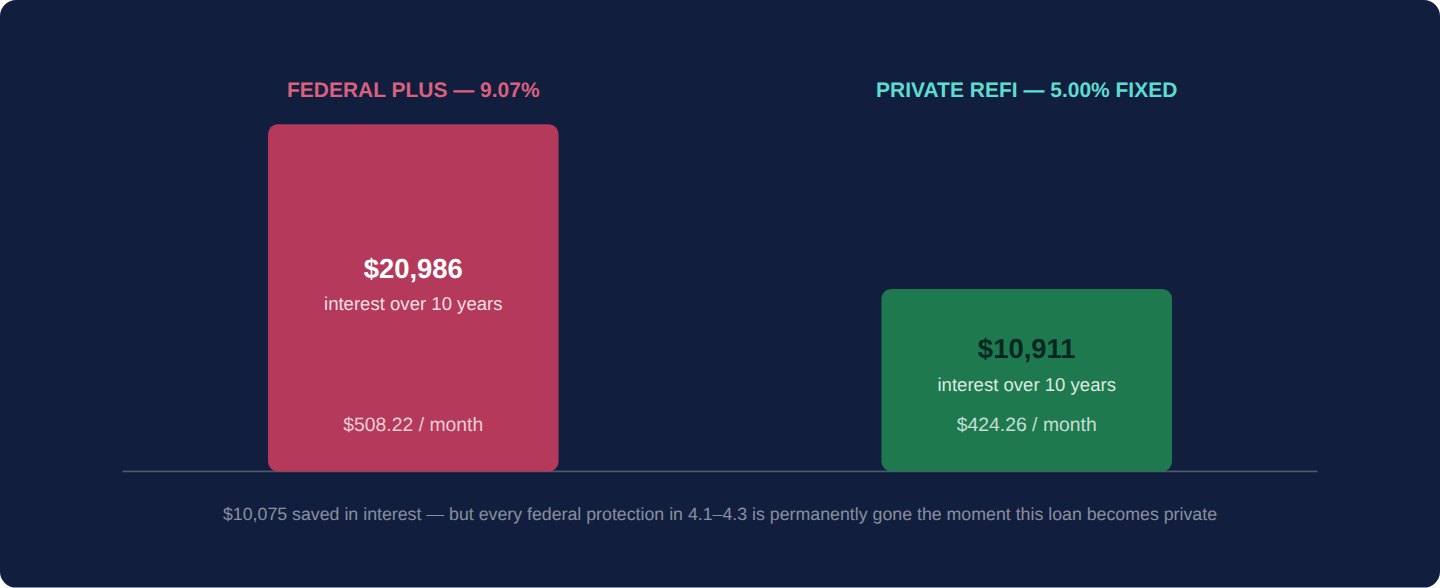
- On $40,000 of PLUS debt at 9.07%, a 5.00% private loan saves $10,074.92 of interest over 10 years, or $7,840.41 against the autopay-reduced federal rate.
- For a PSLF-eligible teacher with AGI $55,000, staying federal on RAP costs $27,500 against $50,911.45 for the refinance: refinancing would cost her $23,411.45.
- For a PSLF borrower, the flip point is the AGI at which your RAP payment equals the private payment: $72,730 for this loan.
- Private rates are priced on your risk; variable rates float with the 30-day average SOFR (3.76% on Oct 2, 2026) plus a margin.
- Direct Consolidation is the only way to combine federal loans and stay federal; it does not lower the rate.
- Private education loans cannot carry prepayment penalties, so you can refinance again if rates fall.
Throughout this volume we follow a single filer earning $75,000 (AGI $67,900); for a federal borrower at that income, the flip-point test below is the one to run if public service is possible; otherwise compare rates, as for borrower A.
Refinancing replaces one or more existing student loans with a single new private loan, at a new rate — and if any of the original loans were federal, this step is irreversible: every federal protection from 4.1 through 4.3 (income-driven repayment, PSLF eligibility, federal discharge on death or total and permanent disability, deferment and forbearance options) is permanently given up the moment a federal loan is refinanced into a private one.
How a refinance works. A refinance is a new private loan whose proceeds pay off your old loans, which then close. The lender prices it on your credit score, income, existing debts and often your degree and field, and offers a choice of term and of a fixed or variable rate. Shopping costs little. A prequalification check does not affect FICO scores, and FICO treats student-loan inquiries within a short window as one search: 45 days in newer score versions, 14 in older ones (myFICO). Compare offers on APR and total of payments for the same term.
Fixed or variable. A variable rate is an index plus a margin. One large lender’s disclosure adds its margin to the 30-day average SOFR, which was 3.76% on Oct 2, 2026, and caps the variable rate at 13.95%; its refinance APRs on Sep 23, 2026 ran from 4.49% to 10.99% fixed and 5.74% to 10.99% variable, including a 0.25-point autopay discount (SoFi disclosure). On $40,000 over 10 years, each point of rate is worth about $20 a month: $424.26 at 5%, $444.08 at 6%. A variable rate starting below the fixed one pays off only if you will repay quickly or can absorb a rise; the Fed raised its target range to 3.75%–4.00% in September 2026.
Federal pricing is flat. Every 2026–27 PLUS borrower pays 9.07%, the 10-year Treasury yield plus a fixed 4.60 points (4.1: Federal vs Private Loans), whether they will earn $40,000 or $400,000, and the same rate comes bundled with income-based payments, interest waivers under RAP, PSLF and discharge on death or disability. A private lender prices risk instead: it lends to borrowers it expects to repay in full and charges each a rate matched to that expectation. Refinancing is therefore a sorting market. The borrowers who can refinance cheaply are those least likely to need the federal protections, and the interest they save is, in effect, the price of the insurance they surrender.
Two corollaries follow. The federal origination fee you already paid (4.228% on a 2026–27 PLUS loan) is sunk and does not belong in the comparison; only the rate from here on matters. And the right federal rate is the one you actually pay: with the Education Department’s autopay reduction, 8.07% through June 30, 2028, then 8.82% if the standard 0.25-point autopay discount continues. Keeping the $508.22 payment, that federal loan is repaid in 116 months for $58,751.86, which trims the refinance’s saving from $10,074.92 to $7,840.41.
The protections are used at scale: about three in ten federal borrowers are on income-driven repayment and roughly one in five is in default (4.2). Those figures describe all borrowers, not the high-income borrowers who typically qualify for a refinance, and there is no good public estimate of how often a refinanced borrower later wishes they had kept federal terms. Treat the evidence as showing that the safety net is used at scale, not as your personal odds.
One payment without leaving the federal system. If the goal is simplicity rather than a lower rate, a Direct Consolidation Loan combines federal loans into one and keeps them federal. It does not lower the rate, and since July 1, 2026, it changes which plans you can use.
By statute, a Direct Consolidation Loan’s rate is the weighted average of the rates on the loans consolidated, rounded up to the nearest one-eighth of a point (20 U.S.C. §1087e(b)(8)(D)). Consolidating $20,000 at 6.52% with $20,000 at 9.07% gives ($20,000 × 6.52% + $20,000 × 9.07%) ÷ $40,000 = 7.795%, rounded up to 7.875%: slightly more interest, never less. A consolidation loan made on or after July 1, 2026, may be repaid only under the Tiered Standard plan or RAP (§1087e(g)(3)), so consolidating loans made before that date ends their access to IBR. Consolidation can still be the right tool, for example to bring older non-Direct federal loans into the Direct Loan program, but it is housekeeping, not a rate cut.
| Refinancing Tends to Make Sense When | Refinancing Is Usually a Mistake When |
|---|---|
| The loan is already private, or was federal PLUS at a rate well above what’s available privately | Income is unstable, or a future income-driven plan or PSLF path is even plausible |
| Income and employment are stable, with strong credit and no near-term risk of job loss | The borrower works, or might work, in public service or for a nonprofit |
| PSLF and income-driven repayment are both irrelevant to the borrower’s situation | Any meaningful chance exists that broader federal forgiveness policy could change again — refinancing forecloses that option permanently |
Each borrower owes $40,000 of graduate PLUS loans at 9.07%, first disbursed in 2026–27 (Grad PLUS stays open only to borrowers in the legacy window, 4.2), so the federal choices are Tiered Standard and RAP, and is offered a 5.00% fixed private refinance over 10 years: $424.26 a month, $50,911.45 in total. Illustrative assumptions: no dependents, AGI unchanged for 10 years, totals not discounted. RAP totals follow the payment rules in 4.3: unpaid interest is waived and principal falls by at least $50 a month.
| Borrower | Best federal path | Federal total paid | Refinance total paid | Better choice |
|---|---|---|---|---|
| A. Private-sector, AGI $120,000 | Tiered Standard prepaid at the 10-year amount, with autopay ($508.22; 8.07% to Jun 2028, then 8.82%) | $58,751.86 | $50,911.45 | Refinance: saves $7,840.41 |
| B. Public-school teacher, AGI $55,000, PSLF | RAP at 5%: $229.17 × 120; $34,000 forgiven tax-free | $27,500.00 | $50,911.45 | Stay federal: saves $23,411.45 |
| C. PSLF-eligible, AGI $72,730 | RAP at 7%: $424.26 × 120; the remaining balance forgiven | $50,911.20 | $50,911.45 | Indifferent: the flip point |
The flip point: for a PSLF borrower, RAP plus forgiveness beats refinancing whenever 120 RAP payments total less than 120 refinance payments, that is, whenever the RAP payment is below $424.26. In the 7% band that happens below AGI = $424.26 × 12 ÷ 0.07 = $72,730. Above it, refinancing wins even with PSLF: at AGI $80,000, RAP’s $466.67 a month totals $56,000. Rising income lowers the flip AGI, because later RAP payments grow; leaving public service before 120 payments removes the forgiveness, and teacher B would then owe a balance that RAP had reduced by only $50 a month. For a borrower with no PSLF prospect the comparison is simply A: the private rate against the federal rate actually paid.
Waiting has value. A federal loan can be refinanced next year; a private loan can never become federal again. If your career, income or public-service plans are likely to settle within a year or two, the cost of waiting is roughly the rate gap for that period: on $40,000, 9.07% against 5.00% is about $40,000 × 4.07% ≈ $1,628 in the first year, against an option that can be worth tens of thousands of dollars, as borrower B shows.
The comparison above assumes one borrower, a fixed rate and a loan used only for education. These situations change it.
| Situation | What changes | Why | Number or rule |
|---|---|---|---|
| Active-duty service member | Refinancing can forfeit the 6% interest cap | The SCRA cap applies to obligations incurred before service; a refinance during service is a new obligation | 50 U.S.C. §3937: 6% on pre-service debts, excess interest forgiven |
| Married to a high earner | Your RAP payment, and so the flip point, may be higher on a joint return | RAP uses joint AGI on a joint return and your own AGI if you file separately | Recompute the flip with the AGI you would actually report (4.3) |
| Consolidating federal loans instead | Stays federal, but loans made before July 1, 2026, lose IBR | New consolidation loans allow only Tiered Standard or RAP | Rate rounded up to the next 1/8 point: 7.795% becomes 7.875% |
| Variable-rate refinance | The payment moves with the index | Rate = 30-day average SOFR + margin, up to the contract cap | Each point on $40,000 over 10 years ≈ $19.82 a month ($424.26 at 5%, $444.08 at 6%) |
| Borrowing extra in the refinance | The interest may no longer be deductible | Refinanced interest qualifies only if the new loan solely refinances qualified student loans | IRS Pub 970: extra used for non-education purposes makes none of the interest deductible |
| A cosigner on the new loan | The cosigner owes the full debt | Joint liability on the contract | FTC: “you may have to pay up to the full amount”; ask about cosigner-release terms before signing |
| Bankruptcy later | No easier to discharge than the federal loan | Both federal loans and qualified private education loans require “undue hardship” | 11 U.S.C. §523(a)(8) |
| Rates fall after you refinance | You can refinance again or prepay at any time | Private education lenders may not charge prepayment fees or penalties | 15 U.S.C. §1650(e) |
The rule of thumb above — refinance when a private rate is meaningfully lower — compares rates and ignores options. It breaks when income falls (a private payment stays fixed, while RAP or IBR would have reset an eligible federal loan’s payment to a share of AGI); when the borrower dies or becomes disabled and the private contract does not discharge the debt; when a public-service job appears later (refinanced loans can never earn PSLF); when the new rate is variable and resets upward; and when the comparison uses the wrong federal rate, such as ignoring an autopay reduction. The $10,075 of interest saved in the chart is, in effect, the price you are paid for giving those options up permanently — worth taking only when you are confident you will never need them.
Refinance a federal loan into a private one only if all four hold: (1) the private payment fits your budget without strain and your RAP payment at today’s AGI is not much lower than it (if RAP would cut your payment sharply, you are likely to need the income-based safety net you would be giving up); (2) you do not work, and do not expect to work, for a government or 501(c)(3) employer; (3) you hold an emergency fund of at least six months of expenses, because the private payment will not flex if income falls (1.4); and (4) the fixed rate offered is at least 2 points below the federal rate you actually pay after any autopay reduction, a heuristic margin for the insurance you surrender (from 9.07% to 7% on $40,000 still saves $5,254.29). If the loan is already private, refinance whenever a fixed rate about 1 point lower is available without fees.
Assumptions: current federal law and stable employment. Ignore the rule if you will repay the whole balance within about two years: the saving is small either way, so choose whichever path lets you pay fastest.
Refinancing loans that were on track for PSLF. Teacher B in the worked example would pay $27,500 over 10 years on RAP and have $34,000 forgiven tax-free. Refinanced at 5%, she pays $50,911.45: $23,411.45 more, for a lower advertised rate. The loss is permanent, because a refinanced loan can never earn PSLF credit, even if she spends the next 20 years in public service.
How to avoid it: before refinancing any federal loan, check whether your current or likely employer qualifies for PSLF, compute your RAP payment, and run the flip test. If the answer is close, wait: the option to refinance later costs about one year of the rate gap; giving it up cannot be undone.
Does refinancing student loans hurt your credit?
Only slightly, and briefly. Prequalification checks do not affect FICO scores; the full application brings a hard inquiry, which myFICO says costs most people fewer than five points, and FICO counts student-loan inquiries within 14 to 45 days as one. The new account lowers your average account age, while on-time payments on the new loan rebuild the record. The bigger risk is not the score but the federal protections you give up.
Can I refinance federal student loans and keep federal benefits?
No. Any private refinance ends income-driven repayment, PSLF eligibility, federal deferment and forbearance, and federal discharge on death or disability. The only way to combine federal loans and stay federal is a Direct Consolidation Loan, which keeps the weighted-average rate rounded up to the next one-eighth point and, since July 1, 2026, allows only the Tiered Standard plan or RAP.
Should I choose a fixed or variable rate when refinancing?
Choose fixed unless you can repay most of the balance within a few years. A variable rate is the 30-day average SOFR plus a margin, so it starts lower but moves with short-term rates; on $40,000 over 10 years, each point adds about $20 a month. A variable loan suits a borrower paying aggressively who could absorb a rise; for anyone stretching the payment, a fixed rate removes that risk.
Can you refinance student loans more than once?
Yes. Federal law bars private education lenders from charging a fee or penalty for early repayment, so you can refinance again whenever a lower rate appears, or simply prepay. Each new application brings a hard inquiry, and each refinance should be compared on APR and total cost for the remaining balance and term, not on the monthly payment.
Is student loan interest still deductible after refinancing?
Yes, if the new loan is used solely to refinance qualified student loans. IRS Publication 970 says that if you borrow more than the old balance and use the extra for something other than qualified education expenses, none of the interest on the new loan is deductible. The deduction is up to $2,500 a year and phases out between $85,000 and $100,000 of modified AGI for single filers in 2026 (4.6).
Refinancing replaces student loans with a single private loan at a new rate, and if any of them were federal the move is permanent: income-driven repayment, PSLF, deferment and forbearance, and discharge on death or total and permanent disability are all given up. On a $40,000 federal PLUS loan at 9.07%, a 5.00% private refinance saves $10,075 of interest over ten years, and that saving is, in effect, the price you are paid for surrendering those options. Refinance only when the loan is already private or a high-rate PLUS loan, your income and credit are strong and stable, and PSLF and income-driven repayment are irrelevant to you, and compare against the right federal rate, including any autopay reduction.
Eight questions on this chapter. Decide on your answer first, then click “Reveal Answer.”
1. A borrower owes $25,000 on a federal PLUS loan at 9.07% and is offered a 5.00% fixed private refinance; each would be repaid over 10 years. About how much interest would refinancing save?
- $13,116
- $6,820
- $10,175
- $6,297
Reveal Answer
Answer: D. Payment = $25,000 × r ÷ [1 − (1 + r)^−120]: $317.64 versus $265.16, so interest is $13,116 versus $6,820, a $6,297 saving. Rate gap × balance × 10 ($10,175) ignores amortization; $6,820 and $13,116 are each loan’s interest, not the saving. (Part 4.5: Should You Refinance?)
2. Which borrower is the strongest candidate to refinance federal student loans into a private loan?
- A dentist with stable income, strong credit and a 9.07% PLUS loan
- A public-school teacher who may later qualify for PSLF on her loans
- A freelancer with uneven income whose RAP payment varies with AGI
- A graduate offered a variable rate starting below her 6.52% loans
Reveal Answer
Answer: A. Refinancing suits a high-rate PLUS loan, stable income, strong credit and no use for PSLF or income-driven plans. Public service, unstable income and a variable rate that can reset upward are the cases where it is usually a mistake. (Part 4.5: Should You Refinance?)
3. Two years after refinancing his federal loans into a 5.00% fixed private loan, a borrower’s income halves. What relief can he get on that loan?
- Reinstatement of the original federal loans by request
- Only what the private lender chooses to offer
- A switch to RAP, resetting payment to a share of AGI
- A return to IBR once he files his next tax return
Reveal Answer
Answer: B. Refinancing federal loans is irreversible: the private payment stays fixed, and hardship options are at the lender’s discretion. RAP or IBR would have reset an eligible federal loan’s payment to a share of AGI. (Part 4.5: Should You Refinance?)
4. A borrower refinances her federal loans into a private loan and later becomes totally and permanently disabled. Which statement is most accurate?
- The refinance is reversed and the loans return to federal status
- The federal disability discharge still applies to the refinanced loan
- The refinanced loan is discharged automatically under federal law
- Whether the debt is discharged depends on the private lender’s contract
Reveal Answer
Answer: D. A federal loan can be discharged for total and permanent disability, but that protection belongs to the federal loan. A private refinance follows its own contract, and some lenders offer less. (Part 4.5: Should You Refinance?)
5. A public-school teacher who expects to stay 10 years owes $40,000 of 9.07% graduate PLUS loans eligible for RAP and PSLF. Her AGI is $65,000, with no dependents. A 5.00% 10-year refinance would cost $424.26 a month. Over 10 years, which costs less, and by about how much?
- Refinancing, by about $10,075
- They cost the same, because her AGI is at the flip point
- Staying federal on RAP, by about $11,911
- Staying federal on RAP, by about $23,411
Reveal Answer
Answer: C. RAP at 6%: $65,000 × 6% ÷ 12 = $325.00; 120 × $325 = $39,000, with the rest forgiven tax-free under PSLF. Refinancing costs 120 × $424.26 = $50,911.45, so staying saves $11,911.45; the flip AGI for this loan is $72,730. (Part 4.5: Should You Refinance?)
6. A borrower combines $15,000 at 6.52% and $25,000 at 8.07% into a Direct Consolidation Loan. What rate will the new loan carry?
- 7.500%
- 7.295%
- 7.489%
- 7.375%
Reveal Answer
Answer: A. The rate is the weighted average rounded up to the next one-eighth point: ($15,000 × 6.52% + $25,000 × 8.07%) ÷ $40,000 = 7.48875%, rounded up to 7.500%. (Part 4.5: Should You Refinance?)
7. Worked problem: Refinancing $40,000 over 10 years from 7.0% to 5.0%: what are the two payments?
Reveal Answer
Answer: 7.0%: $464.43. 5.0%: $424.26.
8. Worked problem: How much interest does it save, and what federal protections would be given up?
Reveal Answer
Answer: Interest saved = (464.43 − 424.26) × 120 = $4,821. The borrower gives up income-driven repayment, forgiveness programs and federal deferment options.