3.1 Bond Pricing Basics — Price, Yield, and the Inverse Relationship
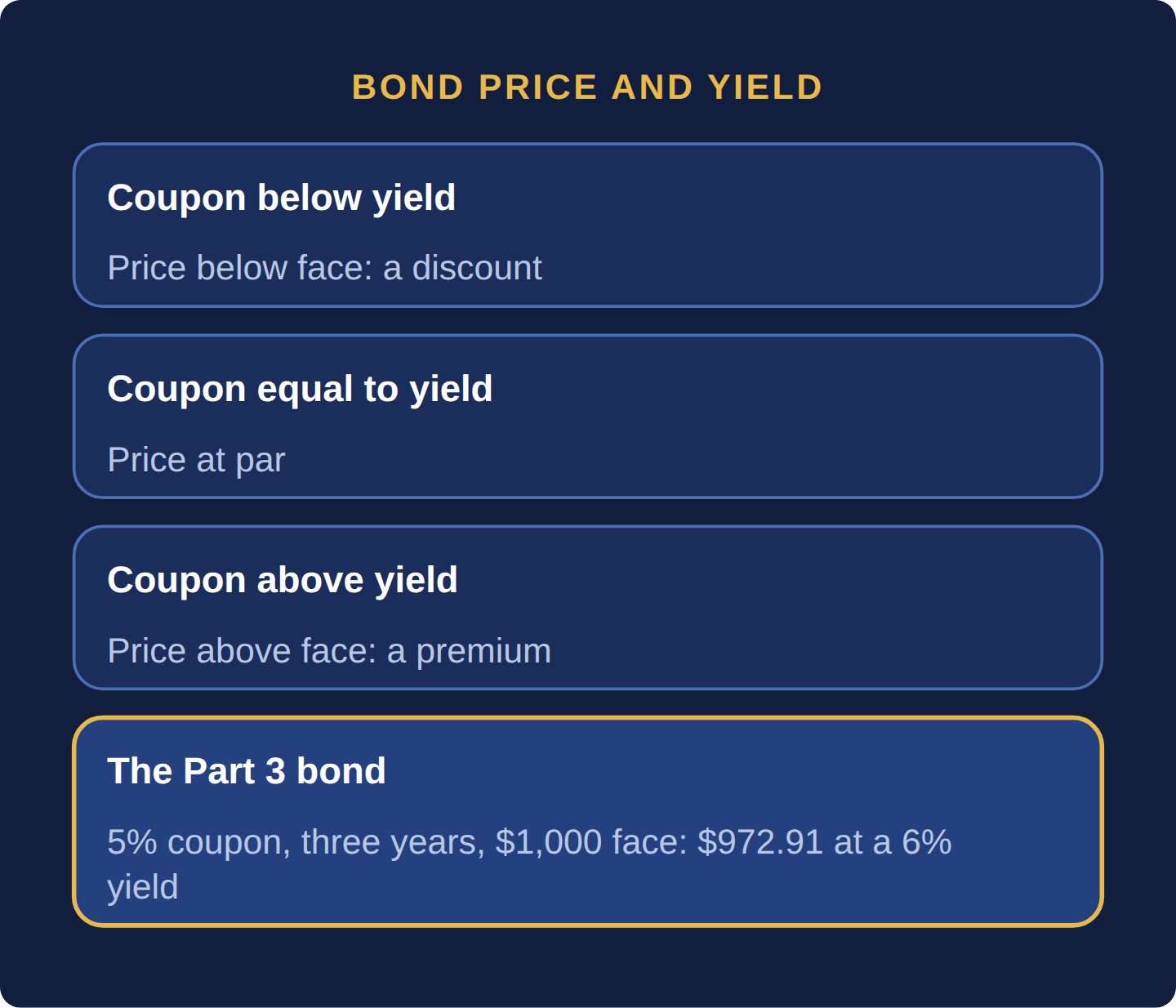
A bond is a loan that pays you fixed interest, and its price is what those future payments are worth today. Prices and yields move in opposite directions. When market yields rise, new bonds pay more, so older bonds with lower payments become less valuable and their price falls. In this chapter’s example, a three-year bond with a 5% coupon and $1,000 face value costs $972.91 when the market yield is 6%. The buyer also pays accrued interest on top of the quoted price.
Why it matters: A rising interest rate is bad news for the bonds you already own.
Summary: A bond’s price is the present value of its remaining coupons and face value, discounted at one rate, the yield to maturity; when market yields rise, that present value falls. The Part 3 bond (5% coupon, three years, $1,000 face) costs $972.91 at a 6% yield, and the buyer also pays accrued interest on top of the quoted clean price.
- Coupon below yield means a discount price, equal means par, above means a premium; every price is pulled to face value at maturity.
- Yield to maturity is your return only if you hold to maturity, are paid in full and reinvest at the same yield.
- You pay the dirty price (clean price plus accrued interest); US corporates accrue on a 30/360 basis.
- Current yield overstates the return on a premium bond: 4.86% versus a true 4.00% in this section’s example.
- Rank bonds on YTM, or on yield to worst if they are callable, never on coupon.
A bond is a loan in tradeable form: the issuer promises to pay periodic coupon payments and return the face value (or “par value”) at maturity. Once issued, a bond trades in the secondary market at whatever price buyers and sellers agree — and that price moves in the opposite direction to prevailing interest rates. This single inverse relationship is the mechanical foundation for everything else in this Part.
The logic: if a bond pays a fixed 6% coupon and newly issued bonds of similar risk now offer 8%, no buyer will pay full face value for the older, lower-paying bond — its price must fall until its yield (the effective return a buyer earns at the current price) rises to match the market. Conversely, if new bonds only offer 4%, the older 6% bond becomes more attractive and its price rises, pushing its yield back down toward the new market level.
A bond’s price is the present value of its remaining cash flows, all discounted at one rate, the yield to maturity (YTM): Price = Σ C ÷ (1 + y/2)k + F ÷ (1 + y/2)n, where C is the semiannual coupon, F the face value and n the number of half-years left. YTM is the single rate that makes this sum equal the market price. It is the return you earn only if you hold to maturity, every payment arrives, and coupons are reinvested at that same yield.
The Part 3 bond (used again in Sections 3.2 and 3.3): $1,000 face, 5% coupon paid semiannually ($25), three years to maturity, priced to yield 6%. Price = 25 ÷ 1.03 + 25 ÷ 1.03² + … + 1,025 ÷ 1.03⁶ = $972.91. Three rules fall out of the formula: coupon below yield gives a discount price ($972.91); coupon equal to yield gives par ($1,000.00 at a 5% yield); coupon above yield gives a premium ($1,028.01 at 4%). As maturity approaches, the price is pulled to $1,000 whatever happens in between, because the final payment is fixed.
Clean versus dirty price. Dealers quote the clean price; you pay the dirty price (full price), which adds accrued interest owed to the seller for the days since the last coupon. US corporate bonds count days on a 360-day year of 30-day months. Settle the Part 3 bond 60 days into its 180-day coupon period: accrued = $25 × 60/180 = $8.33; dirty = $972.91 × 1.0360/180 = $982.55; clean = $982.55 − $8.33 = $974.21. On $10 million face (10,000 bonds) the accrued interest alone is $83,333.
Imagine you hold a fixed-rent lease agreement paying $5,000 a month. If market rents suddenly jump to $7,000 for similar properties, your locked-in lease becomes relatively less valuable — no one would pay you full price to take it over. If market rents instead fall to $3,000, your lease becomes a valuable asset others would pay a premium for. A bond’s price responds to changing interest rates in exactly this way.
Compare bonds on yield, never on coupon. With no embedded option, rank on YTM; if callable, rank on yield to worst, the lowest of the yield to maturity and the yield to each call date. If you will sell before maturity, YTM is not your return; the exit price decides it (Section 3.4: The Yield Curve, Mathematically — Spot Rates and Forward Rates). Budget cash on the dirty price, and use current yield (annual coupon ÷ price) only as an income measure.
Treating current yield as return on a premium bond. The 5% bond priced at $1,028.01 to yield 4% shows a current yield of 50 ÷ 1,028.01 = 4.86%, 0.86 points above the 4.00% it actually earns, because the $28.01 premium shrinks to zero by maturity. On $1 million face that is $28,007 of price that disappears by design. Avoid it: read the YTM or yield to worst on the ticket.
Is yield to maturity the same as the coupon rate?
No. The coupon is fixed at issue and sets the cash paid, $50 a year on a 5% $1,000 bond; YTM is the market’s discount rate today. They match only at par. The Part 3 bond pays 5% but yields 6% because it costs $972.91, and the $27.09 discount accrues to the buyer by maturity.
What is the difference between a clean price and a dirty price?
The dirty price is what you pay; the clean price is what is quoted. The gap is accrued interest, the part of the next coupon the seller earned before settlement. Quoting clean means the quote moves only when the market moves, not every day as interest accrues.
If I hold a bond to maturity, do price drops matter?
Less, but yes. If the issuer does not default, you receive every promised dollar and the interim loss reverses. You still earn the old, lower yield while new bonds pay more, and if you must sell early the loss becomes real, which is how Silicon Valley Bank’s paper losses became a failure (Section 3.2: Duration — Measuring Interest Rate Sensitivity).
A bond’s price is the present value of its cash flows at the yield to maturity, so prices fall when yields rise: the Part 3 bond (5% coupon, three years) costs $972.91 at a 6% yield. Buyers pay the dirty price, the quoted clean price plus accrued interest, and should rank bonds on yield to maturity or yield to worst, never on coupon or current yield.
Six questions on this chapter. Decide on your answer first, then click “Reveal Answer.”
1. A 2-year bond with $1,000 face pays a 4% coupon once a year. What is its price if the market yield is 5%?
- $1,000.00
- $1,019.13
- $952.38
- $981.41
Reveal Answer
Answer: D. Price = 40 ÷ 1.05 + 1,040 ÷ 1.05² = 38.10 + 943.31 = $981.41. A coupon below the yield means a discount price.
2. A bond is quoted at a clean price of $990 per bond and has $12 of accrued interest. How much does the buyer pay per bond at settlement?
- $1,002
- $1,014
- $978
- $990
Reveal Answer
Answer: A. The buyer pays the dirty price, which is the clean price plus accrued interest: $990 + $12 = $1,002.
3. A bond’s coupon rate is above the current market yield for bonds of the same risk and maturity. Where does it trade?
- At face value plus accrued interest
- Above face value, at a premium
- Below face value, at a discount
- Exactly at face value, at par
Reveal Answer
Answer: B. Buyers pay more for a coupon above market yields, and the premium shrinks to zero as the bond approaches maturity.
4. Which yield should you use to rank a callable corporate bond against other bonds?
- Coupon rate
- Current yield
- Yield to worst
- Yield to maturity
Reveal Answer
Answer: C. Yield to worst is the lowest of the yield to maturity and the yield to each call date, the return you can count on if the issuer acts in its own interest.
5. Worked problem: What is the price of a $1,000, three-year bond with a 5% coupon paid semiannually when the yield is 7%?
Reveal Answer
Answer: Price = the present value of six $25 coupons plus $1,000 at 3.5% per half-year = $946.71, a discount because the coupon is below the yield.
6. Worked problem: What is the price of a $1,000, two-year bond with a 6% coupon (semiannual) at a 5% yield, and is it at a premium or a discount?
Reveal Answer
Answer: Price = $1,018.81, a premium, because the coupon exceeds the yield.
3.2 Duration — Measuring Interest Rate Sensitivity
Duration tells you how sharply a bond’s price will move when interest rates change. Think of a seesaw: a longer bond sits farther out, so it swings more. Macaulay duration is the average time you wait for the bond’s cash, weighted by value. Modified duration turns that into a percentage price change for each 1% move in yield. In the chapter’s example, modified duration is 2.74, while a 20-year bond with a 7% coupon at par has about 10.7, so it swings far more.
Why it matters: Duration lets you size interest-rate risk before it hurts.
Summary: Duration measures how much a bond’s price moves when its yield changes: Macaulay duration is the present-value-weighted average time of the cash flows, and modified duration converts it into a percentage price change per point of yield. For the Part 3 bond, Macaulay duration is 2.82 years, modified duration 2.74 and DV01 $2,664 per $10 million face; a 20-year bond with a 7% coupon at par has modified duration of about 10.7.
- % price change ≈ −modified duration × change in yield; it works best for small, parallel moves in option-free bonds.
- DV01 = modified duration × price × 0.0001 turns duration into dollars that add across positions.
- Hedge by matching DV01, not face value: about $14.1 million of a 2-year note offsets $10 million of the Part 3 bond.
- Longer maturities, lower coupons and lower yields all raise duration.
- SVB’s 6.2-year held-to-maturity portfolio duration against deposits that could leave overnight is the textbook duration-gap failure.

Duration measures how sensitive a bond’s price is to a change in interest rates, expressed in years. Despite the name, duration is not simply “time to maturity” — it is a weighted-average measure of when, on average, a bondholder receives their cash flows, weighted by the present value of each payment. In practice, the number that matters most day to day is modified duration, which converts that measure directly into an approximate percentage price change per 1% change in yield.
Inputs: $1,000 face, 5.00% coupon paid semiannually ($25 every six months), 3 years to maturity (6 periods), yield to maturity 6.00% (3.00% per half-year). Formulas: discount factor DFk = 1 ÷ 1.03k; Macaulay duration = Σ (t × PV) ÷ Price; modified duration = Macaulay ÷ (1 + y/2); convexity = Σ PVk × k(k + 1) ÷ [Price × (1 + y/2)² × 4], with k counted in half-years; DV01 (dollar value of a basis point) = modified duration × Price × 0.0001.
| Period k | Time t (years) | Cash flow | DF | PV | Weight (PV ÷ Price) | t × Weight |
|---|---|---|---|---|---|---|
| 1 | 0.5 | $25.00 | 0.970874 | $24.27 | 0.0249 | 0.0125 |
| 2 | 1.0 | $25.00 | 0.942596 | $23.56 | 0.0242 | 0.0242 |
| 3 | 1.5 | $25.00 | 0.915142 | $22.88 | 0.0235 | 0.0353 |
| 4 | 2.0 | $25.00 | 0.888487 | $22.21 | 0.0228 | 0.0457 |
| 5 | 2.5 | $25.00 | 0.862609 | $21.57 | 0.0222 | 0.0554 |
| 6 | 3.0 | $1,025.00 | 0.837484 | $858.42 | 0.8823 | 2.6470 |
| Total | $972.91 | 1.0000 | 2.8200 |
| Output | Formula → substitution | Result |
|---|---|---|
| Price | Σ PV | $972.91 |
| Macaulay duration | Σ t × weight | 2.820 years |
| Modified duration | 2.820 ÷ 1.03 | 2.738 |
| Convexity | Σ PVk × k(k + 1) ÷ (972.91 × 1.03² × 4) | 9.11 |
| DV01 | 2.738 × $972.91 × 0.0001 | $0.2664 per bond; $2,664 per $10 million face |
| Parallel yield move | Duration only | Duration + convexity | Exact reprice |
|---|---|---|---|
| +100 bp | −2.738% | −2.692% | −2.693% |
| −100 bp | +2.738% | +2.783% | +2.784% |
| +200 bp | −5.476% | −5.294% | −5.298% |
| −200 bp | +5.476% | +5.658% | +5.663% |
Reading it. 88% of the bond’s value sits in the final payment, so Macaulay duration (2.82 years) lands just inside the 3-year maturity; the coupons pull it earlier. A zero-coupon bond’s duration equals its maturity, and higher coupons or higher yields shorten duration because more value arrives early. Duration alone misses the exact reprice by about 0.05 points at ±100 bp and about 0.18 to 0.19 points at ±200 bp; adding convexity closes almost all of the gap (Section 3.3: Convexity — The Curve Beneath Duration). DV01 is the number traders use: a $10 million position gains or loses about $2,664 for each basis point.
Try it yourself: bond price, duration, convexity and DV01
Pre-filled with the illustrative Part 3 bond from the worked example above: $1,000 face, 5% coupon paid semiannually, 3 years, priced to yield 6%, so the first results match it ($972.91, Macaulay 2.820 years, modified 2.738, convexity 9.11, DV01 $0.2664). Every default is illustrative.
- Price
- $972.9197.291% of $1,000 face
- Macaulay duration
- 2.820 yearsPV-weighted average time to each payment
- Modified duration
- 2.738about 2.738% price change per 1-point yield move
- Convexity
- 9.11years squared; the curvature duration misses
- DV01
- $0.2664per bond; $2,664 per $10 million face
Cash flows, discount factors and weights (6 periods)
DF = 1 ÷ (1 + y/2)^k; weight = PV ÷ price
| Period k | Time t (years) | Cash flow | DF | PV | Weight | t × weight |
|---|---|---|---|---|---|---|
| 1 | 0.50 | $25.00 | 0.970874 | $24.27 | 0.0249 | 0.0125 |
| 2 | 1.00 | $25.00 | 0.942596 | $23.56 | 0.0242 | 0.0242 |
| 3 | 1.50 | $25.00 | 0.915142 | $22.88 | 0.0235 | 0.0353 |
| 4 | 2.00 | $25.00 | 0.888487 | $22.21 | 0.0228 | 0.0457 |
| 5 | 2.50 | $25.00 | 0.862609 | $21.57 | 0.0222 | 0.0554 |
| 6 | 3.00 | $1,025.00 | 0.837484 | $858.42 | 0.8823 | 2.6470 |
| Total | $972.91 | 1.0000 | 2.8200 |
Price change for a parallel yield move
| Parallel yield move | Duration only | Duration + convexity | Exact reprice |
|---|---|---|---|
| +100 bp | −2.738% | −2.692% | −2.693% |
| −100 bp | +2.738% | +2.783% | +2.784% |
| +200 bp | −5.476% | −5.294% | −5.298% |
| −200 bp | +5.476% | +5.658% | +5.663% |
How to read this: Price is the sum of each cash flow discounted at the yield per period. Macaulay duration weights each payment time by its share of the price; modified duration divides by (1 + y/m) and gives the approximate percentage price change for a one-point yield move. DV01 is the dollar change for one basis point. The last table compares the duration estimate, the duration-plus-convexity estimate and an exact reprice.
Assumptions: valued on a coupon date (no accrued interest), level coupons, the whole yield curve shifts in parallel, no default or call risk. Convexity uses k(k + 1) ÷ [price × (1 + y/m)² × m²] with k in coupon periods. All defaults are the illustrative Part 3 bond, not a market quote.
Approximate % Price Change ≈ −Modified Duration × Change in Yield
A bond with a modified duration of 7 years, if yields rise by 1% (0.01), would be expected to fall in price by approximately 7 × 1% = 7%. The same bond, if yields instead fall by 0.5%, would be expected to rise in price by roughly 3.5%. Notice that a longer-duration bond (say, a 20-year government bond priced at par with a 7% coupon, modified duration about 10.7) is far more volatile in price for the same yield move than a short-duration bond (say, a 2-year note with duration near 1.9) — which is precisely why the SVB collapse covered in Volume I, Part 3 concentrated its damage in a bank holding long-duration bonds.
Duration is the single most important number a bond portfolio manager watches, because it converts an abstract worry ("rates might rise") into a concrete, comparable figure across every bond in a portfolio. Banks, insurers, and pension funds routinely manage their overall balance sheet duration deliberately — matching the duration of their assets to the duration of their liabilities — precisely to avoid the kind of mismatch that made SVB vulnerable.
Use modified duration or DV01 to size rate risk when the bond has no embedded option, the move is under about 100 bp and the curve shifts roughly in parallel. Hedge by matching DV01, not face value: hedge face = position DV01 ÷ hedge DV01 per unit of face. For $10 million of the Part 3 bond ($2,664 per bp) hedged with a 2-year Treasury at par yielding 4.78% (DV01 about $188.60 per $1 million), short 2,664 ÷ 188.60 ≈ $14.1 million face. Switch to effective duration for callables and MBS, add convexity beyond 100 bp, and use key-rate durations when the curve twists (Section 3.3: Convexity — The Curve Beneath Duration).
Funding long-duration assets with short-duration money. Silicon Valley Bank held 55% of its assets in securities, and its held-to-maturity portfolio had a weighted-average duration of 6.2 years at the end of 2022 (Federal Reserve review, April 2023). The 5-year Treasury yield rose from 1.26% to 3.99% during 2022: −6.2 × 2.73% ≈ −16.9%, about $169 million per $1 billion of securities, funded by deposits that could leave in a day. Avoid it: compute the duration gap (asset minus liability duration, weighted by size) and the dollar loss at +200 bp before you buy.
What is the difference between Macaulay and modified duration?
Macaulay duration is a time: the present-value-weighted average date of the cash flows, 2.82 years for the Part 3 bond. Modified duration divides it by (1 + periodic yield), 2.82 ÷ 1.03 = 2.74, turning it into the approximate percentage price change for a one-point yield move.
What is DV01 and why do traders use it?
DV01 is the dollar change in value for a one-basis-point change in yield. Unlike percentages, dollars add across positions, so a desk can net a $10 million bond ($2,664 per bp) directly against its hedge.
How do you choose a bond fund's duration?
Roughly match it to when you need the money. When duration equals your horizon, a parallel rate rise lowers prices but raises reinvestment income by about the same amount by that date, a property called immunization. A 7-year-duration fund is the wrong home for money needed in 2 years.
Macaulay duration is the present-value-weighted time of a bond's cash flows, and modified duration turns it into the approximate percentage price change per point of yield: 2.82 years and 2.74 for the Part 3 bond, about 10.7 for a 20-year 7% bond at par. DV01 converts duration into dollars and is how hedges are sized; mismatched asset and funding duration is what broke Silicon Valley Bank.
Six questions on this chapter. Decide on your answer first, then click “Reveal Answer.”
1. A bond paying semiannual coupons has a Macaulay duration of 4.50 years and a yield of 6%. What is its modified duration?
- 4.24
- 4.50
- 4.64
- 4.37
Reveal Answer
Answer: D. Modified duration = Macaulay ÷ (1 + y/2) = 4.50 ÷ 1.03 = 4.37. Dividing by 1.06 would use an annual compounding period that does not match the coupons.
2. You hold $5 million face of a bond priced at 98 per 100 with modified duration 6. What is the position's DV01?
- $3,000
- $2,940
- $29,400
- $294
Reveal Answer
Answer: B. DV01 = 6 × (0.98 × $5,000,000) × 0.0001 = $2,940. Using face value instead of market value gives $3,000.
3. A 20-year government bond priced at par with a 7% coupon has modified duration of about how much?
- About 20.0
- About 7.0
- About 10.7
- About 15.0
Reveal Answer
Answer: C. Computing the bond's cash flows gives Macaulay duration of about 11.05 years and modified duration of about 10.68; coupons pull duration well below maturity.
4. Your bond position has a DV01 of $4,000. A hedge instrument has a DV01 of $400 per $1 million face. How much face do you short?
- $10 million
- $40 million
- $1 million
- $4 million
Reveal Answer
Answer: A. Hedge face = position DV01 ÷ hedge DV01 per unit = 4,000 ÷ 400 = 10 units of $1 million. Hedges are matched on DV01, not on face value.
5. Worked problem: A bond has a modified duration of 2.7. If its yield rises by 50 basis points, what is the approximate percentage price change?
Reveal Answer
Answer: %ΔP ≈ −2.7 × 0.50% = −1.35%.
6. Worked problem: What is the DV01 of a $1,000,000 position in that bond at par?
Reveal Answer
Answer: DV01 = modified duration × price × 0.0001 = 2.7 × $1,000,000 × 0.0001 = $270 per basis point.
- FINRA Rule 11620: Computation of Interest — 30/360 accrued interest on corporate trades (Part 3.1)
- Federal Reserve, Review of the Supervision and Regulation of Silicon Valley Bank (April 2023) — Securities 55% of assets; HTM duration 6.2 years (Part 3.2)