
C.11 The Chief Actuary
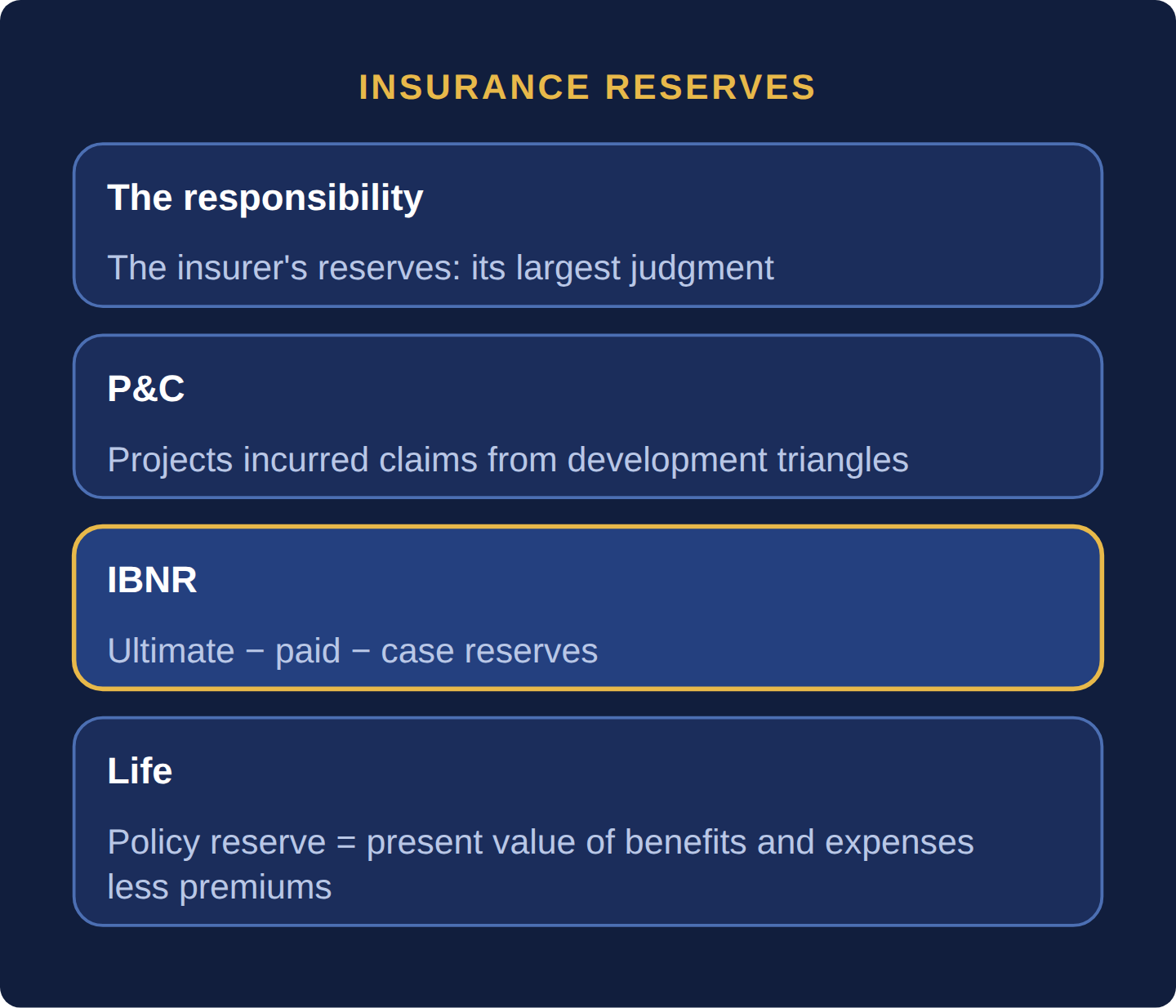
The Chief Actuary owns the insurer’s reserves, its largest judgment: money set aside for claims it expects to owe. For property and casualty insurance, they project incurred claims from development triangles. For life insurance, they value decades of policy cash flows. The result is reported on statutory, US GAAP or IFRS 17 bases and backed by a signed actuarial opinion.
Why it matters: The insurer’s biggest number is an expert’s estimate, backed by a signature.
Summary: The Chief Actuary owns the insurer’s reserves, its largest judgment. Property-and-casualty reserving projects incurred claims from development triangles; life reserving values decades of policy cash flows; the result is reported on statutory, US GAAP or IFRS 17 bases and backed by a signed actuarial opinion.
- Ultimate minus paid minus case reserves equals IBNR.
- A life policy reserve is the present value of benefits and expenses less premiums.
- US GAAP long-duration contracts follow LDTI; IFRS 17 applies from 2023.
- SOA, CAS, IFoA and IAI exams lead to fellowship, the norm for a Chief Actuary.
The Chief Actuary owns the single most consequential set of estimates an insurer makes — how much money the company will eventually have to pay out on policies it has already sold, sometimes decades before the claims actually materialize.
| Cadence | What Actually Happens |
|---|---|
| Daily/Weekly | Reviewing claims experience data against pricing and reserving assumptions, supporting new product pricing requests from underwriting and distribution |
| Monthly | Updating reserve estimates for material product lines, monitoring loss ratio trends against plan |
| Quarterly | Formally reviewing and signing off reserve adequacy for the financial statements (working with the Controller), presenting reserve movements to the CFO and the board’s risk committee |
| Annually | Running the full actuarial reserve review (often with an external actuarial peer review at public companies), setting pricing assumptions for the next product cycle, calculating solvency capital requirements |
Reserve adequacy is arguably the single most judgment-heavy number in an insurer’s financial statements — a reserve set too low overstates today’s profit and stores up a future shock, while one set too high needlessly ties up capital that could otherwise be deployed, which is why the quarterly sign-off carries board-level scrutiny most other accounting estimates never receive.
| Question | Typical answer |
|---|---|
| Entry titles | Actuarial Analyst or Actuarial Assistant in reserving, pricing or valuation, at an insurer, a reinsurer or an actuarial consulting firm. |
| The ladder (typical years) | Actuarial Analyst (0–3) → Actuary at associate level (3–6) → Fellow and Manager (6–10) → Director or Chief Reserving or Pricing Actuary (10–15) → Chief Actuary (15+). Exam passes, not years, set the pace. |
| Qualifications that help | Actuarial exams are required. US life, health and retirement: Society of Actuaries (ASA, then FSA). US property and casualty: Casualty Actuarial Society (ACAS, then FCAS). The UK and many other markets: the Institute and Faculty of Actuaries (Associate, then Fellow). India: the Institute of Actuaries of India. Fellowship is the norm for a Chief Actuary. |
| Where people come from | Mathematics, statistics and actuarial science graduates, often through insurer rotation programs or consulting. |
| Where people go next | Chief Risk Officer, insurer CFO or CEO, consulting partner, reinsurance, or analytics leadership; the SOA’s CERA credential supports a move into enterprise risk. |
| Relative pay tier (1 lowest to 5 highest) | Entry: 3; Senior: 5. Each exam pass and, above all, fellowship moves it; signing roles carry a premium. |
| Who fits | Someone who can study for years alongside a full-time job and defend a judgment to a skeptical board. People who want quick credentials or dislike evening study burn out. |
| What interviewers ask | Your exam progress and plan; explain a reserve increase to a non-actuary; project an accident year with a development factor; how you check data quality before trusting a triangle. |
Property and casualty (P&C): claims already incurred. Claims handlers set case reserves on reported claims. Reserving actuaries then arrange past claims in a development triangle (accident year against years of development) and project each year to its ultimate cost, commonly with the chain-ladder method. Ultimate minus paid minus case reserves is IBNR (incurred but not reported).
Worked number: an accident year has $60.0 million paid and $9.0 million of case reserves, and the triangle gives a cumulative development factor of 1.25. Ultimate = 60.0 × 1.25 = $75.0 million; IBNR = 75.0 − 60.0 − 9.0 = $6.0 million; total unpaid = 75.0 − 60.0 = $15.0 million.
Life: obligations on in-force policies. Valuation actuaries hold a policy reserve: the present value of future benefits and expenses minus the present value of future premiums, built from mortality, morbidity, lapse, expense and interest assumptions that are tested against experience. Policies run for decades, so assumption changes, not new claims, drive most movements.
Several bases at once. A US insurer reports statutory reserves to state regulators and US GAAP reserves to investors; for long-duration life and annuity contracts, US GAAP was reshaped by the FASB’s targeted improvements (ASU 2018-12, “LDTI”), effective for most SEC filers from fiscal years beginning after December 15, 2022. Outside the US, IFRS 17 has applied since periods beginning on or after January 1, 2023 (B.4: Insurance Company).
The signed opinion. In the US, state laws based on the NAIC’s Actuarial Opinion and Memorandum Regulation require a life insurer’s appointed actuary to give an annual statement of actuarial opinion on reserve adequacy. In India, the Appointed Actuary’s appointment is approved by IRDAI. The Chief Actuary may hold that role or oversee the person who does; external peer review is common on top.
Reports to: typically the CFO, sometimes the CEO or the Chief Risk Officer, with direct access to the board’s audit or risk committee, because the reserve is the insurer’s largest judgment.
Typical direct reports: Pricing Actuaries by product line, Reserving Actuaries, and an Actuarial Systems/Modeling lead; P&C insurers split reserving from pricing, life insurers add valuation actuaries.
Key interactions:
- Controller (C.1: The Controller) — reserves are a balance sheet line, so the Controller’s close depends entirely on the actuarial team’s quarterly sign-off to finalize it.
- Head of Investment Management (C.16: The Head of Investment Management) — the two functions coordinate closely so invested assets stay duration-matched to the reserve liabilities.
- Head of Regulatory & Solvency Reporting — receives the liability-side inputs the solvency capital calculation is built from.
- Underwriting and Distribution — sets pricing assumptions before any new product actually launches, not after.
Outside finance: Underwriting (product pricing), Claims (experience data), external actuarial consultants engaged for peer review.
Core systems: actuarial projection and valuation platforms (usually vendor models extended in house), reserving tools for triangles, and R or Python for experience studies.
What does the Chief Actuary own?
The insurer’s reserves, its largest judgment.
How is IBNR calculated?
Ultimate minus paid minus case reserves.
What is a life policy reserve?
The present value of benefits and expenses less premiums.
Revenue Operations (C.9: The Head of Revenue Operations (SaaS)) turns deals into billed, recognized revenue and the ARR bridge, usually under the chief revenue officer while revenue accounting stays with the Controller. Stock Plan Administration (C.10: The Head of Stock Plan Administration) runs equity awards and their ASC 718 expense, and an Indian ESOP is a stock option plan, not the US retirement ESOP. The Chief Actuary (C.11: The Chief Actuary) sets reserves, P&C from claims triangles and life from policy cash flows, behind a signed actuarial opinion.
Six questions on this chapter. Decide on your answer first, then click “Reveal Answer.”
1. An accident year has $80 million paid and $7 million of case reserves, and the cumulative development factor is 1.15. What is IBNR?
- $12 million
- $5 million
- $19 million
- $7 million
Reveal Answer
Answer: B. Ultimate = 80 × 1.15 = $92 million; IBNR = 92 − 80 − 7 = $5 million; total unpaid is $12 million.
2. For a block of life policies, the present value of future benefits is $900 million, of expenses $50 million and of future premiums $700 million. What policy reserve does this give?
- $150 million
- $1,650 million
- $250 million
- $200 million
Reveal Answer
Answer: C. Policy reserve = 900 + 50 − 700 = $250 million: benefits and expenses less premiums, in present value.
3. Which tool belongs to property-and-casualty reserving rather than life reserving?
- Mortality and lapse tables
- Long-term interest assumptions
- Policy reserves on in-force contracts
- Claims development triangles
Reveal Answer
Answer: D. P&C actuaries project incurred claims from development triangles; life actuaries value long-dated policy cash flows.
4. A graduate wants to become a US property-and-casualty Chief Actuary. Which exam route fits best?
- Casualty Actuarial Society, toward FCAS
- Chartered Property Casualty Underwriter
- Institute of Actuaries of India only
- Society of Actuaries, toward CERA only
Reveal Answer
Answer: A. The CAS is the US property-and-casualty actuarial body; fellowship (FCAS) is the norm for a Chief Actuary.
5. Worked problem: Ultimate losses are $500m, paid $320m and case reserves $110m. What is IBNR?
Reveal Answer
Answer: $500m − $320m − $110m = $70 million.
6. Worked problem: With earned premium of $800m, what is the loss ratio?
Reveal Answer
Answer: $500m ÷ $800m = 62.5%.
C.12 The Head of Fund Accounting
The Head of Fund Accounting makes sure each fund’s net asset value, or NAV, the price at which investors buy and sell, is right. At hedge funds and private equity, an outside administrator usually strikes the official NAV. The in-house team checks it with a shadow NAV, its own parallel calculation, and explains every break.
Why it matters: Investors buy and sell at the NAV, so an error in it costs real people real money.
Summary: The Head of Fund Accounting makes sure each fund’s net asset value (NAV), the price investors buy and sell at, is right. At hedge funds and private equity an outside administrator usually strikes the official NAV and the in-house team checks it with a shadow NAV and explains every break.
- Mutual funds and ETFs strike NAV daily; a hedge fund‘s official NAV is typically monthly.
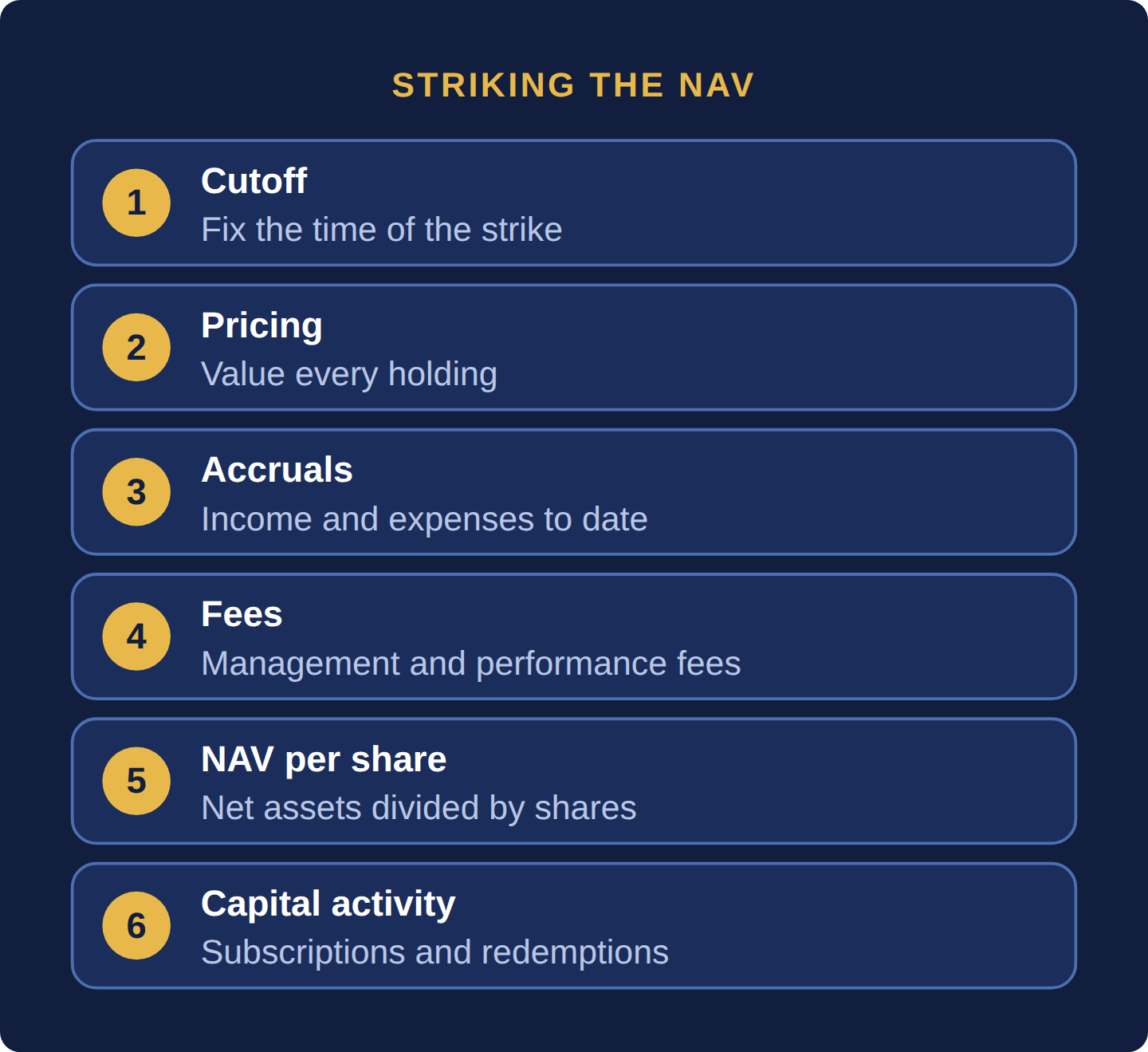
- The strike runs cutoff, pricing, accruals, fees, NAV per share, then capital activity.
- Breaks above tolerance are traced to a cause and escalated before release.
- CPA or CA is the usual credential; administrators are the usual entry point.
Fund Accounting is the private equity or hedge fund equivalent of the Controller function — but applied separately to each individual fund the firm manages on behalf of outside investors, rather than to one company’s own set of books. Its central output is the net asset value (NAV): the fund’s assets minus its liabilities, divided by the shares or units outstanding, which is the price at which investors subscribe and redeem.
| Cadence | What Actually Happens |
|---|---|
| Daily (mutual funds and ETFs) | Striking or reviewing the official NAV after the market close, which US rules require of registered funds every business day |
| Daily (hedge funds) | Estimated NAV and profit and loss, shadow-NAV checks, reconciling positions and cash against prime broker and custodian statements |
| Monthly (hedge funds) / Quarterly (private equity) | Reviewing the official NAV, typically struck monthly by the administrator for a hedge fund; calculating management and performance fees; processing subscriptions, redemptions, capital calls and distributions; producing fund-level financial statements |
| Annually | Coordinating each fund’s annual audit, finalizing investor tax reporting (e.g., K-1s in the US) |
An error in NAV calculation directly misstates what every single investor’s stake is actually worth — unlike a typical company’s books, a fund accounting error has an immediate, per-investor dollar impact that is usually contractually significant, not just an internal reporting inconvenience.
Two operating models exist. Under the administrator model, common at hedge funds and private equity, an outside fund administrator strikes the official NAV and the in-house team runs a shadow NAV and challenges every difference. Under the in-house model, more common at large asset managers, the manager’s own team strikes the NAV and an independent oversight team reviews it; at many mutual funds the custodian bank strikes it as outsourced fund accountant and the manager oversees it, as in the administrator model. Either way, the Head of Fund Accounting signs off that the number investors trade on is right; Part E.8: Fund Administration and Transfer Agency covers the administrator’s side of the work.
An illustrative hedge fund closes September with 950,000 shares outstanding, a high-water mark (the NAV per share at which a performance fee was last paid) of $102.00, a 1.5% annual management fee and a 20% performance fee.
- Cutoff. Trades executed by 4:00 p.m. on the last business day are in; anything later is October’s. Subscriptions received early for October are a liability, not capital.
- Pricing. Each position is priced at the close from the pricing policy’s sources; the valuation team (C.13: The Head of Portfolio Valuation) supplies any hard-to-value marks.
- Accruals. Interest and dividends earned are added; audit, legal and administration costs incurred are deducted.
- Fees. The management fee is accrued on the pre-fee NAV, then the performance fee on the gain above the high-water mark.
- NAV per share and capital activity. NAV is divided by shares outstanding; redemptions are paid and subscriptions issued at that price.
| Line | Formula and substitution | Result |
|---|---|---|
| Gross assets | Securities $98,400,000 + cash $3,150,000 + accrued income $210,000 | $101,760,000 |
| Pre-fee NAV | $101,760,000 − purchases payable $1,200,000 − accrued expenses $85,000 − subscriptions received in advance $2,000,000 | $98,475,000 |
| Management fee | $98,475,000 × 1.5% ÷ 12 | $123,093.75 |
| Gain above high-water mark | ($98,475,000 − $123,093.75) − (950,000 × $102.00 = $96,900,000) | $1,451,906.25 |
| Performance fee | $1,451,906.25 × 20% | $290,381.25 |
| NAV | $98,351,906.25 − $290,381.25 | $98,061,525.00 |
| NAV per share | $98,061,525.00 ÷ 950,000 | $103.2227 |
| Capital activity | Redemption 20,000 × $103.2227; subscription $2,000,000 ÷ $103.2227 | $2,064,454 paid; 19,375.58 shares issued |
The break. The administrator’s NAV comes in $40,000 below the shadow NAV. The team first measures it: $40,000 ÷ $98,061,525 ≈ 4.1 basis points, or about $0.042 per share. If the fund’s tolerance is, say, 2 basis points (firms set their own; this is an illustrative figure), the difference must be explained before the NAV is released. The usual causes, in rough order of frequency, are a price from a different source or time, a trade booked on one side only, a missed corporate action, an accrual or fee difference, and a capital-activity cutoff error. Here the administrator priced 400,000 shares at $41.10 against a closing price of $41.20: 400,000 × $0.10 = $40,000. The fund accountant sends the evidence to the administrator; if the administrator disagrees, or the break is above tolerance at the release deadline, it is escalated to the Head of Fund Accounting and the CFO, and a NAV already published in error goes to the manager’s error-correction policy, which decides whether investors are compensated.
| Question | Typical answer |
|---|---|
| Entry titles | Fund Accountant or Fund Accounting Associate, most often at a fund administrator or custodian bank; Staff Auditor in an accounting firm’s asset-management practice. |
| The ladder (typical years) | Fund Accountant (0–3) → Senior Fund Accountant (3–5) → Fund Controller or Manager (5–9) → Director of Fund Accounting (9–14) → Head of Fund Accounting or Fund CFO (14+). |
| Qualifications that help | CPA (US) or CA (India): common and close to expected above manager. CAIA: optional, useful for alternatives. CFA: optional. |
| Where people come from | Administrator and custodian fund-accounting teams, audit of investment funds, and product control. |
| Where people go next | Fund CFO or COO, management-company controller, operational due diligence at an allocator, and senior client-service roles at administrators. |
| Relative pay tier (1 lowest to 5 highest) | Entry: 2; Senior: 4. Sitting at the manager rather than the administrator, and hedge fund rather than mutual fund, moves it up. |
| Who fits | People who like closure, precision and a fixed deadline every cycle. People who resent repetition or need long projects to stay interested tend to burn out on the monthly treadmill. |
| What interviewers ask | Walk through a NAV calculation; how a high-water mark works; how you would investigate a break against the administrator; how capital calls and distributions hit a capital account. |
Reports to: the CFO (at a hedge fund often a combined CFO/COO) of the management company.
Typical direct reports: Fund Controllers organized by fund or vintage, and NAV/Valuation support analysts.
Key interactions:
- Head of Portfolio Valuation (C.13: The Head of Portfolio Valuation) — supplies the valuations that flow directly into each fund’s NAV.
- Head of Investor Relations (LP Relations) — the fund financials Fund Accounting produces are the core content of every quarterly LP report.
- Management Company Controller — a separate set of books (the firm’s own operating expenses) that must never be commingled with fund-level accounting.
- External fund administrator — many funds outsource day-to-day NAV production entirely, in which case Fund Accounting oversees and reviews rather than performs the work directly.
Outside finance: deal teams (capital call timing tied to closings), Legal (fund documentation governing fee calculations and distribution waterfall terms).
Core systems: fund accounting software (FIS Private Capital Suite, formerly Investran; eFront; Allvue), fund administrator portals, and a shadow-NAV or portfolio accounting system at hedge funds.
What does the Head of Fund Accounting make sure of?
That each fund’s net asset value (NAV), the price investors buy and sell at, is right.
Who strikes the official NAV at a hedge fund or PE firm?
An outside administrator usually strikes the official NAV, and the in-house team checks it.
How often is NAV struck?
Mutual funds and ETFs strike NAV daily; a hedge fund’s official NAV is typically monthly.
The Head of Fund Accounting makes sure each fund’s NAV is right. The strike runs cutoff, pricing, accruals, fees, NAV per share, then capital activity.
Six questions on this chapter. Decide on your answer first, then click “Reveal Answer.”
1. A fund has $50.4 million of assets, $0.4 million of liabilities and 2,000,000 shares outstanding. What is its NAV per share?
- $25.00
- $24.80
- $25.20
- $25.40
Reveal Answer
Answer: A. NAV per share = ($50.4 million − $0.4 million) ÷ 2,000,000 = $25.00.
2. The shadow NAV and the administrator’s NAV differ by $15,000 on a $60 million fund. How large is the break?
- 25 basis points
- 2.5 basis points
- 250 basis points
- 0.25 basis points
Reveal Answer
Answer: B. $15,000 ÷ $60,000,000 = 0.00025, or 2.5 basis points (one basis point is 0.01%).
3. A hedge fund’s NAV per share rises from $100 to $108 on 1 million shares. The high-water mark is $105 and the performance fee is 20%. What fee is earned?
- $1,600,000
- $3,000,000
- $300,000
- $600,000
Reveal Answer
Answer: D. Only the gain above the high-water mark earns a fee: ($108 − $105) × 1,000,000 × 20% = $600,000.
4. How often is the official NAV typically struck for a hedge fund and for a US mutual fund?
- Daily for the hedge fund; daily for the mutual fund
- Monthly for the hedge fund; monthly for the mutual fund
- Monthly for the hedge fund; daily for the mutual fund
- Quarterly for the hedge fund; monthly for the mutual fund
Reveal Answer
Answer: C. Rule 22c-1 requires registered funds to compute NAV at least once each business day; hedge funds typically strike an official NAV monthly, with daily estimates.
5. Worked problem: A fund has assets of $520m, liabilities of $20m and 25 million shares. What is NAV per share?
Reveal Answer
Answer: ($520m − $20m) ÷ 25m = $20.00.
6. Worked problem: An investor buys $10,000 at a NAV of $25.00. How many shares?
Reveal Answer
Answer: $10,000 ÷ $25.00 = 400 shares.
- IRDAI, Actuarial Department — IRDAI approves appointment of the Appointed Actuary (C.11)
- IFRS Foundation, IFRS 17 Insurance Contracts — Effective for periods beginning on or after Jan 1, 2023 (C.11)
- FASB, ASU 2020-11 (LDTI effective dates) — ASU 2018-12 effective for SEC filers excluding SRCs from fiscal years beginning after Dec 15, 2022 (C.11)
- NAIC, Actuarial Opinion and Memorandum Regulation (Model 822) — Appointed actuary’s annual statement of actuarial opinion for life insurers (C.11)
- 17 CFR 270.22c-1 — Forward pricing; NAV at least daily Monday-Friday (C.12)