
11.7 Where Crypto Fits in Monetary History
Some people see crypto as a digital successor to gold. But it has gained ground mainly where regulated wrappers provide stability and access: spot ETFs, tokenized Treasury funds and reserve-backed stablecoins. FTX showed that the decisive risk is custody without segregation, meaning customer assets mixed with the firm’s own, not the technology itself.
Why it matters: Who holds your assets, and whether they are kept separate, matters more than the coin.
Summary: Crypto’s proponents see a digital successor to gold, but it has gained ground mainly where regulated wrappers supply stability and access: spot ETFs, tokenized Treasury funds and reserve-backed stablecoins. FTX showed that the decisive risk is custody without segregation, not the technology.
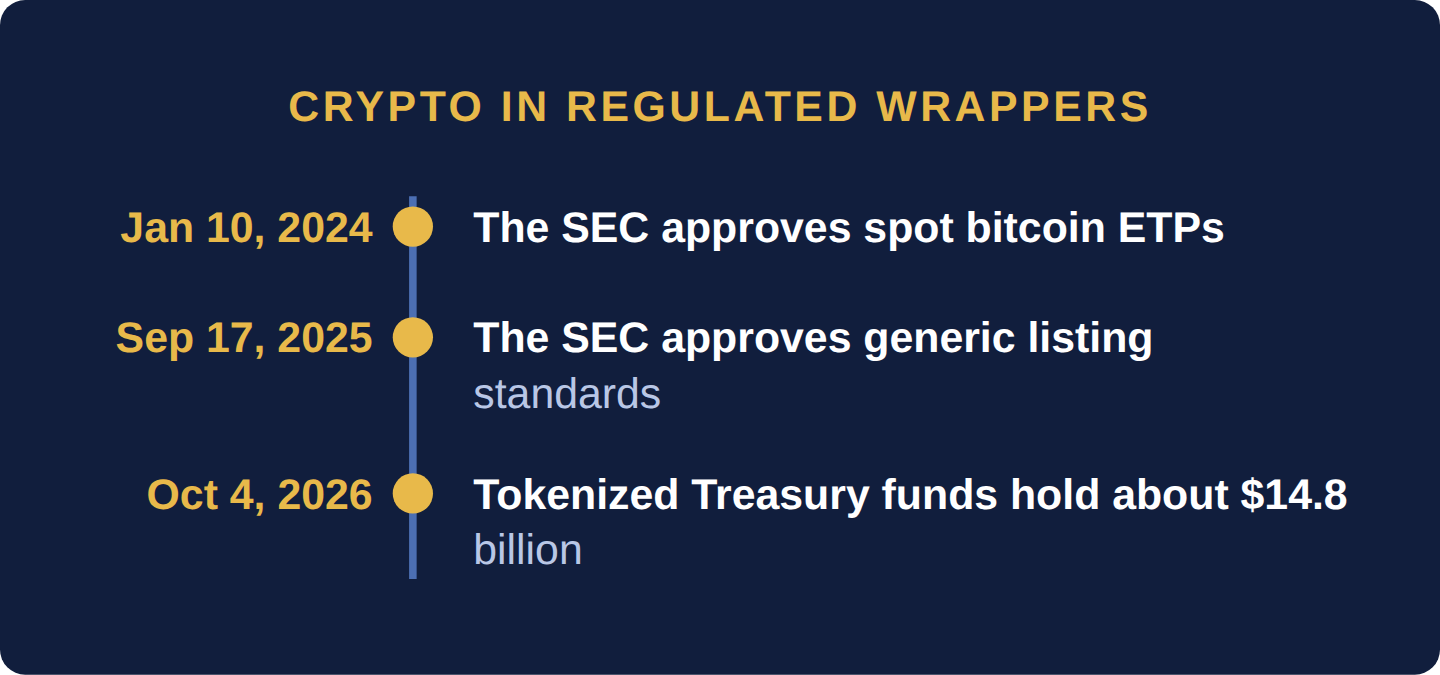
- The SEC approved spot bitcoin ETPs on January 10, 2024, and generic listing standards on September 17, 2025.
- Tokenized Treasury funds held about $14.8 billion on October 4, 2026.
- FTX customers receive about 119% of claims fixed at November 2022 prices: 1 BTC returned about $20,076.
- Whether crypto in an account is yours depends on segregation, title in the terms, and the form of your insolvency claim.
Returning to Volume I’s Part 0 monetary history arc — barter, commodity money, metal coins, paper receipts, the gold standard, Bretton Woods, fiat currency — cryptocurrency’s proponents frame it as the next logical step: a return to a hard-capped, scarce monetary asset (echoing gold) but in digital, globally transferable form, free from any single government’s discretionary control. Skeptics counter that money’s core historical function has always been stability and near-universal usability for everyday transactions — exactly the two properties Bitcoin’s price volatility has, so far, most conspicuously failed to deliver at scale, which is precisely why stablecoins, not volatile cryptocurrencies themselves, have become crypto’s most widely adopted practical payment use case to date.
Since 2024 crypto has been absorbed into the plumbing it set out to replace. The SEC approved the first spot bitcoin exchange-traded products on January 10, 2024, its chair stressing that it “did not approve or endorse bitcoin,” and on September 17, 2025, approved generic listing standards so further commodity-based crypto trusts no longer need case-by-case rule changes. Treasuries moved onto blockchains as well: BlackRock’s BUIDL fund, launched March 20, 2024, for qualified investors with a $5 million minimum, holds cash, T-bills and repo at $1 per token, and tokenized Treasury funds held about $14.8 billion on October 4, 2026. The token most used as money, the payment stablecoin, is now by law a claim on Treasury bills (Section 11.4: Stablecoins and Their Collateral Models). The arc of Volume I’s Part 0 repeats: new forms of money end up wrapped by regulated intermediaries.
FTX shows what happens when the wrapper fails. The exchange filed for bankruptcy on November 11, 2022. Its founder, Sam Bankman-Fried, channeled billions of dollars of customer deposits to his trading firm, Alameda Research, to spend on investments, political contributions and real estate; he was convicted on November 2, 2023, and sentenced on March 28, 2024, to 25 years, with over $11 billion forfeited. Nothing cryptographic failed. What was missing was the segregation of client assets and the daily reconciliation that client-asset rules require of brokers (Section 9.7: Client Asset Protection & Personal Regulatory Accountability; Volume III’s Part 8 shows the reconciliation itself). The bankruptcy plan approved in October 2024 pays about 119% of allowed claims to 98% of creditors, but claims were fixed in dollars at petition-date prices of November 11, 2022, which valued bitcoin at $16,871. A customer who held 1 BTC receives about 1.19 × $16,871 ≈ $20,076; at about $63,000, bitcoin’s price when the plan was approved, the coin itself was worth $63,000 ÷ $20,076 ≈ 3.1 times as much.
The standard answer is “crypto in your account is yours.” Whether it is depends on who holds it and on what terms:
| Situation | What changes | Why |
|---|---|---|
| Exchange commingles customer coins (FTX) | Customers become creditors holding dollar claims fixed at the filing date | No segregated, reconciled pool of customer property exists to return in kind |
| Terms transfer title to the platform (Celsius “Earn”) | The coins belong to the bankruptcy estate; you are an unsecured creditor | On January 4, 2023, Judge Martin Glenn held the terms “unambiguously transferred all right and title”; about $4.2 billion in 600,000 accounts |
| Spot bitcoin ETF shares at a broker | You own registered securities; the bitcoin sits with the fund’s custodian | A broker failure falls under securities customer-protection rules (Section 9.7: Client Asset Protection & Personal Regulatory Accountability); price risk is unchanged |
| Payment stablecoin from a permitted issuer | Holders rank first against reserves if the issuer fails | GENIUS Act priority, with reserves that may not be rehypothecated |
| Tokenized Treasury fund (BUIDL) | You own fund shares recorded on-chain and receive the yield | It is a security sold privately to qualified investors, not a payment stablecoin |
| Self-custody wallet | No intermediary can fail, but a lost or stolen key is final | No custodian, no recovery process, no insurance |
| Fintech app holding cash at partner banks | Deposit insurance works only if the ledger shows whose money is whose | Synapse’s 2024 collapse (Section 11.8) |
A reading rule for any crypto holding: ask whose balance sheet it sits on before asking what the token does. If an intermediary holds it, confirm three things: client assets are segregated and reconciled daily, the terms leave title with you, and your claim in insolvency is to the asset itself rather than to its dollar value on the filing date. If any answer is unknown, treat the balance as an unsecured loan to the platform and size it accordingly.
Leaving coins on an exchange that does not segregate them. An FTX customer with 1 BTC was “repaid in full” at about 119% of a $16,871 claim, about $20,076, when the coin itself was worth $63,000: a shortfall of $63,000 − $20,076 = $42,924, or about 68% of the coin’s value at the time. Hold long-term positions in self-custody or through a segregated, regulated wrapper, and keep on any exchange only what you are trading.
Is bitcoin money?
It meets parts of the definition. It is a scarce, transferable store of value for some holders, but its volatility, about 45% annualized over the year to October 2026, makes it a poor unit of account and an awkward medium of exchange. Dollar stablecoins, not bitcoin, carry most crypto payments.
Is a spot bitcoin ETF safer than holding bitcoin directly?
It removes some risks and keeps the main one. You avoid losing keys or trusting an unregulated exchange, and your shares sit in a regulated brokerage account; you still bear the full price risk of bitcoin, plus the fund’s fee.
Did FTX customers get their money back?
In dollars, mostly yes: the 2024 plan pays about 119% of allowed claims to 98% of creditors. In crypto terms, no: claims were valued at November 2022 prices, so customers missed the later rise in the coins they had deposited.
Crypto has been absorbed by regulated wrappers, from spot bitcoin ETFs to tokenized Treasury funds and reserve-backed stablecoins, while its record as everyday money remains weak. FTX’s collapse was a failure of client-asset segregation and reconciliation, and its dollar-denominated recovery shows why the terms and structure of custody decide what a holder actually owns.
Six questions on this chapter. Decide on your answer first, then click “Reveal Answer.”
1. An FTX customer held 2 BTC, valued at the petition-date price of $16,871. The plan pays 119% of the dollar claim. About how much does the customer receive?
- $126,000
- $33,742
- $40,153
- $20,076
Reveal Answer
Answer: C. 2 × $16,871 × 1.19 ≈ $40,153, far below the value of 2 BTC at the roughly $63,000 price when the plan was approved.
2. When did the SEC approve the first spot bitcoin exchange-traded products?
- January 10, 2024
- July 18, 2025
- September 17, 2025
- November 11, 2022
Reveal Answer
Answer: A. The SEC approved them on January 10, 2024; September 17, 2025, is when it approved generic listing standards.
3. A crypto lending platform’s terms transfer title of deposited coins to the platform, and it files for bankruptcy. What is the depositor?
- A shareholder in the platform
- An unsecured creditor of the estate
- The owner of segregated coins
- A secured creditor with priority over other claims
Reveal Answer
Answer: B. In Celsius (January 2023) the court held such terms transferred title, so the coins belonged to the estate and depositors became creditors.
4. According to the chapter, what failed at FTX?
- Bitcoin’s Proof-of-Work consensus
- The cryptography that secured customer wallets and keys
- The Ethereum contracts it relied on
- Segregation and reconciliation of client assets
Reveal Answer
Answer: D. Customer deposits were channeled to Alameda Research; the missing controls were the client-asset segregation and reconciliation required of brokers (Section 9.7: Client Asset Protection & Personal Regulatory Accountability).
5. Worked problem: The SEC approved spot bitcoin ETPs on January 10, 2024, and generic listing standards on September 17, 2025. How many days apart, and how many months?
Reveal Answer
Answer: 616 days, about 20.2 months.
6. Worked problem: Tokenized Treasury funds held about $14.8bn on October 4, 2026, against $32.4tn of Treasuries held by the public. What share is tokenized?
Reveal Answer
Answer: $14.8bn ÷ $32,400bn = 0.046%.
11.8 Real Fintech: UPI, Account Aggregators, ONDC, BNPL, Embedded Finance and Neobanks
Most of fintech is payments economics. On cards, a fee paid by merchants, called interchange, funds rewards, credit and chargebacks. Bank-to-bank systems such as ACH, FedNow, RTP and India’s UPI move money for cents or nothing. Buy-now-pay-later and neobanks earn from merchant fees and interchange. Embedded finance, where financial services sit inside other apps, is only as safe as the ledger behind it.
Why it matters: To see who earns what, follow the fee.
Summary: Real fintech is mostly payments economics: card interchange funds rewards, credit and chargebacks, while bank-to-bank rails such as ACH, FedNow, RTP and India’s UPI move money for cents or nothing. BNPL and neobanks earn merchant fees and interchange, and embedded finance is only as safe as its ledger.
- On a $100 card sale at 2.9% + $0.30, the issuer gets $2.60, the network about $0.16 and the processor $0.44.
- Regulation II caps large-issuer debit interchange at $0.21 + 0.05% + $0.01; exempt issuers averaged 2.2 times as much in 2024.
- BNPL earned 4.02% of sales against 3.01% costs in 2021 (CFPB).
- Synapse’s 2024 failure left a $65–95 million ledger gap that deposit insurance did not cover.
- UPI processed 24.07 billion payments in September 2026 at zero merchant fees.

Most fintech is a contest over who earns the fees on payments. On a card payment the merchant pays a merchant discount rate (MDR); most goes to the cardholder’s bank as interchange, a slice to the network, the rest to the merchant’s processor. Each firm’s share is its take rate. A $100 online purchase on a Visa Signature Preferred card (interchange 2.50% + $0.10) through a processor charging a flat 2.9% + $0.30:
| Step | Calculation | Amount |
|---|---|---|
| Merchant pays (MDR) | 2.9% × $100 + $0.30 | $3.20 |
| Issuer’s interchange | 2.50% × $100 + $0.10 | $2.60 |
| Network fees | illustrative | $0.16 |
| Processor keeps | $3.20 − $2.60 − $0.16 | $0.44 |
| Issuer after 2% rewards | $2.60 − $2.00 | $0.60 before fraud and credit costs |
Debit flips the split. Regulation II (the Durbin Amendment) caps interchange for issuers with $10 billion or more of assets at $0.21 + 0.05% + $0.01 fraud adjustment: $0.27 on the same $100. In 2024 covered issuers averaged $0.23 per debit transaction and exempt issuers $0.51, 2.2 times as much. A merchant on flat pricing still pays $3.20, so the processor keeps $3.20 − $0.27 − $0.16 = $2.77; interchange-plus pricing passes the saving through. A North Dakota court vacated the cap’s formula in August 2025 but stayed its ruling pending appeal, and a $38 billion Visa–Mastercard settlement, preliminarily approved in June 2026, would cut credit interchange 0.10 point for five years and widen surcharging.
Bank-to-bank rails cost cents, not percent: ACH carried 35.2 billion payments worth $93 trillion in 2025; the Fed’s FedNow (launched July 20, 2023) charges banks $0.045 per instant transfer; The Clearing House’s RTP network moved $621 billion in the third quarter of 2026; bank-owned Zelle moved $1.2 trillion in 2025. Cards survive because interchange pays for credit, rewards and chargebacks.
Buy now, pay later (BNPL) sells merchants higher conversion. A pay-in-four loan with no finance charge falls outside Regulation Z‘s creditor definition (“more than four installments”), and the CFPB withdrew its 2024 rule treating BNPL lenders as card issuers in May 2025. CFPB data for 2021: revenue 4.02% of sales (merchant fees 2.49%), costs 3.01% (credit losses 1.30%), margin 1.01%.
Embedded finance places accounts and loans inside a non-bank’s app, with a bank behind it. Neobanks are its largest form: Chime, “a financial technology company, not a bank,” uses partner banks under $10 billion of assets, exempt from the Durbin cap, and interchange-based revenue was 76% of its 2024 total. The weak point is the ledger: when middleware firm Synapse failed in April 2024, its trustee found $65–95 million less at partner banks than its records said users were owed (Section 9.7: Client Asset Protection & Personal Regulatory Accountability).
India shows public rails as the alternative to private fee pools (Volume I’s Part 10 tells how UPI was built). In September 2026 UPI processed 24.07 billion payments worth ₹29.37 lakh crore, about 802 million a day, at zero MDR by law since January 2020; the state funds it instead, with an incentive of 0.15% on small-merchant payments up to ₹2,000. The Account Aggregator network, live since September 2021, moves financial data only with consent; 112.34 million users had linked accounts by September 2025. The ONDC commerce network reached 500 million cumulative transactions in July 2026: 500 ÷ 802 = 0.62 of one day of UPI. Public rails win where the network effect sits in the rail, not with merchants and logistics.
Merchants: divide total processing fees by card sales and compare with the interchange your card mix implies; if the gap exceeds about 0.5 point on over $1 million of card sales, or much of your volume is regulated debit, ask for interchange-plus pricing (a heuristic). Use ACH or an instant rail for large payments that need no chargeback. Anyone keeping money in a fintech app: confirm the partner bank by name and that your balance is recorded in your name there; treat any balance you cannot verify as uninsured.
Assuming a fintech balance is an insured deposit. FDIC insurance pays when an insured bank fails; it does not rebuild a non-bank’s ledger. Synapse’s users faced a $65–95 million shortfall, and the CFPB’s later $46.2 million allocation from its penalty fund covered less than that gap.
What is the difference between interchange and the merchant discount rate?
Interchange is the part of the card fee paid to the cardholder’s bank; the merchant discount rate is the whole fee the merchant pays. On the $100 credit purchase above, interchange is $2.60 of the $3.20 MDR, with $0.16 to the network and $0.44 to the processor.
Why is UPI free for merchants?
Because Indian law set its merchant discount rate to zero from January 2020. Banks and apps recover costs partly through government incentives, such as 0.15% on small-merchant payments up to ₹2,000, and through other products, which is why UPI’s long-run funding is still debated.
Are neobank accounts FDIC-insured?
Only through the partner bank, and only if records identify you as the owner. Chime is not itself a bank; its partner banks are FDIC members, and pass-through insurance up to $250,000 depends on accurate records kept by both the bank and the fintech.
India neither bans nor endorses crypto; it taxes and polices it. Since April 1, 2022, gains on virtual digital assets have been taxed at a flat 30% with only the purchase cost deductible and no set-off of losses, and since July 1, 2022, buyers have withheld 1% tax (TDS) on transfers, rules carried into the Income-tax Act, 2025 from April 1, 2026. Buy a token for ₹2,00,000 and sell it for ₹3,00,000: tax is 30% × ₹1,00,000 = ₹30,000 plus the 4% health and education cess, ₹31,200 in all before any surcharge, ₹3,000 (1% of ₹3,00,000) is withheld at sale and credited against it, and a ₹50,000 loss on another token cannot reduce the bill. Since March 2023, crypto service providers have been reporting entities under the Prevention of Money Laundering Act; on December 28, 2023, the Financial Intelligence Unit (FIU-IND) issued show-cause notices to nine offshore exchanges, including Binance and Kraken, that served Indian users without registering, when 31 providers had registered.
Custody failures look the same as in the US. Hackers took over $230 million from the Indian exchange WazirX on July 18, 2024; the loss was shared across all users, who approved a Singapore court-supervised scheme offering an estimated 85.3% recovery. The RBI’s December 2025 Financial Stability Report judged that stablecoin risks “outweigh their purported benefits,” warned they can “circumvent controls on capital movement,” and argued for central bank money as the anchor. Its own retail CBDC shows how hard that is when free instant payments already exist: e₹-R in circulation fell 24% to ₹771.66 crore on March 31, 2026, from ₹1,016.46 crore a year earlier, about 0.026% of the ₹29.37 lakh crore UPI moved in September 2026 alone.
Card payments split a merchant fee among issuer, network and processor, with interchange paying for rewards and chargebacks, while regulated debit, ACH, FedNow, RTP and UPI move money for cents or nothing. BNPL lives on merchant fees, neobanks on interchange from Durbin-exempt partner banks, and embedded finance depends on accurate ledgers, as Synapse’s shortfall showed.
Six questions on this chapter. Decide on your answer first, then click “Reveal Answer.”
1. On a $200 card purchase, interchange is 2.0% + $0.10, network fees are $0.20 and the merchant pays 2.9% + $0.30. What does the processor keep?
- $6.10
- $2.00
- $1.80
- $4.10
Reveal Answer
Answer: C. MDR = $5.80 + $0.30 = $6.10; interchange = $4.00 + $0.10 = $4.10; processor keeps $6.10 − $4.10 − $0.20 = $1.80.
2. What is the maximum interchange a large covered issuer can collect on a $60 debit purchase, including the fraud-prevention adjustment?
- $1.50
- $0.51
- $0.24
- $0.25
Reveal Answer
Answer: D. $0.21 + 0.05% × $60 + $0.01 = $0.21 + $0.03 + $0.01 = $0.25.
3. Why do neobanks such as Chime use partner banks with under $10 billion of assets?
- Those banks escape consumer protection rules
- Those banks are exempt from the Durbin cap
- Those banks need no FDIC membership
- Those banks may pay interest to stablecoin holders under GENIUS
Reveal Answer
Answer: B. Exempt issuers earned about $0.51 per debit transaction in 2024 against $0.23 for covered issuers, and interchange was 76% of Chime’s 2024 revenue.
4. UPI charges merchants a zero merchant discount rate. How are banks and apps compensated?
- Partly through government incentive payments
- Through a 1% fee charged to every payer on each transfer
- Through interchange paid by merchants
- Through RBI income from the e-rupee
Reveal Answer
Answer: A. The law set UPI’s MDR to zero from January 2020; the government pays incentives such as 0.15% on small-merchant payments up to ₹2,000.
5. Worked problem: A card sale of $250 costs the merchant 2.7% plus $0.25. What is the total fee, and the merchant’s net?
Reveal Answer
Answer: Fee = $250 × 2.7% + $0.25 = $6.75 + $0.25 = $7.00. Net = $250 − $7.00 = $243.00.
6. Worked problem: What is the effective rate on that sale, and on a $20 sale with the same pricing?
Reveal Answer
Answer: $250 sale: $7.00 ÷ $250 = 2.8%. $20 sale: ($0.54 + $0.25) ÷ $20 = 3.95%, because the fixed part weighs more on small sales.
- US Attorney SDNY, Bankman-Fried sentencing (March 28, 2024) — FTX misuse of customer deposits
- SEC Chair statement on spot bitcoin ETPs (January 10, 2024) — ETP approval
- SEC release 2025-121
- Federal Reserve, Regulation II average interchange fees — 2024 covered vs exempt debit interchange
- Chime Financial Form S-1 (2025) — Durbin-exempt partner banks, payments revenue share
- CFPB, Buy Now, Pay Later: Market Trends and Consumer Impacts (September 2022) — BNPL unit economics, table 10
- Press Release Page (pib.gov.in)
- 12 CFR 1026.2