
11.5 CBDCs — What They'd Actually Change
A central bank digital currency, or CBDC, is a direct digital IOU from the central bank, as safe as cash. Its main risk is faster bank runs, because people could move money out of banks with a tap. Designers limit that with holding caps, zero interest and distribution through banks. The US has barred work on one, while the euro area may issue a digital euro in 2029.
Why it matters: The design choices decide whether it helps payments or weakens banks.
Summary: A CBDC is a direct digital liability of the central bank, as safe as cash. Its main risk is faster bank runs, which designers bound with holding limits, zero interest and distribution through banks; the US has barred work on one, while the euro area may issue a digital euro in 2029.
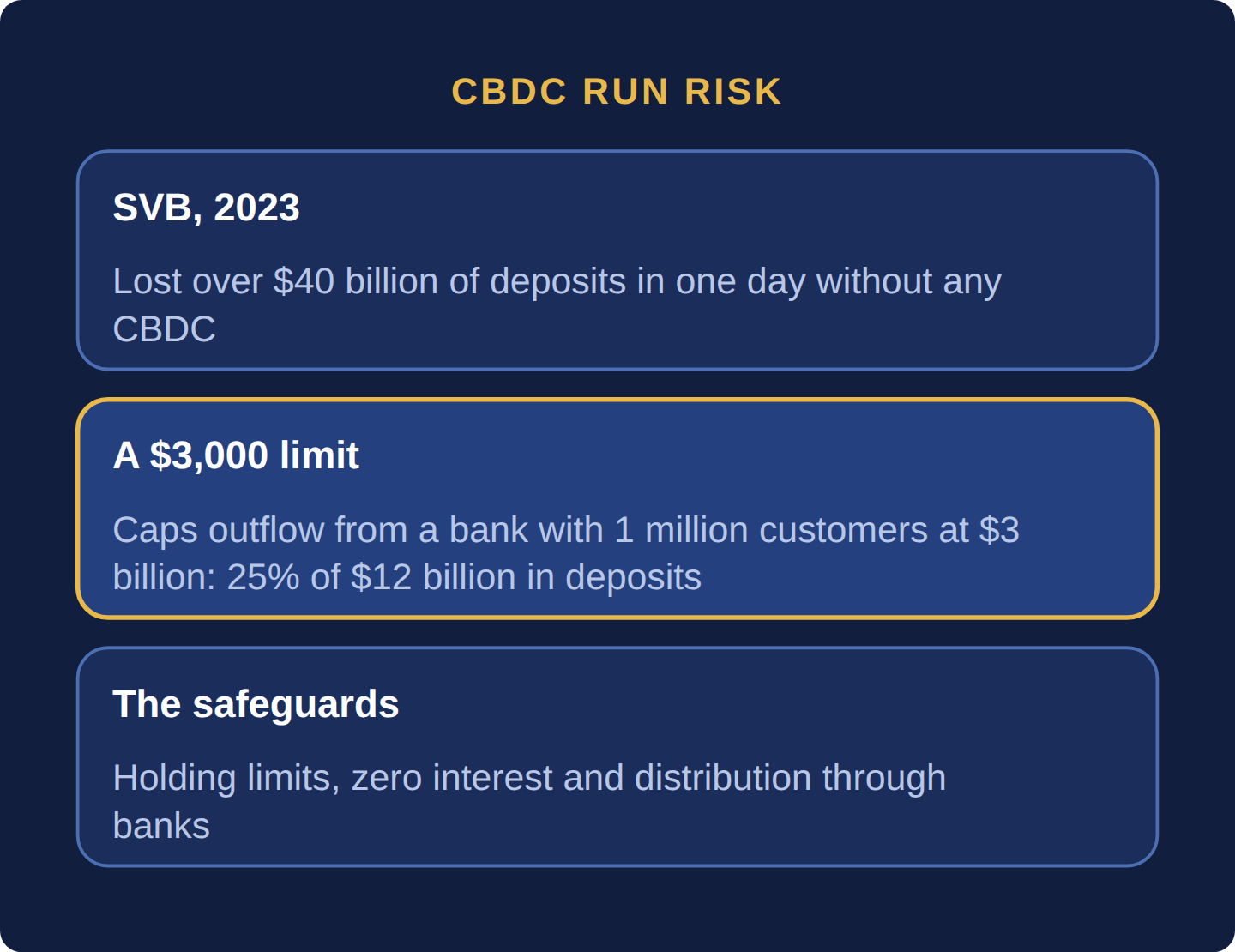
- SVB lost over $40 billion of deposits in one day in 2023 without any CBDC.
- A $3,000 limit caps outflow from a bank with 1 million customers at $3 billion, 25% of $12 billion in deposits.
- Executive Order 14178 (January 23, 2025) bars US agencies from establishing or promoting a CBDC.
- The ECB moved to the next phase on October 30, 2025; first issuance could come in 2029 if EU law passes in 2026.
Volume I named Central Bank Digital Currencies (CBDCs) without detailing what they would actually change relative to money that already exists digitally today. The key distinction: money in a normal bank account is a liability of a commercial bank — a promise from that bank to pay you, which is why deposit insurance and bank regulation (Volume I’s Part 3) exist at all. A CBDC would instead be a direct liability of the central bank itself — functionally identical in legal status to physical cash, but held and transacted digitally.
This distinction is precisely why CBDC design has become such a contested policy question: a retail CBDC that ordinary citizens could hold directly with the central bank, bypassing commercial banks entirely, could in theory trigger large-scale, rapid deposit flight from the commercial banking system during any period of stress — since a central bank liability is inherently safer than a commercial bank deposit. Most current CBDC designs worldwide, including India’s e₹ pilot, therefore route through commercial banks as intermediaries rather than offering fully disintermediated central-bank accounts to the public.
Runs are already fast without a CBDC: Silicon Valley Bank lost over $40 billion of deposits on March 9, 2023, and expected over $100 billion more the next day, together about 85% of its deposit base (Federal Reserve review, April 2023). A retail CBDC would add a costless, risk-free destination one tap away, which is why designs include three brakes: a holding limit per person, little or no interest, and a “waterfall” that sweeps amounts above the limit into a linked bank account.
Take an illustrative bank with 1,000,000 retail customers holding an average of $12,000, so 1,000,000 × $12,000 = $12 billion of deposits. With no limit, all $12 billion could move into central bank money in a stress. With a $3,000 limit (an illustrative figure), the most that can move is 1,000,000 × $3,000 = $3 billion, or 3 ÷ 12 = 25% of deposits, a run the bank’s liquid assets can be sized to meet (Section 9.5: Why Regulatory Arbitrage Happens covers the liquidity coverage ratio). The limit turns an open-ended run into a bounded one; setting it is the real policy decision.
Where things stand: in the US, Executive Order 14178 (January 23, 2025) bars federal agencies from any action “to establish, issue, or promote” a CBDC, and instant payments arrived instead through the Fed’s FedNow service (Section 11.8). In the euro area, the ECB’s Governing Council decided on October 30, 2025, to move to the next phase of the digital euro: if EU legislation is adopted in 2026, a pilot could start in mid-2027 and first issuance could follow in 2029, with holding limits built in but not yet set.
Judge any CBDC proposal on three parameters before its technology. If the holding limit is near a few weeks of household spending, the CBDC pays no interest and banks distribute it (two-tier), deposit flight is bounded and bank lending largely unaffected. If the limit is high or absent and it pays interest close to policy rates, expect banks to lose stable funding and raise deposit rates or shrink lending. If the stated goal is faster payments, first ask whether an instant-payment rail like FedNow or UPI already delivers it without a new form of money.
Launching a retail CBDC without a binding holding limit. In the worked example the unlimited design leaves all $12 billion of deposits runnable into central bank money, against $3 billion with a $3,000 limit: $9 billion of extra runnable funding the bank must cover with low-yielding liquid assets or replace at higher cost. SVB’s 85% run happened without a CBDC; removing the remaining friction without a limit invites a faster one.
Does the United States have a central bank digital currency?
No. Executive Order 14178 of January 23, 2025, prohibits federal agencies from establishing, issuing or promoting a CBDC and ended any ongoing plans. The Fed’s FedNow service, live since July 2023, moves ordinary bank money instantly; it is a payment rail, not a new form of money.
What is the difference between a CBDC and a stablecoin?
The issuer. A CBDC is a direct liability of the central bank, as safe as banknotes. A stablecoin is a private company’s liability backed by reserve assets, so its safety depends on those reserves, their custody and the issuer’s regulation.
Will a digital euro replace cash or bank accounts?
Neither, by design. The ECB presents it as a complement to cash, distributed through banks, with holding limits to keep most savings in bank deposits. Issuance depends on EU legislation; the ECB has said first issuance could come in 2029 if the law is adopted in 2026.
A CBDC would be central bank money in digital form, so its central risk is a faster run out of bank deposits, which holding limits bound: a $3,000 limit caps the outflow in the worked example at 25% of deposits. The US has barred agencies from pursuing one, while the ECB is preparing a digital euro for possible issuance in 2029.
Six questions on this chapter. Decide on your answer first, then click “Reveal Answer.”
1. A bank has 2 million retail customers averaging $9,000 of deposits. With a $2,500 CBDC holding limit, what is the most that can move into the CBDC?
- $2.5 billion
- $5 billion
- $18 billion
- $4.5 billion
Reveal Answer
Answer: B. 2,000,000 × $2,500 = $5 billion, about 28% of the $18 billion of deposits that could move with no limit.
2. Which US measure bars federal agencies from establishing or promoting a CBDC?
- The Federal Reserve Act of 1913
- Regulation II under the Durbin Amendment
- The GENIUS Act of July 2025
- Executive Order 14178 of January 2025
Reveal Answer
Answer: D. Executive Order 14178, signed January 23, 2025, prohibits agencies from any action to establish, issue or promote a CBDC.
3. Why do retail CBDC designs include holding limits?
- To keep CBDC payments slower than cash
- To let banks charge interchange on CBDC
- To bound how much can flee bank deposits
- To stop seigniorage earned by the central bank
Reveal Answer
Answer: C. A CBDC is a risk-free central bank liability; without a limit, deposits could move into it in a stress, turning a bounded run into an open-ended one.
4. What did the ECB’s Governing Council decide on October 30, 2025?
- To move to the next phase, with issuance possible in 2029
- To abandon the digital euro project after the preparation phase
- To fix a €3,000 holding limit in law
- To issue the digital euro in January 2026
Reveal Answer
Answer: A. The ECB moved to the next phase; if EU legislation passes in 2026, a pilot could start in 2027 and first issuance follow in 2029. Holding limits are planned but not set.
5. Worked problem: A CBDC holding limit is $5,000 per person. A bank has 2 million customers. What is the most that could move out of its deposits?
Reveal Answer
Answer: Maximum outflow = $5,000 × 2,000,000 = $10 billion.
6. Worked problem: The bank has $50bn of deposits. What share of deposits is that?
Reveal Answer
Answer: $10bn ÷ $50bn = 20%.
11.6 DeFi — Real Innovations vs Real Risks
DeFi, or decentralized finance, rebuilds trading and lending with smart contracts instead of banks. An automated market maker sets prices from the amounts in a pool of tokens. People who supply tokens earn fees but can suffer impermanent loss when prices move. Lending protocols watch a number called the health factor and liquidate a borrower automatically when it falls below 1.
Why it matters: The rules are strict and automatic, so mistakes are not forgiven.
Summary: DeFi recreates trading and lending with smart contracts: automated market makers price trades from pool reserves, liquidity providers earn fees but suffer impermanent loss, and lending protocols liquidate borrowers automatically when the health factor falls below 1.
- A 100,000 USDC buy in a 1,000 ETH pool pays an average $2,106, 5.3% above the $2,000 mid price.
- Impermanent loss = 1 − 2√r ÷ (1 + r): 5.72% if the price ratio doubles, 20% if it quadruples.
- Health factor = collateral × liquidation threshold ÷ debt; the cushion before liquidation is 1 − 1 ÷ HF.
- Of $3.41 billion stolen in 2025, 44% came from one centralized-exchange hack; US DeFi rules remain unsettled.

Decentralized finance (DeFi) uses smart contracts (Section 11.3: Smart Contracts and Programmable Money) to recreate financial services such as lending, borrowing and trading without a bank, broker or exchange as intermediary. Its innovations are real: a decentralized exchange (DEX) can price trades with a formula, an automated market maker, instead of an order book run by an operator, and DeFi lending protocols match borrowers and lenders directly, with collateral rules enforced by code rather than a loan officer’s judgment.
| Innovation | Risk |
|---|---|
| 24/7 operation with no single operator to fail or shut down | Smart contract code can contain exploitable bugs; one flaw can drain a protocol, with no deposit insurance or lender of last resort |
| Fully transparent, publicly auditable transaction history on-chain | Regulatory ambiguity: many protocols operate in an unsettled legal gray zone, with unclear consumer protection if something goes wrong |
| Automated, code-enforced collateral requirements remove human lending-decision bias | Protocols use one another’s tokens as collateral, so a failure in one (an algorithmic stablecoin losing its peg, a manipulated oracle) can cascade through the rest |
The swap. A constant-product market maker such as Uniswap keeps x × y = k, where x and y are the two token reserves, and charges 0.30% per trade, added to the pool. Take a pool of 1,000 ETH and 2,000,000 USDC: k = 2,000,000,000 and the mid price is $2,000. A buyer pays in 100,000 USDC; after the fee, 99,700 enters, so the pool must hold k ÷ 2,099,700 = 952.52 ETH and releases 1,000 − 952.52 = 47.48 ETH. The average price is 100,000 ÷ 47.48 = $2,106.02, 5.3% above mid. Price impact grows with trade size relative to pool depth, which is how the formula replaces a market maker’s quotes.
The liquidity provider. Depositors fund both sides and earn the fees, but the pool sells the rising token as it rises. If the price of one token relative to the other changes by a factor r, a provider ends with 2√r ÷ (1 + r) of what simply holding would be worth. Deposit 10 ETH and 20,000 USDC at $2,000; if ETH doubles (r = 2), holding is worth 10 × 4,000 + 20,000 = $60,000, while the pool position is worth 2 × √(10 × 20,000 × 4,000) = $56,569, a 5.72% shortfall called impermanent loss. At r = 4 the shortfall is 20%. Fees must exceed it for providing liquidity to pay.
The borrower. Lending protocols such as Aave compute a health factor = collateral value × liquidation threshold ÷ debt and allow liquidation when it falls below 1. With 10 ETH at $2,000, an illustrative 82.5% threshold and $12,000 borrowed: HF = 20,000 × 0.825 ÷ 12,000 = 1.375, and liquidation starts if ETH falls to 12,000 ÷ (10 × 0.825) = $1,454.55, a 27.3% drop. Borrow $15,000 instead and HF = 1.10: a 9.1% drop triggers it. In general the cushion is 1 − 1 ÷ HF. A liquidator then repays up to half the debt and takes collateral worth that amount plus a bonus; at an illustrative 5%, repaying $6,000 seizes $6,300 of the borrower’s ether.
The largest losses now come from keys and bridges more than from the math. Chainalysis counted $3.41 billion of crypto stolen in 2025, 44% of it in a single hack of a centralized exchange (Bybit, about $1.5 billion on February 21, 2025, which the FBI attributed to North Korea), while DeFi protocol hacks stayed subdued even as the value locked in them grew. US rules for DeFi remain thin: Congress repealed the IRS rule that would have made DeFi front-ends report as brokers (signed April 10, 2025), and the market-structure bill that would settle DeFi’s status passed the House in July 2025 but was not law in early October 2026.
Borrowing against volatile collateral: keep the health factor at or above 1.5, which survives a 1 − 1 ÷ 1.5 = 33% fall in the collateral, and add collateral rather than waiting when it drops toward 1.25 (a 20% cushion). Providing liquidity: do it only where expected fees over your holding period exceed the impermanent loss of a plausible move, 5.7% if the pair’s price ratio doubles or halves. The rule relaxes for pairs of two well-reserved stablecoins, where impermanent loss is near zero unless one loses its peg; it tightens for any protocol whose oracle draws on a thin market.
Borrowing to the edge. At a health factor of 1.10 a 9.1% fall in ether triggers liquidation, a move volatile crypto assets can make within days. In the example a liquidator repays $7,500 (half of the $15,000 debt) and takes $7,500 × 1.05 = $7,875 of ether, so the borrower loses a $375 bonus on top of having half the position sold at the low, and the ether seized cannot recover if the price rebounds. The cheaper choice is to borrow less: at $12,000 the same fall would have left the loan untouched.
What is impermanent loss?
It is the shortfall a liquidity provider suffers against simply holding the two tokens, because the pool keeps selling whichever token rises. A doubling of one token’s relative price leaves the provider 5.72% behind holding; it is “impermanent” only if prices return to where they started.
How does liquidation work in DeFi lending?
When collateral value times its liquidation threshold falls below the debt, anyone can repay part of the loan and take an equivalent amount of collateral plus a bonus. Code enforces it in seconds, with no margin call or grace period.
Are DeFi deposits insured?
No. There is no deposit insurance and no lender of last resort; losses from bugs, hacks or oracle failures fall on users unless a protocol chooses to compensate them from its own treasury. Some users buy on-chain cover, which is itself a smart contract with its own risks.
Is DeFi legal in the United States?
Using DeFi is legal, but its regulatory status is unsettled. Securities, commodities, sanctions and anti-money-laundering laws still apply to the people who build and use it, and Congress has not yet passed a market-structure law defining how DeFi protocols are treated.
DeFi’s automated market makers price trades from pool reserves, so large trades move the price, and liquidity providers trade fee income against impermanent loss of 5.72% when a price ratio doubles. Lending protocols liquidate automatically when the health factor falls below 1, so the cushion of 1 − 1 ÷ HF is the number every borrower must manage.
Six questions on this chapter. Decide on your answer first, then click “Reveal Answer.”
1. You deposit 5 ETH priced at $3,000 with an 80% liquidation threshold and borrow $9,000. What is your health factor?
- 1.67
- 0.75
- 1.20
- 1.33
Reveal Answer
Answer: D. HF = collateral × threshold ÷ debt = 15,000 × 0.80 ÷ 9,000 = 1.33; 1.67 ignores the threshold.
2. In a constant-product pool, one token’s price relative to the other quadruples. How far does a liquidity provider trail simply holding?
- 50%
- 75%
- 20%
- 5.7%
Reveal Answer
Answer: C. Value relative to holding = 2√r ÷ (1 + r) = 2 × 2 ÷ 5 = 0.8, a 20% shortfall; 5.7% applies when the price doubles.
3. What sets the price in a constant-product automated market maker?
- The ratio of the two reserves in the pool
- The last price on a major exchange
- An order book run by the protocol’s own operator
- A daily vote of token holders
Reveal Answer
Answer: A. The pool keeps x × y = k, so the price is set by the reserve ratio and moves as each trade changes the reserves.
4. Chainalysis counted $3.41 billion of crypto stolen in 2025. About what share came from the single Bybit hack?
- About 4%
- About 44%
- About 84%
- About 14%
Reveal Answer
Answer: B. $1.5 billion ÷ $3.41 billion ≈ 44%, from one hack of a centralized exchange rather than a DeFi protocol.
5. Worked problem: In a constant-product pool the price of one asset triples against the other. What is the impermanent loss?
Reveal Answer
Answer: IL = 1 − 2√r ÷ (1 + r) = 1 − 2√3 ÷ 4 = 13.4%.
6. Worked problem: What if the price halves (r = 0.5)?
Reveal Answer
Answer: IL = 1 − 2√0.5 ÷ 1.5 = 5.7%: a fall costs about the same as the matching rise (r = 2 gives 5.7%).
- ECB press release, October 30, 2025 — Digital euro timeline
- Executive Order 14178 (January 23, 2025) — US CBDC prohibition
- Federal Reserve, Review of the Supervision and Regulation of Silicon Valley Bank (April 2023) — Run speed
- FBI public service announcement, February 26, 2025
- House Ways and Means, April 10, 2025