
4.1 Futures & Forwards — Locking In a Price
A forward or futures contract fixes today the price of something that will be traded later. Its fair price is not a forecast. It comes from arbitrage: start with today’s price, add the cost of financing and storing it, and subtract any income it pays. Futures add a safety feature. Gains and losses are settled every day through a central counterparty, so neither side can owe more than one day’s move.
Why it matters: The fair futures price follows from costs you can calculate, not from guessing the market.
Summary: A forward or futures contract fixes today the price of a trade that happens later. Its fair price is set by arbitrage, not forecasting: spot grown at the financing rate, plus storage, minus income (F = S × (1 + r)ᵗ), and futures add daily margin through a central counterparty so neither side can default by more than a day’s move.
- One-year gold at $3,000 and 4% has a fair futures price of $3,120; a $3,200 quote locks in $8,000 per 100-ounce contract by cash-and-carry.
- Daily variation margin can demand cash even on a trade that ends profitable: a long gold contract up $1,500 needed $6,000 of top-ups along the way.
- Contango and backwardation describe the curve’s shape; the basis converges to zero at expiry.
- A futures price is spot plus carry, not the market’s forecast of the future spot price.
- Hedges fail on liquidity before they fail on economics: fund margin for a stress move first.

A forward contract is a private agreement between two parties to buy or sell an asset at a specified price on a specified future date. A futures contract is functionally the same idea, standardized and traded on an exchange, with a clearing house (Volume I’s Part 11) stepping in as counterparty to both sides and requiring daily margin — a good-faith cash deposit, adjusted daily as the contract’s value moves — to guarantee performance.
A futures position settles in cash daily. You post initial margin to open it; each evening the clearing house marks every contract to the settlement price and moves the day’s gain or loss, the variation margin, from losers to winners. Below the maintenance margin, you top up to the initial level or are liquidated. One long COMEX gold contract bought at $3,120, illustrative initial margin $15,000, maintenance $13,500:
| Day | Settlement price | Variation margin | Account | Margin call |
|---|---|---|---|---|
| 1 | $3,095 | −$2,500 | $12,500 | $2,500 |
| 2 | $3,060 | −$3,500 | $11,500 | $3,500 |
| 3 | $3,082 | +$2,200 | $17,200 | None |
| 4 | $3,135 | +$5,300 | $22,500 | None |
The position ends $1,500 ahead ((3,135 − 3,120) × 100) yet needed $6,000 of fresh cash on days 1 and 2. Because losses are paid daily, no one can owe more than a day or two of price movement, so the clearing house can act as central counterparty (CCP), buyer to every seller and seller to every buyer through novation (Volume I, Part 11). International standards require CCP initial margin at a one-tailed confidence level of at least 99%, and resources to survive the default of the largest member, or the two largest for CCPs systemically important in several jurisdictions. A forward has no daily settlement, so its gains and losses build up as credit exposure until maturity.
The theoretical fair price of a futures contract on an asset that pays no income is pinned down by arbitrage: it must equal the asset’s current spot price, grown forward at the risk-free rate for the time until the contract expires (the cost-of-carry model) — otherwise, an arbitrageur could lock in a riskless profit by simultaneously trading the futures contract and the underlying asset.
F = S × (1 + r)ᵗ
Suppose gold trades at $3,000 per troy ounce (an illustrative price) and the one-year risk-free rate is 4%. A one-year futures contract should price at F = 3,000 × 1.04 = $3,120. If it were quoted at $3,200, a trader could borrow $3,000, buy an ounce and sell the futures (a cash-and-carry trade); at expiry she delivers the gold, receives $3,200, repays $3,120 and keeps $80 an ounce, or $8,000 on one 100-ounce COMEX contract, wherever gold ends up. Below $3,120, the reverse trade captures the gap. Storage raises fair value (at an assumed $12 an ounce a year, F = 3,000 × 1.04 + 12 = $3,132); income lowers it, whether dividends on a stock index or the convenience yield of holding physical oil when supply is tight. This arbitrage keeps futures prices near fair value in liquid markets.
The gap between a futures price and the spot price, once annualized, is essentially the market’s implied cost of carrying the asset — financing cost, storage cost (for commodities), minus any income the asset generates along the way (like dividends for a stock index future). Traders read this gap, known as the basis, as a signal in its own right, separate from any view on where the underlying price is headed.
In contango, futures trade above spot and longer maturities cost more, the normal state for gold. In backwardation, futures trade below spot, common in oil and grains when supply is tight and holders earn a convenience yield. Either way the basis shrinks to zero at expiry, when the contract becomes the spot asset. The futures price is spot plus carry, not a forecast: a hedger who locks in $3,120 has fixed a cost, not predicted a price.
If a futures quote differs from S × (1 + r)ᵗ + storage − income by more than your round-trip costs (commissions, both bid-ask spreads, your borrowing spread), the gap is tradable; otherwise it is noise. To hedge, use futures when a listed contract matches your asset and you can fund daily margin; use a forward when you need an exact amount or date or cannot absorb interim cash calls, and control its credit risk with collateral. The arbitrage test does not apply to assets that cannot be stored or borrowed, such as electricity.
Hedging with futures without funding the margin. In 1993 Metallgesellschaft’s US unit had sold fixed-price oil products for up to ten years and hedged with short-dated futures it rolled forward. When oil fell, the futures demanded cash at once while the customer contracts gained value only over years; losses exceeded $1 billion when the parent unwound the hedge (whether the hedge or the exit was the error is still debated). A $1 billion futures hedge hit by a 15% price drop needs 0.15 × $1,000,000,000 = $150 million of cash immediately. Stress-test margin at two to three times normal volatility and arrange credit lines of that size first.
What is the difference between a futures contract and a forward contract?
Futures are standardized, exchange-traded, centrally cleared and settled daily through margin; forwards are private, customized and settled once at maturity. The practical difference is cash flow and credit: a futures user faces daily margin calls but almost no counterparty risk, while a forward user faces no interim calls but carries the other side’s default risk until maturity.
Why is a futures price usually higher than the spot price?
Because carrying the asset until delivery costs money. The futures buyer defers payment, so the price adds interest plus storage and subtracts any income or convenience the asset provides. Gold therefore usually trades in contango, while oil can trade in backwardation when barrels are scarce today.
Do futures contracts end with physical delivery?
Usually not. Hedgers and traders typically close out or roll positions before expiry with an offsetting trade, and many contracts, such as stock index futures, settle in cash. Physically settled contracts like COMEX gold allow delivery, so a holder who does not want 100 ounces of metal must exit before the delivery period.
Futures and forwards fix a price today for a later trade, priced by cost of carry rather than forecast: $3,000 gold at 4% gives $3,120. Futures settle daily through initial and variation margin with a central counterparty in the middle, which removes most credit risk but creates cash calls, the reason hedges such as Metallgesellschaft’s can fail on liquidity before economics.
Six questions on this chapter. Decide on your answer first, then click “Reveal Answer.”
1. Gold trades at $2,000 an ounce and the one-year risk-free rate is 5%. The one-year futures is quoted at $2,200. Ignoring storage, what does a cash-and-carry trade lock in on one 100-ounce contract?
- $10,000
- $20,000
- $12,500
- $5,000
Reveal Answer
Answer: A. Fair value is 2,000 × 1.05 = $2,100, so selling at $2,200 locks in $100 an ounce, or $100 × 100 = $10,000. The $20,000 answer ignores the financing cost.
2. You are long one 100-ounce gold future with initial margin of $10,000 and maintenance margin of $8,000. The price falls $25 in a day. What must you deposit?
- $2,000
- $500
- $2,500
- $0
Reveal Answer
Answer: C. Variation margin is −$25 × 100 = −$2,500, leaving $7,500, below the $8,000 maintenance level, so you restore the account to the $10,000 initial level by depositing $2,500.
3. Which statement about a futures price under the cost-of-carry model is correct?
- A number that ignores interest rates once the contract lists
- Spot plus financing and storage, minus income
- A price that must always sit above spot for every asset
- The market’s best forecast of the spot price at expiry
Reveal Answer
Answer: B. Arbitrage pins the futures price to spot plus carry. It can sit below spot (backwardation) when income or convenience yield exceeds financing and storage.
4. A company hedges a large physical exposure with exchange futures. Which risk is most likely to cause trouble before the hedge’s economics play out?
- Default by the clearing house’s members
- The futures price converging to spot at expiry
- Gains on the futures being taxed twice
- Cash needed to meet daily margin calls
Reveal Answer
Answer: D. Futures settle daily, so an adverse move demands cash immediately while the offsetting gain on the physical position arrives later, the liquidity squeeze behind Metallgesellschaft’s losses.
5. Worked problem: Gold spot is $2,000, financing is 5% and the contract is one year, with no storage or income. What is the fair futures price?
Reveal Answer
Answer: F = S × (1 + r)ᵗ = $2,000 × 1.05 = $2,100.
6. Worked problem: The futures contract trades at $2,150. What is the cash-and-carry profit on one 100-ounce contract?
Reveal Answer
Answer: Buy gold at $2,000, finance at 5%, sell the future at $2,150: profit = ($2,150 − $2,100) × 100 = $5,000, riskless.
4.2 Options — Rights, Not Obligations
An option is a right, not a duty. A call gives the buyer the right to buy at a fixed price, called the strike, and a put gives the right to sell at that price. You pay an upfront premium for the right, like paying a deposit to hold a price. The buyer can lose only the premium, but the seller can lose many times what they collected. Put-call parity links the prices of calls and puts so they cannot drift apart.
Why it matters: Knowing who risks what is the first step to using options safely.
Summary: An option gives its buyer the right, not the obligation, to buy (call) or sell (put) at a fixed strike, for an upfront premium. Payoffs are one-sided, so buyers risk only the premium while writers can lose many times what they collect, and put-call parity ties call and put prices together.
- For a $100-strike, one-year option worth $9.93 (call) and $6.00 (put), break-evens are $109.93 and $94.00.
- Put-call parity, C + K × e^(−rT) = P + S, holds at $106.00 on both sides in the example; a $1 mispricing is an arbitrage.
- In, at and out of the money describe moneyness; American options can be exercised early, European only at expiry.
- A takeover gap to $150 costs a naked call writer about $4,007 per contract, four times the premium.
- Size short options by the loss in a three-standard-deviation move, not by the premium.
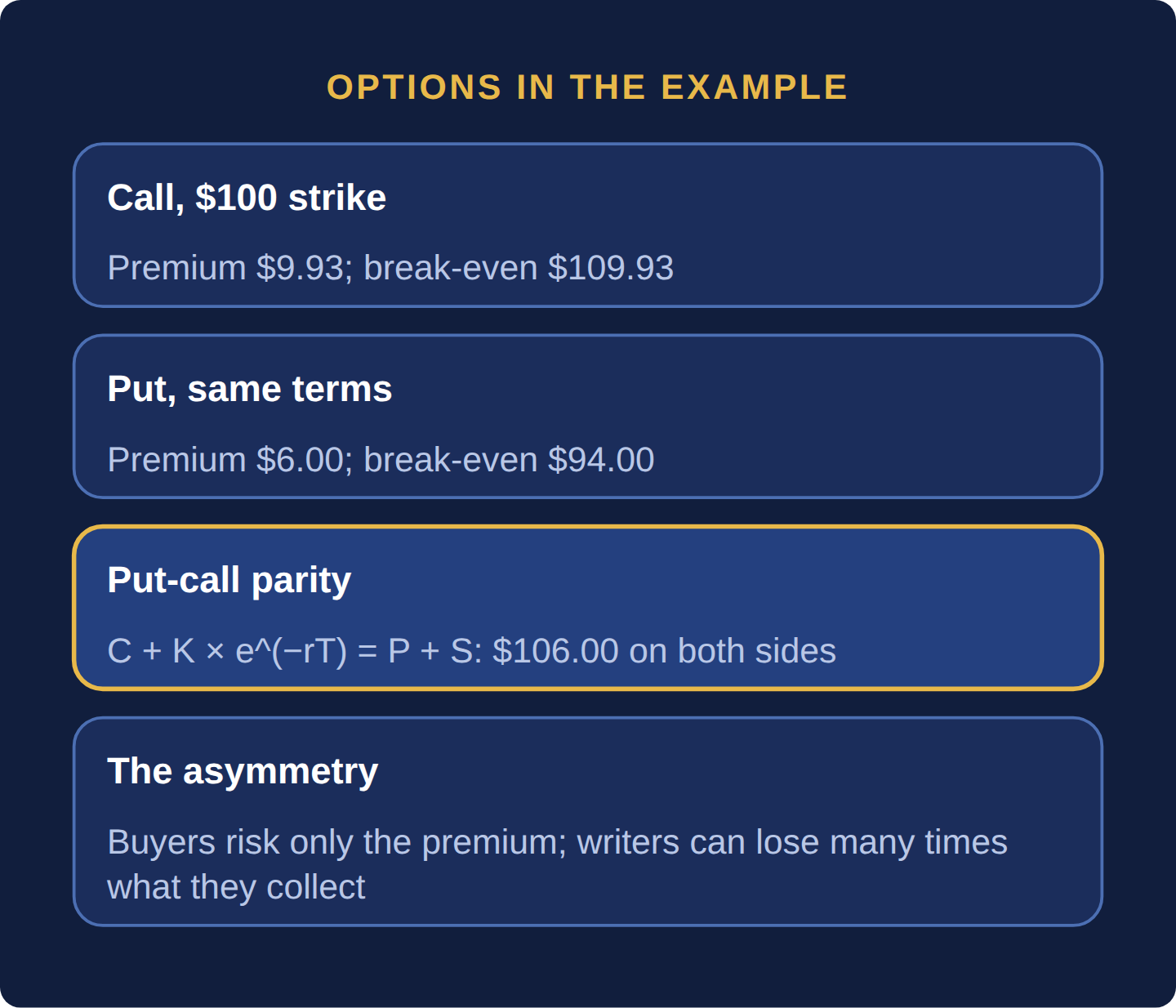
Unlike a future or forward — which obligates both parties to transact — an option gives its buyer the right, but not the obligation, to buy or sell an asset at a fixed price (the strike price) by or on a specified date. A call option gives the right to buy; a put option gives the right to sell. The buyer pays an upfront, non-refundable premium for this right; the seller (the “writer”) collects that premium but takes on the obligation to perform if the buyer chooses to exercise.
An option’s premium is made of two components: intrinsic value (the option’s immediate exercise value — for a call, how far the spot price sits above the strike, if at all) and time value (the extra amount reflecting the possibility that intrinsic value could grow further before expiry). Time value decays continuously as expiry approaches — a phenomenon central enough to derivatives trading that it has its own dedicated Greek, covered next.
An option is in the money when exercising it now would pay (a call with the stock above the strike), at the money when stock and strike are equal, and out of the money otherwise; this moneyness sets the intrinsic part of the premium (a one-year $100 call with the stock at $110 costs about $16.97: $10.00 intrinsic, $6.97 time value). A European option is exercisable only at expiry, an American one on any trading day before it. US single-stock options are American-style, while S&P 500 index (SPX) options are European-style and settle in cash. One listed equity option covers 100 shares, so a $9.93 premium costs $993.
Using the option priced in Section 4.4: Black-Scholes — The Intuition Behind the Formula (stock $100, strike $100, one year, call $9.93, put $6.00), each column is profit per share at expiry net of premium; plot a column against the stock price and you have the payoff diagram.
| Stock price at expiry | Long call | Short call | Long put | Short put |
|---|---|---|---|---|
| $80 | −$9.93 | +$9.93 | +$14.00 | −$14.00 |
| $90 | −$9.93 | +$9.93 | +$4.00 | −$4.00 |
| $100 | −$9.93 | +$9.93 | −$6.00 | +$6.00 |
| $110 | +$0.07 | −$0.07 | −$6.00 | +$6.00 |
| $120 | +$10.07 | −$10.07 | −$6.00 | +$6.00 |
Long call profit = max(S − K, 0) − premium; at $120, (120 − 100) − 9.93 = $10.07. Break-even is 100 + 9.93 = $109.93 for the call and 100 − 6.00 = $94.00 for the put. Short columns mirror long ones: options are zero-sum before costs. A buyer can lose only the premium; a call writer’s loss has no ceiling; a put writer can lose $94.00 per share if the stock goes to zero.
A call plus cash equal to the present value of the strike is worth max(S, K) at expiry; so is the stock plus a put. That equivalence pins their prices together.
Identical payoffs must cost the same today, which gives put-call parity for European options on a non-dividend stock: C + K × e^(−rT) = P + S. With the Section 4.4 numbers (r = 4%, T = 1): left side 9.925 + 100 × e^(−0.04) = 9.925 + 96.079 = $106.004; right side 6.004 + 100 = $106.004 (the Section 4.4 call and put to three decimals). If the put were quoted at $7.00, sell it, buy the call and short one share: you collect 7.00 − 9.925 + 100 = $97.075 today and owe $100 in a year whatever happens, which costs $96.079 today, leaving about $1.00 per share ($99.60 per contract) before costs. Dealers run this trade (a reversal) until the gap closes, which is why a call and a put with the same strike and expiry trade at one implied volatility. Dividends (subtract their present value from S), early exercise and stock-borrow costs loosen the equality.
A call option is like paying a small non-refundable fee today for the right, but not the obligation, to buy a condo at today’s quoted price any time in the next six months. If the condo’s market value rises well above that locked-in price, you exercise your right and buy cheap. If the market falls instead, you let the right lapse and lose only the fee, never the full difference. The seller of that right, by contrast, must sell at the locked-in price if you choose to exercise, however the market has moved.
Buy an option to cap a loss on a position you hold, or when you expect a bigger move than is priced in: the call above profits only above $109.93, a 9.9% rise. Sell one only if you can carry the worst plausible case: size it so a three-standard-deviation move, S × σ × √T × 3 (100 × 0.20 × 1 × 3 = $60 per share here), stays within your loss limit. Premium tells you the most you can make, not the most you can lose.
Treating option writing as steady income. Selling the one-year at-the-money call collects $9.93 per share, $993 per contract. If the company receives a takeover bid and the stock gaps to $150 overnight, the short call loses (150 − 100 − 9.93) × 100 = $4,007 per contract, about four times the premium, and no stop-loss order can act inside a gap. Many small gains and rare large losses make a good track record meaningless. Cap the tail with a higher-strike call bought against the one sold (a call spread), and size by the loss, not the premium.
Can you lose more than you paid for an option?
Not as a buyer: a buyer’s maximum loss is the premium. A writer can: a short call’s loss has no limit, and a short put can lose the strike minus the premium, $94.00 per share here. That is why brokers demand margin from writers but only the premium from buyers.
What happens to an option at expiry if I do nothing?
Out of the money, it expires worthless. A US equity option at least $0.01 in the money is normally exercised under the Options Clearing Corporation’s exercise-by-exception procedure unless you instruct otherwise, so if you cannot pay for the shares, close or roll it before the last trading day.
What is the difference between intrinsic value and time value?
Intrinsic value is what exercise would pay now; time value is the rest. The at-the-money $9.93 call is all time value, since exercising at $100 against a $100 stock pays nothing. Time value decays to zero by expiry, the decay the next section measures as theta.
Options give the buyer a right without obligation for a premium; buyers risk the premium while writers can lose far more, as a $4,007 loss per contract on a takeover gap shows. Payoff tables, break-evens ($109.93 and $94.00 here) and put-call parity, C + K × e^(−rT) = P + S, link calls, puts, stock and cash into one pricing system.
Six questions on this chapter. Decide on your answer first, then click “Reveal Answer.”
1. A stock trades at $50. A one-year European call struck at $50 costs $6.00 and the continuously compounded rate is 5%. By put-call parity, what should the matching put cost?
- About $8.44
- About $6.00
- About $2.50
- About $3.56
Reveal Answer
Answer: D. P = C + K × e^(−rT) − S = 6.00 + 50 × e^(−0.05) − 50 = 6.00 + 47.56 − 50 = $3.56.
2. You buy that $50 call for $6.00. At what stock price at expiry do you break even?
- $53.00
- $44.00
- $56.00
- $50.00
Reveal Answer
Answer: C. A call breaks even at strike plus premium: 50 + 6.00 = $56.00. Below that, the payoff does not recover the premium.
3. Which position carries a potential loss with no upper limit?
- Writing a call without owning the stock
- Writing a put with cash set aside
- Buying a put on a stock you own
- Buying a call on an index
Reveal Answer
Answer: A. A short call loses one-for-one as the stock rises, and the stock price has no ceiling. A put writer’s loss is capped at the strike minus the premium.
4. A one-year call struck at $100 costs $16.97 with the stock at $110. How is the premium split?
- $0 intrinsic and $16.97 time value
- $10.00 intrinsic and $6.97 time value
- $6.97 intrinsic and $10.00 time value
- $16.97 intrinsic and no time value
Reveal Answer
Answer: B. Intrinsic value is what exercise pays now, 110 − 100 = $10.00; the remaining $6.97 is time value.
5. Worked problem: A $50-strike call costs $4.20. What is its break-even price at expiry?
Reveal Answer
Answer: Break-even = strike + premium = $50 + $4.20 = $54.20.
6. Worked problem: A stock trades at $48, a one-year $50 put costs $3.80 and the interest rate is 4% (continuous). What does put-call parity say a $50 call should cost?
Reveal Answer
Answer: C = P + S − K×e−rT = $3.80 + $48 − $48.04 = $3.76.
- Principles for Financial Market Infrastructures (CPMI-IOSCO, April 2012) — CCP initial margin at 99% confidence; cover-1 and cover-2 default resources