
8.5 Real Assets as an Asset Class
Real assets are things you can point to in the physical world: real estate, infrastructure and commodities. They earn income or price gains tied to the physical economy, and they can protect against inflation where contracts reprice with prices. How you hold them matters. US REITs must pay out 90% of their taxable income, and commodity futures returns depend on the roll yield as much as on the spot price.
Why it matters: The same asset can behave very differently depending on the wrapper that holds it.
Summary: Real assets, meaning real estate, infrastructure and commodities, earn income or price gains linked to the physical economy and can hedge inflation where contracts reprice with prices. How you hold them matters: US REITs must pay out 90% of taxable income, and commodity futures returns depend on the roll yield as much as on the spot price.
- US REIT tests: 75% of assets and gross income from real estate, 90% payout, 100+ holders, five-or-fewer limit.
- The 20% section 199A deduction, made permanent in 2025, puts the top federal income tax rate on ordinary REIT dividends at 29.6%, or 33.4% with the 3.8% net investment income tax.
- Futures return = spot change + roll yield + collateral interest.
- A 2% monthly contango costs 21.2% a year on a flat oil price; May 2020 WTI settled at −$37.63.
- Count an inflation hedge only where the contract indexes income to prices.

Real assets — real estate, infrastructure (toll roads, airports, power grids, pipelines), and commodities — are tangible, physical assets valued partly for the income they generate and partly as a hedge against inflation, since their value and the income they produce (rents, tolls, commodity prices) tend to rise alongside the general price level, unlike a fixed nominal bond coupon. Institutional investors increasingly hold infrastructure specifically for its bond-like, contracted, inflation-linked cash flows combined with equity-like long-term return potential — a distinct risk-return profile from either pure fixed income or pure equities.
Most investors reach real estate through a real estate investment trust (REIT), a company that pays no corporate income tax on income it distributes. To qualify, a US REIT must hold at least 75% of its assets in real estate and cash, earn at least 75% of its gross income from real-estate sources, have at least 100 shareholders and no more than 50% of its shares held by five or fewer individuals, and distribute at least 90% of its taxable income each year. The payout rule shapes the business: a REIT with $200 million of taxable income must pay out at least $180 million and can retain at most $20 million, so growth is funded by issuing shares and debt, and REITs are exposed to the cost of capital. For a US individual, ordinary REIT dividends qualify for the section 199A 20% deduction, which the One Big Beautiful Bill Act made permanent in July 2025, so the top federal income tax rate on them is 37% × (1 − 0.20) = 29.6%, or 29.6% + 3.8% = 33.4% for investors who also owe the net investment income tax (modified adjusted gross income above $200,000 single or $250,000 joint; IRS, as of October 2026). Non-traded REITs hold the same assets without a listing, which brings the liquidity and smoothing problems of Section 8.1: What Makes an Investment “Alternative”, and their sales commissions and offering fees usually total about 9% to 10% of the investment, according to the SEC.
Investors rarely hold physical commodities; they hold futures (Part 4.1: Futures & Forwards — Locking In a Price) and replace each expiring contract with the next one, called rolling. A futures position’s total return therefore has three parts: the change in the spot price, the roll yield from selling the expiring contract and buying the next, and the interest earned on the cash held as collateral. Spot oil is $70.00; the expiring future converges to $70.00 and the next month trades at $71.40, a market in contango (futures above spot).
- Contango: buy at $71.40; if spot stays at $70.00, the contract converges to it: 70.00 ÷ 71.40 − 1 = −1.96% a month, compounding to 0.9804¹² − 1 = −21.2% a year on a flat oil price.
- Backwardation (futures below spot) at $68.60: 70.00 ÷ 68.60 − 1 = +2.04% a month, or +27.4% a year on the same flat price.
The extreme case came on April 20, 2020, when the expiring May WTI crude contract settled at −$37.63 a barrel, the first negative price in the contract’s 37-year history, because holders who could not take delivery had to pay others to take their contracts as storage filled. Erb and Harvey (2005, published 2006) showed that a long-only commodity allocation is largely a bet on the term structure, and that tactical strategies using momentum and the futures curve delivered higher average returns with lower risk than long-only exposure.
Before buying a commodity fund as an inflation hedge, read the futures curve: annualize the gap between the front and second contracts. If the curve is in contango by more than your expected spot price gain, the fund will lose money even if you are right about the commodity; prefer a fund that rolls into longer-dated or least-contango contracts, or own producers instead. For real estate and infrastructure, count the inflation link only where the contract delivers it (rents or tolls indexed to CPI); leases fixed for ten years are a nominal bond with a roof.
Buying a front-month commodity fund to “own” the commodity during a glut. With the curve in contango of 2% a month, the position loses 21.2% a year from the roll alone while the spot price is unchanged, and in April 2020 the front contract itself went to −$37.63. The roll yield, not the headline price, decides what a futures-based investor earns.
What is roll yield?
It is the gain or loss from replacing an expiring futures contract with a later one. In contango the later contract costs more, so a long position loses as it converges to spot; in backwardation it gains. Total return = spot return + roll yield + collateral interest.
Do REITs have to pay out 90% of their income?
Yes. A US REIT must distribute at least 90% of its taxable income each year to keep its pass-through status, along with asset, income and ownership tests. Because taxable income is reduced by depreciation, a non-cash charge, REIT payouts are usually judged against funds from operations (FFO), which adds depreciation back, rather than against net income.
Are real assets a good inflation hedge?
Only where income is contractually or economically linked to prices. Indexed tolls and short leases reprice with inflation; long fixed leases and leveraged buildings can lose value when inflation lifts interest rates and discount rates. The hedge is strongest over long horizons and weakest during a rate shock.
Real assets hedge inflation only where income reprices with prices. US REITs pass income through by paying out 90% of taxable income, and a commodity futures investor earns spot change plus roll yield plus collateral interest, so contango can make a flat commodity price a large loss.
Six questions on this chapter. Decide on your answer first, then click “Reveal Answer.”
1. Spot crude is $60.00 and the next-month future is $61.50. If the spot price stays flat for a year and the curve shape is unchanged, roughly what does monthly rolling cost a long futures investor?
- About 0% a year
- About −29.3% a year
- About −2.4% a year
- About −25.6% a year
Reveal Answer
Answer: D. Each month the contract converges from 61.50 to 60.00: 60.00 ÷ 61.50 − 1 = −2.44%; compounded, 0.9756¹² − 1 = −25.6%. −29.3% is the simple 12 × monthly figure.
2. A US REIT has $50 million of taxable income. What is the minimum it must distribute to keep REIT status?
- $37.5 million
- $45 million
- $50 million
- $40 million
Reveal Answer
Answer: B. A REIT must distribute at least 90% of taxable income: 0.90 × 50 = $45 million.
3. What is the top federal income tax rate on ordinary REIT dividends for a US individual after the One Big Beautiful Bill Act?
- 37.0%
- 23.8%
- 29.6%
- 20.0%
Reveal Answer
Answer: C. The section 199A 20% deduction, made permanent in 2025, reduces the 37% top rate to 37% × 0.80 = 29.6%.
4. Which holding gives the most reliable protection against inflation?
- A toll road whose tolls are indexed to CPI each year
- An office building on a ten-year fixed-rent lease
- A long-dated fixed-coupon infrastructure bond
- A front-month oil futures fund in steep contango
Reveal Answer
Answer: A. Inflation protection comes from income that reprices with prices. Fixed leases and fixed coupons are nominal claims, and contango can erase a commodity fund’s gain.
5. Worked problem: A REIT must pay out 90% of taxable income. With $50m of taxable income, what is the minimum distribution?
Reveal Answer
Answer: 90% × $50m = $45 million.
6. Worked problem: It holds $800m of real estate assets out of $1,000m of total assets. Does it pass the 75% asset test?
Reveal Answer
Answer: 800 ÷ 1,000 = 80% ≥ 75%: pass.
8.6 The Rise of Private Credit
Private credit is lending by investment funds, not banks, straight to companies, mostly mid-sized firms owned by private equity sponsors. The loans usually carry a floating rate: a market rate called SOFR plus a fixed extra margin. It grew to about $2.1 trillion by 2023 as banks stepped back. The main risks are whether borrowers can cover their interest when rates are high, interest paid in extra debt instead of cash (PIK), and funds that promise easy withdrawals while holding loans that are hard to sell.
Why it matters: The risks are about cash and liquidity, not just about whether a borrower repays.
Summary: Private credit is lending by non-bank funds directly to companies, mostly mid-sized sponsor-owned borrowers, at floating rates of SOFR plus a spread. It grew to about $2.1 trillion by 2023 as banks retreated, and its key risks are borrower coverage under higher rates, PIK interest and the liquidity mismatch of evergreen funds.
- A unitranche replaces senior and junior debt with one loan at one blended rate.
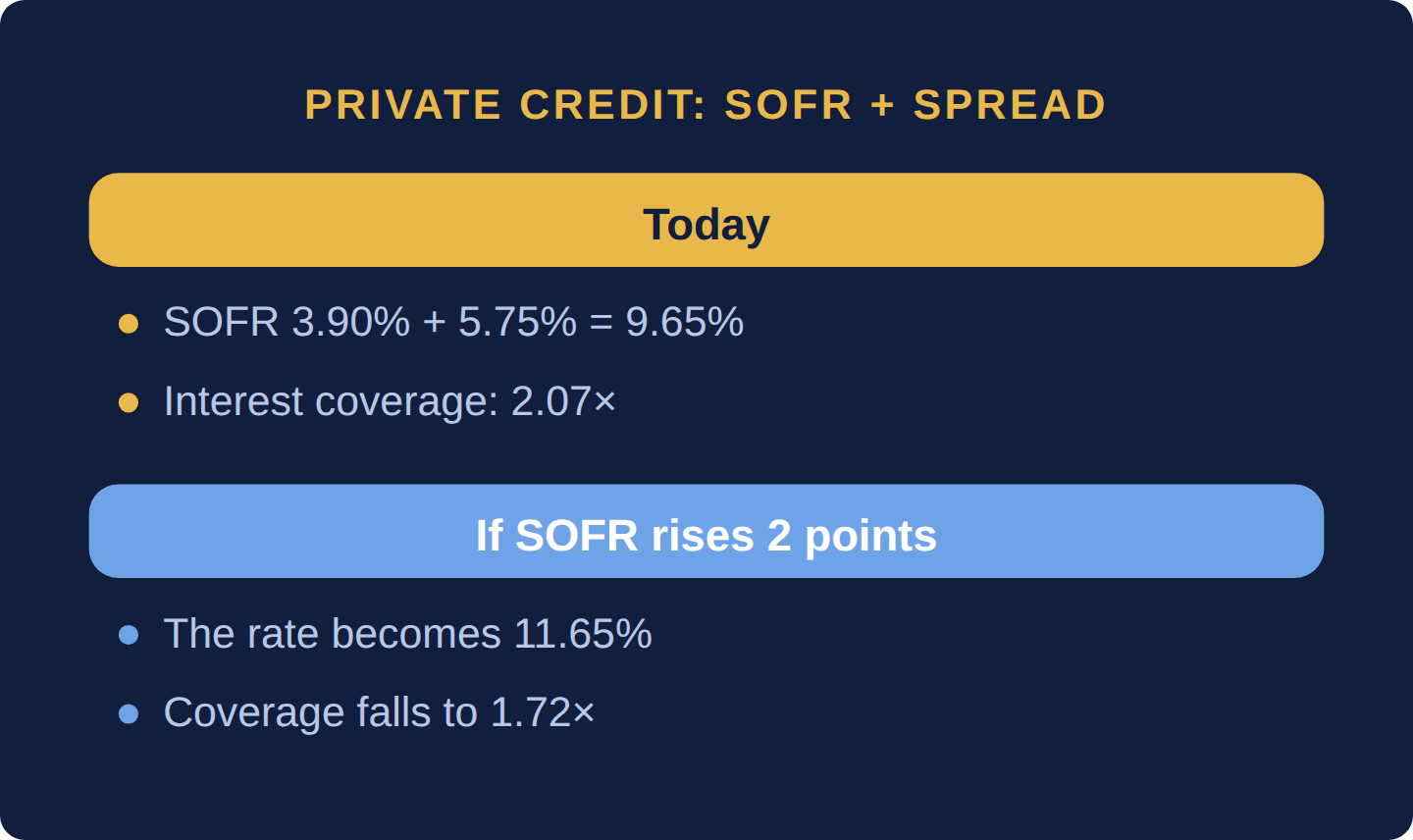
- Example: SOFR 3.90% + 5.75% = 9.65%; coverage 2.07x falls to 1.72x if SOFR rises 2 points.
- A 98 issue price lifts the lender’s yield to 10.46% over three years.
- 3% PIK compounds $200 million to $231.9 million in five years.
- Evergreen funds with 5% quarterly caps prorated in 2026: Golub paid 59% of requests.
Private credit — non-bank lenders providing loans directly to companies, largely outside the traditional bank lending and public bond markets covered in Part 3: Fixed Income & Bond Mathematics — has grown into one of the largest structural shifts in finance since 2008. Post-crisis bank regulation (Basel III, introduced in Volume I’s Part 3) made certain categories of lending, particularly to smaller and mid-sized companies, meaningfully more capital-intensive and less attractive for traditional banks to hold on their own balance sheets — creating a funding gap that private credit funds, raising capital from institutional investors rather than depositors, have stepped in to fill.
The IMF put the market at $2.1 trillion of assets and committed capital globally in 2023, about three-quarters of it in the United States. The core product is direct lending to sponsor-owned companies, often as a unitranche: one loan replacing a senior and a junior layer, at one blended rate. Pricing floats at SOFR (the Secured Overnight Financing Rate, Part 3.8: The Repo Market — Mechanics Underneath It All) plus a spread, with a floor under SOFR and an original issue discount (OID), a price below par that adds yield; some loans allow payment-in-kind (PIK) interest, added to principal instead of paid in cash.
Inputs: EBITDA $40 million (5.0x leverage); SOFR 3.90% (Sep 30, 2026) + 5.75%, SOFR floor 1.00%; issued at 98, repaid at par after 3 years.
- Coupon = max(3.90%, 1.00%) + 5.75% = 9.65%; interest = 200 × 9.65% = $19.3 million; coverage = 40 ÷ 19.3 = 2.07x. At SOFR 0.50% the floor holds the coupon at 6.75%.
- Lender’s yield: pay 98, receive 9.65 a year for 3 years and 100 at the end: internal rate of return 10.46%, so the OID adds 0.81 points.
- Rate shock: SOFR +2 points → interest $23.3 million, coverage 40 ÷ 23.3 = 1.72x, with no change in the business.
- PIK: if 3 points are PIK, cash interest falls to $13.3 million but principal compounds to 200 × 1.03⁵ = $231.9 million in five years: 5.8x leverage at flat EBITDA.
- Evergreen liquidity (a fund that sells and redeems shares continuously): a 5% quarterly cap allows at most 20% a year, while loans with a 3.9-year average life repay about 1 ÷ 3.9 = 26% of the book a year in normal times; the match fails when repayments slow as requests rise. In the second quarter of 2026, requests at Golub Capital’s private credit fund reached 8.5% of shares against a 5% cap, so investors received 5 ÷ 8.5 = 59%: $58,824 on a $100,000 request.
Private credit is the most direct current form of shadow banking (lending done outside the regulated banking system): borrowers get faster, more flexible, more customized financing terms than a bank syndicate would typically offer, while lenders earn a higher yield than public bonds of similar credit quality in exchange for less liquidity and less transparency.
Lenders raise money in closed-end funds locked for years or, increasingly, in evergreen vehicles such as non-traded business development companies (BDCs), which sell shares continuously and allow limited redemptions.
The warning. The IMF’s April 2024 Global Financial Stability Report listed “relatively fragile borrowers”, “multiple layers of leverage” and “stale and potentially subjective valuations”, and warned that under limited oversight these weaknesses “could become systemic”; a staff blog found over a third of borrowers with interest costs above current earnings. The reassurance. A Federal Reserve note by Cai and Haque (February 2024) judged that “redemption and fire sale risks posed by private credit seems to be low, largely due to its long lock-up periods (as high as 10 years) and low leverage or derivative exposures.” The 2026 test. In the first quarter of 2026 non-traded BDC redemptions ($6.9 billion) exceeded sales ($4.9 billion) for the first time; five funds prorated. The caps held without fire sales, but the market at today’s size has not been through a full default cycle, so neither view is settled.
“Floating-rate senior loans protect the lender” bends here:
| Situation | What changes | Why |
|---|---|---|
| Rates rise sharply | Coupon rises, but so does default risk | Coverage fell from 2.07x to 1.72x on a 2-point SOFR move above |
| Interest switches to PIK | Reported income holds up while cash income falls | Accrued PIK counts as income even if never collected |
| Loan is amended and extended | No default is recorded | Extensions delay the loss, so default rates understate stress |
| Requests exceed the redemption cap | Investors are prorated | The loans cannot be sold quickly at their marks |
| Marks are model-based | NAV lags market prices | Smoothing (Section 8.1: What Makes an Investment “Alternative”) lets early redeemers exit at stale values |
Underwrite at the stressed rate: if EBITDA ÷ interest falls below about 1.5x with SOFR 2 points higher and EBITDA 15% lower, the spread does not pay for the risk. In an evergreen fund, hold only money you can leave for two to three years. Treat a rising PIK share or repeated “amend and extend” deals as early default signals.
Treating a quarterly-redeemable private credit fund as a cash substitute. The loans live about four years and a 5% cap is a ceiling, not a promise: a $100,000 request returned $58,824 in the Golub quarter. The extra yield pays for exactly this illiquidity.
What is a unitranche loan?
One loan that replaces a senior and a subordinated layer at one blended rate, usually from one direct lender or a small club. The lenders can split priorities privately in an agreement among lenders.
Why is private credit growing so fast?
Because banks retreated and borrowers value certainty. Post-2008 capital rules made leveraged mid-market loans costly for banks to hold, and sponsors pay a higher spread for one lender who commits quickly and privately. Investors accept the illiquidity for floating coupons like the 9.65% above.
What is PIK interest?
Interest added to principal instead of paid in cash: 3% PIK turns $200 million into $231.9 million in five years. It saves the borrower cash now and compounds the debt.
Private credit funds lend directly to companies at floating rates, often as unitranche loans with floors, OID and sometimes PIK interest. Floating rates shift rate risk to the borrower’s coverage, and evergreen funds holding multi-year loans can only partly meet redemptions in a stress quarter.
Six questions on this chapter. Decide on your answer first, then click “Reveal Answer.”
1. A $150 million unitranche pays SOFR + 6.00% with a 1.00% SOFR floor. SOFR is 4.20% and EBITDA is $30 million. What is interest coverage?
- About 4.76x
- About 1.96x
- About 2.94x
- About 2.86x
Reveal Answer
Answer: B. Coupon = 4.20% + 6.00% = 10.20%; interest = 150 × 10.2% = $15.3 million; coverage = 30 ÷ 15.3 = 1.96x.
2. The same loan’s SOFR falls to 0.50%. What coupon does the borrower pay?
- 7.00%
- 6.50%
- 6.00%
- 5.00%
Reveal Answer
Answer: A. The floor sets SOFR at no less than 1.00%, so the coupon is 1.00% + 6.00% = 7.00%.
3. A $100 million loan pays 4% of its interest in kind (PIK) and nothing is repaid. What is the principal after three years?
- About $100.0 million
- About $104.0 million
- About $112.0 million
- About $112.5 million
Reveal Answer
Answer: D. PIK compounds: 100 × 1.04³ = $112.49 million. $112.0 million ignores compounding.
4. In a quarter, an evergreen private credit fund with a 5% cap receives requests for 10% of shares and prorates. How much does an investor requesting $200,000 receive that quarter?
- $200,000
- $190,000
- $100,000
- $10,000
Reveal Answer
Answer: C. Proration pays 5 ÷ 10 = 50% of each request: 0.5 × 200,000 = $100,000; the rest waits for later windows.
5. Worked problem: A $100m unitranche loan pays SOFR of 4.0% plus a 6.0% spread. EBITDA is $22m. What is the all-in rate and interest coverage?
Reveal Answer
Answer: Rate = 4.0% + 6.0% = 10.0%; interest = $10m. Coverage = $22m ÷ $10m = 2.20×.
6. Worked problem: SOFR rises 2 points. What is coverage now?
Reveal Answer
Answer: Rate = 12.0%; interest = $12m; coverage = $22m ÷ $12m = 1.83×.
- CFTC, interim staff report on April 20, 2020, WTI trading — May 2020 WTI settled at −$37.63, first negative price in 37 years (8.5).
- SEC Investor Bulletin: Real Estate Investment Trusts — REIT asset, income, payout and ownership tests (8.5).
- Investor.gov on non-traded REITs
- Cai and Haque, Private Credit: Characteristics and Risks, FEDS Notes (February 23, 2024) — Redemption and fire-sale risk judged low (8.6).
- IMF Global Financial Stability Report, April 2024 — Private credit vulnerabilities (8.6).
- IMF blog, April 8, 2024
- FRED — FRED