
4.7 Credit Default Swaps (CDS)
A credit default swap is insurance on a loan. The protection buyer pays a yearly fee, called the spread, and if the borrower defaults, the seller pays the loss. The spread roughly equals the chance of default times how much is lost when it happens. Headline sizes can mislead: Lehman Brothers had $72 billion of these contracts registered, but after offsetting them against each other only about $5.2 billion actually had to change hands.
Why it matters: The gross number sounds scary, but the net number is what really gets paid.
Summary: A credit default swap pays the protection buyer the loss on a borrower’s default in return for a yearly spread. The spread approximates default probability times loss given default, and gross CDS notional overstates real exposure: Lehman’s $72 billion registered with DTCC settled for about $5.2 billion net.
- Credit triangle: 2% default probability × 60% loss = 120 basis points; 300 basis points at 40% recovery implies 5% a year.
- Lehman’s October 10, 2008, auction set recovery at 8.625%; netting, not recovery, shrank the payments.
- Standard contracts since April 8, 2009, pay a fixed 100 or 500 basis point coupon plus an upfront amount.
- The 2008 danger was one-way sellers such as AIG facing collateral calls, not dealers’ offsetting books.
- Selling $100 million of protection at 120 basis points risks a $91.4 million payout, 76 years of premium.

A credit default swap functions like insurance against a bond issuer defaulting. The “protection buyer” pays a regular premium (the CDS spread, quoted in basis points per year) to the “protection seller.” If the reference entity (the bond issuer) experiences a defined credit event — bankruptcy, missed payment, or a forced debt restructuring — the protection seller compensates the buyer for the loss, typically the difference between the bond’s face value and its post-default market value.
A CDS buyer need not own the bond: a “naked” CDS is simply a bet on the issuer’s credit, so gross protection written on a name can exceed its bonds many times over. In 2008 that gross figure proved the wrong measure of danger: dealers had bought and sold protection on the same names, and their positions largely canceled, as Lehman’s settlement showed (below). The systemic damage came from concentration: a seller that had written protection one way, in size, had to post more collateral as the insured securities fell in value and its own rating was cut, and could not; that is what led the Federal Reserve to authorize a credit facility of up to $85 billion for AIG on September 16, 2008 (Volume I, Part 3). Read a CDS book by net exposure and collateral, not gross notional.
Lehman’s bankruptcy filing on September 15, 2008, triggered every CDS referencing it; market estimates of the protection outstanding ran as high as $400 billion. What happened:
| Step | Figure | What it means |
|---|---|---|
| Auction, October 10, 2008 | Final price 8.625 | Sellers owed 100 − 8.625 = 91.375 cents per dollar |
| Gross notional in DTCC’s Trade Information Warehouse | $72 billion | Every registered contract, counted separately |
| Net cash settled through DTCC, October 21, 2008 | About $5.2 billion | Net sellers to net buyers, after offsets |
| Net cash as share of gross | 5.2 ÷ 72 | 7.2% |
| Implied net protection | 5.2 ÷ 0.91375 | about $5.7 billion |
Stated precisely: netting reduced $72 billion of gross CDS notional registered on Lehman with DTCC to about $5.2 billion of net cash payments, 13.8 times smaller, settled without incident. Netting, not recovery, did the shrinking. The $72 billion excludes any unregistered trades, and the episode does not show CDS were harmless: the danger lay with one-way sellers like AIG.
A protection seller collects the spread each year and expects to pay the probability of default times the loss given default (one minus the recovery rate). Setting the two equal gives the credit triangle.
Spread ≈ PD × (1 − R), where PD is the annual default probability and R the recovery rate. A borrower with a 2% annual default probability and 40% expected recovery should trade at 0.02 × (1 − 0.40) = 1.20%, or 120 basis points a year. Backward, a 300 basis point spread at 40% recovery implies 0.03 ÷ 0.60 = 5.0% a year; at Lehman’s 8.625% recovery, 0.03 ÷ 0.91375 = 3.3%. The implied PD is risk-neutral, including a premium for default and liquidity risk, so it usually exceeds observed default rates (Section 3.6: Credit Spreads Decomposed). Since ISDA’s “Big Bang” of April 8, 2009, standard contracts pay a fixed coupon, 100 or 500 basis points in North America, with the difference paid upfront: five years at 250 basis points on a 100 coupon costs about (2.50% − 1.00%) × 4.06 years of risky annuity ≈ 6.1% of notional. The reform also hardwired auctions into contracts and gave Determinations Committees binding authority over credit events.
For a protection seller, small steady income is set against one large payment that can arrive without warning.
Convert every spread into an implied default probability, spread ÷ (1 − R), and compare it with your credit view or the rating’s historical default rate; if the market implies far more, find out what it knows before selling protection. Buy protection to hedge a loan only on matching maturity and seniority, and only from a cleared or fully collateralized counterparty: protection from a seller that cannot pay in a crisis is worthless.
Selling protection as if the premium were safe income. Writing $100 million of protection at 120 basis points earns $1.2 million a year. If the name defaults with Lehman’s 8.625% recovery, the seller pays $100,000,000 × 0.91375 = $91.4 million, the premium of 91.4 ÷ 1.2 ≈ 76 years, in one settlement. Sellers who wrote such protection across many correlated names, without the liquidity to meet collateral calls as spreads widened, are the ones crises break. Size protection sold by the payout at a realistic recovery, never by the spread income.
What counts as a credit event in a CDS?
Bankruptcy, failure to pay and, for many contracts, a restructuring of the debt on worse terms for creditors. Since 2009, ISDA’s Determinations Committees decide with binding effect whether a credit event has occurred and whether an auction will set the recovery price, so buyers and sellers do not litigate each default contract by contract.
How is a CDS settled after default?
Usually through an auction that sets one recovery price for all contracts on the defaulted name, after which sellers pay buyers 100 minus that price per 100 of notional in cash. Lehman’s auction set 8.625, so sellers paid 91.375 cents on the dollar, and DTCC netted the resulting obligations into about $5.2 billion of payments.
Why are CDS spreads higher than actual default losses?
Because sellers demand compensation for bearing uncertain, lumpy losses and for illiquidity, not just the average loss. The credit triangle therefore gives a risk-neutral default probability that is higher than the default rate later observed. The gap is the credit risk premium, the same component Section 3.6: Credit Spreads Decomposed identifies in bond spreads.
A CDS spread approximates default probability times loss given default, so spreads convert into market-implied default rates. Netting reduced the $72 billion of Lehman CDS registered with DTCC to about $5.2 billion of net payments after the October 2008 auction set recovery at 8.625%; the real danger lay with one-way sellers such as AIG.
Six questions on this chapter. Decide on your answer first, then click “Reveal Answer.”
1. A five-year CDS trades at 180 basis points and recovery is expected to be 40%. What annual default probability does the credit triangle imply?
- 4.5%
- 3.0%
- 1.1%
- 1.8%
Reveal Answer
Answer: B. PD ≈ spread ÷ (1 − R) = 0.018 ÷ 0.60 = 3.0%. Reading the spread itself as the default probability ignores the loss given default.
2. About $72 billion of CDS on Lehman was registered with DTCC. Roughly how much net cash changed hands at settlement in October 2008?
- About $72 billion
- About $65.8 billion
- About $400 billion
- About $5.2 billion
Reveal Answer
Answer: D. Offsetting positions netted out, so net sellers paid net buyers about $5.2 billion, roughly 7% of gross notional.
3. Since the April 2009 changes, how does a standard North American CDS on a riskier name usually trade?
- With a fixed 500 bp coupon plus an upfront payment
- With no premium paid until a credit event occurs
- With a running spread negotiated freely for each trade
- With physical delivery of bonds at par as the only route
Reveal Answer
Answer: A. Standard contracts pay a fixed coupon of 100 or 500 basis points, with the difference from the quoted spread settled upfront.
4. A firm sells $50 million of protection at 120 bp and the name defaults with 10% recovery. What does it pay?
- $50 million
- $600,000
- $45 million
- $5 million
Reveal Answer
Answer: C. Payout = notional × (1 − recovery) = $50 million × 0.90 = $45 million, against $600,000 a year of premium.
5. Worked problem: A borrower has a 3% annual default probability and a 40% recovery rate. What CDS spread does the credit triangle imply?
Reveal Answer
Answer: Spread = PD × (1 − recovery) = 3% × 0.60 = 180 basis points.
6. Worked problem: A CDS trades at 250 basis points with 40% recovery. What default probability does that imply?
Reveal Answer
Answer: PD = 2.50% ÷ 0.60 = 4.17% a year.
4.8 Hedging vs Speculation — Using Derivatives in Practice
Hedging and speculating use the same tools. What separates them is whether the position offsets a risk you already have. If your company will receive foreign currency, selling that currency forward is a hedge; the same trade with no underlying exposure is a bet. Size a hedge to the exposure using a hedge ratio. Forwards give certainty, while options work like insurance: you pay a premium to keep the upside. Always judge the hedge together with the exposure, never alone.
Why it matters: A hedge that looks like a loss on its own may be doing exactly its job.
Summary: Hedging and speculation use the same instruments; what separates them is whether the position offsets an exposure you already have. A hedge should be sized to that exposure with a hedge ratio, chosen between forwards (certainty) and options (insurance), and judged together with the exposure.
- Minimum-variance hedge ratio h* = ρ × σS ÷ σF, 0.96 in the airline example.
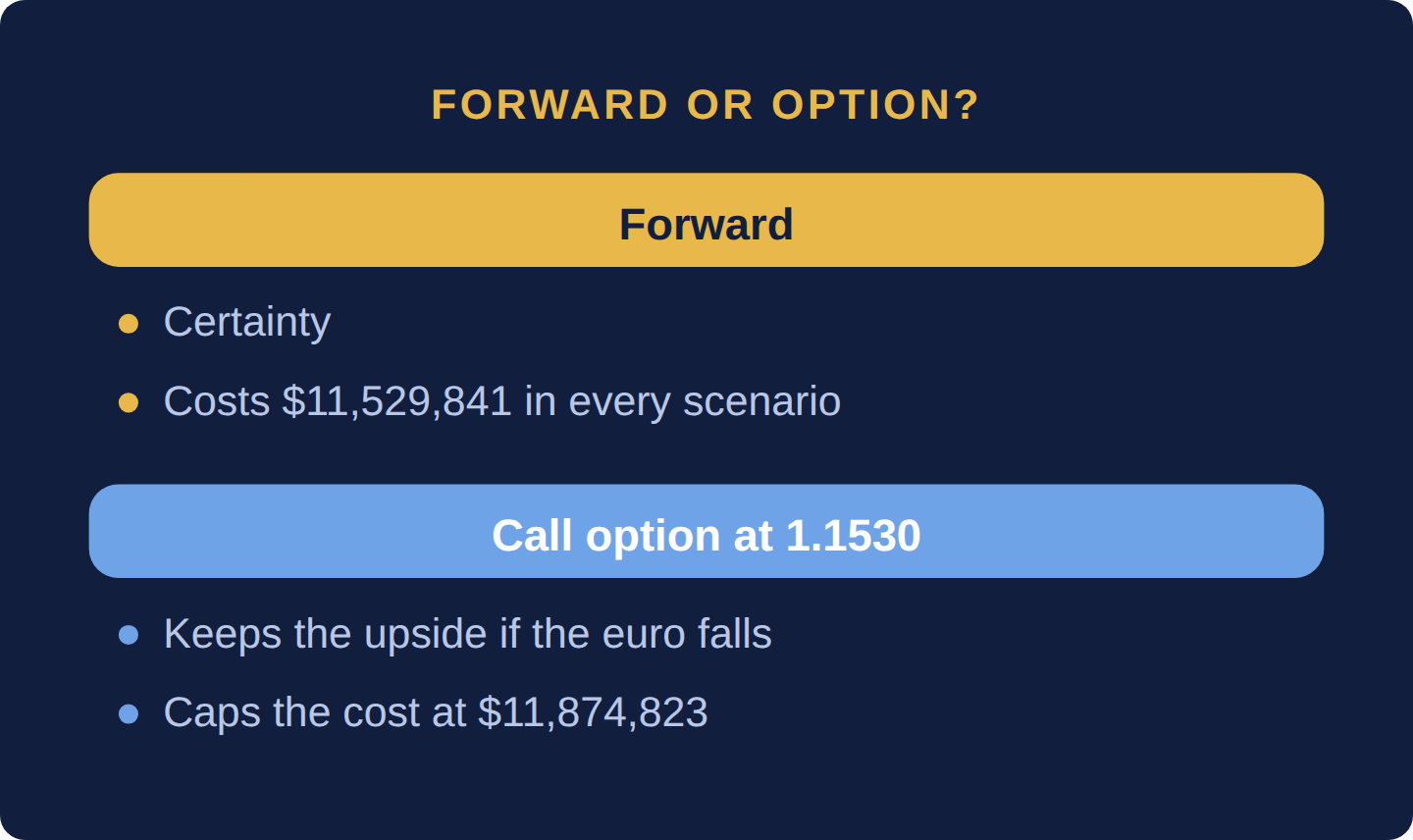
- For a €10 million payable, the forward costs $11,529,841 in every scenario; a 1.1530 call caps the cost at $11,874,823.
- The call beats the forward below 1.1185 and beats staying unhedged above 1.1875.
- Evidence on whether hedging raises firm value is mixed: a 4.87% premium in one study, none in another.
- Futures on 15 million gallons against a 10 million gallon need turn a $0.80 fall into a $4.0 million speculative loss.
Every derivative in this Part can be used for two opposite purposes with identical instruments and near-identical mechanics. Hedging uses a derivative to reduce an existing risk the user already carries — an airline buying oil futures to lock in fuel costs it must pay regardless. Speculation uses the same instrument to deliberately take on a new risk in pursuit of profit — a trader buying the same oil futures with no underlying fuel exposure at all, purely betting on price direction.
The line between the two is a matter of the user’s underlying exposure, not the instrument itself — which is exactly why corporate treasury policies (as introduced in Volume I’s Part 5) typically define hedging mandates strictly, specifying maximum notional amounts and requiring a demonstrable underlying exposure, precisely to prevent a hedging desk from drifting into speculative position-taking under the same institutional umbrella.
An airline hedging jet fuel with heating oil futures carries basis risk, the chance the two prices diverge. The variance-minimizing hedge ratio is h* = ρ × σS ÷ σF; with illustrative correlation 0.9 and volatilities of 30% (fuel) and 28% (futures), h* = 0.9 × 0.30 ÷ 0.28 = 0.96 gallons of futures per gallon of fuel.
A US importer owes €10 million in one year; spot is 1.1355, the forward 1.1530 (Section 4.6: Currency Swaps). It can stay open, buy euros forward, or buy a one-year euro call struck at 1.1530 costing $0.0330 per euro at an illustrative 7.5% volatility (Garman-Kohlhagen, the currency form of Black-Scholes): $329,685 today, $344,823 at maturity at the 4.49% continuously compounded dollar rate. Dollar cost at maturity:
| EURUSD in one year | Unhedged | Forward at 1.1530 | Call at 1.1530 (incl. premium) |
|---|---|---|---|
| 1.05 (euro weakens) | $10,500,000 | $11,529,841 | $10,844,823 |
| 1.15 (near the forward) | $11,500,000 | $11,529,841 | $11,844,823 |
| 1.25 (euro strengthens) | $12,500,000 | $11,529,841 | $11,874,823 |
Flip points. The forward beats staying open whenever the euro ends above 1.1530. The call beats the forward only if the euro ends below strike − premium = 1.1530 − 0.0345 = 1.1185, and beats staying open only above strike + premium = 1.1530 + 0.0345 = 1.1875. Between those points the call costs most: the price of keeping the upside while capping the worst case at $11,874,823. The forward buys certainty, the option insurance with a deductible; staying open is the one speculative choice, because the importer already owes the euros.
In theory hedging adds value only through market imperfections such as distress costs and taxes. The evidence is split. Allayannis and Weston (2001), studying 720 large US nonfinancial firms, found a hedging premium of about 4.87% in Tobin’s Q for currency-exposed firms using currency derivatives. Jin and Jorion (2006), studying 119 US oil and gas producers, found hedging cut stock-price sensitivity to oil and gas prices but did not affect market value. Guay and Kothari (2003) found large firms’ derivative positions small relative to their exposures: fine-tuning, not transformation. A fair reading: hedging reliably cuts volatility; whether it adds value depends on how close the firm is to distress, and selection effects (better-run firms both hedge and trade at higher multiples) blur the premium.
Treasury policies turn this into limits: approved exposures, instruments and hedge ratios, plus independent valuation.
Call a position a hedge only if it offsets an exposure you carry or are committed to, its notional is at most 100% of that exposure (lower, say 50% to 80%, for forecast flows), its size follows the hedge ratio, and you can fund its margin under stress. Otherwise treat the excess as a trading position with its own limits. Use a forward for certainty, an option when the exposure is uncertain (a bid you may not win).
Over-hedging and booking the excess as risk management. An airline that will burn 10 million gallons buys futures on 15 million because “prices can only go up.” If fuel falls $0.80 a gallon, futures on the 10 million lose what the airline saves at the pump, but the extra 5 million lose 5,000,000 × $0.80 = $4.0 million with no offset: a speculative loss under a hedging label. Cap notional at forecast exposure and have someone outside the desk check it monthly.
Can a good hedge lose money?
Yes, and it often should: a hedge loses whenever the exposure it protects gains. The importer’s forward at 1.1530 shows a loss if the euro ends at 1.05, while the euro bill itself costs less. Judge a hedge on the combined position, exposure plus derivative, never on the derivative alone.
Is buying an option always speculation?
No. Buying a put on shares you own, or a currency call against a payable you owe, is insurance and therefore a hedge. Buying the same option with no exposure behind it is speculation. The instrument is identical; what decides is whether a matching exposure exists.
Why don’t all companies hedge everything?
Because hedging costs premiums, spreads, collateral and management time, gives up upside, and covers risks shareholders can often diversify themselves. Firms near financial distress or with large fixed foreign-currency obligations gain most; for others the evidence on value is mixed, as the box above shows.
Scale. Citing Futures Industry Association data, the National Stock Exchange of India (NSE) reports that it was the world’s largest derivatives exchange by contracts traded in calendar 2025. Contract counts flatter it: Brazil’s B3 led for the first seven months of 2025, which NSE’s chief executive attributed to B3’s even smaller contracts.
Retail losses. In FY22 to FY24, individual traders lost more than ₹1.8 lakh crore in equity derivatives, with about 93% of them making losses after transaction costs. In FY26, 87.5 lakh individuals traded (down 18%), net losses were ₹91,685 crore (from a revised ₹1.12 lakh crore in FY25), 87.7% lost money, the average loss was ₹1.17 lakh, and options caused 92% of losses. Proprietary traders earned gross profits of about ₹44,000 crore, and 99% of foreign portfolio investor and proprietary profits went to algorithmic traders.
SEBI’s curbs. SEBI’s circular of October 1, 2024, set six measures for index derivatives: a minimum contract value of ₹15 lakh (₹15 to 20 lakh at review) and weekly expiries on only one benchmark index per exchange, both from November 20, 2024; an extra 2% extreme loss margin on short options on expiry day, also from November 20, 2024; upfront collection of option premium from buyers and no calendar-spread margin benefit on expiry day, from February 1, 2025; and intraday monitoring of position limits, from April 1, 2025. FY26, the first full year with all six in force, brought the first fall in individual traders since FY16.
Rupee versions of this Part’s examples. Gold at an illustrative ₹62,000 per 10 grams and 6% gives a one-year futures value of 62,000 × 1.06 = ₹65,720, so a ₹68,000 quote offers a cash-and-carry profit of ₹2,280 per 10 grams (prices illustrative, not current MCX quotes). A ₹500 crore floating loan swapped to pay 8% fixed costs a fixed 8% plus its loan margin. An Indian firm with dollar revenue and rupee debt uses a currency swap as in Section 4.6: Currency Swaps.
Hedging and speculation differ only in whether a position offsets an existing exposure. The importer example shows the trade-off: a forward fixes the cost, a call caps it for a premium (beating the forward only below 1.1185), and staying open is the speculative choice; the evidence on whether hedging adds firm value remains mixed.
Six questions on this chapter. Decide on your answer first, then click “Reveal Answer.”
1. Spot and futures returns have a correlation of 0.8, with volatilities of 25% and 20%. What is the minimum-variance hedge ratio?
- 1.00
- 0.80
- 0.64
- 1.25
Reveal Answer
Answer: A. h* = ρ × σS ÷ σF = 0.8 × 0.25 ÷ 0.20 = 1.00. Using the volatility ratio alone gives 1.25 and ignores imperfect correlation.
2. An importer owes €10 million in a year and buys a euro call struck at 1.1530 with a future-value premium of 0.0345 per euro. Below what EURUSD rate at maturity does the call cost less in total than a forward at 1.1530?
- 1.1530
- 1.1185
- 1.1355
- 1.1875
Reveal Answer
Answer: B. The call costs min(S, 1.1530) + 0.0345 per euro, which beats the forward’s 1.1530 only when S < 1.1530 − 0.0345 = 1.1185. Above strike plus premium, 1.1875, the call beats staying unhedged.
3. A firm with no foreign-currency exposure buys a large euro forward to profit from an expected rise. How is this best classified?
- Arbitrage, because the forward price is fixed
- Hedging, because a forward is a hedging tool
- Hedging, if the trade is booked by the treasury desk
- Speculation, because no exposure is being offset
Reveal Answer
Answer: D. What separates hedging from speculation is the existence of an offsetting exposure, not the instrument or the desk that books it.
4. What did Jin and Jorion (2006) find for US oil and gas producers?
- A higher bankruptcy rate among hedging producers
- More stock sensitivity to oil and gas prices
- Less price sensitivity, but no gain in value
- A rise in market value of about 4.87%
Reveal Answer
Answer: C. They found that hedging reduced stock-price sensitivity to oil and gas prices but had no effect on market value; the 4.87% premium is Allayannis and Weston’s currency-hedging result.
5. Worked problem: An airline’s fuel cost has a 0.90 correlation with the hedge futures. Its volatility is 30% and the futures’ is 25%. What is the minimum-variance hedge ratio?
Reveal Answer
Answer: h* = ρ × σS ÷ σF = 0.90 × 0.30 ÷ 0.25 = 1.08.
6. Worked problem: With a $27m exposure and futures contracts of $250,000 notional, how many contracts should it hold?
Reveal Answer
Answer: Contracts = 1.08 × $27,000,000 ÷ $250,000 = 116.64, so about 117 contracts.
- BIS Quarterly Review, December 2008: Three market implications of the Lehman bankruptcy — Lehman CDS auction, 8.625% recovery, $72 billion outstanding, $5.2 billion net
- Federal Reserve testimony on government assistance to AIG (Scott G. Alvarez, May 26, 2010) — AIG CDS collateral calls and the $85 billion facility of September 16, 2008
- SEBI circular, October 1, 2024
- SEBI study, August 2026