
7.5 Sustainability-Linked Loans — A Different Model
In a sustainability-linked loan or bond, the money isn’t tied to green projects. Instead, the price changes if the borrower misses sustainability targets agreed in advance, usually through a margin ratchet on a loan or a coupon step-up on a bond. Their value depends on two things: how ambitious the target is, and how much the penalty costs.
Why it matters: A weak target or a tiny penalty makes the label little more than words.
Summary: Sustainability-linked loans and bonds leave the money unrestricted but change the price if the borrower misses pre-agreed sustainability targets, usually through a margin ratchet or a coupon step-up. Their value depends on how ambitious the target is and how much the penalty costs.
- ICMA’s principles require targets beyond business as usual and independent external verification.
- Enel’s 2019 bond, the first, promised a 25 bp step-up if renewables were below 55% of capacity at end-2021.
- On a $1 billion, 8-year bond, a 25 bp step-up for three years is worth $5.51 million in present value.
- To outweigh an illustrative $30 million abatement cost, the step-up would need to be about 136 bps.
- A call option before the step-up date can cancel the penalty entirely.
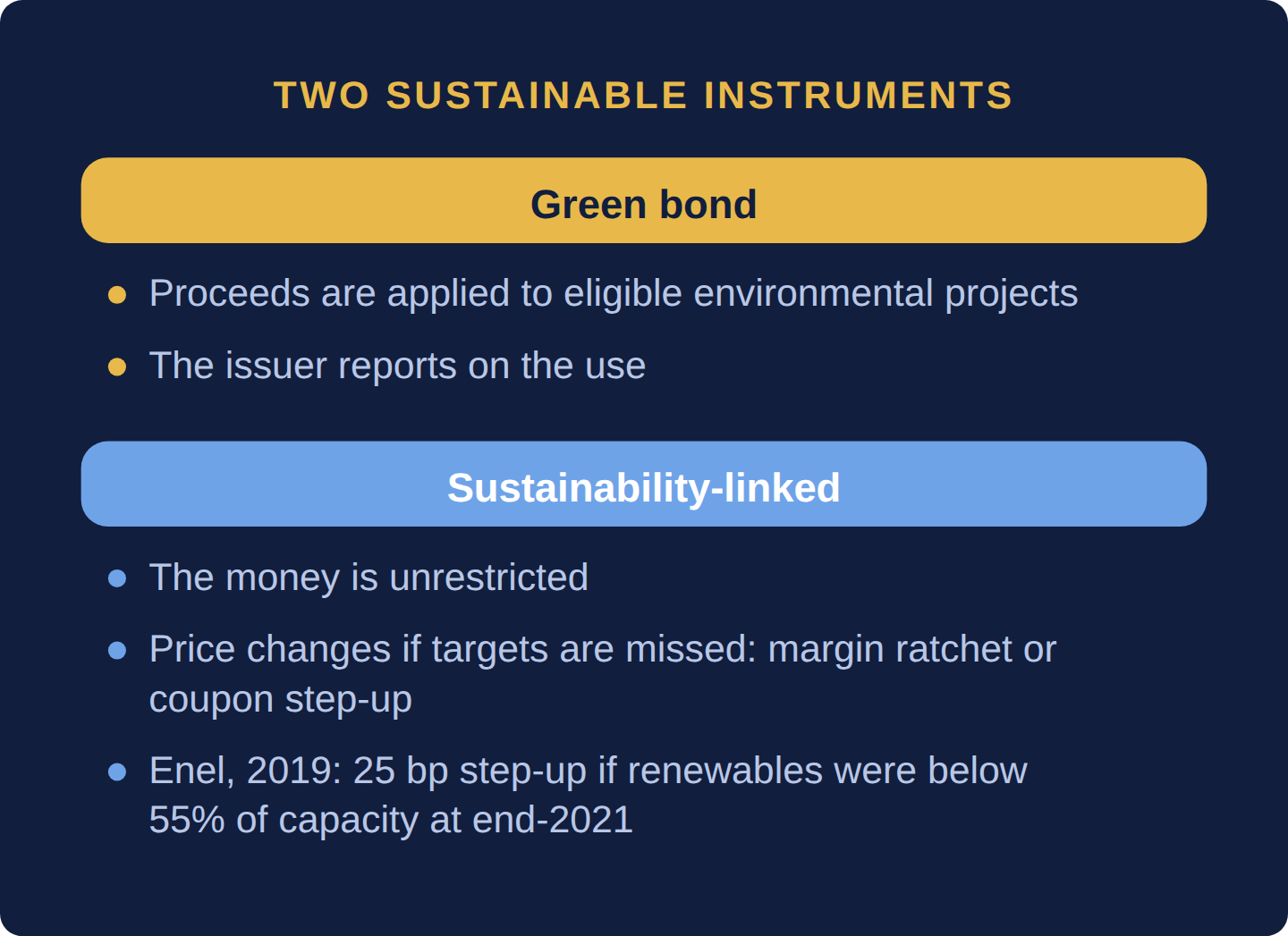
A sustainability-linked loan (SLL) takes a different structural approach from a green bond: instead of directing how the proceeds are spent, it ties the interest rate to whether the borrower meets pre-agreed sustainability performance targets, for instance a set cut in carbon emissions intensity. If the borrower meets the target, the margin steps down slightly (a margin ratchet); if it misses, the margin typically steps up. The money can be used for any corporate purpose.
A green bond is like giving someone money with the explicit condition it can only be spent on a specific approved purpose. A sustainability-linked loan is more like offering someone a discount on their rent if they hit a defined fitness goal by year-end — the money itself isn’t restricted to any specific use at all; only the price they pay changes, based on whether they actually achieve the agreed outcome.
An SLL’s targets must be specific, measurable and ambitious relative to the borrower’s own business-as-usual path; a target it would have hit anyway gives no incentive and works as marketing, not as a sustainability commitment.
The bond-market version is the sustainability-linked bond (SLB). ICMA’s Sustainability-Linked Bond Principles (June 2024 edition) set five core components: selection of key performance indicators (KPIs), calibration of sustainability performance targets (SPTs), bond characteristics, reporting, and verification. The SPTs should be “a material improvement in the respective KPIs and be beyond a ‘Business as Usual’ trajectory”, and performance must be verified independently and externally, at least annually and for every date that matters to the target. The usual bond characteristic is a coupon step-up: if the KPI misses the target on the observation date, the coupon rises for the remaining life of the bond. The first, Enel’s US$1.5 billion bond of September 2019 (coupon 2.65%, maturing 2024), promised a 25 basis point step-up if renewables were below 55% of installed capacity at December 31, 2021, against 45.9% when the bond was sold (Energynomics on Enel’s launch).
A company issues a $1 billion, 8-year SLB at a 4.50% coupon. The target is observed at the end of year 5; if it is missed, the coupon rises by 25 bps for years 6, 7 and 8. Discount at 4.5%.
- Penalty if missed, undiscounted: $1,000,000,000 × 0.0025 × 3 = $7.5 million.
- Present value today: 2.5m ÷ 1.0456 + 2.5m ÷ 1.0457 + 2.5m ÷ 1.0458 = 2.5m × 2.2059 = $5.51 million.
- Assume hitting the target needs extra abatement spending with a present value of $30 million (an illustrative figure). The rational issuer compares $30 million with $5.51 million and misses the target.
- Step-up needed to make hitting the target the cheaper path: 30,000,000 ÷ (1,000,000,000 × 2.2059) = 0.0136, about 136 bps, more than five times the 25 bps in Enel’s structure.
The same arithmetic applies to loans. A $500 million SLL with a ±5 bp margin ratchet moves interest by $500,000,000 × 0.0005 = $250,000 a year either way, a $500,000 swing between hitting and missing. For a company spending tens of millions on decarbonization, a penalty that size changes the decision only at the margin; the target’s ambition, not the price adjustment, does the work.
Judge a sustainability-linked deal by three tests. Ambition: if the target is at or below the issuer’s own published trajectory, or below what peers already achieve, it is business as usual and the structure adds nothing. Bite: compute the present value of the step-up and compare it with a rough cost of meeting the target; if the penalty is under about a fifth of that cost, assume the price adjustment will not drive behavior. Escape routes: check whether the issuer can call the bond at par before the step-up starts, whether the KPI can be recalculated after acquisitions, and who verifies it. Ignore the bite test when the target is already in the issuer’s funded capital plan; then the structure is a disclosure commitment, and should be priced as one.
Buying the step-up as if it protected you, when a call option can switch it off. If the 8-year bond above is callable at par at the end of year 5, an issuer that has missed its target can refinance before the higher coupon starts; the investor’s expected $7.5 million of extra coupons (PV $5.51 million on $1 billion, about 0.55% of face) becomes zero. Read the call schedule against the target observation date, and treat a call that falls before the step-up period as canceling the penalty.
What is the difference between a green bond and a sustainability-linked bond?
A green bond commits the issuer to spend an amount equal to the proceeds on eligible green projects; its coupon does not depend on results. A sustainability-linked bond can fund anything, but its coupon or other terms change if the issuer misses a stated sustainability target on a set date. One controls the use of money, the other prices the outcome.
How does a coupon step-up work?
The bond names a KPI, a target and an observation date. If an external verifier confirms the target was missed, the coupon rises by a fixed amount, for example 25 basis points in Enel’s 2019 bond, for the remaining interest periods. On a $1 billion bond with three years left, that is $2.5 million a year.
What makes a sustainability-linked bond weak?
A soft target and a small penalty. Targets that match what the issuer already planned add nothing, and a 25 basis point step-up can be far smaller than the cost of meeting the target, as the worked example shows (about 136 basis points would be needed there). Call options that end the bond before the step-up starts weaken the penalty further.
Sustainability-linked loans and bonds price an outcome instead of restricting the use of money, through a margin ratchet or a coupon step-up tied to verified targets. A typical 25 bp step-up can be far smaller than the cost of meeting an ambitious target, and a call before the step-up date can remove it, so judge ambition, bite and escape routes.
Six questions on this chapter. Decide on your answer first, then click “Reveal Answer.”
1. A $500 million sustainability-linked bond steps up its coupon by 25 bps for its final two years if a target is missed. What is the undiscounted extra interest if it is missed?
- $1.25 million
- $0.25 million
- $2.5 million
- $5.0 million
Reveal Answer
Answer: C. $500,000,000 × 0.0025 × 2 = $2,500,000.
2. What is the core structural difference between a green bond and a sustainability-linked bond?
- One pays a fixed coupon; the other always floats
- One needs a rating; the other is unrated
- One is issued by governments; the other by companies
- One directs proceeds; the other prices an outcome
Reveal Answer
Answer: D. Green bonds commit an amount equal to proceeds to eligible projects; SLB proceeds are unrestricted but the coupon changes with KPI performance.
3. An 8-year SLB’s step-up starts in year 6, but the issuer can call it at par at the end of year 5. It misses its target. What is the likely result for investors?
- The step-up is paid on the call date as a lump sum
- The issuer may call the bond and avoid the step-up
- The step-up doubles to compensate for the call
- The bond converts into a green bond automatically
Reveal Answer
Answer: B. A call before the step-up period lets the issuer refinance and the extra coupons never become payable.
4. Under ICMA’s Sustainability-Linked Bond Principles, how should sustainability performance targets be set?
- Beyond business as usual, verified externally
- Equal to the average of industry peers
- At the issuer’s current performance level or below
- Set by the bond’s credit rating agency
Reveal Answer
Answer: A. The principles require SPTs to be a material improvement beyond business as usual and independent external verification at least annually.
5. Worked problem: A sustainability-linked bond of $1bn pays a 25 bp step-up if the target is missed. What is the extra annual interest?
Reveal Answer
Answer: 0.0025 × $1,000m = $2.5 million a year.
6. Worked problem: If the step-up applies for the remaining 3 years, what is the total extra?
Reveal Answer
Answer: 3 × $2.5m = $7.5 million.
7.6 Greenwashing and Regulatory Response
Greenwashing means making misleading or unsupported sustainability claims. So far, enforcement has turned on the gap between what firms said they did and what they actually did, as in the SEC’s $19 million DWS and $17.5 million Invesco cases. The EU’s SFDR disclosure regime is being rewritten and is not settled.
Why it matters: The claim that gets a firm into trouble is the one it can’t back up.
Summary: Greenwashing is making misleading or unsupported sustainability claims. Enforcement so far turns on the gap between what firms said they did and what they did, as in the SEC‘s $19 million DWS and $17.5 million Invesco cases, while the EU’s SFDR disclosure regime is being rewritten and is not settled.
- The SEC charged DWS under general Advisers Act antifraud provisions, not an ESG statute; DWS also paid €25 million in Germany in 2025.
- SFDR’s Articles 8 and 9 became de facto labels; the November 2025 proposal would replace them with Transition, ESG Basics and Sustainable categories.
- As of October 2026 SFDR 2.0 is still in negotiation and would likely apply in late 2028 or 2029.
- The amended US Names Rule requires funds with ESG terms in their names to invest at least 80% consistently with the name.

Greenwashing is making misleading or unsupported claims about the environmental or sustainability credentials of a product, company or financial instrument. The enforcement cases so far have turned less on whether a fund is “green enough” in some absolute sense than on the gap between what a firm said it did and what it did. That is why enforcement in the United States runs through ordinary antifraud law, while the EU has also built a disclosure regime aimed at the claims themselves.
The EU’s Sustainable Finance Disclosure Regulation (SFDR) was written as a disclosure law, not a labeling law. It sorts products by what they claim: Article 8 products “promote” environmental or social characteristics, Article 9 products have sustainable investment as their objective, and everything else falls under Article 6. The market treated the articles as quality labels, which the Commission itself called a de facto labeling problem that amplified greenwashing concerns. SFDR is now being rewritten and should not be read as settled. The Commission’s proposal of November 20, 2025, replaces Articles 8 and 9 with three categories (Transition, ESG Basics and Sustainable), each requiring at least 70% of investments to follow the strategy the name claims, with fossil-fuel exclusions. The Council agreed its negotiating position on June 24, 2026; the Parliament’s economic committee adopted its mandate in September 2026, with a plenary vote expected in October; trilogue talks may end in late 2026 or run into 2027, and the new rules would apply roughly 18 to 24 months after adoption, likely in late 2028 or 2029. Until then, Articles 6, 8 and 9 remain the law.
In 2021 DWS’s then head of sustainability, Desiree Fixler, alleged that the Deutsche Bank asset manager overstated how far ESG was built into its investing. German police searched DWS’s Frankfurt offices in May 2022. On September 25, 2023, the SEC fined DWS’s US adviser $19 million, finding that it had marketed itself as an ESG leader but, from August 2018 until late 2021, “failed to adequately implement certain provisions of its global ESG integration policy”; the violations charged were Sections 206(2) and 206(4) of the Investment Advisers Act, the general antifraud provisions, not any ESG statute. On April 2, 2025, DWS agreed to pay €25 million to settle the Frankfurt prosecutor’s case over statements made from 2020 to 2023, reported as the largest such penalty in Germany (D&O Diary, April 2025).
The SEC’s Invesco order follows the same logic. Invesco said that 70% to 94% of its parent’s assets under management were “ESG integrated” when much of that sat in passive ETFs that did not consider ESG at all; on November 8, 2024, it paid a $17.5 million penalty (SEC, 2024-179). In neither case did the regulator decide what ESG investing should be. It compared written policies and marketing with what investment teams did, which is why the compliance answer is documentation: a policy you can evidence trade by trade, or no claim.
US fund names are the other front. The SEC’s 2023 amendments to the Names Rule (Rule 35d-1) extend the requirement to invest at least 80% of assets in line with the name to funds whose names suggest “a thematic investment focus, such as the incorporation of one or more Environmental, Social, or Governance factors” (SEC, September 20, 2023). After a March 2025 extension, larger fund groups had to comply from June 11, 2026, and smaller groups by December 11, 2026; in February 2026 the SEC pushed the related Form N-PORT reporting to November 17, 2027, and May 18, 2028 (Simpson Thacher, April 2025; SEC, February 2026). A fund called “ESG” or “Sustainable” therefore needs an 80% policy and a definition of the term it can defend.
If you write or approve an ESG claim, every sentence must map to a policy, a data point and a record showing the policy was followed; if any of the three is missing, cut the sentence. If a claim covers a share of assets (“90% ESG integrated”), the numerator must exclude every portfolio where the process is not actually applied, passive funds included. If a fund’s name uses an ESG term, it needs an 80% investment policy under the Names Rule and, if sold in the EU, a category that will survive SFDR 2.0’s 70% thresholds. As a fund buyer, ask for the exclusion list, the 80% or 70% calculation and one recent example of ESG changing a decision; a manager who cannot supply them is selling a label.
Letting marketing describe a process the investment teams do not follow. DWS’s penalties alone came to $19 million from the SEC and €25 million in Germany, before legal costs, years of investigation and the reputational damage of a police search; Invesco paid $17.5 million for one overstated percentage. In each case the fix would have cost far less: either implement the policy as written and keep the evidence, or describe the process as it actually was. The DWS statement that “in the past our marketing was sometimes exuberant” is the cheapest lesson in this Part.
What is greenwashing in finance?
It is marketing a fund, bond or firm as more sustainable than it is, for example by claiming ESG analysis is applied to assets where it is not. Regulators usually test the claim against the firm’s own policies and records, as the SEC did with DWS ($19 million, 2023) and Invesco ($17.5 million, 2024).
What is the difference between Article 8 and Article 9 funds?
Under the current SFDR, an Article 8 fund promotes environmental or social characteristics, while an Article 9 fund has sustainable investment as its objective. They are disclosure categories, not quality labels. The November 2025 proposal would replace them with Transition, ESG Basics and Sustainable categories, but as of October 2026 it is still being negotiated.
Does the SEC have a greenwashing rule?
Not a dedicated one. The SEC brings ESG cases under general antifraud and compliance provisions of the Investment Advisers Act, and the amended Names Rule requires funds with ESG terms in their names to invest at least 80% of assets consistently with the name.
Greenwashing enforcement, as in the DWS and Invesco cases, tests firms’ claims against their own policies and records under ordinary antifraud law. The EU’s SFDR Articles 8 and 9 still apply but are being replaced through negotiations that were unfinished in October 2026, and US funds with ESG names must follow the Names Rule’s 80% policy.
Six questions on this chapter. Decide on your answer first, then click “Reveal Answer.”
1. On what basis did the SEC fine DWS’s US adviser $19 million in September 2023?
- It used an unapproved ESG rating provider
- It did not implement the ESG policy it marketed
- It broke the EU’s SFDR Article 9 rules
- Its funds held shares of fossil-fuel producers
Reveal Answer
Answer: B. The SEC found that from August 2018 to late 2021 DWS failed to implement provisions of its global ESG integration policy, charged under Advisers Act antifraud provisions.
2. Under the amended Names Rule, a US fund with “ESG” in its name must invest what share of its assets in line with the name?
- At least 90%
- At least 65%
- At least 80%
- At least 70%
Reveal Answer
Answer: C. The 2023 amendments extend the 80% investment policy to names suggesting a thematic focus such as ESG factors.
3. As of October 2026, what is the legal status of SFDR’s Article 8 and Article 9 categories?
- They still apply while SFDR 2.0 is negotiated
- They were abolished in November 2025
- They apply only to funds launched before 2024
- They were replaced by EU taxonomy labels in 2026
Reveal Answer
Answer: A. The Commission’s November 20, 2025, proposal is still in negotiation between the Council and Parliament; until it is adopted and applies, Articles 6, 8 and 9 remain law.
4. A manager reports that 90% of its assets are “ESG integrated”, counting its passive index funds that do not use ESG data. What is the problem?
- Passive funds cannot legally be counted as assets
- ESG integration must be measured by a rating agency
- The figure must be reported under SFDR Article 9
- It counts assets where no ESG process applies
Reveal Answer
Answer: D. This mirrors the SEC’s Invesco order: a share-of-assets claim must exclude portfolios where the process is not applied.
5. Worked problem: A fund charges 0.50% on $8bn of ESG-labeled assets. What is annual fee revenue, and what is a $19m settlement as a share of it?
Reveal Answer
Answer: Revenue = 0.5% × $8bn = $40m. $19m ÷ $40m = 47.5%.
6. Worked problem: A fund claims 90% of holdings meet its ESG criteria, but an audit finds 63%. How many percentage points is the gap?
Reveal Answer
Answer: 90 − 63 = 27 points: the sort of gap enforcement cases focus on.
- SEC press release 2023-194 (DWS) — $19 million ESG penalty, September 25, 2023
- SEC press release 2024-179 (Invesco) — $17.5 million penalty for 70–94% ESG-integrated claim
- SEC press release 2023-188 (Names Rule amendments) — 80% policy extended to ESG-themed names
- European Commission, SFDR review proposal (November 20, 2025) — SFDR 2.0 proposal and its rationale
- SEC, February 2026