
8.7 ESG and Sustainable Finance
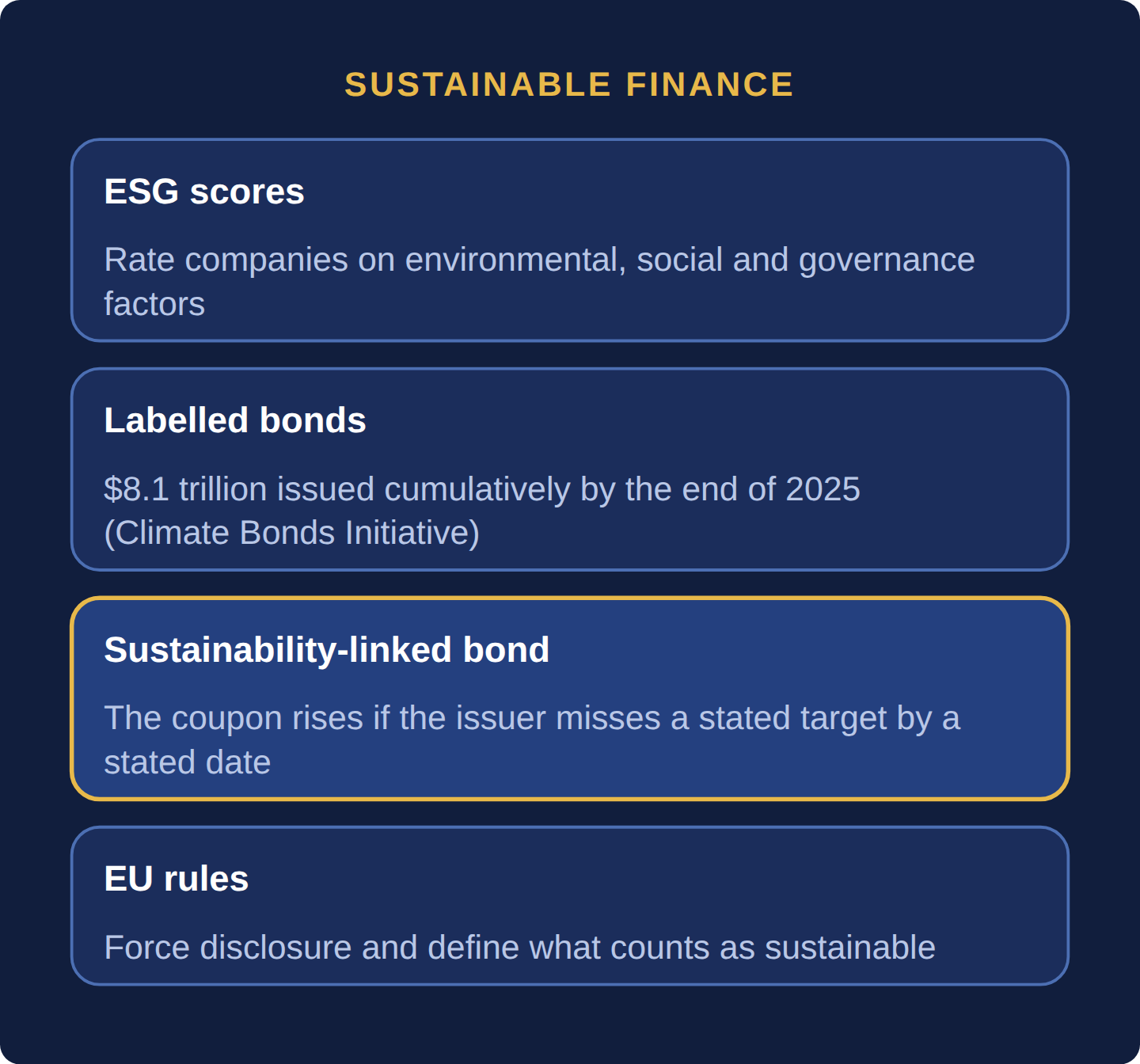
ESG scores companies on environmental, social and governance factors, and sustainable finance turns them into products such as green and sustainability-linked bonds. EU rules force disclosure and define what counts as sustainable.
Why it matters: It shows how ESG moves from a score to real financial products.
Summary: ESG scores companies on environmental, social and governance factors, and sustainable finance turns them into products such as green and sustainability-linked bonds. EU rules force disclosure and define what counts as sustainable.
- Cumulative issuance of green, social, sustainability and sustainability-linked bonds reached $8.1 trillion by the end of 2025, according to the Climate Bonds Initiative.
- In a sustainability-linked bond the coupon is tied to the issuer hitting specific ESG targets, so it rises if the company misses a stated emissions target by a stated date.
- Under the EU’s SFDR, Article 8 funds promote environmental or social characteristics and Article 9 funds have sustainable investment as their objective; the Commission proposed a revision on November 20, 2025, so check the current text.
ESG stands for Environmental, Social, and Governance — a framework that investors increasingly use to evaluate companies on non-financial factors alongside traditional financial performance. What began as a consideration in ethical investment portfolios two decades ago has become mainstream in global capital markets, driven by institutional investor demand, growing investor interest in how ESG factors may affect long-term risk, although the evidence on returns is mixed, and the weight of mandatory regulatory disclosure requirements in major markets.
| Pillar | What It Covers | Example Metrics |
|---|---|---|
| Environmental (E) | Impact on the natural environment — climate change, carbon emissions, water usage, waste management, biodiversity, physical climate risk exposure | Scope 1 (direct) and Scope 2 (purchased energy) carbon emissions; Scope 3 (value chain) emissions; energy intensity; water withdrawal; deforestation exposure in supply chains |
| Social (S) | Treatment of people — employees, supply chain workers, communities in which the company operates, and the customers it serves | Employee diversity (gender, ethnicity, seniority); pay equity ratio; human rights policies in supplier contracts; customer data privacy practices; community investment spend |
| Governance (G) | Quality of corporate leadership, accountability, and transparency — board independence, executive remuneration, anti-corruption policies, audit quality | Percentage of independent board directors; CEO-to-median-worker pay ratio; lobbying disclosure; tax transparency; auditor tenure and audit quality |
Key sustainable finance products: Green bonds — bonds whose proceeds are contractually earmarked for environmentally beneficial projects (renewable energy, clean transport, sustainable buildings). By the end of 2025, cumulative issuance of green, social, sustainability and sustainability-linked bonds had reached $8.1 trillion, according to the Climate Bonds Initiative. Sustainability-linked bonds (SLBs) — where the interest rate is explicitly tied to the issuer achieving specific ESG targets (e.g., a company’s coupon rises if it fails to reduce its Scope 1 emissions by a stated percentage by a stated date). ESG-screened investment funds — which exclude certain sectors (tobacco, weapons, fossil fuels) or weight companies by ESG scores.
The EU’s Sustainable Finance Disclosure Regulation (SFDR) requires firms offering financial products in the EU to disclose their ESG characteristics — whether they promote environmental or social characteristics (Article 8 funds) or have sustainable investment as their objective (Article 9 funds). The European Commission proposed a revision of the regulation on November 20, 2025, so check the current text before relying on the article numbers. The EU Taxonomy defines specifically which economic activities qualify as environmentally sustainable — creating a standardized green labeling system for the first time. Both regulations are already reshaping how global financial institutions design and market their products, because any product offered to EU investors must comply regardless of where it is managed.
ESG literacy is no longer a specialization — it is a baseline expectation in most major financial institutions globally. Whether you work in equity research (ESG factors are now standard in most analytical frameworks), operations (ESG data validation and regulatory reporting are growing compliance requirements), risk management (physical and transition climate risks are now incorporated into stress testing), or client services (institutional clients increasingly ask about the ESG characteristics of the products they hold), you will encounter ESG as a professional requirement. The professionals who understand it substantively — not just as a label — will handle client conversations and regulatory discussions far more effectively.
What is ESG?
A way of scoring companies on environmental, social and governance factors.
How big is the sustainable bond market?
Cumulative issuance of green, social, sustainability and sustainability-linked bonds reached $8.1 trillion by the end of 2025, according to the Climate Bonds Initiative.
What is a sustainability-linked bond?
A bond whose coupon is tied to the issuer hitting specific ESG targets, so it rises if the company misses a stated emissions target by a stated date.
ESG scores companies on environmental, social and governance factors, and sustainable finance turns them into products such as green and sustainability-linked bonds ($8.1 trillion of cumulative issuance by end-2025, per the Climate Bonds Initiative). EU rules (SFDR and the EU Taxonomy) force disclosure and define what counts as sustainable.
Four questions and two worked problems on this chapter. Decide on your answer first, then click “Reveal Answer.”
1. A company’s coupon rises if it fails to hit a stated emissions target. Which product is this?
- An Article 9 fund
- A bond with a call option
- A sustainability-linked bond
- A green bond
Reveal Answer
Answer: C. Sustainability-linked bonds tie the interest rate to ESG targets; green bonds earmark proceeds.
2. Which pillar covers board independence and audit quality?
- Governance
- Social
- Taxonomy
- Environmental
Reveal Answer
Answer: A. Board independence, executive pay and audit quality are governance metrics.
3. Which describes Scope 3 emissions?
- Direct emissions from the company’s own sources, such as boilers and company vehicles
- Emissions from the electricity the company buys, counted at the power station
- Emissions offset by planting trees, which are subtracted from the total reported
- Emissions in the value chain, outside the company’s own operations and purchased energy
Reveal Answer
Answer: D. Scope 1 is direct, Scope 2 is purchased energy, Scope 3 is the value chain.
4. A fund promises sustainable investment as its objective. Under the EU’s SFDR, what is it?
- An Article 8 fund, which promotes characteristics only
- A green bond fund, which must hold only green bonds
- An Article 9 fund
- A taxonomy-labeled fund, by definition of the term
Reveal Answer
Answer: C. Article 8 funds promote characteristics; Article 9 funds have sustainable investment as the objective.
5. Worked problem: A green bond raises $500m and the issuer has allocated $380m to eligible projects. What share is allocated?
Reveal Answer
Answer: 380 ÷ 500 = 76%, leaving $120m to allocate.
6. Worked problem: A ‘greenium’ of 5 basis points lowers the coupon on $500m. What is the annual saving?
Reveal Answer
Answer: 0.0005 × $500m = $250,000 a year.
8.8 The Full Chain — From the Global Economy to Your Daily Work
One thread runs from a rate decision to a reconciliation break: administered rates move, repo funding costs reprice overnight, collateral loses value as yields rise, margin calls follow, settlements fail and breaks land in the exception queue.
Why it matters: It links the macro world to the back-office desks that feel it first.
Summary: One thread runs from a rate decision to a reconciliation break: administered rates move, repo funding costs reprice overnight, collateral loses value as yields rise, margin calls follow, settlements fail and breaks land in the exception queue.
- On September 16, 2026, the FOMC raised the federal funds target range by 0.25 point to 3.75%–4.00%, moving interest on reserve balances to 3.90% and the overnight reverse repo rate to 3.75%.
- The effective federal funds rate went from 3.63% on September 16 to 3.88% on September 17, and SOFR from 3.62% to 3.85%.
- The 10-year Treasury yield rose from 5.01% on September 16 to 5.29% on September 30.
- A fund holding $200 million of 10-year notes with a modified duration of about 7.85 faces a $4,396,000 margin call after that 0.28-point rise.
- The fund wires the margin the next morning, but the payment goes to an outdated settlement instruction and is returned, creating a linked cash and collateral break.
Every concept in Parts 0 to 8 is part of a single, continuous, interconnected system. Nothing stands alone. The chain below traces the journey from the largest possible scale down to the daily work of the professionals who keep it all running; the prose after it then follows one thread of that chain, from a single rate decision to a single reconciliation break.
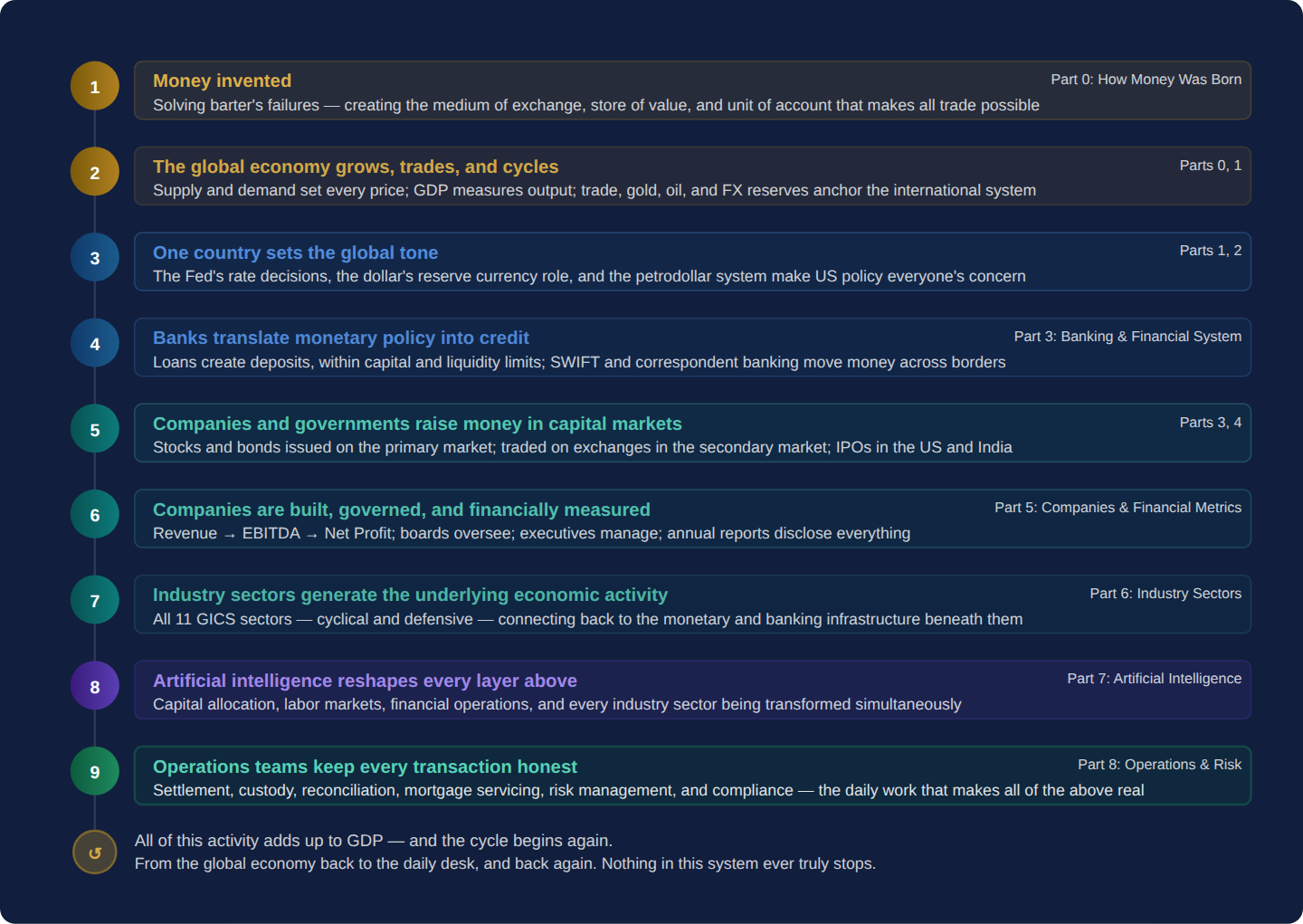
From a rate decision to a reconciliation break. The chart compresses the whole book into ten steps. Here is one thread of it at full resolution, using the real rate moves of September 2026.
1. The decision. On September 16, 2026, the FOMC raised the federal funds target range by 0.25 point, to 3.75%–4.00%. It did so by moving its administered rates, effective the next day: interest on reserve balances (IORB) to 3.90% and the overnight reverse repo (ON RRP) rate to 3.75% (Section 2.10: The Federal Funds Rate: How the Fed Actually Sets the Price of Money). No bonds had to be bought or sold.
2. Funding costs reprice overnight. Because banks and money funds can earn those rates from the Fed, they will not lend overnight for less. The effective federal funds rate went from 3.63% on September 16 to 3.88% on September 17, and SOFR, the rate on overnight repo loans backed by Treasuries, from 3.62% to 3.85%. Every dealer and fund that finances its securities in repo paid more from the first night.
3. Collateral loses value. Longer yields move on expectations, not by decree: the 10-year Treasury yield rose from 5.01% on September 16 to 5.29% on September 30. A bond’s price falls by roughly its modified duration times the rise in its yield, so every Treasury pledged as collateral was suddenly worth less.
4. Margin calls. A repo lender re-marks its collateral every day. When the collateral is worth less than the loan plus the agreed haircut (the safety cushion the lender keeps), it issues a margin call for more cash or securities, typically due the next morning. Clearing houses collect variation margin on the same logic (Section 11.1: The Plumbing — Clearing Houses, Depositories, and Custodians).
5. Settlements fail. A firm short of cash or collateral at a cutoff fails somewhere: its margin payment misses the window, or it sells securities it had already promised to deliver elsewhere and that delivery fails. With US settlement at T+1, one business day separates the price move from the delivery (Section 8.2: Capital Markets Operations — The Trade Lifecycle).
6. Breaks appear. The next morning each failure surfaces as a break: the firm’s books show collateral sent or securities delivered that the counterparty’s or custodian’s statement does not. One root cause can show up in the position step and the cash step at once; the discipline is to log it once, under the earliest step, and link the rest (Section 8.3: Reconciliation — Financial Bookkeeping at Massive Scale).
7. Exceptions are escalated. A margin break cannot be left to age, because an unmet call lets the lender declare a default and sell the collateral. That is how a sentence in an FOMC statement becomes a line in an operations exception queue within days, as margin calls accumulate.
A fund holds $200 million (market value) of 10-year Treasury notes with a modified duration of about 7.85, financed in repo with a 2% haircut. The position is illustrative; the rate moves are the actual ones of September 16-30, 2026, so the $4.4 million is cumulative; daily re-marking would have called it in pieces.
| Step | Formula | Result |
|---|---|---|
| Repo loan against the notes | $200,000,000 × (1 − 0.02) | $196,000,000 |
| Extra overnight funding cost | $196,000,000 × (3.85% − 3.62%) ÷ 360 | ≈ $1,252 a day |
| Fall in collateral value (cumulative, Sept 16-30) | $200,000,000 × 7.85 × (5.29% − 5.01%) | ≈ $4,396,000 |
| Collateral the lender requires | $196,000,000 ÷ (1 − 0.02) | $200,000,000 |
| Margin call | $200,000,000 − ($200,000,000 − $4,396,000) | $4,396,000 |
The fund wires $4,396,000 the next morning, but the payment goes to an outdated settlement instruction and is returned. The fund’s ledger shows the call paid, the dealer’s margin statement shows it unpaid, and the bank statement shows the cash back. The morning reconciliation raises a $4,396,000 cash break and a collateral break against the dealer, linked to one root cause (stale reference data), and both go to the head of operations the same morning because an unmet call can trigger a default notice. The instruction is corrected, the call is paid, both breaks close, and the stale-instruction count becomes a key risk indicator for the data team.
The same chain runs in every currency. In India the trigger is the RBI’s repo rate and the plumbing runs through CCIL and NSE Clearing (Section 10.2: The Reserve Bank of India — The Economy’s Guardian and the India Lens below); Part 9: The Other Giants follows it through China, Japan and the eurozone; Part 11: The Post-Trade World takes the post-trade machinery of this Part to full professional depth. Underneath every term so far is something simple: people trying to trade fairly, build things, borrow and lend responsibly, price risk accurately, and keep their promises to each other — with institutions and rules in place to help make sure that mostly happens. The operations desks of this Part are where those promises are checked, line by line, every day.
1. A trade breaks: the custodian’s records show 10,000 shares, the fund’s internal books show 11,000. Walk the investigation in order — trade, position, cash — and explain why that sequence saves time. 2. The Fed cuts rates 0.5%. Trace the effect to a Bengaluru mortgage-processing team’s workload within 90 days. 3. Your operations team’s error rate is stable, but aged breaks are rising. Which is the leading indicator, what is it warning about, and what would you check first?
How does a Fed rate decision reach operations teams?
Administered rates move, repo funding costs reprice overnight, collateral loses value as yields rise, margin calls follow, settlements fail and breaks land in the exception queue.
What happened on September 16, 2026?
The FOMC raised the federal funds target range by 0.25 point to 3.75%–4.00%, moving interest on reserve balances to 3.90% and the overnight reverse repo rate to 3.75%.
How fast did market rates respond?
The effective federal funds rate went from 3.63% on September 16 to 3.88% on September 17, and SOFR from 3.62% to 3.85%.
India finished moving its equity market to T+1 on January 27, 2023, sixteen months before the US, and on March 28, 2024, added an optional same-day (T+0) cycle for 25 stocks, which SEBI widened in December 2024 to the top 500 companies by market capitalization. The clearing houses split by market. Equities clear through NSE Clearing or the Indian Clearing Corporation (ICCL, BSE’s clearing corporation), which have been interoperable since 2019, so a broker can clear trades from either exchange through one of them. CCIL, incorporated in April 2001 and clearing government securities since February 2002, is the central counterparty for government securities, money markets and foreign exchange. NSE Clearing keeps a core settlement guarantee fund of over ₹12,000 crore, more than ₹5,300 crore of it its own money, and tracks positions and collateral client by client for crores of registered client accounts.
India’s answer to CASS is structural. Under SEBI’s June 8, 2023, circular, brokers may not retain client funds at the end of the day: they must upstream them to the clearing corporation as cash, fixed deposits lien-marked to it, or pledged units of overnight mutual funds. Sell shares worth ₹5 lakh on a Monday and the trade settles on Tuesday; any of your cash left with the broker on Monday night sits with the clearing corporation, not on the broker’s balance sheet. The rate end of the chain, from the RBI’s repo rate to a floating-rate EMI, is in Section 10.2: The Reserve Bank of India — The Economy’s Guardian.
One thread runs from a rate decision to a reconciliation break: administered rates move, repo funding costs reprice overnight, collateral loses value as yields rise, margin calls follow, settlements fail, and breaks land in the exception queue. In the worked example a 0.28-point rise in the 10-year yield turns into a $4,396,000 margin call on $200 million of notes and, through one stale settlement instruction, a linked cash and collateral break.
Four questions and two worked problems on this chapter. Decide on your answer first, then click “Reveal Answer.”
1. In the worked example, a 0.28-point rise in the 10-year yield hits $200 million of notes with duration 7.85. What is the fall in collateral value?
- About $4,396,000, from $200M × 7.85 × 0.28%
- About $1,252, from the extra funding cost
- About $439,600, from $200M × 7.85 × 0.028%
- About $43,960,000, from $200M × 7.85 × 2.8%
Reveal Answer
Answer: A. $200,000,000 × 7.85 × 0.0028 = $4,396,000.
2. Which is the correct order in the chain from a rate decision to a reconciliation break?
- Rate decision, breaks, margin calls, collateral loses value, funding costs reprice, failed settlements
- Rate decision, funding costs reprice, collateral loses value, margin calls, failed settlements, breaks
- Funding costs reprice, breaks, rate decision, collateral loses value, margin calls, failed settlements
- Margin calls, rate decision, failed settlements, funding costs reprice, breaks, collateral loses value
Reveal Answer
Answer: B. Each step causes the next, ending in the exception queue.
3. A lender re-marks collateral daily and finds it is worth less than the loan plus haircut. What does it issue?
- A confirmation of the original trade
- A rate reset on the repo agreement
- A margin call for more cash or securities
- A netting notice of offsetting trades
Reveal Answer
Answer: C. The haircut is the cushion; when collateral value drops below it, a margin call follows.
4. Why must an unpaid margin break be escalated within hours?
- An unmet call lets the lender declare a default and sell the collateral
- The Fed requires every break to be reported the same day to it
- Margin breaks automatically change the policy rate for the lender
- Unmatched items disappear from the ledger overnight if not resolved
Reveal Answer
Answer: A. That is how an FOMC decision becomes an operations exception within days.
5. Worked problem: A dealer funds $50bn through overnight repo and the rate rises 0.25 point. What is the extra one-day cost (actual/360)?
Reveal Answer
Answer: $50bn × 0.0025 ÷ 360 = $347,222 a day.
6. Worked problem: Over a year at the higher rate, what is the extra cost?
Reveal Answer
Answer: $50bn × 0.0025 = $125 million.
- ICMA, Green Bond Principles — The voluntary guidelines for green bonds
- European Commission, EU taxonomy for sustainable activities — The EU classification of sustainable economic activities
- European Commission, Sustainability-related disclosure in the financial services sector — The EU disclosure rules for sustainable investment products
- New York Fed, SOFR — SOFR before and after the Sept 2026 decision (Section 8.8; Part 12)
- New York Fed, EFFR — Effective federal funds rate, Sept 16-17, 2026 (Section 8.8; Part 12)
- FOMC implementation note, September 16, 2026 — Target range 3.75–4.00%, IORB 3.90%, ON RRP 3.75%, standing repo 4.0%, primary credit 4.0%, reserve-management bill purchases (Sections 2.3, 2.10, 3.2, 3.3, 8.8; Part 12)
- US Treasury, daily par yield curve rates (2026) — 10-year yield 5.01% to 5.29% (Sections 8.4, 8.8; Part 12)