
Banks make a lot of money from small fees, and the biggest is the overdraft fee, charged when you spend more than you have. You can usually avoid it by saying no to overdraft coverage on debit card purchases, keeping a small cushion in the account, and turning on low-balance alerts. When choosing where to bank, compare fees, interest rates and how easy it is to reach your money. Banks, credit unions and online banks all carry the same federal insurance, so safety is not what separates them.
Why it matters: Most of these fees can be avoided with two settings and a small cushion.
Summary: Most overdraft fees are avoidable: do not opt in to overdraft coverage for debit and ATM transactions, keep a small buffer, and set a low-balance alert. Then choose where to bank on fees, rates and access, because banks, credit unions and online banks carry the same $250,000 federal insurance.
- There is no federal cap on overdraft fees; the median at large banks charging one was $35 (CFPB, 2023).
- A $34 fee on a $24 overdraft repaid in three days costs as much as a loan at about 17,000% APR.
- The opt-in protection covers ATM and one-time debit transactions only, not checks or automatic bills.
Throughout this volume we follow a single filer earning $75,000, with $2,343.90 a month of essential spending (1.4).
An overdraft happens when a bank pays a transaction anyway even though the account doesn’t have enough money to cover it, then charges a fee for having done so. A non-sufficient funds (NSF) fee is the reverse — the bank declines the transaction and charges a fee regardless. Both exist because of the same underlying event: spending or a scheduled payment exceeding the available balance.
This is an unsettled area of regulation as of 2026, worth understanding precisely because it has moved. In December 2024, the Consumer Financial Protection Bureau finalized a rule capping overdraft fees at large banks (over $10 billion in assets) at $5, or at the bank’s actual cost of providing the service. In March and April 2025, Congress voted to repeal that rule under the Congressional Review Act, and the President signed the repeal on May 9, 2025 — the rule never took effect, and by law the CFPB cannot issue a substantially similar rule again without new legislation. There is currently no federal cap on overdraft fees, and the traditional fee — commonly around $35 per overdraft — remains legal at banks that still choose to charge it.
The CFPB found that most debit-card overdraft fees were triggered by purchases of $24 or less, that the median fee was $34, and that more than half of overdrawn consumers were back above zero within three days. As an annual rate: $34 ÷ $24 × 365 ÷ 3 = 172.4, or about 17,000%. The revenue is concentrated: in 2011–2012 account data, the 9% of accounts at the study banks with more than ten overdraft and NSF items a year paid 79% of all overdraft and NSF fees. So the default matters more than the price: since 2010, no opt-in has meant no ATM or debit overdraft fee.
The repeal of the federal cap does not mean overdraft fees are back to where they were a decade ago. Separately from that rule, overdraft and NSF revenue at banks with over $1 billion in assets had already fallen by more than half between 2019 and 2023 ($11.96 billion to $5.83 billion, CFPB), as competitive pressure pushed many banks to voluntarily eliminate NSF fees entirely, add small buffer amounts before a fee triggers, or offer short grace periods to cover the shortfall before charging anything. Whether your own bank is one of them is worth checking directly — the answer varies enormously by institution, and isn’t governed by federal rule either way.
One consumer protection in this area is stable and has applied since 2010: under Regulation E (written by the Federal Reserve, now administered by the CFPB), a bank cannot charge an overdraft fee on an ATM withdrawal or everyday debit card purchase unless you have specifically opted in to “overdraft coverage” for those transaction types. Without that opt-in, the transaction is simply declined at no charge — no fee, no surprise. Most accounts default to not opted in, but it’s worth confirming directly with your bank, and opting out deliberately if you’d rather a purchase be declined than covered for a fee.
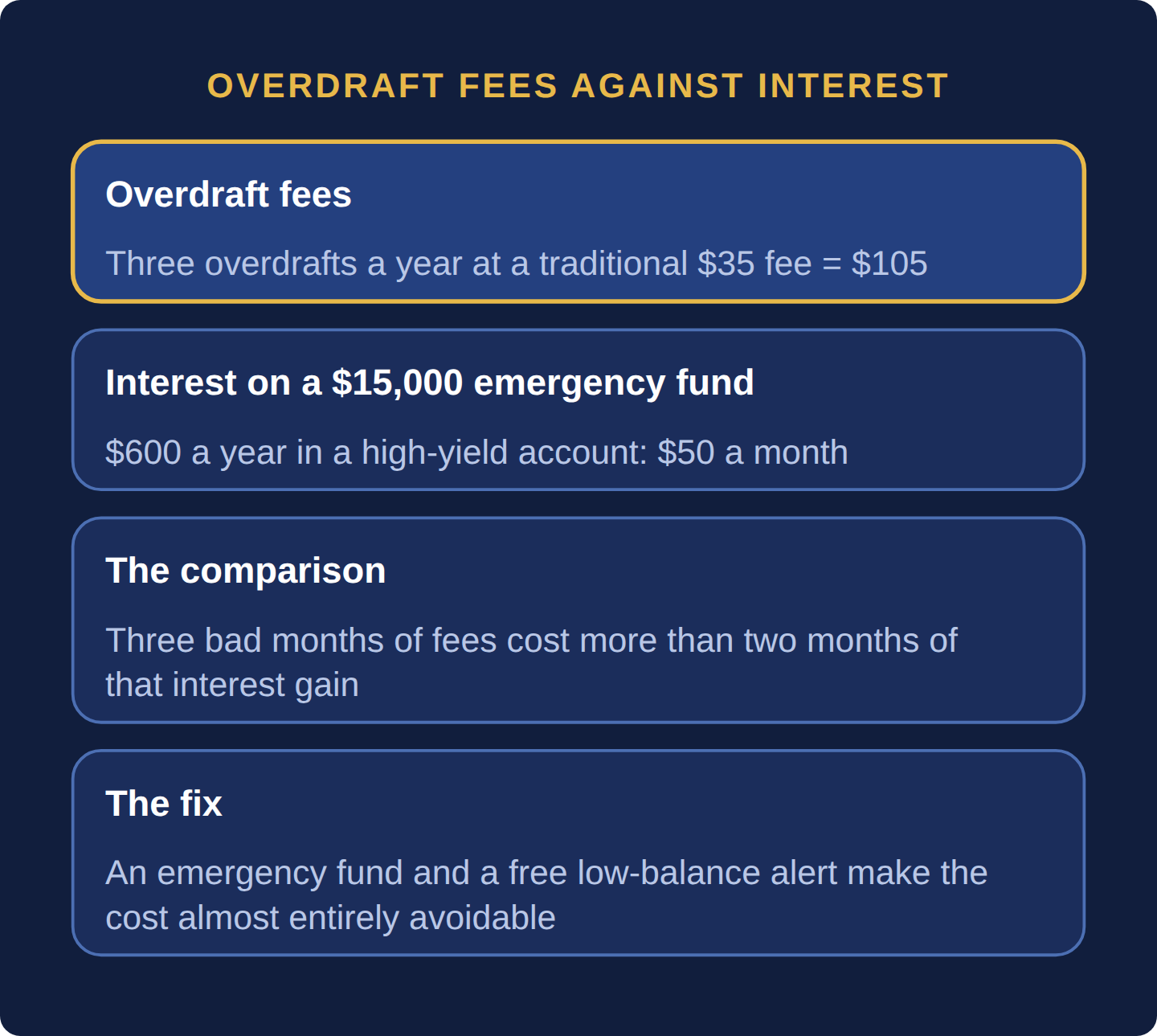
Three overdrafts in a year at a traditional $35 fee = $105. Compare that to 2.1’s finding that a full $15,000 emergency fund (about the household’s six-month target) earns $600 a year simply by sitting in a high-yield account instead of a checking account paying nothing — the fee from three bad months would consume more than two months’ worth of that interest gain ($600 ÷ 12 = $50 a month, against $105 of fees). An emergency fund and a low-balance alert (most banking apps offer these free) together make this cost almost entirely avoidable.
| Situation | What changes | Why | Number or rule |
|---|---|---|---|
| You opted in to debit overdraft coverage | ATM and debit overdrafts can be paid and charged | The opt-in lifts the Regulation E default | Revoke it at any time; past fees stay |
| Checks, ACH bills, recurring debit payments | Paid for a fee or returned, by bank policy | The opt-in rule covers only ATM and one-time debit | Date autopays after payday (1.5) |
| A pending or deposit hold | Available balance below the ledger balance | Card holds (2.2); Regulation CC holds (2.1: Checking vs Savings — What Each Is Actually For) | Spend against “available,” never “current” |
| Account closed with a negative balance | New banks may refuse you | Reported to checking-account reporting companies such as ChexSystems | ChexSystems keeps records five years (the law allows up to seven for most items); one free report a year; dispute errors |
| Refused a regular account | Second-chance or Bank On–certified accounts | Built without overdraft | Bank On standard: no overdraft or NSF fees, ≤ $25 to open, ≤ $5 monthly fee (≤ $10 if waivable) |
All three hold deposits and offer largely the same core products, but their underlying structure — who actually owns the institution — shapes rates, fees, and service in predictable ways.
| Traditional Bank | Credit Union | Online-Only Bank | |
|---|---|---|---|
| Ownership | For-profit, owned by shareholders | Nonprofit, owned by its own members | For-profit, usually owned by a parent company or fintech |
| Typical rates & fees | Lower savings rates, more fee income (Part 2.4: Overdraft & NSF Fees — and Avoiding Them) | Often lower loan rates and fewer fees than banks, because profit is returned to members | Frequently the best savings rates of all three — no branch network to fund |
| Deposit insurance | FDIC, up to $250,000 per depositor, per bank, per ownership category | NCUA (National Credit Union Administration), same $250,000 structure | FDIC, directly when the firm is itself a chartered bank (check BankFind); an app that is not a bank relies on pass-through coverage at a partner bank (2.6) |
| Access | Physical branches, large ATM networks | Fewer branches, but often shared ATM/branch networks across credit unions | No branches; relies on mobile deposit and large fee-free ATM networks |
| Who can join | Anyone | Membership eligibility required — an employer, geography, or association, though many have broadened this considerably | Anyone, usually with instant online signup |
Average fees from Bankrate’s 2025 survey; forgone interest = extra balance × (4.00% − account APY) × (1 − 22%). The household already keeps $4,687.80 in checking.
| Account | Arithmetic | Cost a year |
|---|---|---|
| A. Branch checking, $5.47 monthly fee not waived | $5.47 × 12 | $65.64 |
| B. Interest checking, $15.65 fee waived by a $10,705 balance | ($10,705 − $4,687.80) × (4.00% − 0.07%) × 0.78 | $184.45 |
| C. Online checking, no fee, 12 out-of-network ATM withdrawals | 12 × $4.86 | $58.32 |
Flip points: a balance-based waiver beats paying the fee only if the interest forgone on the extra balance is less than the fee: for a $5.47 fee on an account paying nothing, an extra balance under $65.64 ÷ (4.00% × 0.78) = $2,103.85; for B’s $15.65 fee, under $187.80 ÷ (3.93% × 0.78) = $6,126.44, so B’s waiver ($184.45) only just beats paying B’s $187.80 fee, and both cost more than A or C. The online account beats A until out-of-network withdrawals exceed $65.64 ÷ $4.86 = 13.5 a year; use its fee-free network and it costs nothing. A fee waived by direct deposit costs nothing.
The $250,000 FDIC/NCUA insurance figure is per depositor, per institution, per ownership category — not per account. A single person with a checking and a savings account at the same bank is covered up to $250,000 combined across both, not $250,000 each; but that same person adding a joint account with a spouse at the same bank gets a separate $250,000 of coverage for that joint category. Households holding significantly more than $250,000 in cash at one institution should split it across institutions or account categories to stay fully insured (2.6 covers every category).
If your checking costs more than about $60 a year in maintenance and ATM fees, or you paid more than one overdraft or NSF fee in the past 12 months, then move to a no-monthly-fee account, decline debit overdraft coverage, and set a low-balance alert at one week of needs ($2,343.90 × 12 ÷ 52 = $540.90 here). Assumes switching takes a few hours once. Ignore it if the account earns you something worth more, such as a mortgage-rate discount, or you deposit cash often.
Opting in, then running near zero. The day before payday, with $0 available, four debit purchases of $6, $12, $9 and $15 ($42) are each paid as an overdraft at a bank charging $35 per item with no daily cap: 4 × $35 = $140, or 333% of what was bought. Without the opt-in, all four would have been declined free. How to avoid it: revoke the opt-in and keep the $540.90 alert.
How do I avoid overdraft fees?
Decline overdraft coverage for ATM and everyday debit transactions, so a shortfall is declined free. Cover checks and automatic bills, which that rule does not reach, with a buffer and a low-balance alert.
Are credit unions safer than banks?
For deposits within the limit, neither is safer: NCUA and FDIC insurance both cover $250,000 per depositor, per institution, per ownership category (2.6).
Is an online bank safe?
If it is itself an FDIC-insured bank, yes, to the same limits; look it up in the FDIC’s BankFind. An app holding your money at a partner bank is a different case (2.6).
Can I be denied a checking account for past overdrafts?
Yes. Banks screen applicants through reporting companies such as ChexSystems, where an unpaid negative balance generally stays on file for five years. Get your free annual report and dispute errors.
An overdraft is a payment the bank covers anyway for a fee; an NSF fee is charged when it declines the payment instead. The CFPB’s December 2024 rule capping large banks’ overdraft fees at $5 was repealed in May 2025 before it took effect, so as of 2026 there is no federal cap and a fee of around $35 remains legal, although many banks have cut or dropped these fees on their own. The stable protection is Regulation E: unless you opt in to overdraft coverage, an ATM withdrawal or everyday debit purchase you cannot cover is simply declined, at no charge. Choose where to bank by ownership: credit unions return profit to members, online-only banks have no branches to fund, and both often beat traditional banks on rates. Deposit insurance is $250,000 per depositor, per institution, per ownership category, not per account, so split large balances to stay covered.
Eight questions on this chapter. Decide on your answer first, then click “Reveal Answer.”
1. Your checking account holds $40, and you try to buy $60 of groceries with your debit card. You have never opted in to overdraft coverage. What happens?
- The purchase is declined, and a $35 NSF fee is charged
- The purchase goes through, with a fee capped at $5
- The purchase is declined, and no fee is charged
- The purchase goes through, and a $35 overdraft fee applies
Reveal Answer
Answer: C. Under Regulation E, a bank cannot charge an overdraft fee on an ATM withdrawal or everyday debit purchase unless you opted in; without the opt-in it is usually declined, and no overdraft fee can be charged. (Part 2.4: Overdraft & NSF Fees — and Avoiding Them)
2. As of 2026, what federal rule limits the overdraft fee that a bank with over $10 billion in assets may charge?
- The CFPB’s December 2024 rule, which caps the fee at $5
- None; there is no federal cap, so each bank sets its own fee
- A rule capping the fee at the bank’s own cost of covering it
- A $35 ceiling that Congress wrote into law in May 2025
Reveal Answer
Answer: B. The CFPB’s $5-or-cost rule was repealed under the Congressional Review Act in May 2025 before it took effect; the common $35 fee remains legal where banks still charge it. (Part 2.4: Overdraft & NSF Fees — and Avoiding Them)
3. At one bank, a single person holds $110,000 in checking and $200,000 in savings in her own name, plus a $150,000 joint account with her spouse. How much of her money is uninsured?
- $60,000
- $135,000
- $0
- $210,000
Reveal Answer
Answer: A. Coverage is per depositor, per bank, per ownership category: her single accounts share one $250,000 limit ($310,000 − $250,000 = $60,000 over), while the joint account has its own coverage. Per-account thinking gives $0; lumping all categories gives $210,000. (Part 2.5)
4. Why do credit unions often offer better savings and loan rates than traditional banks?
- They take more risk with deposits, so they can pay more
- They have no branch network to fund, unlike traditional banks
- They are member-owned nonprofits that return profit to members
- Their NCUA insurance costs less than a bank’s FDIC coverage
Reveal Answer
Answer: C. Ownership drives the difference: a credit union is a nonprofit owned by its members, so profit comes back as rates and fewer fees. Having no branches is the online-only bank’s advantage, and NCUA coverage mirrors FDIC’s. (Part 2.5)
5. A $34 overdraft fee is charged on a $24 debit purchase, and the account is back above zero three days later. Treated as a loan, about what annual rate is that?
- About 142%
- About 34%
- About 1,700%
- About 17,000%
Reveal Answer
Answer: D. Annual rate ≈ fee ÷ amount × 365 ÷ days = $34 ÷ $24 × 365 ÷ 3 = 172.4, or about 17,000%; 142% is the fee as a share of the purchase. (Part 2.4: Overdraft & NSF Fees — and Avoiding Them)
6. To waive a $5.47 monthly fee, a bank requires you to keep $3,000 more in checking than you otherwise would. Savings pays 4.00% APY and you are in the 22% bracket. Which is cheaper?
- Keeping the balance: $93.60 forgone is less than a $120 fee
- Keeping the balance, since money left in checking costs nothing
- They cost the same, about $65 a year each
- Paying the fee: $65.64 a year against $93.60 of interest forgone
Reveal Answer
Answer: D. Forgone interest = $3,000 × 4.00% × 0.78 = $93.60, more than the $5.47 × 12 = $65.64 fee. A balance waiver pays only if the extra balance is under $65.64 ÷ 0.0312 = $2,103.85. (Part 2.5)
7. Worked problem: Account A charges $12 a month and pays 0.50% on a $3,000 balance; Account B has no fee and pays 0.01%. What is the yearly difference?
Reveal Answer
Answer: A: $15 interest − $144 fees = −$129. B: $0.30. B is better by $129.30.
8. Worked problem: You use an out-of-network ATM 8 times a year, paying a $3 bank fee and a $3 owner fee each time. What is the cost?
Reveal Answer
Answer: 8 × ($3 + $3) = $48 a year.