
Your bank offers two main kinds of account, and each does one job well. A checking account is built to move money: bills, cards and transfers run through it. A savings account is built to hold money, and a good insured one pays far more for waiting. So keep only a month or two of spending in checking and park the rest in insured savings. Payments differ too. Some can be undone if you make a mistake, like card payments, and some cannot, like wires. Choose by asking whether you could take it back.
Why it matters: The right account and payment method means your cash earns more and mistakes cost less.
Summary: Keep one to two months of essential spending in checking, which is built to move money, and the rest of your cash in an insured high-yield savings account, which is built to hold it. Choose each payment rail by whether a mistake can be undone: card and ACH payments often can, wires and instant payments cannot.
- The same $15,000 earns $1.50 a year at 0.01% APY and about $600 at 4%, with identical FDIC coverage.
- No federal rule has capped savings withdrawals at six a month since April 2020; your bank’s contract still may.
- Federal rules release the first $275 of a check deposit the next business day, with longer holds allowed for large deposits.
- Merchants pay the interchange fee on every tap; it is capped on large banks’ debit cards, not on credit cards.
Throughout this volume we follow a single filer earning $75,000, paid $2,163.60 net every two weeks, with $2,343.90 a month of essential spending (1.4).
The two account types are optimized for opposite things, and the confusion most people have about them comes from expecting one account to do both jobs well.
| Checking | Savings | |
|---|---|---|
| Optimized for | Frequent movement — bill pay, debit card spending, transfers | Holding money you won’t touch this week, earning interest while it waits |
| Typical interest | Near zero, even at large banks | Varies enormously — see the diagram below |
| Withdrawal friction | Essentially none — that’s the point | Historically limited to six “convenient” withdrawals a month under Federal Reserve Regulation D; the Fed suspended that federal limit in 2020, but many banks still enforce their own version of it by contract, so check your account’s terms |
| Right amount to hold there | One to two months of expenses — enough to never bounce a payment, not so much that meaningful interest is left on the table | Everything from Part 1’s emergency fund upward — this is where that fund should actually live |
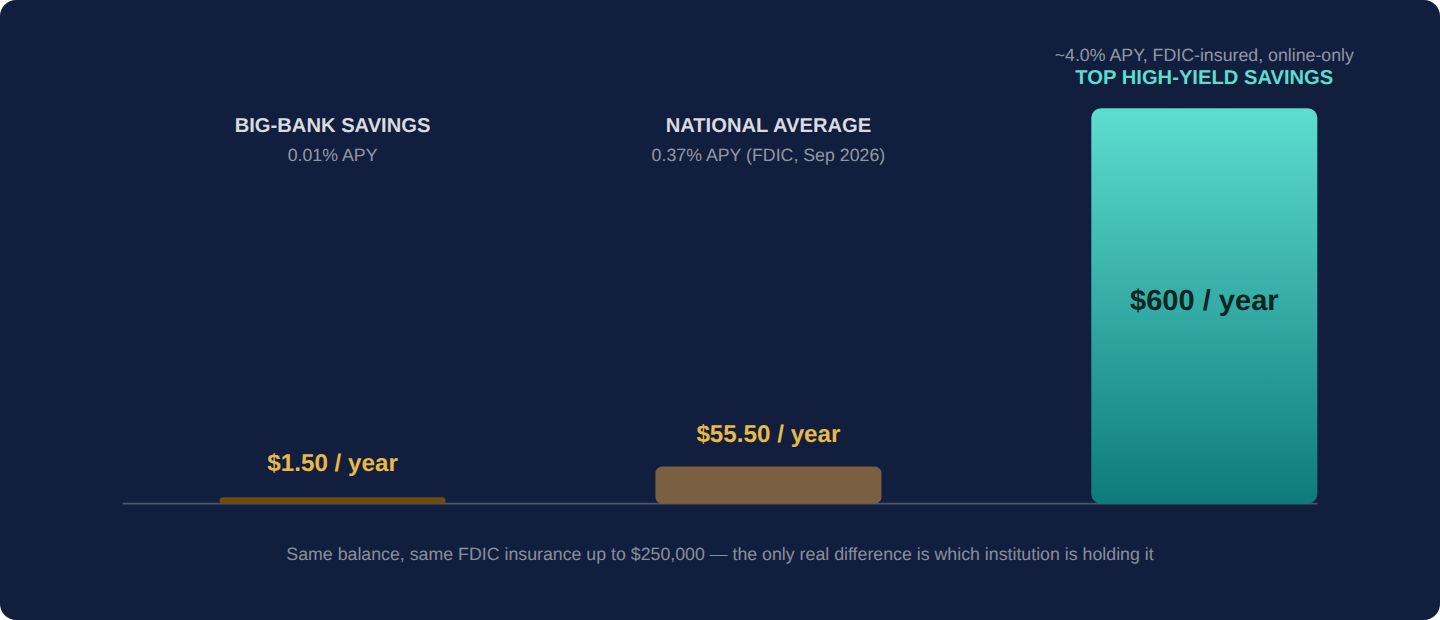
Both accounts on the left are FDIC-insured up to $250,000, exactly like the account on the right. The $598.50 difference in annual interest isn’t compensation for extra risk — it’s simply the difference between a bank paying what it can get away with paying a captive customer, and a bank competing on price for a customer’s deposits. Moving an emergency fund to a high-yield account is one of the very few free upgrades in personal finance.
Regulation D once limited “convenient” transfers out of savings to six a month, because the Federal Reserve required reserves against transaction accounts and needed a bright line separating them from savings. When reserve requirements were cut to zero in 2020 the line did no work, and on April 24, 2020, the Fed deleted the limit. Many banks kept it, or a per-withdrawal fee, in their contracts.
Regulation CC sets when deposits become spendable: direct deposits by the next business day; for checks, the first $275 of a day’s deposits the next business day and the rest of a local check by the second. Banks may hold longer, generally up to five extra business days, for the part of a day’s check deposits above $6,725 and for accounts overdrawn on six or more days in six months. In an account’s first 30 days the protection is weaker still: ordinary checks have no federal deadline at all, and only the first $6,725 of cashier’s, certified and government checks must be available the next business day (the rest by the ninth). A $3,000 check deposited Monday guarantees $275 on Tuesday and, if it is a local check with no exception, $3,000 − $275 = $2,725 on Wednesday; a bill scheduled against it on Tuesday is how an overdraft starts (2.4: Overdraft & NSF Fees — and Avoiding Them).
A card payment that feels instantaneous at checkout is actually two separate processes, running on two very different timelines — which is exactly why a purchase can show up as “pending” on your account for several days before it settles for good.

Step 1 is like a bouncer checking your name is on the guest list — fast, and it only confirms you’re allowed in. Step 2 is the actual settling of the bill afterward, which happens on a completely separate, slower schedule. The bouncer’s nod (authorization) and the bill actually getting paid (settlement) are two different events, days apart, even though from the cardholder’s seat they feel like the same instant.
Every card payment carries an interchange fee, taken from the merchant’s proceeds by the bank that issued your card and recovered by merchants through prices. For debit cards, the Durbin Amendment (Dodd-Frank Act §1075, 2010) caps it for issuers with $10 billion or more in assets. On a $50 purchase: 21¢ + 0.05% × $50 + 1¢ fraud adjustment = 24.5¢, or 0.49%. Smaller issuers are exempt, and the Fed’s data show the effect: in 2024 the average debit fee was 23¢ (0.47%) on transactions subject to the cap and 51¢ (1.21%) on exempt ones (cards from smaller issuers, plus certain prepaid and government cards), which helps explain why many fintech apps issue debit cards through small partner banks. Credit-card interchange has no federal cap, and that money funds credit-card rewards.
Illustrative assumptions: $1,500 a month of card spending ($18,000 a year), a flat 1.5% cash-back card, and the 22.15% average rate on card accounts charged interest (3.3). Interest ≈ average balance carried × APR.
| Scenario | Rewards | Interest | Net a year |
|---|---|---|---|
| Debit card | $0 | $0 | $0 |
| Credit, paid in full monthly | $18,000 × 1.5% = $270 | $0 | +$270 |
| Credit, $2,000 average balance carried | $270 | $2,000 × 22.15% = $443 | −$173 |
Break-even: rewards equal interest at an average carried balance of $270 ÷ 0.2215 = $1,218.96. Above about $1,220 the card costs more than it pays, and the true flip point is lower, because carrying a balance also ends the grace period on new purchases (3.3). Rewards belong to people who pay in full; for everyone else, debit is the cheaper card.
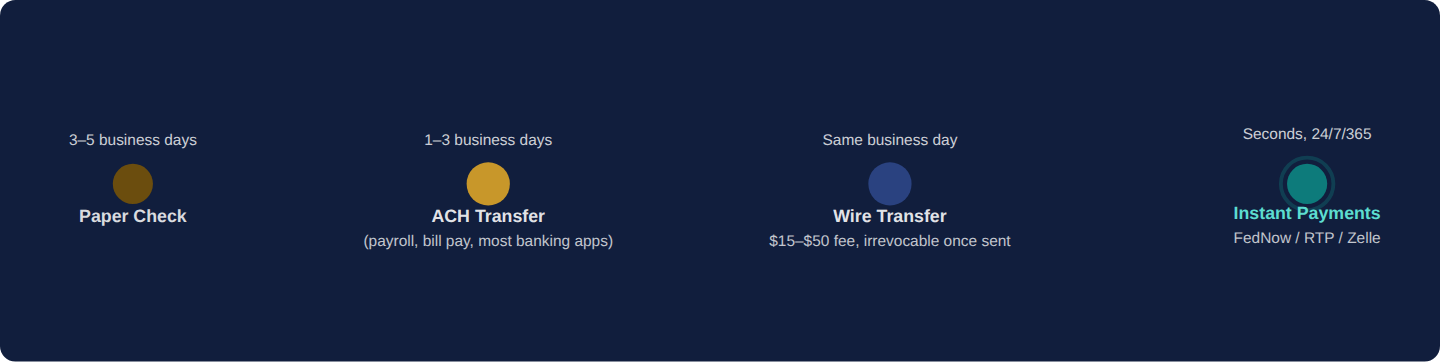
Beyond a card swipe, an individual moving money has several distinct “rails” to choose from, each with a different speed, cost, and reversibility trade-off. Instant, account-to-account transfers — which Vol. I’s Part 10 described as India’s national payments success story, UPI — have arrived in the U.S. far more slowly and remain partial.
| Situation | What changes | Why | Number or rule |
|---|---|---|---|
| Fuel pump, hotel or car rental on debit | A hold larger than the final charge shrinks your available balance | The merchant authorizes an estimate | Spend against the available balance; use credit where a hold would strain checking |
| Large check deposit or new account | Longer holds | Regulation CC exceptions | Amount over $6,725 in a day: generally up to five extra business days; first 30 days: no federal deadline for ordinary checks |
| Someone else’s ACH debit hits your account | You can force it back | ACH rules let your bank return unauthorized consumer debits | 60-day return window; report statement errors within 60 days (13.4) |
| Wire sent to the wrong account | No federal consumer error rights | Regulation E excludes wire systems (12 CFR 1005.3(c)(3)) | Ask your bank at once to request a recall; success depends on the recipient |
| An impostor uses your login, versus talks you into paying | Only the first is “unauthorized” | Regulation E covers transfers you did not initiate | Loss capped at $50 if reported within two business days; no cap if you sent it |
| Rail | Typical Cost | Reversible? | Use It For |
|---|---|---|---|
| ACH | Usually free | Yes, within a limited window — this is how fraudulent or mistaken transfers are often clawed back | Payroll, bill pay, moving money between your own accounts, most everyday transfers |
| Wire Transfer | $15–$50, sometimes waived for large banks’ premium accounts | No — wires settle same-day and are effectively final within hours | Large, time-sensitive, one-time transfers to a verified recipient: a home down payment (confirm the wiring instructions by phone, using a number you already have), a large purchase from a known counterparty |
| Instant (FedNow/RTP/Zelle) | Often free between consumers; some banks charge for instant transfers out | No — like a wire, settlement is final within seconds | Splitting a bill, paying a person you trust immediately — never for a payment to a stranger, precisely because it can’t be reversed |
Reversibility is the single most important, and least advertised, fact about any payment rail. A wire or an instant transfer sent to the wrong person — or to a scammer — is, in the overwhelming majority of cases, simply gone. Before sending either one for the first time to a new recipient, send a $1 test transfer first and confirm it arrived at the intended account.
If checking has stayed above two months of essential spending ($2,343.90 × 2 = $4,687.80 for the running household) just before payday for two cycles in a row, sweep the excess to insured high-yield savings; if it falls below one week ($2,343.90 × 12 ÷ 52 = $540.90), refill it before the next automatic payment. If a payee is new and you cannot confirm them through contact details you already had, pay by card or ACH, never by wire or instant payment. Assumes savings transfers take one to three business days. Ignore it when income is irregular (11.5) or a large known payment is days away.
Moving money yourself because a stranger told you to. A caller posing as your bank’s fraud team persuades you to “protect” $4,000 with an instant transfer to a “safe account.” Because you initiated it, Regulation E‘s limits do not apply and all $4,000 is at risk. Had the same caller stolen your login and sent it himself, prompt reporting would have capped your loss at $50 (13.4): a difference of $4,000 − $50 = $3,950. How to avoid it: no real bank asks you to move money to protect it. Hang up, call the number on your card, and send a first payment to anyone new only after a $1 test (2.3).
How long does a pending transaction take to clear?
Most card purchases settle one to three business days after approval, when “pending” becomes “posted” (2.2). Fuel, hotel and car-rental holds can last longer because the merchant approved an estimate.
Is there still a limit on savings account withdrawals?
Not in federal law: the Federal Reserve deleted Regulation D’s six-a-month limit on April 24, 2020. Many banks kept a limit or a per-withdrawal fee in their account agreements.
Can a Zelle payment be reversed?
Usually not; once it arrives, it is final. If someone took over your account and sent it, it is an unauthorized transfer your bank must investigate (13.4). If you sent it yourself, even to a scammer, the bank is not required to refund it, so treat Zelle like cash.
Why is my check deposit on hold?
Regulation CC lets banks hold checks while they clear. The first $275 of a day’s check deposits must be available the next business day and the rest of a local check by the second; the part of a day’s deposits above $6,725 and deposits to repeatedly overdrawn accounts can wait about five business days longer, and in an account’s first 30 days ordinary checks have no federal deadline.
Checking is built for frequent movement and pays almost nothing, so hold one to two months of expenses there; savings is for money that can wait, and your emergency fund belongs there. Rates vary enormously for identical FDIC protection: the same $15,000 earns $1.50 a year at 0.01%, $55.50 at the 0.37% national average (Sep 2026) and about $600 in a 4.0% high-yield account, so moving it is a free upgrade. A card tap is two events: authorization in milliseconds, then settlement a day to three later, minus the interchange fee, which is why purchases sit as pending. Among payment rails, ACH is slow but can often be reversed, while wires and instant payments (FedNow, RTP, Zelle) are final, so reversibility decides the rail: never send an irreversible payment to a stranger, and test a new recipient with $1 first.
Eight questions on this chapter. Decide on your answer first, then click “Reveal Answer.”
1. A household’s $15,000 emergency fund sits in a savings account paying the national average of 0.37% APY (Sep 2026). About how much more interest a year would it earn at a 4.0% APY high-yield account?
- $600
- $544.50
- $54.45
- $598.50
Reveal Answer
Answer: B. $15,000 × 4.0% = $600 against $15,000 × 0.37% = $55.50, so the gain is $544.50. Using the 0.01% big-bank rate gives $598.50; ignoring the current interest gives $600; a decimal slip gives $54.45. (Part 2.1: Checking vs Savings — What Each Is Actually For)
2. A household spends about $4,000 a month and keeps $25,000 in a checking account paying near zero. What does the volume suggest?
- Keep roughly $4,000–$8,000 in checking and move the rest to savings
- Keep it all in checking, where emergencies can reach it instantly
- Keep one week of spending in checking to cut idle cash to a minimum
- Move it all to savings, since the Regulation D limit is suspended
Reveal Answer
Answer: A. Checking should hold one to two months of expenses, enough never to bounce a payment; beyond that, money in checking forgoes interest that a savings account would pay. (Part 2.1: Checking vs Savings — What Each Is Actually For)
3. A debit card purchase is approved at the register instantly but still shows as “pending” on the account two days later. Why?
- The interchange fee must be agreed before the charge can post
- The issuing bank is still checking whether the funds are available
- Approval and settlement are separate; the money moves days later
- The merchant has not yet accepted the card network’s approval
Reveal Answer
Answer: C. Authorization (the issuer checking funds and approving) and settlement (real money moving issuer to network to acquirer to merchant, T+1 to T+3) are separate events; the gap between them is the pending period. (Part 2.2)
4. You sent money to the wrong account by mistake. On which payment rail do you have the best chance of getting it back?
- An ACH transfer, within its limited reversal window
- A FedNow payment, because the Federal Reserve runs it
- A wire transfer, if you report it on the same day
- A Zelle payment, because it moves between two banks
Reveal Answer
Answer: A. ACH can be reversed within a limited window, which is how mistaken or fraudulent transfers are often clawed back. Wires and instant payments (FedNow, RTP, Zelle) are final within hours or seconds. (Part 2.3)
5. On Monday you deposit a $3,000 local check, drawn on another bank, into an account you have held for years. Under Regulation CC, how much must your bank make available on Tuesday?
- $3,000
- $2,725
- $0 until the check clears
- $275
Reveal Answer
Answer: D. Regulation CC requires the first $275 of a day’s check deposits by the next business day and the rest of a local check by the second business day: $3,000 − $275 = $2,725 on Wednesday. (Part 2.1: Checking vs Savings — What Each Is Actually For)
6. You put $18,000 a year on a 1.5% cash-back card that charges 22.15% APR. Above roughly what average carried balance does the interest outweigh the rewards?
- About $2,700
- About $1,220
- About $270
- About $443
Reveal Answer
Answer: B. Rewards = $18,000 × 1.5% = $270; interest equals that at an average balance of $270 ÷ 0.2215 = $1,218.96, and losing the grace period lowers the true break-even further. (Part 2.2)
7. Worked problem: A checking account charges $12 a month unless you keep $1,500. Holding $1,500 in a savings account would earn 4%. Which is cheaper?
Reveal Answer
Answer: Fee = 12 × $12 = $144 a year. Interest forgone = 4% × $1,500 = $60. Keeping the balance is cheaper by $84.
8. Worked problem: A $35 fee on a $20 overdraft repaid after 3 days is equivalent to what annual rate?
Reveal Answer
Answer: Cost = $35 ÷ $20 = 175% over 3 days; annualized = 1.75 × 365 ÷ 3 = 21,292%.