
The interest on your savings is set by your bank, not by the central bank, and banks often pay far less than they earn on the same money. APY is the honest number to compare, because it shows what you really earn in a year, including interest on interest. How often interest is added matters very little. What matters is the rate. Moving your emergency fund to a competitive insured account can earn you hundreds of dollars a year for doing nothing different. Remember that interest counts as income, so some of it goes to tax.
Why it matters: The same savings can earn far more just by changing where they sit.
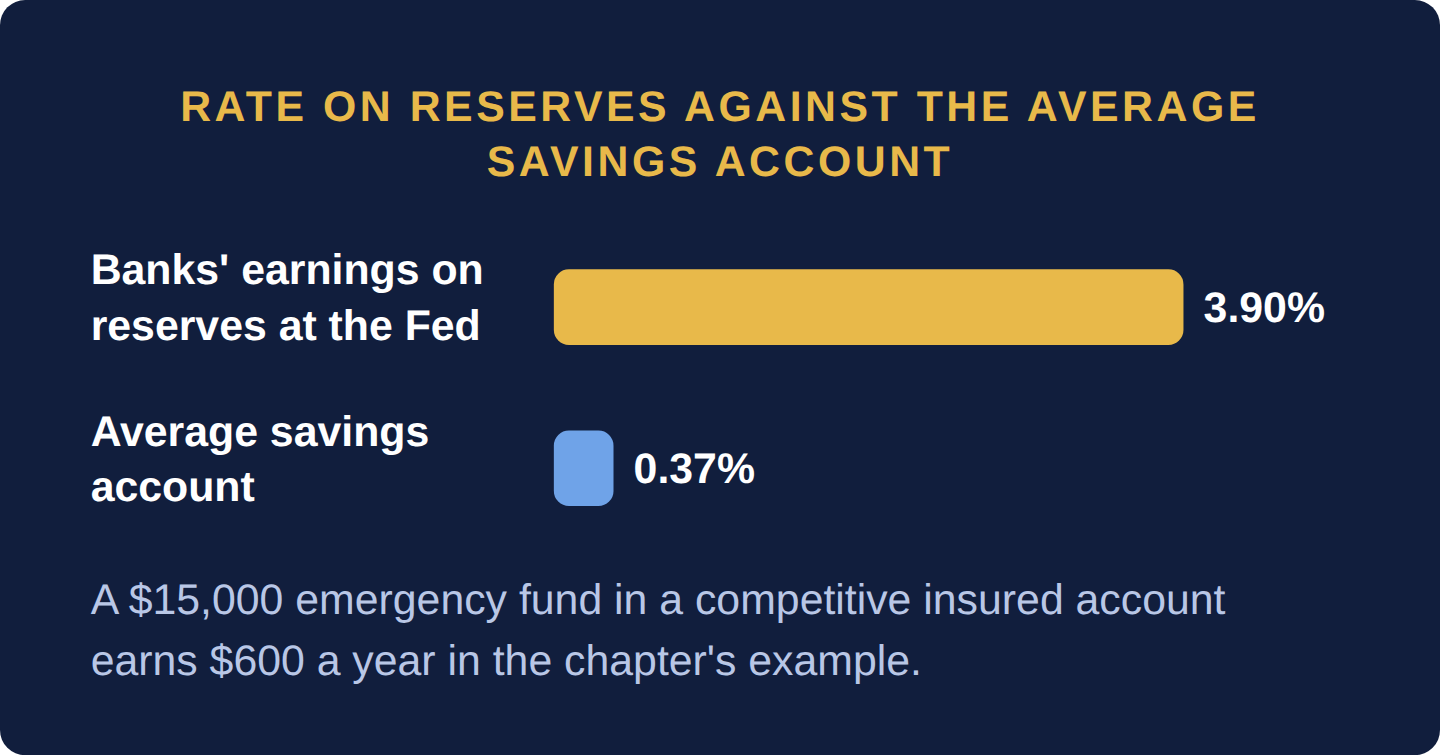
Summary: Compare savings accounts on APY, because the rate matters far more than how often it compounds, and remember your bank, not the Fed, sets it: banks earn 3.90% on reserves at the Fed while the average savings account pays 0.37%. Moving an emergency fund to a competitive insured account is worth hundreds of dollars a year.
- APY = (1 + r ÷ n)n − 1; Regulation DD requires banks to disclose it and to pay interest on the full daily or average daily balance.
- Historically, deposit rates rose only about 0.46 point for each 1-point rise in the Fed funds rate.
- Interest is ordinary income: 4.00% APY nets 3.12% in the 22% bracket.
- With a state income tax, Treasury bills can beat a higher-rate savings account.
- Move when balance × rate gap × (1 − tax rate) exceeds about $50 a year.
Throughout this volume we follow a single filer earning $75,000 in the 22% bracket, with a $15,000 emergency fund (1.4).
A savings account quotes two numbers. The interest rate is the nominal annual rate the bank applies. The annual percentage yield (APY) is what a balance actually earns in a year once interest is credited and starts earning interest itself. Federal Truth in Savings rules (Regulation DD) require banks to disclose APY, so APY is the number to compare. If a rate r is compounded n times a year:
APY = (1 + r ÷ n)n − 1
A 3.92% rate compounded daily: (1 + 0.0392 ÷ 365)365 − 1 = 0.03998, an APY of 4.00%. The same formula explains why 4.00% compounded daily (APY 4.081%) beats 4.00% compounded monthly (APY 4.074%) by a trivial margin: compounding frequency matters far less than the rate itself. Most banks compute interest daily on each day’s balance and credit it monthly; on $15,000 at 3.92%, about $15,000 × 0.0392 ÷ 365 × 30 ≈ $48 appears at the end of a 30-day month.
Regulation DD fixes the method: interest is figured with a daily rate of no less than 1/365 of the stated rate, on either each day’s balance or the average daily balance. Your statement must show the APY earned = (1 + interest ÷ average daily balance)365 ÷ days − 1. Check it: $48.33 on $15,000 over 30 days gives (1 + 48.33 ÷ 15,000)365 ÷ 30 − 1 = 3.99%, the advertised 4.00% within rounding. A wider gap means a tier, a balance change or a rate cut, and on a variable-rate account the bank owes you no advance notice of a cut (fee and other term changes need 30 days).
APR is a borrowing measure from the Truth in Lending rules. It excludes compounding, which is why a card’s 20% APR, charged daily at 20% ÷ 365 = 0.0548%, works out to (1 + 0.20 ÷ 365)365 − 1 ≈ 22.13% a year on an unpaid balance (3.3). When you save, look at APY; when you borrow, the true annual cost is higher than the APR whenever interest compounds.
Why online banks pay more, and why rates move. Savings rates are variable: a bank can change them at any time, and most follow the Federal Reserve. On September 16, 2026, the Fed raised its target range by 0.25 point to 3.75%–4.00%; top online high-yield accounts were already paying about 4% APY in early September, against an FDIC national average of 0.37% (September 2026). Online banks have no branch network to fund and compete nationally for deposits, so they pass rate changes on faster. Large branch banks rely on customers who rarely move money, and many still pay about 0.01% (2.1: Checking vs Savings — What Each Is Actually For). No bank is required to match a Fed move, in either direction.
A bank’s risk-free alternative to paying you is leaving your money at the Federal Reserve, which has paid 3.90% on reserve balances since September 17, 2026. Against the FDIC national average savings rate of 0.37%, the average bank keeps a spread of 3.90 − 0.37 = 3.53 points; on interest checking at 0.07%, 3.83 points. The spread survives because most depositors never move. The research: Drechsler, Savov and Schnabl (Quarterly Journal of Economics, 2017), using bank data from 1986 to 2013, found that for each 1-point rise in the Fed funds rate the gap to the average rate on core deposits (checking, savings and small CDs) widened by 0.54 point, so deposit rates rose only about 1 − 0.54 = 0.46 point; branch-level data showed the gap widened more where fewer banks competed. That describes the average bank, not yours: check your own rate after every Fed move.
| Where to hold cash | Insured? | Rate | Access | Tax on interest |
|---|---|---|---|---|
| High-yield savings | FDIC/NCUA to $250,000 (2.6) | Variable | Any time, by transfer | Federal and state |
| Money market deposit account | FDIC/NCUA — it is a bank deposit | Variable, often tiered | Any time; may offer checks or a card | Federal and state |
| Money market mutual fund | No — an investment fund, not a deposit | Tracks short-term market rates daily | Usually next business day | Federal and state (government funds may be partly state-exempt) |
| Certificate of deposit (CD) | FDIC/NCUA | Fixed for the term | Penalty for early withdrawal | Federal and state |
| Treasury bills | Not insured; a direct U.S. government obligation | Fixed for 4 to 52 weeks | Hold to maturity, or sell at market price | Federal only — exempt from state and local tax |
Taxes. Interest is ordinary income, taxed at your marginal rate (Part 9). Banks send Form 1099-INT when they pay you $10 or more in a year, but smaller amounts are taxable too. For the running household in the 22% bracket, $600 of interest costs $600 × 22% = $132 of federal tax, so a 4.00% APY nets 4.00% × (1 − 0.22) = 3.12% after tax.
Real return. Prices rose 3.4% in the 12 months to August 2026 (CPI-U, released by the Bureau of Labor Statistics on September 11, 2026). The real, after-inflation return is (1 + nominal) ÷ (1 + inflation) − 1. Before tax: 1.04 ÷ 1.034 − 1 = +0.58%. After tax: 1.0312 ÷ 1.034 − 1 = −0.27%. At the 0.37% national average: 1.0037 ÷ 1.034 − 1 = −2.93% before tax.
| Situation | What changes | Why | Number or rule |
|---|---|---|---|
| Bank is not well capitalized | It cannot pay far above market | FDIC rate restriction (12 CFR 337.7) | Savings cap 4.38% (Sep 21, 2026) |
| You cash a CD early | A penalty, set by contract | Federal rules set only a minimum | At least 7 days’ simple interest within the first six days; the penalty is deductible on Schedule 1 |
| A bonus or gift for opening an account | Taxable as interest | IRS treats it as interest | A cash bonus is taxable in full; a noncash gift is reportable if worth more than $10 (deposit under $5,000) or $20 (deposit of $5,000 or more) |
| No taxpayer ID on file, or an IRS underreporting notice | Tax withheld from interest | Backup withholding | 24% |
| Joint account | Interest split between owners | Each owner’s share follows state law, whoever’s number is on the 1099 | Report your share; if the 1099 carries your number, show the full amount on Schedule B, subtract the other owner’s part as a nominee distribution and give them a 1099-INT (not needed for a spouse) |
2.1 showed one year of interest on a $15,000 emergency fund (the household’s $14,063 six-month target from 1.4, rounded up). Holding each APY constant for five years (a simplification; real rates will move), the balance after five years is $15,000 × (1 + APY)5:
| Account (APY) | Arithmetic | After 5 years | Interest earned |
|---|---|---|---|
| Big-bank savings (0.01%) | $15,000 × 1.00015 | $15,007.50 | $7.50 |
| National average (0.37%) | $15,000 × 1.00375 | $15,279.56 | $279.56 |
| High-yield (4.00%) | $15,000 × 1.045 | $18,249.79 | $3,249.79 |
| High-yield, after 22% tax (3.12%) | $15,000 × 1.03125 | $17,490.64 | $2,490.64 |
Compounding adds $3,249.79 − $3,000 = $249.79 over five years compared with simple interest of $15,000 × 4% × 5 = $3,000. The gap between the high-yield account and the big bank is $3,249.79 − $7.50 = $3,242.29 on an identical, equally insured balance. Yet at 3.4% inflation, the after-tax $17,490.64 is worth $15,000 × (1.0312 ÷ 1.034)5 ≈ $14,798 in today’s dollars: the best savings account roughly preserved the fund’s buying power, while the big-bank balance shrank to $15,007.50 ÷ 1.0345 ≈ $12,697, a loss of about 15%. That is the right job for an emergency fund — safety and access — and the reason long-term money belongs in Part 7, not here.
Illustrative rates, not quotes: high-yield savings 4.00% (variable), 12-month CD 4.10% (fixed), 52-week Treasury bill 3.90% (fixed). Taxes: 22% federal, and either no state tax (the running household) or an illustrative flat 5%, with no itemizing.
| Option | Interest | After tax, no state tax | After tax, 5% state |
|---|---|---|---|
| Savings 4.00% | $600.00 | $600 × 0.78 = $468.00 | $600 × 0.73 = $438.00 |
| CD 4.10% | $615.00 | $479.70 | $448.95 |
| T-bill 3.90% | $585.00 | $456.30 | $456.30 (state-exempt) |
Flip points: the CD wins unless the savings rate averages above 4.10% for the year; if cuts pull it to 3.50%, savings earns $525 against the CD’s $615. With a 5% state tax, a T-bill beats any taxable rate below 3.90% × 0.78 ÷ 0.73 = 4.17%, so here it wins outright. CDs charge to exit and T-bills sell at market price before maturity, so keep the cash you might need this month in savings.
“Highest rate wins” assumes the advertised APY is the rate you will get, on your whole balance, for as long as you hold it. Promotional offers break each assumption: a teaser rate that lasts three months and then drops; a top rate paid only on the first few thousand dollars; conditions such as a monthly direct deposit or a minimum number of debit purchases; “up to” rates; and fintech apps that are not banks (2.6). Read the rate schedule and the fine print before moving money. Chasing small differences rarely pays: an extra 0.25 point on $15,000 is $15,000 × 0.0025 = $37.50 a year, or $29.25 after 22% tax — worth a move once, not every month.
Move savings when balance × rate gap × (1 − marginal tax rate) exceeds about $50 a year, roughly an hour’s effort. For the running household’s $15,000 that is any gap above $50 ÷ 0.78 ÷ $15,000 = 0.43 point; at 0.01% versus 4.00% the gain is $15,000 × 3.99% × 0.78 = $466.83 a year. Assumes the new account is insured in your name (2.6), the rate is not promotional, and transfers are free. Ignore it for teaser, capped or conditional rates, and for this week’s spending money, which belongs in checking (2.1: Checking vs Savings — What Each Is Actually For).
Leaving the fund where the paycheck lands. Held for ten years at constant rates, $15,000 earns $15,000 × (1.000110 − 1) = $15.01 at 0.01% and $15,000 × (1.0410 − 1) = $7,203.66 at 4.00%: a gap of $7,188.65 before tax, or $5,383.14 after 22% tax. How to avoid it: open an insured high-yield account, link it to checking, move the fund once, and point the automatic transfer there (1.5).
How is interest calculated on a savings account?
Daily: the bank applies the rate ÷ 365 to each day’s balance and usually credits the total monthly, after which that interest earns interest too. At 3.92%, $15,000 earns about $48 in a 30-day month, an APY of 4.00%.
What is the difference between APY and the interest rate?
The interest rate is the nominal yearly rate; APY is what you earn in a year once interest compounds, so 3.92% compounded daily is 4.00% APY. Every bank must quote APY, which makes it the fair comparison.
How much interest will $10,000 earn in a high-yield savings account?
At 4.00% APY, $400 in a year if the rate holds, about $32 a month, and $400 × 0.78 = $312 after 22% federal tax. The rate is variable, so the real figure follows your bank.
Are CDs better than high-yield savings accounts?
Yes, when the CD’s fixed rate beats what savings will average over the term and you will not need the money early. A 12-month CD at 4.10% beats a variable 4.00% account unless rate increases push the account’s average above 4.10% for the year, and exiting early costs a penalty. Use CDs for money with a known date.
Vol. I’s Part 8.6 introduced credit risk from a bank’s side of the desk — how an institution measures and prices the chance that a borrower doesn’t repay. This Part is the same risk, viewed from the borrower’s side: how that risk gets scored, reported, and priced back to you personally, and how to tell the debt worth taking from the debt worth avoiding entirely.
India’s counterpart to FDIC insurance (2.6) is the DICGC (Deposit Insurance and Credit Guarantee Corporation), a wholly owned RBI subsidiary. It insures up to ₹5 lakh per depositor per bank, principal and interest combined, across savings, current, fixed and recurring deposits — a limit in force since Feb 4, 2020. As with FDIC ownership categories, money held in a different capacity (a joint account, or as a guardian or partner) is insured separately, while deposits in the same capacity at every branch of one bank are added together. Commercial, small finance, payments, regional rural and co-operative banks are covered; NBFC and company fixed deposits are not. A higher limit has been discussed publicly but, as of Oct 2026, has not been notified.
UPI is what U.S. instant rails (2.3) have not yet become: near-universal, free for individuals, account to account. The reversibility warning in 2.3 applies with more force — a completed UPI payment is final, and you never enter your UPI PIN to receive money, which is the trick behind “collect request” scams. Indian savings accounts generally decline a payment rather than overdraw, so 2.4’s overdraft fees rarely arise, though banks do charge for bounced auto-debits; check your bank’s schedule of charges.
A savings account’s interest rate is the nominal figure, while the APY includes interest earning interest and is the number Regulation DD makes banks disclose, so compare on APY and remember that compounding frequency matters far less than the rate itself. APR, a borrowing measure, leaves compounding out, which is why a 20% card APR charged daily costs about 22.13% a year on an unpaid balance. In September 2026 top online high-yield accounts paid about 4% APY against a 0.37% national average, a gap worth $3,242.29 over five years on an equally insured $15,000, but teaser rates, balance caps and conditions mean you should read the rate schedule before moving money. Interest is taxed as ordinary income and inflation ran 3.4%, so 4.00% in the 22% bracket nets 3.12% and a real −0.27%: a savings account preserves an emergency fund, and long-term money belongs elsewhere.
Eight questions on this chapter. Decide on your answer first, then click “Reveal Answer.”
1. You can move $25,000 of savings to an insured account paying 0.30 point more APY. In the 22% bracket, how much more do you keep per year after federal tax?
- $16.50
- $4.88
- $58.50
- $75.00
Reveal Answer
Answer: C. Extra interest = $25,000 × 0.0030 = $75.00; after tax, $75.00 × (1 − 0.22) = $58.50. $75.00 ignores tax, $16.50 is the tax itself and $4.88 is one month: worth a move once, not every month. (Part 2.7)
2. Bank A pays 4.05% compounded monthly; Bank B pays 4.00% compounded daily. Which earns more on the same balance over a year?
- Bank B, because daily compounding outweighs a 0.05-point gap
- They tie, since daily compounding offsets the rate difference
- Bank B, with an APY of about 4.13% against 4.08%
- Bank A, with an APY of about 4.13% against 4.08%
Reveal Answer
Answer: D. APY = (1 + r ÷ n)^n − 1: Bank A = (1 + 0.0405 ÷ 12)^12 − 1 = 4.13%; Bank B = (1 + 0.04 ÷ 365)^365 − 1 = 4.08%. Compounding frequency matters far less than the rate itself. (Part 2.7)
3. A saver in a state with a high income tax wants a safe place for $20,000 for six months and wants the interest to escape state tax. Which fits?
- A six-month bank certificate of deposit
- Treasury bills held to maturity
- A high-yield savings account
- A money market deposit account
Reveal Answer
Answer: B. Treasury bill interest is taxed federally but exempt from state and local tax; interest on savings, money market deposit accounts and CDs is taxed by both. The trade-off: T-bills are not deposit-insured, though they are direct U.S. government obligations. (Part 2.7)
4. With $15,000 to park, you see “up to 5.00% APY” for new customers, paid on the first $2,000 for three months and conditioned on a monthly direct deposit. What should you do first?
- Work out what you would earn on the whole balance over a year
- Plan to move the money again whenever another bank tops the rate
- Move the full $15,000 now, since the highest advertised APY wins
- Compare nominal rates instead, since APY overstates promotions
Reveal Answer
Answer: A. “Highest rate wins” assumes you get the advertised APY on your whole balance for as long as you hold it; teaser periods, balance caps and conditions break that. Read the rate schedule, and don’t chase small differences. (Part 2.7)
5. Your statement shows $48.33 of interest on an average daily balance of $15,000 for a 30-day period. What APY earned does that imply?
- About 3.87%
- About 0.32%
- About 3.99%
- About 4.08%
Reveal Answer
Answer: C. APY earned = (1 + 48.33 ÷ 15,000)^(365 ÷ 30) − 1 = 3.99%. Multiplying the monthly yield by 12 gives 3.87% because it ignores compounding; 0.32% is the 30-day yield. (Part 2.7)
6. You pay 22% federal and 5% state income tax. Below what taxable savings rate does a 3.90% Treasury bill leave you with more after tax?
- About 4.17%
- About 3.65%
- 3.90%
- About 4.10%
Reveal Answer
Answer: A. The T-bill is state-exempt, keeping 3.90% × 0.78 = 3.04%; a taxable rate r keeps r × 0.73. They are equal at r = 3.90% × 0.78 ÷ 0.73 = 4.17%. (Part 2.7)
7. Worked problem: A bank advertises a 4.00% APR compounded monthly. What is the APY?
Reveal Answer
Answer: APY = (1 + 0.04 ÷ 12)12 − 1 = 4.074%.
8. Worked problem: $15,000 earns 4.2% APY in one account and 0.4% in another for five years. What is the difference?
Reveal Answer
Answer: 4.2%: $18,426. 0.4%: $15,302. Difference = $3,124.
- Consumer Price Index news release — CPI-U inflation
- About Form 1099-INT — Interest reporting
- Treasury bills — T-bill terms and taxation
- 12 CFR 337.7
- 12 CFR 204.2(c)
- Publication 550