
11.4 Risk Governance in Practice — The Three Lines at Work
The Three Lines work through tools: RCSAs in the first line, KRIs that warn before KPIs turn red, and board-set risk appetite. Operational resilience adds impact tolerances for important business services, tested against severe but plausible scenarios.
Why it matters: Tools like KRIs let a firm act before a problem becomes a loss.
Summary: The Three Lines work through tools: RCSAs in the first line, KRIs that warn before KPIs turn red, and board-set risk appetite. Operational resilience adds impact tolerances for important business services, tested against severe but plausible scenarios.
- In the KRI example, an amber trigger sits at 2% of open breaks past their deadline and a red trigger at 5%: 220 aged breaks out of 4,000 is 5.5%, above red, so the second line must escalate even if the STP rate looks healthy.
- The Institute of Internal Auditors renamed the Three Lines of Defense the Three Lines Model in 2020.
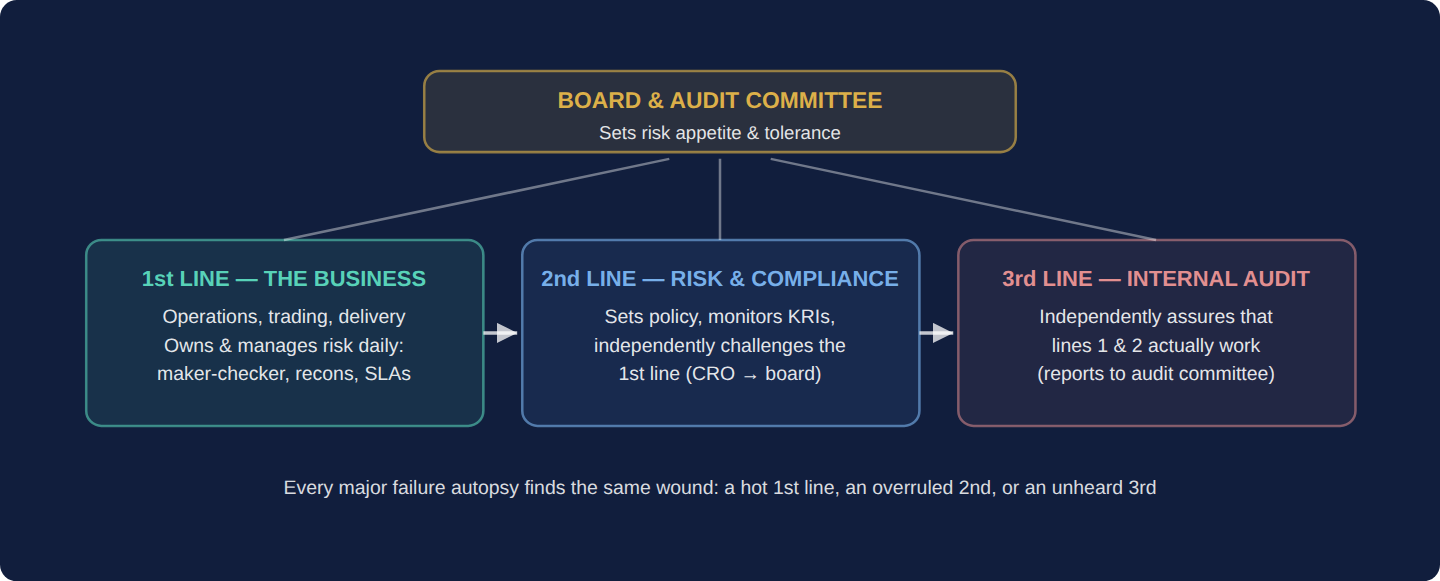
- Every major failure autopsy finds the same wound: a first line that ran hot, a second line that could be overruled, or a third line that wasn’t heard.
Chapters 8.5 and 8.6 introduced the Three Lines of Defense and the four types of financial risk. This chapter shows the model at work: the self-assessments and early-warning indicators (KRIs) that keep it honest, and the newer discipline — operational resilience — that assumes failures will happen and asks how fast the things that matter recover.
Chapter 8.5: Risk Management and Compliance in Practice introduced the Three Lines of Defense (renamed the Three Lines Model by the Institute of Internal Auditors in 2020) — the business owning its risks, Risk and Compliance independently challenging it, Internal Audit assuring both. This chapter is about how that elegant organization chart behaves in practice: the tools each line runs, the early-warning dials they watch, and the newer discipline regulators have layered on top. Two practical details give the model its teeth. First, the second line’s Chief Risk Officer must report to the board through a channel that does not pass through the businesses being challenged — independence on paper means nothing if a profitable desk can overrule its challenger. Second, every major failure autopsy — the 2008 banks, the rogue-trader losses — finds the same wound: a first line that ran hot, a second line that could be overruled, or a third line that wasn’t heard.
The working toolset: an RCSA (Risk and Control Self-Assessment) — each unit periodically cataloging its own risks and candidly rating its controls, feeding the firm’s risk register; a distinction between KPIs, which report current performance (STP rate, SLA adherence), and KRIs — key risk indicators — which are chosen to warn early: rising aged breaks (chapter 11.2: Reconciliation — Making a Quadrillion Numbers Agree), climbing attrition in a critical team (chapter 10.6: From BPO to GCC — India’s Global Delivery Economy), lengthening system downtimes. A mature operation watches KRIs the way sailors watch the barometer — the storm hasn’t arrived, but the pressure is dropping. Above both sit the board-level dials of risk appetite (how much risk we’re willing to run in pursuit of return) and risk tolerance (the numeric thresholds that trigger action) — in regulated finance, often floor-set by the regulator rather than chosen freely.
A numeric example of a KRI: set an amber trigger at 2% of open breaks past their deadline and a red trigger at 5%. With 4,000 open breaks of which 220 are aged, the aged share is 220 ÷ 4,000 = 5.5%, above red, so the second line must escalate even if the STP rate (Section 8.3: Reconciliation — Financial Bookkeeping at Massive Scale) still looks healthy (illustrative thresholds).
The frontier discipline is operational resilience — the post-2010s recognition (crystallized by outages, cyberattacks, and COVID) that preventing all failure is impossible, so regulation now asks a different question: when something breaks, how quickly does what matters recover? UK rules (in force since March 31, 2022, with firms expected to be within their tolerances by March 31, 2025) and the EU’s Digital Operational Resilience Act (applying since January 17, 2025) require firms to identify their important business services (payments, settlement — the things whose interruption harms customers or markets), set impact tolerances (maximum bearable outage, e.g. “payments restored within X hours”), and prove by testing severe-but-plausible scenarios that they can stay inside them. The reach extends explicitly to third parties — the cloud providers and offshore delivery centers a firm depends on — which is precisely how the GCCs of chapter 10.6 became regulated financial infrastructure: a bank’s resilience is only as strong as the weakest link in its chain, wherever on the planet that link sits.
What is a KRI?
A key risk indicator, which warns before KPIs turn red.
Can you give an example of a KRI?
An amber trigger sits at 2% of open breaks past their deadline and a red trigger at 5%. With 220 aged breaks out of 4,000, or 5.5%, the firm is above red and the second line must escalate even if the STP rate looks healthy.
What is an impact tolerance?
A limit set for important business services, tested against severe but plausible scenarios as part of operational resilience.
What did the Institute of Internal Auditors change in 2020?
It renamed the Three Lines of Defense the Three Lines Model.
The Three Lines work through tools: RCSAs in the first line, KRIs that warn before KPIs turn red, and board-set risk appetite and tolerance. Operational resilience adds impact tolerances for important business services, tested against severe but plausible scenarios, and now reaches third parties. In the example, 220 aged breaks out of 4,000 is 5.5 percent, above a 5 percent red trigger.
Four questions and two worked problems on this chapter. Decide on your answer first, then click “Reveal Answer.”
1. A unit has 4,000 open breaks, 220 of them past deadline, and a red KRI trigger at 5 percent. What should happen?
- The aged share is 5.5 percent, so no action is needed
- The aged share is 0.55 percent, so no action is needed
- The aged share is 5.5 percent, so the second line escalates
- The aged share is 18 percent, so audit takes over
Reveal Answer
Answer: C. 220 ÷ 4,000 = 5.5 percent, above the 5 percent red trigger, even if KPIs such as the STP rate look healthy.
2. What is the difference between a KPI and a KRI?
- A KPI is reviewed yearly, while a KRI is never reviewed by anyone
- A KPI is set by the board, while a KRI is set by the auditors alone
- A KPI measures risk, while a KRI measures revenue and growth
- A KPI reports current performance, while a KRI is chosen to warn early
Reveal Answer
Answer: D. STP rate and SLA adherence are KPIs; rising aged breaks or attrition in a critical team are KRIs, which warn before performance suffers.
3. Operational resilience rules ask which question?
- How quickly do important business services recover when something breaks
- How much capital must be held against each outage of a service
- Which unit should be held responsible for each failure in a service
- How can every possible failure be prevented in advance for every service
Reveal Answer
Answer: A. Regulators now assume failures will occur and require firms to set impact tolerances for important services and test that they stay within them.
4. Why must the Chief Risk Officer report to the board through a channel that bypasses the businesses?
- So the first line owns the risk limits and the CRO reports to it
- So the businesses can approve the CRO’s budget and set the pay
- So a profitable desk cannot overrule its independent challenger
- So internal audit can be dissolved into the risk function entirely
Reveal Answer
Answer: C. Independence on paper means little if the people being challenged control the challenger’s reporting line.
5. Worked problem: A KRI has an amber trigger at 2% and a red trigger at 5% of breaks past deadline. With 190 aged breaks out of 4,000, what is the status?
Reveal Answer
Answer: 190 ÷ 4,000 = 4.75%, above 2% but below 5%: amber.
6. Worked problem: With 260 aged breaks out of 4,000?
Reveal Answer
Answer: 260 ÷ 4,000 = 6.5%, above 5%: red, so the second line must escalate.
11.5 The Mortgage Machine — Securitization and the Secondary Market
Lenders sell most US mortgages to Fannie Mae, Freddie Mac or Ginnie Mae, which pool them into mortgage-backed securities for global investors. This is what makes 30-year fixed loans possible and why post-closing quality control exists.
Why it matters: It is why an ordinary US homebuyer can get a 30-year fixed loan.
Summary: Lenders sell most US mortgages to Fannie Mae, Freddie Mac or Ginnie Mae, which pool them into mortgage-backed securities for global investors. This is what makes 30-year fixed loans possible and why post-closing quality control exists.
- The conforming loan limit for a one-unit home in most of the country in 2026 is $832,750.
- No single bank funded by overnight deposits could safely lend at a fixed rate for 30 years, so securitization manufactures the long-term fixed-rate loan.
- The GSEs have been in conservatorship since September 6, 2008.
- The reforms include ability-to-repay rules and 5 percent risk retention, which is $17.5 million on a $350 million pool.
Chapter 8.4: Mortgage Lending — How a House Purchase Connects to the Whole System followed a home loan to closing day. Here’s the missing second half: in the US, most mortgages are then sold, pooled with thousands of others, and sliced into bonds sold to global investors. This machine is why 30-year fixed-rate home loans exist at all, why post-closing quality control is a serious profession — and how, mishandled, it detonated the world in 2008.
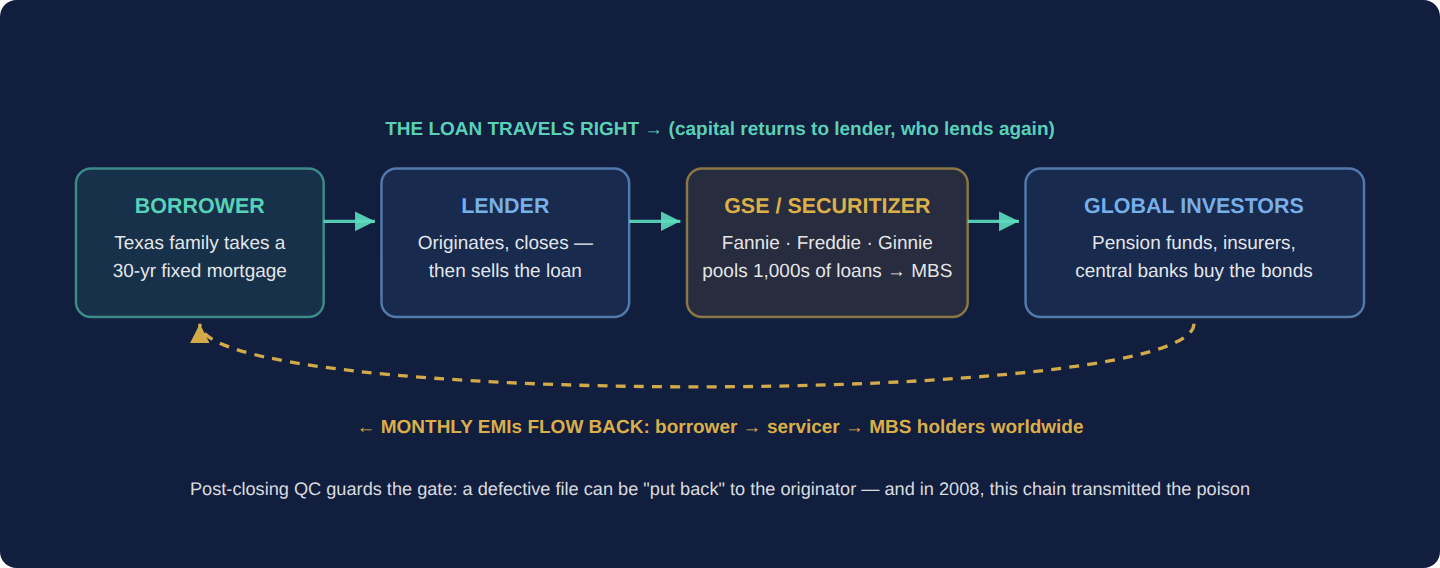
The US mortgage lifecycle runs origination (application, underwriting, approval) → closing (signing and funding, governed by the TILA/RESPA disclosure regime that mandates the Loan Estimate and Closing Disclosure so borrowers can see and compare true costs) → post-closing (quality control, document custody, delivery of the loan file onward) → servicing (collecting payments, managing escrow and delinquency — often by a different firm than the lender, which is why your loan’s “owner” and the company you pay can differ). The pivot is that the originating lender usually doesn’t keep the loan: it sells it into the secondary market, replenishing its capital to lend again.
The dominant buyers are the GSEs — Fannie Mae and Freddie Mac — government-sponsored enterprises that buy conforming loans (those within a size limit set by their regulator, $832,750 for a one-unit home in most of the country in 2026), pool thousands into mortgage-backed securities (MBS), guarantee the payments, and sell the bonds to the pension funds, insurers, and central banks of earlier chapters (Ginnie Mae does the same for government-insured loans). Securitization — converting streams of loan payments into tradable bonds — is the machine’s engine, and in its clean form it works remarkably well: it connects a teacher’s pension in Toronto to a firefighter’s mortgage in Texas, spreads risk across the globe, and manufactures the long-term fixed-rate loan, since no single bank funded by overnight deposits could otherwise safely lend at a fixed rate for 30 years.
This machinery explains two things. First, the profession of post-closing QC: investors buy loan files sight-unseen against contractual representations, and a defective file — missing signature, faulty appraisal, income miscalculated — can be put back to the originator for repurchase years later; the thousands of specialists (many in India’s GCCs, chapter 10.6: From BPO to GCC — India’s Global Delivery Economy) who verify every document exist because each file is a manufactured product with a warranty. Second, 2008 (chapter 3.8: The 2008 Financial Crisis — When the System Almost Broke) in one sentence: the machine kept running after the inputs turned toxic — “originate-to-distribute” meant lenders bore no consequence for bad loans, private-label securitizers sliced subprime pools into tranches the rating agencies (chapter 3.14: Credit Rating Agencies — The Scorekeepers of Trust) blessed as AAA, and when house prices fell, the machine transmitted the poison to every corner of the global system with the same efficiency it had transmitted capital. The reforms — ability-to-repay rules, risk retention (“skin in the game”), the GSEs in conservatorship since September 6, 2008 — all target that broken feedback loop. Risk retention means sponsors of most securitizations must keep at least 5 percent of the credit risk: on a $350 million pool of loans, 0.05 × $350,000,000 = $17,500,000 stays on the sponsor’s books. India’s rule is similar: under the RBI’s 2021 securitization directions an originator keeps 5 percent of a residential-mortgage pool (5 or 10 percent for other loans) and must hold the loans a minimum period before selling.
1. A mid-size broker fails tonight. Walk through what happens to (a) its shareholders, (b) its bondholders, and (c) its clients’ securities — and name the specific mechanisms from chapters 11.1 and 11.3 that make (c) different. 2. Settlement moves from T+1 to T+0. List every process in this Part that must compress, and the one risk that gets smaller. 3. Your KPIs are green but two KRIs — aged breaks and attrition — have risen for three straight months. Draft the one-paragraph warning you’d send leadership. 4. Explain to a 10th grader why a defective signature on a Texas mortgage file can matter to a Norwegian pension fund. If you can, you’ve connected chapters 8.4, 11.5, and 3.15.
What is mortgage securitization?
Lenders sell most US mortgages to Fannie Mae, Freddie Mac or Ginnie Mae, which pool them into mortgage-backed securities for global investors.
What is the conforming loan limit?
$832,750 for a one-unit home in most of the country in 2026.
Why can’t one bank fund a 30-year fixed loan itself?
No single bank funded by overnight deposits could safely lend at a fixed rate for 30 years, so securitization manufactures the long-term fixed-rate loan.
Part 11: The Post-Trade World‘s machinery has Indian faces. Equities clear through NSE Clearing or ICCL (Section 11.1: The Plumbing — Clearing Houses, Depositories, and Custodians); CCIL, incorporated in April 2001 and clearing government securities since 2002, clears government securities, money-market trades and dollar-rupee foreign exchange, and the RBI recognized it as a qualified central counterparty in 2014. Your shares sit in your own demat account at NSDL or CDSL, in your name, so a broker’s failure normally does not touch them; the exposure is a power of attorney that lets the broker move or pledge them, so grant it narrowly. Netting works as in New York, counted in crore (1 crore = 10 million): suppose A owes B ₹500 crore, B owes C ₹420 crore and C owes A ₹310 crore, a gross ₹1,230 crore. After novation, A pays 500 − 310 = ₹190 crore, B receives 500 − 420 = ₹80 crore and C receives 420 − 310 = ₹110 crore, so only ₹190 crore moves, a cut of 1 − 190/1,230 ≈ 84.6% (illustrative). Behind it stands NSE Clearing’s core settlement guarantee fund of over ₹12,000 crore (about $1.4 billion by its own conversion), over ₹5,300 crore of it NSE Clearing’s own money. For clients, SEBI’s end-of-day rule, effective July 1, 2023, says no broker may hold client funds overnight: they go to the clearing corporation as cash, a lien-marked fixed deposit or pledged overnight mutual fund units.
Lenders sell most US mortgages to Fannie Mae, Freddie Mac or Ginnie Mae, which pool them into mortgage-backed securities for global investors; this is what makes 30-year fixed loans possible and why post-closing quality control exists. In 2008 the machine kept running on toxic inputs, and the reforms (ability-to-repay rules and 5 percent risk retention, $17.5 million on a $350 million pool) aim to restore skin in the game.
Four questions and two worked problems on this chapter. Decide on your answer first, then click “Reveal Answer.”
1. A sponsor securitizes a $350 million pool of mortgages and must retain 5 percent of the credit risk. How much stays on its books?
- $7 million
- $17.5 million
- $1.75 million
- $35 million
Reveal Answer
Answer: B. 0.05 × $350,000,000 = $17,500,000, which is the sponsor’s skin in the game.
2. Why can a defective mortgage file be returned to the originator years after sale?
- The servicer must guarantee every payment on the loans it manages for the investors
- Rating agencies insure each loan file, so any defect is covered by the rating firm
- The borrower can cancel any loan after five years, which sends the file back to the originator
- Investors buy on contractual representations and can put back files that breach them
Reveal Answer
Answer: D. Loans are sold sight-unseen against representations, so a missing signature or faulty appraisal can force a repurchase.
3. What did originate-to-distribute do to lending standards before 2008?
- It forced lenders to keep every loan on their books until maturity
- It capped loan sizes at the conforming limit for all lenders
- Lenders that sold loans on bore little consequence for bad ones
- It required borrowers to prove their income twice before closing
Reveal Answer
Answer: C. If the lender sells the loan, the risk travels with it, so the incentive to underwrite carefully weakened.
4. Which institutions buy conforming loans, pool them into MBS and guarantee the payments?
- The depositories NSDL and CDSL
- Fannie Mae and Freddie Mac, the GSEs
- The custodians BNY and State Street
- The CCPs NSCC and FICC
Reveal Answer
Answer: B. Fannie Mae and Freddie Mac (and Ginnie Mae for government-insured loans) pool loans into securities and guarantee payments to investors.
5. Worked problem: The 2026 conforming loan limit is $832,750. A buyer wants a $900,000 loan. By how much does it exceed the limit, and what kind of loan is it?
Reveal Answer
Answer: Excess = $900,000 − $832,750 = $67,250. It is a jumbo loan, which the agencies cannot buy.
6. Worked problem: A $1bn mortgage pool pays 4.5%. Servicing takes 0.25% and the agency guarantee fee 0.50%. What do investors receive?
Reveal Answer
Answer: Investors get 4.50% − 0.25% − 0.50% = 3.75%, or $37.5m a year.
- EUR-Lex, Regulation (EU) 2022/2554 (DORA) — Applies from January 17, 2025
- FCA, Operational resilience — UK rules effective March 31, 2022, deadline March 31, 2025
- The IIA, Three Lines Model — 2020 update of Three Lines of Defense
- FHFA, Conservatorship — Fannie Mae and Freddie Mac in conservatorship since Sept 6, 2008
- RBI, Securitisation of Standard Assets Directions, 2021 — MRR 5 percent RMBS, 5 or 10 percent others, MHP
- FHFA, 2026 conforming loan limits — $832,750 baseline limit
- SEC, Credit risk retention final rule (2014) — 5 percent risk retention