
7.1 How Artificial Intelligence Became an Economic Force
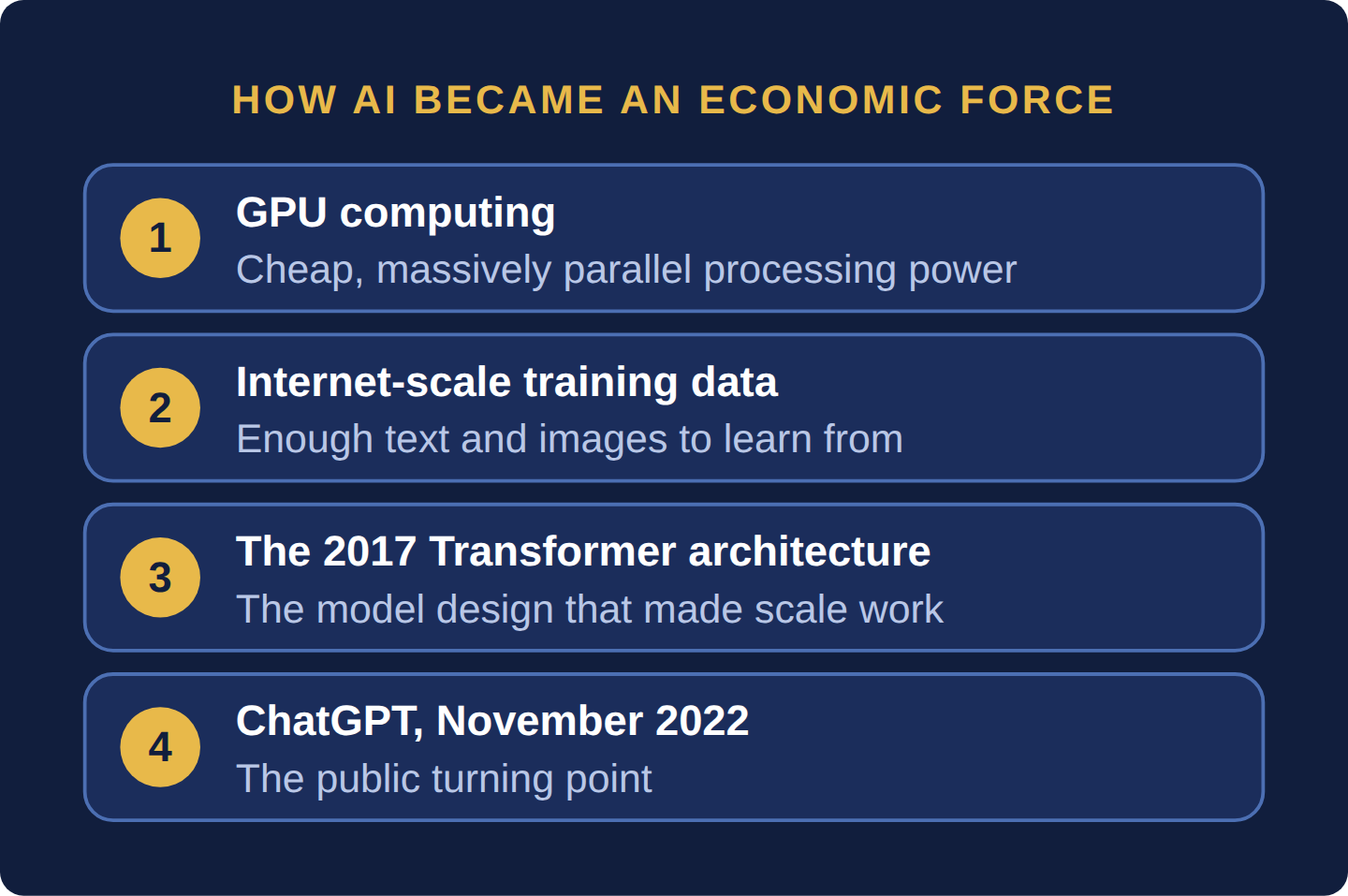
AI became an economic force when three things converged: GPU computing, internet-scale training data and the 2017 Transformer architecture. ChatGPT’s launch in November 2022 was the public turning point.
Why it matters: It explains why AI moved from research labs to a trillion-dollar investment theme so quickly.
Summary: AI became an economic force when three things converged: GPU computing, internet-scale training data and the 2017 Transformer architecture. ChatGPT’s launch in November 2022 was the public turning point.
- The Stanford AI Index 2025 estimates that the cost of AI hardware has been falling about 30% a year and its energy efficiency improving about 40% a year.
- The Stanford AI Index 2026 estimates that generative AI reached 53% population adoption within three years, faster than the PC or the internet.
Artificial intelligence — the ability of software to perform tasks that previously required human intelligence — has existed as a research field since the 1950s. What changed in the 2010s and accelerated in the 2020s was the convergence of three factors that moved AI from academic laboratory to the most significant capital allocation event in current economic history.
First, computing power. NVIDIA’s GPUs — originally designed for video game graphics — turned out to be extraordinarily well-suited for AI training, which requires performing the same mathematical operations millions of times simultaneously in parallel. The Stanford AI Index 2025 estimates that the cost of AI hardware has been falling about 30% a year and its energy efficiency improving about 40% a year. Second, training data. The internet created an unprecedented corpus of human-generated text, images, code, and video — the raw material that modern AI models learn from. Third, the Transformer architecture, introduced by Google researchers in a landmark 2017 paper titled “Attention Is All You Need,” which became the mathematical foundation for every major AI language model that followed.
The moment that brought AI from industry knowledge to global awareness was November 2022, when OpenAI launched ChatGPT. The Stanford AI Index 2026 estimates that generative AI reached 53% population adoption within three years, faster than the PC or the internet. Heads of government, corporate boards, and central banks immediately began assessing the implications. The capital response was historically rapid and historically large.
Economists call technologies like electricity and the internet general-purpose technologies — innovations so fundamental that they eventually transform every industry rather than just one. Electricity did not simply replace candles; it enabled electric motors, assembly lines, refrigeration, broadcasting, and computing — entirely new industries that could not have existed without it. AI is now producing the same pattern: not simply doing existing tasks faster, but enabling entirely new products, business models, and economic activities that were not previously conceivable.
Why did AI take off as an economic force?
Three things converged: GPU computing, internet-scale training data and the 2017 Transformer architecture. ChatGPT’s launch in November 2022 was the public turning point.
How fast is AI hardware improving?
The Stanford AI Index 2025 estimates that the cost of AI hardware has been falling about 30% a year and its energy efficiency improving about 40% a year.
How fast was generative AI adopted?
The Stanford AI Index 2026 estimates that generative AI reached 53% population adoption within three years, faster than the PC or the internet.
AI became an economic force when three things converged: GPU computing, internet-scale training data and the 2017 Transformer architecture. ChatGPT’s launch in November 2022 was the public turning point, and the Stanford AI Index 2026 estimates that generative AI reached 53% population adoption within three years, faster than the PC or the internet.
Four questions and two worked problems on this chapter. Decide on your answer first, then click “Reveal Answer.”
1. Which three developments does the chapter say converged to turn AI into an economic force?
- Powerful parallel GPU computing, internet-scale training data, and the Transformer architecture
- Falling interest rates, rapid venture capital growth, and cheaper cloud storage and bandwidth
- Faster stock exchanges, mobile payments networks, and large language dictionaries and glossaries
- Cheap fiber broadband, open-source operating systems, and the smartphone app store ecosystem
Reveal Answer
Answer: A. The chapter names computing power, training data and the 2017 Transformer paper as the three factors.
2. Economists call electricity and the internet ‘general-purpose technologies’. What defines such a technology?
- It is cheap enough that every household buys it within a year
- It replaces the technology that came directly before it
- It eventually transforms many industries, not just one
- It is owned by a single dominant firm worldwide
Reveal Answer
Answer: C. Electricity enabled motors, refrigeration and computing; the label applies to innovations that spread across the whole economy.
3. Which statement about the Stanford AI Index figures in this chapter is correct?
- They are estimates by researchers, such as hardware cost falling about 30% a year
- They are audited company filings, like capex, signed off by outside accountants
- They are legally binding forecasts issued by regulators and updated each quarter
- They are vendor sales targets for the coming year, published in company reports
Reveal Answer
Answer: A. The chapter presents the AI Index numbers (cost falling about 30% a year, energy efficiency improving about 40% a year) as estimates, not filings.
4. A reader claims generative AI is the ‘fastest-adopted technology ever’ because ChatGPT hit 100 million users in two months. Which is the better-supported statement in this chapter?
- Adoption cannot be compared with the PC or the internet at all, because the data are not comparable
- The AI Index 2026 estimates 53% population adoption within three years, faster than the PC or the internet
- ChatGPT’s user count proves adoption beat every earlier technology, so no population measure is needed
- Adoption has been slower than the PC because chips are expensive, so the claim is false on cost alone
Reveal Answer
Answer: B. The chapter relies on the AI Index estimate of population adoption rather than one product’s early user count.
5. Worked problem: AI hardware costs fall 30% a year. What does $100 of compute cost after five years?
Reveal Answer
Answer: $100 × 0.705 = $16.81.
6. Worked problem: Energy efficiency improves 40% a year. By what factor after five years?
Reveal Answer
Answer: 1.405 = 5.38×.
7.2 The Three Layers of the AI Economy
The AI economy has three layers: infrastructure (chips, data centers, power), models and applications. NVIDIA’s chips have moved from Hopper to Blackwell to Vera Rubin.
Why it matters: Knowing the layers shows where the money flows first.
Summary: The AI economy has three layers: infrastructure (chips, data centers, power), models and applications. NVIDIA’s chips have moved from Hopper to Blackwell to Vera Rubin.
- NVIDIA’s revenue reached $215.9 billion in the fiscal year to January 2026, 3.5 times the $60.9 billion of two years earlier, with $193.7 billion of it from data centers.
- The Stanford AI Index estimated that GPT-4 used about $78 million of computing to train and Google’s Gemini Ultra about $191 million, counting compute only.
- DeepSeek’s V3 cost $5.576 million for its final training run by the company’s own arithmetic: 2.788 million GPU-hours at an assumed $2 per GPU-hour.
The AI economy can be understood through three distinct but interdependent layers, each playing a different role, attracting different capital, and generating value in different ways. Understanding the layered structure is essential — it explains where the current trillion-dollar investment is going, where future economic value will be captured, and what the geopolitical tensions are really about.
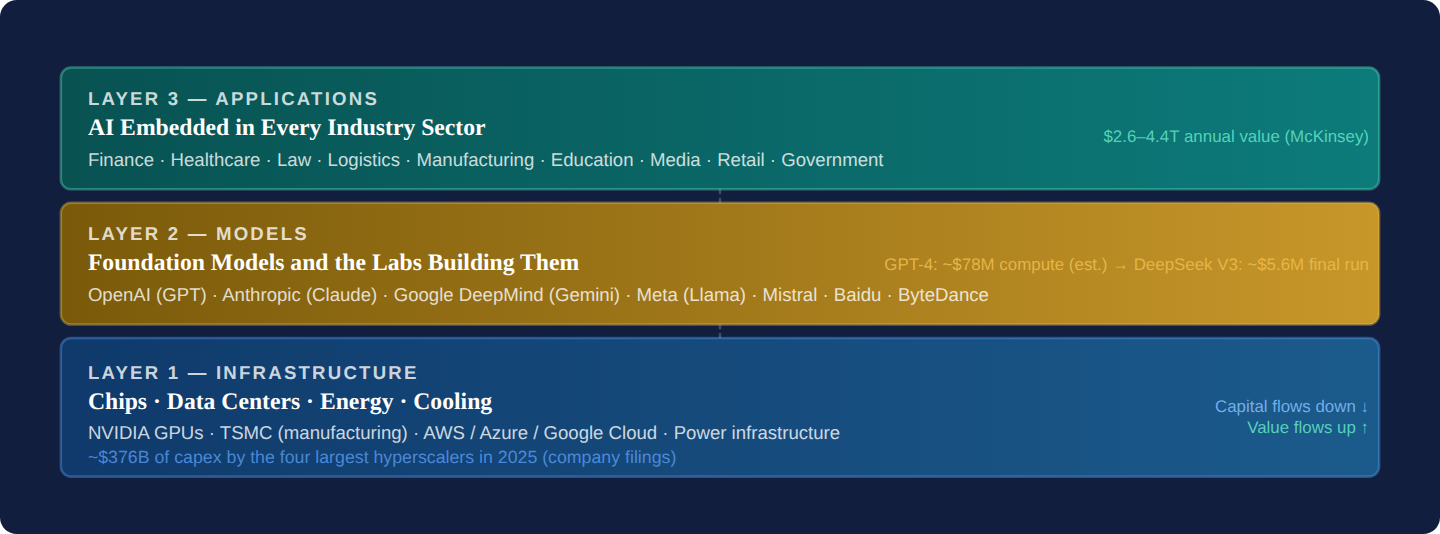
The Infrastructure layer is where the physical foundations of AI live — the chips that perform the calculations, the data centers that house the chips, the power infrastructure feeding the data centers, and the cooling systems preventing them from overheating. NVIDIA’s AI chips come in generations: Hopper (the H100 and H200) set the pace in 2023–24, Blackwell reached billions of dollars of sales in its first quarter on the market (the three months to January 2025), and the Vera Rubin platform entered full production in mid-2026. A frontier training cluster links tens of thousands of these GPUs. NVIDIA’s own results show the scale: revenue of $215.9 billion in the fiscal year to January 2026, 3.5 times the $60.9 billion of two years earlier, with $193.7 billion of it from data centers. This layer is where almost all of the current multi-hundred-billion-dollar capital deployment is going.
The Models layer is where foundation models — the large language and multimodal models that power AI applications — are trained and maintained. The Stanford AI Index estimated that GPT-4 used about $78 million worth of computing to train and Google’s Gemini Ultra about $191 million; those figures count compute only. This cost has historically been a significant barrier to entry. The January 2025 DeepSeek moment challenged this assumption: DeepSeek’s V3 model — the base on which its R1 reasoning model was built — cost $5.576 million for its final training run by the company’s own arithmetic (2.788 million GPU-hours on NVIDIA H800 chips × an assumed rental price of $2 per GPU-hour) while achieving performance comparable to leading US models. That figure excludes research salaries, failed experiments, and the hardware itself, so it is not directly comparable to estimates for GPT-4 — but even with those caveats, the efficiency leap was real enough to cut NVIDIA’s share price by 17% on January 27, 2025, about $590 billion of market value in a single day (($142.62 − $118.42) × 24.4 billion shares), as investors reconsidered how much GPU demand the AI build-out would actually require if models could be trained far more efficiently. Whether DeepSeek’s efficiency gains are replicable at full frontier scale remains one of the most consequential open questions in technology economics.
The Applications layer is where economic value is ultimately captured and where the broadest economic impact occurs — AI embedded in the workflows of healthcare, finance, logistics, manufacturing, education, and every other industry. The infrastructure and models layers are means to this end. The common expectation, a forecast rather than an observation, is that the applications layer will capture the largest share of total AI economic value over the coming decade, even though today’s investment is concentrated in infrastructure.
What are the layers of the AI economy?
Infrastructure (chips, data centers and power), models, and applications.
How much does NVIDIA earn from AI?
NVIDIA’s revenue reached $215.9 billion in the fiscal year to January 2026, 3.5 times the $60.9 billion of two years earlier, with $193.7 billion of it from data centers.
How much does it cost to train a leading AI model?
The Stanford AI Index estimated that GPT-4 used about $78 million of computing to train and Google’s Gemini Ultra about $191 million, counting compute only.
The AI economy has three layers: infrastructure (chips, data centers, power), models and applications. NVIDIA’s chips have moved from Hopper to Blackwell to Vera Rubin, and its revenue reached $215.9 billion in the year to January 2026. Training-cost figures are estimates that count different things: about $78 million of compute for GPT-4 (AI Index) versus DeepSeek V3’s $5.576 million for one final run at an assumed $2 per GPU-hour.
Four questions and two worked problems on this chapter. Decide on your answer first, then click “Reveal Answer.”
1. Which NVIDIA chip generation does the chapter say set the pace in 2023-24?
- Ampere (A100 and A800)
- Blackwell (B100 and B200)
- Vera Rubin (the 2026 platform)
- Hopper (H100 and H200)
Reveal Answer
Answer: D. Hopper led in 2023-24; Blackwell reached billions in sales in its first quarter (to January 2025) and Vera Rubin entered full production in mid-2026.
2. NVIDIA’s revenue was $215.9 billion in the year to January 2026 and $60.9 billion two years earlier. By what multiple did it grow?
- About 4.5 times
- About 1.7 times
- About 3.5 times
- About 2.5 times
Reveal Answer
Answer: C. 215.9 ÷ 60.9 = 3.545, which rounds to 3.5.
3. DeepSeek V3’s training cost of $5.576 million is calculated as 2.788 million GPU-hours times what assumed price?
- $2 per GPU-hour
- $20 per GPU-hour
- $200 per GPU-hour
- $0.20 per GPU-hour
Reveal Answer
Answer: A. 2,788,000 × $2 = $5,576,000. It is one final run at an assumed rental price, so it is not comparable to an all-in budget.
4. Why can the $5.576 million figure not be set directly against the AI Index’s $78 million estimate for GPT-4?
- The first includes salaries and the second does not, so the two cannot be compared line by line or in total
- The first covers one final run at an assumed rental price; the second is an estimate of total training compute
- The first is an audited figure and the second is a government forecast, so only one of them can be used as evidence
- The first is in dollars and the second in GPU-hours, so the two use entirely different units and cannot be compared
Reveal Answer
Answer: B. The DeepSeek figure leaves out research, failed runs and staff, and the two use different methods.
5. Worked problem: NVIDIA’s revenue rose from $60.9bn to $215.9bn in two years. What is the multiple and the annual growth rate?
Reveal Answer
Answer: Multiple = 215.9 ÷ 60.9 = 3.55×. Annual growth = √3.55 − 1 = 88.3%.
6. Worked problem: Data centers brought in $193.7bn of that. What share is that?
Reveal Answer
Answer: 193.7 ÷ 215.9 = 89.7%.
7.3 The Financial Flows — Where the Trillions Are Going
Capital being deployed into AI is historically extraordinary, and spending reaches profit through depreciation, so assumptions about how long servers last matter. Government programs such as Stargate’s $500 billion are stated plans, not money spent.
Why it matters: Accounting assumptions can move reported profit by billions without any change in cash.
Summary: Capital being deployed into AI is historically extraordinary, and capex reaches profit through depreciation, so assumptions about how long servers last matter. Government programs such as Stargate’s $500 billion are stated plans, not money spent.
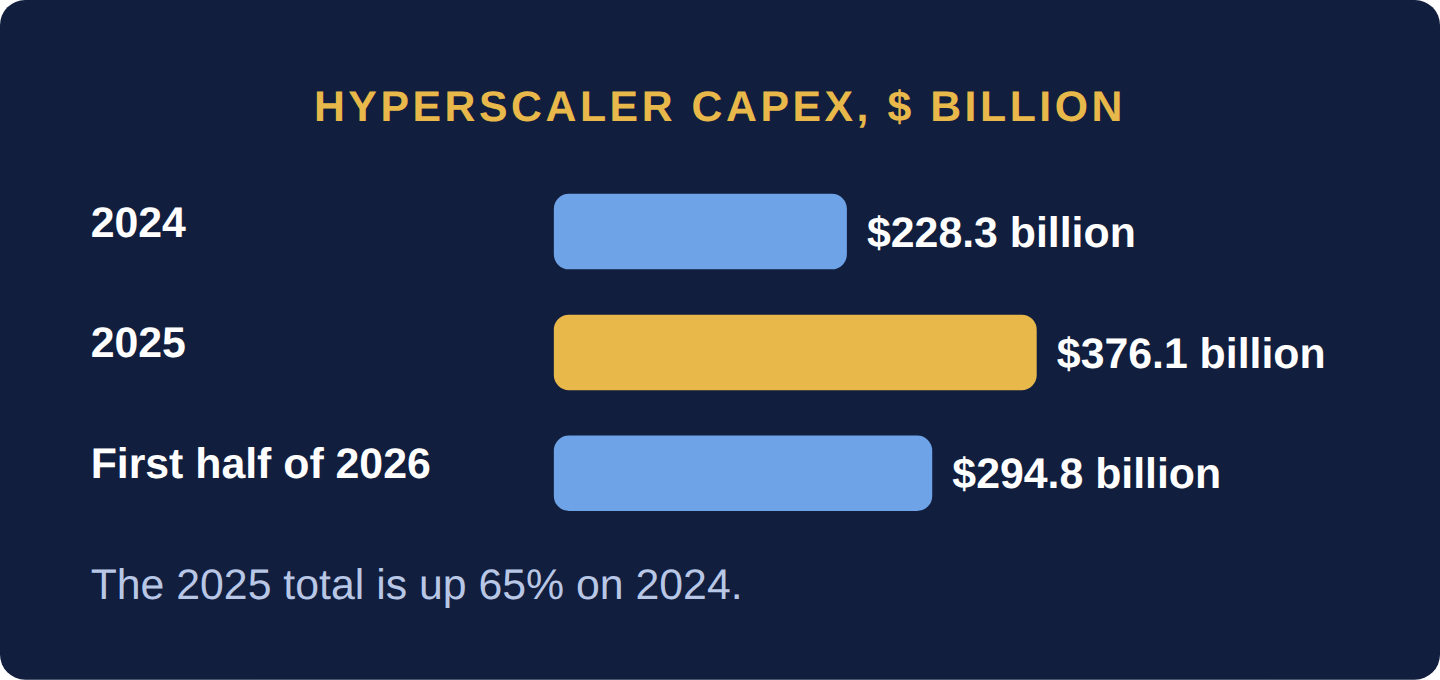
- The four hyperscalers reported $376.1 billion of capex in 2025, up 65% from $228.3 billion in 2024, and $294.8 billion in the first half of 2026 alone.
- A useful life of five rather than six years raises the yearly charge on $100 billion of servers from $16.67 billion to $20 billion, moving $3.33 billion a year from profit into depreciation with no change in cash.
- Amazon lengthened its server lives from five to six years in 2024, which cut that year’s depreciation by $3.2 billion, then moved a subset back to five years from January 2025.
- Economists describe the 19th century railway boom as private capital poured in at a scale that seemed absurd relative to immediate returns, yet it ultimately transformed every other industry.
The scale of capital being deployed into AI is historically extraordinary. The four largest US cloud and platform companies, the hyperscalers (Microsoft, Alphabet, Amazon and Meta), reported $376.1 billion of capital expenditure (capex: spending on long-lived assets such as buildings and servers) in 2025, up 65% from $228.3 billion in 2024, and $294.8 billion in the first half of 2026 alone. Those are observed numbers from their filings, not forecasts.
Hyperscaler Capital Expenditure — The Largest Numbers in the Story
| Company | 2024 capex (reported) | 2025 capex (reported) | Jan–Jun 2026 (reported) | Primary allocation |
|---|---|---|---|---|
| Microsoft | $55.6 billion | $83.1 billion | $66.7 billion | Azure AI infrastructure; OpenAI partnership; global data center capacity |
| Alphabet (Google) | $52.5 billion | $91.4 billion | $80.6 billion | Google Cloud AI; custom TPU chips; DeepMind and Gemini infrastructure |
| Amazon | $83.0 billion | $131.8 billion | $98.4 billion | AWS data centers and chips, plus warehouses and logistics; $8 billion of notes in Anthropic committed through 2025 (a separate investment, not capex) |
| Meta Platforms | $37.3 billion | $69.7 billion | $49.1 billion | Llama models; AI infrastructure for Facebook, Instagram, WhatsApp |
| Total (4 companies) | $228.3 billion | $376.1 billion | $294.8 billion | 2025 up 65% on 2024; first half of 2026 up 84% on the first half of 2025 ($160.2 billion) |
Capex does not hit profit in the year it is spent. A company that buys $100 billion of servers records them as an asset and charges depreciation: an equal slice of the cost each year over the assets’ estimated useful life. That life is a management estimate, and in AI it is contested, because each new chip generation (Section 7.2: The Three Layers of the AI Economy) makes the last one less valuable sooner. Amazon lengthened its server lives from five to six years in 2024, which cut that year’s depreciation by $3.2 billion, then moved a subset back to five years from January 2025, citing the faster pace of AI development (2024 Form 10-K).
| Line | Six-year life | Five-year life |
|---|---|---|
| Annual depreciation = $100B ÷ life | $16.67B | $20.00B |
| Return the investors want = 10% × $100B | $10.00B | $10.00B |
| Gross profit needed each year | $26.67B | $30.00B |
| Revenue needed if power, staff and other running costs take 40% of revenue = gross profit ÷ 0.60 | $44.4B | $50.0B |
Shortening the life by one year moves $20.00B − $16.67B = $3.33B a year from reported profit into depreciation, with no change in cash. Scale it up: if all $376.1 billion of the four companies’ 2025 capex were servers on a six-year life, it would need about 3.761 × $44.4B ≈ $167 billion of new yearly revenue. The 10% return and the 40% running-cost share are illustrative assumptions, not company figures; the depreciation arithmetic is how the accounts work.
Sovereign Wealth Funds and National AI Strategies
| Country / Region | Strategic Initiative | Scale |
|---|---|---|
| United States | CHIPS and Science Act (2022); Stargate project (January 2025) | CHIPS Act: $52B in semiconductor manufacturing subsidies. Stargate: a new company that its funders (SoftBank, OpenAI, Oracle and MGX) said in January 2025 intends to invest $500B over four years, a stated plan rather than money spent |
| European Union | EU AI Act (regulatory framework); European AI investment initiative | AI Act: the first comprehensive AI law (Section 7.7: AI Regulation — How Governments Are Responding), with compliance costs for any firm serving EU customers |
| China | National AI development plans; state-directed investment across the value chain | Hundreds of billions in state-directed investment; strategic goal to be world AI leader by 2030; severely constrained in advanced chips by US export controls |
| UAE | G42 (government-linked AI company); Microsoft partnership | Microsoft invested $1.5B in G42 (April 2024); aiming to become a global AI hub using sovereign wealth fund capital |
| Saudi Arabia | NEOM; AI investment through PIF (Public Investment Fund) | Significant AI investments as part of Vision 2030 economic diversification away from oil dependency |
| India | IndiaAI Mission | ₹10,371.92 crore approved in March 2024 for AI computing infrastructure, foundation model development, and talent programs (see the India Lens at the end of Part 7: Artificial Intelligence) |
| Japan | National AI strategy | Government pushing AI adoption; TSMC built a major fab in Japan with government support |
Economists studying the 19th century railway boom describe a period where private capital and government investment poured into rail infrastructure at a scale that seemed absurd relative to the immediate commercial returns — but which ultimately transformed every other industry by connecting markets, enabling logistics at scale, and making the Industrial Revolution’s productivity gains available everywhere. AI infrastructure investment today has the same structural character: the returns are not primarily in the infrastructure itself, but in everything the infrastructure makes possible in the application layer above it.
How much are the biggest companies spending on AI?
The four hyperscalers reported $376.1 billion of capex in 2025, up 65% from $228.3 billion in 2024, and $294.8 billion in the first half of 2026 alone.
How does AI spending reach profit?
Through depreciation. A useful life of five rather than six years raises the yearly charge on $100 billion of servers from $16.67 billion to $20 billion, moving $3.33 billion a year from profit into depreciation with no change in cash.
Is Stargate’s $500 billion real spending?
It is a stated plan, not money spent.
The four hyperscalers reported $376.1 billion of capex in 2025, up 65% from $228.3 billion in 2024, and $294.8 billion in the first half of 2026. Capex reaches profit through depreciation, so a useful life of five rather than six years raises the yearly charge on $100 billion of servers from $16.67 billion to $20 billion. Government programs such as Stargate’s $500 billion are stated plans, not money spent.
Four questions and two worked problems on this chapter. Decide on your answer first, then click “Reveal Answer.”
1. The four hyperscalers’ capex was $228.3 billion in 2024 and $376.1 billion in 2025. What was the growth?
- About 45% (376.1 ÷ 228.3 − 1)
- About 25% (376.1 ÷ 228.3 − 1)
- About 85% (376.1 ÷ 228.3 − 1)
- About 65% (376.1 ÷ 228.3 − 1)
Reveal Answer
Answer: D. 376.1 ÷ 228.3 = 1.647, so growth is about 65%.
2. A company buys $100 billion of servers. How much does the yearly straight-line depreciation charge rise if their useful life is set at 5 years instead of 6?
- From $20 billion to $25 billion
- From $16.67 billion to $33.3 billion
- From $16.67 billion to $20 billion
- From $10 billion to $12.5 billion
Reveal Answer
Answer: C. 100 ÷ 6 = 16.67 and 100 ÷ 5 = 20; a shorter life raises the yearly charge and lowers reported profit, with no change in cash.
3. Stargate’s ‘$500 billion’ is best described in this chapter as what?
- A loan commitment guaranteed by the US Treasury, drawn down over four years
- A subsidy paid under the CHIPS Act to the firms building the sites
- A stated intention to invest over four years, not money already spent
- Audited capex already reported in company filings for the past year
Reveal Answer
Answer: C. Funders said in January 2025 they intend to invest; only filings show cash spent.
4. Which of these is observed data rather than a forecast or plan?
- Hyperscaler capex of $294.8 billion in the first half of 2026 from company filings
- A plan to invest $500 billion over four years, announced by a consortium of firms
- A scenario in which AI adds 7% to world GDP over the next decade, from a bank study
- A vendor outlook for next quarter’s revenue, issued in an investor presentation
Reveal Answer
Answer: A. Filings report cash actually spent; the other three are plans, scenarios or outlooks.
5. Worked problem: Hyperscaler capex rose from $228.3bn to $376.1bn. What was the percentage increase?
Reveal Answer
Answer: 376.1 ÷ 228.3 − 1 = 64.7%.
6. Worked problem: $100bn of servers is depreciated over 5 years instead of 6. What is the extra annual charge and the effect on profit?
Reveal Answer
Answer: Charge = $100bn ÷ 5 = $20bn vs $100bn ÷ 6 = $16.67bn. Extra = $3.33bn a year, with no change in cash.
- Stanford HAI, AI Index Report — Annual data-driven report on AI progress, adoption and cost
- Amazon.com Form 10-K for 2024 — Server useful life 5→6 years (2024, −$3.2B D&A) and subset back to 5 years from Jan 2025; Anthropic notes $1.25B+$2.75B+$1.3B+$2.7B
- SEC EDGAR XBRL company facts and filings: Microsoft, Alphabet, Amazon, Meta (10-K/10-Q) — Purchases of property and equipment 2024, 2025, H1 2026
- Microsoft
- Alphabet — SEC
- Meta — SEC
- PIB on the IndiaAI Mission (Mar 2024)