
6.3 India's Position in Each Sector — A Summary Snapshot
India is globally significant in some sectors, a large domestic market in others and an emerging force in the rest. The snapshot shows where each sector stands.
Why it matters: It shows which Indian sectors compete globally and which serve the home market.
Summary: India is globally significant in some sectors, a large domestic market in others and an emerging force in the rest, and the snapshot shows where each sector stands.
- India imports 85% of its oil, while Reliance’s Jamnagar refinery is world-class and Adani is rapidly building renewable capacity.
- Indian pharma supplies about 20% of global generic medicines by volume and 60% of global vaccines.
- IT services bring in $200B+ in annual exports with 5M+ direct employees, the largest source of India’s forex earnings.
For readers building a career in finance with an India focus, it is useful to see the complete picture of where India is globally significant, where it is a large domestic market, and where it is an emerging force still building its position.

Reading India’s sector position in numbers
India’s weight differs sharply by sector. In pharmaceuticals it is a major global supplier, in energy a large importer. A sector’s share of world supply or demand turns a statement like “India supplies about 20% of generics” into a quantity that can be compared.
Suppose world demand is 1,000 units of generic medicines and 500 doses of vaccines. India supplies about 20% of generics by volume and 60% of vaccines.
| Product | World demand | India’s share | India supplies |
|---|---|---|---|
| Generic medicines | 1,000 units | 20% | 200 units |
| Vaccines | 500 doses | 60% | 300 doses |
| Oil needs | 100 units | Imports 85% | 85 units imported |
Result: on these figures India supplies 200 units of generics and 300 doses of vaccines to the world, yet imports 85 of every 100 units of oil it uses.
| GICS Sector | India’s Role | Key Indian Companies | Global Context |
|---|---|---|---|
| Energy | Large net importer; growing domestic renewables | ONGC, Reliance Industries, IOC, Adani Green, Tata Power | 85% oil imported; Reliance Jamnagar = world-class refining; Adani rapidly building renewable capacity |
| Materials | Significant producer; world-class in some sub-sectors | Tata Steel, JSW Steel, Hindalco, UltraTech Cement | UltraTech = world’s 3rd largest cement co. outside China; Hindalco (via Novelis) = world’s largest aluminum rolling co. |
| Industrials | Strong domestic base; building defense self-reliance | L&T, Bharat Forge, HAL, BEL, BEML | L&T is globally competitive in engineering and construction; defense indigenization policy driving domestic procurement |
| Consumer Discretionary | Massive growing domestic market | Maruti Suzuki, Tata Motors Passenger Vehicles, Titan, Eternal (Zomato), Nykaa | India’s middle-class consumption growth is among the most important demand stories in global consumer markets |
| Consumer Staples | Large domestic market; MNC subsidiaries dominant | HUL, ITC, Nestlé India, Dabur, Marico, Godrej Consumer | HUL (Unilever subsidiary) and Nestlé India are among the most consistently profitable and well-managed companies in India |
| Health Care | Global force in generics and vaccines | Sun Pharma, Dr. Reddy’s, Cipla, Lupin, Divi’s Labs | ~20% of global generic medicines by volume; 60% of global vaccines; “pharmacy of the world” — a genuine strategic advantage |
| Financials | Large, growing, bifurcated market | HDFC Bank, ICICI Bank, SBI, Kotak, LIC, Bajaj Finance | India’s banking sector is large but has historically had high NPL ratios; private banks generating strong ROEs; UPI = global model for digital payments |
| Information Technology | Global leader in IT services | TCS, Infosys, Wipro, HCL Tech, Tech Mahindra | $200B+ in annual IT exports; 5M+ direct employees; largest source of India’s forex earnings; navigating AI transition |
| Communication Services | World’s second-largest telecom market; disrupted and consolidated | Reliance Jio, Bharti Airtel, Vodafone Idea | World’s cheapest mobile data; 700M+ smartphone users; 5G rollout underway; Airtel building enterprise services business |
| Utilities | Large scale; significant quality challenges | NTPC, Power Grid, Adani Green, Tata Power | 500 GW non-fossil target by 2030 (304.3 GW installed, Aug 2026); T&D losses (~16–18%) a major inefficiency; data center electricity demand creating new growth driver |
| Real Estate | Massive domestic demand; young REIT market | DLF, Godrej Properties, Prestige, Embassy REIT, Mindspace REIT | Urbanization + young demographics driving demand; office REIT market growing; data center real estate fastest-growing sub-sector |
In which sectors is India globally significant?
Pharmaceuticals is a clear example: Indian pharma supplies about 20% of global generic medicines by volume and 60% of global vaccines.
How dependent is India on oil imports?
India imports 85% of its oil, while Reliance’s Jamnagar refinery is world-class and Adani is rapidly building renewable capacity.
Is India a global leader in every sector?
No. India is globally significant in some sectors, a large domestic market in others and an emerging force in the rest.
India is globally significant in some sectors, a large domestic market in others and an emerging force in the rest. It imports 85% of its oil, yet supplies about 20% of global generic medicines by volume and 60% of global vaccines.
Four questions and two worked problems on this chapter. Decide on your answer first, then click “Reveal Answer.”
1. Which sector earns India the label “pharmacy of the world”?
- Materials, through its large specialty chemicals exports
- Health Care, through generics and vaccines
- Industrials, through medical equipment exports
- Consumer Staples, through Ayurvedic brands
Reveal Answer
Answer: B. Indian companies supply about 20% of global generic medicines by volume.
2. Which weakness does the snapshot flag for India’s utilities sector?
- No national transmission operator
- A shortage of listed power companies
- A ban on private renewable developers
- High transmission and distribution losses
Reveal Answer
Answer: D. Roughly 16–18% of electricity is lost in transmission and distribution, versus about 5–8% in developed markets.
3. What cut India’s telecom market to three significant players?
- A 2016 law limiting licenses to three firms
- The 5G spectrum auction of 2023
- Reliance Jio’s 2016 entry with very cheap data
- The merger of all state-owned operators
Reveal Answer
Answer: C. Jio’s near-free voice and cheap data started a price war that forced consolidation.
4. Crude oil prices jump 40%. Given India’s position in Energy, what is the most direct macro effect?
- India’s IT export earnings fall
- India’s oil export earnings rise
- India’s IT services export earnings fall sharply
- India’s current account deficit widens
Reveal Answer
Answer: D. India imports most of its crude, so a higher oil bill worsens its current account.
5. Worked problem: India imports 85% of its crude oil. If it uses 5.0 million barrels a day, how many does it import?
Reveal Answer
Answer: 85% × 5.0m = 4.25 million barrels a day (illustrative consumption figure).
6. Worked problem: A $5 a barrel rise in the oil price adds how much to the annual import bill?
Reveal Answer
Answer: 4.25m × 365 × $5 = $7.76bn a year.
6.4 The Festival Economy — Black Friday, Singles' Day, and the Business of Shopping Days
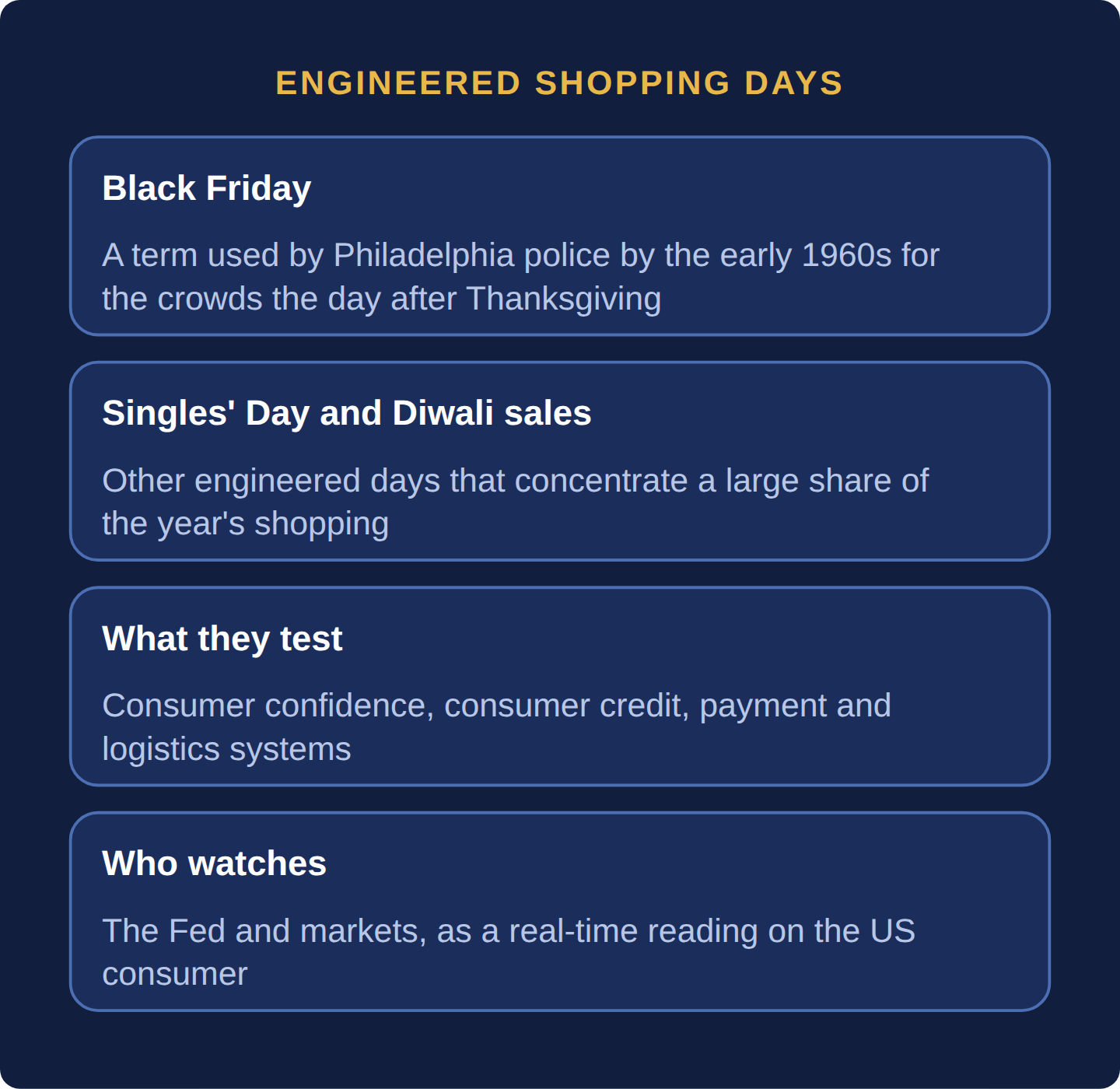
A few engineered shopping days, Black Friday, Singles’ Day and India’s Diwali-season sales, concentrate a large share of the year’s shopping. They act as a test of consumer confidence, consumer credit and payment and logistics systems.
Why it matters: Holiday spending is read as a real-time signal of how the consumer is doing.
Summary: A few engineered shopping days, Black Friday, Singles’ Day and India’s Diwali-season sales, concentrate a large share of the year’s shopping and act as a test of consumer confidence, consumer credit and payment and logistics systems.
- The documented origin of “Black Friday” is Philadelphia police, who by the early 1960s used the term for the crowds and traffic that clogged the city the day after Thanksgiving.
- For many US retailers the November–December quarter delivers a hugely disproportionate share of annual sales, so holiday spending data is watched by the Fed and markets as a real-time reading on the US consumer, roughly two-thirds of US GDP.
- Flipkart’s Big Billion Days and Amazon’s Great Indian Festival, timed to the Navratri–Diwali season, generate gross sales well past $10 billion in a few festive weeks.
- Price anchoring (“was ₹79,999, now ₹49,999”) makes a sale price feel like a windfall regardless of the true everyday price.
A few engineered days now concentrate a staggering share of the world’s shopping: America’s Black Friday, China’s Singles’ Day, and India’s Diwali-season sales. They matter far beyond retail — they are the year’s biggest test of consumer confidence, a large burst of consumer credit, and the annual stress test of payment and logistics systems. When economists want to know how the consumer is feeling, they watch these days.
Start with the name. The documented origin is Philadelphia police, who by the early 1960s used “Black Friday” for the crowds and traffic that clogged the city the day after Thanksgiving. The popular folk explanation, which retailers later promoted, is that American retailers ran at thin margins — in the red — for much of the year and the day after Thanksgiving pushed their ledgers “into the black”: into profit. (The accounting idiom comes straight from the financial statements of chapter 5.3: Key Financial Metrics — Reading the Scoreboard.) Whatever the name’s origin, the structural truth holds: for many US retailers the November–December quarter delivers a hugely disproportionate share of annual sales — and, for some retailers, most of their profit — which is why holiday spending data is watched by the Fed and by markets as a real-time reading on the US consumer, who at roughly two-thirds of US GDP (chapter 2.2: What Makes Up the US Economy) is arguably the single most consequential economic actor on Earth.
The day itself is a masterclass in pricing psychology. The signature tool is the loss leader — a television sold below cost, not to make money on the television but to fill the store (or app) and profit on everything else that lands in the basket. Around it: engineered scarcity (“only 50 units!”), countdown urgency, and price anchoring — “was ₹79,999, now ₹49,999” — which makes the sale price feel like a windfall regardless of what the true everyday price was. Regulators in several countries now police fake “was” prices for precisely this reason. The event has also migrated: the store-stampede spectacle of the 2000s gave way to Cyber Monday and week-long online events, a miniature history of retail’s shift to e-commerce.
Then the world took the idea and scaled it. China’s Singles’ Day (11 November) began as a students’ anti-Valentine’s joke; Alibaba adopted “11.11” in 2009 and built it into the largest shopping event on Earth — by the last totals it published (2021), its gross sales across platforms far exceeded US Black Friday and Cyber Monday online spending, and its live sales tickers became a national spectacle (until Alibaba and JD stopped publishing headline totals after 2021, reportedly under regulatory pressure — itself a lesson in how China manages economic optics, chapter 9.1: China — The State-Capitalist Superpower). India’s version rides something far older: Flipkart’s Big Billion Days and Amazon’s Great Indian Festival are deliberately timed to the Navratri–Diwali season, generating gross sales well past $10 billion in a few festive weeks — but they are e-commerce’s overlay on a centuries-old truth that Indians time major purchases to auspicious days: gold on Dhanteras and Akshaya Tritiya, vehicles and homes on Diwali and Dussehra. Auto companies, jewelers, and real-estate developers have always booked their best months around the festivals; the festival economy predates the internet here by centuries — the apps simply plugged into it.
Finally, the finance layer — the part invisible to shoppers and central to this guide. These events are credit events as much as retail ones: no-cost EMI offers, bank card tie-ups, and the explosive rise of Buy Now, Pay Later (BNPL) — installment credit granted at checkout in seconds — mean each mega-sale is a burst of consumer credit (when a bank is the lender, chapter 3.2: How Banks Create Money — Fractional Reserve Banking‘s loans creating deposits, compressed into a weekend; non-bank BNPL lenders fund themselves by borrowing and do not create money), with the repayment hangover, and rising BNPL delinquency concerns, following in the new year. They are also the annual stress test of the plumbing: UPI records its heaviest days of the year during festive sales, card networks and banks provision for peak load, and logistics networks hire lakhs of seasonal workers — while somewhere behind it all, the reconciliation teams of Part 11: The Post-Trade World face their highest-volume nights of the year matching every one of those transactions. A single discounted smartphone bought at midnight on a Big Billion Day touches pricing psychology, consumer credit, payment rails, and post-trade operations before breakfast — which is why a shopping day earned a chapter in an economics guide.
| Black Friday (US) | Singles’ Day (China) | Festive Season (India) | |
|---|---|---|---|
| When | Day after Thanksgiving (late Nov), extending through Cyber Monday | 11 November (“11.11”), now a multi-week event | Navratri → Diwali (Sep–Nov), anchored by Dhanteras |
| Origin | Philadelphia police slang (by the early 1960s) for post-Thanksgiving crowds and traffic; the “into the black” ledger story is a later folk explanation | Student anti-Valentine’s joke; commercialized by Alibaba from 2009 | Centuries of auspicious-day buying; e-commerce overlay since ~2014 |
| Scale signal | The year’s key reading on the US consumer (~2/3 of US GDP) | Largest shopping event on Earth by gross sales when last published (2021) | $10bn+ festive e-commerce, plus peak season for gold, autos, property |
| Finance layer | Card credit, BNPL boom, holiday-quarter earnings that move retail stocks | Platform credit, live sales tickers as economic optics | No-cost EMIs, BNPL, UPI’s heaviest days of the year |
| What it teaches | Consumer confidence in one number | Engineered demand at national scale | Culture, not technology, sets the calendar — tech plugs in |
1. The RBI signals rate cuts are coming. Using sector rotation logic, which three sectors would investors typically rotate into first, and why? 2. Crude oil falls 40%. Name one sector that celebrates, one that suffers, and one that barely notices — for both the US and India. 3. Why do people keep buying toothpaste in a recession but delay buying cars? Which two sector chapters does your answer connect? 4. A smartphone bought on no-cost EMI at midnight during a festive sale: trace every system it touches within 24 hours — pricing psychology, consumer credit creation, UPI’s peak load, logistics, and the reconciliation teams matching the payment. How many chapters of this guide did one discounted phone just activate?
Where does the name Black Friday come from?
The documented origin is Philadelphia police, who by the early 1960s used the term for the crowds and traffic that clogged the city the day after Thanksgiving.
Why do markets watch holiday shopping data?
For many US retailers the November–December quarter delivers a hugely disproportionate share of annual sales, so the Fed and markets watch holiday spending as a real-time reading on the US consumer.
What do big shopping days test?
Consumer confidence, consumer credit, and payment and logistics systems.
Indian exchanges and index providers do not use GICS. NSE Indices uses its own four-level structure: 12 macro-economic sectors, 22 sectors, 59 industries and 197 basic industries (current version July 2023), so an Indian factsheet’s “Fast Moving Consumer Goods” or “Capital Goods” will not match a GICS label one for one.
The bigger difference is concentration. On September 30, 2026, Financial Services made up 37.45% of the Nifty 50, followed by Oil, Gas & Consumable Fuels at 9.39% and Information Technology at 7.52%; HDFC Bank and ICICI Bank alone were 10.38% and 9.05%. So if financial stocks fall 5% while every other stock is flat, the index falls 0.3745 × 5% ≈ 1.87%. An Indian investor who “owns the market” is making a large bet on banks and lenders.
That is why rate decisions reach Indian stocks quickly. Since October 1, 2019, new floating-rate retail and small-business loans at Indian banks must be linked to an external benchmark such as the repo rate and reset at least once every three months (Section 10.2: The Reserve Bank of India — The Economy’s Guardian). A repo-rate cut therefore lowers banks’ loan yields within a quarter while their fixed-rate deposits reprice only as they mature, squeezing margins for a while, and the effect shows up in more than a third of the index at once.
Black Friday, Singles’ Day and India’s Diwali-season sales concentrate a large share of the year’s shopping and test consumer confidence, credit, payments and logistics. The Fed and markets watch holiday spending as a real-time reading on the US consumer.
Four questions and two worked problems on this chapter. Decide on your answer first, then click “Reveal Answer.”
1. According to documented history, where does the name “Black Friday” come from?
- Philadelphia police describing holiday crowds
- Stores shutting early for a public day of mourning
- A stock market crash the day after Thanksgiving
- A 1960s rule letting stores open at midnight
Reveal Answer
Answer: A. Philadelphia police used the term by the early 1960s for the crowds and traffic. The popular story that retailers’ ledgers went into the black is a later folk explanation that retailers promoted.
2. A retailer sells a television below cost to bring shoppers into its app. What is this tactic called?
- Engineered scarcity
- A loss leader
- Countdown urgency
- Price anchoring
Reveal Answer
Answer: B. The loss leader loses money on one item to profit on everything else in the basket.
3. A bank finances a festive-sale phone on a no-cost EMI. Following chapter 3.2: How Banks Create Money — Fractional Reserve Banking, what happens to the money supply?
- Money rises only after the loan is repaid
- The new loan creates a new deposit, so money rises
- The central bank must first print new notes
- The bank lends existing savings, so money is unchanged
Reveal Answer
Answer: B. When a bank lends it credits a deposit, creating money; repayment later destroys it.
4. Why do India’s festive mega-sales fall between Navratri and Diwali?
- The government grants a sales-tax holiday in those weeks
- It is the end of India’s financial year
- Retailers must clear stock before the monsoon
- E-commerce joined centuries of auspicious-day buying
Reveal Answer
Answer: D. Indians have long timed gold, vehicle and home purchases to festivals; the apps simply joined that calendar.
5. Worked problem: A retailer makes 35% of its $2bn annual sales in the November–December quarter. How much is that?
Reveal Answer
Answer: 35% × $2bn = $700 million.
6. Worked problem: Holiday sales come in 6% below forecast. What is the shortfall on that quarter?
Reveal Answer
Answer: 6% × $700m = $42 million, or 2.1% of the year.
- PIB, National Statement by the Prime Minister at COP26 (November 1, 2021) — 500 GW non-fossil capacity by 2030 and net zero by 2070 (Sections 1.17, 6.2, 6.3)
- MNRE, Physical Progress — Non-fossil capacity 304.33 GW on Aug 31, 2026
- RBI, External Benchmark Based Lending (2019)