
E.3 Corporate Actions
Corporate actions are events that a company causes, such as dividends, splits or takeovers. The Corporate Actions team turns each event into what every holder is entitled to, and for voluntary events it collects each holder’s choice before the deadline. A missed election is usually a loss the firm has to repay.
Why it matters: A missed deadline here is rarely forgiven, and the firm pays for it.
Summary: Corporate Actions turns issuer events into each holder’s entitlement and collects elections on voluntary events before the deadline. A missed election is usually a loss the firm repays.
- Mandatory events happen to every holder; voluntary ones need a decision.
- Deadlines shorten at every link in the custody chain.
- Entitlements are fixed on the record date position.
- Announcements are checked against a second source to build a golden record.
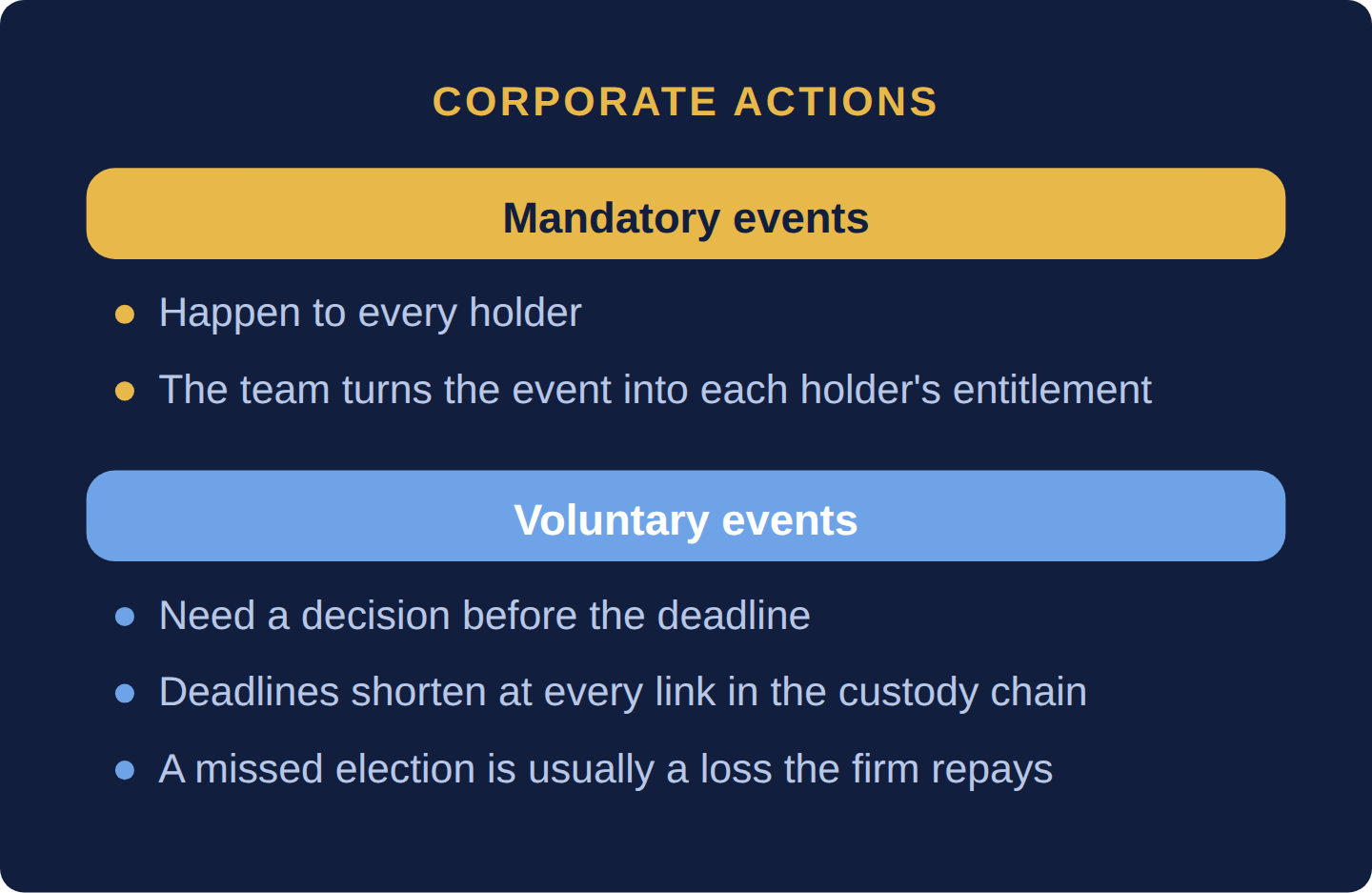
Corporate Actions (part of asset servicing) captures every event an issuer applies to its securities, works out what each holder is entitled to, collects elections from clients or portfolio managers, and books the result. Events split into mandatory ones, which happen to every holder (cash dividends, stock splits, mergers for cash or stock, coupon payments), and voluntary ones, which need a decision by an election deadline (rights issues, tender offers, dividend reinvestment, conversions). The function exists because these events change positions and cash without any trade, so nothing else in the firm will catch them.
| Cadence | What Actually Happens |
|---|---|
| Daily | Capturing announcements from depository and vendor feeds; checking them against a second source to build a “golden” record; calculating entitlements on record date; notifying holders of voluntary events and chasing elections; booking payments on pay date and investigating short payments |
| Weekly | Review of upcoming election deadlines and outstanding instructions; open claims against counterparties for entitlements on trades pending settlement |
| Monthly | Aged-claims and unreconciled-entitlement report; missed-election and late-booking incident review |
| Quarterly | Peak dividend seasons managed as projects; control testing; vendor data-quality review |
| Annually | Proxy season support where the team also handles voting; tax-documentation renewal so income is paid at the right withholding rate |
A missed voluntary election is a loss the firm usually owes the client in full, and on a large holding one missed deadline can cost more than a year of the team’s small errors. Deadlines compress at every link: the issuer’s agent sets a deadline, the depository sets an earlier one, and each custodian sets an earlier one still, so the client may have a day or two to decide. Mandatory events carry a quieter risk: on US exchanges the ex-dividend date is usually the record date itself, so a trade done the day before still carries the dividend, and if that trade fails, the entitlement must be claimed from the counterparty.
The process: capture the announcement; validate terms against a second source; on record date, fix the eligible position (settled holdings plus or minus pending trades); calculate the entitlement; notify and collect elections for voluntary events; instruct the custodian before its deadline; book and reconcile the payment or new shares on pay date.
A fund holds 12,000 shares. The issuer pays a $0.85 dividend and launches a one-for-five rights issue at $40.00 while the shares trade at $52.00.
| Step | Formula | Result |
|---|---|---|
| Dividend (mandatory) | 12,000 × $0.85 | $10,200 (before any withholding) |
| New shares the rights allow | 12,000 ÷ 5 | 2,400 |
| Cost to take them up | 2,400 × $40.00 | $96,000 |
| Theoretical ex-rights price (TERP) | (5 × $52.00 + $40.00) ÷ 6 | $50.00 |
| Value of the rights | 2,400 × ($50.00 − $40.00) | $24,000 |
If the election is missed and the rights lapse without compensation, the holding falls from 12,000 × $52.00 = $624,000 to 12,000 × $50.00 = $600,000: a $24,000 loss. Had the fund subscribed, it would hold 14,400 shares worth 14,400 × $50.00 = $720,000 for $624,000 + $96,000 invested, so no loss. The firm that missed the deadline usually compensates the $24,000.
| Question | Typical answer |
|---|---|
| Entry titles | Corporate Actions Analyst, Asset Servicing Associate, Income Processing Analyst. |
| The ladder (typical years) | Analyst (0-3) → Senior Analyst or Team Lead (3-6) → Assistant Vice President or Manager (5-9) → Vice President, Asset Servicing (8-13) → Head of Corporate Actions or Asset Servicing (12+). |
| Qualifications that help | A finance or commerce degree is common. FINRA SIE and Series 99: common at broker-dealers. CFA Level I: optional, useful for valuing complex events. |
| Where people come from | Reconciliations (E.2: Reconciliations), settlements (E.1: Settlements), custodian client service, fund accounting (C.12: The Head of Fund Accounting). |
| Where people go next | Reference-data management, fund administration (E.8: Fund Administration and Transfer Agency), product roles at custodians, operational risk. |
| Relative pay tier (1 lowest to 5 highest) | Entry: 1; Senior: 3. Expertise in complex voluntary events and cross-border tax moves it up. |
| Who fits | Careful readers of legal terms who like deadlines they can see coming. People who skim, or who dislike peak seasons, struggle. |
| What interviewers ask | Mandatory versus voluntary; record date, ex-date and pay date; compute an entitlement with fractions; what you do when two data vendors disagree. |
Reports to: the Head of Asset Servicing or Securities Operations under the COO; at custodian banks, a large business line in its own right.
Typical direct reports: leads for announcements and data, mandatory events and income, voluntary events and elections, claims, and tax.
Key interactions:
- Fund Accounting (C.12: The Head of Fund Accounting): needs events booked before the NAV strike.
- Reconciliations (E.2: Reconciliations): flags short or missing payments.
- Settlements (E.1: Settlements): shares claims on trades pending over record date.
- Investment Management (C.16: The Head of Investment Management): makes the election decisions.
Outside finance: portfolio managers, client service, tax, custodians and the depository.
Core systems: a corporate-actions platform with a golden-record engine, vendor and depository feeds, custodian portals, SWIFT messaging.
Where this work sits: GBS/GCC teams in Bengaluru, Hyderabad, Pune and Chennai typically scrub announcements, calculate entitlements and book income; onshore teams keep client-facing election handling and sign-off on high-value voluntary events. The control consequence is a hard rule that no deadline is missed during the handoff: elections are tracked on one shared calendar with escalation hours before each cutoff.
What do Corporate Actions teams do?
They turn issuer events into each holder’s entitlement and collect elections on voluntary events before the deadline.
What is the difference between mandatory and voluntary events?
Mandatory events happen to every holder; voluntary ones need a decision.
What happens if an election is missed?
It is usually a loss the firm repays.
Corporate Actions turns issuer events into each holder’s entitlement and collects elections on voluntary events before the deadline. A missed election is usually a loss the firm repays.
Six questions on this chapter. Decide on your answer first, then click “Reveal Answer.”
1. A fund holds 8,000 shares. The issuer pays $1.20 a share. What is the gross dividend?
- $12,000
- $8,000
- $6,667
- $9,600
Reveal Answer
Answer: D. 8,000 × $1.20 = $9,600, before any withholding.
2. Shares trade at $30. A one-for-four rights issue is priced at $20. What is the theoretical ex-rights price?
- $28.00
- $25.00
- $27.50
- $29.00
Reveal Answer
Answer: A. TERP = (4 × $30 + $20) ÷ 5 = $140 ÷ 5 = $28.00.
3. Which of these events needs an election from the holder?
- A cash merger
- A tender offer
- A cash dividend
- A stock split
Reveal Answer
Answer: B. Tender offers are voluntary; the others apply to every holder automatically.
4. A client’s rights issue election arrives after the custodian’s deadline, and the rights lapse. Who usually bears the lost value?
- The issuer’s paying agent
- The client, as the decision maker
- The firm that missed the deadline
- The central depository
Reveal Answer
Answer: C. A missed election caused by the firm is typically compensated by the firm.
5. Worked problem: A company splits its shares 2-for-1. A holder has 1,000 shares at $60. What does she have afterward?
Reveal Answer
Answer: 2,000 shares at $30: the value stays $60,000.
6. Worked problem: A rights issue offers 1 new share at $40 for every 5 held, with shares at $50. What is the theoretical ex-rights price?
Reveal Answer
Answer: (5 × $50 + 1 × $40) ÷ 6 = $48.33.
E.4 Client Assets and Safeguarding (CASS Oversight)
Client Assets keeps customers’ money and securities separate from the firm’s own, and proves it every day. In the US, the rule is SEC Rule 15c3-3. In the UK, it is CASS 6 and CASS 7.
Why it matters: A daily proof is what keeps client assets safe if the firm fails.
Summary: Client Assets keeps client money and securities apart from the firm’s own and proves it daily. In the US that is SEC Rule 15c3-3; in the UK, CASS 6 and CASS 7.
- CASS 7: daily internal client money reconciliation; any shortfall funded by close of business.
- Larger US broker-dealers compute the customer reserve daily, others weekly.
- Under SM&CR a named senior manager is accountable for CASS.
- The SEC withdrew its 2023 adviser safeguarding proposal in June 2025.

Client Assets makes sure that money and securities the firm holds for clients are kept apart from the firm’s own, recorded client by client, and reconciled often enough that clients would get them back in full if the firm failed. It exists because a broker that mixes client cash with its own can lose it to its creditors in an insolvency. The US rule for broker-dealers is the SEC’s customer protection rule, Rule 15c3-3: securities held for customers must be in the firm’s possession or control, and customer cash, net of what customers owe, sits in a special reserve bank account. In the UK the equivalent is the FCA’s Client Assets Sourcebook (CASS): CASS 6 for custody assets and CASS 7 for client money. This is the only chapter covering UK rules, because many firms run UK entities from the same teams.
| Cadence | What Actually Happens |
|---|---|
| Daily | Internal client money reconciliation (CASS 7: every business day, on the previous day’s records) and same-day funding of any shortfall; for larger US broker-dealers, the reserve computation; reviewing breaks that touch client accounts |
| Weekly | The standard US reserve computation (for firms below the daily threshold); oversight meeting on open client-asset breaks |
| Monthly | External client money reconciliation and custody record checks (CASS: at least monthly); the Client Money and Asset Return (CMAR) to the FCA within 15 business days of month-end; acknowledgment letters for new client bank and custody accounts |
| Quarterly | Reporting to the board or risk committee; control testing; breach review |
| Annually | The auditor’s client assets report to the FCA (within four months of period-end); the US investment adviser’s surprise custody examination by an independent accountant; refreshing the CASS resolution pack, which must be retrievable within 48 hours of an insolvency |
When a broker fails, segregation decides whether clients are paid from their own protected pool or join the queue of general creditors. A shortfall found today is a firm problem only if it is funded today: CASS 7 requires any shortfall shown by the internal reconciliation to be paid into a client bank account by close of business on the day the reconciliation is done, and material failures must be notified to the FCA without delay. Accountability is personal: under the Senior Managers and Certification Regime (SM&CR), CASS compliance is an FCA-prescribed responsibility given to a named senior manager.
The process (CASS 7 standard method): take yesterday’s close-of-business records; compute the client money requirement (what the firm should hold for clients, built client by client); compare it with the client money resource (the balance in client bank accounts per the firm’s records); fund any shortfall or withdraw any excess the same day; separately, at least monthly, reconcile the firm’s records of client bank accounts to the banks’ statements.
| Line | Formula | Result |
|---|---|---|
| Client money requirement | Sum of client balances, by client | $48,640,000 |
| Client money resource | Client bank account balances, firm records | $48,515,000 |
| Shortfall | $48,640,000 − $48,515,000 | $125,000 |
The firm transfers $125,000 of its own money into the client bank account before close of business, then finds the cause (here, a client withdrawal paid from the client account before the client’s sale proceeds had arrived). The US analogue: if a broker-dealer’s reserve formula shows customer credits of $900 million against customer debits of $760 million (ignoring the formula’s adjustments), it must hold $900 million − $760 million = $140 million in the reserve account; with $130 million on deposit, it deposits $10 million by the rule’s deadline.
| Question | Typical answer |
|---|---|
| Entry titles | Client Assets Analyst, CASS Analyst, Customer Protection (15c3-3) Analyst, Regulatory Operations Analyst. |
| The ladder (typical years) | Analyst (0-3) → Senior Analyst (3-6) → Assistant Vice President or Manager, Client Assets (5-9) → Vice President or Director, Client Assets Oversight (8-14) → Head of Client Assets or the named CASS oversight senior manager (12+). |
| Qualifications that help | CPA, CA or ACCA: common, because the work is reconciliation and rule interpretation. FINRA Series 27 (Financial and Operations Principal): required for the person who signs off books and net capital at many broker-dealers, and useful for the 15c3-3 side. |
| Where people come from | Reconciliations (E.2: Reconciliations), regulatory reporting (C.15: The Head of Regulatory Capital & Reporting), financial control, Big 4 client-assets audit teams. |
| Where people go next | Head of operations control, compliance (C.14: The Chief Compliance Officer), operational risk, chief operating officer of a broker, client-assets advisory. |
| Relative pay tier (1 lowest to 5 highest) | Entry: 2; Senior: 4. Named regulatory accountability and audit experience move it most. |
| Who fits | People who read rules literally and stay calm reporting a breach. People who prefer to wait for certainty before escalating do badly. |
| What interviewers ask | Requirement versus resource; what you do with a shortfall at 3 p.m.; possession or control; when a breach must be notified. |
Reports to: the daily reconciliations sit in operations or finance; the oversight function reports to the named senior manager, often the COO or CFO, with direct access to the board and the risk or audit committee. Part 0: The Map of Finance places it as a control function over back-office processing.
Typical direct reports: client money and custody reconciliation leads, a regulatory returns lead (CMAR, reserve computation), a policy and testing lead.
Key interactions:
- Reconciliations (E.2: Reconciliations): supplies the cash and position matching CASS relies on.
- Treasurer (C.2: The Treasurer): funds shortfalls the same day.
- Chief Compliance Officer (C.14: The Chief Compliance Officer): interprets rules and handles notifications.
- Regulatory Capital and Reporting (C.15: The Head of Regulatory Capital & Reporting): shares the reserve and net capital calculations.
Outside finance: legal (acknowledgment letters, insolvency analysis), internal audit, external client-assets auditors, banks and custodians.
Core systems: the client ledger, the reconciliation engine, banking portals and the regulatory reporting tool.
Where this work sits: GCC teams in Bengaluru, Pune and Hyderabad typically prepare the daily reconciliations, reserve computations and returns. Onshore staff keep the funding decision, breach assessment and the accountable senior manager’s sign-off, because the accountability is personal and the regulator expects the named person to understand the controls.
What does Client Assets do?
It keeps client money and securities apart from the firm’s own and proves it daily.
Which rules apply in the US and UK?
In the US, SEC Rule 15c3-3; in the UK, CASS 6 and CASS 7.
How often is the US customer reserve computed?
Larger US broker-dealers compute it daily, others weekly.
Client Assets keeps client money and securities apart from the firm’s own and proves it daily, under SEC Rule 15c3-3 in the US and CASS 6 and CASS 7 in the UK.
Six questions on this chapter. Decide on your answer first, then click “Reveal Answer.”
1. A firm’s client money requirement is $31,200,000 and its client money resource is $31,050,000. What must it do under CASS 7?
- Withdraw $150,000 by close of business
- Report $150,000 at the next CMAR
- Pay in $150,000 within five days
- Pay in $150,000 by close of business
Reveal Answer
Answer: D. $31,200,000 − $31,050,000 = $150,000 shortfall, which must be paid into a client bank account by close of business that day.
2. A US broker-dealer’s reserve formula shows credits of $600m and debits of $520m, with $70m on deposit. Ignoring adjustments, what must it deposit?
- $0
- $10 million
- $80 million
- $70 million
Reveal Answer
Answer: B. Required = $600m − $520m = $80m; $80m − $70m = $10m.
3. A broker-dealer has average total credits of $750 million. How often must it run the reserve computation?
- Daily
- Quarterly
- Weekly
- Monthly
Reveal Answer
Answer: A. Rule 15c3-3 requires daily computation at $500 million or more of average total credits.
4. What was the status of the SEC’s 2023 proposal to replace the adviser custody rule in October 2026?
- Re-proposed in March 2026
- Finalized and in force
- Withdrawn in June 2025
- Still open for comment
Reveal Answer
Answer: C. The SEC withdrew the safeguarding proposal on June 17, 2025; Rule 206(4)-2 still applies.
5. Worked problem: A US broker-dealer has customer credits of $480m and customer debits of $90m. What reserve deposit does the formula require (credits minus debits)?
Reveal Answer
Answer: $480m − $90m = $390 million.
6. Worked problem: Under CASS 7 the client money requirement is $120m and the resource $115m. What must the firm do by close of business?
Reveal Answer
Answer: Fund the $5 million shortfall from its own money.