
E.5 Collateral and Margin
Collateral and Margin is the team that calls, pays and tracks the collateral securing derivative and financing trades. There are two kinds of margin. Variation margin covers today’s price move. Initial margin covers the cost of closing out the position in the future.
Why it matters: Margin is the cushion that keeps one counterparty’s failure from spreading.
Summary: Collateral and Margin is the team that calls, pays and tracks the collateral securing derivatives and financing trades. Variation margin covers today’s move; initial margin covers a future close-out.
- The CSA sets threshold, minimum transfer amount, haircuts and eligible assets.
- A call is made only when it exceeds the minimum transfer amount.
- US uncleared initial margin phased in from 2016 to September 1, 2022.
- Margin turns market shocks into same-day liquidity needs.

Collateral and Margin calculates, calls, pays and tracks the collateral that secures derivatives, repo and securities-lending exposures. Two kinds matter. Variation margin moves daily to cover today’s mark-to-market change, so neither side carries yesterday’s loss. Initial margin is posted up front against the loss that could build while a defaulted counterparty is closed out, and is usually held by a third-party custodian rather than the receiving firm. For uncleared over-the-counter derivatives, the terms sit in a credit support annex (CSA) to the ISDA Master Agreement: eligible collateral, haircuts, the threshold, the minimum transfer amount and the call timetable. For cleared trades, the central counterparty sets both margins itself.
| Cadence | What Actually Happens |
|---|---|
| Daily | Importing valuations; computing exposure per CSA; issuing and answering margin calls before the agreed cutoff; agreeing or disputing the counterparty’s figure; booking collateral moves; meeting central counterparties’ variation and intraday calls; choosing which assets to post (cheapest-to-deliver) |
| Weekly | Dispute aging review with trading and credit risk; portfolio reconciliation with frequent counterparties |
| Monthly | Collateral and funding cost report to treasury; review of initial margin model results and of how close each counterparty group is to its initial margin threshold |
| Quarterly | Liquidity stress testing of margin outflows with treasury (E.9: Treasury and Asset-Liability Management (ALM)); CSA renegotiation pipeline with legal |
| Annually | The average aggregate notional calculation that determines whether initial margin rules apply; recalibration of the initial margin model; audit of eligibility and haircut schedules |
Margin turns market moves into cash calls the same day, so the margin desk is where a market shock first becomes a liquidity problem. A firm can be solvent on paper and still fail because it cannot meet a call by the deadline. After 2008, regulators made margin on uncleared swaps mandatory for the largest users: in the US, variation margin daily, with no threshold between swap dealers and financial end users, and initial margin phased in over the uncleared margin rules (UMR) from September 1, 2016, to September 1, 2022, when the last phase captured groups with more than $8 billion of average aggregate notional.
The process: value the portfolio; compute the credit support amount (exposure minus the threshold); subtract the collateral already held, valued after haircuts; call only if the result exceeds the minimum transfer amount; agree the figure or open a dispute; receive the collateral and check it settled.
A bank faces a corporate client under a negotiated CSA (the client is outside the mandatory rules): threshold $10,000,000, minimum transfer amount (MTA) $500,000, Treasuries accepted at a 2% haircut, calls rounded up to $10,000.
| Step | Formula | Result |
|---|---|---|
| Day 1 required collateral | $27,400,000 exposure − $10,000,000 threshold | $17,400,000 |
| Day 1 call | $17,400,000 − $15,000,000 held | $2,400,000 (above the $500,000 MTA: call) |
| Treasuries to deliver | $2,400,000 ÷ (1 − 0.02) = $2,448,980, rounded up | $2,450,000 market value |
| Day 2 required collateral | $27,800,000 − $10,000,000 | $17,800,000 |
| Day 2 shortfall | $17,800,000 − ($15,000,000 + $2,450,000 × 0.98) | $399,000 (below the MTA: no call) |
The threshold is unsecured credit the bank chooses to extend, and the MTA keeps small transfers from clogging operations; both are credit decisions, which is why credit risk, not operations, approves them. If the client disputes the $2,400,000, the undisputed part is usually transferred while the two sides reconcile valuations.
| Question | Typical answer |
|---|---|
| Entry titles | Collateral Analyst, Margin Operations Analyst, Derivatives Operations Analyst. |
| The ladder (typical years) | Analyst (0-3) → Senior Analyst (3-5) → Assistant Vice President (4-8) → Vice President, Collateral Management (7-12) → Head of Collateral or Collateral Trading (12+). |
| Qualifications that help | FRM: optional, useful for exposure and initial margin models. CFA: optional. FINRA SIE and Series 99: common at broker-dealers. Python and a firm grip of the CSA’s legal terms count more than any exam. |
| Where people come from | Settlements (E.1: Settlements), derivatives trade support (E.6: Trade Support), treasury operations, credit risk. |
| Where people go next | Collateral trading and optimization (front office), treasury and ALM (E.9: Treasury and Asset-Liability Management (ALM)), counterparty credit risk, clearing relationship management. |
| Relative pay tier (1 lowest to 5 highest) | Entry: 2; Senior: 4. Moving from processing calls to optimizing collateral, a front-office trading function, moves it most. |
| Who fits | Numerate people who negotiate calmly with counterparties under deadline. People who freeze on a disputed call at cutoff struggle. |
| What interviewers ask | Initial versus variation margin; compute a call with threshold, MTA and haircut; how you resolve a dispute; what happens to margin in a market shock. |
Reports to: the Head of Derivatives or Securities Operations under the COO; at some banks the collateral optimization desk reports to treasury. Part 0: The Map of Finance places it in the middle office.
Typical direct reports: leads for OTC bilateral margin, cleared margin, initial margin and segregation, repo and securities-lending collateral, and disputes.
Key interactions:
- The CRO’s credit risk team (C.7: The Chief Risk Officer): sets thresholds and eligible collateral.
- Treasury and ALM (E.9: Treasury and Asset-Liability Management (ALM)): funds the cash and plans margin liquidity.
- Product Control (E.7: Product Control): shares valuations that drive exposure.
- Settlements (E.1: Settlements): moves the collateral.
Outside finance: legal (CSA negotiation), traders, custodians and tri-party agents, central counterparties.
Core systems: a collateral management platform, the ISDA SIMM calculation, portfolio reconciliation and dispute tools, CCP portals.
Where this work sits: GCC teams in Bengaluru, Pune and Hyderabad typically run call calculation, portfolio reconciliation and booking; onshore teams in New York keep dispute negotiation, the call cutoff decision and CCP liaison. The control consequence: a call left unissued is unsecured credit, so every missed call is escalated to credit risk the same day.
What does Collateral and Margin do?
It calls, pays and tracks the collateral securing derivatives and financing trades.
What is the difference between variation and initial margin?
Variation margin covers today’s move; initial margin covers a future close-out.
What does the CSA set?
Threshold, minimum transfer amount, haircuts and eligible assets. A call is made only when it exceeds the minimum transfer amount.
Collateral and Margin is the team that calls, pays and tracks collateral. Variation margin covers today’s move and initial margin a future close-out, under the terms of the CSA.
Six questions on this chapter. Decide on your answer first, then click “Reveal Answer.”
1. Exposure is $18.0m, threshold $5.0m, collateral held $12.2m, MTA $500,000. What happens?
- Call $13.0m
- Call $800,000
- Call $5.8m
- No call is made
Reveal Answer
Answer: B. Required = $18.0m − $5.0m = $13.0m; $13.0m − $12.2m = $0.8m, above the MTA, so call $800,000.
2. You need $1,960,000 of collateral value and deliver Treasuries at a 2% haircut. What market value must you deliver?
- $1,999,200
- $2,039,200
- $1,920,800
- $2,000,000
Reveal Answer
Answer: D. $1,960,000 ÷ 0.98 = $2,000,000.
3. What does initial margin cover?
- Today’s mark-to-market change in the position
- Fees owed to the clearing house for the trade
- Losses while a defaulted position is closed out
- Interest earned on the cash that was posted
Reveal Answer
Answer: C. Variation margin covers today’s move; initial margin covers the future close-out risk.
4. Under the CFTC rules, what is the minimum transfer amount for uncleared swaps?
- $500,000
- $250,000
- $50,000,000
- $8,000,000,000
Reveal Answer
Answer: A. The rule sets a $500,000 combined initial and variation margin MTA; $50 million is the initial margin threshold.
5. Worked problem: Exposure is $12.4m, collateral held $10.0m and the minimum transfer amount is $0.5m. Is a margin call made, and for how much?
Reveal Answer
Answer: Shortfall = $2.4m, above the $0.5m MTA: call $2.4m.
6. Worked problem: If exposure is $10.3m instead?
Reveal Answer
Answer: Shortfall = $0.3m, below the $0.5m MTA: no call.
E.6 Trade Support
Trade Support makes sure each trade is booked correctly and agreed with the counterparty before it can fail. Under the T+1 cycle, broker-dealers must be set up to complete allocation, confirmation and affirmation of institutional trades by the end of the trade date.
Why it matters: Catching a mismatch on the day it happens is far cheaper than fixing a failed trade later.
Summary: Trade Support makes sure each trade is booked correctly and agreed with the counterparty before it can fail. Under T+1, broker-dealers must be set up to complete allocation, confirmation and affirmation of institutional trades by the end of trade date.
- Lifecycle: execution, capture, enrichment, allocation, confirmation, affirmation, settlement.
- Most fails start as booking errors.
- Breaks are resolved against the execution record, not by negotiation.
- Offshore teams flag; desk sign-off changes economic terms.
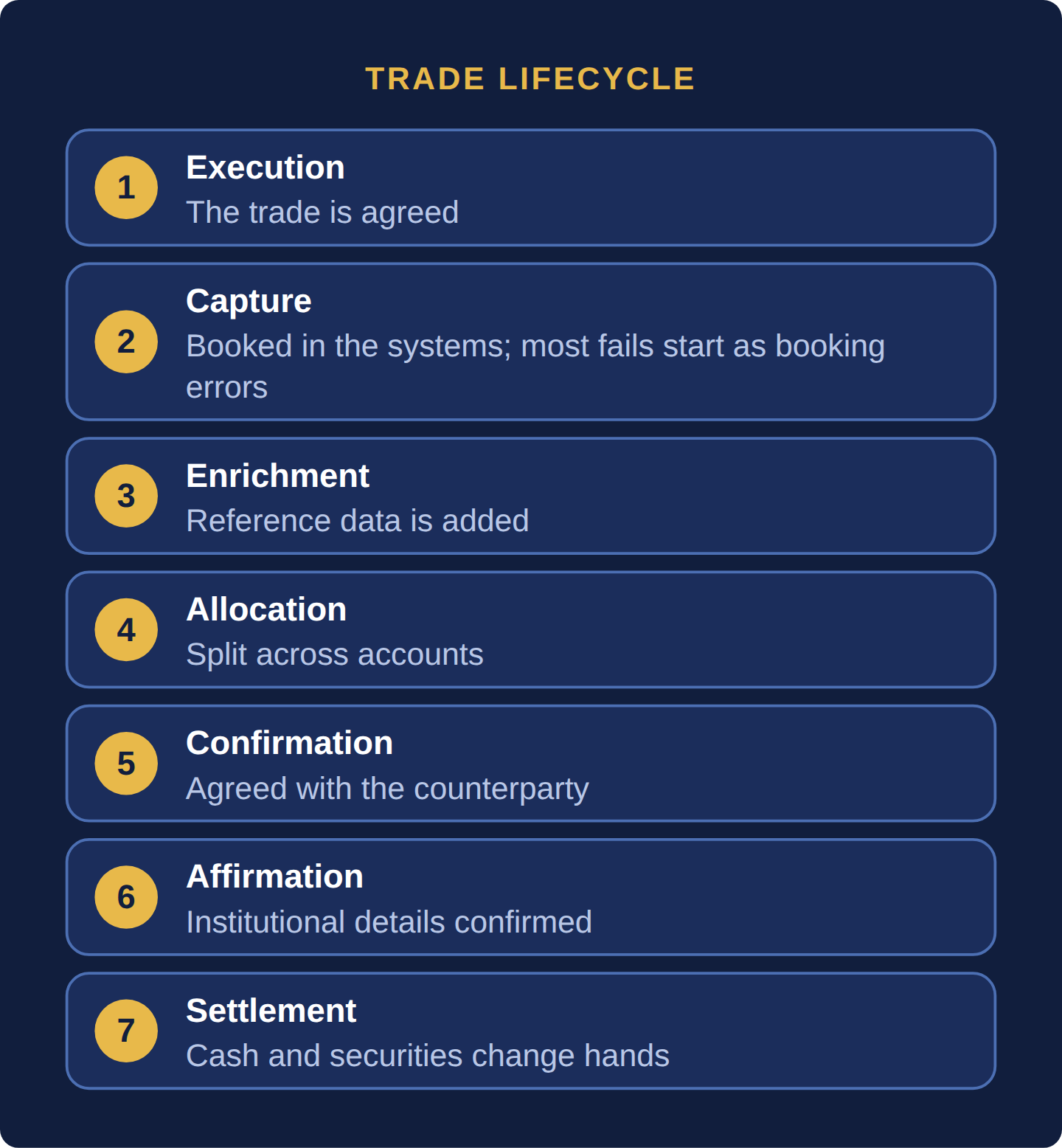
Trade Support sits next to the trading desk and makes sure every trade is captured correctly, enriched with the data settlement needs, agreed with the counterparty and ready to settle. It exists because a trade is agreed in seconds, often by voice or chat, while every later step (settlement, margin, P&L, regulatory reporting) depends on the booking being right. The front-to-back lifecycle runs: execution, trade capture in the booking system, enrichment (settlement instructions, fees), allocation of a block trade to underlying funds, confirmation (the broker sends the trade details), affirmation (the investment manager agrees them), clearing, settlement (E.1: Settlements) and reconciliation (E.2: Reconciliations).
| Cadence | What Actually Happens |
|---|---|
| Daily | Checking that every trade on the desk’s blotter is booked; fixing rejected and unmatched trades; chasing allocations and affirmations before the trade-date deadline; resolving price, quantity and account breaks with traders and counterparties; explaining day-one P&L differences with product control (E.7: Product Control) |
| Weekly | Review of repeat break causes by trader, counterparty and product; outstanding unconfirmed derivative trades |
| Monthly | Same-day affirmation and booking-accuracy metrics; static-data and booking-model fixes; month-end trade population checks for the close |
| Quarterly | New-product onboarding sign-offs; control testing of booking and amendment rights |
| Annually | Desk-structure and booking-model review; preparing for market changes such as a shorter settlement cycle or new reporting rules |
Most settlement fails start as booking errors: a wrong price, account, quantity or settlement instruction caught too late. T+1 moved the deadline into trade date: the SEC’s Rule 15c6-2 requires broker-dealers to have written agreements, or policies and procedures reasonably designed, to complete allocations, confirmations and affirmations as soon as technologically practicable and no later than the end of trade date for institutional trades, and investment advisers must keep records of them. A break found the next morning is now a likely fail, so trade support works in the same hours as the desk.
The process: the broker sends its trade details; the investment manager’s details are matched against them on a central matching platform; a mismatch beyond tolerance stops affirmation; trade support on each side compares the execution record, agrees who is right, and one side amends; the trade then affirms and flows to settlement.
A fund buys 100,000 shares; commission is $0.02 a share.
| Record | Formula | Net amount |
|---|---|---|
| Investment manager’s booking at $45.12 | 100,000 × $45.12 + 100,000 × $0.02 | $4,514,000 |
| Broker’s confirmation at $45.21 | 100,000 × $45.21 + 100,000 × $0.02 | $4,523,000 |
| Break | $4,523,000 − $4,514,000 | $9,000 |
The execution report shows $45.12, so the broker amends a mistyped price and the trade affirms at 6:40 p.m. on trade date. Had it stayed open overnight under T+1, the fund’s custodian would not settle on the broker’s figure, the trade would fail (E.1: Settlements), and the $9,000 question would still need answering, now with a fail on top.
| Question | Typical answer |
|---|---|
| Entry titles | Trade Support Analyst, Middle Office Analyst, Trade Capture Analyst, Derivatives Confirmations Analyst. |
| The ladder (typical years) | Analyst (0-3) → Senior Analyst (2-5) → Assistant Vice President (4-8) → Vice President, Middle Office (7-12) → Head of Middle Office or Trade Support (12+). |
| Qualifications that help | FINRA SIE and Series 99: common at broker-dealers. CFA Level I: optional, helps move toward the desk. Product knowledge (equities, rates, credit, FX) counts more than a credential. |
| Where people come from | Graduate programs, settlements (E.1: Settlements), reconciliations (E.2: Reconciliations), fund operations at asset managers. |
| Where people go next | Product control (E.7: Product Control), trading assistant and junior trader seats, risk, collateral (E.5: Collateral and Margin), business management for a desk. |
| Relative pay tier (1 lowest to 5 highest) | Entry: 2; Senior: 3. Proximity to the desk and complex derivatives move it up; the move to product control or the desk moves it most. |
| Who fits | Quick, assertive people who can tell a trader a booking is wrong. People who need quiet, scheduled work, or who defer to seniority on facts, struggle. |
| What interviewers ask | Walk through the trade lifecycle; affirmation versus confirmation; what T+1 changed; how you handle a trader who refuses to amend a booking. |
Reports to: the Head of Middle Office under the COO, aligned to a trading business; at asset managers, the Head of Investment Operations. Part 0: The Map of Finance places it in the middle office.
Typical direct reports: desk-aligned leads (cash equities, rates, credit, FX, listed and OTC derivatives), a confirmations lead and a booking-model or static-data lead.
Key interactions:
- Settlements (E.1: Settlements): receives clean, affirmed trades.
- Product Control (E.7: Product Control): depends on correct bookings for daily P&L.
- Collateral and Margin (E.5: Collateral and Margin): needs new derivatives booked to compute exposure.
- Reconciliations (E.2: Reconciliations): reports trade and position breaks back to trade support.
Outside finance: traders and sales, counterparties’ middle offices, compliance (trade reporting), technology.
Core systems: the order and execution management systems, the booking and risk system, a central matching platform for affirmation, derivatives confirmation platforms.
Where this work sits: onshore staff sit beside the desk for live fixes and trader escalation; GCC teams in Bengaluru, Pune and Hyderabad typically handle booking checks, confirmations and break investigation. Same-day affirmation under T+1 forces India teams to cover the New York afternoon, so the control consequence is clear amendment rights: offshore staff may flag but not change economic terms without desk sign-off.
What does Trade Support do?
It makes sure each trade is booked correctly and agreed with the counterparty before it can fail.
What is the lifecycle?
Execution, capture, enrichment, allocation, confirmation, affirmation, settlement.
Where do most fails start?
Most fails start as booking errors.
Trade Support makes sure each trade is booked correctly and agreed with the counterparty before it can fail. Most fails start as booking errors.
Six questions on this chapter. Decide on your answer first, then click “Reveal Answer.”
1. A fund buys 50,000 shares. It booked $20.05; the broker confirms $20.50. Commission is $0.02 a share. What is the break?
- $23,500
- $1,000
- $22,500
- $2,250
Reveal Answer
Answer: C. 50,000 × ($20.50 − $20.05) = $22,500; the commission is the same on both sides.
2. Under SEC Rule 15c6-2, by when must a broker be set up to complete allocation, confirmation and affirmation of an institutional trade?
- Before the market opens
- Within two business days
- By noon on settlement date
- By the end of trade date
Reveal Answer
Answer: D. The broker needs written agreements, or policies and procedures reasonably designed, to complete them as soon as technologically practicable and no later than end of trade date.
3. A trader refuses to amend a booking that does not match the execution record. What should trade support do?
- Escalate with the execution evidence
- Accept the counterparty’s figure to settle
- Amend the booking without telling the desk
- Leave the break for settlements to fix
Reveal Answer
Answer: A. Breaks are resolved against the execution record; refusals are escalated, not worked around.
4. Which step comes directly after trade capture and enrichment for a block trade?
- Variation margin calculation
- Allocation to the underlying funds
- Settlement at the depository
- Reconciliation against custody
Reveal Answer
Answer: B. A block is allocated to accounts before confirmation, affirmation and settlement.
5. Worked problem: A 10,000-share order is allocated 50/30/20 across three accounts. How many shares each?
Reveal Answer
Answer: 5,000, 3,000 and 2,000.
6. Worked problem: It executes on Wednesday, December 23, 2026. When does it settle under T+1?
Reveal Answer
Answer: Thursday, December 24, 2026.