
6.5 Deferred Tax — Assets, Liabilities, and Why They Exist
Sometimes accounting rules and tax rules count the same item in different years. Deferred tax is the bridge between the profit in the accounts and the profit the tax authority sees. A deferred tax liability is tax postponed, often because of faster depreciation for tax. A deferred tax asset is future tax relief, often from losses. US rules reduce doubtful assets with a valuation allowance, while the international and Indian standards recognize only the amount that is probable.
Why it matters: These entries show tax that is delayed or banked, not tax that disappears.
Summary: Deferred tax reconciles accounting profit with taxable income when the two recognize the same item in different years. Deferred tax liabilities are taxes postponed, often by accelerated depreciation; deferred tax assets are future relief, often from losses. US GAAP reduces doubtful assets with a valuation allowance; IAS 12 and Ind AS 12 recognize only the probable amount.
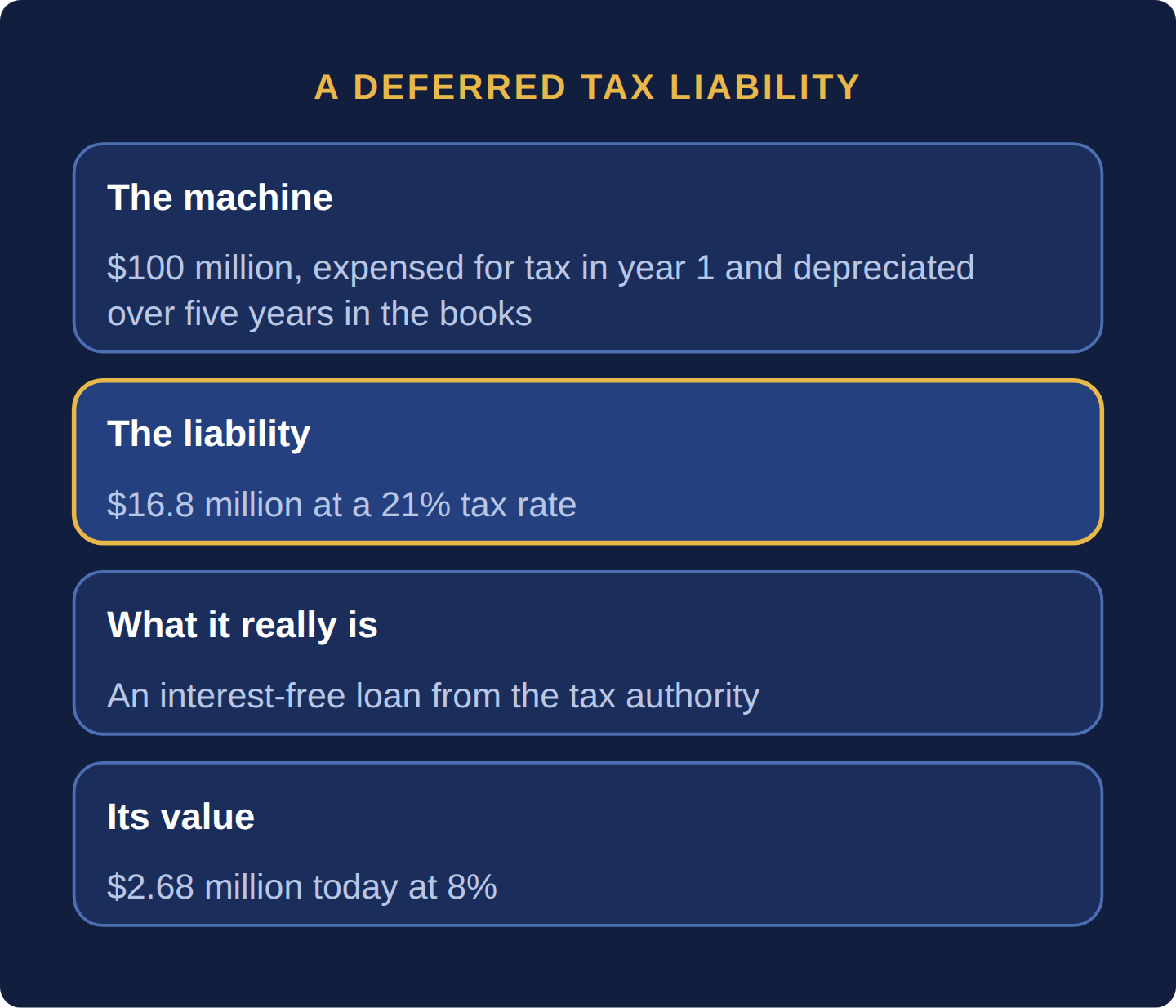
- A $100 million machine expensed for tax in year 1 and depreciated over five years in the books creates a $16.8 million liability at 21%.
- That deferral is an interest-free loan: worth $2.68 million today at 8%.
- US losses arising after 2017 carry forward indefinitely but offset only 80% of taxable income a year.
- The valuation allowance is a US GAAP term; IFRS and Ind AS use a probability test with no allowance account.
- Tesla’s 2023 net income of $15.00 billion included a one-time $5.93 billion allowance release.
A company’s reported profit (calculated under accounting rules) and its taxable income (calculated under tax law) are almost never identical, because accounting standards and tax authorities frequently treat the same transaction differently, especially in its timing. Deferred tax exists purely to reconcile this timing gap.
| Concept | What It Represents |
|---|---|
| Deferred Tax Liability | Tax the company will owe in the future, because it has recognized more expense (or less income) for tax purposes today than for accounting purposes — e.g., accelerated tax depreciation on a new asset compared to the slower depreciation shown in the accounts |
| Deferred Tax Asset | Tax relief the company expects to claim in the future, often arising from carried-forward losses that can offset future taxable profit |
A company buys a $100 million machine. Its accounts depreciate it straight-line over five years ($20 million a year); US tax law lets it deduct the whole cost in year 1 through 100% bonus depreciation, made permanent for property acquired after January 19, 2025. The temporary difference is the gap between the asset’s book value and its tax basis; the deferred tax liability is that gap times the 21% federal rate.
| End of year | Book value ($m) | Tax basis ($m) | Temporary difference ($m) | Deferred tax liability ($m) | Cash tax vs straight-line ($m) |
|---|---|---|---|---|---|
| 1 | 80 | 0 | 80 | 80 × 21% = 16.8 | 16.8 lower |
| 2 | 60 | 0 | 60 | 12.6 | 4.2 higher |
| 3 | 40 | 0 | 40 | 8.4 | 4.2 higher |
| 4 | 20 | 0 | 20 | 4.2 | 4.2 higher |
| 5 | 0 | 0 | 0 | 0 | 4.2 higher |
Total tax over five years is identical; only timing moves. The reported tax expense each year is 21% of book profit, and the difference between that expense and cash tax builds or releases the liability. The deferral is an interest-free loan from the government: discounted at an assumed 8%, the $16.8 million saved in year 1 less $4.2 million repaid in each of years 2 to 5 is worth $2.68 million today. A company that keeps investing renews the loan every year, so its liability can stay on the balance sheet indefinitely; valuers often treat such a liability as closer to equity than to debt.
Losses work in reverse. A company with $500 million of federal net operating losses holds a gross deferred tax asset of $500m × 21% = $105 million. Losses arising after 2017 carry forward without time limit but can offset only 80% of taxable income in any year, so even a company earning $75 million a year of taxable income uses at most 0.8 × $75m = $60 million a year. If management can support using only $300 million of the losses, the allowance is ($500m − $300m) × 21% = $42 million and the net asset $63 million; under IAS 12 the company would simply recognize $63 million. Releases are just as material: Tesla’s 2023 net income of $15.00 billion included a one-time, non-cash tax benefit of $5.93 billion from releasing a valuation allowance, so earnings before that benefit were about $9.07 billion.
A large deferred tax asset is only as valuable as the company’s ability to earn enough future taxable profit to use it, and the two frameworks test that differently in form. US GAAP (ASC 740) records the full asset and then deducts a valuation allowance for any portion that is more likely than not (a likelihood above 50%) never to be realized. IAS 12, and India’s Ind AS 12, have no allowance account: a deferred tax asset is recognized only to the extent that it is probable that taxable profit will be available, and a history of recent losses requires convincing other evidence. The thresholds land in a similar place; the presentation differs. Under either, a sudden write-down of a deferred tax asset is a quiet signal that management itself now expects less future profit.
Strip valuation-allowance releases and charges out of earnings before applying a P/E: they are one-time, non-cash and reflect a judgment about the future, not this year’s operations. If the effective tax rate differs from the statutory rate by more than about 5 percentage points, read the rate reconciliation before forecasting. Treat a deferred tax liability from continuing investment as long-dated, near-equity financing; treat one from a single asset sale or a reversing timing item as debt due on the reversal date.
Capitalizing a tax benefit as if it were operating profit. Tesla’s reported 2023 net income was $15.00 billion; $5.93 billion of it, 39.5%, was the valuation allowance release. Apply any earnings multiple to the reported figure and 39.5% of the resulting value rests on a one-time accounting event; at an assumed 50× P/E that is about $297 billion of value. Avoid it by valuing on pre-tax operating income, or on net income with the release removed.
Is a deferred tax liability real debt?
Only partly. It is tax the company will pay if the timing differences reverse, but for a company that keeps investing, new accelerated deductions replace those that reverse, so the balance can persist for decades. It carries no interest, so its present value is well below its face amount. Analysts usually leave it out of net debt unless a reversal is imminent.
What is the difference between a valuation allowance and IAS 12’s probability test?
A valuation allowance is a US GAAP contra-account: the full deferred tax asset is recorded, then reduced for the part that is more likely than not to go unused. IAS 12 and Ind AS 12 recognize only the probable amount in the first place, with no separate allowance. In practice both aim at a similar threshold; IFRS just shows the net figure.
Why is a company’s effective tax rate different from the statutory rate?
Because of permanent differences (items never taxed or never deductible), foreign profits taxed at other rates, credits, and changes in valuation allowances. Timing differences alone do not move the effective rate, because deferred tax absorbs them. The reconciliation in the tax note lists each cause and its size.
Deferred tax arises when accounts and tax law recognize the same item in different years. US GAAP records deferred tax assets in full and deducts a valuation allowance, while IAS 12 and Ind AS 12 recognize only the probable amount, and releases or charges of allowances are one-time items to strip out before valuing earnings.
Six questions on this chapter. Decide on your answer first, then click “Reveal Answer.”
1. A US company buys a $50 million machine, depreciates it straight-line over five years in its accounts and deducts it all in year 1 for tax. At a 21% rate, what deferred tax liability does it carry at the end of year 2?
- $2.1 million
- $6.3 million
- $10.5 million
- $8.4 million
Reveal Answer
Answer: B. Book value is $50m − 2 × $10m = $30m and the tax basis is zero, so the liability is $30m × 21% = $6.3m.
2. A US company has $400 million of federal net operating losses but can support using only $250 million of them. At 21%, what net deferred tax asset does it report?
- $63.0 million
- $84.0 million
- $52.5 million
- $31.5 million
Reveal Answer
Answer: C. Gross asset = $400m × 21% = $84.0m; valuation allowance = $150m × 21% = $31.5m; net = $52.5m. IAS 12 would simply recognize the $52.5m.
3. How do IAS 12 and Ind AS 12 treat a deferred tax asset whose use is uncertain?
- They recognize only the probable amount; there is no allowance
- They record it in full, then deduct a separate valuation allowance
- They recognize it only if the losses will be used within five years
- They never recognize deferred tax assets arising from tax losses
Reveal Answer
Answer: A. The valuation allowance is a US GAAP (ASC 740) device. IFRS and Ind AS apply a probability test at recognition and show the net figure.
4. Tesla’s 2023 net income attributable to common stockholders was $15.00 billion, including a one-time $5.93 billion tax benefit from releasing a valuation allowance. What was net income excluding that benefit?
- $20.93 billion
- $5.93 billion
- $15.00 billion
- $9.07 billion
Reveal Answer
Answer: D. $15.00bn − $5.93bn = $9.07bn. The release is a non-cash, one-time change in an estimate, so it should be stripped out before applying an earnings multiple.
5. Worked problem: A $60m machine is fully expensed for tax in year 1 but depreciated over five years in the books. At 25%, what deferred tax liability exists at the end of year 1?
Reveal Answer
Answer: Book value = $60m − $12m = $48m; tax base = $0. Liability = $48m × 25% = $12.0 million.
6. Worked problem: What is the present value, at 8%, of the timing benefit compared with deducting evenly over five years?
Reveal Answer
Answer: Tax saved at once = $60m × 25% = $15m. Evenly, $3m a year for five years has present value $11.98m. The benefit is $3.02 million: an interest-free loan from the tax authority.
6.6 Inventory and Depreciation Method Choices
Choosing how to value inventory and how long assets last changes a company’s profit from year to year without changing its cash. When costs are rising, LIFO, which is allowed only under US GAAP, reports the lowest profit and the lowest tax. Changing the assumed useful life of equipment can move billions of dollars of profit for the largest companies. Nothing in the bank changes; only the accounting story does.
Why it matters: Two companies with the same cash can report very different profits.
Summary: Inventory method and depreciation estimates shift profit between years without changing cash. In rising-cost periods LIFO, allowed only under US GAAP, reports the lowest profit and tax; useful-life changes can move billions of profit for the largest companies.
- On the same purchases, FIFO showed a 47.5% gross margin and LIFO 42.5%.
- FIFO inventory = LIFO inventory + the LIFO reserve; analysts convert before comparing peers.
- The LIFO conformity rule ties tax use of LIFO to its use in reports to shareholders.
- Amazon’s move to six-year server lives cut 2024 depreciation by $3.2 billion and raised net income by $2.5 billion.
- Estimate changes apply going forward only, so read the property note every year.

Two further accounting choices, individually minor but collectively important for comparing companies, deserve explicit attention. Inventory costing (FIFO — First-In-First-Out — versus weighted-average cost, since LIFO is IFRS-prohibited as noted in 6.1) determines which cost layer is matched against revenue when inventory is sold, materially affecting reported gross margin during periods of significant inflation. Depreciation method — straight-line (equal expense every year) versus accelerated methods (larger expense in early years) — changes the timing of when an asset’s cost hits the income statement, without changing the total amount depreciated over the asset’s full life.
A distributor starts the year with no stock, buys 1 million units at $10, then 1 million at $11, then 1 million at $12, and sells 2 million units at $20 (revenue $40 million). Tax rate 21%.
| Method | Cost of goods sold | Gross profit | Gross margin | Tax at 21% | Ending inventory |
|---|---|---|---|---|---|
| FIFO (oldest cost out first) | $10m + $11m = $21m | $19m | 47.5% | $3.99m | $12m |
| Weighted average | 2m × ($33m ÷ 3m) = $22m | $18m | 45.0% | $3.78m | $11m |
| LIFO (newest cost out first; US GAAP only) | $12m + $11m = $23m | $17m | 42.5% | $3.57m | $10m |
With rising costs, LIFO reports the lowest profit and pays $3.99m − $3.57m = $0.42 million less tax than FIFO, which is why US companies use it; under the LIFO conformity rule (Internal Revenue Code §472(c)) a company that uses LIFO for tax must also use it in its reports to shareholders. The balance sheet pays the price: LIFO inventory sits at old costs. The LIFO reserve, FIFO inventory minus LIFO inventory, here $12m − $10m = $2 million, is disclosed so analysts can convert: FIFO inventory = LIFO inventory + LIFO reserve, and FIFO COGS = LIFO COGS − the increase in the reserve during the year ($23m − $2m = $21m). One trap runs the other way: if a LIFO company sells more than it buys, decades-old low costs flow into COGS and inflate margins for that year (a LIFO liquidation).
Depreciation hides the larger lever: the useful-life estimate. Spreading $30 billion of servers over six years instead of five cuts annual depreciation from $6.0 billion to $5.0 billion, 16.7% less expense without a dollar of cash changing. Real filings show the swing. Amazon lengthened its servers’ lives from five to six years from January 1, 2024, which cut 2024 depreciation and amortization by $3.2 billion and raised net income by $2.5 billion; a year later, citing the faster pace of AI technology, it shortened a subset back to five years from January 1, 2025, an expected $0.7 billion reduction in 2025 operating income. Alphabet moved its servers and some network equipment to six-year lives in January 2023, an expected $3.4 billion reduction in that year’s depreciation. Both disclosed the change as an estimate revision, applied going forward, so prior years are never restated: read the property note every year.
When peers use different inventory methods, convert the LIFO reporter to FIFO with its LIFO reserve before comparing margins or inventory turns; skip the step if the reserve is below about 1% of inventory. When a company lengthens useful lives, recompute the year’s earnings at the old lives and treat the difference as non-recurring for valuation. As a check, if depreciation falls as a share of gross property while capex rises, look for a life change in the notes.
Treating earnings lifted by a useful-life extension as operating improvement. Amazon’s 2024 change added $2.5 billion to net income with no change in how the servers performed. Capitalized at an assumed 30× earnings, that is $75 billion of value resting on an estimate the company partly reversed a year later. Avoid it by valuing on cash flow after capex, which no depreciation estimate can change.
Why is LIFO banned under IFRS?
Because it leaves inventory on the balance sheet at costs that can be decades old, so the asset no longer reflects current value, and because it rarely matches how goods physically move through a business. IAS 2 permits only FIFO, weighted average and specific identification. The United States keeps LIFO largely because of its tax benefit, tied to the conformity rule.
Does changing depreciation method or life change cash flow?
Not directly. Book depreciation is non-cash, so operating cash flow before tax is unchanged. Tax depreciation follows tax law, not the book estimate, so cash taxes are unchanged too. Only reported profit, and ratios built on it, move.
What is a LIFO reserve?
The difference between what a LIFO company’s inventory would be worth under FIFO and its LIFO carrying amount. It grows when costs rise and lets analysts restate inventory and cost of goods sold to a FIFO basis. A shrinking reserve can mean falling prices or a LIFO liquidation that has flattered margins.
Inventory methods and depreciation estimates move profit between years without moving cash. LIFO, allowed only under US GAAP, lowers profit and tax when costs rise and is reversed with the LIFO reserve; useful-life changes, applied going forward, can shift billions of profit.
Six questions on this chapter. Decide on your answer first, then click “Reveal Answer.”
1. A distributor with no opening stock buys 1 million units at $20, then 1 million at $22, then 1 million at $24, and sells 2 million. What is its LIFO reserve at year-end?
- $8 million
- $4 million
- $6 million
- $2 million
Reveal Answer
Answer: B. FIFO leaves the newest unit cost in inventory ($24m); LIFO leaves the oldest ($20m). The reserve is $24m − $20m = $4m.
2. A company extends the useful life of $12 billion of servers from four years to six years, straight-line, no salvage. By how much does annual depreciation fall?
- $2.0 billion
- $1.5 billion
- $0.5 billion
- $1.0 billion
Reveal Answer
Answer: D. Depreciation falls from $12bn ÷ 4 = $3.0bn to $12bn ÷ 6 = $2.0bn, a $1.0bn rise in pre-tax profit with no change in cash.
3. Why do many US companies with rising costs keep using LIFO?
- It cuts taxable income, and tax use requires book use
- IFRS requires it for every company with US operations
- It raises reported gross margin whenever costs are rising
- It shows inventory on the balance sheet at current cost
Reveal Answer
Answer: A. LIFO charges the newest, higher costs to cost of goods sold, cutting taxable profit; Internal Revenue Code §472(c) makes companies that use LIFO for tax also use it in reports to shareholders.
4. Amazon lengthened its servers’ useful lives from five to six years from January 1, 2024. What did it do from January 1, 2025?
- It restated its 2024 results on the old five-year basis
- It moved its servers to accelerated depreciation in its accounts
- It shortened a subset back to five years, citing AI
- It lengthened its server lives again, this time to seven years
Reveal Answer
Answer: C. Amazon’s 2024 Form 10-K said a subset of servers and networking equipment would return to five-year lives, reducing 2025 operating income by about $0.7 billion. Estimate changes apply going forward, not by restatement.
5. Worked problem: A firm buys 100 units at $10 then 100 at $12 and sells 100 at $20. What gross margin does FIFO report compared with LIFO?
Reveal Answer
Answer: FIFO cost = $1,000, margin = ($2,000 − $1,000) ÷ $2,000 = 50%. LIFO cost = $1,200, margin = 40%.
6. Worked problem: A LIFO firm reports inventory of $3,000m with a LIFO reserve of $800m. What is inventory on a FIFO basis?
Reveal Answer
Answer: FIFO inventory = LIFO inventory + LIFO reserve = $3,000m + $800m = $3,800 million.
- Tesla 2023 Form 10-K — $15.00bn net income incl. $5.93bn valuation allowance release
- IRS: guidance on 100% bonus depreciation under the One Big Beautiful Bill — Permanent 100% bonus for property acquired after Jan 19, 2025
- 26 U.S.C. §172
- IAS 12 paras 24, 34–35 (IFRS Interpretations Committee paper)
- Amazon 2024 Form 10-K — Server lives 5→6 years (2024: −$3.2bn D&A, +$2.5bn net income); subset back to 5 years from 2025
- 26 U.S.C. §472
- Alphabet 2022 Form 10-K