
6.3 Off-Balance-Sheet Financing
Companies used to keep leases off their balance sheets. Not anymore: under both US and international rules, leases now appear as assets and debts. Today’s hidden borrowing sits mainly in working capital, such as stretched payables and supplier finance, where a company pays its suppliers later and leans on their credit. The international lease rule also raises EBITDA and leverage ratios mechanically, which can trip a loan covenant even though no cash has changed.
Why it matters: Debt can hide in places that look like ordinary bills.
Summary: Leases are now on the balance sheet under both ASC 842 and IFRS 16, so today’s hidden debt sits mainly in working capital: stretched payables and supplier finance. IFRS 16 also raises EBITDA and leverage ratios mechanically, which can trip covenants with no change in cash.
- A $10 million, 10-year lease at 6% creates a $73.6 million liability; IFRS lifts the whole payment out of EBITDA.
- Covenant flip: a retailer at 2.5× debt/EBITDA breaches 3.0× under IFRS 16 once annual rent exceeds $11.5 million.
- Stretching DPO from 60 to 90 days on $730 million of COGS adds $60 million of operating cash, once.
- Carillion drew about £350 million of supplier finance; Moody’s argued up to £498 million was really borrowing.
- Supplier-finance disclosure is now required: US GAAP from 2023, IFRS from 2024.

Off-balance-sheet financing refers to structuring an arrangement so that a liability — or an asset used to generate revenue — does not appear on the company’s own balance sheet, typically by routing it through a separate legal entity that the company doesn’t have to formally consolidate (covered in 6.4). Historically, the most common legitimate version was operating lease accounting — a company using an asset (like an aircraft or a store) without owning it, keeping the associated long-term obligation off the balance sheet.
Both GAAP and IFRS have significantly tightened this specific loophole in recent years — modern lease-accounting standards (ASC 842 under GAAP, IFRS 16 internationally) now require most leases to appear on the balance sheet as a “right-of-use asset” alongside a matching lease liability. The historically more dangerous versions of off-balance-sheet financing involved deliberately structured special purpose entities (SPEs), engineered specifically to avoid consolidation and hide genuine debt — the core mechanism behind Enron’s collapse, covered in 6.8.
Both standards, effective for public companies from 2019, put leases of more than 12 months on the balance sheet at the present value of the payments. Take $10 million a year for 10 years, paid at each year-end and discounted at 6%: lease liability = $10m × [1 − 1.06−10] ÷ 0.06 = $10m × 7.3601 = $73.6 million, matched by a right-of-use asset. The income statements diverge.
| Item | IFRS 16 (every lease) | US GAAP ASC 842, operating lease |
|---|---|---|
| Year-1 expense | Depreciation $73.6m ÷ 10 = $7.36m + interest 6% × $73.6m = $4.42m; total $11.78m | One straight-line lease cost, $10.0m |
| EBITDA | $10.0m higher than if the rent were expensed | Unchanged |
| Operating cash flow | Principal ($5.58m) in financing; interest ($4.42m) in operating or financing by policy | Whole $10.0m payment in operating |
IFRS front-loads the expense ($11.78 million in year 1, $7.93 million in year 10, $100 million in total either way) and lifts the whole payment out of EBITDA. Once IFRS 18 applies (periods from January 1, 2027), most companies must report interest paid in financing, so IFRS operating cash flow will exceed the US GAAP figure by the full $10 million.
A retailer earns EBITDA of $100 million after paying rent, carries $250 million of borrowings and has a covenant capping debt at 3.0× EBITDA. Its lenders switch to IFRS 16 definitions: lease liability (7.3601 × annual rent, 10-year leases at 6%) added to debt, rent added back to EBITDA. Same cash, three levels of leasing:
| Scenario | Annual rent | Lease liability | Debt ÷ EBITDA, rent expensed | Debt ÷ EBITDA, IFRS 16 |
|---|---|---|---|---|
| Owns its stores | $0 | $0 | 2.50× | 2.50× |
| Moderate leasing | $10m | $73.6m | 2.50× | (250 + 73.6) ÷ 110 = 2.94× |
| Heavy leasing | $25m | $184.0m | 2.50× | (250 + 184.0) ÷ 125 = 3.47×, a breach |
Flip point. Solve (250 + 7.3601L) ÷ (100 + L) = 3.0: 250 + 7.3601L = 300 + 3L, so 4.3601L = 50 and L = $11.5 million of annual rent, 11.5% of EBITDA. Above it the covenant breaks with no change in cash, rent or borrowing. Each dollar of rent adds about 7.36 dollars to debt but one dollar to EBITDA, so leasing raises the ratio whenever starting leverage is below 7.36×; that is why loan agreements often freeze definitions at signing.
Today’s hidden debt sits in working capital. Paying suppliers later raises operating cash flow once: moving from 60 to 90 days payable outstanding (DPO) on $730 million of annual cost of goods sold keeps $730m ÷ 365 × 30 = $60 million, and only once. Supplier finance (reverse factoring) institutionalizes the stretch: a bank pays suppliers early at a discount and the buyer repays the bank later. The buyer has in effect borrowed, yet the balance can stay in trade payables and in operating cash flow.
Carillion, the UK contractor liquidated on January 15, 2018, set 120-day payment terms and let suppliers sell invoices to a bank for payment after 45 days. Parliament’s inquiry found it drawing about £350 million of a facility of up to £500 million; Moody’s argued as much as £498 million was misclassified as payables rather than borrowing. The lender side can fail too: Greensill Capital entered administration on March 8, 2021, after Credit Suisse closed about $10 billion of supply-chain-finance funds filled with Greensill-sourced claims. Disclosure has caught up: US GAAP (ASU 2022-04) requires supplier-finance obligations to be disclosed for fiscal years beginning after December 15, 2022, and IFRS for periods from January 1, 2024.
Before computing leverage, add lease liabilities (paired with EBITDA on the same basis for every peer), disclosed supplier-finance obligations and guarantees of unconsolidated entities to borrowings. If DPO rises more than about 15 days in a year with no disclosed change in suppliers or terms, deduct the extra payables (COGS ÷ 365 × the rise in days) from operating cash flow.
Pairing IFRS 16 EBITDA, which excludes rent, with net debt that excludes lease liabilities. Take the moderate-leasing retailer at an assumed 8× EBITDA. Mixed: 8 × $110m = $880 million of enterprise value, less $250 million of borrowings = $630 million of equity. Consistent: $880m − $250m − $73.6m of leases = $556.4 million. The mix overstates equity by $73.6 million, 13.2%. Always move the lease liability and the rent together.
Are operating leases still off the balance sheet?
No. Since 2019 both US GAAP (ASC 842; 2022 for private companies) and IFRS 16 put leases longer than 12 months on the balance sheet as a right-of-use asset and a lease liability. The difference is in the income statement: US operating leases keep one rent-like expense in operating costs, while IFRS splits every lease into depreciation and interest.
What is reverse factoring?
A bank pays a company’s suppliers early at a small discount, and the company repays the bank on the original or a later due date. Suppliers get cash sooner and the buyer stretches its terms, but a large program is short-term debt that can be withdrawn, as Carillion showed.
Does IFRS 16 change a company’s cash flow?
No. The payments are the same; the principal part simply moves to financing, so EBITDA and operating cash flow rise while free cash flow after all lease payments does not move.
Leases are on the balance sheet under both frameworks, but IFRS 16 still raises EBITDA and leverage ratios mechanically and can trip covenants with no change in cash. Today’s hidden debt sits in stretched payables and supplier finance, which Carillion used at scale and which both rulebooks now require companies to disclose.
Six questions on this chapter. Decide on your answer first, then click “Reveal Answer.”
1. A lessee signs a 10-year lease at $20 million a year, paid at each year-end, with a 6% discount rate. What lease liability does it record at the start?
- $147.2 million
- $200.0 million
- $134.2 million
- $156.0 million
Reveal Answer
Answer: A. Liability = $20m × [1 − 1.06^−10] ÷ 0.06 = $20m × 7.3601 = $147.2m. $200m ignores discounting, $134.2m uses 8%, and $156.0m treats payments as made at the start of each year.
2. A company has EBITDA of $200 million after rent, $400 million of debt and a covenant capping debt at 3.0× EBITDA. If lenders add 10-year lease liabilities (7.3601 × annual rent) to debt and add rent back to EBITDA, above what annual rent is the covenant breached?
- About $66.7 million
- About $91.7 million
- About $45.9 million
- About $27.2 million
Reveal Answer
Answer: C. Solve (400 + 7.3601L) ÷ (200 + L) = 3.0: 4.3601L = 200, so L = $45.9m. Each dollar of rent adds about $7.36 of debt but only $1 of EBITDA.
3. A company with $1,095 million of annual cost of goods sold stretches its days payable outstanding from 45 to 60 days. What does this do to operating cash flow?
- Adds about $180 million, once
- Adds about $45 million, once
- Adds about $15 million every year
- Adds about $45 million every year
Reveal Answer
Answer: B. Extra payables = $1,095m ÷ 365 × 15 days = $45m. The gain recurs only if the company stretches again.
4. What did Moody’s argue about Carillion’s early payment facility, according to the UK Parliament’s 2018 report?
- Its pension deficit had been understated by £498 million
- Its contract revenue had been booked before work was done
- Its leases had been kept off the balance sheet for a decade
- As much as £498 million of payables was really borrowing
Reveal Answer
Answer: D. Suppliers were paid early by a bank and Carillion repaid the bank later, so the amounts behaved like debt while sitting in trade payables, outside lenders’ debt tests.
5. Worked problem: A lease pays $5m a year for eight years, discounted at 7%. What lease liability goes on the balance sheet?
Reveal Answer
Answer: Liability = $5m × [1 − 1.07−8] ÷ 0.07 = $29.86 million.
6. Worked problem: A retailer has $250m of debt and $100m of EBITDA (2.5×). It adds a lease liability of $88.3m (10-year, 6%) and $12m of annual rent moves out of EBITDA under IFRS 16. What is the new leverage, and does it breach a 3.0× covenant?
Reveal Answer
Answer: New ratio = ($250m + $88.3m) ÷ ($100m + $12m) = 3.02×, which breaches 3.0× with no change in the business.
6.4 Consolidation and Goodwill
When one company controls another, it adds up 100% of the other’s assets, debts and results, and shows the outside owners’ share as noncontrolling interest. With less than control, it uses the equity method or fair value instead. Goodwill is the extra price paid above the identifiable net assets of the company bought. Public companies don’t write it off a little each year; they write it down only when an impairment test shows it has lost value.
Why it matters: Goodwill is a record of what was paid, not proof that the value still exists.
Summary: A company that controls another consolidates 100% of its assets, liabilities and results, showing outside owners as noncontrolling interest; below control it uses the equity method or fair value. Goodwill is the price paid above identifiable net assets, is not amortized by public companies, and is written down only when an impairment test fails.
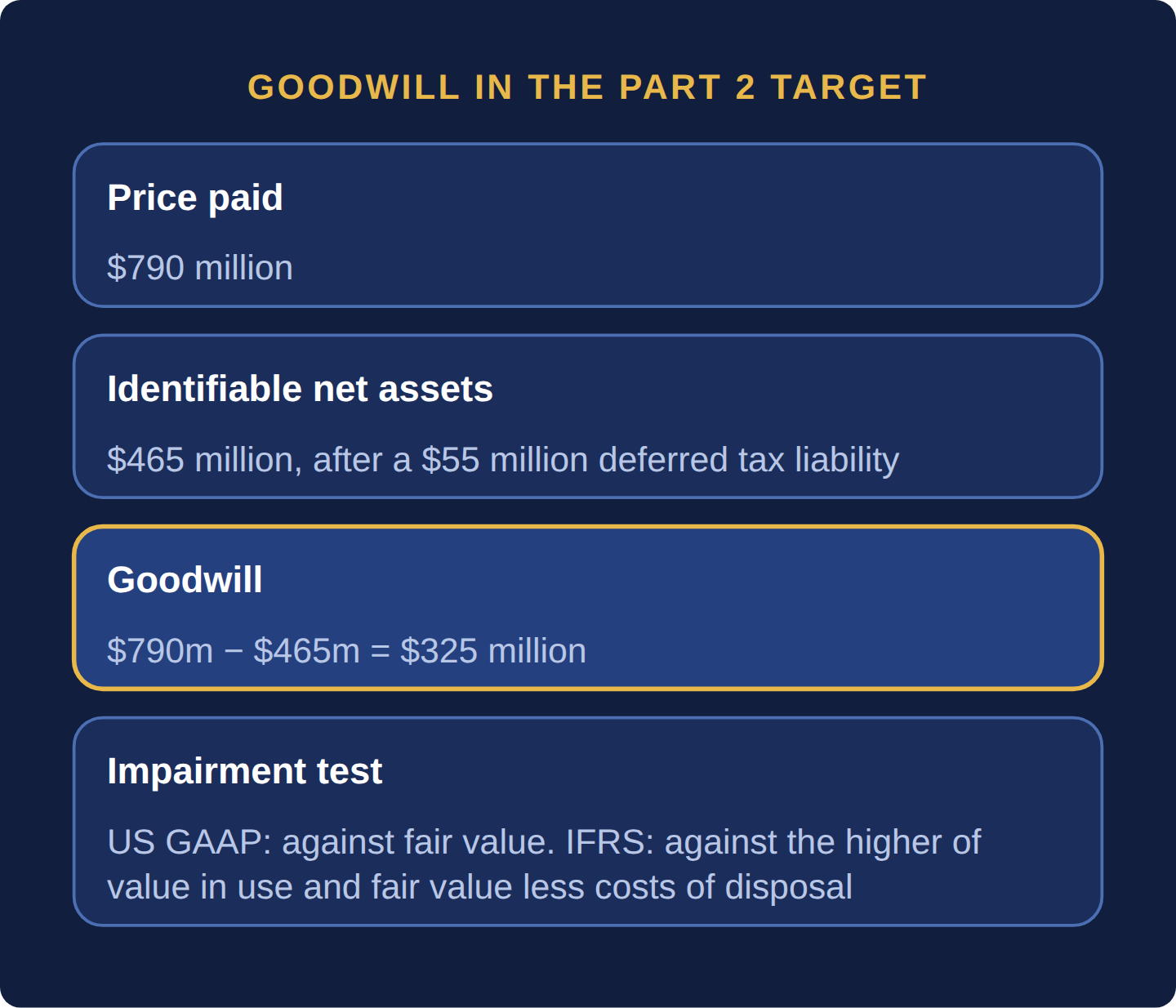
- The Part 2 target: $790 million price − $465 million identifiable net assets (after a $55 million deferred tax liability) = $325 million goodwill.
- US GAAP measures impairment against fair value; IFRS against the higher of value in use and fair value less costs of disposal.
- Goodwill impairments are never reversed under either framework.
- Kraft Heinz’s $15.4 billion of impairments in February 2019 produced a $12.6 billion quarterly loss with no cash outflow.
- Whether goodwill should be amortized again is unsettled: the FASB dropped the idea in 2022 and the IASB is still redeliberating.
When one company acquires control of another (typically defined as owning more than 50% of voting rights, though control can exist below that threshold), accounting rules require the acquirer to consolidate — combine the target’s full financial statements, line by line, into its own, rather than showing the investment as a single line item. This is why the multinational corporations described in Volume I’s Part 5 report a single set of financials covering dozens of subsidiaries worldwide.
Goodwill arises specifically in an acquisition: it is the excess of the purchase price paid over the fair value of the target’s identifiable net assets — in effect, the premium paid for intangible value the accounting system cannot otherwise capture (brand strength, customer relationships, synergies). Unlike most assets, goodwill is not depreciated on a schedule; instead, it must be tested at least annually for impairment — and if the acquired business’s value has deteriorated, the goodwill must be written down, taking a direct hit to reported profit in that period.
Take the company bought in the Part 2 buyout (Section 2.2: Stock Deals vs Asset Deals builds its purchase price allocation): equity price $790 million, book net assets $300 million, and fair-value step-ups of $220 million (plant, customer relationships, trade name). In a stock deal the tax basis does not step up, so the acquirer books a deferred tax liability of 25% × $220m = $55 million (6.5). Identifiable net assets at fair value = $300m + $220m − $55m = $465 million, so goodwill = $790m − $465m = $325 million.
| Three years later | US GAAP (ASC 350) | IFRS (IAS 36) |
|---|---|---|
| Unit tested | Reporting unit (segment or one level below) | Cash-generating unit (smallest group with independent cash flows) |
| Carrying amount, incl. goodwill | $760m | $760m |
| Compared with | Fair value $610m | Recoverable amount = higher of value in use $600m and fair value less costs of disposal $590m = $600m |
| Impairment | $760m − $610m = $150m (capped at goodwill of $325m) | $760m − $600m = $160m, charged to goodwill first |
| Later recovery | No reversal | No reversal of goodwill |
The charge goes straight through the income statement although no cash moves; the cash was spent, and overpaid, on the day of the deal. Since ASU 2017-04 (in force for SEC filers from 2020) US GAAP measures the loss in this single step, no longer re-measuring the “implied” goodwill. The real case at scale: on February 21, 2019, Kraft Heinz reported $15.4 billion of non-cash impairments of goodwill and of intangible assets, mainly the Kraft and Oscar Mayer trademarks, which turned the quarter into a net loss of $12.6 billion.
Ownership below control follows a ladder. Under roughly 20% with no significant influence, the stake is a financial asset carried at fair value. From about 20% to 50%, or with board seats and similar influence, the equity method applies: one balance-sheet line that grows by the investor’s share of the investee’s profit, and one income line for that share, so the investee’s debt never appears. Above control, consolidation brings in 100% of the subsidiary’s assets, liabilities and debt even when the parent owns less than all of it; the outside owners’ slice shows as noncontrolling interest. Buy 80% of the target above for $632 million (0.8 × $790m, assuming no premium for control). US GAAP measures noncontrolling interest at fair value ($158 million), so goodwill stays $632m + $158m − $465m = $325 million. IFRS 3 lets the acquirer choose, deal by deal, between that “full goodwill” and the proportionate method: $632m − 0.8 × $465m = $260 million. When identifiable net assets exceed the price, the difference is a bargain purchase gain, booked in profit after the acquirer rechecks its valuations.
US GAAP replaced goodwill amortization with impairment testing under SFAS 142, and IFRS 3, issued in March 2004, did the same; both now rely on annual impairment tests. Critics argue the tests come too late. Li and Sloan (Review of Accounting Studies, 2017) find that the impairment-only model produced relatively inflated goodwill balances and untimely impairments, and that investors were slow to price the delay. Defenders answer that amortizing over an arbitrary life tells investors nothing, while impairments carry information. Standard-setters have wavered: the FASB tentatively decided in December 2020 to reintroduce amortization, then removed the project from its agenda on June 15, 2022; the IASB’s March 2024 exposure draft proposed keeping impairment-only and adding disclosure of how acquisitions perform against management’s targets, and as of September 2026 it was still redeliberating, with a July 2026 staff paper noting that only 7 of 13 Board members had supported the latest disclosure package. Either way, treat a large goodwill balance as an untested claim and run your own test.
If goodwill exceeds about a quarter of equity, or the stock trades below book value, re-run the impairment test yourself: value the acquired unit’s cash flows (Part 1.3: Discounted Cash Flow (DCF) — Building the Model) and compare with its carrying amount. If your value is lower, deduct the shortfall from book value and expect a write-down. Treat a write-down as a signal about the original price, not as a fresh loss of cash. For equity-method investees, look through to their debt when assessing group leverage.
Valuing an acquirer on price-to-book or return on equity without asking whether its goodwill is still earned. In the example, book equity includes $325 million of goodwill, and the test three years on removes $150 million of it, 46%, in one charge. Investors who bought at book value took that loss the day the deal closed; the accounts simply admitted it later. Avoid it by measuring returns on tangible capital as well as on total capital.
Is goodwill amortized?
Not by public companies under US GAAP or IFRS. Goodwill stays on the balance sheet at cost and is tested for impairment at least once a year, and sooner when there is a sign of trouble. Identifiable intangibles with finite lives, such as customer relationships, are amortized. US tax law amortizes goodwill bought in an asset deal over 15 years (Section 2.2: Stock Deals vs Asset Deals).
What is the difference between the equity method and consolidation?
The equity method, used for significant influence (usually 20% to 50%), shows the stake as one asset and your share of its profit as one income line. Consolidation, used once you have control, adds every asset, liability, revenue and expense of the subsidiary to your own, and shows the part you do not own as noncontrolling interest.
Can goodwill impairment be reversed?
No. Both US GAAP and IAS 36 prohibit reversing a goodwill impairment, even if the business recovers, because a later increase would be internally generated goodwill, which neither framework lets a company recognize.
Control means consolidating 100% of a subsidiary with noncontrolling interest shown separately; significant influence means the equity method, which keeps the investee’s debt off the balance sheet. Goodwill is the price above identifiable net assets, tested for impairment rather than amortized, and never written back up.
Six questions on this chapter. Decide on your answer first, then click “Reveal Answer.”
1. An acquirer pays $600 million in a stock deal for a target with $250 million of book net assets and $120 million of fair-value step-ups. With a 25% tax rate, what goodwill is recorded?
- $230 million
- $200 million
- $260 million
- $350 million
Reveal Answer
Answer: C. The step-ups create a deferred tax liability of 25% × $120m = $30m, so identifiable net assets = $250m + $120m − $30m = $340m, and goodwill = $600m − $340m = $260m.
2. A cash-generating unit carries $500 million including goodwill. Its value in use is $420 million and its fair value less costs of disposal is $440 million. What impairment does IAS 36 require?
- $70 million
- $50 million
- $80 million
- $60 million
Reveal Answer
Answer: D. Recoverable amount is the higher of the two measures, $440m, so the impairment is $500m − $440m = $60m, charged to goodwill first.
3. An investor owns 30% of a company and has significant influence. How does the investee’s $1 billion of debt appear in the investor’s balance sheet?
- 30% of it, $300 million, is added to borrowings
- It does not appear; only the stake and a share of profit do
- It is shown on the face as a contingent liability
- All of it is consolidated, offset by noncontrolling interest
Reveal Answer
Answer: B. Under the equity method the investment is one line and the share of profit one income line, so the investee’s debt stays off the investor’s balance sheet. Analysts look through to it when judging leverage.
4. In February 2019 Kraft Heinz reported $15.4 billion of non-cash impairments. What did they mainly reduce?
- Goodwill and two trademarks, Kraft and Oscar Mayer
- Inventory written off after a large product recall
- Cash and short-term investment balances held abroad
- Derivatives used to hedge its commodity input costs
Reveal Answer
Answer: A. The charge lowered goodwill in certain reporting units and intangible assets, chiefly two trademarks, and produced a quarterly net loss of $12.6 billion with no cash outflow.
5. Worked problem: A buyer pays $500m. Identifiable assets at fair value are $380m, liabilities $60m and a deferred tax liability of $20m is created. What is goodwill?
Reveal Answer
Answer: Identifiable net assets = $380m − $60m − $20m = $300m. Goodwill = $500m − $300m = $200 million.
6. Worked problem: The business is later worth $430m against a carrying value of $500m. What impairment is recognized?
Reveal Answer
Answer: Impairment = $500m − $430m = $70 million, which is within the $200m of goodwill so it is charged against goodwill.
- IFRS 16 (effective Jan 1, 2019)
- IASB Supplier Finance Arrangements (May 2023)
- Kraft Heinz Q4 2018 results (Exhibit 99.1, Feb 21, 2019) — $15.4bn impairments; $12.6bn net loss
- IASB Goodwill and Impairment project page and July 2026 staff paper — Redeliberation status; 7 of 13 members supported the package
- IASB Goodwill and Impairment project page
- IFRS – IAS 36 Impairment of Assets (IFRS Foundation)