
F.1 The Month-End Close Fails
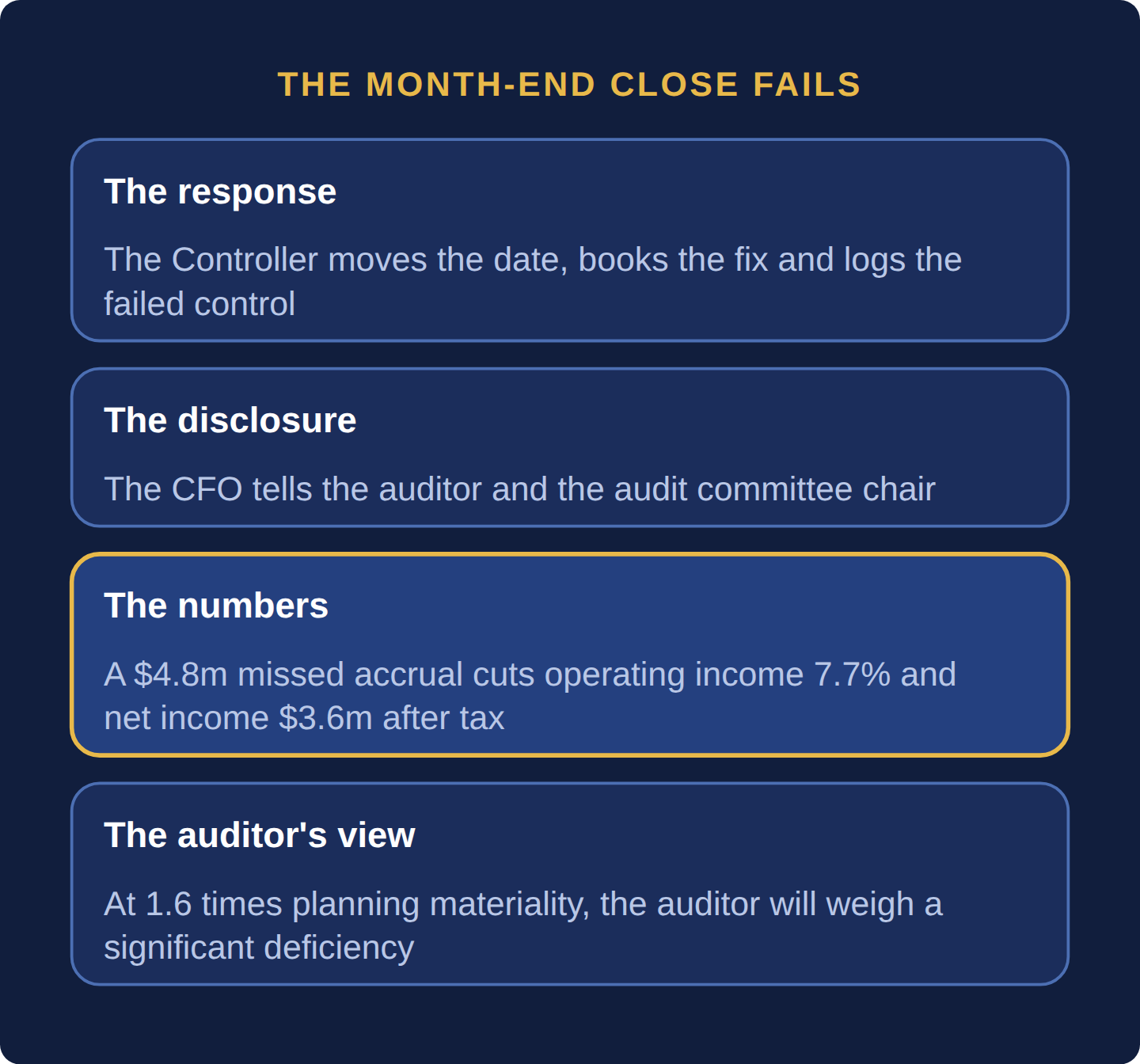
Sometimes the month-end close finds a real error late. Then the Controller moves the date, books the fix and logs the failed control, and the CFO tells the auditor and the audit committee chair. Nothing is restated because the numbers had not yet been issued, but the control failure still counts in the SOX evaluation.
Why it matters: Catching the error before issuing the numbers avoids a restatement, but the lapse is still recorded.
Summary: When the close finds a real error late, the Controller moves the date, books the fix and logs the failed control; the CFO tells the auditor and audit committee chair. Nothing is restated because the numbers were not yet issued, but the control failure still enters the SOX evaluation.
- A $4.8m missed accrual cuts operating income 7.7% and net income $3.6m after tax.
- At 1.6 times planning materiality, the auditor will weigh a significant deficiency.
- A flux review that catches the error is a detective control working.
- Closure needs a full quarter of evidenced interface checks, not a memo.
Each scenario in Part F uses an illustrative company with invented, internally consistent numbers, in USD. Here it is a manufacturer with about $1.2 billion of revenue that closes in five business days (C.1: The Controller). It is day 4 of the September quarter-end close. The flux review shows freight and outside-services expense down 30% against August with no volume change, and the goods-received-not-invoiced (GRNI) accrual is $4.8 million lower than the purchasing system says it should be: an interface from the receiving system dropped two days of receipts, so the accrual was never booked. Before the fix, quarterly operating income is $62.0 million and pre-tax income $60.0 million; the earnings call is in 12 days.
Who acts, who owns, who escalates.
| Role | What they do | Deadline |
|---|---|---|
| General ledger manager (C.1: The Controller) | Reruns the interface, ties record counts from the receiving system to the ERP, books the accrual | Same day |
| Controller (C.1: The Controller), owner | Decides the close date moves by one day, approves the entry, writes up the root cause for the deficiency log | 24 hours |
| Head of FP&A (C.3: The Head of FP&A) | Reruns the variance pack and checks whether the forecast used the wrong number | 1 day after the fix |
| CFO (A.1: What Every CFO Owns, Universally) | Escalates to the audit committee chair and the external auditor; confirms the earnings date holds | 48 hours |
| Head of IR (C.4: The Head of Investor Relations) | Updates the earnings script and any guidance bridge | Before the call |
| Head of Internal Audit (C.5: The Head of Internal Audit) | Tests the redesigned interface control and reports on it to the audit committee | Within the quarter |
Entry: debit outside-services and freight expense $4.8 million; credit accrued liabilities (GRNI) $4.8 million. The liability side of the balance sheet rises by $4.8 million; equity falls by the after-tax amount.
| Measure | Formula and result |
|---|---|
| Operating income | $62.0m − $4.8m = $57.2m (a 4.8 ÷ 62.0 = 7.7% fall) |
| Net income effect | $4.8m × (1 − 25% assumed tax rate) = $3.6m |
| Against materiality | Illustrative planning materiality = 5% × $60.0m = $3.0m; error ÷ materiality = 4.8 ÷ 3.0 = 1.6× |
Because the error was caught and booked before the numbers were issued, nothing is restated. The interface failure is still a control deficiency: under the PCAOB definitions a material weakness is a deficiency giving a “reasonable possibility” of a material misstatement not being prevented or detected on time. An error 1.6 times materiality points toward at least a significant deficiency; the fact that the company’s own flux review caught it weighs against a material weakness. The auditor makes that judgment, not the Controller.
An interface completeness control: every day, receipts count and value in the receiving system are compared with what landed in the ERP, and any difference above zero is cleared before the next run. Evidence an auditor accepts: the system-generated comparison report for each day of the quarter, the exception log with resolution dates, and the GL manager’s dated sign-off, plus a monthly GRNI reconciliation reviewed by the Controller. Internal Audit closes the finding only after the control has run cleanly for a full quarter.
| A good response | A bad response |
|---|---|
| Delays the close a day, fixes the number, tells the auditor and audit committee chair the same week | Holds the date and books a “top-side” estimate nobody can support |
| Finds the root cause (the interface) and adds a preventive check | Treats it as a one-off and adds another review layer |
| Logs the deficiency for the SOX year-end evaluation | Discovers in January that the same interface failed twice more |
The lesson: a close that slips a day to fix a real error is a working control; a close that hits its date with a wrong number is a deficiency waiting to be found.
What happens when the close finds a real error late?
The Controller moves the date, books the fix and logs the failed control; the CFO tells the auditor and audit committee chair.
Is anything restated?
No, because the numbers were not yet issued.
How big is the example error?
A $4.8m missed accrual cuts operating income 7.7% and net income $3.6m after tax.
When the close finds a real error late, the Controller moves the date, books the fix and logs the failed control, and the CFO tells the auditor and audit committee chair. Nothing is restated because the numbers were not yet issued.
Six questions on this chapter. Decide on your answer first, then click “Reveal Answer.”
1. On day 3 of the close you find a $2.5 million GRNI accrual was never booked. The tax rate is 25%. By how much does booking it reduce net income?
- $1.875 million
- $2.5 million
- $0.625 million
- $3.125 million
Reveal Answer
Answer: A. After-tax effect = $2.5m × (1 − 0.25) = $1.875m. The full $2.5m reduces pre-tax income; tax absorbs a quarter of it.
2. Planning materiality is 5% of pre-tax income of $50 million. A close error of $3.5 million is found before release. How large is it relative to materiality?
- 0.7 times materiality
- 1.75 times materiality
- 1.4 times materiality
- 7.0 times materiality
Reveal Answer
Answer: C. Materiality = 5% × $50m = $2.5m; $3.5m ÷ $2.5m = 1.4. An error above materiality points toward at least a significant deficiency in the failed control.
3. It is day 4 of a five-day close, a $1.2 million expense swing has no explanation, and the earnings call is in ten days. What should the Controller do?
- Hold the date and look into the swing again next quarter
- Move the close a day, find the cause, tell the auditor
- Have FP&A explain the swing away in the variance commentary
- Hold the date and book a top-side estimate to cover the gap
Reveal Answer
Answer: B. An unexplained flux is a possible error. A one-day delay to fix it is a control working; a plug nobody can support creates a deficiency.
4. Internal Audit is asked to close a finding on a failed receiving-to-ERP interface. Which evidence best supports closing it?
- An email from the Controller confirming the accrual is now right
- A single reperformance of the interface on the day of the fix
- An IT memo confirming the interface code has been corrected
- Daily comparison reports, exceptions and sign-offs for a quarter
Reveal Answer
Answer: D. A control is proved by evidence that it operated over a period, not by a statement that it was fixed.
5. Worked problem: A $3.5m accrual is missed. Operating income is $70m and the tax rate 25%. What is the effect on operating income and net income?
Reveal Answer
Answer: Operating income falls 5.0%; net income falls 3.5 × 0.75 = $2.625m.
6. Worked problem: Planning materiality is $2.2m. How many times materiality is the error?
Reveal Answer
Answer: 3.5 ÷ 2.2 = 1.59×: the auditor will weigh a significant deficiency.
F.2 The Cash Forecast Deteriorates
When the cash forecast gets worse, each role has a job. The Treasurer owns the 13-week forecast and the conversation with lenders. FP&A reforecasts EBITDA, and the Controller books the credit loss. A covenant breach spotted nine weeks out can be fixed by collecting cash and managing inventory, or by asking for an early amendment, but not by a late surprise.
Why it matters: Bad news raised early gives you options; raised late, it gives you none.
Summary: The Treasurer owns the 13-week forecast and the lender conversation; FP&A reforecasts EBITDA and the Controller books the credit loss. A covenant breach seen nine weeks out is fixed by collections and inventory, or by an early amendment, never by a late surprise.

An illustrative specialty-chemicals company has $520 million of revenue, a $200 million term loan and a $150 million revolving credit facility. Its loan agreement tests net leverage (net debt ÷ trailing twelve-month EBITDA) at no more than 3.50× each quarter-end, plus a $25 million minimum liquidity floor. Last quarter: net debt $240 million, EBITDA $80 million, leverage 3.00×. In week 3 of the quarter, the largest customer (12% of sales) stops paying a $12 million receivable and announces a restructuring. The Treasurer’s 13-week cash forecast (C.2: The Treasurer) shows the quarter-end test, in week 9, failing.
Who acts, who owns, who escalates.
| Role | What they do | Deadline |
|---|---|---|
| Treasurer (C.2: The Treasurer), owner | Reruns the 13-week forecast weekly, models the covenant at each test date, opens the conversation with the agent bank | 48 hours |
| Controller (C.1: The Controller) | Books the credit-loss allowance on the receivable; confirms the EBITDA definition in the loan agreement | By quarter-end close |
| Head of FP&A (C.3: The Head of FP&A) | Reforecasts EBITDA without the customer; sizes cost actions | 1 week |
| Chief Risk Officer or credit manager (C.7: The Chief Risk Officer) | Cuts credit limits on similar customers; stops further shipments on open terms | 24 hours |
| CFO (A.1: What Every CFO Owns, Universally) | Escalates to the CEO and the board; decides between self-help and asking lenders for an amendment | 1 week |
| Head of IR (C.4: The Head of Investor Relations) | Checks whether guidance or a disclosure needs updating | Before any public statement |
The Controller reserves half the receivable: debit credit-loss expense $6 million, credit allowance for credit losses $6 million. Lost margin costs another $2 million of EBITDA this quarter. Unpaid cash ($12 million) and stranded inventory ($4 million) raise net debt.
| Measure | Formula and result |
|---|---|
| Headroom last quarter | Debt capacity 3.50 × $80m = $280m; headroom $280m − $240m = $40m (EBITDA could fall 1 − 240 ÷ (3.50 × 80) = 14.3% before a breach) |
| Projected at the test date | EBITDA $80m − $6m − $2m = $72m; net debt $240m + $12m + $4m = $256m; leverage 256 ÷ 72 = 3.56× (breach) |
| Gap to close | 3.50 × $72m = $252m allowed; $256m − $252m = $4m of net debt to remove |
| After self-help | Collect $8m of overdue receivables from other customers and cut inventory $6m: net debt $256m − $14m = $242m; leverage 242 ÷ 72 = 3.36×; headroom $252m − $242m = $10m |
| The alternative | An amendment for a fee of 0.25% (illustrative) on $350m of commitments = $0.875m, plus a higher margin |
Drawing the revolver does not help: it adds equal cash and debt, so net debt is unchanged. It protects liquidity, not leverage.
Two controls, both evidenced. First, a weekly forecast-to-actual variance review of the 13-week forecast with a set tolerance (for example ±5% of receipts), signed by the Treasurer, with every miss explained. Second, the quarterly covenant calculation, prepared by treasury, reperformed by the Controller’s team from the general ledger using the loan agreement’s own EBITDA definition, and signed by the CFO before the compliance certificate goes to the agent bank. An auditor accepts the signed calculation, its tie-out to the ledger and the forecast variance log.
| A good response | A bad response |
|---|---|
| Tells lenders in week 4 with a plan and numbers | Tells lenders the day after the test date fails |
| Reserves the receivable now | Delays the reserve to stay inside the covenant |
| Fixes collections and inventory, which also free cash | Draws the revolver and calls the problem solved |
The lesson: a covenant is managed weeks before its test date in the 13-week forecast, and the lender who hears early negotiates; the lender who is surprised reprices.
Who owns the 13-week forecast?
The Treasurer, who also owns the lender conversation; FP&A reforecasts EBITDA and the Controller books the credit loss.
How is covenant headroom calculated?
Headroom = covenant multiple × EBITDA − net debt.
How can a breach seen nine weeks out be fixed?
By collections and inventory, or by an early lender conversation.
The Treasurer owns the 13-week forecast and the lender conversation. A covenant breach seen nine weeks out can be fixed by collections and inventory, or by an early talk with lenders.
Six questions on this chapter. Decide on your answer first, then click “Reveal Answer.”
1. Your loan caps net leverage at 3.0×. Trailing EBITDA is $100 million and net debt is $250 million. How much more net debt could you carry before breaching?
- $83 million
- $75 million
- $50 million
- $25 million
Reveal Answer
Answer: C. Capacity = 3.0 × $100m = $300m; headroom = $300m − $250m = $50m.
2. A customer default cuts trailing EBITDA to $90 million and raises net debt to $280 million. The covenant is 3.0×. Where does leverage land?
- 3.33×, a breach
- 2.50×, inside the covenant
- 2.80×, inside the covenant
- 3.11×, a breach
Reveal Answer
Answer: D. Leverage = $280m ÷ $90m = 3.11×, above the 3.0× limit.
3. A week before a leverage test, the CEO suggests drawing $30 million on the revolver to look stronger. What does the draw do to the net leverage ratio?
- It lowers leverage because cash rises $30 million
- Nothing: cash and debt both rise $30 million
- It lowers leverage once the cash is invested
- It raises leverage because debt rises $30 million
Reveal Answer
Answer: B. Net debt = debt − cash; equal increases cancel. A draw protects liquidity, not leverage.
4. Your 13-week forecast shows a covenant breach at the test date nine weeks away. When should the CFO approach the lenders?
- Now, with the forecast and a self-help plan
- After the auditors have signed the quarter
- After the test date, once the breach is certain
- Only if self-help fails in week eight
Reveal Answer
Answer: A. Lenders who hear early with numbers negotiate waivers or amendments; a surprise after the test date weakens the company’s position and price.
5. Worked problem: Net debt is $280m, EBITDA $100m and the covenant is 3.0×. What is the headroom in dollars?
Reveal Answer
Answer: 3.0 × $100m − $280m = $20m.
6. Worked problem: A $15m receivable defaults and EBITDA falls $6m. What is the leverage, and is the covenant breached?
Reveal Answer
Answer: Net debt = $295m; EBITDA = $94m; leverage = 3.14×, above 3.0×: breached.
F.3 The IPO Is Six Months Away
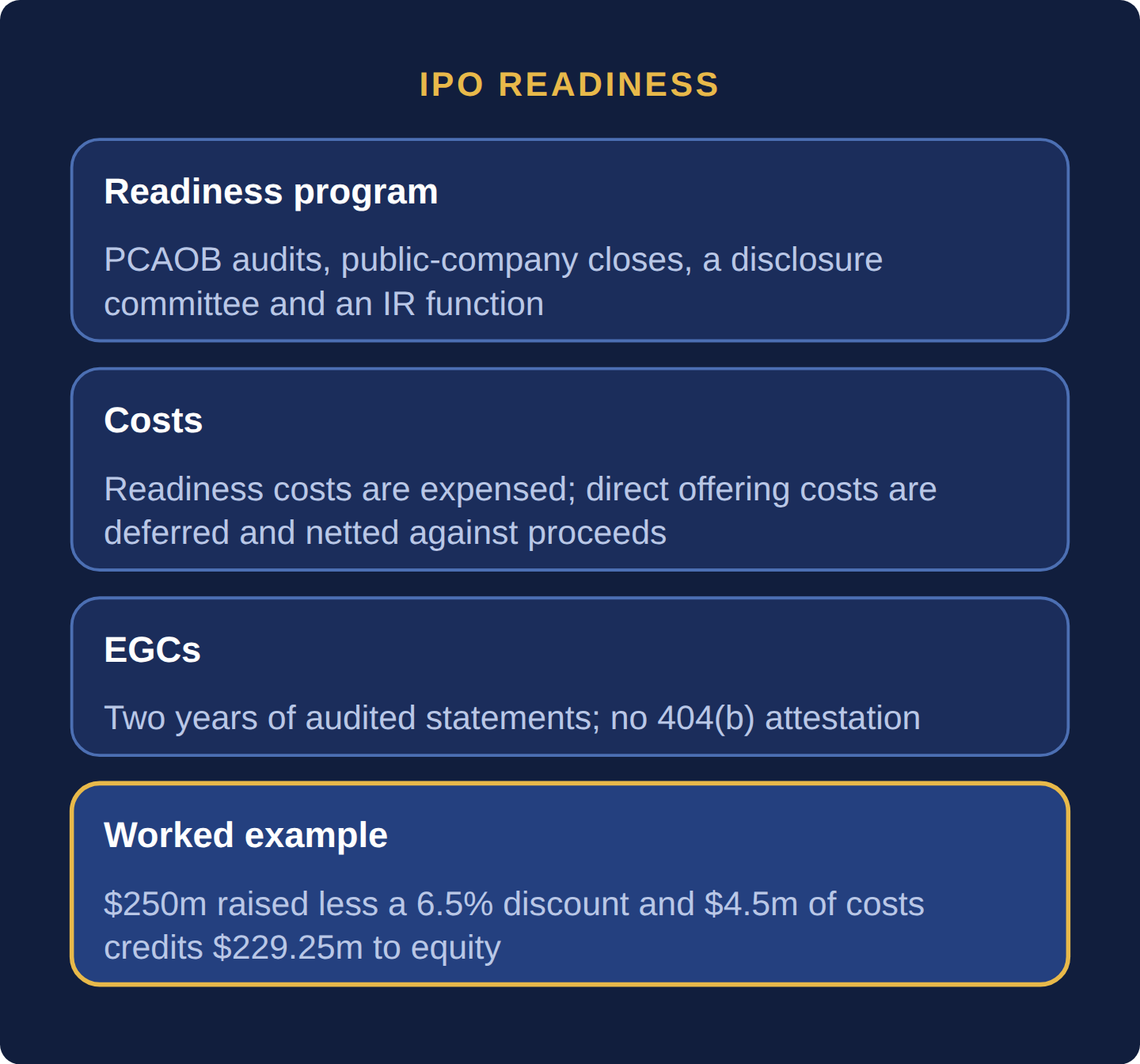
Six months before an IPO, the CFO runs a readiness program: PCAOB-standard audits, closing the books like a public company, a disclosure committee and an investor relations function. The costs of getting ready are expensed, while the direct costs of the offering are deferred and netted against the money raised.
Why it matters: Going public is mostly a long list of habits built months before the day.
Summary: Six months before an IPO, the CFO runs a readiness program: PCAOB audits, public-company closes, a disclosure committee and an IR function. Readiness costs are expensed; direct offering costs are deferred and netted against the proceeds.
- EGCs show two years of audited statements and skip the 404(b) attestation.
- $250m raised less a 6.5% discount and $4.5m of costs credits $229.25m to equity.
- No comfort-letter negative assurance 135 days or more after the latest period.
- SOX 302 certifications start with the first 10-Q.
An illustrative software company with a December year-end expects $310 million of revenue for 2026 and plans to price an IPO in early May 2027, selling 12.5 million new shares at an assumed $20. With revenue under $1.235 billion it qualifies as an emerging growth company (EGC): it may show two years of audited financial statements instead of three, submit its Form S-1 registration statement for confidential SEC review, and skip the auditor’s attestation on internal control (SOX 404(b)) while it remains an EGC. Its finance team of 40 has never filed anything with the SEC.
Who acts, who owns, who escalates.
| Role | What they do | Deadline |
|---|---|---|
| CFO (A.1: What Every CFO Owns, Universally), owner | Runs the readiness program; chooses underwriters, auditor scope and the disclosure committee; reports progress to the board monthly | Now |
| Controller (C.1: The Controller) | Delivers audits to PCAOB standards for 2025 and 2026, quarterly reviews, a 10-day quarterly close and the S-1 financial statements | Audited 2026 by late February |
| Head of FP&A (C.3: The Head of FP&A) | Builds the model underwriters test and the guidance framework | Before analyst day |
| Head of IR (C.4: The Head of Investor Relations) | Hired now; drafts the equity story and the disclosure policy for the quiet period | 3 months before pricing |
| Stock plan administration (C.10: The Head of Stock Plan Administration) | Cleans the cap table, option records and lock-up lists | Before the first S-1 draft |
| Head of RevOps (C.9: The Head of Revenue Operations (SaaS)) with the Controller | Fixes definitions of ARR and net revenue retention so the S-1 metrics reconcile | Before the first S-1 draft |
| Head of Internal Audit (C.5: The Head of Internal Audit) or advisers | Documents and tests key controls so the first SOX 302 certifications are supportable | Before pricing |
SEC staff guidance (SAB Topic 5.A) lets “specific incremental costs directly attributable” to an offering be deferred and charged against the proceeds; salaries and general overhead are expensed. All amounts are illustrative.
| Item | Treatment and result |
|---|---|
| Readiness costs (SOX consultants $1.8m, new hires $1.9m, systems $1.0m, board recruiting $1.5m) | Expensed in G&A as incurred: $6.2m hits operating income before the IPO |
| Direct offering costs (S-1 legal $2.6m, comfort letter and offering audit work $1.2m, printing and filing $0.7m) | Held as a deferred offering cost asset until pricing: $4.5m |
| Gross proceeds | 12.5m shares × $20 = $250.0m |
| Underwriting discount (6.5%, illustrative) | 6.5% × $250.0m = $16.25m |
| Net to equity | $250.0m − $16.25m − $4.5m = $229.25m credited to share capital and additional paid-in capital |
The calendar trap: the underwriters’ comfort letter gives “negative assurance” on changes after the latest financial statements, but under PCAOB AS 6101 the auditor may not give it as of a date 135 days or more after the end of the latest audited or reviewed period. December 31, 2026 + 135 days = May 15, 2027. If pricing slips past that date, the S-1 needs reviewed March 2027 quarterly numbers first.
A disclosure committee and sub-certification process that runs before the S-1 is filed: each owner of a number or statement (revenue, the cap table, the key metrics, legal matters) signs a sub-certification, the committee minutes record its review, and the CEO and CFO sign the registration statement only after that. Evidence an auditor and underwriters’ counsel accept: signed sub-certifications, minutes, a tick-and-tie binder linking every S-1 number to a source, and the comfort letter itself. A newly public company does not file a management report on internal control until its second annual report, but the SOX 302 certifications start with its first quarterly report.
| A good response | A bad response |
|---|---|
| Runs two quarterly closes as if already public before the road show | Learns the 10-Q timetable from the first 10-Q |
| Reconciles every S-1 metric to the ledger before drafting | Fixes metric definitions in SEC comment letters |
| Treats the quiet period as a rule for everyone, sales included | A CEO interview that “conditions the market” during the offering |
The lesson: an IPO is a finance-function build, not a transaction; the six months before it are spent closing, documenting and certifying as if the company were already public.
What does the CFO run six months before an IPO?
A readiness program: PCAOB audits, public-company closes, a disclosure committee and an IR function.
How are IPO costs accounted for?
Readiness costs are expensed; direct offering costs are deferred and netted against the proceeds.
What do emerging growth companies get?
Two years of audited statements and no 404(b) attestation.
Six months before an IPO the CFO runs a readiness program. Readiness costs are expensed; direct offering costs are deferred and netted against proceeds, so $250m raised credits $229.25m to equity in the example.
Six questions on this chapter. Decide on your answer first, then click “Reveal Answer.”
1. An IPO sells 10 million new shares at $18. The underwriting discount is 7% and direct offering costs are $3.0 million. What is credited to equity?
- $180.0 million
- $164.4 million
- $177.0 million
- $167.4 million
Reveal Answer
Answer: B. Gross $180m − 7% × $180m ($12.6m) − $3.0m = $164.4m. Direct offering costs are charged against proceeds.
2. The latest reviewed financial statements in the S-1 are for the quarter ended March 31, 2027. From what date can the auditor no longer give negative assurance in the comfort letter?
- July 30, 2027
- June 29, 2027
- August 13, 2027
- September 27, 2027
Reveal Answer
Answer: C. PCAOB AS 6101 bars negative assurance as of a date 135 days or more after the period end: March 31 + 135 days = August 13, 2027.
3. Six months before the IPO you hire an SEC reporting manager. How is the salary treated?
- Expensed as incurred in operating costs
- Deferred and charged against IPO proceeds
- Deferred until the registration is effective
- Capitalized and amortized over five years
Reveal Answer
Answer: A. SAB Topic 5.A allows deferral only of specific incremental costs directly attributable to the offering; salaries and general overhead are expensed.
4. A company with $900 million of revenue plans its first IPO. Which relief does EGC status give it?
- No SOX 302 certifications in its first year as public
- No comfort letter from the auditor to the underwriters
- No quiet period around the registration statement
- Two years of audited statements instead of three
Reveal Answer
Answer: D. EGCs may show two years of audited statements and skip the auditor’s 404(b) attestation; certifications, the quiet period and comfort letters still apply.
5. Worked problem: An IPO raises $300m with a 7% discount and $5m of direct offering costs. What is credited to equity?
Reveal Answer
Answer: $300m − $21m − $5m = $274m.
6. Worked problem: An emerging growth company must present how many years of audited statements?
Reveal Answer
Answer: Two, rather than three, and it skips the 404(b) attestation.
- PCAOB, AS 2201 — Control deficiency, significant deficiency and material weakness definitions; restatement as indicator (F.1, F.4)
- Investor.gov, Initial Public Offering (IPO) — Investor.gov’s explanation of the IPO process
- 15 U.S.C. §7241, Corporate responsibility for financial reports (Cornell LII) — The officer certification that public-company CFOs must make
- 15 U.S.C. 77f (Securities Act Section 6) — EGC confidential draft filed publicly 15 days before road show (F.3)
- SEC, Staff Accounting Bulletin Topic 5 — Topic 5.A expenses of offering (F.3)
- PCAOB, AS 6101 Letters for Underwriters — Comfort letters, negative assurance, 135-day limit (F.3)
- SEC, Emerging Growth Companies — EGC threshold and accommodations (F.3)
- 17 CFR 229.308 (Regulation S-K Item 308) — No effective ICFR conclusion with a material weakness; newly public transition (F.3)