
F.4 A Revenue-Recognition Issue Surfaces
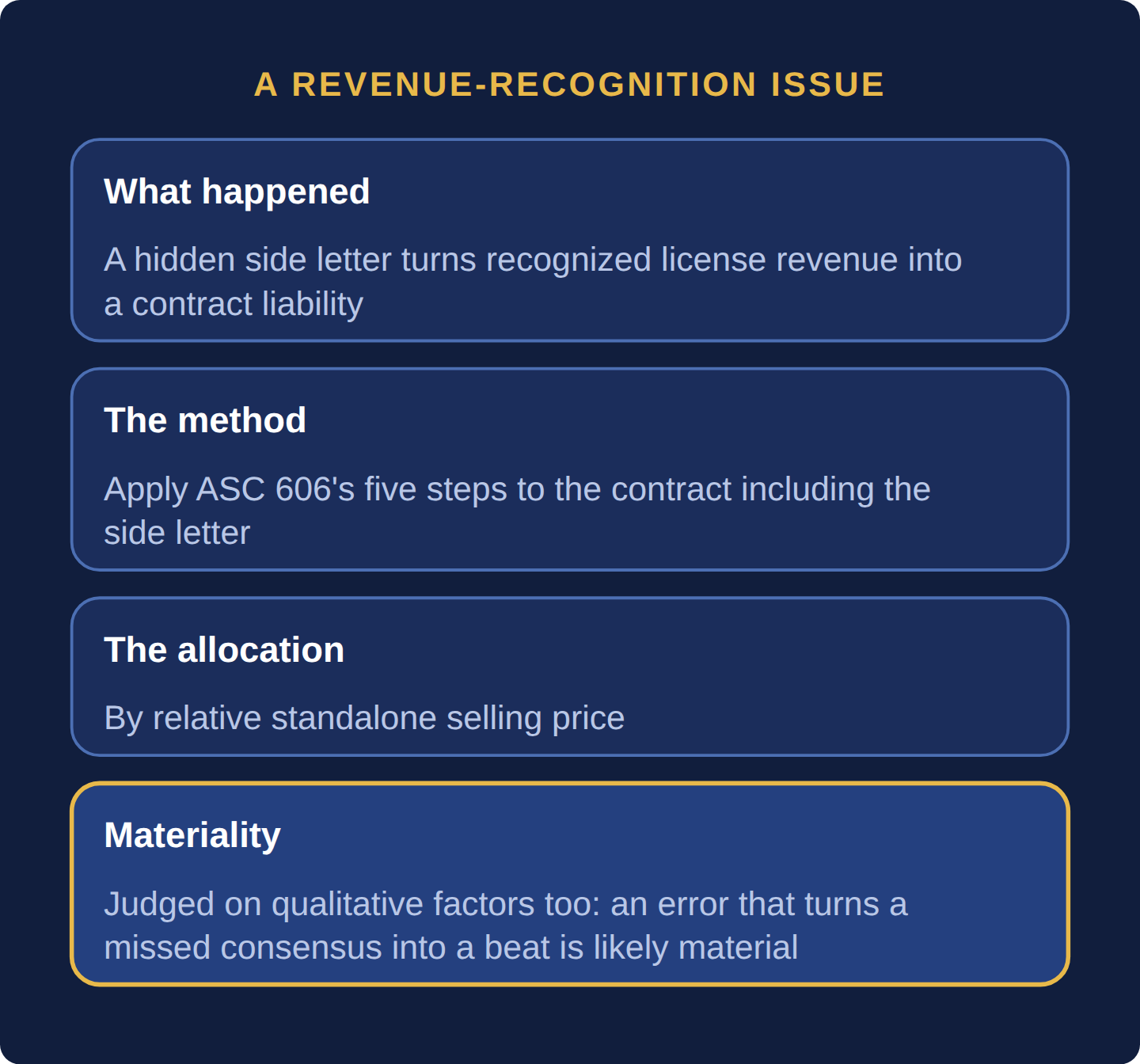
A hidden side letter, a private promise outside the main contract, turns license revenue that was recognized into a contract liability. Judging whether an error is material depends on qualitative factors as well as size. An error that turns a missed consensus into a beat is likely material and requires a restatement and an Item 4.02 Form 8-K.
Why it matters: A small error can be a big problem if it changes the story the numbers tell.
Summary: A hidden side letter turns recognized license revenue into a contract liability. Materiality is judged on qualitative factors as well as size: an error that turns a missed consensus into a beat is likely material and requires a “Big R” restatement and an Item 4.02 Form 8-K.
- Apply ASC 606‘s five steps to the contract including the side letter.
- Allocate the price by relative standalone selling price.
- SAB 99: no percentage threshold alone decides materiality.
- SAB 108: measure under both rollover and iron curtain methods.
An illustrative listed software company reported third-quarter revenue of $46.0 million, beating the analyst consensus of $45.2 million, and pre-tax income of $4.0 million. In November, after the 10-Q is filed, the deal desk (C.9: The Head of Revenue Operations (SaaS)) finds a side letter on a $2.4 million contract signed September 28: a sales executive promised free implementation and made the license subject to customer acceptance, which has not happened. The company had recognized $1.5 million of license revenue on signing.
Who acts, who owns, who escalates.
| Role | What they do | Deadline |
|---|---|---|
| Controller and technical accounting (C.1: The Controller), owner of the accounting | Reruns the ASC 606 analysis, quantifies the error, drafts the materiality memo | 3-5 days |
| CFO (A.1: What Every CFO Owns, Universally) | Escalates to the audit committee chair and the auditor the day the side letter is confirmed | 24 hours |
| Audit committee (A.3: The CFO’s Relationship to the CEO and Board) | Decides whether an independent investigation is needed (other side letters, who knew) and concludes on reliance | Days to weeks |
| Head of Internal Audit (C.5: The Head of Internal Audit) | Searches every quarter-end deal for side agreements; reports to the audit committee | 2-4 weeks |
| Head of RevOps (C.9: The Head of Revenue Operations (SaaS)) | Tightens deal-desk approval: no contract terms outside the system | Before quarter-end |
| Head of IR (C.4: The Head of Investor Relations) and Legal | Prepare the Form 8-K and investor messaging if prior numbers can no longer be relied on | 4 business days after that conclusion |
ASC 606, step by step: (1) the contract includes the side letter, because promises made to the customer are part of the contract; (2) there are three performance obligations: license, two years of support, implementation; (3) the transaction price is $2.4 million; (4) allocate it on relative standalone selling prices (SSP) of $1.6m, $0.8m and $0.4m, total $2.8m, a factor of 2.4 ÷ 2.8 = 0.857; (5) recognize each when control transfers.
| Item | Formula and result |
|---|---|
| Allocation | License 1.6 × 0.857 = $1.371m (on acceptance); support 0.8 × 0.857 = $0.686m (ratably, $0.686m ÷ 24 = $0.029m a month once it starts); implementation 0.4 × 0.857 = $0.343m (as delivered) |
| Q3 error | Recognized $1.5m, should be $0; overstatement $1.5m |
| Correcting entry | Debit revenue $1.5m; credit contract liability $1.5m |
| Quantitative size | 1.5 ÷ 46.0 = 3.3% of revenue; 1.5 ÷ 4.0 = 37.5% of pre-tax income |
| Qualitative test | Corrected revenue $46.0m − $1.5m = $44.5m, $0.7m below the $45.2m consensus: the error turned a miss into a beat |
SEC Staff Accounting Bulletin 99 rejects relying on any percentage threshold alone and names hiding a failure to meet analyst expectations as a factor that can make a small error material. SAB 108 requires quantifying errors under both the “rollover” (income statement) and “iron curtain” (balance sheet) methods; for a single-quarter error both give $1.5m. Here the error is 3.3% of revenue but 37.5% of pre-tax income, far above the common 5%-of-pre-tax-income rule of thumb, and it hid a miss: material on both counts, so this is a “Big R” restatement under ASC 250: the 10-Q is amended and an Item 4.02 Form 8-K (non-reliance) is due within four business days. Had the error been immaterial to Q3 but material if corrected in Q4, a “little r” revision of the comparatives in the next filing would do. A restatement is also a listed indicator of a material weakness.
A quarter-end contract completeness control: every contract above a threshold (say $250,000) is reviewed by technical accounting against the signed documents, and the sales leader on the deal signs a certification that no side agreements, oral or written, exist; customers on large deals receive a confirmation of terms. Evidence an auditor accepts: the review checklist per contract, the signed certifications, confirmation replies, and Internal Audit’s retest over two quarters before the material weakness is reported remediated.
| A good response | A bad response |
|---|---|
| Takes the materiality memo to the audit committee with the qualitative factors stated | Argues “3.3% of revenue is under 5%” and stops |
| Searches all quarter-end deals before deciding | Fixes the one contract found |
| Files the 8-K on time and explains the fix | Corrects it quietly in Q4 revenue |
The lesson: materiality is a judgment about what an investor would care about, and an error that turns a miss into a beat is material whatever its percentage.
What does a hidden side letter do?
It turns recognized license revenue into a contract liability.
How is the price allocated?
By relative standalone selling price, after applying ASC 606’s five steps to the contract including the side letter.
When is an error material?
Materiality is judged on qualitative factors as well as size; an error that turns a missed consensus into a beat is likely material.
A hidden side letter turns recognized license revenue into a contract liability. Materiality is judged on qualitative factors as well as size, so an error that turns a miss into a beat is likely material.
Six questions on this chapter. Decide on your answer first, then click “Reveal Answer.”
1. A $1.8 million contract has a license, support and services with standalone selling prices of $1.2m, $0.6m and $0.3m. How much is allocated to the license?
- $1.50 million
- About $1.03 million
- About $0.86 million
- $1.20 million
Reveal Answer
Answer: B. Relative SSP: $1.2m ÷ $2.1m × $1.8m = $1.029m.
2. A $2.0 million overstatement hit reported quarterly revenue of $80.0 million; consensus was $79.0 million. The CFO says 2.5% is below 5%. What is the right conclusion?
- Immaterial: it is below the 5% rule of thumb
- Material only if it also exceeds 5% of total assets
- Immaterial: the error is only 2.5% of revenue
- Likely material: corrected revenue misses consensus
Reveal Answer
Answer: D. $2.0m ÷ $80.0m = 2.5%, but corrected revenue $78.0m misses $79.0m. SAB 99 names hiding a missed consensus as a qualitative factor that can make a small error material.
3. An error is immaterial to last year’s statements but would be material if corrected entirely in this year’s results. How is it corrected?
- Revise the prior-year comparatives when next filed
- Amend last year’s 10-K and file an Item 4.02 8-K
- Disclose it in a footnote and make no correction
- Book the whole correction in this year’s results
Reveal Answer
Answer: A. This is a “little r” revision: prior periods are corrected when next presented, without amending past filings or a non-reliance 8-K.
4. On a Monday the audit committee concludes that last quarter’s 10-Q can no longer be relied upon. When is the Item 4.02 Form 8-K due?
- Within 30 calendar days of the decision
- With the next scheduled quarterly report
- Within four business days, by Friday
- With the amended 10-Q, whenever ready
Reveal Answer
Answer: C. Form 8-K is due within four business days of the reportable event; for Item 4.02 that is the non-reliance conclusion.
5. Worked problem: A bundle costs $90,000: a license (standalone price $80,000) and support ($40,000). How is revenue allocated?
Reveal Answer
Answer: License = $90,000 × 80 ÷ 120 = $60,000; support = $90,000 × 40 ÷ 120 = $30,000.
6. Worked problem: A hidden side letter gives a $10,000 credit to the customer. What happens to the transaction price?
Reveal Answer
Answer: It falls to $80,000, so recognized revenue must be reduced by $10,000 (11% of the original).
F.5 A Regulator Finds a Control Deficiency
When the SEC sends a deficiency letter, the Chief Compliance Officer answers within about 30 days with a full recalculation, refunds with interest and a dated remediation plan. The Controller books the refund reserve, and Internal Audit tests the fixed control before the finding is closed.
Why it matters: A finding is only closed when an independent check shows the fix works.
Summary: An SEC deficiency letter is answered by the CCO within about 30 days with a full recalculation, refunds with interest and a dated remediation plan. The Controller books the refund reserve; Internal Audit tests the fixed control before the finding is closed.
- A misapplied breakpoint overbills $7,500 a year on an $8m account.
- $1.86m of refunds plus $0.14m of interest gives a $2.00m reserve.
- Immaterial under both SAB 108 methods, so corrected in the current period.
- Prompt corrective action can weigh against an Enforcement referral.

An illustrative SEC-registered investment adviser manages $12 billion in separately managed accounts and is owned by a listed parent with $380 million of annual revenue. Its fee schedule charges 1.00% a year on the first $5 million of an account and 0.75% above that. An SEC examination (C.14: The Chief Compliance Officer) tested fee calculations, and the deficiency letter says the billing system applied 1.00% to the whole balance on 420 accounts above the breakpoint for three years: $1.86 million overbilled, about $0.62 million a year. The letter asks for a written response, typically within 30 days.
Who acts, who owns, who escalates.
| Role | What they do | Deadline |
|---|---|---|
| Chief Compliance Officer (C.14: The Chief Compliance Officer), owner of the response | Drafts the response, the remediation plan and the refund method; escalates to the CEO and the parent’s board | Response within 30 days |
| Billing and fund operations (C.12: The Head of Fund Accounting) | Recalculates every account for every quarter; fixes the breakpoint table | 2 weeks |
| Controller (C.1: The Controller) | Books the refund liability; assesses the error under SAB 108 | Current quarter close |
| Relationship managers (E.11: Relationship Management) | Send client letters and refunds; log questions | Per the response plan, typically 60-90 days |
| Head of Internal Audit (C.5: The Head of Internal Audit) | Validates the recalculation and later retests the fixed control | Before closing the finding |
| CEO and General Counsel | Sign the response; judge whether self-reporting beyond the letter is warranted | Before submission |
| Item | Formula and result |
|---|---|
| An $8m account, correct fee | $5m × 1.00% + $3m × 0.75% = $50,000 + $22,500 = $72,500 a year |
| Charged | $8m × 1.00% = $80,000; overbilled $7,500 a year |
| Reserve | Refunds $1.86m + interest (illustrative 5% simple, average 1.5 years outstanding) $1.86m × 5% × 1.5 = $0.14m; total ≈ $2.00m |
| Entry | Debit fee revenue $1.86m and interest expense $0.14m; credit refunds payable $2.00m |
| SAB 108, both methods | Rollover (current-year error) 0.62 ÷ 380 = 0.16% of revenue; iron curtain (cumulative) 1.86 ÷ 380 = 0.49% |
Immaterial under both methods and on qualitative grounds, so the parent records it in the current period rather than restating. In SOX terms it is likely a control deficiency, below a significant deficiency; the size is small, but overcharging clients is exactly the conduct examiners and clients care about, so the regulatory and client consequences outweigh the accounting ones.
A preventive control (the fee schedule for each account is loaded from the signed advisory agreement, with changes approved by a second person) plus a detective one (each quarter, compliance testing independently recalculates a sample of invoices, every account above the breakpoint included, before they go out). Evidence an examiner accepts: the recalculation workpapers, the exception log, refund proof per client and the CCO’s annual review under Rule 206(4)-7 recording the finding, the fix and the test results.
| A good response | A bad response |
|---|---|
| Recalculates every account, refunds with interest, explains the root cause | Refunds only the accounts the examiners sampled |
| Names an owner and a date for each fix in the response letter | Promises to “enhance procedures” with no date |
| Retests the control before reporting it fixed | Closes the finding on the day the code changes |
The lesson: a deficiency letter is answered with recalculated numbers, made-good clients and a tested control, because, in the SEC’s own words, prompt corrective action can be a mitigating factor in whether a finding is referred to Enforcement.
How is an SEC deficiency letter answered?
By the CCO within about 30 days, with a full recalculation, refunds with interest and a dated remediation plan.
How big is the refund reserve in the example?
$1.86m of refunds plus $0.14m of interest gives a $2.00m reserve.
Who does what afterward?
The Controller books the refund reserve and Internal Audit tests the fixed control.
The roles barely change in India; the clocks and the rulebooks do. Listed companies report under Ind AS (notified under section 133 of the Companies Act, 2013, and converged with IFRS), disclose under SEBI’s Listing Obligations and Disclosure Requirements (LODR) Regulations, and go public under SEBI’s Issue of Capital and Disclosure Requirements (ICDR) Regulations, 2018.
| Scenario | What changes in India |
|---|---|
| The close fails (F.1: The Month-End Close Fails) | Quarterly results are due to the stock exchange within 45 days of quarter-end (LODR Regulation 33(3)), annual audited results within 60 days, so a failed close eats a fixed window. Much of the close itself often runs in a GCC in Bengaluru, Hyderabad or Pune, while the onshore Controller signs. |
| The forecast deteriorates (F.2: The Cash Forecast Deteriorates) | Same 13-week discipline, mostly with bank consortiums. Under LODR Regulation 30(6), a material event is disclosed within 30 minutes of the board meeting that decides it, 12 hours if it arises inside the company, 24 hours if it arises outside. |
| The IPO approaches (F.3: The IPO Is Six Months Away) | The draft red herring prospectus is filed with SEBI and made public for comments for at least 21 days. Regulation 6(1) eligibility includes average operating profit of at least ₹15 crore over the preceding three years on restated, consolidated figures; issuers that fail it may use Regulation 6(2) with at least 75% of the net offer to qualified institutional buyers. |
| A revenue error surfaces (F.4: A Revenue-Recognition Issue Surfaces) | Ind AS 115 mirrors ASC 606’s five steps; Ind AS 8 corrects material prior-period errors by restating comparatives. There is no “Big R” and “little r” vocabulary. Reopening filed statements needs section 131 of the Companies Act: board-initiated, Tribunal (NCLT) approval, covering any of the three preceding financial years and at most once a financial year. |
| A regulator finds a deficiency (F.5: A Regulator Finds a Control Deficiency) | RBI’s sequence for banks and NBFCs: a statutory inspection against a reference date, then a show-cause notice, a reply and, if upheld, a monetary penalty announced by press release as based on “deficiencies in regulatory compliance.” A listed entity discloses a fine of ₹1 lakh or more from a sectoral regulator within 24 hours (LODR Schedule III), smaller ones quarterly. |
For the Controller, CFO and compliance officer, the practical difference is speed: Indian disclosure clocks run in hours, so the escalation column in each table above shortens.
An SEC deficiency letter is answered by the CCO within about 30 days with a full recalculation, refunds with interest and a dated remediation plan; the Controller books the reserve.
Six questions on this chapter. Decide on your answer first, then click “Reveal Answer.”
1. A $12 million account should pay 1.00% on the first $5 million and 0.75% above. The system charged 1.00% on everything. What was the annual overbilling?
- $52,500
- $30,000
- $12,500
- $17,500
Reveal Answer
Answer: D. Correct fee = $5m × 1% + $7m × 0.75% = $102,500; charged $120,000; overbilled $17,500.
2. Overbilling totals $3.0 million over three years, $1.0 million in the current year; revenue is $500 million. What are the SAB 108 measures?
- Rollover 0.2% and iron curtain 0.6% of revenue
- Rollover 0.6% and iron curtain 0.6% of revenue
- Rollover 0.6% and iron curtain 0.2% of revenue
- Rollover 0.2% and iron curtain 0.2% of revenue
Reveal Answer
Answer: A. Rollover uses the current-year error: $1.0m ÷ $500m = 0.2%. Iron curtain uses the cumulative error: $3.0m ÷ $500m = 0.6%.
3. An SEC deficiency letter cites fee errors found in a sample of 40 accounts. What should the CCO’s written response commit to?
- Dispute the sample and request a further meeting first
- Refund the 40 sampled accounts and then review policy
- Recalculate all accounts, refund with interest, set dates
- Explain the system error and promise better procedures
Reveal Answer
Answer: C. Examiners expect full-population remediation and a dated plan; prompt corrective action can be a mitigating factor in whether a finding is referred to Enforcement.
4. Six months after a billing fix, the CCO must show the deficiency is closed. Which evidence is strongest?
- A board minute recording that the issue was discussed
- Quarterly independent fee recalculations and exception logs
- The deficiency letter response as filed with the SEC staff
- A vendor letter confirming the billing code was changed
Reveal Answer
Answer: B. Closure is shown by a control that operated and was tested over time, recorded in the Rule 206(4)-7 annual review.
5. Worked problem: A regulator finds $1.2m of overcharges and $0.1m of interest is due. What reserve is needed?
Reveal Answer
Answer: $1.2m + $0.1m = $1.3m.
6. Worked problem: The letter arrives on Monday, March 2, 2026, with 30 days to respond. What is the due date?
Reveal Answer
Answer: Wednesday, April 01, 2026.
- SEC, Staff Accounting Bulletin No. 99: Materiality — Qualitative materiality factors; no reliance on percentage thresholds alone (F.4)
- SEC, Staff Accounting Bulletin No. 108 — Rollover and iron curtain methods; correcting immaterial prior-year errors (F.4, F.5)
- SEC, Assessing Materiality: Focusing on the Reasonable Investor When Evaluating Errors (Mar 9, 2022) — Big R restatement versus little r revision (F.4)
- IFRS Foundation, IFRS 15 — Five-step model issued jointly with ASC 606 (F.4)
- SEC, Form 8-K and General Instructions — Four-business-day deadline; Item 4.02 non-reliance (F.4)
- PCAOB, AS 2201 — Control deficiency, significant deficiency and material weakness definitions; restatement as indicator (F.1, F.4)
- SEC, Division of Examinations Exam Handbook — Deficiency letters, 30-day response, Enforcement referral (F.5)
- RBI, press release