
8.1 What Makes an Investment "Alternative"
An alternative investment is anything outside listed stocks, bonds and cash: hedge funds, private equity, private credit, real assets and the pools that own them. You give up easy selling and clear price information, and the law limits access to accredited investors or qualified purchasers. Reported returns from assets that rarely trade are smoothed, so their true ups and downs are bigger than they look.
Why it matters: A calm-looking return can hide real risk.
Summary: An alternative investment is anything outside listed stocks, bonds and cash: hedge funds, private equity, private credit, real assets and the pools that own them. You give up liquidity and transparency, and access is limited by law to accredited investors or qualified purchasers. Reported returns from illiquid assets are smoothed, so their true volatility is higher than it looks.
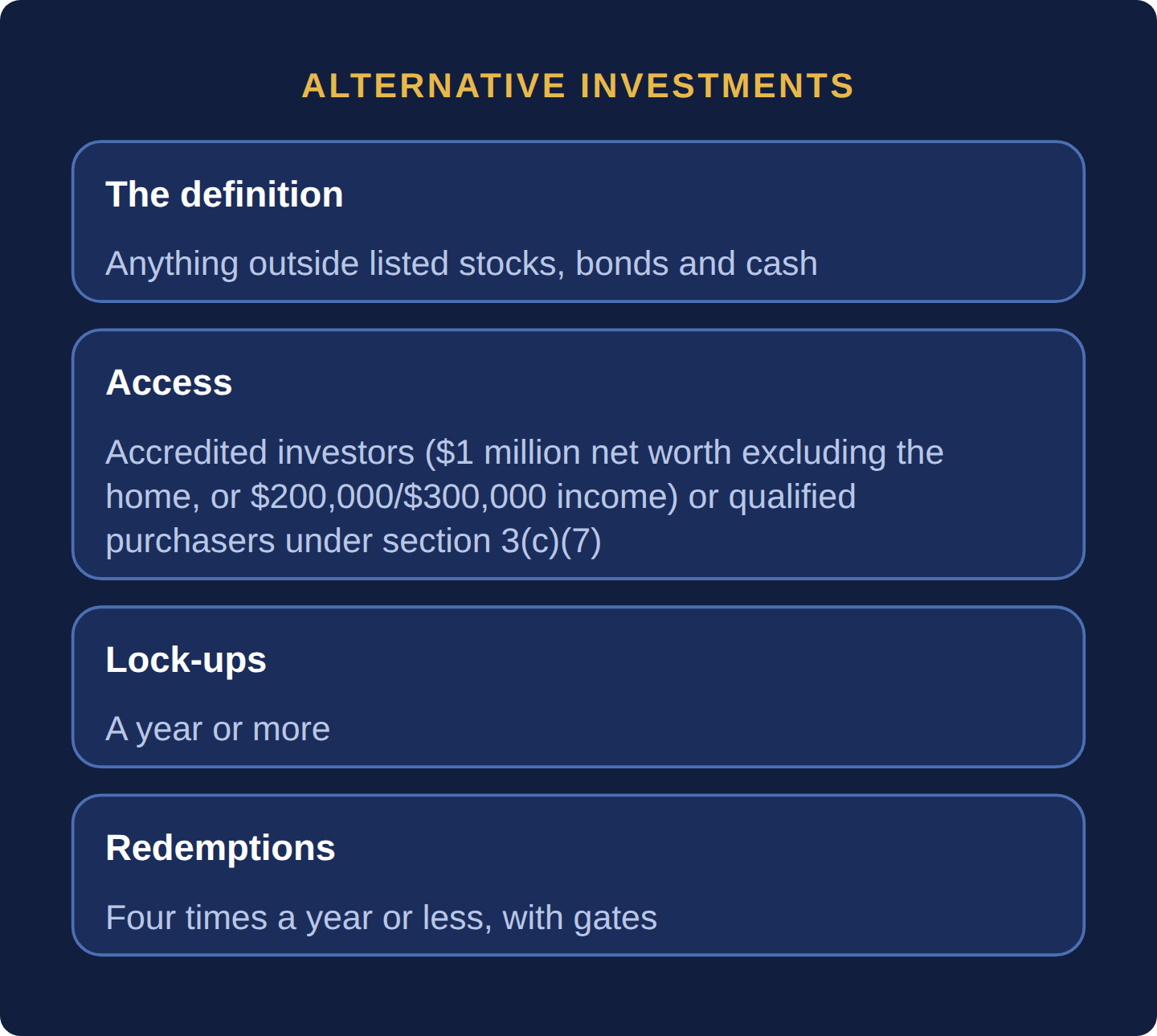
- US private funds sell to accredited investors ($1 million net worth excluding the home, or $200,000/$300,000 income) or, under section 3(c)(7), qualified purchasers ($5 million of investments).
- Liquidity is contractual: lock-ups of a year or more, redemption four times a year or less, and gates.
- Smoothing hides risk: true volatility = reported × √[(1 + φ) ÷ (1 − φ)], 1.73 times at φ = 0.5.
- A 0.50 reported Sharpe ratio becomes 0.29 once unsmoothed in the worked example.
- Compare alternatives net of fees and unsmoothed, then ask whether the premium pays for the lock-up.
Volume I’s Part 3 named the shadow banking universe as a broad category of non-bank finance without detailing what actually happens inside it. Alternative investments is the umbrella term for everything outside traditional publicly-traded stocks and bonds — hedge funds, private equity (already covered in Part 2: M&A, Private Equity & LBOs), real assets, private credit, and the large private capital pools that invest in all of them. They share three defining characteristics: lower liquidity (money is typically locked up for a defined period), lower transparency (less standardized, less frequent public disclosure than listed securities), and, in exchange for both, the potential for returns less correlated with traditional stock and bond markets.
Two features follow from that definition. First, access is restricted by law. Most US hedge and private funds sell only in private offerings, in practice to an accredited investor (for an individual, net worth above $1 million excluding the primary residence, or income above $200,000, $300,000 jointly, in each of the last two years, under SEC Rule 501(a)); funds relying on the Investment Company Act’s section 3(c)(7) exemption take only qualified purchasers (individuals with at least $5 million of investments). A registered adviser may charge an individual a performance fee only if that client is a qualified client: from June 29, 2026, $1.4 million managed by the adviser or $2.7 million of net worth. Second, liquidity is contractual: a hedge fund typically has a lock-up of a year or more, then redemption four times a year or less often, with advance notice and often a gate that caps how much of the fund can leave on one date; private equity and private credit funds return money only as investments are sold or repaid. The fees that pay for all this are worked through in Section 8.2: Long/Short Equity.
A listed stock is marked at a traded price every day. An unlisted loan, building or company is marked by a model or an appraisal, and appraisals move slowly: each period’s reported return blends part of the true change with last period’s reported return. Getmansky, Lo and Makarov (2004), studying 908 hedge funds, showed that this return smoothing explains the strong serial correlation of illiquid strategies and “will understate volatility and increase risk-adjusted performance measures such as the Sharpe ratio.”
Model it as reported return = (1 − φ) × true return + φ × last reported return. Then true volatility = reported volatility × √[(1 + φ) ÷ (1 − φ)]. With φ = 0.5: √(1.5 ÷ 0.5) = √3 = 1.73. A fund reporting 7% a year with 6% volatility, against a 4% risk-free rate, shows a Sharpe ratio of (7 − 4) ÷ 6 = 0.50; unsmoothed volatility is 6 × 1.73 = 10.4%, and the Sharpe ratio (7 − 4) ÷ 10.4 = 0.29. The reported figure overstates risk-adjusted performance by 73%. Same-period correlation with stocks is understated too, by a factor of √(1 − φ²) = 0.87 here, because a smoothed series lags the market rather than ignoring it. At φ = 0.3 the volatility multiplier is 1.36; at φ = 0.7 it is 2.38.
Before you compare an alternative with a listed fund, put both on the same footing: use returns after all fees, unsmooth the alternative’s volatility (multiply by √[(1 + φ) ÷ (1 − φ)], with φ the first-order autocorrelation of its monthly returns), and then ask whether the extra return pays for the lock-up. If φ is above about 0.2, treat the reported Sharpe ratio and correlation as flattering. As a heuristic, require an expected net return premium of at least 2 to 3 percentage points a year over the closest listed equivalent for a multi-year lock-up; ignore the rule only when the asset has no listed equivalent at all.
Sizing an allocation on smoothed numbers. An optimizer fed the 6% reported volatility above sees a Sharpe ratio of 0.50 and a near-zero stock correlation, so it loads up; the economic volatility is 10.4% and the Sharpe ratio 0.29. In a sell-off the illiquid sleeve is marked down a quarter or two late, its share of the portfolio jumps (the denominator effect), and the investor must sell liquid assets at the bottom to rebalance or meet calls. Unsmooth first, then size.
What counts as an alternative investment?
Anything outside publicly traded stocks, bonds and cash: hedge funds, private equity, private credit, real estate, infrastructure and commodities. The label describes the wrapper and liquidity as much as the asset: a listed REIT holds real estate but trades like a stock, while a private real estate fund holding the same buildings is an alternative because you cannot sell it on demand.
Can an ordinary investor buy hedge funds?
Usually not directly. Private funds are sold to accredited investors (over $1 million of net worth excluding the home, or over $200,000 of income, $300,000 jointly) or to qualified purchasers ($5 million of investments). Retail investors reach similar strategies through registered “liquid alternative” mutual funds and ETFs, which face daily liquidity and leverage limits and therefore cannot copy every strategy.
What is a gate in a hedge fund?
A limit on how much capital can leave the fund on one redemption date, often a percentage of NAV. Requests above it are cut back pro rata and carried to later dates, which protects remaining investors from a fire sale but means you may not get your money when you ask.
Alternatives trade liquidity and transparency for returns that may be less correlated with listed markets, and US law limits most of them to accredited investors or qualified purchasers. Because illiquid assets are marked by models or appraisals, their reported volatility and correlation are too low; unsmooth with √[(1 + φ) ÷ (1 − φ)] before comparing them with listed funds.
Six questions on this chapter. Decide on your answer first, then click “Reveal Answer.”
1. A private real estate fund reports 8% annual volatility, and its monthly returns have a first-order autocorrelation of 0.5. Using the smoothing model in this chapter, what is its approximate true volatility?
- About 12.0%
- About 11.3%
- About 13.9%
- About 16.0%
Reveal Answer
Answer: C. True volatility = reported × √[(1 + φ) ÷ (1 − φ)] = 8 × √3 = 13.9%. The other figures use multipliers of 1.5, √2 and 2.
2. Which individual may invest in a US fund that relies on the Investment Company Act’s section 3(c)(7) exemption?
- One who owns at least $5 million of investments
- One with $1.4 million managed by a single adviser
- One with $1.2 million of net worth excluding the home
- One who earned $250,000 in each of the last two years
Reveal Answer
Answer: A. Section 3(c)(7) funds are limited to qualified purchasers, which for an individual means at least $5 million of investments. The other three describe accredited investor or qualified client tests.
3. Why does an appraisal-based fund usually show a lower same-period correlation with stocks than its true economic exposure implies?
- Its managers hedge market risk with index futures every quarter
- Its reported returns lag market moves because each mark blends in past marks
- Its fees are charged before returns are reported to its investors
- Its assets are legally separated from the listed stock market by regulation
Reveal Answer
Answer: B. Smoothing spreads each true move over several periods, so the reported series lags the market; in the model the same-period correlation is scaled down by √(1 − φ²).
4. A hedge fund receives redemption requests for 15% of NAV on a quarterly date, and its documents cap withdrawals at 10% per date. What happens?
- Investors lose the unpaid part of their requests entirely
- The fund must sell assets at once to pay all requests in full
- The lock-up period restarts for every requesting investor at once
- Requests are cut back pro rata and the rest carried to later dates
Reveal Answer
Answer: D. That cap is a gate: it protects remaining investors from a fire sale by paying requests pro rata up to the limit and deferring the excess.
5. Worked problem: An individual has $1.2m of net worth excluding the home and $190,000 of income. Is she an accredited investor ($1m net worth excluding the home, or $200,000 income)?
Reveal Answer
Answer: Net worth $1.2m > $1m, so yes, on net worth alone; income of $190,000 would not qualify on its own.
6. Worked problem: A couple’s joint income is $290,000 and their net worth excluding the home is $800,000. Do they qualify (joint income $300,000)?
Reveal Answer
Answer: Income $290,000 < $300,000 and net worth $800,000 < $1m: no.
8.2 Long/Short Equity
A long/short equity fund buys some stocks and bets against others at the same time, so how much market risk it carries depends on its net exposure, best measured after adjusting for each stock’s beta. What investors keep depends heavily on fees. Under a 2-and-20 structure, a fund must earn 12% gross to deliver 8% net. The high-water mark, the hurdle and how often fees are locked in decide how much of a bumpy return the manager takes.
Why it matters: The fee terms can matter as much as the strategy.
Summary: Long/short equity funds hold longs and shorts at once, so their market risk depends on net exposure, best measured beta-adjusted rather than in dollars. What investors keep depends heavily on fee terms: under 2-and-20 a fund must earn 12% gross to deliver 8% net, and the high-water mark, hurdle and crystallization frequency decide how much of a volatile return the manager takes.
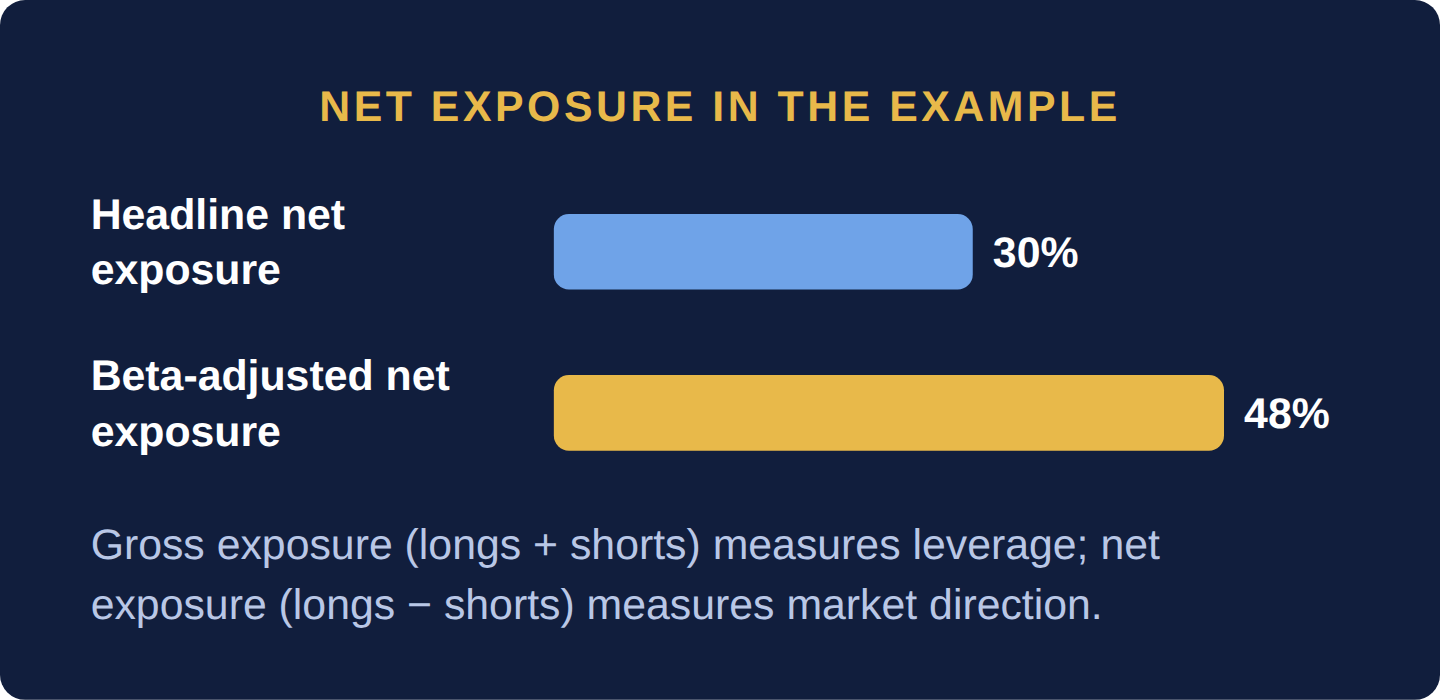
- Gross exposure (longs + shorts) measures leverage; net exposure (longs − shorts) measures market direction.
- Beta-adjusted net exposure was 48% in the example against a headline 30%.
- On a +20%, −15%, +15% path, 2-and-20 took 57% of the gross profit even with a high-water mark.
- Quarterly crystallization can pay the manager $2.00 million in a year that gained under 1%.
- Evidence splits: funds showed alpha before investor timing (Ibbotson, Chen and Zhu), but investors’ dollar-weighted alpha was near zero (Dichev and Yu).
Long/short equity, the original and still most common hedge fund strategy, holds long positions in stocks the manager expects to outperform and short positions (Volume I’s Part 4 introduced short selling) in stocks expected to underperform, simultaneously. The manager’s net exposure — long positions minus short positions, as a percentage of capital — determines how much the fund’s overall return still depends on the broad market’s direction. A fund running near-zero net exposure (“market neutral”) is betting almost entirely on the manager’s specific stock-picking skill, largely independent of whether the overall market rises or falls; a fund running high net long exposure behaves much more like a traditional long-only equity fund with some downside protection layered on top.
A fund with $1,000 million of capital holds $700 million in long positions and $400 million in short positions. Gross exposure = $700 million + $400 million = $1,100 million (110% of capital, so the fund is using leverage). Net exposure = $700 million − $400 million = $300 million, or 30% of capital. Now weight each side by its beta (sensitivity to the market, Part 1.5: CAPM — The Cost of Equity): if the longs average a beta of 1.2 and the shorts 0.9, beta-adjusted net exposure = 700 × 1.2 − 400 × 0.9 = 840 − 360 = $480 million, or 48%. A 10% market fall then costs about 0.10 × 480 = $48 million (4.8% of capital) before any stock-picking gain, not the $30 million the headline 30% suggests. A market-neutral fund targets beta-adjusted net exposure near 0%, not just dollar net exposure.
Hedge funds typically charge a management fee on assets (1–2% a year) and a performance fee on profits (15–20%), classically “2-and-20”. Three terms decide what the performance fee costs. A high-water mark means the fee is paid only on gains above the highest net asset value (NAV) on which a fee was previously paid. A hurdle is a minimum return that must be earned first: with a hard hurdle the fee applies only above it, with a soft hurdle the whole gain is fee-bearing once the hurdle is cleared. Crystallization is when an accrued fee becomes the manager’s for good.
Take $100 million invested at 2-and-20 with a high-water mark, gross returns of +20%, −15% and +15%, the management fee charged on opening NAV and the performance fee crystallized annually ($ millions):
| Year | Opening NAV | After gross return | Mgmt fee (2%) | Perf. fee (20% above mark) | Closing NAV | High-water mark |
|---|---|---|---|---|---|---|
| 1 (+20%) | 100.00 | 120.00 | 2.00 | 0.2 × (118.00 − 100.00) = 3.60 | 114.40 | 114.40 |
| 2 (−15%) | 114.40 | 97.24 | 2.29 | 0 | 94.95 | 114.40 |
| 3 (+15%) | 94.95 | 109.19 | 1.90 | 0 (107.30 is below 114.40) | 107.30 | 114.40 |
Gross, the money would have grown to 100 × 1.20 × 0.85 × 1.15 = 117.30, a profit of $17.30 million (5.5% a year). Fees took 6.19 + 3.60 = $9.79 million, or 9.79 ÷ 17.30 = 57% of the gross profit, leaving 2.4% a year. Without the high-water mark the Year 3 fee would be 0.2 × (107.30 − 94.95) = $2.47 million and the investor would end at $104.83 million. A 5% hard hurdle cuts the Year 1 fee to 0.2 × (118.00 − 105.00) = $2.60 million; a soft one leaves it at $3.60 million.
Crystallization frequency. Quarterly gross returns of +10%, −6%, +5% and −7% leave a year only 0.97% up. Crystallized annually, the fee is 0.2 × 0.97 = $0.19 million. Crystallized quarterly, the manager locks in 0.2 × 10.00 = $2.00 million after the first quarter, keeps it, and the investor ends the year at $99.13 million, below where it started on a positive gross year (management fee ignored to isolate the effect).
Yes, on fund returns. Ibbotson, Chen and Zhu (Financial Analysts Journal, 2011) split 1995–2009 hedge fund returns of 11.13% a year before fees into 3.43 points of fees, 3.00 points of alpha and 4.70 points of market beta, and found alpha positive in every year of the decade. No, on investor returns. Dichev and Yu (Journal of Financial Economics, 2011) measured what investors actually earned after their own timing of inflows and outflows: dollar-weighted returns were 3% to 7% a year below buy-and-hold fund returns, and “the real alpha of hedge fund investors is close to zero.” Both can be true: funds added value, but investors chased past winners just before returns faded. Self-reported databases also suffer survivorship bias, so treat reported alphas as upper bounds.
Gross up the fee before judging the manager: under 2-and-20 charged on opening NAV, a fund must earn 12% gross to hand you 8% net (0.8 × (12% − 2%) = 8%). If a beta-matched index blend can be expected to return within that 4-point gap of the manager’s expected gross return, the fees consume the edge. Insist on a high-water mark and annual crystallization, and ask for a hurdle at the cash rate when beta-adjusted net exposure is low, since cash-like returns should not earn a performance fee.
Reading “2-and-20” as “about 2% a year”. In the three-year example a 5.5% gross annual return became 2.4% net: fees took 57% of the gross profit, and without a high-water mark the investor would have paid another $2.47 million while still below the peak. The share rises as gross returns fall, because the 2% is charged regardless. Model the fees on a down-up path before signing.
What is a high-water mark in a hedge fund?
It is the highest NAV on which a performance fee has already been paid; no new performance fee is due until the investor is back above it. A fund closed below its mark and relaunched starts a fresh mark.
What does crystallization mean for a performance fee?
It is the point at which an accrued fee is paid to the manager and can no longer be reduced by later losses. Annual crystallization lets a bad second half offset a good first half; quarterly does not, so in a year of +10%, −6%, +5% and −7% the manager keeps $2.00 million on $100 million although the year gained under 1%.
What is the difference between gross and net exposure?
Gross exposure adds longs and shorts and measures leverage; net exposure subtracts shorts from longs and measures market direction. A fund at 200% gross and 0% net carries large stock-specific risk with little market risk.
Long/short equity’s market risk is its beta-adjusted net exposure, not its headline net figure. Fee terms decide what you keep: 2-and-20 needs 12% gross for 8% net, and the high-water mark, hurdle and annual crystallization protect investors on volatile paths, while the evidence on whether alpha survives fees and investor timing remains split.
Six questions on this chapter. Decide on your answer first, then click “Reveal Answer.”
1. A fund has $500 million of capital, $600 million of longs with an average beta of 1.1 and $350 million of shorts with an average beta of 0.8. What is its beta-adjusted net exposure?
- 190% of capital
- 62% of capital
- 50% of capital
- 76% of capital
Reveal Answer
Answer: D. 600 × 1.1 − 350 × 0.8 = 660 − 280 = $380 million, and 380 ÷ 500 = 76%. 50% is the dollar net exposure and 190% the gross exposure.
2. A $100 million account pays 2-and-20 with the management fee on opening NAV and a high-water mark of $100 million. Gross return in the year is +10%. What are total fees?
- $2.0 million
- $4.0 million
- $3.6 million
- $2.2 million
Reveal Answer
Answer: C. Management fee 0.02 × 100 = 2.0; NAV after it 110 − 2 = 108; performance fee 0.2 × (108 − 100) = 1.6; total 3.6. $4.0 million wrongly charges 20% on the gross gain before the management fee.
3. A fund has a 5% hurdle. After the management fee, NAV rises from $100 million to $113 million. How does the performance fee differ between a hard and a soft hurdle (20% rate)?
- Hard: $1.6 million; soft: $2.6 million
- Hard: $2.6 million; soft: $1.6 million
- Both $2.6 million once the hurdle is cleared
- Hard: $1.0 million; soft: $2.6 million
Reveal Answer
Answer: A. A hard hurdle charges only the gain above it: 0.2 × (113 − 105) = 1.6. A soft hurdle, once cleared, charges the whole gain: 0.2 × 13 = 2.6.
4. What did Dichev and Yu (2011) find when they measured hedge fund returns on a dollar-weighted basis?
- Investors earned 3% to 7% a year more than buy-and-hold fund returns
- Investors earned 3% to 7% a year less than buy-and-hold fund returns
- Fees took 3.43 points of an 11.13% gross annual return
- Alpha was positive in every year of the decade studied
Reveal Answer
Answer: B. Investors’ timing of flows cost them 3% to 7% a year, leaving a real alpha close to zero. The fee split and positive annual alphas are Ibbotson, Chen and Zhu’s findings on fund returns.
5. Worked problem: A fund is 80% long with a beta of 1.1 and 50% short with a beta of 0.9. What are its headline and beta-adjusted net exposures?
Reveal Answer
Answer: Headline net = 80% − 50% = 30%. Beta-adjusted = 80% × 1.1 − 50% × 0.9 = 43%.
6. Worked problem: What is the gross exposure, and what does it measure?
Reveal Answer
Answer: Gross = 80% + 50% = 130%, a measure of leverage, whereas net exposure measures market direction.
- 17 CFR 230.501 (Regulation D definitions, accredited investor) — Accredited investor net worth and income tests (8.1).
- SEC Investor.gov, Hedge Funds — Fee ranges (1–2% of NAV, 15–20%), lock-ups of a year or more, redemption four times a year or fewer (8.1, 8.2).