
GICS sorts companies into 11 sectors, 25 industry groups, 74 industries and 163 sub-industries. Cyclical sectors swing with the economy partly because of operating leverage: with heavy fixed costs, a fall in sales cuts profit by far more.
Why it matters: A company’s sector tells you how it is likely to behave in a recession.
Summary: GICS sorts companies into 11 sectors, 25 industry groups, 74 industries and 163 sub-industries. Cyclical sectors swing with the economy partly because of operating leverage: with heavy fixed costs, a fall in sales cuts profit by far more.
- The global economy produced about $118 trillion of output in 2025 (IMF).
- An auto-parts maker and a packaged-food maker, each with $1,000 million of revenue and $100 million of operating profit, behave very differently in a recession, when the auto-parts maker’s revenue falls 20% and the food maker’s 3%.
- With fixed costs of $400 million against $150 million, a 20% fall in sales can wipe out the auto-parts maker’s operating profit, while the food maker barely notices a 3% dip.
- Sector rotation describes which sectors tend to lead at each phase of the cycle, but the labels and the clock both bend.
The global economy’s annual output, about $118 trillion in 2025 (IMF), is generated across a set of major industry sectors. Investors, economists, and analysts classify companies into sectors to compare similar businesses, understand economic cycles, and make investment decisions. The most widely used system is the Global Industry Classification Standard (GICS), developed jointly by MSCI and S&P Global, which divides the economy into 11 sectors, 25 industry groups, 74 industries, and 163 sub-industries (the structure since its March 2023 revision). Every company in every major global index is classified within this framework.
Understanding sectors matters for three distinct reasons. First, companies within the same sector share common revenue drivers, cost structures, and risk factors — making sector classification the essential starting point for any comparative analysis. Second, different sectors perform very differently at different stages of the economic cycle, creating the investment strategy known as sector rotation. Third, the sector lens is how financial services firms organize their coverage, their client relationships, and many of their operations workflows.
Cyclical vs Defensive — The Fundamental Distinction
The most important dividing line in sector analysis is between cyclical and defensive sectors. Cyclical sectors are those whose revenues and profits rise and fall with the economic cycle — when the economy grows, they boom; when it contracts, they suffer. Defensive sectors are those whose revenues remain relatively stable regardless of economic conditions — demand for food, medicine, and electricity does not disappear in a recession. Knowing which category a sector falls into determines how investors position before and during economic downturns, and how analysts model earnings through a cycle.
A recession hits a cyclical company twice. Its sales fall further, and its costs do not fall with them, because factories, equipment and salaried staff cost the same whether the plant runs full or half empty. That second effect is operating leverage: the higher the share of fixed costs, the more each dollar of lost revenue comes straight out of profit.
Compare two illustrative companies, each with $1,000 million of revenue and $100 million of operating profit. An auto-parts maker has fixed costs of $400 million and variable costs of 50% of revenue: $1,000m − $500m − $400m = $100m. A packaged-food maker has fixed costs of $150 million and variable costs of 75%: $1,000m − $750m − $150m = $100m. In a recession the auto-parts maker’s revenue falls 20% and the food maker’s 3%.
| Auto-parts maker (cyclical) | Food maker (defensive) | |
|---|---|---|
| Recession revenue | $1,000m × 0.80 = $800m | $1,000m × 0.97 = $970m |
| Operating profit | $800m − $400m − $400m = $0 | $970m − $727.5m − $150m = $92.5m |
| Change in profit | −100% | −7.5% |
| Degree of operating leverage | ($1,000m − $500m) ÷ $100m = 5.0 | ($1,000m − $750m) ÷ $100m = 2.5 |
The degree of operating leverage says how many percent profit moves for each 1% move in revenue, near the starting point. The same arithmetic runs in reverse in a recovery, which is why cyclical stocks often lead when the cycle turns up.
Sector Rotation Across the Business Cycle
| Cycle Phase | Sectors That Typically Outperform | Why |
|---|---|---|
| Early Recovery | Consumer Discretionary, Technology, Financials | Interest rates falling; consumer confidence returning; credit expanding; risk appetite growing as recession fears ease |
| Mid Expansion | Industrials, Materials, Technology | Investment and production ramping up; demand for raw materials rising; capex cycles beginning; earnings revisions positive across the board |
| Late Expansion | Energy, Materials, Real Estate | Inflation rising; commodity prices rising; real assets performing well; the economy running hot but the peak approaching |
| Recession | Consumer Staples, Healthcare, Utilities | Defensive sectors — people still buy food, medicine, and electricity regardless of the economy; earnings stable, dividends maintained, balance sheets strong |
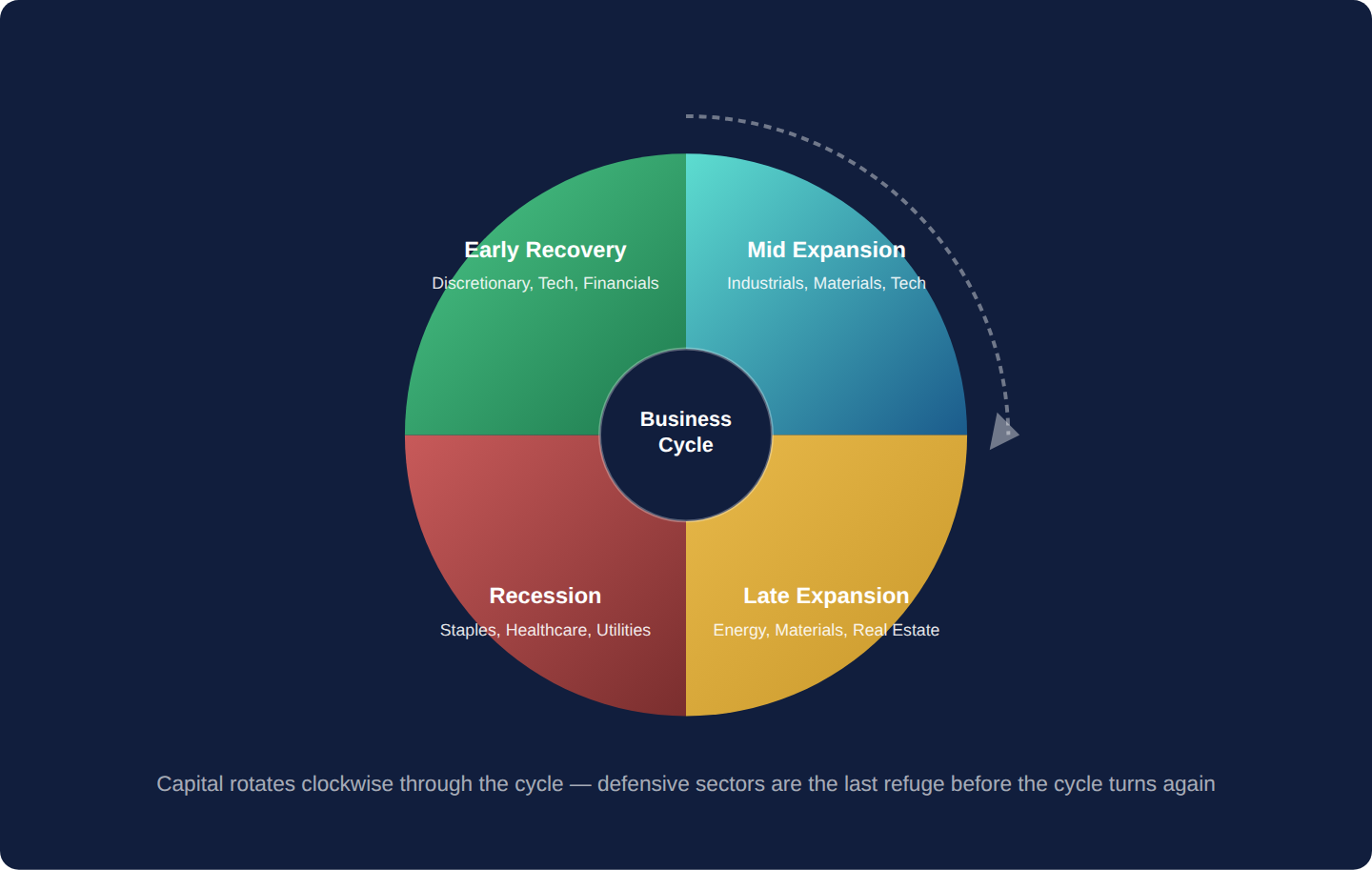
The sector labels and the rotation clock are averages. These are the places where they bend.
| Situation | What changes | Why |
|---|---|---|
| Google and Meta | Sit in Communication Services, not Information Technology | In September 2018 GICS renamed Telecommunication Services as Communication Services and moved media and internet platforms into it |
| Visa and Mastercard | Counted as Financials since March 2023 | The 2023 revision created a Transactions & Payment Processing Services sub-industry inside Financials, moving payment networks out of IT |
| Amazon | A cloud and logistics giant classified as Consumer Discretionary | GICS classifies a company by its principal business, judged mainly by revenue, and most of Amazon’s revenue comes from retail; the 2023 revision folded internet retail into Broadline Retail |
| Conglomerates such as Reliance Industries | One sector label for oil refining, telecom and retail | Each company gets a single classification, so sector weights can hide large businesses in other sectors |
| The 2020 recession | The clock did not run in order | A two-month recession (NBER: February to April 2020) caused by lockdowns, not a credit cycle, favored online retail and software while some “defensive” health care providers lost revenue as elective procedures were postponed |
| Utilities in the AI build-out | A defensive sector priced partly for growth | Data-center power demand (Part 7: Artificial Intelligence) gives some utilities growth investment needs that their regulated returns were not designed around |
| The rulebook itself | Classifications can move | MSCI and S&P are consulting until October 30, 2026, on changes such as splitting semiconductors and placing AI foundation-model developers; nothing has been adopted yet |
Sector rotation is not just an investment abstraction — it has direct operational implications. When markets rotate into defensive sectors, trading volumes in cyclical stocks fall, client portfolio activity shifts, derivatives hedging patterns change, and corporate actions (dividend payments, bond issuances) in defensive companies spike. For anyone in capital markets operations, understanding which part of the cycle the market is in — and which sectors are active — gives context to the pattern of daily work on the desk.
What is GICS?
A classification that sorts companies into 11 sectors, 25 industry groups, 74 industries and 163 sub-industries.
What is operating leverage?
With heavy fixed costs, a fall in sales cuts profit by far more than it cuts revenue.
How do cyclical and defensive companies differ in a recession?
An auto-parts maker and a packaged-food maker, each with $1,000 million of revenue and $100 million of operating profit, behave very differently when the auto-parts maker’s revenue falls 20% and the food maker’s 3%.
How big is the global economy?
About $118 trillion of output in 2025 (IMF).
GICS sorts companies into 11 sectors, 25 industry groups, 74 industries and 163 sub-industries. Cyclical sectors swing with the economy partly because of operating leverage: with heavy fixed costs, a 20% fall in sales can wipe out operating profit, while a defensive company with low fixed costs barely notices a 3% dip. Sector rotation describes which sectors tend to lead at each phase of the cycle, but labels and the clock both bend, as the 2018 and 2023 GICS revisions and the 2020 recession show.
Four questions and two worked problems on this chapter. Decide on your answer first, then click “Reveal Answer.”
1. How is the GICS structure organized today?
- 12 sectors, 22 industry groups, 59 industries, 197 sub-industries
- 11 sectors, 24 industry groups, 69 industries, 158 sub-industries
- 10 sectors, 25 industry groups, 70 industries, 160 sub-industries
- 11 sectors, 25 industry groups, 74 industries, 163 sub-industries
Reveal Answer
Answer: D. The current GICS structure, after the March 2023 revision, has 11 sectors, 25 industry groups, 74 industries and 163 sub-industries.
2. A company has $1,000m of revenue, fixed costs of $300m and variable costs of 60% of revenue. If revenue falls 10%, by how much does operating profit fall?
- 25%
- 40%
- 60%
- 10%
Reveal Answer
Answer: B. Profit starts at $1,000m − $600m − $300m = $100m and becomes $900m − $540m − $300m = $60m, a 40% fall (operating leverage of 4).
3. Which group of sectors does the rotation table list as typical recession leaders?
- Consumer Staples, Health Care and Utilities
- Consumer Discretionary, Technology and Financials
- Industrials, Materials and Technology
- Energy, Materials and Real Estate
Reveal Answer
Answer: A. Demand for food, medicine and electricity holds up in a downturn, so their earnings and dividends are stable.
4. Why are Visa and Mastercard classified in Financials rather than Information Technology?
- A 2023 GICS change moved payment processing there
- They hold banking licenses in every country
- Their revenue comes mainly from lending
- Their revenue now comes mainly from consumer lending
Reveal Answer
Answer: A. The March 2023 revision created a Transactions & Payment Processing Services sub-industry inside Financials.
5. Worked problem: A cyclical firm has revenue $1,000m, variable costs 60% of revenue and fixed costs $300m. Revenue falls 15%. What happens to profit?
Reveal Answer
Answer: Before: 1,000 − 600 − 300 = $100m. After: 850 − 510 − 300 = $40m. Profit falls 60% on a 15% fall in revenue.
6. Worked problem: A defensive firm has revenue $1,000m, variable costs 80% and fixed costs $100m. Revenue falls 3%. What happens to profit?
Reveal Answer
Answer: Before $100m; after 970 − 776 − 100 = $94m, a fall of 6%: lower fixed costs mean less operating leverage.
- IMF World Economic Outlook database (April 2026), GDP at current prices and at PPP — 2025 GDP rankings at market rates (India sixth) and PPP (India third); India projected fourth in 2027 (Sections 1.14, 6.1)