
10.1 1991 — The Crisis That Created Modern India
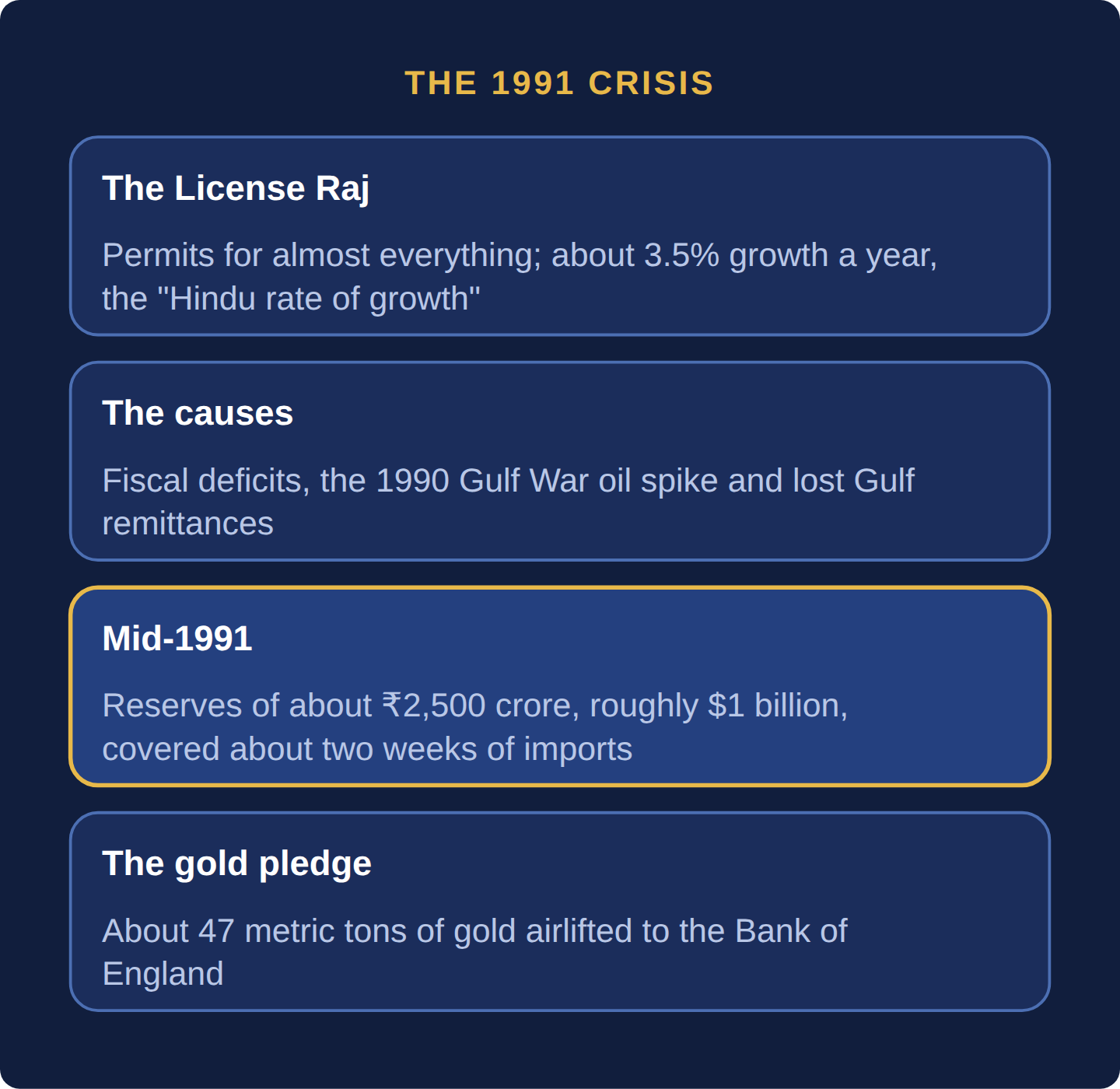
In mid-1991 India’s reserves, about ₹2,500 crore or roughly $1 billion, would have paid for only about two weeks of imports, and the country pledged gold abroad. The reforms that followed dismantled the License Raj.
Why it matters: The 1991 crisis is the starting point of India’s modern economy.
Summary: In mid-1991 India’s reserves, about ₹2,500 crore or roughly $1 billion, would have paid for only about two weeks of imports, and the country pledged gold abroad. The reforms that followed dismantled the License Raj.
- For four decades the License Raj required permits to produce almost anything, producing the “Hindu rate of growth” of about 3.5% a year while East Asia boomed.
- The crisis followed fiscal deficits, the 1990 Gulf War oil spike and lost Gulf remittances; about 47 metric tons of gold was airlifted to the Bank of England.
- After the reforms growth roughly doubled to 6–7%+, and reserves stood at $747.6 billion on September 25, 2026, against about $1 billion then.
In mid-1991 India’s reserves would pay for barely two weeks of imports, and the country pledged gold abroad as collateral for emergency loans. Out of that humiliation came the liberalization reforms that dismantled the License Raj — the founding event of the economy every Indian under 40 has grown up inside.
For four decades after independence, India ran a socialist-inspired command economy: the License Raj, under which producing almost anything required government permits specifying what, how much, and where; imports faced tariffs among the world’s highest; foreign investment was unwelcome (Coca-Cola and IBM exited in 1977); and the result was the sardonic “Hindu rate of growth” — ~3.5% a year while East Asia boomed.
The reckoning arrived as a classic balance-of-payments crisis (the full anatomy of chapter 9.4: When Countries Go Broke — Sovereign Default and the IMF, happening to India). Fiscal deficits had been funded by borrowing through the 1980s; the 1990 Gulf War spiked oil imports and cut Gulf remittances; political instability spooked lenders. By July 1991 reserves of about ₹2,500 crore, roughly $1 billion, would have paid for only about two weeks of imports, as the Finance Minister told Parliament, and the RBI had pledged gold abroad against emergency loans: about 47 metric tons airlifted to the Bank of England is the figure usually reported — in a country where pawning household gold is the universal symbol of desperation, the nation itself had done it.
The response, under PM Narasimha Rao and Finance Minister Manmohan Singh, compressed a generation of reform into months: the rupee devalued in two steps on July 1 and 3 (reported as about 9% and 11%, which compounds to 1 − 0.91 × 0.89 ≈ 19%); industrial licensing abolished for most industries; tariffs begun on a long descent; foreign investment invited; the path opened that would create SEBI‘s empowered markets, private banks, and the telecom and IT booms. Singh quoted Victor Hugo near the close of his July 24, 1991, budget speech: “No power on earth can stop an idea whose time has come.” Growth roughly doubled to 6–7%+, hundreds of millions exited poverty, and reserves stood at $747.6 billion on September 25, 2026 — versus about $1 billion then. Every subsequent chapter of India’s story — the IT industry, the startup ecosystem, the GCCs of chapter 10.6: From BPO to GCC — India’s Global Delivery Economy — walks through the door 1991 opened. It is also the permanent counter-example to fatalism about crises: Sri Lanka 2022 and India 1991 faced the same cliff; what differed was what each built afterward.
What caused India’s 1991 economic crisis?
Fiscal deficits, the 1990 Gulf War oil spike and lost Gulf remittances, on top of four decades of the License Raj.
How low were India’s reserves in 1991?
In mid-1991 reserves of about ₹2,500 crore, roughly $1 billion, would have paid for only about two weeks of imports.
What was the License Raj?
For four decades it required permits to produce almost anything, producing the “Hindu rate of growth” of about 3.5% a year while East Asia boomed.
What happened to India’s gold in 1991?
About 47 metric tons of gold was airlifted to the Bank of England.
In mid-1991 India’s reserves, about ₹2,500 crore or roughly $1 billion, would have paid for only about two weeks of imports, after fiscal deficits, a Gulf War oil shock and lost Gulf remittances. The response under Narasimha Rao and Manmohan Singh devalued the rupee in two steps (about 19% combined), abolished industrial licensing for most industries and opened the economy; reserves reached $747.6 billion by September 2026.
Four questions and two worked problems on this chapter. Decide on your answer first, then click “Reveal Answer.”
1. In the budget speech of July 24, 1991, India’s foreign exchange reserves were described as enough to finance imports for roughly how long?
- About one full year of imports
- About two months of imports
- About six months of imports
- About two weeks of imports
Reveal Answer
Answer: D. The Finance Minister said reserves of about ₹2,500 crore would suffice to finance imports for a mere two weeks.
2. The rupee was devalued in two steps in July 1991, reported as about 9% and then about 11%. What is the combined fall in the rupee’s value?
- About 20%, because 9% plus 11% simply adds
- About 19%, because 1 − 0.91 × 0.89 ≈ 0.19
- About 10%, because the two steps average out
- About 2%, because the second step offsets the first
Reveal Answer
Answer: B. Successive percentage falls compound: the rupee kept 0.91 × 0.89 = 0.81 of its value, a fall of about 19%.
3. Which description fits the License Raj that the 1991 reforms dismantled?
- The state fixed the retail price of every consumer good each year
- Foreign firms had to hold a majority stake in every venture they launched
- Permits were needed to decide what, how much and where to produce
- The central bank rationed every household loan by its own quota each year
Reveal Answer
Answer: C. The License Raj was a permit system for production and capacity; reform abolished industrial licensing for most industries.
4. Which pair of events pushed India toward the 1991 balance-of-payments crisis?
- A collapse in monsoon rains, plus a ban on all foreign portfolio investment
- A run on private banks, plus an RBI decision to raise the repo rate sharply
- A sharp rise in exports, plus a surge in foreign investment that overheated the rupee
- Deficits funded by borrowing, plus a Gulf War oil shock that also cut Gulf remittances
Reveal Answer
Answer: D. Deficits financed by borrowing left India exposed; the 1990 Gulf War raised the oil import bill and reduced remittances from the Gulf.
5. Worked problem: India’s reserves are $1.1bn and imports are $2.2bn a month. How many days of imports do reserves cover?
Reveal Answer
Answer: $1.1bn ÷ ($2.2bn ÷ 30) = 15 days.
6. Worked problem: Using the rule of 72, how long does an economy take to double at 3.5% growth and at 7%?
Reveal Answer
Answer: 72 ÷ 3.5 = 20.6 years; 72 ÷ 7 = 10.3 years.
10.2 The Reserve Bank of India — The Economy's Guardian
The RBI’s six-member Monetary Policy Committee sets the repo rate to hold CPI inflation at 4% within a 2% to 6% band. Floating loans linked to the repo rate reset within three months, so an Indian EMI reprices within a quarter while a US 30-year fixed mortgage does not.
Why it matters: It shows why Indian and American borrowers feel rate decisions at such different speeds.
Summary: The RBI’s six-member Monetary Policy Committee sets the repo rate to hold CPI inflation at 4% within a 2% to 6% band. Floating loans linked to the repo rate reset within three months, so an Indian EMI reprices within a quarter while a US 30-year fixed mortgage does not.
- The RBI was founded in 1935, and since the RBI Act was amended in 2016 the policy rate has been set by the six-member MPC.
- The 4% target with a 2% to 6% tolerance band was kept on March 25, 2026, for April 2026 to March 2031; if inflation stays outside the band for three consecutive quarters, the RBI must report to the government why.
- The standing deposit facility rate (repo − 0.25) is the floor and the marginal standing facility rate (repo + 0.25) the ceiling of the corridor; the SDF replaced the old fixed reverse repo rate as the floor in April 2022.
- The CRR and SLR govern liquidity, not a lending multiple.
- Transmission leaks through older MCLR-linked loans and informal credit.
The RBI is India’s Federal Reserve — but with a wider job description: it sets interest rates, issues the rupee, regulates banks, manages the exchange rate, runs the payment systems, and acts as the government’s banker. When the rate on your floating-rate home loan changes, the first cause is usually a decision of the Monetary Policy Committee in Mumbai, and unlike a US 30-year mortgage, your loan reprices within months.
Where chapter 2.3 gave you the Fed, here is India’s counterpart, founded in 1935 and broader in remit. Since the RBI Act was amended in 2016, the policy rate has been set by a six-member Monetary Policy Committee (MPC): the Governor, who chairs it; the Deputy Governor in charge of monetary policy; one other RBI officer; and three external members appointed by the government. The RBI publishes the minutes, with each member’s vote, on the fourteenth day after every meeting. The committee’s task is set in law: keep consumer price inflation (CPI) at an inflation target of 4%, inside a tolerance band of 2% to 6%. The government reviews the target every five years; on March 25, 2026, it kept both for April 2026 to March 2031. If average inflation stays above 6% (or below 2%) for three consecutive quarters, the RBI must report to the government why.
The toolkit maps onto the Fed’s (Section 2.10: The Federal Funds Rate: How the Fed Actually Sets the Price of Money) with Indian names. The headline lever is the repo rate, the rate at which the RBI lends to banks overnight against government securities under its liquidity adjustment facility (LAF). Around it the RBI builds a corridor. The standing deposit facility (SDF) rate, 0.25 point below repo, is what a bank earns by parking surplus cash with the RBI, without collateral. The marginal standing facility (MSF) rate, 0.25 point above repo, is the penal rate at which a bank short of cash can borrow overnight against the government bonds it holds. The SDF replaced the old fixed reverse repo rate as the floor in April 2022. The MPC votes only on the repo rate; the other two follow by rule.

| Rate | Level, Oct 5, 2026 | Rule | Role |
|---|---|---|---|
| MSF rate | 5.50% | Repo + 0.25 point | Ceiling: borrowing when short of cash |
| Policy repo rate | 5.25% | Set by the MPC | Headline rate, middle of the corridor |
| SDF rate | 5.00% | Repo − 0.25 point | Floor: deposit of surplus cash |
| Cash reserve ratio | 3.00% | Set by the RBI | Cash banks must hold at the RBI |
| Statutory liquidity ratio | 18.00% | Set by the RBI | Government securities, cash and gold banks must hold |
The second pair of Indian instruments are reserve requirements. The cash reserve ratio (CRR), 3.00% today, is the share of a bank’s net demand and time liabilities (NDTL), roughly its deposits and similar obligations, that it must keep as a daily average in its account at the RBI. The statutory liquidity ratio (SLR), 18.00%, is the share it must hold in government securities, cash or gold, which quietly guarantees the government a steady buyer for its debt. Neither works the way the old textbook story says: a loan creates its own deposit and the bank finds funding afterward (chapter 3.2: How Banks Create Money — Fractional Reserve Banking). What the two ratios control is liquidity and its cost. Raise the CRR by 0.5 point and, per ₹100 lakh crore of NDTL, 0.5% × ₹100 lakh crore = ₹0.5 lakh crore (₹50,000 crore) of cash moves into RBI accounts at once; overnight money gets scarcer and call rates drift toward the top of the corridor. A cut does the opposite. The CRR is a blunt valve; day to day the RBI steers with auctions of overnight to 14-day repo and reverse repo funds.
The RBI also regulates and inspects banks and NBFCs. When Yes Bank came under heavy stress in March 2020, the RBI superseded its board on March 5, capped withdrawals at ₹50,000 for the following month, and on March 13 the Union Cabinet approved a State Bank of India-led reconstruction. It manages the rupee through FX intervention using its reserves, $747.6 billion on September 25, 2026 — a managed float, smoothing volatility rather than defending any level — supervises the payment rails of chapter 10.3: UPI and Digital Public Infrastructure — India’s Payments Revolution, and issues the currency itself.
From the repo rate to your EMI. A household feels the repo rate through the lending rate on a floating loan. Since October 1, 2019, banks must price new floating-rate retail loans, such as home and auto loans, and loans to micro and small enterprises, off an external benchmark, most often the repo rate, and reset the rate at least once every three months. This is the external benchmark-linked lending rate (EBLR): loan rate = repo rate + a spread the bank sets for its costs and your credit risk. When the MPC moves the repo rate by 0.25 point, every EBLR loan follows within three months at the latest. Your EMI (equated monthly installment, the fixed monthly payment that repays a loan) is recomputed at the new rate or, at many lenders, stays put while the loan tenure stretches or shrinks, so an Indian floating-rate borrower feels a rate decision within three months at the latest. A US 30-year fixed mortgage works the other way: it is priced off the 10-year Treasury yield, not the funds rate (Section 2.10: The Federal Funds Rate: How the Fed Actually Sets the Price of Money), and once signed its payment never changes, whatever the Fed does.
The 2022 hikes show the design under load. India’s CPI rose above the 6% upper band in January 2022, stayed there ten successive months and peaked at 7.8% in April, so the MPC raised the repo rate by 2.50 points between May 2022 and February 2023 (4.00% to 6.50%). The Fed’s tightening mattered at the margin, through rupee weakness and portfolio outflows, but the trigger was a domestic breach of the band (compare chapter 2.3: The Federal Reserve — America’s Economic Thermostat). In 2026 the mandate cuts the other way: CPI reached 4.4% in June after 16 months below target, but on food and fuel while core inflation stayed at 3.9%, and in August the MPC held at 5.25%. Interest rates can cool a demand surge, not a supply shock (chapter 10.4: The Informal Economy — India’s Invisible Majority).
The full chain from a rate decision to a back-office break, in an Indian thread (the US thread, with every number worked, is in chapter 8.8: The Full Chain — From the Global Economy to Your Daily Work):
- 1. The decision. The MPC announces a new repo rate; the SDF and MSF move with it, and the RBI’s liquidity operations pull the weighted average call rate toward it the same day.
- 2. Funding costs and EMIs. Overnight funding costs rise at once; every EBLR loan resets within three months and its EMI is recomputed.
- 3. Collateral loses value. Bond prices fall by about modified duration times the rise in yield. For ₹100 crore of bonds with an illustrative duration of 6.5 and a 0.25-point rise: ₹100 crore × 6.5 × 0.0025 = ₹1.625 crore.
- 4. Margin calls. A lender or clearing house that re-marks collateral daily asks for ₹1.625 crore more (chapter 11.1: The Plumbing — Clearing Houses, Depositories, and Custodians).
- 5. Fails and breaks. A firm that cannot find the cash or collateral by the cutoff fails to settle, and the mismatch surfaces next morning as a reconciliation exception (chapter 8.3: Reconciliation — Financial Bookkeeping at Massive Scale).
The RBI’s standing tension is universal to central banking: the government prefers cheap borrowing and pre-election growth, while the RBI’s mandate is price stability, and friction between Mint Street and the Finance Ministry is a recurring feature of Indian life. Its conservatism is also credited with India’s escape from the worst of 2008: the RBI had restricted exotic securitization and kept banks boring precisely when boring proved priceless.
Take the October 2026 settings. A bank with idle cash will not lend it to another bank below 5.00%, because the RBI pays 5.00%, risk-free, through the SDF. A bank short of cash will not pay more than 5.50%, because the MSF will lend to it at 5.50% against its government bonds. So the overnight call rate is boxed into a band 5.50% − 5.00% = 0.50 point wide, and the RBI’s operations aim to keep the weighted average call rate, the average rate on overnight loans between banks and its operating target, near the 5.25% repo rate in the middle. With surplus cash in the system the call rate sags toward the floor; when cash is short it climbs toward the ceiling, so liquidity operations matter as much as the repo rate. A repo cut to 5.00% would shift the corridor to 4.75%–5.25%.
Take a ₹50 lakh (₹5,000,000) floating-rate home loan over 20 years (240 months) at an EBLR equal to repo plus an illustrative spread of 3.00 points. The EMI formula is EMI = P × i ÷ (1 − (1 + i)−n), with i the monthly rate and n the number of months.
| Step | Repo rate | Loan rate | EMI |
|---|---|---|---|
| Before the hikes (May 2022) | 4.00% | 7.00% | ₹38,765 |
| After +2.50 points (Feb 2023) | 6.50% | 9.50% | ₹46,607 |
| Change | +2.50 | +2.50 | +₹7,842 a month (+20.2%) |
Over a year that is ₹7,842 × 12 = ₹94,104 more (₹94,099 at unrounded EMIs). Now the American counterpart: a $400,000 30-year fixed mortgage at 6.50% costs $2,528.27 a month for all 360 months, and the Fed’s hikes of the same period changed nothing about it. The Indian borrower gains when rates fall and pays when they rise; the American borrower buys certainty and a refinancing option that pays only if rates drop far enough.
In the 2022–23 tightening the repo rate rose 2.50 points and loan rates on new EBLR loans rose the same 2.50, but the average rate on all outstanding loans rose only 1.00 point, because older loans were still tied to banks’ internal benchmark, the MCLR, which rose 1.40 points (RBI Annual Report 2022–23, Table III.3). Borrowers outside banks never see the repo rate: the moneylender’s rate is set by local scarcity (chapter 10.4: The Informal Economy — India’s Invisible Majority). A rate hike also cannot fix a failed monsoon: the RBI can raise the price of money, but not the supply of onions.
Who sets India’s repo rate?
The RBI’s six-member Monetary Policy Committee, since the RBI Act was amended in 2016. The RBI itself was founded in 1935.
What is the RBI’s inflation target?
CPI inflation of 4% within a 2% to 6% band, kept on March 25, 2026, for April 2026 to March 2031. If inflation stays outside the band for three consecutive quarters, the RBI must report to the government why.
How quickly does a repo rate change reach Indian borrowers?
Floating loans linked to the repo rate reset within three months, so an Indian EMI reprices within a quarter while a US 30-year fixed mortgage does not.
The RBI’s six-member Monetary Policy Committee sets the repo rate to hold CPI inflation at 4% within a 2% to 6% band; the SDF (repo − 0.25) and MSF (repo + 0.25) form the corridor, and liquidity operations steer the weighted average call rate toward repo. Floating loans linked to the repo rate (EBLR) reset within three months, so an Indian EMI reprices within a quarter while a US 30-year fixed mortgage does not. The CRR and SLR govern liquidity, not a lending multiple, and transmission leaks through older MCLR-linked loans and informal credit.
Four questions and two worked problems on this chapter. Decide on your answer first, then click “Reveal Answer.”
1. The MPC cuts the repo rate from 5.25% to 5.00%. With the SDF 0.25 point below repo and the MSF 0.25 point above, what are the new SDF and MSF rates?
- SDF 4.75% and MSF 5.25%
- SDF 4.75% and MSF 5.00%
- SDF 4.50% and MSF 5.50%
- SDF 5.00% and MSF 5.25%
Reveal Answer
Answer: A. The SDF is repo − 0.25 = 4.75% and the MSF is repo + 0.25 = 5.25%, so the whole corridor shifts down by the same 0.25 point.
2. Which rate does the RBI treat as its day-to-day operating target, steering it toward the repo rate through liquidity operations?
- The 10-year government bond yield
- The weighted average call rate
- The average rate on outstanding bank loans
- The cash reserve ratio
Reveal Answer
Answer: B. The weighted average call rate, the average rate on overnight loans between banks, is aligned with the repo rate through liquidity management.
3. A bank system has net demand and time liabilities of ₹200 lakh crore. The RBI raises the CRR by 0.25 point. How much cash moves into RBI accounts?
- ₹5 lakh crore (₹5,00,000 crore)
- ₹50 lakh crore (₹50,00,000 crore)
- ₹0.5 lakh crore (₹50,000 crore)
- ₹0.05 lakh crore (₹5,000 crore)
Reveal Answer
Answer: C. 0.25% × ₹200 lakh crore = ₹0.5 lakh crore. A CRR change drains or releases liquidity; it does not cap lending by a multiple.
4. A US borrower with a 30-year fixed mortgage and an Indian borrower with an EBLR-linked home loan both face a policy rate hike. What happens?
- Both payments rise automatically at the next monthly billing date of each loan
- Neither changes, because both loans are priced off deposit rates alone
- The US payment rises within weeks while the Indian EMI stays fixed for the term
- The Indian EMI is recomputed within three months; the US payment is unchanged
Reveal Answer
Answer: D. EBLR loans reset to the repo rate at least every three months; a US fixed mortgage is priced off the 10-year yield and locked at signing.
5. Worked problem: A ₹50 lakh, 20-year floating loan is linked to the repo rate. What is the EMI at 8.50%, and at 8.25% after a 0.25 point cut?
Reveal Answer
Answer: 8.50%: ₹43,391. 8.25%: ₹42,603.
6. Worked problem: How much does the cut save each month and over the remaining term?
Reveal Answer
Answer: Monthly saving = ₹788; over 240 months = ₹189,091.