
9.4 When Countries Go Broke — Sovereign Default and the IMF
A sovereign default is usually a foreign-currency problem: a government can print its own money but not the dollars it owes, so falling reserves, a sliding currency and fleeing lenders reinforce one another. Sri Lanka’s 2022 default shows the sequence.
Why it matters: It shows how a default builds, step by step, so the warning signs can be recognized.
Summary: A sovereign default is usually a foreign-currency problem: a government can print its own money but not the dollars it owes, so falling reserves, a sliding currency and fleeing lenders reinforce one another. Sri Lanka’s 2022 default shows the sequence.
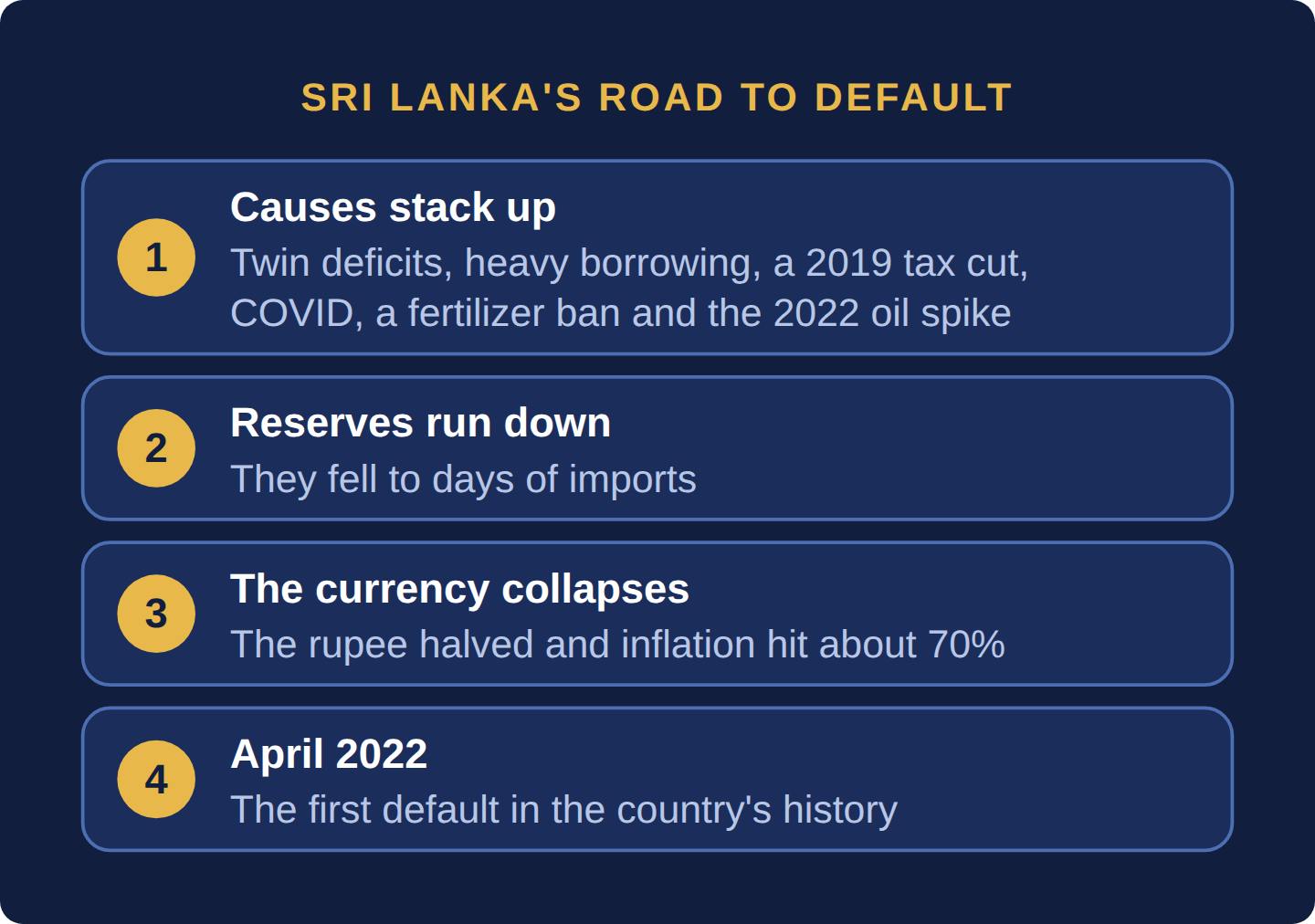
- Sri Lanka’s causes stacked up: chronic twin deficits, heavy commercial and Chinese borrowing, a 2019 tax cut that gutted revenue, COVID’s destruction of tourism and remittances, a fertilizer ban and the 2022 oil spike.
- Reserves fell to days of imports, the rupee halved, inflation hit about 70%, and in April 2022 Sri Lanka defaulted for the first time in its history.
- India extended about $4 billion in credit lines and swaps.
Countries can’t file for bankruptcy — there’s no court that can seize a nation. When one runs out of foreign currency to pay imports and dollar debts, it defaults, its currency collapses, and the IMF arrives as lender of last resort, offering dollars in exchange for painful reform. Sri Lanka in 2022 showed the full sequence next door to India.
A sovereign default is almost always a foreign-currency problem. A government can always print its own currency (at inflation’s price — chapter 0.9: How Currency Is Created Today — and How Much Is Too Much‘s hyperinflation), but it cannot print the dollars needed for oil, medicine, and external debt. The crisis mechanics are self-accelerating: reserves (chapter 1.7) drain → the currency slides → imports and dollar debts cost more in local terms → reserves drain faster → foreign lenders flee, and refinancing becomes impossible. Argentina (a serial defaulter across three centuries), Greece (via the euro’s special trap), Zambia, Ghana (both in Section 9.7: The Rest of the World: Capital-Flow Stories from Emerging Markets), and Pakistan’s repeated near-misses all rhyme.
Sri Lanka 2022 is the textbook case, unfolding within sight of India. The causes stacked: chronic twin deficits (Section 2.4: Government Spending, Taxes, and the National Debt); heavy commercial and Chinese borrowing (chapter 9.1: China — The State-Capitalist Superpower‘s Belt and Road) for low-return projects like the Hambantota port — later leased to China for 99 years to raise dollars; a 2019 tax cut that gutted revenue; COVID’s destruction of tourism and remittances; a disastrous overnight ban on chemical fertilizer that slashed harvests; and finally the 2022 oil spike. Reserves fell to days of imports; the rupee halved; inflation hit ~70%; fuel queues stretched for kilometers; and in April 2022 Sri Lanka defaulted for the first time in its history. Protesters occupied the presidential palace. India extended ~$4 billion in credit lines and swaps — neighborhood diplomacy through finance.
Then the standard rescue: an IMF program (~$3 billion, approved 2023) with conditionality — tax rises, cost-based utility pricing, central-bank independence, anti-corruption legislation — plus debt restructuring, in which creditors accept losses (“haircuts”) and longer maturities, finalized across 2024. Restructuring has grown harder in the modern era because creditors now include China, private bondholders, and traditional Paris Club governments, who must all agree on shared pain. The IMF remains double-edged: the only fire brigade that exists, and one whose austerity conditions can deepen the very slump it treats — Greece and Sri Lanka both bear the scars. For India, Sri Lanka is also a mirror: 1991 (chapter 10.1: 1991 — The Crisis That Created Modern India) was India reaching the same cliff-edge — and turning it into a founding moment instead.
Why do countries default on their debt?
A sovereign default is usually a foreign-currency problem. A government can print its own money but not the dollars it owes, so falling reserves, a sliding currency and fleeing lenders reinforce one another.
What caused Sri Lanka’s 2022 default?
Causes stacked up: chronic twin deficits, heavy commercial and Chinese borrowing, a 2019 tax cut that gutted revenue, COVID’s destruction of tourism and remittances, a fertilizer ban and the 2022 oil spike.
What happened to Sri Lanka’s economy?
Reserves fell to days of imports, the rupee halved, inflation hit about 70%, and in April 2022 Sri Lanka defaulted for the first time in its history.
A sovereign default is usually a foreign-currency problem: a government can print its own money but not the dollars it owes, so falling reserves, a sliding currency and fleeing lenders reinforce one another. Sri Lanka’s 2022 default, IMF program and restructuring show the sequence, with creditors taking haircuts while conditions bite. The IMF is the only fire brigade, yet its austerity can deepen the slump; Zambia and Ghana are told in Section 9.7: The Rest of the World: Capital-Flow Stories from Emerging Markets.
Four questions and two worked problems on this chapter. Decide on your answer first, then click “Reveal Answer.”
1. Why is a sovereign default almost always a foreign-currency problem?
- Foreign lenders always charge higher interest rates than domestic ones, which causes defaults
- A government can print its own money but not the dollars its imports and external debts require
- Central banks are barred from financing governments in every country by international law
- Governments never owe money in their own currency, so every debt they hold is foreign debt
Reveal Answer
Answer: B. Printing local currency costs inflation, but it cannot create dollars. That is why Sri Lanka’s reserves, not its printing press, decided the outcome.
2. In the self-accelerating crisis sequence, what follows a draining of reserves?
- Inflation falls because imports become pricier and spending drops
- The IMF is no longer needed because reserves are refilled by new borrowing
- Lenders become more willing to refinance the debt once reserves have fallen
- The currency slides, so imports and dollar debts cost more local currency
Reveal Answer
Answer: D. Each step worsens the next: weaker currency, pricier dollar debts, faster loss of reserves, and lenders who flee.
3. In a debt restructuring, what is a “haircut”?
- A reduction in the borrower’s imports forced by creditors
- A tax on foreign bondholders paid when interest is received
- A loss that creditors accept on the value of what they are owed
- A cut in the borrower’s interest rate on all future loans
Reveal Answer
Answer: C. Creditors accept haircuts and longer maturities so that the country can return to a payable debt.
4. Why is the IMF called double-edged in the chapter?
- It lends only to rich countries, yet it taxes the poor ones through its loan rules
- It is the only emergency lender, yet its austerity conditions can deepen the slump
- It cancels all debts, yet it forbids any borrowing afterward from other lenders
- It sets exchange rates, yet it cannot lend dollars to any member country in crisis
Reveal Answer
Answer: B. The IMF supplies dollars that no one else will, but tax rises and spending cuts as conditions can worsen the downturn, as in Greece and Sri Lanka.
5. Worked problem: A country has reserves of $1.9bn and imports of $1.5bn a month. How many days of imports do reserves cover?
Reveal Answer
Answer: $1.9bn ÷ ($1.5bn ÷ 30) = 38 days.
6. Worked problem: A government owes $50bn and the currency halves (200 to 400 per dollar). What happens to the debt in local currency?
Reveal Answer
Answer: Before: 50 × 200 = 10,000bn. After: 50 × 400 = 20,000bn: it doubles with no new borrowing.
9.5 The Safe Havens — Why Small, Stable Countries Hold the World's Money
Small stable countries export trust: Switzerland’s secrecy has given way to automatic information exchange, Luxembourg domiciles funds and Singapore hosts family offices.
Why it matters: It shows how a small country can become a financial center without a large economy.
Summary: Small stable countries export trust: Switzerland’s secrecy has given way to automatic information exchange, Luxembourg domiciles funds and Singapore hosts family offices.
- An estimated $10 trillion-plus sits offshore.
- Switzerland’s 1934 Banking Act made revealing a client’s identity a criminal offense; the secrecy era ended through the 2008–09 UBS case, America’s FATCA law and the OECD’s automatic exchange of information from 2017–18, which now covers over 100 countries including India.
- Switzerland remains the largest cross-border wealth-management center, with roughly $2.5 trillion of foreign wealth, and Luxembourg is the second-largest investment-fund center after the US, administering over €5 trillion.
A handful of small countries — Switzerland, Luxembourg, Singapore — punch absurdly above their weight in finance. Their export product isn’t goods; it’s trust: political stability across party lines, iron rule of law, neutrality, and policies that don’t change with governments. Wealthy individuals, corporations, and funds from unstable or high-tax places park money there — an estimated $10 trillion-plus sits offshore. Some of it is legitimate safety-seeking; some of it is hiding.
Everything this guide has said about money reduces to trust — and trust, it turns out, can be a national business model. The recipe is consistent: centuries of political stability, courts that enforce contracts against anyone (including the state), policy continuity regardless of which party governs, neutrality in conflicts, skilled multilingual professionals, and — historically — discretion. Countries rich in this recipe attract the world’s nervous money: families in unstable economies, entrepreneurs fearing expropriation, corporations pooling global cash, and, inevitably, those with something to hide.
Switzerland wrote the archetype. Neutral since 1815, unbombed through two world wars, its 1934 Banking Act made revealing a client’s identity a criminal offense — creating the legendary numbered account, where even most bank staff knew clients only as digits. For decades it drew everyone from legitimate wealth fleeing hyperinflations and revolutions to dictators, tax evaders, and — most shamefully — dormant accounts of Holocaust victims whose heirs banks long stonewalled, plus wartime Nazi gold, controversies settled only in the late 1990s. The secrecy era’s end came in stages: the 2008–09 UBS case, in which the US prosecuted the bank for helping Americans evade tax and forced client-name disclosure; America’s FATCA law compelling foreign banks worldwide to report US clients; and the OECD’s automatic exchange of information from 2017–18, under which over 100 countries — Switzerland and India included — now swap account data annually. Classic secrecy is dead; yet Switzerland remains the world’s largest cross-border wealth-management center (roughly $2.5 trillion of foreign wealth), proof that clients valued the stability even more than the secrecy.
Luxembourg chose a different specialty: not hiding wealth but domiciling it. This country of ~680,000 people is the world’s second-largest investment-fund center after the US, administering over €5 trillion — when global asset managers sell a fund across Europe (and often into Asia), the legal wrapper is very likely Luxembourgish, thanks to EU-wide “passporting,” deep legal expertise, and famously accommodating tax rulings (exposed in the 2014 “LuxLeaks” scandal). Singapore is Asia’s version and the clearest heir to the Swiss model — English law, zero tolerance for instability, strategic neutrality between the US and China — and has boomed as Asian wealth exploded: thousands of family offices (private firms managing a single wealthy family’s fortune) have set up there, including a substantial wave of Indian ones.
Then there is the openly darker tier: pure tax havens — Cayman Islands, British Virgin Islands, Panama — selling zero taxes and anonymous shell companies (entities with no operations, existing only to hold assets or obscure ownership). The Panama Papers (2016) and Pandora Papers (2021) leaks exposed how presidents, celebrities, and criminals alike used layered shells to hide ownership. Keep the legal distinctions sharp: tax avoidance (legal structuring, like the transfer pricing of chapter 5.7: Multinational Corporations — Private Empires of the Global Economy), tax evasion (illegal concealment), and money laundering (washing criminal proceeds) are three different things that share the same postal addresses. The system-wide cost is real — governments lose an estimated few hundred billion dollars of tax revenue yearly — and the global counterattack (information exchange, beneficial-ownership registries, the 15% minimum tax) is one of the quiet megatrends of modern finance. For India specifically, this world is familiar terrain: the perennial “black money in Swiss banks” political debate, round-tripping concerns that shaped the India–Mauritius tax treaty, and the automatic data India now receives annually from over a hundred jurisdictions.

Why do small countries become financial centers?
Small stable countries export trust: Luxembourg domiciles funds, Singapore hosts family offices and Switzerland built a reputation for secrecy.
Did Swiss banking secrecy end?
Yes. Switzerland’s 1934 Banking Act made revealing a client’s identity a criminal offense, but the secrecy era ended through the 2008–09 UBS case, America’s FATCA law and the OECD’s automatic exchange of information from 2017–18.
How much money is held offshore?
An estimated $10 trillion-plus sits offshore.
Small stable countries export trust: Switzerland’s secrecy has given way to automatic information exchange, Luxembourg domiciles funds and Singapore hosts family offices. Tax havens add shell companies, and the legal lines between tax avoidance, tax evasion and money laundering stay sharp. India’s black-money debate and its automatic data from over a hundred jurisdictions show how this world touches it.
Four questions and two worked problems on this chapter. Decide on your answer first, then click “Reveal Answer.”
1. What made the Swiss Banking Act of 1934 distinctive?
- It made revealing a client’s identity a criminal offense
- It required every account to carry a public registry number
- It banned foreign clients from opening accounts
- It capped the amount any one client could deposit
Reveal Answer
Answer: A. Criminal secrecy created the numbered account. It ended in stages, through the UBS case, FATCA and the OECD’s automatic exchange of information.
2. A family moves savings to Singapore to escape home-country instability, a firm legally structures profits into a low-tax country, and a criminal hides stolen money in shell companies. Which labels fit, in that order?
- Safety-seeking, tax evasion, tax avoidance
- Tax avoidance, money laundering, safety-seeking
- Money laundering, safety-seeking, tax avoidance
- Safety-seeking, tax avoidance, money laundering
Reveal Answer
Answer: D. Moving money for safety is lawful, structuring within the rules to reduce tax is avoidance, and washing criminal proceeds is laundering. Evasion, which is illegal concealment of taxable income, is a different offense.
3. What is Luxembourg’s specialty among the safe havens?
- Operating numbered accounts for private clients abroad
- Hosting the world’s largest stock exchange by value
- Issuing the currency used by the other tax havens
- Domiciling investment funds that are sold across Europe
Reveal Answer
Answer: D. Its fund wrappers use EU passporting, so a fund sold across Europe is often Luxembourgish. It is the second-largest fund center after the US.
4. What did the OECD’s automatic exchange of information, from 2017-18, change?
- Tax havens agreed to a 100% tax on foreign deposits
- More than 100 countries now share account data annually
- Banks were required to close all numbered accounts
- Switzerland was removed from the global financial system
Reveal Answer
Answer: B. Classic secrecy is dead because account data are swapped each year, though Switzerland remains a large wealth-management center.
5. Worked problem: Swiss banking secrecy was set in the 1934 Banking Act and automatic information exchange began in 2017–18. How many years did the secrecy era run?
Reveal Answer
Answer: 2017 − 1934 = about 83 years.
6. Worked problem: An estimated $10tn sits offshore. Against global financial assets of roughly $500tn, what share is that?
Reveal Answer
Answer: $10tn ÷ $500tn = 2% (the $500tn is a rounded figure used for illustration).
9.6 The Great Financial Cities — A Map of Where Money Lives
Finance clusters in a relay of cities because talent, counterparties, law and trust compound together, so somewhere the market is always open. Each city has a specialty.
Why it matters: It explains why money keeps flowing through the same few cities.
Summary: Finance clusters in a relay of cities because talent, counterparties, law and trust compound together, so somewhere the market is always open. Each city has a specialty.
- New York prices capital, with the largest stock markets and the deepest bond market; London trades currencies, Singapore and Hong Kong bank Asia, and Dubai bridges East and West.
- London handled about 38% of global FX turnover in April 2025 (BIS), despite losing its EU passporting rights after Brexit.
- Hong Kong’s slide toward Singapore shows that a center’s real asset is confidence in its institutions, which GIFT City must earn.
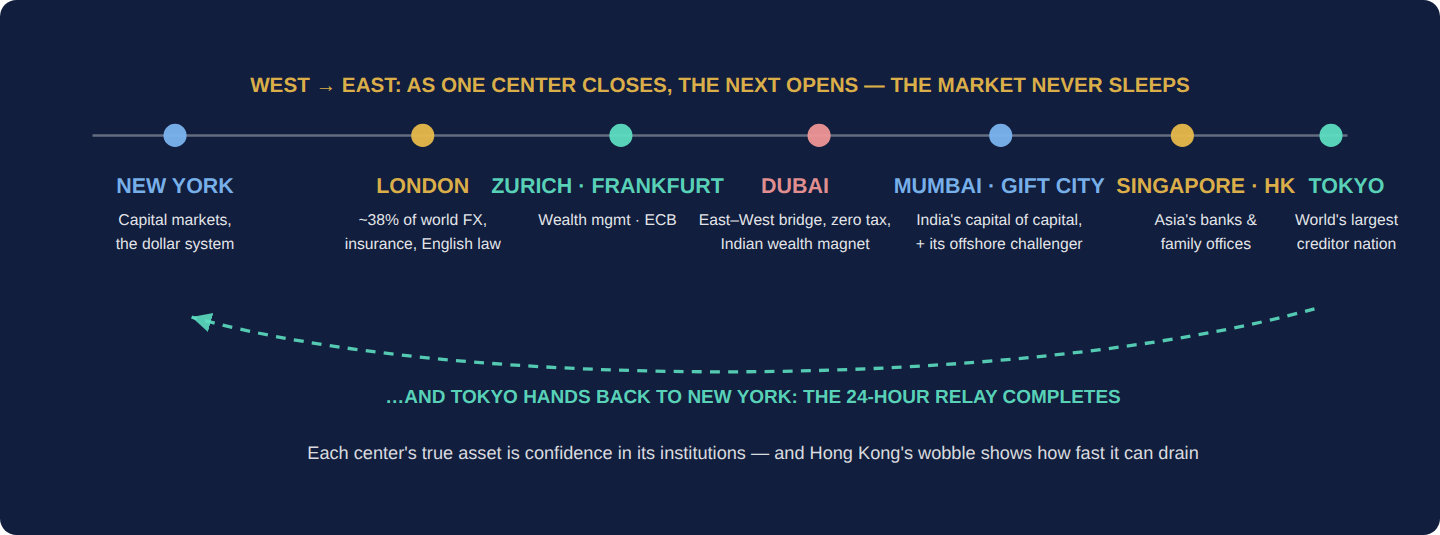
Global finance runs through a relay of cities spread across time zones — Tokyo and Singapore hand off to Dubai, Dubai to London and Zurich, London to New York — so that somewhere, the market is always open. Each city has a specialty: New York prices capital, London trades currencies, Singapore and Hong Kong bank Asia, Dubai bridges East and West, and India is building its own contender at GIFT City.
Money is weightless, yet it clusters in a few square kilometers of a few cities — because finance runs on talent, counterparties, law, and trust, and all four compound where they concentrate. The result is a 24-hour relay: as New York closes, Asia opens; as Asia lunches, the Gulf and Europe wake; as London winds down, New York is mid-session. This is the same follow-the-sun logic as the delivery centers of chapter 10.6: From BPO to GCC — India’s Global Delivery Economy — finance discovered it first.
New York is the system’s heart: the largest stock markets (NYSE, NASDAQ), the deepest bond market (Treasuries — chapter 2.9: Bonds and the Yield Curve — The Market That Rules Them All), the headquarters of the great investment banks, and the home turf of the dollar system itself, which is what gives US sanctions (chapter 1.18: Sanctions — Finance as a Weapon) their global reach. London is the paradox: no longer atop an empire, wounded by Brexit — Britain’s 2016 referendum decision to leave the European Union, completed in 2020 — which cost London its “passporting” rights, the automatic license that had allowed UK-based firms to sell financial services across the entire EU — yet still the world’s largest foreign-exchange trading center, handling about 38% of global FX turnover (BIS, April 2025), plus dominant shares of international insurance (Lloyd’s) and cross-border lending, powered by its time zone (bridging Asia and America in one working day), English law’s global standing, and three centuries of accumulated expertise. Hong Kong vs. Singapore is Asia’s contested crown: Hong Kong long served as China’s window to global capital, but political tightening after 2020 pushed talent and family offices toward Singapore — a live demonstration that the true currency of a financial center is confidence in its institutions, and that it can drain fast.
Dubai is the century’s fastest riser: perfectly placed between European and Asian hours, zero personal income tax, the DIFC financial free zone running on English-style common law, golden visas — and a magnet for exactly the flows this guide’s Indian readers see around them, as one of the largest destinations for Indian HNI wealth, NRI business, and (controversially) undeclared assets. Zurich and Geneva anchor wealth management (chapter 9.5: The Safe Havens — Why Small, Stable Countries Hold the World’s Money); Frankfurt hosts the ECB; Tokyo banks the world’s largest creditor nation; Mumbai is India’s financial capital — RBI, SEBI, both exchanges, and the corporate headquarters cluster. And India’s official challenger is GIFT City in Gujarat: a purpose-built international financial services center with its own unified regulator (IFSCA), offshore-style tax treatment, and a mandate to pull back onshore the India-linked trading, fund domiciliation, and financing that historically routed through Singapore, Mauritius, and Dubai. It is young, growing fast, and its success or failure over the coming decade is one of the more interesting experiments in whether financial geography can be built by design rather than accumulated by history.
Read this chapter and the last as one lesson: chapter 9.5: The Safe Havens — Why Small, Stable Countries Hold the World’s Money explained where money rests; this one, where money works. The next chapter (9.7) follows the capital that flows between these cities out to the emerging markets that borrow it; where the future it funds actually gets built belongs to the technology capitals of chapter 7.9.
What are the main financial centers?
New York prices capital, with the largest stock markets and the deepest bond market; London trades currencies, Singapore and Hong Kong bank Asia, and Dubai bridges East and West.
How big is London in foreign exchange?
London handled about 38% of global FX turnover in April 2025 (BIS), despite losing its EU passporting rights after Brexit.
Why does finance cluster in a few cities?
Talent, counterparties, law and trust compound together, so finance clusters in a relay of cities and somewhere the market is always open.
Finance clusters in a relay of cities because talent, counterparties, law and trust compound together: New York for capital, London for foreign exchange (about 38% of turnover in April 2025), Singapore and Hong Kong for Asia, Dubai as the East-West bridge. Hong Kong’s slide toward Singapore shows that a center’s real asset is confidence in its institutions, which GIFT City must earn.
Four questions and two worked problems on this chapter. Decide on your answer first, then click “Reveal Answer.”
1. Why does finance cluster in a few cities, according to the chapter?
- Talent, counterparties, law and trust all strengthen where they concentrate
- Financial centers are chosen by international treaty and assigned a role
- Money is heavy and expensive to move between countries, so firms stay near it
- Regulators allow banks to operate in only a few designated cities
Reveal Answer
Answer: A. Money is weightless, but each of the four ingredients compounds in the same place.
2. What share of global FX turnover did the UK handle in the BIS survey of April 2025, according to the chapter?
- About 52%
- About 19%
- About 38%
- About 12%
Reveal Answer
Answer: C. The UK handled about 38%, so London is still the largest FX center despite Brexit.
3. What does Hong Kong’s wobble after 2020 teach about a financial center’s real asset?
- Its stock exchange size, which never shifts after listing
- Its tax rate, which can be raised at will without any cost
- Its time zone, which cannot change however politics shift
- Confidence in its institutions, which can drain quickly
Reveal Answer
Answer: D. Political tightening moved talent and family offices toward Singapore within a couple of years.
4. What is India’s official challenger to Singapore and Dubai as an international finance hub?
- GIFT City, with its own regulator, IFSCA
- The Reserve Bank’s Kolkata office
- Mauritius, through its tax treaty
- Mumbai’s Dalal Street, with SEBI as its regulator
Reveal Answer
Answer: A. GIFT City is a purpose-built international financial services center that aims to bring India-linked trading and funds back onshore.
5. Worked problem: London handles about 38% of global FX turnover of $9.6tn a day. What is that in dollars?
Reveal Answer
Answer: 38% × $9.6tn = $3.65tn a day.
6. Worked problem: A city’s financial sector employs 320,000 people out of 8 million. What share is that?
Reveal Answer
Answer: 320,000 ÷ 8,000,000 = 4%.
- BIS Triennial Central Bank Survey 2025 — USD on one side of 89.2% of FX trades, April 2025 (Sections 2.1, 9.6)